Joe Hawkins on Running a 60% Gross Margin in California

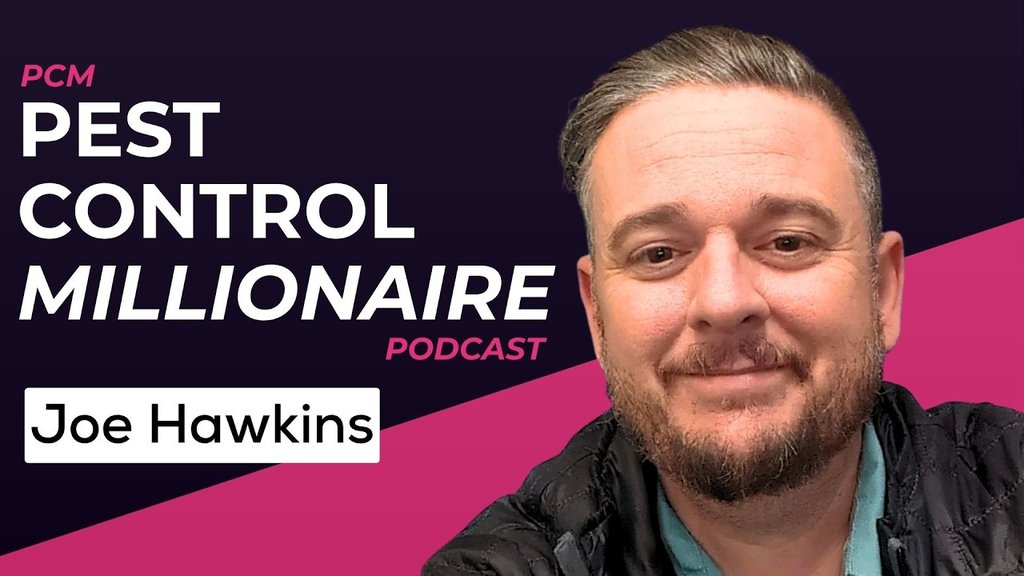
Table of Contents
- He grew up pulling his dad’s hose
- He started over with $7,000 and a Yelp contract
- One-time jobs pay now, recurring builds the company
- Learn to read your P&L
- What a 60% gross margin takes in California
- Raise every price every year, a few at a time
- A $300 customer is cheap if they stay six years
- Pick software that can scale, then stop switching
- Frequently Asked Questions
Joe Hawkins owns Earthwise Pest Management in Sacramento, California. He grew up riding in his dad’s pest control truck, started his first company at 20 in Oregon, and started over in Sacramento in 2014 with about $7,000 to his name. When we recorded this, Earthwise had 13 trucks on the road and ran a 60% gross margin in a state where, as Joe put it, everything costs money.
Joe came up as a technician, and most of this conversation is about the business side he had to learn later. Here is what stuck with me.
This episode is part of the PCM Podcast. For another owner who had to stop being the tech, read Benjamin Williams on getting out of the technician box.
He grew up pulling his dad’s hose
Joe’s dad owned a pest control company in a town of about 50,000 people and grew it to about half a million a year before selling around 2015. His parents couldn’t afford child care, so summers meant sitting under a desk at a bank or riding in his dad’s truck, pulling his hose. Everything was power sprayed with Dursban back then. “If you’ve been around long enough, that smell never leaves,” he said. In high school he worked for his dad for a couple of weeks, then told him he was going to get a real job, at McDonald’s.
Around 2004, a 1099 tax bill from painting sent him to the newspaper classifieds and a pest control job in Southern Oregon. The company ran the old Sears model, one aggressive treatment for a couple thousand dollars up to $5,000 with a lifetime guarantee renewable every year. A month in, Joe went to the dunes, went off a cliff and put a rib through his lung. By the time he got out of the hospital six days later, they had fired him in a phone message and called the cops, thinking he’d stolen a truck that was parked in their yard.
The next company, based in Vancouver, Washington, trained him for two days and left him running a quarterly route alone, five hours from his manager. The next day’s tickets came off a fax machine in his living room at 4. Six months later, at about 20, he figured he knew it all and started his own company, Earthwise. “Had no clue what I was doing. No clue at all,” he said. About six years later, it was doing about $125,000 a year.
One memory from his dad’s truck stuck. They were on a roof hunting for a rodent entry his dad had spent hours looking for, and Joe found it. He has built both of his companies around rodent exclusion, which made it easy in California when anticoagulants came off the market.
He started over with $7,000 and a Yelp contract
By about 2011, Joe felt maxed out at $125,000. Costs were high and the market wasn’t big enough. One night, with two kids and all their family nearby, he and his wife closed their eyes and pointed at a map of the West Coast. They landed on Stockton, California. His wife looked up the crime rate, so they picked Sacramento, the next closest place, where they knew nobody. He sold the company and moved.
Going from owner back to employee was hard. One company lost him in its yard, when he saw a dingy white truck and a tech pulling out with his shirt untucked, dirty and filthy. It was a great company that later sold for really high multiples, but “that first impression” turned him off. Your trucks and your techs are the first thing customers see too, and first impressions decide a lot.
He took a job with a big termite company that wanted a guy in a truck to produce money, not someone to help it grow. Then he worked for a door-to-door company, one of three techs following the sales teams around. “Wow, you could really build a decent-sized company without being technical at all,” he realized.
In March 2014, with about $7,000 to his name, Joe started Earthwise in Sacramento. His wife believed in him, but if it didn’t work, he would have to move on. He knocked doors himself and spent a few days crying at the end of streets. So he called Yelp, which back then only took on as many companies as it could send leads to. When a spot opened in April, it was $500 a month, and he sat on the contract for 40 days. In the first month, starting in mid-May, Yelp sent him $10,000 in work. “From then on out that year, it was just go, go, go,” he said.
He brought his wife into the company so he could stop writing addresses on the back of his green glove, where his sweat washed them out. The first year ended around $95,000. Sacramento had no slow season, either. It went from ants and spiders to rats, and his competitors were putting a piece of steel wool here and there.
One-time jobs pay now, recurring builds the company
Joe was so comfortable with termites and rodents that his first two years were heavy on one-time services. They brought in cash flow, and he didn’t yet get how important recurring revenue was. He was probably somewhere around 40% to 60% recurring then. Now they talk about being at 80%. Recurring is what builds the business, and it’s what a buyer pays for when you sell your company.
Earthwise hit a million dollars around year five or six. Joe’s operations manager came in as a CSR about a year and a half after he started, then moved up to office manager and service manager, and went through Phil Cooper’s program for two years. She has never worked a day in the field, and she runs Joe’s service manager, who has 20 years in.
Learn to read your P&L
About five years before we recorded this, Joe started paying attention to “this thing they call a P&L. I hadn’t heard those letters before,” he said. Earthwise became a customer of PCO Bookkeepers, and he took the monthly meetings seriously. “Sit through those meetings with your account manager,” he said. He also joined their peer group, where owners read each other’s P&Ls, and found a 100-year-old company in it that didn’t know its P&L either.
I got lucky early. I went through Jason Cupp’s academy in lawn care, and it was the first time I went through a P&L and learned what COGS was. Being around people who have already done it is a game changer. You can solve a problem with a five-minute phone call.
The P&L changed how Joe markets too. He used to blindly throw money at marketers and trust the beautiful report every month. “There’s ways to manipulate the filters in there to show you data that is correct,” he said, but correct isn’t the same as things going in the right direction. So he learned Search Console and Google Analytics himself, and now he tracks CAC, close rate and leads per month.
What a 60% gross margin takes in California
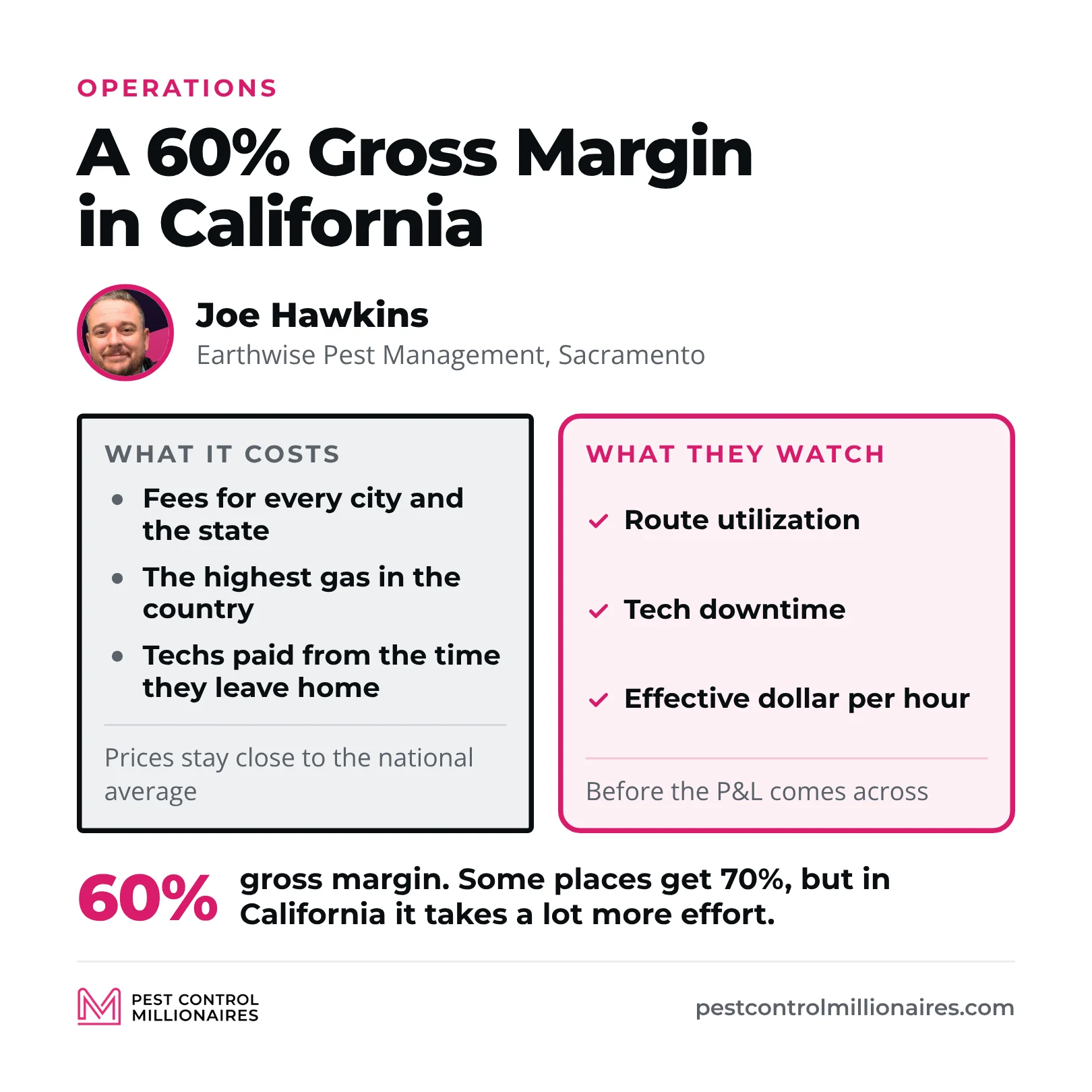
Joe runs a 60% gross margin. “I know places can get 70,” he said, but in California it takes a lot more effort. Every city he works in charges fees, the state charges fees, and California has the highest gas in the country and some of the highest employment costs. His prices still aren’t much different from the rest of the country, because a customer can Google what to pay for pest control and see a national average.
On top of that, Earthwise pays techs from the time they leave home until they get back, on its attorney’s advice. One tech’s drive to his route and back is about an hour and a half. So Joe runs reports that show problems before the P&L comes across, like route utilization, tech downtime and EDH, effective dollar per hour. In season, when the starts pile up, you can watch the margin slip, so they keep re-looking at routes. We track technician KPIs every day for the same reason.
Earthwise is about 88% residential, and Joe likes residential better, “100%,” because commercial jobs make it harder to hit your dollars per hour. I like residential for another reason too. Put a card on file and charge it as soon as the service is done, instead of waiting 30, 45 or 60 days and carrying a huge accounts receivable. Earthwise services quarterly. Most companies started out bi-monthly, Joe said, but most have switched to quarterly, and it’s definitely the most profitable.
Raise every price every year, a few at a time
A few years before we recorded this, Earthwise started raising every customer’s price every year, no matter what. A lot of owners still don’t give their customers raises. Joe spreads the increases across the months instead of doing them all at once, so his office handles a few of those calls every month. He doesn’t have to retrain anyone each year on how to take the calls and save the accounts, because it’s routine. When I raise prices, I want the new price on the invoice. Here’s how we took customers from $50 to $129.
A $300 customer is cheap if they stay six years
Most of Earthwise’s marketing budget goes to Google LSA and retargeting ads. It’s expensive, and everybody complains about the cost going up, but Joe can justify it. His CAC runs $200 to $300, his average customer stays about six years, and he makes about $3,700 of gross profit over that customer’s life. “I’ll exchange 2-300 bucks for that,” he said. Yelp still gets a very small piece of the budget, and it’s still worth it.
Our average CAC across the whole year before we recorded this was about $95, but Sacramento is a competitive market. What you can pay comes down to what a customer is worth in gross profit and how fast you get your money back, not a fixed ceiling. I walk through our numbers in how much to pay for a new pest control customer.
Pick software that can scale, then stop switching
Earthwise runs on PestPac, and Joe doesn’t plan to switch. I see owners switch software all the time, and the company never gets a chance to grow, because a whole year goes to learning a new system and moving the customer database. Every software is going to have glitches. And every system expects you to run your company a certain way, so if you don’t, your reports give you bad data.
Joe picked a system early that could handle the company if it grew. His rule is simple. If it’s lining up on your P&L and it isn’t causing a lot of issues for your company or your staff, there’s not a lot of reasons to switch. Here’s the software we use at Pest Badger, and for lead follow-up on top of your CRM, read about pest control lead management software.
When we recorded this, Earthwise was a Google Workspace company using Gemini and NotebookLM to put together training. Joe wanted AI to answer calls after hours but was holding off until it worked with the rest of his system. Next, he wants to build middle management so his operations manager isn’t wearing 10 hats, set up a second office for the roughly 500 customers Earthwise has around Stockton, of all places, and get even more efficient. “That’s our lion’s cry right now,” he said. Younger Joe was super stubborn. Now if somebody gives him an idea that sounds right, he tries it.
Frequently Asked Questions
Who is Joe Hawkins?
Joe Hawkins owns Earthwise Pest Management in Sacramento, California. He grew up in his dad’s pest control company, started his first company at 20 in Oregon, and started over in Sacramento in March 2014 with about $7,000. When we recorded his episode, Earthwise had 13 trucks and ran a 60% gross margin.
What is a good gross margin for a pest control company?
Joe runs a 60% gross margin and says some places get 70%. In California that takes more effort, because of city and state fees, the highest gas in the country and paying techs from the time they leave home, while prices stay close to the national average.
How much can you pay to get a pest control customer?
It depends on what the customer is worth. Joe pays $200 to $300 to get a customer because his average customer stays about six years and brings in about $3,700 of gross profit over that time.
Should you switch pest control software?
Usually not. Switching can eat a year of learning a new system and moving your customer database, and every software has glitches. Pick one that can grow with you, and if it’s lining up on your P&L and isn’t causing problems for your company or your staff, there isn’t much reason to switch.
Full transcript
Every word of the episode, from the video captions
Building the business turns you into a different kind of human being. Realize that failure is a part of the journey. I think there's hope out there for all of us. They say procrastination be [music and singing] the assassination of destinations. That's why we out here grinding with no association. We'll hate us then them other crabs [music] trying to put us down. Pest Badger's in the house, boy, don't clown. Got another stud on here. Super excited get to know Joe really well. Joe, real quick, I always ask this from the very beginning of the podcast. If you and I are sophomore or junior in high school, who is Joe Hawkins in high school? Probably two different people at that time. My parents, they split up when I was super young. And so my freshman and sophomore year I was in Southern California.
Pretty strict environment with my father. And like most owners, I played a lot of I did football, then transitioned to my favorite, which was basketball. I hated baseball. I know a lot of people love it, but so I chose golf. Yeah, it my school offered it, never played it before. So I took that up and those were the kind of the three sports I was in when I was down there. My sophomore year I my dad owned a pest control company and I went and worked for him for a couple weeks, I think it was, and then I told him I was going to get a real job. I wound up finding a job at McDonald's. And that was an experience. And then later on I into my sophomore year I moved up with my mom.
So my junior and senior year, I didn't know any of the coaches. I wasn't really wanting to get reestablished in sports again. So I played some basketball which is a some traveling teams and worked. That's all I did. So What did you do for work? What did you do for work in your junior senior year? Well, McDonald's was the easy go-to cuz I had I had history there and the one at the time had a cute girl. So and so I just made the decision that I'd start there. The tenure there wasn't very long though. I was kind of done with the fast food scene. And so I kind of begged my way into Rite Aid working with a lot of older people and whatnot. But it was a really good good choice for me at the time. Yeah, we'll circle back. We'll come back to this in a little bit, but grew up in a pest control company. So we'll circle back to that. Then where did you go after high school? So I met my wife in high school.
Damn. Yeah, yeah, we've been together 22 years now. That's unreal. Congratulations. Thank you. Thank you. We just been married for 20, so we got the ball rolling right away. You guys got kids? We do. We've got two kids, a daughter who is graduating this year. So that's something new for me and then my son's a sophomore. Awesome. My oldest just turned 16 like week and a half ago.
So it's going by fast. And my youngest is six, so...
Does. Yeah. It sure does. But anyway, so I worked for her mom at a painting my senior year and it was pretty much it fit me well because I only had to take a single class my senior year. And she worked on this big fourplex project that was going on for like four years. So we were paid under the table and I could show up whenever I wanted because nobody was there and just work till midnight if I felt like it. We didn't really have labor laws that we had to follow. I mean, I'm sure they existed with child labor, but right but they weren't enforced on this job site. So I was able to put in 40-50 hours in a week, go to my one class, so it just really fit perfectly for me. Yeah, that's really cool. I My very first job ever I was I had to pick strawberries at this place called the finest. It's really funny. My grandpa ended up got me the job there.
I was like 13 or And I got into an argument with a girl that graduated like a year ahead of me. We're friends now, but like back then she was like my boss and she like she said something like I can make your life a living hell and then I said that back to her and then I was then I was fired. So for only job ever I got fired from picking strawberries. And then from there I went I bagged I bagged groceries at a grocery store for like 6 years all throughout high school. So I did the same thing. I went to school or went to work from like 5 5:30 a.m. To like 10:00 a.m. Then I went to school the rest of the day. So I had like school to work. It's pretty cool. It's something they offer back then. I always like to work. I always like nice things, so there's sometimes where I was like ah like I don't want my kids to do that cuz like you have your whole life to work. But it's just what I like to do. I grew up on a farm, so I just always busy. And then where did you go after high school? So after high school, I'm still working as a painter for about a year. And I guess we can go back to how I was raised in a pest control cuz it kind of transfers at that point.
So my dad did have a company in a really small town. It was about 50,000 people, probably less. He grew it to about maybe half a million a year and that's where he finished off. He sold in like 2015. And so my parents didn't have a lot of money growing up at all. And so as we went, they both lived in that same town for a while and we found ourselves like in the summer we they couldn't really afford child care so I was either underneath the desk at a teller row at a bank or I was in the truck with my dad driving around pulling his hose for him. Back then everything was power sprayed. We used Dursban if you've been around long enough that smell never leaves at all like I can still like remember the smell of Dursban. And so anyways I grew up kind of doing that in the summer so it was a natural transition for me when he's in Southern California I'm up in Oregon at this point. And I wanted to get away from the painting thing. I was 1099 at the end of the year as a young guy I didn't manage that very well so coming up with the tax dollars at the end of the year was tough.
I liked quads and dirt bikes and all the fun stuff. And going out to bars and spending my money that I have kids at that point so coming up with that 1099 tax bill at the end of the year was a little difficult. So I decided like let me look find something different. I'm thumbing through the newspapers cuz we're about and that's how we found jobs back then. And so I'm thumbing through the classified sections and I come across one that a pest control company in my market was offering and it just clicked like hey I kind of understand what this is about. So why don't I give this a shot and it was above minimum wage so everything sounded great. It was for a kind of a decent size outfit they were doing about a quarter million a month in a in a super small market.
They had kind of the Sears philosophy back in the day where it was we'll come out to your house, charge you know, a couple thousand dollars up to five thousand dollars, treat one aggressive time, and give you a lifetime guarantee that's renewable every single year. And so it's basically you're mixing 50 gallons at a time, you're injecting walls around the house, you're spraying the heck out of it, you're getting a good 100-ft band around the home, not really, but pretty far. Right. And then you're going underneath the house and hitting it by They made a product at the time. But I believe it was salt-based, kind of like a boric acid something. And we would just flood the underneath of the structure, and if you still had fluid, you would just untwist the nozzle until there was no more fluid coming out, and at that time the job was over. And you could go to your next one. And so that was kind of my first time away from seeing how my dad operated, and getting to see how maybe a different company operated.
And yeah, it was way different, obviously. We're not doing the same thing in Southern Oregon that we were in that he was doing in Southern California. He had monthly accounts, this was once a year. So I got to kind of see a different take on pest shortly after that, I went to the dunes after getting hired. I was big into riding, and my wife would drop everything on a dime, we had no kids. We'd head over to the dunes for the weekend. And so I had like a week-long trip I wanted to do. They had brought me on like a month earlier, so I'm young, you know, earning time at a job wasn't really a thought in my head yet. I wanted this time off, so I put it in, they were very apprehensive, but gave it to me for whatever reason.
I was supposed to be back that That didn't happen. I ended up going off a cliff, and putting a rib through my And I spent about 6 days in the over on the coast there. And we're 2004, so smartphones aren't really a thing. This is, you know, a bar phone back then. Text messaging wasn't as You weren't You were using cell phones, but they were They're nothing like they are now. And I wasn't thinking about calling the place that I worked at. I had a punctured lung. And so by the time I got out, I realized like, "Hey, I should probably check my messages." And they had fired me in a message and also called the cops on me. They had thought I had had one of their vehicles and since I wasn't getting back to them that I stole their only they found it in their yard. They had a couple acres there and it was parked somewhere in the back part of the yard. I never had it. But anyways, it wasn't like an official firing. We just, you know, ended the relationship there. And so I got back. I still had to recover from the rib going through my lung.
It's not something that, you know, you get out of a hospital and you're healed. Like I can't crawl under houses for for a good 6 months to a year. So I found another company that hired me on the spot. They were based out of Vancouver and Washington and they had just one guy running a route down there. Don't know what happened to the guy before me, but the guy that was running it in term was the manager and he was from Portland. So his whole thing was getting back to his family and his life up there. And so he hired me. I took the job. I was still getting over the chest thing, but just, you know, I'm young. I can fight through it. And that's what it happened, you know. He wanted me to start ASAP because he was looking to get home. The training was about 2 days and then he left. And so I'm, you know, freshly from my I don't know, 3 months training with the other company to now I'm solo by myself, you know, 5 hours away from my manager, running a route, doing a completely kind of more so what my dad did but not on a monthly.
They were running quarterly. And a lot of that. So, they'd give you a bunch of a stack of paper contracts and say, "Here's your route." and send you off?
No, no, it was fax machine. Wow.
You would They did they didn't make a schedule which was, you know, unseen at that time because back then everybody was scheduling their own routes. You had one lady that kind of managed about four routes, I think. She would schedule and then at 4:00 the fax machine in your living room would turn on and tickets would shoot out and then you knew what your day looked like the next day. Hold up. Quick pause. If you're running a pest control company or fertilization weed control company and you're not in our Facebook group, you're choosing the harder path. Every operator that's in there is skipping years of mistakes cuz people are actually sharing what's working right now. So, stop trying to brute force your way through growth alone. Search Pest Control Millionaires on Facebook or click the link below. And now, let's get back to it. I remember [snorts] I thinking back now, I remember when they had printers in the trucks. Do you remember that?
Yeah. Yeah.
Printed the routes up in the truck. That was a long time ago. Holy man. Forgot all about that.
Yeah, I never got one. It was fax machine and that's kind of the as far back as I go with it is fax machine. So, yeah, that was interesting, you know, ordering product, you know, almost like an owner because it's being shipped out of Portland. I'm barely know what I'm doing out there and I'm supposed to keep inventory on a vehicle with 2 days of training. It was it was, you know, I didn't see it as a negative thing, but I definitely there were some learning curves. It I wasn't able just to go grab product somewhere. So, I better put in an order that's going to last on the vehicle. Luckily, Talstar was out at that time. You know, you could use it for almost everything. So, if I was missing something and they just got Talstar. Nice. So, how long did you do that for? I did that for about 6 months. So, I'm about 20 at that time and I'm young and I just felt like I was ready to start a company. I knew it all. And or at least I thought I did. You know, at 20 years old I start my first company.
It's called Earthwise Pest Elimination. Kept the same name. Had no clue what I was doing. No clue at I can't even remember back then yellow pages were were what you advertised in. So, I E was we worked off the alphabet, right? So, E was kind of towards I think I had an ABC Pest Control in my in my market. So, that was not available. So, E was it made sense. The name made sense and in my market that that name really picked up. Really picked up in a way that you know, is a small market. When I got out of it, I was doing like 125 a year. That was about it. And that was about 6 years that's where Earthwise the first one started. I'm 20 running around figuring stuff out as I went.
I always I think from when I was a little kid with my dad, there was this one memory I have where we're on a roof trying to figure out this rodent thing and I found the hole like the perfect movie style half moon shape on a on a top of a roof hole and he had been looking for hours for it and I found that thing and he was just so impressed by it. I think that kind of inherently stuck in me like I'm really good at finding rodent holes. And so I've always kind of built that company and this company with rodent exclusion as the forefront. Gotcha.
In California that made it super easy when pyrethroid or not pyrethroids when anticoagulants were taken off the market that you know, we were already set up. We were already doing exclusion work as as a primary tool. So it wasn't as difficult when that took place. Yeah, when did you move from Oregon back to California then? Yeah, so the great recession's in there, you know, 2005 I started the company.
Gotcha. About 2011 you know, as I felt maxed out, you know, at 125 there's not much left for myself there. Costs were crazy high. I just felt like you know, the market wasn't big enough to allow me to stay there. I wanted to try something different. So me and my wife about 2011 we were just laying in bed one night and we have all our family there like her family's everybody's there. We have two kids at this point. My oldest is 2 years old and just on a whim I'm like, well, why don't I just try to get rid of this thing, sell it and we move somewhere where maybe it's a bigger market. And it was pretty scary. We sat in bed. I remember it to this day and we just sat we had the West Coast cuz we wanted to stay semi-close family, close our eyes, pointed out a place. Ended up pointing at Stockton,...
Of all places. I knew nothing. I had never been through that area at all. My wife being a mother at that point, she goes and looks up the crime rate in Stockton and immediately that one's exiled off the off the map. And so Sacramento was the next closest place. We know nobody here. We have no support system. But we decide we're just going to go ahead and take off. I before I left, I left first. Had a little chunk of change from selling the company, so I felt, you know, we were comfortable for a minute. And I responded to an ad and I came down that Monday and interviewed at that job. I had about two other interviews lined up at the same time. The first one they were ready to hire me on the spot. Everything sounded good, but they offered a commission structure.
This was my first time really introduced to a 25% we were paid hourly, but then that came out that was like a base that came off the commission. And so I was a little uneasy on how commission worked. I'd never been introduced to it yet. A little timid of that coming from a smaller market. I knew like, hey, maybe maybe these routes are small and you know, 25% doesn't sound great. But it ended up being really good. I didn't accept it that day. They were ready to hire me on the spot cuz again, managers in the truck trying to complete a route himself. He's ready to be a back to his manager duties and let me get out and do my thing, but I'm not licensed in California. So that was kind of the issue with him is it's going to take a minute. I went and interviewed at one other company.
And this is a great one for people to hear cuz I judged that company right when I pulled in their a kind of dingy white truck was there and a big heavy guy pulled out of there. Shirt was untucked. He was dirty, filthy, and I would say right there it was a great company. They ended up selling for really high multiples at a later date, but the guy that I saw before even entered the building already told me I'm not interested in this job. So we did an interview went semi fast and I was already in my mind taking that other job that I was offered. It was that that first impression seeing that guy out front in a messy outfit that that kind of turned me off from it. Yeah. So you said to go take the other job? Yeah. So I accepted the job.
At the time in California you didn't have to really apply to take a test like you do today. It was a lot quicker. So the closest place was like an hour away that he could get me in two day to take a test. And on the drive out there so I'm fresh like I'm an owner of it in a different state but have no idea on the laws of California. We're driving up there on passenger and he's like hey I just got to be honest with you if you don't pass this test you know you don't have a job. And you know so I'm like all right great. Like let's go take this test and see what it's about. It had been 5 years since I took a test. Again I took it initially at 20 so you know I'm still very new in the industry. The only knowledge I really have is my knowledge of what I was doing up So I go I pass the test thank god. And he's happy I'm happy.
We leave and I start the next week. Again it's like 3 days of training but I had been used to that from another company. I guess I shouldn't skip over the part of how hard it is from going from an owner to an employee.
Can imagine. And when I took that job I had been complete mindset if I want to help somebody else grow and that's kind of why I accepted it is that I had a belief that maybe, you know, I'll do really good at this and be able to scale this company and help them I don't think they had the same idea. They wanted a guy in a truck to produce money. They were a large termite company with a very small pest And so yeah, there there wasn't a lot of opportunity for me at that job. I had a great manager though, the same one that, you know, put me in a truck 2 days after training and sent me off. But I did learn a lot from that guy. He may have had a drug problem and got fired about 9 months into my working there. And so now I get a newer manager that gets in there. He wants to make a name for himself, so he's stirring everything up. And so at that point I kind of lost interest in it, you know, I wanted to see what else is out there. I didn't see this thing going anywhere. The routes weren't growing. It was at three routes, I think, while I was there and it was at three routes when I left.
I just don't think it was a big part of their growth strategy. It might be today, but I didn't get the feeling that the termite was where the owner had came from and typically when you find owners that come from termite, they build a company that's termite related. There was a few other issues right when I started. God forbid a guy had died on the job. He was on the termite side and a house fell on him, a porch fell on him. He cut a support he shouldn't have cut. And so they got penalized by the board here and they had to shut down for 10 days like 2 months after getting So, right after getting hired 10 days into the month, we get like told, "Hey, we just got to chill at our house and wait for the 10 days to lapse."
That's crazy.
A new experience for me, but then when we got back, it's like, "Hey, all all hands on deck. You have a full route to complete right now." And so, that, getting the new manager, I just lost interest in it. I went and I worked for another company, right after that. Ended up being kind of a whole new take on it. They were a door-to-door company. We kind of got those littered throughout the Sacramento area, just like most of the country does. I ended up landing there. It was a newer company. He's huge now, but at the time he was pretty small. And so, they had the sales teams out working the doors, and there was three of us at the time. We were just kind of following them around, doing all the starts, getting the routes done. It was very fast-paced. It really opened my eyes to like, you don't really need to know the bug side to be successful in this industry.
And that was my kind of first glimpse into like, "Wow, you could really build a decent-sized company without being technical at all." so, six months into that thing, I was I was just ready to start my own thing again. And had about $7,000 to my name. And at the time, my wife told me that you know, "I believe in you. I think you can do it, but if it doesn't work out, I want to know that you're you can move on from this chapter in your life, and you know, we need to start thinking about our kids and everything else." And so, I had a lot of pressure on me to make something work there. I started in March of didn't really know how it was going to work out when I started. I planned on I'll hit doors and see how that works out. Had no experience doing it's horrible. Absolute horrible if you don't have training. It is a very very difficult job. Hats out off to the guys that can handle that sort of pressure at the doors and those people you get to interact with at the doors are quite interesting.
Some of the feedback you get I spent a few days crying on on the end of streets, for It's not easy, that's for sure. No, it's not. It's you got to put up with a lot and it's can be very frowned on for from those knows, you know, they're very hard to take sometimes. And so, if you can make it past that training and do door, you know, good on you. I it wasn't my thing. So, I was looking at other options. And so, at the time I had heard of this thing called Yelp. And I'm on the West Coast. And I call up Yelp and they're I'd called them several months before and they at the time they sold only so much work, you know, they only would would bring on companies if they could fulfill what their promise was. So, you would get so many leads a month and that was their initial model of how Yelp ran.
And they didn't have any openings, so they wouldn't even accept me to pay. And so, come April, they had an opening. I was able to get in, but they wanted $500 a month. Had 7,000 to start. I probably had burnt through I had a truck and some some I had purchased some stuff along the way. So, the 7,000 was on top of that, but that bleeds out really be when that's what you got to work with.
It doesn' go very far. No, not at all. And I would not suggest it this day and age. It's a very difficult way to get up and running. But, Yelp said $500 a month. They sent over a contract and I sat on that contract for a good 40 days. I was just I couldn't make a decision. They're calling me, "Do you want this? Are you interested?" And I tried, "Can you guys do 6 months, you know? Can we work something out here?" You know, looking at how much money I had, not sure if this Yelp thing was going to work for me. Finally, I made the decision, "Okay, let's just send it off. See how it goes." That very first month, it was like mid-May. Our very first month, they gave me $10,000 in work. And from then on out that year, it was just go, go, go. And like I said, it was probably with the little bit of money I had at the time, that was probably the best thing I could have done. It definitely, you know, made it a lot easier. The cash flow started coming through the company.
I put on quite a few customers that first year. I was able to bring my wife into the company. Well, cool.
6 months ago, she's telling me that, you "This is your last go at this thing, you know?" Without saying it that way, she was very supportive, but I knew the pressure that I had. But, anyways, I ended up bringing her over. Because I was sick of being in crawl spaces, writing down addresses on on the back of my green glove, and then it getting washed out by my sweat. Me having, you know, pieces of paper all over the truck with addresses and names and promise of dates and all these calls still coming in. It was a little hectic at the beginning. So, she came over and we were able to support the two of us on a small income, very small. Still utilizing that seven grand. It didn't make it very far, but cash flow was coming in and we were able to make it work. That's awesome. So, where do you think you ended that first year? That first year was probably I think it was like 95.
That was awesome. So, cuz I think you ended your first company after six years like 150, right? Yeah, yeah. So, I was almost there.
Cool. Yeah, that was quite eye-opening for me. And it that up in Oregon was very seasonal, you know, like where you're saying you had snow outside, you know. I you know, in the winter things shut down, you know, you're just you're not getting the ant calls, you're not getting the spider calls. You have a small route to run. Rodents weren't as as prolific. They were up there, but we're on the West Coast, so rats are a big problem for us. But, you know, it's maybe people dealt with them more out in the country up there. I don't know what the case was, but I definitely had a slow season. When I came here there there was no slow season. It transitioned from ants and spiders to rats. And I so right away I was able to start selling rodent work. I had that familiarity with exclusion.
People were looking for it at the time, but that was early on. That was before anticoagulants were taken off the market. So, most of my competition you know, was putting a piece of steel wool here and there, but they're not really knowing what to do to seal up holes. They're not putting a lot of in those areas. That's awesome. So, then walk me through the next few years and then obviously where you're at today, but there's obviously a lot of growth throughout the last few years. Yeah, the first two years I definitely made some mistakes. Being that I felt so comfortable with termites and rodents, I put on a of one-time services. So, why I was really Yeah, why Yeah, it's what I was comfortable and it brought the cash flow in.
So, I started hiring people to help right after that first year. But again, we've got a small route going, but we're selling a lot of termite, we're selling a lot of one-time work. I didn't I'm still like don't have a lot of experience at other companies, even though I've been in the game for 10 years at this point. It was mainly what I knew and what I had taught myself and what I was used to doing up there. And so, I didn't really get the concept of how important the recurring revenue was. I know now we talk about being at 80%. I couldn't tell you what I was down there. It was probably 40, you know, 60 at at the time. It There was definitely a more one-time heavy, doing a lot of exclusionary work.
And so, I was able to bring on more employees cuz cash flow was coming, rodent work was plentiful, people keep calling. We are throwing on maintenances, but the technicians I'm bringing on are helping with exclusion plus doing route work. We're a young company, we're not really, you know, we don't have departments established or anything. We're just taking what comes to the door without really a lot of guidance or knowing where this thing's going. When I started it that was not my intent. It was just to give me income and me to have a route and I was cool with being a solopreneur and doing my own thing. I didn't really think it would take off like that, but once you get to like grow that quickly, you start needing the help and you out of necessity, you have to start growing. And so, that's what we did for the first four or five years.
I think by year six, we hit a million, maybe be through year five. And yeah, we kept growing through that. I've got a couple routes at that point. And I have my wife working in the office. We had a Before that, we have a tenured employee who she's celebrating her 10 years with us this month.
It's awesome.
She's my operations manager. She knows every part of this business like me plus some and she's only been going at it 10 years. But she went through the ringer of a startup for sure. She came in, you know, that first year with us year and a half in and she's been with us ever since. So, her and my wife kind of ran things themselves. So, she saw the startup phase and as we've grown and she sat in as a office CSR first and then graduated to a office manager as we continued to grow. She graduated to a service manager out of necessity cuz I'm running the specialty crew. She's running the that part. I put her through a training program that was really good. At Phil Cooper's program. I'm not sure if you're familiar with it.
And so, she went through it for about a year, well, 2 years actually. And as she's doing that, she's not She understands past from from answering phones, but she's never worked a day in the field at all. But this girl's just she's nuts, man. She can take on any task. I love having her here. We were super fortunate to find her and to have her on. She's been an absolute beast and an asset. So, now she's my operations manager. And she kind of she's the boss of my service manager who I worked with at a previous company who has 20 years in too. And it's just it's amazing just her wealth of knowledge in such a short time. Like she truly understands everything without being in the field. That's awesome. How did you Did you Did you like for those first 5-6 years, did you mainly grow off Yelp or did you just try other avenues?
I've heard people grow like massive companies off Yelp. Yelp was It wasn't the same way for the rest of the country. I know East Coast guys didn't have that same...
Work at all. Did you Did you have anything else outside like...
Angie's List, was that big over there or...
It's still big. There was It's just never really great around here, you know? Just I'm not sure why, either. Yeah, that's super, you know, it started West Coast, so maybe it was just I know it does good in Arizona and in some of the South, for sure. Do you still use Yelp today as the same? I have a very small investment in it and they don't feed us a ton, but we still get work from it and it's worth the But yeah, I don't I don't put a lot of our marketing budget towards it anymore. Yeah, where does the most of your marketing budget come go toward now? Google LSA is a big part, retargeting ads, those sort of things. It's expensive. It is and I hear everybody complaining about the constant cost going up, but we can still justify it as a company. If we're paying you know, if our CAC's 2-300 bucks, you know, but we know the customer stays with us for an average of 6 years and they're going to invest, you know, our gross on those accounts are about 3,700 over the life of those customers.
I'll exchange 2-300 bucks for that. I'll For sure. And you just in a competitive market, you know? Am I Yeah, it is it is a competitive My average CAC for all of last year combined was 95 bucks. Oh my gosh. I'm jealous of that. There's probably people in my market that they get that for sure that have other avenues that they're they're working. But yeah, it's if you do Google here, you're you're paying a lot of money for it and it's Yeah, but you're in a really good market, too, you know?
Yeah. You guys have unlimited budgets through there as well, where we would get tapped out real fast. Yeah, yeah, exactly. I've heard that a lot. I think people get tapped out here, too. I know we did for a long time. Google has their their algorithm. I think it's tied to reviews for sure, but you know, there's people that they tell me even in our market like I have it maxed out, but I'm only getting, you know, a thousand bucks a month charged, you know, they just not very many leads are coming through. So, I think you have to get to almost that thousand review mark to really them to really start feeding you some of that Google money. Yeah, when did you when did you start learning the business side of like reoccurring and all that? When did you start putting all that together? But you go find a coach?
Man. Got you.
That's very new to me. Cool. But you found it? Into it. Kind of found it. I'm still learning it for sure, but probably about five years ago. I started really paying attention to this thing they call a P&L. I hadn't heard those letters before. And I started paying a lot of attention to the groups and, you know, the stuff that PCOB puts out about, you know, where you should be spending money, how much in each area. And I came we became customers of PCOB and I took my monthly meetings pretty seriously and we I would sit through it. I would ask a lot of questions and I feel like even to today I hear people talk about it that that miss those meetings, you know, that don't take advantage of learning at all what their P&L is or how to read it and how to follow it, or how important it is.
And I can't stress that enough. Like, sit through those meetings with your account I know there's a few other companies out there that service the industry, and I'm sure they have a similar setup, but take advantage of the monthly meetings if you're really not understanding what that P&L is. Yeah, I agree. It takes a while for a bug guy to become a business guy, for sure, and to get those metrics and understand what levers to pull and how everything but yeah, that was probably the first introduction of being a real business person. It wasn't till a few years back that I really got out of the field and started focusing on the company at And it was you have to look at my background to really understand it. I knew pest control. I felt comfortable in the field. And so, I kind of let other people I would blindly market. I would I would throw money away at marketers and trust that they're doing it, but I really didn't know that side, so I wasn't concentrated on it.
I was really comfortable in the field. Even today, I don't have an office at my office. I don't go in the field anymore, but I just I can't sit still. I can't be in the office. I need to be moving, so I try to get out there, hang out with the crew, even though I'm not there like direct reports. I take I got thousands of pictures. One day I'm going to really push social media. I haven't really done that yet, but when I do, I've got a ton of...
That's awesome. From videos to pictures, it's all ready to go. But it was getting introduced to the P&L and really focusing on it that made that mind shift of like where I needed to concentrate on the company and really dive into these numbers and figure out how to move these levers. And so that's kind of what I do today more than anything. I would do the marketing out of necessity. Like I had to learn how to become a marketer because you can't you know, if you blindly throw money out there, I'm sure you know and all your listeners know like you're going to get a beautiful report every single month showing you how great everything looks but it's not necessarily the true story and they can claim like we're using Google Analytics or Search Console, but there's ways to manipulate the filters in there to show you data that is correct.
But not necessarily an indicator that things are going in the right direction. Through those mistakes, I kind of got familiar with Search Console Google and really was able to look at my marketing and see okay, I need to be more on top of it. I need to be paying attention in these monthly meetings. I need to be asking questions like I did with PCOB, you know, I just need to become familiar with it and so we've been able to really dial that in and understand what our CAC is, understand, you know, what our close rate is, understand how many leads we're getting a month, tracking that information and dialing in kind of that part of the company. So where did you find PCOB? It's online? Facebook? Yeah, it was online. It was probably through one of the pest control groups, one of the Yeah, it I met Dan at I think we were in Boston.
Yeah, like Boston. At PestWorld. First time I ever met him. And then we go back and forth here and there. And then I met one of his guys out in Arizona last week. So, he connected us in an email. And Dan's going to jump on here one of these days as well. So, I'm excited to have him on here, too. Dan's a smart guy and yeah, he's got a lot of cool things that he's doing. Yeah, I'm also involved in their peer group. And for any of your listeners, that's it's worth it, you know, get involved in that. When we talk about investing in ourselves and our growth, like it's those sort of things. I know there's a lot of peer groups out there, so it doesn't have to be that one. But, it's important that as you're growing as a as a leader and just understanding business, it that you get other people's takes on how you're dealing.
Absolutely.
In PCOB, it's a it's highly about, you know, each other's P&L's and reading them. So, talk about elevating your knowledge on that when you have, you know, implementers and you have Dave Billingsley who's, you know, been there, done that, you know, and can kind of really talk through it. It's been really nice to kind of dive in and then seeing that you're not alone out there, you know.
That's for sure. I don't know my P&L, but I've got a 100-year-old company in the group that doesn't doesn't know their P&L either. And you're like, "How?" you know, and 50-year-old companies and a lot of East Coast companies and getting kind of open up to how they operate and just seeing those legacy companies out there, it's pretty fascinating. So, I recommend it. I got super lucky early on in my career, too. Got into an academy kind of like that. And all of a sudden, fire hose of information. Jason Cupp, he's very very popular like in the lawn care world. I went and I was in lawn care before I sold. And the first I doubt I started going through P&L, learning the cogs and like, "What is all this information? And like the first time I'd ever experienced that and thankfully it was early on in my career and I learned a lot through that academy.
Again, like you said, just being around other people with bigger learning from them that have already been there and done it and like it's a game changer and like you said, you're not the only one out there, but people have the same problems that you have. You can pick up the phone and say, "Hey, I'm having this issue." and you can solve it with a 5-minute phone call. It's amazing. So, I agree like groups for me were very very good. I know I've heard I've heard some people say that they weren't great for them, but I just found a really good one early on, so I got lucky. Yeah, I find that, you know, when you go into it kind of like the Facebook groups and just being a business owner overall, leaving you go out the doors is massive, you know, go in there with what I can take out. If I look at like the guys in this industry that are climbing the quickest, the fastest, super humble dudes and they're you know, they're asking you know, smaller companies questions and they're...
Learn from every single person out there. 100%. Yeah. And 100%. A startup today can have knowledge on maybe something that changed in the industry where they were affiliated with a bigger company before that and you totally missed it cuz you're just in your zone as a as a business owner. So, there's always something to take in from from other companies that have either been there or trying to get there and they have their own kind of model and way they're going to do it. That's where you at? How many trucks you guys got on the road now? We're up to 13 now. Awesome. 13 trucks. I would say going back to the profit margin in California specifically and just really knowing it. I know other states gross profit, you know, you can you don't have to pay real close attention to it. You're probably going to make money. Costs are down in those states, you know, you don't have what we have. We're very unique in California. Everything costs money here.
For sure. You know, each city I do business in, I got to pay fees to, you know, the state requires fees. Their fees go up. To give them reports, I got to pay them fees, you know. They're we're we're fee'd to death here. And then on top of that, we run the highest gas in the country, some of the highest employment in the country. And if you look at our prices, they're not much different than the rest of the country. We're still held to that standard of, you know, a customer can Google, you know, what should I pay for pest control and an average for the nation pops up. So we're we might be a slightly higher than a lot of places, but we're not for what we pay for everything, we're not above. For us, on top of that, we pay our technicians when they leave their house and when they return home every day. And for a lot of people, that's staple, but it's even a lot in California, it's not. It's a very gray area here. Our attorney advised us to do it.
And so when we talk about gross profit, like you got to take all that into account. Well, I've got one guy that he's he lives, you know, where he can afford and it might be an hour and a half to his...
Round trip, you know, and so when you're paying that, you've got downtime factored in there. Those accounts cost us a little more. So you really have to be in tune with that that gross profit. And so we have other reports too that really allow us to stay on top of that. Route utilization's a major one that we do. Tech downtime, EDH, effective dollar per hour. We run several different reports that really let us know how we're doing without seeing it out there waiting till a P&L comes across. We can proactively see that. Yeah, and California is a beautiful state. I was there last year, took the girls my girls out there on vacation. They're not making friends with business owners from all of us, so I'll leave it at where it's at, but it's you hear from everyone and lots of people are moving out.
Yeah, it's hard, it's not impossible, you know? We run a 60% margin gross profit. I know places can get 70 and stuff, but it takes us a lot more effort to run 60% like we have to be on top of our...
For sure. One thing we chose to do a few years back is monthly raises on our customers. I know that's been big in the industry. I know a lot of people still haven't given raises out to their customers, but it's important, you know? We do it every single every year, no matter what. You do it annually? It we do it annually, yeah. Yeah. I don't know why we do it monthly, honestly. Maybe it was recommended, but it made more sense to me. The reason we like doing it that way or we choose to is I don't have to train office staff every single year on how to take those calls and try to save those accounts. You know, they're so in tune to doing it on a monthly basis that they're they're just it's a very common...
Bi-monthly, monthly, quarterly? What do you have there mostly? We're quarterly. Yeah, most of the companies started bi-monthly, but most of them have switched to the quarterly model.
Definitely the most profitable, for Oh, 100%, yeah. Are you guys mostly residential or commercial? What's your split? Yeah, so we're about 88% and the rest is commercial with some federal stuff in there as well. Yeah, which one do you like better? Oh, 100%...
When I look at when we talk about gross profit, you know, and we struggle with meeting some of our reports and holding ourselves accountable. There's jobs commercial wise you know, are harder to For sure. Make those dollars per hour Yeah, and then just put a credit card on file and as soon as you leave you charge card not waiting for the business to pay you after 30, 45, 60 days and don't have a huge accounts receivable all the time. So there's a lot of good things about residential for sure. Yeah, and then one thing I've been really good at is just you know, listening to advice out there and implementing it myself. I younger Joe was super stubborn and super set in his ways. I'm slowly humbled. Like I somebody gives me an idea. I will try it out. I will run with it. Like we will we will make it work especially if it sounds right and seems like something we should be implementing. That's really cool. What's the what's the goal for the company over the next let's go 3 years. Where do you see the vision going in this thing? Building up middle management for sure.
We've got a good team right now and I'd love to keep the team. But building that middle management a little little better to be able to take places of things where I'm still needed a little bit. It's not very often that I'm needed, but I feel like sometimes like my tenured employee for instance, my operations manager like she gets stretched pretty thin, you know, she's she's wearing the 10 hats now, you know, and she's trying to take care of the service side plus the office side and everything in between. So I'd love to bring her more support and kind of get that established. We've started to grow outside of our our market a little bit and looking at a second office. We have you know a geotagged location down there where we have some stored item but really get it set up. We have about 500 customers down there out of Stockton now and so kind of get that set up more like an office and have a tech that just kind of runs that area or a service manager.
So that's really where we're going over the next 3 years really dialing in efficiency even better than we are. That's our lion's cry right now is how we can become more and more efficient. I would say we have a lot of stuff dialed in to get that 60% gross is a coveted thing here. It's very difficult. So and we see it where if we have a month where maybe you know starts for instance you know right now we're in season. You know you'll watch that number slip down pretty easy pretty quickly. So you've really got to you know even up your game more re-look at the routes optimize all the time. And make sure all the techs are you know running the best they can out there. So Right. What software do you guys use? We use PestPac.
Cool. You guys liking it? Of course. Like everybody loves their software...
No no software is perfect ever. No no I feel like what you go with just like other than if you stuck with like a horrible software we'll we'll stick with it you know.
Many people like constantly like switching softwares and like the company never even gets a chance to grow cuz the owner operator is constantly just switching what they're doing and they never just gets time to focus and grow organically like I see all the time like it's such a waste of time. Where are they putting their time and their effort you know? It's in the next year learning a software. And transferring the customer the database. Yeah, and then it's just like and I get it cuz there's just some really bad ones out there, but I'll see if someone go go from like just as an example, not real life, but like let's just say from GorillaDesk or from FieldRoutes to GorillaDesk or vice versa or whatever. It's like I get it. But like you spend so much time focusing on these big tasks, there's just not a whole lot of difference. Every software is going to have glitches. Every software is not going to be perfect. You just got to make it work. And every software is built like they all say like you can run it how you guys run it, but when you run those reports, you better know exactly how they want you to run your company or you're going to be getting bad data. And so for those reasons, I don't think we'll ever switch, you know?
I'm sure it's possible, but yeah, it doesn't come without its headaches, you know, like all the other softwares I'm familiar with. You know, the glitches that they have sometimes as well. I know a couple of them they had they had issues with, you know, their guys are out that day and they don't have access to their their software that day and they can't pull it up on their devices. And I'm like, I've never had that issue with PestPac. That's a whole 'nother fire. Right. But it just happens. It's software and like even even the company doesn't always have control of what happens. It could be some other whatever they're called tower or I don't know what they're called their backup data or whatever. Like you just never know what it is. Yeah, and it always goes back to your P&L, you know? If it makes sense for the company to use it like and you get it like the only thing I can think of is you made a poor decision maybe and it happens with a small company as they grow, they might not have thought scaling.
We I did think that, you know, it was possible. So I chose a software that would be able to accommodate it if it came. But that would be the only reason I'd say to switch, you know, is once you become familiar with it, if it's lining up on your P&Ls, it's not causing a lot of issues for your company or your staff, like there's not a lot of reasons to switch in there. For sure. Cool. Any Are you much of a reader, podcast listener? What do you What do How do you like to learn? Podcast all the time. I listen to yours quite...
Oh, good. I appreciate it. No, I appreciate it. And you're giving back quite a bit and that's but I do read. We implement EOS at the company. So I tackled Traction a few times. Great. I love that book.
That on maybe 5 years ago. We like everybody, we run kind of a hybrid model of it. But we're pretty close to how the model runs. We have our rocks, we have our our level 10 meetings. We read Patrick Lencioni Five Dysfunctions of a Team before the our annual meetups. So That's cool. We run it pretty pretty close. That's awesome. I love it. I know I said go about an hour. We're already over an hour and I don't want to go over too much of your time. I know you're busy, too. But any favorite books or favorite podcasts besides mine? So thanks for the shoutout. Appreciate it. Any other ones you that you like listening to? Oh man, I would say I listen to it A1's Garage Store, you know, Tommy Mello. I used to love it a lot more. Now it's I think turned into the beast it is, you know, where he's people are paying to be on it and that's what it is now. But early on, his podcast was absolutely amazing. Like when when it was smaller, before I don't know that PE had a play in that or how that worked out but it's definitely changed.
Other than that PCOB shout out them again. They have a great one. You don't have to be a member there but you can get some really solid about certain things and even AI's talked about a lot on their podcast so you can kind of get your take on that and AI is definitely changing the game for sure. We're finding new ways to use it all the time. We're a Google strong company so we use chats we use their whole workspace environment and so Gemini and NotebookLM is a huge part of how we put together training and yeah it all just allows us to do a lot of stuff inside there. So that's about as far as we're using it right now but I imagine I do feel like we want to get the after hours and I'm sure your company has that.
I don't know I just haven't pulled the trigger and I really feel like we're missing that kind of final thing with with that you know it doesn't seem it's almost like PestPac they put out a product it's new it's great purchase it but we don't have it completely figured out yet. There's still the whole customer service side of it that integrating with the system that's not quite there so I'm kind of holding out hopefully that you know we'll get that figured out in the next like 2 months it'll probably be pretty fast huh. Yeah and a lot of things haven't changed in years and now all of a sudden the last 2 years it's changed so fast and you guys just stay up on the times for sure. Yeah no it is and there's new new AI stuff coming out all the time I try to stay on top of it yeah.
That's why like just connecting with people like through the podcast like what they're doing what's working in their mind it's so cool like that's the one great thing about the podcast that I get to learn from them and then everyone just gets to learn along with me. It's pretty cool. I love it. Cool, man. Well, again, I appreciate taking the time with us today. I know you're you're busy. Looks like you're at work and I'm at work, but I just wanted to say thanks for being here. I appreciate your time and look forward to connecting with you. And then when I get out to Sacramento, I'm hoping to go this year still. Once I get out there, I'll give you a buzz and we'll connect. I'm sure you have a lot of us to check out, but yeah, maybe maybe we can all get together and have...
I hear you. Lunch or something. Cool, man. Well, take care. Good seeing you and look forward to seeing what you do next few years. All right. Thanks for having me on.
Appreciate it, bud. See you. Yep. Later. Hey guys, thanks for listening to another episode of Pest Control Millionaire. We don't charge any money for this show, but the podcast isn't free. Please like and subscribe. Give us a five-star review on your favorite podcast app. This makes a huge difference for us. If you have any specific questions about your business or your personal [music] life that you'd like answered by me or any of my podcast guests, please send an email to And if you want to get in touch with me about our marketing class, we do a live version every Thursday night. Check out our website at Thank you guys for listening. I'll see you guys in the next one.
Watch the PCM Podcast on YouTube