
Facebook Marketing for Pest Control: The Complete Guide to Facebook Groups


Table of Contents
- Why Facebook Groups Are the Most Underrated Marketing Channel for Pest Control
- How to Find the Best Facebook Groups (The Ones That Actually Convert)
- How to Actually Get Into These Groups (Without Getting Rejected)
- What to Actually Post (The Value-First Strategy That Builds Trust)
- The Posting Schedule That Actually Works
- How to Avoid Getting Banned (The Rules Nobody Tells You)
- How to Convert Leads from Facebook Groups (The Soft Pitch That Works)
- Speed to Lead (Reply in Seconds, Call Within Five Minutes)
- Tracking What Actually Works (The Metric That Matters Most)
- How to Automate the Entire Process (For Less Than $10 an Hour)
- The Templates That Actually Convert (Plug and Play)
- The Long-Term Compound Effect (Why This Gets Easier Over Time)
- The Reality Check (This Only Works If You Actually Do It)
- Frequently Asked Questions
- Related Articles
Facebook marketing for pest control works best in local Facebook groups, and it costs nothing but time. I’ve gotten over 100 accounts from a single group. The system takes four steps.
- Join 50 or more local groups (mom, community, suburb and networking groups) from your personal profile.
- Post an introduction with a family or pet photo in each one.
- Post value in 10 groups a day, five days a week, and never more than once a week in the same group.
- Move every message to a phone call within five minutes.
I’m Jake Sheldon, the original founder of Pest Control Millionaires. I’m active in 178 Facebook groups and have helped more than 400 pest control companies with lead generation.
Why Facebook Groups Are the Most Underrated Marketing Channel for Pest Control
First, they’re completely free. You’re not paying for ads or clicks. You’re getting in front of tens of thousands of potential customers without spending a dollar.
Second, they’re local. Community groups, mom groups and neighborhood groups are full of people who actually live in your service area. These aren’t random people across the country. These are your neighbors.
Third, they build trust faster than any other marketing channel. When people see you answering questions and helping solve problems week after week, they start to see you as the local expert. When they need pest control, they don’t Google random companies. They message you directly.
Fourth, the return is insane. I know pest control owners who’ve added hundreds of accounts from Facebook groups at zero cost. Add 100 accounts at an average of $500 a year and that’s $50,000 a year in recurring revenue. How much would you have to spend on Google Ads or pest control Facebook ads to get the same result? Thousands of dollars, easily.
So yes, Facebook marketing for pest control works. But only if you do it the right way.
How to Find the Best Facebook Groups (The Ones That Actually Convert)
Not all Facebook groups are created equal. Some will get you tons of leads. Others you can post in for six months and get nothing. Here’s what to join and what to skip.
| Group type | Join or skip | Why |
|---|---|---|
| Local mom groups | Join | Absolute gold. Moms make the pest control decisions in most households, and I’ve seen people sell hundreds of accounts from one mom group |
| Community and suburb groups | Join | Built around one town or neighborhood (“Glenview Community Group,” “Northbrook Neighbors”). Every suburb usually has its own |
| Networking and business owner groups | Join | Residential customers, plus local businesses that can become referral partners |
| Dog walking and pet groups | Join | People with pets care about pest control and want treatments that are safe for their animals |
| Buy, sell, trade groups | Skip | They’re online garage sales. Not a fit for pest control |
| Groups under 300 members | Skip | Too small. Not enough volume, not enough engagement |
| Spam-filled groups | Skip | If every post is someone promoting a business, the admins don’t moderate and nobody engages |
To find them, go to Facebook search and be specific. Don’t search “Dallas groups.” Search “Dallas mom groups,” “Dallas networking groups,” “Dallas community groups” and “Dallas neighbors,” then click the Groups tab.
Then do it for every suburb in your area, not just the main city. In the Dallas area, you’d search these.
- Dallas mom groups
- Plano mom groups
- Frisco networking groups
- Allen community groups
- McKinney neighbors
ChatGPT can list every suburb in your area so you don’t miss any. Every suburb gets its own search, and that’s how you end up with 50+ groups. Aim for at least 50. I’m in 178 because I post at volume. More on picking groups in the best Facebook groups for pest control.
Here’s why volume matters. If you’re in five groups and post once a week, that’s five posts a week. In 50 groups, posting in 10 a day, that’s 50 posts a week and about 200 a month. That’s 200 times your name is in front of potential customers. For free.
How to Actually Get Into These Groups (Without Getting Rejected)
Some groups are public and you can join instantly. Most of the good ones are private, and you have to answer questions like “Do you live in this area?” or “How do you know about this group?”
If you live in the area, answer honestly and you’re in. If the group is for a suburb you service but don’t live in, message the admin directly and be upfront. Say, “Hey, I run a local pest control company and I’d love to be part of this community. I promise to provide value and help people out. Can you let me in?” A lot of admins will say yes, especially if you’re respectful and not immediately pitching your business.
Be honest on the join questions every time. This whole strategy runs on trust, and misstating where you live is a fast way to lose it and get removed.
Be persistent. Don’t give up after a few rejections. You only need 50 to 100 groups total, and most markets have hundreds.
Use Your Personal Profile, Not Your Company Page
Join and post from your personal profile. A lot of groups won’t let business pages in, and people trust a person more than a logo. Aaron Huskey of Huskey Turf Solutions found this out the hard way. He posted in local groups from his company page two or three times a week, and it did basically nothing. When he switched to his personal profile with a simple introduction, people “hit on that like crazy.”
Before you start, clean up your personal profile. Everyone who sees your posts is going to click on it.
What to Actually Post (The Value-First Strategy That Builds Trust)
This is where most people screw it up. They join a bunch of groups, immediately post “50% off pest control!” and get banned within a week. Don’t do that. Post in this order, and grab the exact wording from the templates below.
The Introduction Post (Your First Post in Every Group)
Your very first post in any group is an introduction. It doesn’t matter if you’ve been in the group for 15 years. Say who you are, that you run a local pest control company and that you’re there if anyone needs help. Then end with a line like “even if you’re not interested in pest control, I’d still love to connect.” That sentence keeps you from looking like a spammer.
Include a photo. Not a promotional graphic. Not a discount offer. A wholesome photo. You with your family, you holding your baby, you with your dog. One owner posted a photo of himself with his golden retriever wearing sunglasses, and it absolutely blew up.
The Thank-You Post (Social Proof)
Once people from a group reach out and sign up (and they will if you’re doing this at volume), thank the group publicly. Add another wholesome photo, of you and your team or you at a job site. People who missed your introduction see that their neighbors are using you, and that makes them more likely to call. Only post it when it’s true.
Value Posts (Every Week After That)
Now you just provide value, week after week. No pitching. No discounts.
“Hey everyone, I’ve been getting a lot of questions about carpenter ants lately. If you’re seeing big black ants around your deck or wood piles, here’s what you need to know…” Then post a 30-second video showing how to identify them and what people can do themselves to prevent them. Or a quick tip on how dumping standing water cuts down mosquitoes in the yard.
The videos you already make for social media work here too. Jonas repurposes his TikTok videos as group posts.
You’re literally teaching people to solve their own pest problems. Why give away your secrets? Because when people see you helping them for free, they think, “This guy really knows his stuff. If I ever have a real problem, I’m definitely calling him.”
The Priming Post (Once You’ve Built Trust)
Once you’ve been in a group a while, ask a question that gets people talking. “Hey everyone, has anyone been seeing stink bugs in their house lately? I’ve been getting a lot of calls about them.”
People comment. “Oh my gosh yes!” “They’re everywhere!” Now you have a list of people dealing with stink bugs. Let the comments build up, leave one comment at the end offering to help, then send each person a soft message (the wording is in the section on converting leads below). That’s not spammy. That’s helpful, and it converts. More examples in what to post in pest control Facebook groups.
The Posting Schedule That Actually Works
Post in 10 different groups a day, five days a week. That’s 50 posts a week and about 200 a month.
Never post in the same group more than once a week. If you post there every day, people get annoyed and the admins kick you out. Once a week, people see you regularly without feeling buried. With 50 groups, this schedule reaches every group once a week. If you’re in more groups than that (I’m in 178), each group’s turn just comes around less often.
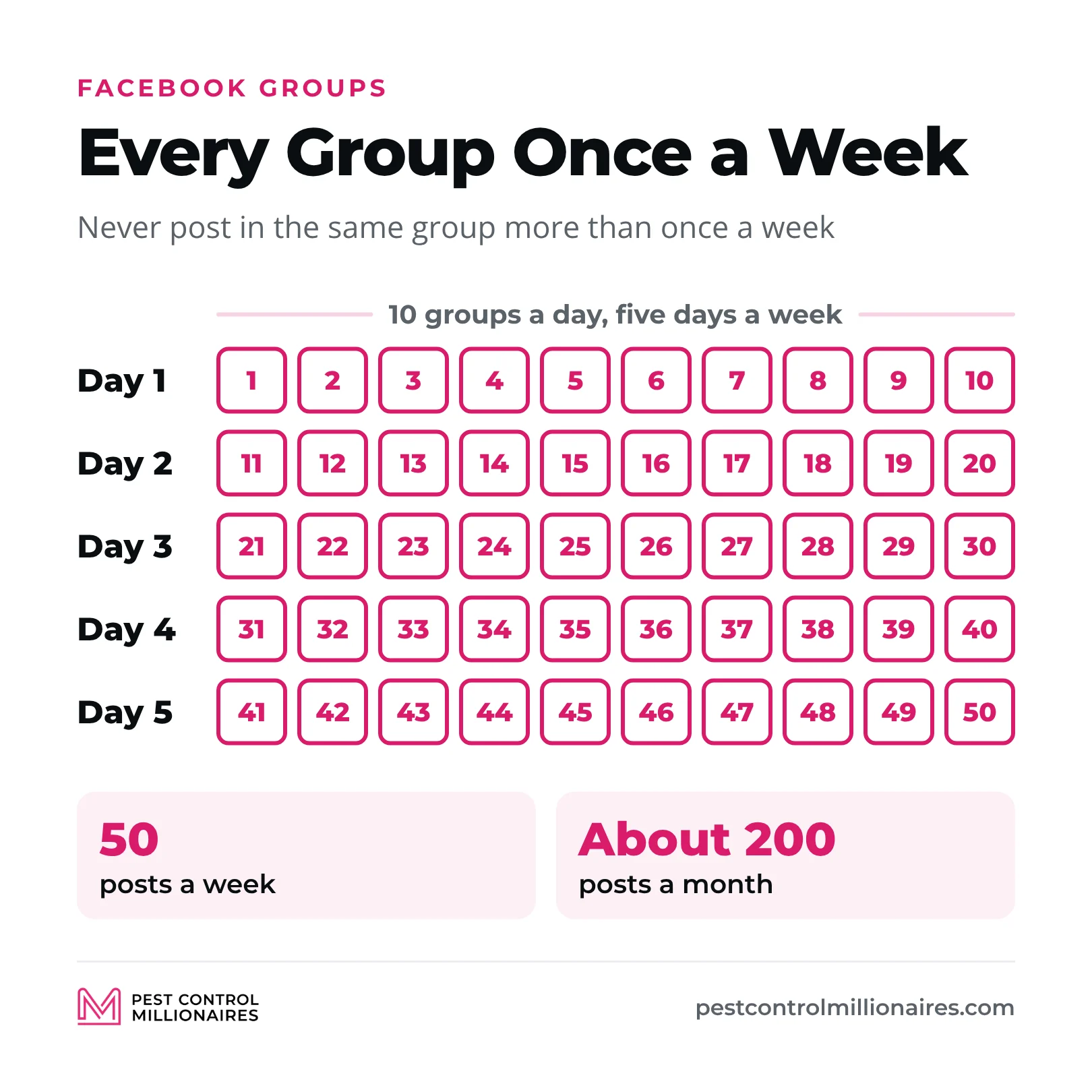
That sounds like a lot of work, right? It’s not, because you use the same post across all 10 groups. Write it once, then copy and paste it. My virtual assistant does all 10 in 10 to 15 minutes a day. If Facebook ever stops letting you post, slow down, space the posts out through the day and change the first line for each group.
How to Avoid Getting Banned (The Rules Nobody Tells You)
Let me save you some pain. I’ve been banned from plenty of groups over the years because I was doing it wrong. Here’s what gets you banned.
- Promotional posts. Anything that looks like an ad. “50% off pest control!” “First service for $1!” “Call now for a free quote!” Even if promotional posts are technically allowed in the group, don’t do it. Value posts convert way better anyway.
- Spam commenting. If you do a priming post and 30 people comment, don’t reply to all 30 with your phone number. Comment once at the end with a general offer to help, then message people individually.
- Over-posting. Post in the same group every day and you’re getting kicked out. Once a week, max.
- Getting reported. If several people report your posts, the admin reviews them and may ban you. Don’t be aggressive. Don’t be salesy.
Here’s how to stay in the admin’s good graces. First, be a real member of the group. Like other people’s posts, comment and answer questions. Second, when a group converts really well for you, thank the admin. I’m not kidding. I message them and say, “Hey, I just wanted to thank you for running this group. I’ve gotten a ton of business from being active here and I really appreciate you creating this community.”
Then I offer to take them to lunch or dinner, give them a gift card and do their pest control for free. Now the admin loves me. They’re not going to ban me from the group, and they might even promote my posts.
I know one pest control owner who did this and became an admin of a massive local group. Now he can post whatever he wants. That’s the ultimate cheat code. The full playbook is in how to avoid getting banned from pest control Facebook groups.
How to Convert Leads from Facebook Groups (The Soft Pitch That Works)
After a few weeks of value posts, people start engaging, and some reach out. Leads come in two ways.
When They Message You
This is the best scenario. Someone messages you, “Hey Jake, I saw your post about termites. I think I might have them in my garage. Can you help?”
You answer, “Absolutely! I’d be happy to take a look. What’s a good phone number to reach you at?” That’s it. Get their number, call them and close them on the phone.
Don’t try to close over Facebook Messenger. I see people spend a week going back and forth explaining their services and pricing. Just get them on the phone. It takes five minutes and you’ll close them way faster. On the call, it’s the same pitch as any other lead. Introduce yourself, hear their pain point, handle their objections, explain what makes you different, and close.
When You Message Them
This happens after a priming post, when people comment. Your message should be super soft. Not salesy at all. “Hey Sarah, I saw you commented on my post about stink bugs. I run a local pest control company here in Dallas and I’d be happy to help if you’re still dealing with them. Let me know if you want me to take care of it!”
No discounts. Those are for ads. If they’re interested, they’ll respond, and then you ask for their number and call them. If they’re not, no big deal. You’re offering to solve their problem, not forcing them to buy something. More on this in converting leads from pest control Facebook groups.
Speed to Lead (Reply in Seconds, Call Within Five Minutes)
Speed to lead matters as much with Facebook groups as it does with Google Ads or any other channel. Someone who messages you about a pest problem might be Googling pest control companies at the same time. If you don’t respond fast, they’ll call someone else.
So turn on your Facebook notifications and reply the moment a message comes in, within seconds if you can. Ask for their number and call within five minutes. If you can’t watch your messages all day, have a virtual assistant reply right away and get the number, then you make the call.
Couri Leuschner learned this the expensive way. He was texting his Facebook leads automatically and calling them when he had time, and he says it cost him money until he brought in a call center to call every lead.
This isn’t a dating game where you play hard to get. Respond fast. Get their number. Call them. Close them.
Tracking What Actually Works (The Metric That Matters Most)
Here’s the biggest mistake I see with Facebook groups. People join a bunch of groups, post random stuff and have no idea whether it’s working. The metric that matters is sales per group, so you have to track it.
Create a spreadsheet with one row per group and these columns.
- Group name
- Group URL
- Last post URL
- Date of last post
- Number of leads from that group
- Number of sales from that group
Every time you get a lead, mark which group it came from. After a few months, you’ll see patterns. Maybe one mom group is absolutely crushing it and a networking group gets zero. Post more and engage more in the groups that convert, and build relationships with their admins. In the groups that don’t, post less or stop.
I have 14 or 15 groups that absolutely crush it, and those are the ones I really focus on. The other 150+ still get posts, but I don’t put as much effort into engagement there.
A Google Sheet is free. If you want to get more advanced, set up a Facebook groups pipeline in lead management software like GoHighLevel and tag each lead with the group it came from. Either way, track it. You can’t improve what you don’t measure.
How to Automate the Entire Process (For Less Than $10 an Hour)
Let’s talk about the elephant in the room. Posting in 10 groups a day sounds like a lot of work, and if you do it yourself, it is. So don’t. Hire a virtual assistant.
I pay my virtual assistant less than $10 an hour. They handle all my Facebook group posting, plus scheduling and routing, and they even order chemicals for my service businesses. The Facebook groups take them 10 to 15 minutes a day.
Here’s the process.
- I give them the templates. We have five to seven that work. Start with the five below.
- I send them quick videos from me or my technicians on how to deal with common pest problems. The VA edits them if needed.
- The VA writes the post from a template and adds the video.
- The VA posts in 10 groups a day, so every group gets one post a week.
- The VA logs every post, and the leads and sales from each group, in the tracking spreadsheet.
I still handle the sales myself. When someone from a group wants service, I’m the one who calls and closes them. I don’t recommend having a VA close sales until they’re very well trained. Sales is too important to delegate until you’ve really scaled.
But the posting, the tracking and the engagement? A VA can do all of that for pennies on the dollar. Your time is worth more than $10 an hour. The full setup is in how to automate pest control Facebook groups.
The Templates That Actually Convert (Plug and Play)
Here are the five templates we use. Copy them, fill in the brackets and rotate through them. You don’t need to reinvent the wheel every week.
| Template | When to post | Copy and paste | Attach |
|---|---|---|---|
| 1. Introduction | Your first post in every group | “Hey everyone! My name is [Your Name]. I run a local pest control company here in [Your City]. Just wanted to introduce myself and let you know I’m here if anyone ever needs help with bugs, rodents, or any pest issues. And even if you’re not interested in pest control, I’d still love to connect and be part of this community!” | A photo of you with your family or pet. No logo, no discount |
| 2. Thank you | After people from that group have reached out or signed up | “Hey everyone, just wanted to say thanks for all the support! I’ve had several people reach out from this group and I really appreciate you trusting me with your homes. This community has been awesome!” | A photo of you and your team, or you at a job site |
| 3. Value post | Every week after that | “Hey everyone, I’ve been getting a lot of questions about [specific pest problem] lately. If you’re seeing [description of problem], here’s what you need to know…” | A short video from you or a technician showing how to solve it |
| 4. Priming post | Once you’ve built some trust in the group | “Hey everyone, has anyone been seeing [specific bug] in their house lately? I’ve been getting a lot of calls about them.” | A photo of the bug |
| 5. Seasonal value post | When the season changes | “With [season] here, I’m seeing a ton of [seasonal pest] activity. Here’s a quick tip to reduce them without spending a dime… [your tip]” | A relevant photo or video |
That’s your whole group content plan. Five templates, rotated.
The Long-Term Compound Effect (Why This Gets Easier Over Time)
Here’s what most people don’t understand about Facebook marketing for pest control. It compounds.
The first month, you might get a few leads. The second month, a few more. By month six, you’re getting leads every single week.
Kirk Slack got there inside his first year at Dang Pest Control in Tyler, Texas. Facebook became his second largest source of referrals, and it wasn’t his company page doing it. The page has fewer than 400 followers. The leads came from being visible in local groups every day.
Why does it build? Because people have seen you posting helpful content for months. They recognize your name and see you as the local expert. And as the groups grow, your reach grows with them. A group with 5,000 members today might have 8,000 next year, and you didn’t have to do anything.
I’ve been doing this for years. In some of my groups, people have seen my posts for so long that I’m the first person they think of when they need pest control. It’s not about going viral with one post. It’s about showing up week after week and becoming the go-to person in your market.
The Reality Check (This Only Works If You Actually Do It)
Let me be honest with you. Most people will read this guide, think it sounds great, and never do it. They’ll join five groups, post twice, get no immediate results and quit. Or they’ll spend weeks writing the perfect post instead of using the templates. Or they’ll pitch too hard, get banned from a few groups and give up. Don’t be that person.
Join 50+ groups. Post consistently. Provide value. Track your results. Adjust based on what’s working. Do that for six months and I guarantee you’ll have more leads than you know what to do with. And the best part? It’s completely free.
Join your first group today and make your introduction post. Six months from now, you’ll wish you had started today. The rest of the local marketing playbook is in our book, Zip Code Kings.
Frequently Asked Questions
How do I start Facebook marketing for my pest control company?
Start with local Facebook groups, from your personal profile. Join 50 or more local groups, post an introduction with a family or pet photo in each, then post in 10 groups a day (never more than once a week in the same group) and move every message to a phone call.
What budget do I need for pest control Facebook marketing?
Facebook groups are free. The only cost is time, about 10 to 15 minutes a day for 10 posts, and a virtual assistant can do that for under $10 an hour. Facebook ads are a separate budget of at least $600 a month ($20 a day).
How do I generate leads from Facebook groups for pest control?
Lead with value. Post an introduction, then a thank-you post once people sign up, then weekly value posts and the occasional priming post. Never post discounts. When someone comments or messages you, reply right away, ask for their phone number and close on the call, not in Messenger.
Should I post in Facebook groups from my personal profile or my company page?
Your personal profile. Many groups don’t let business pages in, and people trust a neighbor more than a logo. Aaron Huskey posted from his company page two or three times a week and it did basically nothing, then switched to his personal profile and people “hit on that like crazy.”
How many Facebook groups should a pest control company join, and how often should I post?
Join at least 50 local groups. Post in 10 groups a day, five days a week, and never more than once a week in the same group. With 50 groups, that reaches every group once a week, about 200 posts a month.
How do I measure pest control Facebook marketing success?
Track every group in a spreadsheet (group name, URL, last post URL, date of last post, leads and sales) or in a GoHighLevel pipeline. After a few months, put your effort into the groups that produce sales. I have 14 or 15 groups that do most of the work.
Should I use Facebook groups or pest control Facebook ads?
Both, for different jobs. Groups are free and build trust over months. Ads buy volume now, usually at about $10 to $20 a lead with at least $600 a month in spend, and a 20 to 30% close rate on ad leads is good. Our pest control Facebook ads guide covers setup, targeting and testing.
How do I get into private Facebook groups in my service area?
Answer the join questions honestly. If a group is for a town you serve but don’t live in, message the admin, say you run a local pest control company and promise to help rather than pitch. A lot of admins will say yes.
Related Articles