Lucas Richert on the 600 Past Customers He Never Called Back

Table of Contents
- Where his $200K comes from
- Stop asking one time or quarterly
- Your price only feels high to you
- The 600 customers sitting in his software
- Don’t stop doing what got you there
- A card on file and every lead in the CRM
- Hire 20 interviews deep
- What three months full time showed him
- Answer the phone before you buy leads
- Spray inside on the first visit, then only when asked
- Frequently Asked Questions
Lucas Richert works 24-hour shifts as a firefighter with the Oklahoma City Fire Department. On his days off he runs Scissortail Pest Control, which does about $200,000 a year in Oklahoma City, almost all of it from referrals. He sprays 8 to 10 hours on his days off and does his invoicing and scheduling from the station. He has two kids under three, and his wife just left her job to start her own practice.
He and I had been talking for a couple of weeks before we recorded this live breakdown, and he’d already changed things between our calls. The biggest find came about halfway through. Lucas has around 600 past customers in his software who bought once and never heard from him again.
This episode is part of the PCM Podcast. For another live breakdown of a company this size, read Joey Mantione on doubling a $250K pest control company.
Where his $200K comes from
Lucas started mowing yards in high school. One day a pest control guy showed up next door, finished his service in half the time it took Lucas to cut the grass, and Lucas started researching. He ran a termite van for a local company for two years to learn the trade, got hired by the fire department, gave up mowing and went all in on pest control. When we recorded this, he’d owned his company for three years.
He does quarterly pest control, liquid termite treatments, and he had just done his first bait station install. When he ran the numbers before our call, he had about $50,000 in quarterly service, about $55,000 in termite work and about $46,000 in one-time sprays, with some rodent work on top. He has about 185 recurring customers.
“I would take any work that came,” he said. That’s how most of us start. It’s also why almost a quarter of his revenue walks away after one visit.
Stop asking one time or quarterly
I asked Lucas to walk me through a call. The first thing he does is ask whether the customer wants a one-time service or recurring. I stopped him right there and asked what he thought they’d say. “They’re going to say one time,” he said.
Of course they are. It’s the least friction and the least setup. You come out, you spray, they never hear from you again. That’s nothing he was doing wrong, it’s just something he didn’t know.
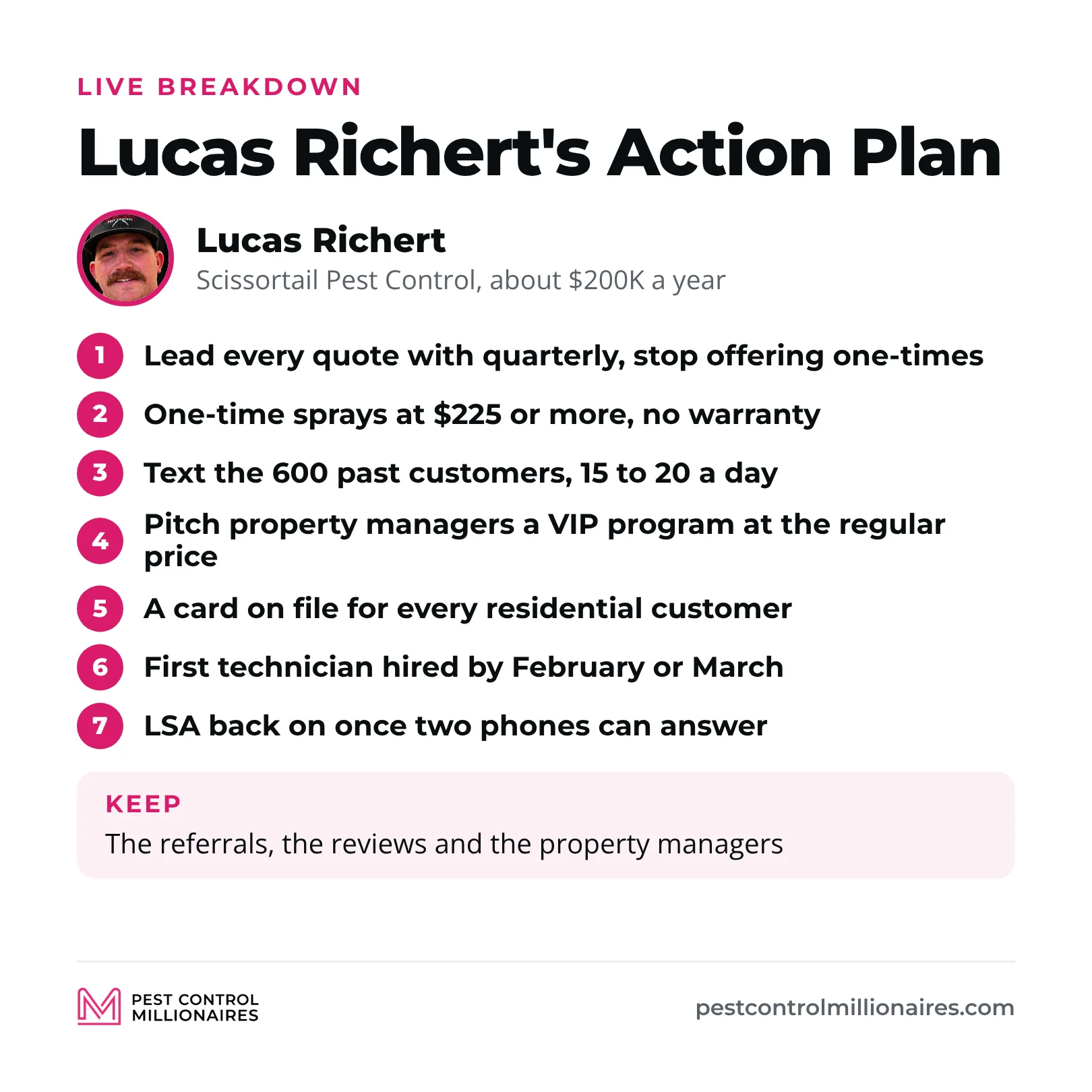
So don’t ask. When someone calls with a problem, ask what they’ve tried, walk them through how you’re going to solve it, show them your program and your schedule, and sign them up. You’ll close just as many deals. Write the script out and read it for a while until it’s natural. Not everyone will take recurring, and that’s okay, but it’s the first thing you offer.
Lucas’s goal for 2027 is $400,000, and he wants his residential customers at 90% recurring and 10% one-time. Property managers are the exception, because the tenant isn’t the one deciding.
Your price only feels high to you
Lucas was pricing one-time sprays by square footage, about $129 for a 1,000 square foot house and $149 to $159 for 3,500 square feet, close to what a quarterly visit cost. After our first call he put all his fixed costs into Claude and realized there wasn’t enough left over. So he raised one-times to $225.
The first person who called after that still got asked “one time or quarterly?” They said one time, he said $225, and they said okay without any hesitation. Same service, same time on the property, and a lot more money for it.
“I think I have a bad habit of selling out of my own pocket,” he said. He was pricing for what he would pay, and most people don’t care about $250, $300, even $400 for a problem they want gone. He could go to $299 or $399. People with money will pay it, and for the ones who are price sensitive, have a downsell ready, like a recurring program that fits their budget. His one-times also come with no warranty, which is how it should be.
His older quarterly customers pay as little as $89. His average is $139. That’s not a bad spot, I’ve seen quarterlies at $60 and $70, but you can’t hire employees at $89 a quarter. I told him to call around to the local guys and the bigger companies when it’s slow, see what everyone charges and put himself toward the top. On the legacy accounts, add $10 a quarter during the busy season, when nobody’s shopping for a new pest control company. That’s about $3.30 a month. Most of them won’t notice. For the full process, read how we raised customers from $50 to $129.
The 600 customers sitting in his software
Lucas has about 800 customers in GorillaDesk. Take out his recurring customers and about 600 are left, one-time sprays and termite inspections for real estate sales. I asked how many of those he’d reached out to for a second visit. “Zero,” he said.
That’s a gold mine. Those 600 people already trusted him with their home. If he sold just 10% of them and each was worth $1,000 a year, that’s 60 recurring customers and $60,000 a year from people already in his system. If he sold half, that’s 300 customers and $300,000. I’m not saying he will, but the potential is there.
Here’s how I told him to do it.
- Text from your own phone. With a couple thousand customers, I’d run it through the software. With 600, a blue iPhone text from a number they’ve saved, with your name and picture, gets a much better response than a random number. It’s more work, but it does much better.
- Send 15 to 20 a day. Test it with 20 or 30 people first. If you blast all 600 at once and can’t handle the volume, you put yourself in a bad spot.
- Time it. Reach out when they’re thinking about pests. Rodent season is a good one and spring is another.
- Pre-sell, then hire. It’s fine to sell the work first and bring on a technician to service it, as long as you’re ready.
He also does termite inspections for realtors’ clients. Instead of handing the buyer a business card that ends up crumpled in a truck, ask for their phone number and text them right there. Now you have an easy way to follow up. Our reactivation strategy for old clients has more on working a past-customer list.
Don’t stop doing what got you there
Lucas gets steady work from four property management companies. The biggest one had sent him about $10,000 of work when we recorded this, all one-time cleanouts for roaches and fleas, and the next two about $8,000 and $6,000. The biggest manages about 1,000 doors, the smallest about 300. They send a work order, he coordinates with the tenant or uses the lockbox, and they pay in about a week. They like him because he answers and gets in fast.
He got the biggest one by cold outreach on the first day he opened, and the next three from being in the real estate investor world. There are probably another 15 or 20 property managers in town. So I asked the obvious question. If cold outreach worked, why did he stop?
“Your schedule gets so full that you just kind of quit doing the things that got you there,” he said.
I see it all the time. Owners are scrappy until they get comfortable, then they stop doing the things that got them there. If you know it works, keep doing more of it. Here’s what I’d do with the property managers.
- Ask his four best for introductions. They network together and they go to the same events.
- Build a VIP program and give the property managers the VIP treatment at the regular price, so they feel special and send their friends.
- Keep asking for reviews and referrals. He’s built his whole business on referrals without a referral system, so build one. Our guide to getting more customer referrals walks through it.
A card on file and every lead in the CRM
Only about 25% of Lucas’s recurring customers have a card on file. When you’re working 24-hour shifts and spraying on your days off, you end up billing 30 or 40 services at the end of the month from memory. He’d already gotten his receivables down from about $10,000 to about $2,500, which is great, but the easy fix is to charge the card the moment the job is done. You can’t feed a family and grow a business off accounts receivable.
Get a card on file from every residential customer going forward, and send the existing ones an automated email or text from GorillaDesk asking them to update their payment method. On billing, he asked whether to go monthly. I told him what I’ve told a lot of owners. In the study I go by, monthly subscriptions had the highest churn, about 12.5%, and prepaid had the lowest, 2%. The more often a customer sees the charge, the more likely they are to cancel. When I heard that, we switched every new sale to quarterly the same day. Prepay is even better.
A few more simple ones. Put every quote and every lead into the CRM, even the ones that don’t buy, and tag where they came from, so you know your close rate by source. Clock in and out of every job so you know how long a 1,000 square foot home really takes. And build your square footage pricing into the software, so whoever answers the phone can quote the same price you would.
Hire 20 interviews deep
Lucas hired his first technician on June 1. He was getting busy, panicked, interviewed one person and hired him. He ignored red flags, including no reliable transportation, and let him go after a week. “It was my fault that it didn’t work out,” he said, because he had no processes written down and no clear picture of what he wanted.
His wife asked him the question that settled it. “When you close your eyes, can you imagine this guy being the face of your company while you’re not there?” He couldn’t. I ask my guys something similar. Would you hire six more of that person?
Next time, here’s the process I gave him.
- Write a structured interview scorecard first.
- Do 20 interviews. Have Claude rank the resumes against what you want and what your company is about. We just did this for a big hire. About 292 people applied and we interviewed the top 21.
- Move five or six to a second round and take each on a paid ride-along for a day.
- Take the top one or two to dinner with your spouse. It’s your first technician and it matters.
- Keep the runners-up. If the first hire doesn’t work out, you have a bench.
He’d started his tech at $18 an hour while training and planned $20 to $21 once he was on his own, but he hadn’t checked what techs make in Oklahoma City. Call around before you post. A technician can run about $250,000 to $300,000 of work, maybe $350,000 with termite work, so Lucas is close. I’d have one hired and trained by February or March, before it gets busy there. For the full process, read how to hire your first pest control technician.
What three months full time showed him
When his baby was born, Lucas took three months of leave from the fire department and ran the business full time. “It was awesome,” he said. He worked a normal schedule instead of cramming a week into two days, and he did a little under $82,000 in those three months, his best stretch ever.
I’m not going to tell anyone to leave a job with good pay and insurance. That’s his and his wife’s decision. I have friends who never worked in their business day to day, and one just retired from a fire department after 25 years while running a multimillion-dollar company. But those three months proved what he can do when he puts his time into the business. If he took the 8 to 10 hours a day he spends spraying and put them into cold outreach, realtors and investors, he’d crush it.
Answer the phone before you buy leads
Lucas tried Google’s Local Services Ads. The calls came while he was in an attic or a crawl space, or out on a run at the firehouse. By the time he called back, they’d already called someone else. He’d get frustrated, turn LSA off, turn it back on, and around it went.
LSA leads are hot. If nobody answers, you’re paying for leads that go to your competitor. So don’t turn it back on until you can answer. Hire the technician, put a phone app on both of your phones for about $30 a month, and have calls ring to whoever’s free. Make the script so simple that anyone can take the order. Then turn LSA back on. Calls you answer become reviews, and the reviews make his Google profile stronger. He’s at about 68 reviews, and once you get past 100 to 200 you’re in good shape. Our Local Services Ads guide covers the setup.
I wouldn’t touch Meta ads yet. But I’d start posting on social media. When people find him on Google and like his reviews, they’ll check his social pages, and a post every day shows he’s real.
Spray inside on the first visit, then only when asked
Lucas’s last question was a good one. He sprays inside and outside on every quarterly visit, and that’s where most of his time goes. He sees it as his time to build the relationship.
I wouldn’t go inside every quarter unless the customer asks. Do the inside on the first service, then maybe once a year, in your slower season. A good exterior service usually means you don’t need to go in. You can still knock, ask about the kids and the dog, and before you leave tell them what you found, what you did and what you solved. That’s also when you mention the next thing, like the mouse droppings in the garage or a gap a rodent could get through. That’s how you raise what each customer is worth.
Frequently Asked Questions
Who is Lucas Richert?
Lucas Richert owns Scissortail Pest Control in Oklahoma City and is a full-time firefighter with the Oklahoma City Fire Department. He ran a termite van for a local company for two years, started his own company about three years before this breakdown and grew it to about $200,000 a year, almost all from referrals.
Should a pest control company offer one-time services?
Not as the first option. If you ask a caller whether they want a one-time service or a recurring plan, they’ll almost always pick the one-time, because it’s the least friction. Lead with the quarterly plan instead, and charge well above a quarterly visit for a one-time, with no warranty. Lucas raised his one-times to $225 and the people who wanted one paid it without blinking.
How do you win back past pest control customers?
Text them from your own phone, 15 to 20 a day, timed for when they’re thinking about pests, like rodent season or spring. A text from a number they know does a lot better than a blast from your software when the list is a few hundred people. Test a small batch first and make sure you can service the work you sell.
When should a small pest control company turn on Local Services Ads?
Once someone can answer every call. LSA leads are hot and they call the next company if you don’t pick up. Lucas kept turning LSA on and off because the calls came while he was in an attic or on a fire run, so his plan is to hire his first technician and put both of their phones on the line before he turns it back on.
Should pest control technicians spray inside the house every quarter?
No, I wouldn’t unless the customer asks for it. Treat the inside on the first service, then maybe once a year. A good exterior service usually keeps you from needing to go inside, and you can still knock, talk to the customer and tell them what you found and did.
Full transcript
Every word of the episode, from the video captions
Businesses like they're super scrappy when they first start out. They get that first million and it's like they took all of the things. They didn't have a lot of capital. A lot of most almost all didn't have a lot of capital. Get into that first million. So they're just scrappy doing whatever it takes to get there. Then when they get like 800,000 to a million, they start to get they get comfortable. They have more cash in the bank. They're not worried about you know, just staying scrappy. And they like turn everything that's on like back online and you're going to LSA they're going to Facebook doing all those things. They stop doing all the things [music] that got them there.
Just keep doing more. Like more of those things work. Keep doing more. If you know that it works, don't stop doing those things. All right. Welcome back to another episode of the Business Breakdown. Today Lucas has been We've been chatting for a couple of weeks now at this point, hey? We've been going back forth had jumping a few calls and thought this would be a good opportunity. Finally got some time to connect. You were doing your thing. I was doing my thing, but we got together. But if you own a pest control business and want to grow, this show is for you. We break down how to get more customers, how to build your team, and how to scale your company. I've grown my own pest control company to millions a month and helped over 400 pest control owners grow their company to over $100,000 a month. Today we're looking at how to take this pest control company from 200k and beyond.
Really excited. You have a really cool story. I'll let you kind of introduce yourself. Like I said, you're Lucas Richert. You own Scissortail Pest Control. You're out of OKC, right? And you have you have a lot of cool things going on with your with your life, with your wife, and your full-time job. So you got a lot to unpack there. A lot of really good questions I'll go back and forth. But yeah, I'm excited to have you here of course. So why don't you just kind of introduce yourself real quick? And I said I told your name, but then how you got in the industry, where you started, kind of where you're at today, and just all of the above.
Thanks for having me, Jonas.
Absolutely. So basically I started out like a lot of other people in the landscape industry, mowing yards, just doing anything I could in high school. And then [sighs and gasps] I think just one day I saw, you know, a pest control a pest control guy next door, you know, showing up doing a service while I'm cutting grass and he's half the time and I'm like, man, what there's something with that. So I started researching and researching and realized that I wasn't going to be able to learn the things I needed to know without working for somebody else. So I went and actually ran a termite van for a local company in town. Did that for two years and then actually wound up getting hired on the Oklahoma City Fire Been there for about six years and I've owned my company for three years now. So when I got hired, I didn't want to didn't want to cut grass anymore. So gave up all of that and just went all in on on pest control and didn't really know anything about actually running a pest control business. I'm you know, knew more about the technician side than So been doing that and then you know, we just had a new baby on July 4th actually.
So we've got two two kids, a two-year-old and a three-month-old. So just staying busy.
I love it. And then tell me a little bit about your wife and what her path was like and then what she's up to today. There's a lot to ask here.
Sure. So my wife is a nurse practitioner and she was just working a regular pain management job and always gone, always working, not getting to be at home raising the kids. So she actually quit her job on June 18th and we're going all in on a on a men's health clinic. So she does testosterone, peptides, weight loss, all that kind of stuff and she just kind of jumped off the deep end and I'm still hanging on to a W-2 job.
Yeah. And how is that all going so far?
It's going good. I mean it's tough floating obviously a Just bootstrapping it, but it's getting there. We've kept it lean. Don't have any employees on her side. Kept kept the rent low and everything else. So I'm I am floating it with with my company right now, but it's getting...
So you So you basically two startups and working full-time. So walk me through what a typical with cuz you're working a full-time job, plus you got all this going on. To walk me through what a typical week looks like.
So we'll we'll use this week as an example. So I'm at the fire station this week, Monday.
Can't use the months prior yet cuz you've been off for 3 months.
Right. Yep. Since we had since we had the baby, I've been off off for 3 months and actually just went back. But this week for example is we're I'm at the fire station Monday, Wednesday, Friday. So Tuesday, Thursday's jam packed with you know, going and doing inspections, sales, spraying, I mean everything. Today did a termite treatment. So it's basically leave the firehouse, come home, say hi real quick, and then jump [snorts] in the truck and go all day long.
How many days Yeah, how many days do you work at the firehouse versus...
So it's 10 days a month at the at the firehouse and 20 days off, which obviously some of those days off are weekends, you know. So it just kind of it's a revolving schedule. So like next week I'll be off Tuesday Monday, Tuesday, and Thursday. So I'll only be at the station Wednesday, Friday. So it kind of it's a it's a revolving and we're there for 24 hours. So you know, when I leave tomorrow morning and go to the fire station, I'm there for 24 hours. So I'll be doing all my invoicing, scheduling, and everything from the station and then I'll leave and you know, go go spray on Thursday and then back to the fire station on Friday.
How many hours do you say you work an average week at the firehouse and then on the...
Let's see. This week is 24 * 3. So those those three days I'll be at the fire station and then probably 8 to 10 hour days on Tuesday and Thursday. So if I'm if I'm not at the fire station, I'm usually spraying 8 to 8 to 10 hours.
Okay, cool. A day, right? For two days a...
Yep. Yep. You kind of already already alluded to it, but what service offerings do you currently offer?
So mainly...
Quarterly pest control, termite liquid treatments, and then actually just picked up bait stations. Actually did my first one today. So the company that I learned for was that guy was kind of a dinosaur. He only believed in liquid treatments. So, of course when I started my own that I believe the same thing. So, now I'm kind of starting to evolve and try new things. So, but yeah, general pest, termite, mosquito, and Just average service that goes awesome. I like that. And you said that I'll ask your question first. Like how how are you getting most of your clients currently?
Pretty much 100% referral. So, started really slow. Did did some work for, you know, couple people here and there and it just kind of snowballed. I'm also in the real estate investor world a little bit. And so I have a lot of connections with property management and people that own multiple houses. So, I get a lot of termite work from them. You know, roach cleanouts, flea flea cleanouts, all all the, you know, mice, all that kind of...
Yeah, I know we talked a lot about that and I think there's some huge leverage opportunities there that would be really so I like that as well. You said you're about $200,000 in revenue this year currently, right?
Yes, sir.
Of that 200k, I know the answer to this because we talked about this before. How much is recurring versus one time?
So, I actually after after we talked I went and looked, and I was sitting when I ran the numbers two, three days ago, I went and looked at the quarterly and I was sitting right at 50,000 in quarterly and about 55,000 in termite. And then I had about 40 46,000 in just one-time sprays. So, that that could be you know, for investors, you know, anybody. Like I told you on the phone the other day, I would take any work that it came. So I didn't care if they wanted one time or quarterly. And then, you know, some some mice thrown in there. So, but yeah, it's mainly general pest and termite.
Yeah, and so walk me through like a referral comes in, talking to one of the property management companies. Walk me through the process of what it say looks like, what it sounds like on the phone, and then how you pitch it through the...
I basically ask them, you know, do you want one time or do you want And then I try obviously to...
Hold up. Hold up. Stop you right there. So, you'll first thing one of the first things you ask them do you want one time versus recurring?
What do you think they're going to say?
They're going to say one time.
Yeah, so we're going to work on the...
We'll We'll We'll create a pitch for you outside of this. We'll do that here and Okay, but before you get that, just stop with that, okay?
If you ask them for a one time treatment or a recurring, they're always going to say one time because it's the least amount of friction, less amount of setup. Like it's just super easy. You can come out, you spray them, you never have to hear from them again. That is it's nothing that you're doing wrong. It's just something that you don't know, so we can tweak that. So, with that, just like, you know, just all you got to do is tell them when you're coming out, what the service looks like, what your schedule is, and just get them on the schedule. It's really that simple. So, they call, they have a problem, you tell them how to solve it, ask what they tried so far, walk them through your process, how you're going to solve their problem for tell them that you're going to love it here, show them your program, show them like show them your schedule, and then sign them up.
You'll get You'll close just as many deals, but that 46,000 that you have in one time recurring will probably more like 100 and thousand in...
But we'll we'll we'll we'll wait further on than that, but just right out the right out the gate, let's just stop there. Just I know it's going to be hard to break at first because you're just so accustomed to doing it. As you do it, just like, you know, write out a script and just read it for a little bit until you'll get the hang of it, okay?
So, it's something super easy to fix,...
But again, we want to sell recurring work, not one-times. Not everyone's going to convert at recurring, and that's okay. You know, we don't really want to do one-times, but we'll we'll talk about that part first. So, hold up. Quick pause. If you're on a pest control company or fertilization weed control company, you're not in our Facebook group, you're choosing the harder path. Every operator that's in there is skipping years of mistakes because people are actually sharing what's working right now. So, stop trying to brute force your way through growth alone. Search Pest Control Millionaires on Facebook or click link below. And now, let's get back to it. From there, move on. Then I'm asking them how many square feet their house is and where where they're located in the in the metro And then once I get those two things, I'm you know, telling them the price.
And then I'm getting them on the schedule and hopefully obviously getting to them within 24 to 48 hours. I like to, you know, not book them out a week and give them a option to go find somebody else. But yeah, that's about that simple.
I like the square footage thing, but why do you ask that question?
Just trying to calculate time, you know. If I've got a 1,000 square foot house versus a 3,500 square foot house,...
So, I take yes. Then do you obviously you'll charge different?
Sure. Yep. And even after we talked on the phone last, I kind of realized that my pricing was probably way too low. And so, I've even kind of started working and building a new price sheet. But say a 1,000 square foot house, you know, I'd go spray it for 129 bucks and a 3,500 square foot house, I'd set it at, you know, 149 159. Obviously, I know that that's too low and after running, you know, putting all my fixed cost into Claude and trying to get very detailed, I realized that there's just not enough there. And so, I've upped those prices and I've upped one times to 225 just to try to build more value into the recurring...
Love it. So I'll go through that next. So first question. So we've got you got square footage. Are you currently using a CRM?
Yep. I use GorillaDesk.
And then you get the square footage. Inside GorillaDesk, you have the rate matrix built out so like when you have the square footage, you have to populate the price for you?
No. So I'm I guess I'm a cheap skate. I just I just get their square footage and I send them a price off of my price sheet. And do it kind of the old-fashioned way.
Yeah. So you're asking for a square footage. You promise me know how long it takes you when you when you see what you got in your head. So when you get into the GorillaDesk, you can just start taking all this information out of your head, getting it in GorillaDesk. So when you do hire your CSR, you don't have one yet, that she's answering phones she can get the same price that you're giving just by going in there, measuring up the home quick and it just populate a price for you. It'll automatically calculate the square footage and say here's your here's your quote for this size house in this location, right?
So just take that thing out of your head and then as you start getting more customers and you start you know you're probably not super great at I'm just guessing. I could be wrong. So tell me if I'm wrong. Are you really good at clocking in and clocking out of jobs?
No. Awful at it.
How did I know? But once you start training technicians because us as the owners, we typically it's like do as I say not as I do because we're just too busy running around like crazy. As you scale this up, you have to do you have to have SOPs. And so just it's the simple things of clocking in and clocking out of each job so you can track the actual time. I know in your head you can say oh it typically takes me this long, drive time's typically this long, but you get inside GorillaDesk, you'll know exactly how long it takes because you'll have so much data of all those I'll use your example of 1,000 square foot homes. You went to 1,000 there different times, take those 1,000 jobs, divide them by how many times you went and then that'll give you an average time that you're on that home for that service level.
And they you okay, typically it takes us, I'm just going to go throw a number, 12 minutes per stop and we're going to charge this much, right? You spent the money to do it. Super smart move there. With GorillaDesk do you have like all of the follow-up sequence put in there for you know when you send out estimates or quotes or text messages, things like that, service appointments?
Yep. So I've got all like all of my quarterlies when they pop back up they're already I probably need to go in and change it because they're already...
So it's sending them that I'm coming out so I get a lot of texts from customers like well hey I'm not going to be there. I didn't confirm you know I didn't I didn't schedule this and it's like well it's just popping up. I promise I'll reach out. So right now I have to reach out to every single job and I know I need to automate that better because every day when I get done spraying then I'm texting for the next day. Hey we'll be by tomorrow at this time. Does that work for you? And then I got to you know be moving everything around on the schedule. But yes I do have I get a phone number, email address, and an address from every single customer.
Oh I love that. And so yeah you'll get to a point where like the person like your CSR or yourself will just go in there and you'll have your schedule for tomorrow. The texts will go out you know 24 hours in advance just to let everyone know you're coming, your time slots. And just let them know that they don't have to be home if you're doing interior treatments but yeah you'll you'll sequence that. And then as far as like if you do send out a quote right now are you just texting it to them, doing it over the phone? Then once you get the quote you put in the system?
Yeah so it just kind of depends like I get a lot of people that be like hey man I'm just texting you. I got your number from so and so. Shoot me a price for the and I'll just shoot it right back to them or but sometimes they'll call you know if it's termite related they got a little bit more questioning and so they'll call but usually they'll just shoot a text. Hey I got this. I heard about you from so and so and then and then they just want to know a price and they say sweet, when can you get me in? That kind of deal.
The best pest control companies do not leave growth to chance. They build systems. They have a system for generating leads, systems for answering the phone, system for servicing the customer, and systems for collecting payments. But most companies still treat referrals like luck. They do a great job, hope the customer remembers to tell a friend, and maybe send an occasional text asking for a referral. That is not a system. Clicki Referrals turns your happiest customers into active trackable sales channel for your business. Clicki automatically invites customers into your referral program, gives each person their own referring, tracks the leads and sales they generate, and makes it easy to reward them when those referrals turn into business. And now Clicki has launched Rewards Pass. Rewards Pass is a brand referral pass for your company directly inside your customer's Apple Wallet or Google Wallet. Think about that. Your brand can live on your customer's phone alongside their cards, tickets, and brands that they already use every day. Their personal referral link is always one swipe away. You send push notifications, announce special offers, promote events, and stay connected long after the initial service is complete. This is not another app your customers have to download or another login they have to remember. It's your company, your referral program, and your rewards living directly inside their wallet.
If you want more referrals, stronger customer retention, and customer experience your competitors probably do not have yet, go to joinclicki.com/pcm, book a live demo of Rewards Pass to get $350 in payout credits. Tell them you heard about it on Pest Control Millionaires. That is joinclicki.com/pcm. Stop having your customers send referrals, build a system that makes it happen. And then let's [snorts] just say obviously if they move forward you can put in the system. If they don't move forward and they don't respond, do you still put that in the system?
Well, another thing you should do is just like that way you can just start tracking everything, right? Just get you tracking your conversion rate. So if like let's just say you I'm sure you close that at a really high percentage. I know you get to pricing next. But they're they're almost all referrals he said, so they're going to close 80% plus, so probably very little push back. But as you again start scaling up and you start getting in putting back on LSA we do that too. Start turning these things back on, you're going to want that person in the office tracking all this through like came from Google, this is a referral, this is the referral it from and then all that. So simple things, but yeah, cool. So sounds like in a good spot, get the CRM.
Let's switch to pricing a little bit. I know when we talked originally, you probably have some older customers. What would you say that your older customers are paying?
Shoot, I've got I've got some quarterlies on there for 89 bucks, interior, exterior. So and I think a lot of that comes from, you know, it's people that I'm close with or have known a long time. So it's obviously you're like, I don't I don't really want to raise the prices on it, you know, that kind of deal. And the company that I used to work for, that's no, just customers that I've worked for for a long time.
Are these like family members close? Okay. So they're...
Or say a long time, 3 years.
And they want to see your business succeed, right? I would imagine so. So if you raise, I'm just saying 10 15 bucks, they probably at over a 3 month period, it's like $4 a month. I don't really think they care that much.
Sure. No, probably not.
So I would say we'll come back to that. Okay, so $89 roughly is your lowest, right?
And then when we talked last week, your average pricing was like 120-ish...
139 is my average. Yeah, I mean, I've seen way worse. I've seen quarterlies for like 60 bucks, 70 bucks. It's pretty crazy. So it is you're not in a bad spot like I told you on the phone. I think you have rooms a little bit more room for some head for some headroom. I think there's more room to grow there. But you're not in a bad spot, honestly.
I know I told you last time just to, you take the time. You don't have to do it now or before, but just take time in your when it's slower, just call around, call to the local guys, call the bigger guys, and just kind of see what everyone's pricing.
And this I'd put myself towards the top. Like I said, you your very skilled at your job, you know what you're doing, you're heavily invested, and you want to grow this thing, you want to grow it profitably, you want to hire employees. You can't hire employees at $89 a quarter. That's not in the game, right? And then I know we talked about Well, I don't I don't want to get into myself. But so I would just we'll start there with the pricing. Like I said, I don't think you're in a bad spot. It wouldn't be a terrible idea, you know, like as the busy season comes around next spring, you know, add ten bucks to the rest of those legacy accounts. Not the end of the world. They're not going to balk at it but raise $10.
You can send them a letter if you want to. You can send them email or text They're probably not even going to notice to be honest with you. I probably just add it if I were you and just and move on. It's $10. It's $3 a month basically, $3.30 a month. Not even going to notice the difference. And then I know you had a question for me when it comes to pricing as well and billing. Why don't you go through that real quick?
So I mean I hear I hear I listen to a bunch of podcasts and obviously reading all the Facebook group comments and everything and my question is on quarterly, you know, at service billing or monthly billing. And it almost seems like people are getting inundated with oh just another payment for this and which I feel like it's good for the bundling aspect of things. But you know, I've quoted multiple jobs where people are like oh you don't do the monthly billing? I'm like no, I do at service and they're like oh thank goodness the other bids that we got were monthly. And I mean that's fine. I'm just trying to figure out what's best cuz then, you know, when you get into like mosquito and all this other then you're adding charges for this and this and that's where I see the benefit of the monthly billing and packaging everything up. So I'm kind of wrestling with that a little bit and not sure which way I should go.
So here's my feedback for that. There was a study done of like a couple hundred dollars a couple hundred million dollars in revenue in the service industry alone. And the highest churn rate, which is like 12 and 1/2% this study, was monthly billing. It was the highest churn rate.
The second highest churn rate was quarterly billing. And then the low which I think was 6 and 1/2% or 6 or 6 and 1/2% of this study. And the lowest churn was prepaid at 2%. This is just me, like so I know the data, I know the data behind it, so the data is accurate. So I know that that's And what I will say is I think that when Amazon came out, they had their whole subscription model and then everyone came with subscriptions and it was really good. It broke up the payments, it was smart, it hit their card. But the but what they noticed in the studies is that the more times that the card was hit, the more they obviously noticed it and they were more likely to cancel because it was just in front of them all the time.
And so I think the it has shifted back to per service And I don't know why like in the long care world and in that side of the world like it was always like they pay like 30 days later, 45 days later. Don't we'll we'll get into that a little bit. Just make sure you have cards on file and you charge the card right then and You can't go anywhere else in this country. You can't go on Amazon, you can't go to the gas station, you can't go to the store without card on file and just pay for it as soon as you walk away. But we'll get into that. So to answer your question, I think that quarterly billing or prepay in my opinion is better. And I think a lot of our customers like The flip side of the subscription billing is it is good for like you said what you said is for bundling until they want to cancel.
And again in my opinion, it's like when they're calling to cancel the your CSR or sales people or whoever is charge of retention or yourself, they have to be really good at identifying which they want to cancel and don't just cancel the entire thing. So they call the cancels it's way easier all we just want to cancel services. Well, which one do you like to cancel? There's pest control, rodent control, and mosquito. Like which one do you like to cancel? Termite, whatever, right? And so they have to really unpack that and get it back to bundling, right? And then and then go into an whole new conversation about retention, but I don't I don't want to take it there. But so what I think is that if someone's calling to cancel for a that person has to be better at saving the account cuz they you don't want to leave lose three accounts, you want to lose one or two of the three and try to save them. So they just have to be better on the retention side in my opinion.
So I would if it's me, which we do, when I heard this study, this was two I would say two and a half years ago, I called on on our lunch break and we fixed it right then and then changed everything back to quarterly billing.
No kidding.
From all the from previous sales, we left them be. We had we had a lot on quarterly already and then we had some monthlies. We had switched to monthly. But from that day forward, we only sold reoccurring on quarterly.
Same thing with mosquito. It's just per visit. Of course, if they want to prepay for the year, we love the prepayment, right?
Sure. Sure. With that being said, something we already talked about, how many people of your how many customers do you have roughly?
Reoccurring roughly shoot, let's see. What did I tell you? I'm drawing a blank here.
I think it was a I have it I have it in my notes somewhere. It doesn't matter. There's a couple hundred, I think.
Yeah. Yeah. I think I'm I think I'm sitting right at like a maybe 185 I think is where I'm at.
Yeah, something like that. I have it in my notes somewhere. So in front of me...
And I've got like 800 total probably in my GorillaDesk of customers that Well, I guess that would be combined and then I probably have 600 or so without that were just one times or termite inspections for real estate sale, you know, stuff like that.
Cool. Love it. Of those 180 customers, of that 180, how many you think have a card on file?
I'd say probably It's pretty low, maybe 25 %. That is okay. Again, you know, there's automated emails, text messages that can go out through GorillaDesk that can get those cards on file for you.
Do an automation around it, not a big deal, but I would just really start collecting those. Going back to when you're onboarding, obviously we're going to lead with reoccurring, not one time. And then every time you have a call and I know like sometimes you're at the firehouse, you have a computer in front of you, just ask for the card to put on...
Or let's just say, you know, you're out in the field, you can't you can't put it in GorillaDesk, say hey, not a problem, when I get there, I'll certainly need someone to meet me there to put the card on file. It's not that hard. Like every single person knows they have to pay with the card. So it's not the end of the You do ACH card, whatever. It doesn't matter. Just because I know it happens with you, I'm assuming, again, tell me if I'm is that you're so busy, you're going to the fire house, maybe you have more time there, so maybe I'm wrong, but you're out there grinding all day long, you're servicing all the accounts, then you're going to work, then you're going home, you got babies and you got the business, you're probably not super great at billing on time all the time.
That would be true.
Yeah, good. And I know you have a little bit of time at the fire house to catch up on things, but it's like now it's the end of the month and now you have 30 or 40 services you got to try to remember what you did and you're there's doing all that at once and it's hectic. It's so much easier just to go there, get the card on file, do the job, clock out, you have to clock in first, clock out, and finish the job, hit the button, charge the card. That way you It's one, you're growing your wife's business, right? So you can't hard to feed the kids, feed the family, and grow the wife's business off accounts receivable. It's not doable. Thankfully, you have a good paycheck from the fire house.
We're going to get into that in a bit too. So a few tweaks, right? It's the simple things like this that help the business scale. Raising prices will help. Not doing one times will those recurring, because we want to We're going to get to the technician part soon. So all these little it's the little tiny things that just keep piling up, right?
This is something that I didn't know though, which is interesting. The 600 customers that you have in GorillaDesk that were one times, right?
How many of those people have you reached out to for a second visit?
I think you're sitting on a gold mine.
Yep, zero.
So this is something that I would work when you're at work is maybe you have Claude or ChatGPT or whatever you use maybe to create some emails and text campaigns, reactivation around this...
And maybe you just and maybe you have extra time and you're not servicing, maybe you don't have any extra time right now, but you could literally stop at these people's houses. You have 600 people that are in your system that have already trusted you.
Even if you sold 20 let's go 10% to make it easy, that's still 60 customers that are reoccurring. Let's say at you know say 1,000 bucks a pop, it's still 60 grand in reoccurring revenue with the base that you already have and it's a simple text and email and a phone Yep, absolutely. I hadn't hadn't even thought about that.
And you just like we never talked about that before, but you're like there's 600 customers who already liked you, who already trusted you, already know your service. It's just a matter of you reaching out like hey, we're we're starting back up in the springtime. Like I'm just I'm spitballing here, right? Schedule, this is the offer that we're running this month. Get them on the schedule. You might get you might get some bundles out of there, you might get some pest control client like whatever. You might even get some one times. It doesn't matter like you're still collecting revenue from these reoccurring customers like they're already in your system. Like start there. Like so before I went anywhere else like whether it's LSA we'll get into all this marketing stuff, but that's the first place I would start right there. Sit on I mean if you sold half those at 300 customers at 1,000 bucks a pop, that's 300 grand right there.
I'm not saying that you will, but I'm just saying the potential is there to do that. Like if you stop by all 300 people's houses and knock knock on the door and just talk to them and tell them what your offering was and they already like you and trust know you, like that is so and there's some commercial accounts in there, there's some one off stuff in there. I know that too cuz you did like you work with the agencies or realtors or whatever, but still like reach back out to them.
Yeah, but I mean and even I'm like I'm hooked up with a bunch of realtors and so I get I do the termite inspection on behalf of their client...
Love it. So I mean I've already been there, I've already seen the house and they've already trusted me to do that which is you know one of the most important parts of pest control is making sure that it doesn't have termites. And then, but I'm not reaching back out to try to get them set up. And I've done things where if the buyer is there, I'll try to give them a business card, but I'm just so busy and trying to get to the next to the next job on time so that I can get done for the day,...
And I would just I would keep it simpler than that. Just like, hey, like I'll be in the area or whatever, like let's just exchange phone numbers. I'll send you a text real quick with your phone number.
That we're going to we're going to worry about business cards floating around in your pocket, you're sweating, wet, and they're crumply or the truck or Just ask them for their phone number that you're going to send them a text message, shoot them a text, but you already have their contact. Perfect. Now it's easy way to follow up. Something so simple, like screw the business cards because you're waiting waiting on them to call you back. Hey, just send you a quick text with your phone number. Nine times out of 10 like, oh, here here it is right here. And then now you have a easy way to follow up with that customer. It's so and you'll be able to, you know, transcribe this when we're done, give you all the notes for it when we're done as well. And of course, you can go back and rewatch it when it when it posts here in a couple weeks too.
But I don't really want you to wait until that's done to fix a lot of this stuff. So I got through that. Oh yeah, with pricing, when you're doing a one time...
So kind of kind of like what I told you on the phone is I actually wasn't changing the price on the one times at...
No, you were. That's right. No.
And just recently I changed it to 225. And the craziest thing is the people that we're going to do one time anyways, they don't care paying 225. So this whole time that I've been charging somebody, you know, 139 or they'd have paid the 225. So now now I'm getting less one times because they're like, well, okay, well, what about a quarterly? Which now I know not to lead with that question, but...
But like you But like you said, you could raise that to 299 or 399.
People are like the people with money are still going to pay it. The people who don't have money, you down sell them to something cheaper inside the quarterly pass. You always want to have a downsell in there because again, these customers are going to go somewhere else. They're going to say no, but if you can downsell them into their next offering, like some so people who have money aren't they're not going to balk. They're just say, okay, cool, sounds good, come do it.
If you who like are more price sensitive, you just downsell them in the next thing. So oh yeah, we do a monthly program or whatever like a little bit more affordable that meets their means with the same with the same ACB overall.
So yes, so I'm glad that you did that. So you found out that you raised prices to 225 and people still signed up. So you made an additional 150 roughly on the same service.
Absolutely. Yep, same amount of time, everything. Just up the price.
Well, were you afraid the first time you did it?
Yeah, I think I have a bad habit of selling out of my own pocket.
Of course.
And so I think about the way that I manage money and the way that I think about money and I think that everybody does and I just I think that's my biggest problem is that I try to I try to sell to myself pretty much of like what I would buy when there's not a whole lot of people that are going to you know, really care about 250 bucks, 300 bucks, 400 bucks even, you know, so that's I think that's my biggest hangup is selling out of my own pocket.
Cool. So the first time you did it, walk me through that.
I just I made a mental note, all right, today is the day. I am not doing another one time for the same price as a quarterly and when that next person called which I still led with the oh, do you want a one time or a quarterly? And when they said one time, I said, okay, that's 225 and they no hesitation at all. Said, okay, sounds it I mean, it kind of made me feel dumb that I've been doing it this way for three years and thought that I would...
How did that feel?
Don't know what you don't know. We all we all have to learn.
That's just in business. I didn't know either. So we're all learning together. That's cool. Good work. I love that. With the one times, do you still offer a warranty or no?
Nope, no warranty.
Love it. So let's talk a little bit about their property managers. How many of those guys do you know? Oh, and what does that look like and what kind of work do you typically get from...
So I've got four. I kind of dissected this down because I figured you'd ask about that. I've got four large my biggest one they bring me about 10 or to this point this year they brought me $10,000 worth of work. None of it none of it was termite, all one time sprays. So roach clean outs, all that kind of stuff. And then the next closest one was about 8,000 and then 6,000 I think. And the last one was like a thousand or two because I just I just got hooked up with them. But basically I have a they send me a work order and it can either be a vacant with a lock box and I go go spray it or it'll have tenants and I coordinate with the tenants and we get it sprayed.
So is that more on the commercial side only or is that residential too?
It's more on the residential. They manage some commercial properties, not much. It's more I think the biggest one I have has about a thousand doors that they manage. The smallest one that I have probably manages 300 doors maybe. So and then the rest are in between they basically they just send a they just send a house that just somebody moved out of and it's nasty. It's got roaches and fleas and we go in and we spray it, send a work order, they get it paid in about a week.
Cool. Is there anything in it for them at all? Or they just like you and they're just referring you?
So I got the biggest one I have. I just cold outreach when I the very first day that I opened my doors got They take [sighs] like I think like $5 off of each job which was a you know an agreement when I first started with them. So but they get a little bit off the top. But no, they just they like that I answer. I get to the tenants quick cuz obviously those those tenants can be a squeaky wheel. And they like that I just get in there, get it taken care of and move on down the road.
And you said Okay, so you got that's how you got that one that was cold outreach. How did you get the next three?
Next three was just kind of being in the real estate investor world. I was buying and selling properties, so it just kind of kind of worked out just telling people, hey, this is what I do. You know, I also I buy houses, but I also I also spray houses and next thing you know, I was I was hooked up with a handful of them. And they all use the same software, so it all comes to one spot and I just click on the phone number, reach out to the tenant, get them scheduled and go spray.
How many more realtors or these people that you work with, property managers are in the same pool?
Like in this area?
Yeah, like that are all in that same CRM kind of all I mean I kind of do like a quick Google search just to see if any new ones have popped out that I can cold But I mean I've got four, you know, three, four, five of the big ones, but there's probably another 15 or 20 out I would assume.
And they probably all know each other, I'm assuming. Interesting. Because I think that there's something there's something unique here because you're already in the system. You already work with these guys. They already know you. Like I wonder if there's a way I know there's a way where you have like what typically are you just doing one times for them typically like clean out Okay, cool.
But they're selling a lot of houses,...
Yep. And a lot of them are like they're they're managing the tenant or the rental. So the house is owned by some landlord that doesn't want to deal with it, so they hire this property management company. And so, you know, when the tenant moves in, they there's some cobwebs in the corner cuz it's been empty for six months and they place a work work order saying, hey, we want to get sprayed.
Yeah. Maybe there's like a way that we one create a referral program around that to get some more money in their pocket to maybe get more referrals. Maybe you can get invited to one of their events. They network together. They all have events. Maybe you go talk to them at events. But I wonder if there's a strategy where you have like a VIP program and you have like a your regular program and then you give them the VIP program at the price of the regular program. So you go in there and do the clean outs, you're doing all the stuff and you get like a white glove for this customer is at the regular So like they know that their tenants are getting and I know their rentals so it's a little bit different but just think like think about that a little bit and maybe they have more residential stuff too where you have like a white glove offering for those for those specific like clients of yours that are realtors.
Become a super unique and special to them. So like they're going to use you, they're going to refer you to their friends and really scale that up. I think that's super unique. And so my next question was like okay you got the one by cold outreach. It sounds like you've done more but my question was if that worked why did you stop doing that?
Just cuz I started filling the schedule and got busy. And it's funny cuz I think about that myself. I'm like well how how did I get these ones that I have? And it was by cold outreach but you know you just your schedule gets so full that you just kind of quit doing the things that got you there I guess.
I actually I actually had a podcast yesterday dropped today and it's one of the things that I said. It's like what happens is businesses like they're super scrappy when they first start out. They get that first million and it's like they took all the things they didn't have a lot of capital. A lot of most almost all didn't have a lot of capital.
Get into that first million so they're just scrappy doing whatever it takes to get there. Then when they get to like 800,000 to a million they start to get like they get comfortable. They have more cash in the bank, they're not worried about you know just staying scrappy and they turn everything that's on like back online, they're going to LSA, they're going to Facebook, doing all those things. They stop doing all the things that got them there.
Just keep doing more. Like more of those things work. Keep doing more.
So I only say that be like if you know that it works and you're still scrappy entrepreneur stage like young startup phase like don't stop doing those things. And so we'll get into the technician side next. But you know, we're going to start building up we're obviously we're going to increase prices. We're going to start selling more recurring. And then that's start building up the monthly revenue so that you can start affording the technician. And I know we kind of talked through text already. So it's a good place to segue. So with that technician that you hired, walk me through how that went. Again, I know the backstory, but just walk me through the process of how I hired, how it went.
So I hired him on June 1st. I got I panicked cuz I was getting so busy. Obviously start of a new season. Decided oh this is going to be when I hire somebody. So I interviewed one person, hired that one person and ignored a lot of red flags. And did not work out very well. And ended up letting him go after a week. So then of course you kind of get into that or I got into that mode of thinking well like you know what I can just do it all myself. It didn't work out. When in reality it was my fault that it didn't work out cuz I didn't have any any processes written down. It was all everything was a mess. I didn't actually have a you know a clear outline of what I wanted in an employee. I didn't know how to train an And so it didn't work out.
Yeah, what were the red flags? Just the way basically the customer interaction on the very first customer I could tell that it wasn't going to work out. Just kind of had an...
Been to like all through like the hiring process and the onboarded state was it good up to then?
He wasn't he wasn't bad. I overlooked the not having reliable transportation which was a big deal. I should I should not have overlooked that. Wound up having to go get him and stuff during that first week and realized that that wasn't going to be and then you know there there was just some answers during the interview process that I that I overlooked. But I was just so busy that I thought you know what I'll make it work. It'll be fine.
That that first just [clears throat] kind of having an attitude.
The first interaction, what happened?
You know, and Yep. Yep. And then kind of I guess my way of doing things, my standard. You know, he just he told me at one point, hey man, you're you know, you're overkill, right? You do too much. Like you don't have to do all this. You can charge them that you know, cuz he worked for another company before. I was like, well, I'm I understand what you're saying, but you know, this is my standard and this is my company. So by the time we got to Friday, you know, that had happened, you know, spitting a customer's driveway. Just a bunch of bunch of stuff. And then my wife finally asked me. She said, when you close your eyes, can you imagine this guy being the face of your company while you're not there? And I said, absolutely not. And she said, okay, then don't waste any more time. Don't waste his time. Let let him...
Yeah, and I told you in the last call, wife's smart. It's like question I always ask myself if anything comes up like this, I'll ask my guys the same thing. Would you hire six more of that?
Right. And I And I would not have. And a good thing there too like so it was the first time I ever hired and it's okay. What I would tell you the next time is like I know this sounds like a lot. Interview 20 people.
I should have.
Because you'll like you'll you'll find out what you like and you'll find out what you don't want. And then you find out this is a really good candidate. This is a really good candidate. Have Claude go through. Turn all the resumes. Put in there what you're looking for, what your company culture is, what the businesses to you, what you want them to what you want that technician to do and look like. And then have Claude scale them from 1 to 20.
So you jump on you jump in I literally just did this, right? We're hiring a new position that I'm doing all the interviews for cuz it's a big hire. Me and my director of operations are doing the hiring together. We literally just do the same thing. I'm doing all 20 interviews or there's 21 interviews. But it's like you go through 20 I think there was 292 who applied. We went through all of them, picked the top 21 I think it's 25 or 21. I think it's 21. And I'm interviewing all top 21, but you'll just you really understand what you're looking for.
And so like someone might knock your socks off like oh this guy was awesome like and he said he set a new standard for you for the interviews. Then all of a sudden like you go through a few like oh not so good. Then like another one bam like he out does the other one. It's like holy man the level out there of people that are out there. But I'm just saying this because you'll go through and you'll really get to understand what you like, what you don't like. And then you finally get down to like the last two or three hires. Bring your wife in on it, have her go have dinner. It's an important hire for you. Your first technician is super important for you. Go sit down, have dinner with them.
The first few technicians that I hired I did the same exact thing.
Took the took my fiance at the time with me. And every time that I went out to eat to dinner they came in a suit like a shirt and tie. And those were absolute rock stars. They worked me you know five plus years. They were great from the very so yeah just like obviously you learned a lesson. Don't go hire one. Interviewed 20. Take the top five. Maybe just do a ride along with them. Say hey come with me for a day. Let's do a ride along together cuz you got to like them. They got to like you. It's got to be a good fit. It's got to be a win-win for both sides. Do a ride along pay ride along pay Take them for a day each one of them each five. One one a day for a week. And just see which one you like. See which one performs better. See which one talks to the customer the best. You'll know right away.
If it doesn't work it obviously you pay those guys. And then if the first one that you hire doesn't work out you have a bench of four people that you really really like that you can reach out to in if it doesn't work out. So it's something like again you're just learning first time hiring. This is all things that took me a long time to learn but it works really well for us, you...
And then from that point you'll have to create like an onboarding and you want to do you know ride along for weeks or a month probably a probably a month or so, you know? You start trusting them and you start to get a feel for how is, but yeah, it'll it'll work out. I think that where you're adding monthly recurring revenue versus one time, you're getting really close. Like you're at 200 k a year, you know, technicians 250 to 300, maybe 350 if doing termite stuff like that. I think really really close. And know how you hustle already. And I and I probably wouldn't tell you to do this in the off season, not quite yet, but come springtime, get ready to hire. But the way you hustle already, dude, if you took all that time and energy, those 8 to 10 hours a day, every other every twice a week, and you put that time under cold outreach, meeting with these realtors, investors, like you would absolutely crush this thing.
Yep. That's that I know it's funny cuz I know what needs to be done. It's just I keep my schedule so busy that I don't do the things that I know that I need to do.
Yeah, and so we're not talking about this publicly, but I know how much you make at the at the fire house, right? And you make a good living there. But you are on your paternity leave for 3 months. In those 3 months when you just focused on the business, walk me through...
Pretty much every day all day, spraying houses, doing termite treatments, inspections. I mean it was honestly it was awesome. You know, never felt overwhelmed like it's just running running the business and doing you know, doing what I knew needed to be done. Not trying to cram, you know, a whole week into 2 days of work or anything like that. So just you have to work a normal normal schedule and it was awesome.
How about the revenue side of things?
Dude, it's funny. I was I was curious to see what that was going to be too just so that I could pair it up to what I would have made at the station, you know, in that same time frame if I'd have been there. Did did right at a little under $82,000.
Yeah, not bad, hey? And that was your best I'm assuming that was your best months ever?
Yep, and this will be my best year to date, so.
That's awesome. So it just goes to show you if you just focus on just your where your your business, what you could do. I'm not going to tell you I'm not the person that's going to tell you to leave the firehouse, that's not my decision. I told you before that I've had friends that I've never even worked in their until they got up to a million dollars in revenue. They had no they were making 100k plus a year and they just said, hey look, when I have my business at a million dollars they could have paid me for replacement salary, that's what I'll do. In your situation, I know what I would do. That's just me, because I know the backstory and I would kind of the insurance stuff and so there's I'm not going to tell you what to do there, that's just a you thing. And I wouldn't tell you to do that in the winter, but I would just play your cards right, you know what I mean? That's it. That's a you and your wife decision, not mine. Like I said, I've had friends that built massive companies and never even worked in the day-to-day ever.
I In fact, one of my really good friends shout out to Chris if you're listening to this, he just retired from the fire station after 25 or 26 same I don't know if not maybe not the same schedule, but he worked at the firehouse 24-hour shifts so he was running a multi-million dollar company and he wasn't even there but now he's retired, now he's going in full-time and his brother ran the company, but still it's like I'm not saying that you have to quit your job because your insurance and all that stuff you have going on there's other ways of doing it. But you just have to work on the business from the firehouse, you have to get a really good technician in there. I know you can still answer some calls at the firehouse and get a CSR, but we'll get there.
Yeah, that's awesome.
So I'm not going to tell you what to do, I know what I would do. I know what my friends have done, so but that's just a your call. I just...
And I know I know what needs to be done. It's just a it's just a hard hard decision to make.
It is because I and I get it, but it's like you have to believe in yourself. If that's the decision that you make is like believe in yourself, your wife believes in you already that she has a startup and now like you're going to leave your full-time thing to go on your startup, so I totally get it. But you've already proven that if you go all in on your thing, what you can produce in three months.
So that's all I'm saying. Insurance is just money. You know, we talked about this in the last call. I told you how much I pay for my insurance, how to go get insurance. And it and people get at this level because like oh I have insurance and it's like well that same insurance might cost you $1,000 out of pocket, but if you're making $70 $80,000 or $90,000 in three months, it's really not that bad. But there's no right or wrong way. It's your decision, your your and your wife's decision at the end of the day. So yeah, we'll leave it at that. Termites how many how many termites do you jobs do you do a month and what are you typically charging and is there a warranty and a renewal in...
Yeah, so I've been doing just purely liquid treatments. That's the company that I learned from. That's what they did, so that's how I started my business. I'd say probably on average maybe seven seven to 10 somewhere in there. I'd say an average termite treatment $1,300 bucks, $1,400 bucks.
It's all footage?
Do what?
You just charge by the linear footage?
Yep. Yep. All all linear footage and then yes, there's a warranty and then a yearly renewal.
Same thing with with rodents. Is that monthly and then are you doing any exclusion work or are you just putting out bait stations? I don't do any exclusion work. I know that I need to get into it. But I don't do any right now. And on the on the rodents mainly it's already quarterly customers and they ask, you know, while I'm there, hey yeah, actually we saw you know some mouse droppings in the garage. You know, that's usually how those come about.
So you set up a bait station and charge a monthly bait station. Do you have a setup fee for those as well?
Yeah, so I charge them per bait station and then per quarter to monitor them.
Love it. Okay, cool. That all sounds when you, I know again, we went to this, when you hire that technician, what was the hourly rate that you paid him?
Started him out at 18 while training and then was going to bump him up to 20 21 on his own.
And what is the average technician make in your market?
See that and that's I didn't call around to see or check around to see. I know when I was doing it 6 years ago, I was getting paid like 14 15 bucks an hour. Which in my mind I saw it as an opportunity to learn a new business and get paid to do it. So I was fine with...
I worked for two years for free.
After work I worked for two years for free with the company pulling hose, filling trucks just to learn.
Yeah. Yeah, absolutely. I just wanted to learn. But I know that not everybody's like that so I want to pay you know a good wage that that will be attractive to somebody that is you know a good technician.
If you had someone if you had the money to hire someone right now, which I know you do, what would in your mind who would be the first person that you'd hire?
I'm leaning towards technician just because of I know that I could be doing cold outreach. I know that I could be networking more. I know that I could be you know actually putting systems in place and processes and a referral system. I mean I don't have any that I get I built my business on referrals and I don't have a referral system. You know so I'm leaning towards a technician, but also I mean the CSR part of the job takes up a lot of time also.
It's this because you're good at all of it, but in your situation, I don't want to say this to everyone, but I think your first hire probably should be a...
And then I know cuz I know that you said that you do answers to phone calls and can answer to phone calls at the fire house. Listening to this. [clears throat and laughter] and then you step outside or whatever is so I probably wouldn't do that first thing. I'd probably hire a tech person cuz you can't you know when you're a servicing job or work at the fire house and work 24 hours and you get someone service that day or the next day and they call and need to get done, you just have someone to bring there right away, you know?
So in your situation, I probably would go technician first.
I have him ready to rock and roll by probably I'll be by January, February it starts getting, you know, in February, March starts to get banging down there.
I was thinking February. That was that was the date that I had in mind. But yeah, usually January is slow, but I mean we don't get a whole lot of snow or...
Even storms typically...
Still like 50 40 50 degrees. But then yeah, by end of February, early March it starts to bang, you know? Yeah, I would just have him ready, you know? Make sure you're training him in, have him ready to go. Make sure you teach him how to do inspections, termite inspections, things like that. Really dialing your processes, things like that, get cards Just really work on these things until then. So you I know your goal next year is 400k, right? Revenue. So you'll have to double, which I know you'll do pretty easily. How much of that do you want in reoccurring versus one time?
I want to completely flip my business upside down as as far as the reoccurring and one times. I mean I'm pretty much sick of the one times other than for property management. I don't mind doing that cuz I know that they don't want to you know, they aren't the ones that are making that decision. But as far as any residential customer, I'd like to get it to 90% recurring and 10% one time.
I love that. And easily doable. You're already on track to do that, which is cool. So pretty pretty straightforward. I'll be obviously you full full-time technician, maybe two probably two full-time technicians or whether it's a full-time technician doing 250,000 300,000 you're still doing the part-time stuff. Not a problem with that. And again, if you focus your eight to 10 hours twice a week, three times a week just on sales and in networking, you get there fast.
So I want to switch gears a little bit for wrap this thing up. We only got like 15 minutes left. I'm almost at an hour already, which goes by fast. I we're over an hour. Right right at an hour right now, I think.
Yeah, we are at 57 minutes. Holy crap. Goes that fast? LSA, walk me through what happened when you turned that on and what that process was like for you.
So, I just I heard about it, you know, read about I thought, okay, I need to turn on some advertising. So, I thought, you know what, this Google LSA sounds pretty my Google my business profile is Yeah, yeah, it's decent. The biggest issue I'm seeing with it is I'm service based cuz I don't or area based cuz I don't have a brick and...
Is there an office there that you could So, I'm thinking that I'm going to I'm going to make a sign and put it on this door here and you know, to get verified by Google.
Is that you All right, you can add it at your house. Just get a sign, put it in the door and use that. That'd be That'd be massive improvement from just a area. Yeah.
Yeah, cuz I feel like even when I was doing LSA, I'm not being seen. Just based off service area.
That too, but it's like you have like what I think last time you told me it was like 68 reviews. Tell me if I'm...
And so like you're just starting to get to like that 100 and so like there's a lot of big companies in there that will pay a how much you in your service Once you get over that 100 200 reviews, you're just fine. But even with LSA at 68 reviews, if you switch that to like a actual location, you'll obviously do a lot better. And you're just posting pictures like you are, keep getting five star reviews like you are. There's not much to do with LSA. It's just you turn them on, kind of let them run. They're already optimized. They're kind of fitting there. They got just got put into like the PPC campaigns, but still they're just there and run. But walk me through what happened when you did turn them on.
I would turn them on and I would start getting calls. And of course, it'd be when I'm in an attic, crawl space. I'd get out 5 minutes later, try to hurry up and call them back. They obviously they're a very hot lead. They've already called somebody else. There there goes that money down the drain. So, I get frustrated, turn them back off. And then it was just kind of a never ending cycle.
Yeah, what about when you're at the fire house? Could you answer those or no?
I mean, it seems like...
Never happen when you're just sitting in a recliner hanging out. It's always when you're going on a ride and then you come back 20 minutes later and you've got two missed calls from Google. You're like, well, that's nice. I mean, there's no shot those are going to be...
Yeah, I would still like you said, call them back, try to win them back, but the odds are pretty done. The last I heard was like after after 3 minutes, I think. I think it's after 3 minutes it drops 80%.
Yep. I believe it.
So before I turn them on, I would make sure you have your technician hired. And maybe there's an office there that you hire a CSR at some point, put her in an office there. If that looks like I wouldn't worry about that yet. I would just keep I would really nail down on this on this networking thing and then really nail down on your past customers.
And then once you get freed up from the technician spot, then you probably probably could turn LSAs on so you have more free time just that's all you that's your full-time job just going to be selling.
At that point, I would turn them on once you have a technician. That way you have time to answer the phone. And then maybe you have his phone have an app on it as well and teach him just teach him the script easy, very very easy. Like super simple, make it so easy that you could coach anyone to do it. Like you're basically taking an order, right? Make it so easy that way like if you're busy, they get transferred to him and back and forth, right? So you both your phone If his phone if your phone's ringing first and then he like you don't answer it goes to him and he's like, oh dang, if it's ringing to him, he knows that you didn't answer it and you should answer it. So you have two people with different phones, which would be good. And that is something super simple that would just solve a lot of problems that would cost you 30 bucks a month, you...
So I think that's the easiest thing to solve there that we can start growing And then those those leads come through LSA, they'll get recorded by Google and on the back end you get reviews and it's going to make your Google My Business profile that much better.
When it comes to marketing outside of that, are you doing anything else at yeah, so you're not posting on social media yet, nothing like that?
Nothing. Nothing at all. I mean, I've gone through phases where I post every day, know, just on the business page and share it on my personal and but no no meta ads, no not anything.
I wouldn't go meta ads yet. Nowhere near that yet. I think LSA PPC be first what I would do through referral campaign build out a really good solid referral campaign for his realtors. Like I think GorillaDesk has something built in now to their to their CRM for referrals.
I'm almost positive. So reach out to them, check on that. But pretty simple, pretty straightforward, easy way to track them inside GorillaDesk so you have all the information there, which is really good. But outside of that, honestly, like marketing wise, there's with Claude, ChatGPT, there's so many ways to make good content these days...
That you can just have a post posted to your account every single day that you don't even touch anymore. And so there's ways around that So I think you should probably start posting on social media. It's just it's just showing that you have a heartbeat because what happens if you go to your Google Business profile, they're going to go, oh, they've got really good reviews. They're going to jump over to your social social media profiles like try to find you. And they'll see the post like, oh, this dude does they look real. They got a heartbeat and just go, you know, they're on the sign up. So just kind of being everywhere. So obviously we covered a lot of stuff today already. Do you have any other questions for me?
Trying to think here. I mean, I think what's your what's your thoughts on So right now every customer that I go spray, I'm spraying interior exterior every quarter. You wouldn't do that?
Not necessarily. I wouldn't do inside if unless they asked you to.
I just don't Because with the product, it typically it lasts about a year if it's not getting broken down by the sunlight. And so I think you're over doing it in my opinion. And so unless the customer is demanding that you go inside, I wouldn't go inside. I would maybe once maybe it's in the winter service or in your, you know, slower season go on the inside, do one application a year. Typically think they said that I think it lasts up to I think it's up to 12 months. Correct maybe back check me on that, but maybe once a year or not at all unless they ask you for it. If they ask you if they have any issues inside going...
I mean cuz that's where that's where the majority of my time is spent. With I've always thought of it as building relationships cuz that's when you're speaking to the customer asking them you know their kids or whatever and that's where the relationship is built. So I'm like well I don't want I don't want to give that up cuz that's what made these these customers so...
If you do that if you do that on your first service ever for them, I think it's a good idea.
And then to say you know last year come back next spring or whatever you signed them up for the first time and just go back there in the inside one more time. But still I would still want to go talk on the you know knock on the door talk to them ask what their kids are doing ask what their dogs doing whatever and still build that relationship and then when you before you leave knock on the door let them know what you found what you did what you solved and then again just keep building that relationship on that on the back end of that as well. Those those are great opportunities to pitch them on the next thing, right? Like whether if they don't have rodent based issues like maybe they're just signed up for quarterly, but you saw some rodent droppings or you saw you know some crack in their foundation or maybe you saw a place where bats could get in I'm just giving you examples, right? Or maybe you saw a pond or upsell them the next thing. That's just how you increase the LTV of the client, you...
So yeah I would I would just say I would not do it at every visit. I would do it on the first visit for sure and then once you after that unless they ask for it then go inside. But most most of the time we don't have to go on the inside. You do such a good job on the site you don't have to go on the inside, but that's just that's my take on things and I can be wrong.
It's just I feel like it's a old old way of thinking of...
It's like going back to old school days where everyone like I still see it today where like a company will spray the entire house from top to bottom. Spray the house and like just shaking my head and it's like you try to take those customers over they expect you to do it like it's by law. We can't even do it like you look at the...
You look at the at bottle and you the directions that like they don't even allow us to go higher than a one foot or three feet, you know? So any other questions besides that? A good question though, but I wouldn't do it. I would just do it on the first visit and then, you know, once a year after that.
No, I don't think I have any other...
Cool. So I'll just go through things kind of in order what I would work on. First thing is lead every quote with quarterly. Stop asking to go out on one time. We'll work on a scripting after this outside of here. I'll just send it to you in a text message. And then just train your technician when you do hire them on it. You already have your pricing move, which is good. That was on my list. Make sure to go to 199 or 299 or then 225, which is a great start.
And then obviously increase your quarterly as...
Run a win back program for all those 600 customers. Like dude, that's money right there. And I don't care if you just pick up the phone and text every single one of them like from your personal phone number, like you will do so good on that.
Timing is obviously really important. So you got to think of the times that it's needed the most and when they'll be thinking about it the most. So whether it's rodent season probably a really good one. And then springtime is another really good one, you know? Definitely you have 600 customers you could convert a lot of those within 30 days. That alone can lead to the your to your call already for next...
Sure. And what do you think about using GorillaDesk and just sending it out as a blast? I mean do you think...
I would say the watch out there is that if you can't handle all that volume of leads right now and you don't have a technician ready, you put yourself in a bad spot.
And I wouldn't I would test it. I would send out to, you know, 20 30 customers at a time and see if you do the response because that you're going to be really But with only the 600 customers I can know it's a lot of extra work. But if it's just from your iPhone to their iPhone, dude, you're going to so like if you had a couple thousand...
Customers I'd say to run it through GorillaDesk. If you if you're just sending 15 to 20 text messages a day for a month like you do you do you do so much better than GorillaDesk would. And it's just blue iPhone message, their blue iPhone message, you absolutely crush this.
I for you I would normally say yeah go through GorillaDesk that's way easier. But it's a little bit more work this But it'll do so much better. Those are response rate from your phone because they're having their contact you do it so good.
Yeah I feel like it's a lot more personal and they'll know exactly who it is rather than trying to figure out why this random number's texting them.
Yeah because I mean you have your pictures, your contact and your profile and it does do really really well. Honestly it will. So that's what I would do if I were you.
And so I would again do 15 to 20 at a Make sure you have a technician ready so it maybe if you don't like you could you could pre-sell all this on the front end and hire a technician on the back end. There's nothing wrong with that.
So think of timing super important. Rodent season's a good one, spring season's a good one, maybe both is a good one. Just make sure you pre-sell this work and then go hire a technician and get them onboarded. So that's really really good. The third thing is to pitch four to five property managers and that said in that portfolio program. Ask ask your your four best people for other connections. They know people I promise you. And they already like already for any work so hey like got a really good partnership like do you know anyone else in your network that could benefit from my service, right?
Create a really good script on there, really good referral program like a tech with the VIP versus regular. They get their VIP treatment but at the regular price you charge everyone else for I think is really really smart for you as next thing is make sure to get a card on file for every single person going forward. I get the property managers, they might not because they send them a bill. I get that. But even still they might be open to it but as far as residential go it's like get all cards on file, send out the email through GorillaDesk that you know you're updating your payment method blah blah blah Like people people see this all the But for everyone else going forward, just get a card on file. This is so easy. Would you like to pay with ACH or debit What's card number you like to use?
And then last thing is this I know we talked a little bit about the receivables a little bit. We didn't kind of walk through that, but have you been working on the contract receivable at all?
Yep. Got it Got it down quite a bit.
I know it was like a It was like a 10k before.
Yep, it was. Got it down to I think we're sitting at 2,500.
Awesome. Good job. Cool. I love that. So good work there. You're never going to be zero, but you can get to a very low number. So good job there. Again, capture every lead. So every time you get a call or text message, just put it in GorillaDesk. Just start, you know, seeing where it came from, whether it's a referral, whether it's from their property management companies or just from from wherever, Facebook, it doesn't matter. And just log all those in GorillaDesk. First tech, obviously we said we're going to shoot for February, March, somewhere in there. And then just write a structured interview scorecard first. Obviously you know what you're going to pay them. I'd do 20 interviews, hire 20 people or not hire 20 but go through 20 interviews, interview 20 people, hire move move five to six to the second round.
Ask them some questions, do the ride along, take the top one or two out to dinner, and your wife can decide. Like girls are really good at this. They just have like that sixth sense of how the person reacts as far as male female. They can read body language super well. So I think your wife is going to want to like this person too cuz they'll be in the office or whatever. So I think it's a good idea. Phones, obviously. You're going to want to get you know like a app on your phone. They're really really expensive when you hire the technicians so you guys can both answer the phone. Pretty simple. Only turn on ads like the LSA only I start with LSA only. Add maybe Facebook not Facebook ads but posting on but only turn those on when you have the phone system figured out and you're both on running phones, right?
Leaving the firehouse that's again, I'm not going to that's you and your wife's decision whenever that's the right time for you guys. It is the right time. But the things that that I think that are working that I wouldn't touch is obviously your referral engine is working really good. So if you double down on the referrals, like you'd do really well. If you ask all your current customers for a would be smart. If you have 200 200 customers that already like you know them all personally at this point, ask them for you know 3 to 5 people that they know. Even if you close one or two, like you double your business right there. Super simple. Reviews are doing really good. Keep asking have your technician make sure you teach him how to ask for reviews after each service.
Property management relationships that's going really really well. I wouldn't touch that. I'd double down on that like I said. And then at some point I would increase your existing reoccurring customer like price. I would probably do it in the busy season, you know like in March, April, May, June when people don't look for someone else. Like just you add 10 bucks. It's not like they're not going to find anyone cheaper honestly. They're paying $89 like they call anyone else it's going to be like that. 139 to 159 to 189. And so from $89 to 119 that's not going to be the end of the world for them.
I would definitely do that. And yeah, I think if you did all those things you'd be in a really really good spot, honestly. I know there's a lot to unpack there. I'll send you these notes right right now as soon as you jump off here so you can have a highlight of bullet points to go through. But if you do all this stuff by springtime, you're going to be in a really good spot.
I know that's a lot to unpack. We went over an hour, but you'll process this a lot after. You'll go through the notes and yeah, I'd love to do a follow-up like in you know 6 to 9 months just to kind of see where you're at, how things are to do that.
Yeah, absolutely. I would love In the two like that we've talked, you've already changed things, which is awesome. Yep, absolutely.
I like that you'll take the information and you process it and you just go run with it.
Yeah. I mean, what's what's the worst that happens? I can just keep doing what I'm doing and get the same results, so might as well.
Absolutely. Cool, man. Well, do you have any other questions for me?
I don't think so, man. I really appreciate you.
Cool. Anytime. I'll talk to you soon. See you, bud. Hey guys, thanks for listening to another episode of Pest Control Millionaire. We don't charge any money for the show, but the podcast isn't free. Please like and subscribe and give us a five star review on your favorite podcast app. This makes a huge difference for us. If you have any specific questions about your business or your personal [music] life that you'd like answered by me or any of my podcast guests, please send an email to And if you want to get in touch with me about our marketing class, we do a live version every Thursday night. Check out our website at Thank you guys for listening. I'll see you guys in the next one.
Watch the PCM Podcast on YouTube