
Traditional Marketing for Pest Control: The Complete Guide to Building Dense Routes

Table of Contents
- Traditional Pest Control Marketing Methods Compared
- Why Route Density Is Where You Actually Make Money
- The Marketing Frequency That Actually Converts
- Door Knocking Scripts That Actually Work
- Handling Objections Like a Pro (They’re All Smoke Screens)
- Yard Signs (The Strategy Everyone Thinks Is Dead)
- Mailers and Door Hangers (The Guerrilla Marketing Goldmine)
- Putting It All Together (The Market Saturation Strategy)
- The Mindset That Separates Winners from Quitters
- Frequently Asked Questions
- Related Articles
Traditional marketing for pest control means door knocking, yard signs, door hangers, direct mail and truck wraps, all aimed at the same few neighborhoods until people have seen you 7 to 20 times. If you think of pest control inbound and outbound marketing as two halves, this is the outbound half. You go to the homeowner instead of waiting for Google. A new knocker sells 1 to 3 accounts per 100 doors from day one, yard signs cost under $10 each, door hangers pull 1 to 3% and EDDM postcards 0.5 to 1.5%. The payoff is route density, where one technician runs 25 jobs in a day within two miles. I built Pest Badger past $20 million a year with these strategies alongside digital.
Traditional Pest Control Marketing Methods Compared
Here’s how the main offline methods stack up. These are the benchmarks we see across our companies and our members’ companies, and your market will vary.
| Method | Cost | Typical response | Best use |
|---|---|---|---|
| Door knocking | Your time, or about $480 per customer with paid reps, Pest Badger’s most expensive channel | 1 to 3 sales per 100 doors for a new knocker, more with practice | Signing customers fast around every job and in your target neighborhoods, and building a new market faster than any other channel |
| Yard signs | Under $10 each | Up to about one customer a year per sign | One in every customer’s yard after service, plus neighborhood entrances where your city allows it |
| Door hangers | Printing, plus whoever hangs them | 1 to 3% response | Neighborhoods where you already have customers, right after a visible treatment |
| Direct mail (EDDM postcards) | About $0.50 to $0.80 per postcard, all in | 0.5 to 1.5% response | The same 200 homes mailed five times a season with seasonal offers |
| Truck wraps | $3,000 to $4,000 per truck | Hard to track, but it works every day you drive | Every truck, once you pass about $100K a year |
The real power is stacking them. Every sign, hanger and postcard on a street makes the next knock on that street easier.
Why Route Density Is Where You Actually Make Money
Before we dive into tactics, you need to understand the one thing that separates profitable pest control companies from struggling ones. Route density.
Route density means keeping your routes as tight as possible. The more neighbors you sign up in the same area, the better off you are. Less drive time equals more money for everyone. Your technicians make more, your company makes more, everybody wins.
I actually have a shirt upstairs that says “Route Density” right on it. That’s how important this is.
Here’s what most new operators do wrong. They’re so hungry for customers that they take everything that comes in. A job on the north side, another on the south side, one way out in the sticks. Before you know it, they’re running across town between jobs. Eight hours of work, four jobs completed, maybe $450 in revenue for the day.
That’s not scalable. You’ll burn out your techs and bleed cash on fuel costs. If your routes already look like that, start with our guide to improving route efficiency.
The name of the game is finding neighborhoods where your ideal customer lives and absolutely dominating those areas. If your customer avatar is women ages 35 to 55 living in homes worth $300,000 or more with young families and pets, you need to find those neighborhoods and hit them with everything you’ve got.
Every marketing strategy we’re about to cover works together. Door hangers, mailers, yard signs, door knocking, Facebook ads, Google Ads. All of it pointed at the same exact neighborhoods over and over again. Traditional marketing is one piece of a complete pest control marketing plan, and it compounds when you layer it with digital in the same streets.
You become top of mind constantly. They see your pink trucks rolling through. They see your sales guys. They see your yard signs on every other lawn. They get your postcards. They see your Facebook ads. Then when you finally knock on their door, they’re like, “Oh man, I’ve seen you guys everywhere. I was actually thinking about calling you.”
That’s when you know you’ve done it right.
The Marketing Frequency That Actually Converts
People need to see your brand somewhere between 7 and 20 times before they actually convert. One postcard isn’t going to cut it. One door hanger campaign won’t do it either.
Let me give you an example. Let’s say you have 1,000 postcards to mail out. You could send all 1,000 to different people one time. Or you could find 200 houses in your target neighborhood and hit them five times throughout the year.
Which do you think works better?
The second option crushes the first one every single time. Because those 200 people see you again and again. You’re not some random company that sent them junk mail once. You’re the pest control company that keeps showing up in their world.
Same thing with door hangers. Don’t just blanket an entire city once. Focus on specific neighborhoods and hit them multiple times with different offers at different times of year.
This is where a marketing calendar becomes essential. Map out your whole season. Know when grubs are an issue in your area. Know when mosquitoes go crazy. Know when wasps become a problem. Then create marketing pieces around those pain points and deploy them at exactly the right time. The 12-month calendar in our offers guide maps it out month by month.
A door hanger about grub control in July won’t work. But in April or May when people are thinking about their lawns? That’s when it crushes.
Door Knocking Scripts That Actually Work
Alright, let’s get into the nitty gritty. What do you actually say when you knock on someone’s door? Here’s the five-step pitch at a glance. The word-for-word version is in our pest control door-to-door sales pitch guide.
| Step | Goal | Example line |
|---|---|---|
| 1. Icebreaker | Earn three more seconds by noticing something about them | “Thanks for not siccing the guard dog on me.” |
| 2. Introduction | Zero ambiguity about who you are | “Hey, my name is Jonas Olson. I’m the CEO with Pest Badger.” |
| 3. Justification | Explain why you’re on their street | “I just got done servicing Betty Jones’ house next door.” |
| 4. Offer | Show them the problem, the fix and the price | “Come check this out real quick.” |
| 5. Close | Ask for the sale | “Just give us a shot.” |
First, let’s talk about what NOT to do. Don’t stand right at the door when you knock. That’s confrontational. Step back six to eight feet and angle yourself at 45 degrees. This does two things. One, it makes people feel safe. They don’t feel cornered or trapped. Two, it gives them space to naturally come outside instead of talking through a cracked door.
I learned this during COVID when everyone was paranoid about social distancing, and I realized people would just follow me outside if I backed up far enough. It works.
Now for the actual pitch. There are five steps, and you need to nail all of them.
Step One: The Icebreaker (You Have Three Seconds)
Your opening line is like a headline in marketing. You have three seconds to get their attention and earn the right to say the next thing.
The easiest opener I’ve ever used? “Are you the homeowner?” Simple, direct, gets them to respond.
But what works even better is connecting with them on something personal. While you’re walking up to the door, you should already be scoping out their house. Do they have a dog barking inside? Do they have a really nice car in the driveway? Is their lawn immaculate? Do they have a college flag hanging up?
Find something you can relate to immediately. If a little dog comes running up barking, I’ll laugh and say, “Thanks for not siccing the guard dog on me.” They laugh, their walls drop, and boom, I’ve got their attention.
If they have a classic car in the driveway, I’ll compliment it. “Man, I can’t believe you’ve kept that car this clean. Haven’t seen one that nice in forever.”
If they have a backed-in truck with nice wheels, I know that’s a certain type of person. Detail oriented. Takes care of their stuff. I’m going to tailor my pitch to match their personality.
The point is this. The icebreaker can NEVER be about you. If you walk up and say, “Man, it’s hot out here today,” they’re thinking, “Who cares?”
It has to be about them. Show them you took the time to notice something unique about their property. That earns you three more seconds to move to step two.
Step Two: The Introduction (Zero Ambiguity)
Now you get to tell them who you are. First name, last name, your role and the company name.
“Hey, my name is Jonas Olson. I’m the CEO with Pest Badger.”
Not just “I’m Jonas.” Not just “I’m with Pest Badger.” Full transparency. Zero ambiguity.
Why? Because psychologically, you’re building trust. They can see your shirt, they know your full name, they see you’re not hiding anything. There’s no reason to be sketchy about who you are.
This takes two seconds. Move to step three.
Step Three: Justification (Why You’re in Their Neighborhood)
This is where you explain why you belong there. You’re not some random guy wandering around knocking doors. You have a reason to be there.
The easiest way to do this? Reference a current customer.
“Hey, I just got done servicing Betty Jones’ house next door. She was dealing with wasps around her deck and ants coming into the kitchen. We got it all cleared up for her. Since my truck’s already in the area, I wanted to see if you’d like me to take care of your property while I’m here.”
Boom. Social proof, urgency, and relevance all in one sentence.
Pro tip. Before you leave a customer’s house, ask them if they know any of the neighbors. Get names. I’ve literally had customers walk me to the neighbor’s house and help me sell them. Don’t be afraid to ask.
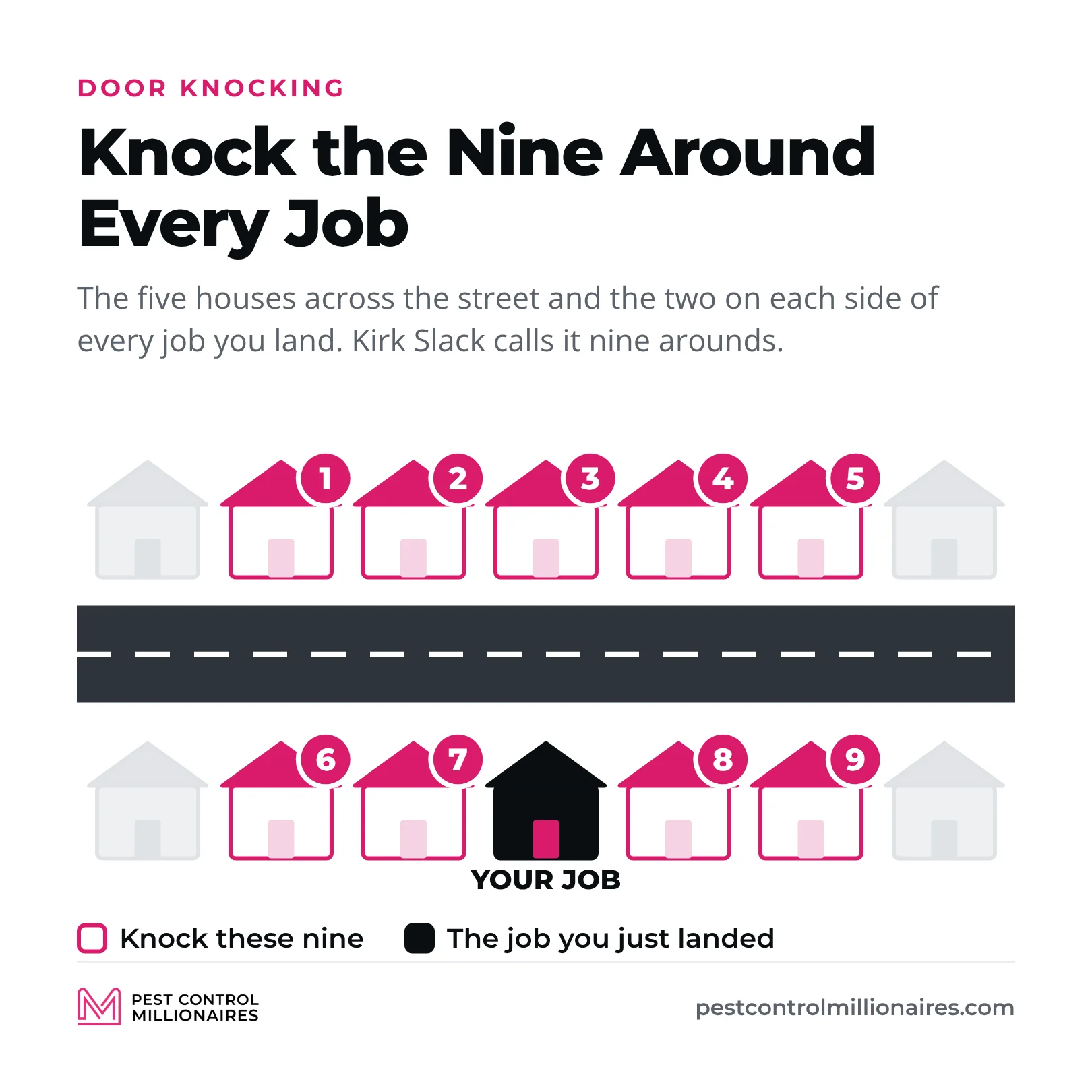
Kirk Slack, one of our members, calls this nine arounds. After every job you land, hit the five houses across the street and the two on each side.
If you’re cold knocking and don’t have a current customer to reference, you can still justify being there. “Hey, I was driving through the neighborhood and noticed a lot of wasp activity on the houses around here. Wanted to check if you’re dealing with the same thing.”
Step Four: The Offer
Now you’re going to soft pitch them on price and service.
Walk them through what you’re doing. Show them visuals on your iPad or phone. Point out issues around their house. Not to make them feel bad, but to show them you know what you’re talking about.
“Come check this out real quick. See those wasp nests forming under your eaves? And you’ve got ants trailing along your foundation here. This is super common. Everyone else in the neighborhood has the same issues. Here’s exactly how we take care of it.”
Show them your price sheet. People need to see something to believe it. If you walked into McDonald’s and there were no prices on the menu, you’d feel weird, right? Same thing here.
Walk them through the service. Show them reviews from other people in the neighborhood. Let them see that their neighbors are already using you and loving it.
Step Five: The Close
I’m not big on hard closes. That’s not how I operate.
My favorite closing line? “Just give us a shot.”
That’s it. It’s simple, it’s friendly, and it works every single time. “Hey, we’re just a small local company. Just give us a shot.”
Or I’ll use an option close. “Would you like to use ACH or debit?” Most people say, “Yeah, I’ll do ACH. That’s what everyone else does too.”
Notice what I did there? I gave them an option, but I pushed them toward the one I want, because card fees hit us hard. Either way, they’re signing up. If you want to push ACH harder, give a discount for it. Never add a fee for debit, because Visa and Mastercard don’t allow surcharges on debit cards.
Another option close: “Would you like my lawn care tech to start in the front yard or the back?”
Doesn’t matter which they choose. We’re still doing the service.
Remember what they say. A scared salesman has skinny kids. You have to ask for the sale. Don’t just have a nice conversation and then walk away hoping they’ll call you later. They won’t.
Handling Objections Like a Pro (They’re All Smoke Screens)
Here’s the truth about objections. Ninety percent of them are smoke screens.
I’m not saying customers are liars. I’m saying they have a reactionary defense response. They don’t know you, they don’t know why you’re there, and their default setting is to get you out of their space as quickly as possible.
Think about walking into a shoe store. The second you walk in, someone asks, “Can I help you find something?” What do you say? “No, I’m just looking.”
Even if you desperately need new shoes and that’s the only reason you’re there. You still say no.
Same thing happens at the door. Everything they say initially is just a smoke screen to get rid of you. Your job is to get past the smoke screen and find the real objection. Here are the most common ones and how to handle them. The full set is in our guide to door-to-door pest control objections.
“I’m Not Interested”
Of course they’re not interested. They don’t even know what you’re doing yet. They weren’t sitting around thinking, “Man, I hope the pest control guy knocks on my door today.” Here’s how I handle it.
“Totally understand. You weren’t expecting the bug guy to stop by today. Let me just show you real quick what I was doing for Mrs. Jones next door. If it works for you, cool. If not, that’s cool too. There’s no pressure.”
Boom. You’ve taken away the pressure, you’ve given them permission to say no, and you’ve earned the right to keep talking. Nine and a half times out of ten, this works.
“I Need to Talk to My Spouse”
This is a one-legger. Does it happen sometimes that the spouse comes home mad and cancels? Yeah, occasionally. But most of the time, this is just a stall.
First, ask if they’re home. “Is he here? Cool, let’s go grab him real quick.”
A lot of times they’ll actually go get them. Problem solved.
If they’re not home, I’ll use humor to diffuse it. “Hey, I’m not trying to get you sleeping on the couch over pest control. What do you think he’d say no to? Is it the price? The product? Me?”
They laugh. Then they tell you the real objection.
Or I’ll ask, “Do you think your wife likes bugs?” Of course she doesn’t. “Well then she’s probably going to be happy you took care of this, right?”
The point is to find out what the real concern is. Price? Product? Trust? Then address that.
“Can You Just Leave a Business Card?”
This is a stall. They want more information, but what they really want is to get you off their porch.
I don’t even carry business cards anymore for this exact reason. It’s too easy for them to take the card and toss it in the trash the second you leave. Here’s what I say instead.
“I could definitely get you a card, but I can give you way more information than a business card could. I’m basically a walking billboard out here. What questions do you have?” Or I’ll ask, “Have I given you enough information to make a decision today?”
That’s a gold mining question. It forces them to tell you what they’re actually thinking.
If they say, “Well, yes, but what’s the price?” That’s a buying question. You’re moving to the close.
If they say, “No, I’m still concerned about whether it’s safe for my dog,” that’s also a buying question. Answer it, then close.
“I Do It Myself”
This one requires qualification. You need to figure out if they actually love doing it themselves or if they just think they have to.
Ask them where they get their products. “Are you going to Lowe’s or Home Depot, or are you getting it from a local supplier?”
If they’re buying professional-grade products from a supplier or ordering them on Amazon by name, they probably know what they’re doing. You could sell them, but it’s going to take time. Move on to more qualified prospects.
But if they’re buying the cheap stuff from the big box store? That’s your guy.
“Totally get it. In my experience, one of two things usually happens. Either people are trying to save money, or they’ve been burned by a company in the past. Which one is it for you?”
If it’s money, I’ll break down the time value equation. “How much time are you spending on this every weekend? Let’s say an hour. You’re a smart guy. What’s your time worth? Probably more than the $50 you’re spending on product that’s mostly water, right? You’re basically paying yourself to do a job you hate instead of spending that time with your family.”
If they’ve been burned in the past, I’ll address trust. “I get that. Bad companies have given our industry a bad name. Here’s what I’ll do for you. I’ll give you my personal cell phone number. If you ever have an issue, you text me directly and I’ll make sure it gets handled. No call centers, no runaround. Just me.”
Problem solved.
The Switchover Pitch (For Established Markets)
In traditional markets like Florida, Texas, or California, seven out of ten people already have pest control. In non-traditional markets like the Midwest, it’s more like three out of ten.
If you’re in a market where most people already have service, you’re not selling them on pest control. You’re selling them on why you’re better than their current company.
This requires homework. You need to know your competition as well as you know yourself. Their pricing, their service frequency, what they do on each visit, their technician’s names if possible.
When someone tells you they already have service, don’t panic. Ask them who they use.
“Awesome, you’ve got something out here already. Who’d you go with?”
If they don’t remember, that’s a great sign. They’re not loyal.
If they do remember, here’s what you do. It’s called the 8 Mile strategy.
You know that scene at the end of 8 Mile where Eminem takes away everything his opponent could possibly say about him? “I live in a trailer, my mom’s white trash, I’m poor.” Boom. Nothing left to attack.
Do the same thing here.
“Yeah, Orkin’s a great company. They do a solid job. They spray the foundation, they’ll come inside when you need them, they treat the mulch beds. Have you seen them do anything outside of that?”
They’ll say no.
“Okay, cool. So what they’re doing is basically the same thing we do, but the reason people are switching to us is we also use this 30-foot web pole to knock down all the cobwebs around your doors, windows, and eaves. We dust around all the entry points. And we do it for about the same price they’re charging you, sometimes a little more. Do you see that as an upgrade?”
Of course they do. You didn’t talk bad about the competitor. You just showed them what extra value you provide. Then you close.
Yard Signs (The Strategy Everyone Thinks Is Dead)
Let me tell you a story. Two years ago, I decided to plaster my entire city with yard signs. I’m talking entrances to neighborhoods, four-way stops, highway boulevards, intersections, everywhere.
The city called me and said I had to take them down. I said, “That’s fair. You can take them out, or I can.”
They took them out. My cousin works for the city. He called me a week later and said, “Hey, I have all your signs. You want them back?”
I got every single one back. That’s how much I believe in yard signs. Check your city’s sign rules before you copy me, though. Many cities don’t allow signs in the public right-of-way, and some will fine you for them.
I have friends running multi-million dollar companies where yard signs are their number one lead source. Not Facebook. Not Google. Yard signs.
Here’s what makes them so powerful. They’re cheap (less than $10 each), they last for months or years, and if they generate even one customer per year, your return on investment is insane. But most people use them wrong. Our pest control yard signs guide goes deeper on design and placement.
How to Design Yard Signs That Actually Convert
Your yard sign is a mini billboard, like a truck wrap that never moves. People walking or driving by aren’t going to stop and read a paragraph. They’re going to glance at it for two seconds.
You need a clear brand (logo and colors), a pain point headline (“Got Pests?” or “Got Weeds?”), and a phone number.
I tested QR codes on tens of thousands of signs. Three got scanned. Total waste. Phone numbers work way better.
But here’s the thing. Most people aren’t going to call the number on the sign. They’re going to Google you when they have a problem. The sign just keeps you top of mind.
The best designs have your pest control mascot or character doing something relevant. We have our badger driving a truck over a cockroach. Instant brand recognition.
Where to Put Them (Hint: Everywhere)
After every single service, we put a sign in the yard. Pest control or lawn care, doesn’t matter. Sign goes in.
I don’t ask permission. If they don’t want it, they’ll take it out. But 90% of the time, it stays. And I’ve had customers ask me for another sign when theirs goes missing. If the home is in an HOA, check the rules first. Many HOAs restrict yard signs, and you don’t want your customer getting a letter because of you.
Beyond customer yards, I put them at neighborhood entrances, four-way stops, traffic light intersections and along highways. Anywhere there’s high visibility and the city allows it.
Why This Works Better Than You Think
A guy once pulled into the gas station behind me. He’d driven through Green Bay and seen our signs everywhere, then came down to Appleton and saw us again. He signed up on the spot.
That’s the power of saturation. When people see you everywhere, they assume you’re successful, established, and trustworthy. Even if you just started last month.
Pair yard signs with door hangers, mailers, and door knocking in the same neighborhoods, and you’ve created an environment where it’s almost impossible for people NOT to know who you are.
Mailers and Door Hangers (The Guerrilla Marketing Goldmine)
Here’s what most people get wrong about mailers and door hangers. They think they’re the same as digital ads. They’re not.
Digital ads are interruptive. You’re shoving your message in front of people who didn’t ask for it, hoping a tiny percentage will click.
Mailers and door hangers are different. They’re physical. They sit on someone’s counter. They hang on their door handle for days. Their spouse sees it. Their kids see it. It sticks around.
But just like digital ads, you have to test and optimize them. One campaign won’t cut it.
The Difference Between Door Hangers and Mailers
Door hangers go directly on people’s doors. You can hang them yourself, hire neighborhood kids, hire a sales guy who’s not great at closing, or hire a company to do it for you.
Mailers (postcards) get delivered through USPS. You design them, bundle them, drop them off at the post office, and they go out with regular mail.
Both serve the same purpose. Get your brand and offer in front of your ideal customer. But the deployment is different. Our postcards and door hangers guide has the layouts and design specs.
The Eight Elements Every Mailer and Door Hanger Needs
Most door hangers and mailers fail because they’re missing one or more of these elements. Get all eight right, and your response rate will skyrocket.
1. Headline
This is the most important part. If your headline sucks, nothing else matters. People will glance at it for one second and toss it.
Your headline needs to call out their pain point. Not your brand. Not your logo. Their problem.
“Tired of Wasps Taking Over Your Deck?” “Ants Invading Your Kitchen Again?” “Weeds Ruining Your Curb Appeal?”
Test different headlines. Split test the same neighborhood with two different versions and see which one converts better. Then double down on the winner.
2. Pain Point
Expand on the headline. Show them you understand their problem.
“Every spring, the same thing happens. Wasps build nests under your eaves, and suddenly you can’t even enjoy your own backyard without getting stung.” Make them feel seen.
3. The Offer
Every single mailer and door hanger needs a specific offer. Not just “call us for service.” Give them a reason to act now.
“Free Mosquito Treatment with Annual Signup” or “A Year of Pest Control Plus a Free Flea and Tick Treatment.” Stack value instead of cutting the price.
Test different offers. Some will crush, some will flop. Find the ones that work and run them at the right time of year.
4. Social Proof
Include reviews. At least one, ideally four or five. And make sure they’re from people in the same town or neighborhood, something like this.
“[Your company] got rid of our ant problem in one treatment. Finally, a company that actually shows up when they say they will!” [Customer’s first name], [their neighborhood]
The more specific, the better. If you can tie the review to the exact service you’re promoting, even better. Use real reviews from real customers, and ask before you print their name.
5. Pictures
People respond to visuals. Teams work great. A picture of you and your crew standing in front of your trucks. Or just a clean shot of your truck.
If you have kids, put them on there with a little speech bubble. “My dad helps families enjoy their backyards again!”
Sounds cheesy, but it works. People care about kids and families.
6. Urgency and Scarcity
“Routes filling up fast. Only 10 spots left this month.” “Offer expires in 7 days.” Give them a reason to act now instead of tossing it in the junk pile. Just make sure it’s true.
7. Guarantee or Risk Reversal
Take the risk away from the customer, but skip the tired “100% satisfaction guarantee” and the overused “200% ironclad guarantee” language. Everyone says that. Say the same thing in a fresh way, like “If the ants come back between visits, we come back and re-treat for free.”
8. Clear Call to Action
Tell them exactly what to do next.
“Call or text 555-1234 to claim your spot.” “Visit YourCompany.com/FirstService to book online.”
Don’t assume they’ll figure it out. People follow directions. Give them clear directions.
How to Deploy Mailers Without Wasting Money
Here’s the mistake everyone makes. They buy 10,000 postcards, send them to 10,000 random addresses, get 100 responses, convert 10 customers, and declare the whole thing a failure. That’s not how this works.
Go to USPS.com and look up Every Door Direct Mail. The online tool lets you pick specific mail routes and filter them by household income, age range and household size.
Find the routes where your ideal customer lives. Then hit those routes multiple times throughout the year.
If you have 1,000 postcards, don’t send them to 1,000 different people. Send them to 200 people five times. Hit them in March with a grub control offer, May with a mosquito offer, July with a wasp offer, and September and November with rodent offers as the weather turns.
By the fifth time they see you, they’re not thinking, “Who is this company?” They’re thinking, “Oh yeah, Pest Badger. I’ve seen them a million times.” That’s when they call.
Tracking What Actually Works
You need a different tracking number for every single campaign. Not one number for all your postcards. A unique number for each design.
Why? Because when someone calls, you want to know exactly which mailer they responded to. Was it the grub control headline or the mosquito headline? Was it the free mosquito offer or the flea and tick one?
Track it in the CRM we recommend. Ask them how they heard about you. “Oh, I got your postcard about the ants.” Perfect. Mark it down.
Over time, you’ll see patterns. Certain headlines crush. Certain offers flop. Double down on what works.
Putting It All Together (The Market Saturation Strategy)
Alright, let’s bring this full circle. Traditional marketing isn’t about doing one thing really well. It’s about doing all of it in the same place at the same time until you completely dominate that market. Here’s what that looks like in practice.
You pick a neighborhood where your ideal customer lives. Let’s say it’s a subdivision with 500 homes. Families with kids, decent incomes, home values over $300,000.
You start knocking doors. You hang door hangers. You send out postcards every other month with different offers. You put yard signs in every customer’s yard. You run hyper-targeted Facebook ads to people who live in that subdivision. You drive your trucks through there constantly.
Within six months, everyone in that neighborhood has seen you at least a dozen times. Your name is everywhere. Your trucks are everywhere. Your signs are everywhere.
Then someone has an ant problem. Who are they going to call? The company they’ve never heard of? Or you, the company they’ve seen literally everywhere for the past six months?
That’s how you build route density. That’s how you make real money in this business.
Aaron Huskey, one of our members in Oklahoma, puts it simply. If he were starting over, he’d knock every door in one neighborhood for a year, try to sign at least 30% of the homes, and only then move to the next one.
The Mindset That Separates Winners from Quitters
Let me close with this. Door knocking is 90% mental and 10% what you actually say. If you’re confident, if you look like you’ve done this before, if you believe in what you’re selling, people will buy from you.
They love to buy. They hate to be sold. So don’t sell them. Just show them how you can solve their problem and take away every reason they have to say no.
The same goes for every strategy I’ve covered here. Yard signs, mailers, door hangers, they all require consistency and commitment. You can’t try it once and quit. You have to stick with it.
I have one friend who built his entire company on postcards. Another friend where yard signs are the number one lead source. I’ve personally knocked doors and put on 11 sales in a single day.
This stuff works. But only if you work it.
Don’t give up after one campaign. Don’t get discouraged when the first 50 doors say no. Don’t quit when the first mailer only brings in a few calls.
Stay in the pocket. Keep testing. Keep improving. And remember, everyone makes more money when your routes are dense.
Now get out there and dominate your market. Jake, Dan and I break the whole system down in Zip Code Kings, our book on growing a pest control company.
Frequently Asked Questions
Is traditional marketing still effective for pest control companies?
Yes. Pest control is local, so door knocking, yard signs, door hangers and mailers aimed at the same neighborhoods build the 7 to 20 touches it takes before people call. Pest Badger grew past $20 million a year using them alongside digital ads.
What is the best traditional marketing method for pest control?
Door knocking, backed by yard signs. Knocking signs customers from the first day and builds route density, and a sign in every customer’s yard keeps your name on the street for under $10. Door hangers and mailers work best as repeat touches in the same neighborhoods.
How much should a pest control company spend on traditional marketing?
About 20 to 30% of your marketing budget. The budget itself isn’t a set percentage of revenue. Spend as long as the economics hold, meaning you have the cash, the money comes back fast enough, you can service the customers and your cost per customer still works. Newer companies with more time than money can lean harder on door knocking, which mostly costs time.
Do door hangers work for pest control?
Yes, when you target them. Hang them in neighborhoods where you already have customers, right after a visible treatment, with a neighborhood-specific offer, and expect a 1 to 3% response.
How do I track ROI on traditional pest control marketing?
Give every campaign and design its own tracking phone number or promo code, ask every new customer how they heard about you, and log the answer in your CRM. Over a season you’ll see which headlines and offers bring in customers, and you can map new customers against the neighborhoods you marketed to.
Does direct mail still work for pest control companies in 2026?
Yes, if you mail the same homes repeatedly. Pick EDDM routes where your ideal customer lives (the USPS tool filters routes by household income, age and household size), mail the same 200 homes five times a season with seasonal offers, and expect a response rate of about 0.5 to 1.5%.
What is the highest-ROI form of traditional pest control marketing?
Yard signs and door knocking you do yourself. A sign costs under $10 and can bring in about one customer a year, and a new knocker sells 1 to 3 accounts per 100 doors for the cost of your time. A paid door-to-door team is different. It costs Pest Badger about $480 a customer, our most expensive channel, but it builds a new market faster than anything else.
Related Articles