How to Buy a Pest Control Company: The Pest Control M&A Playbook

Table of Contents
- When Is the Right Time to Start Acquiring Companies?
- Finding Acquisition Targets: Off-Market Deals Are King
- The Buying Process: From First Call to Closing
- Integration: Where Most Acquisitions Actually Fail
- When to Sell Your Own Company
- The Acquisition Playbook That Actually Works
- Frequently Asked Questions
- Related Articles
To buy a pest control company, find an owner who’s ready to sell, check the profit and the customer list yourself, agree on a price based on EBITDA (profit), line up the financing and have your integration plan ready before you close. Companies making under $1 million a year in EBITDA usually sell for about 1x EBITDA, not the “three times revenue” you see online. The financing is usually a mix of an SBA or bank loan, your own cash and money the seller leaves in the deal, and closing takes three months to a year. I’ve bought several companies while building Pest Badger to over $20 million a year in about six years.
Here are the eight steps, in order.
- Decide why you’re buying. Route density in your market or a way into a new one. My floor is $600,000 to $700,000 a year in revenue.
- Find an off-market deal. Build relationships with owners who are close to retiring.
- Have the first conversation yourself. Learn what the seller wants after the sale.
- Hire your deal team. A business attorney who does acquisitions and an accountant who knows pest control.
- Sign an NDA and collect the documents. P&Ls, tax returns, bank statements, licenses, insurance, vehicle records and CRM logins.
- Send a letter of intent. Base the offer on EBITDA.
- Do due diligence and structure the deal. Verify the customers and the risks, then set the financing, holdback and clawback.
- Close and integrate. Have the brand, CRM, technician and pricing plan ready for day one.
When Is the Right Time to Start Acquiring Companies?
There’s no magic number, and it’s different for every company and market. If you have some money set aside and want to get into the industry, start looking now.
I’m looking at companies doing $600,000 to $700,000 a year and up. If you’re new and want to buy your way in with a million-dollar company, there’s nothing wrong with that either. The real question is whether you have the capital, the systems and the time to integrate another company.
Why Buy a Pest Control Business Instead of Building One?
It’s fast. Depending on the deal it can also be the most expensive way to grow, but nothing else adds customers as quickly. Buy in your own market and their customers go onto your routes, so your technicians drive less, your routes get denser and your brand shows up more. Buy in a new market and you skip starting from zero.
What Size Should You Actually Buy?
There is such a thing as too small. Owners selling a route see “three times revenue” online and think their $200,000 company is worth $600,000. It isn’t. Deals are priced on EBITDA, which is just a fancy word for profit, and at $250,000 in revenue I don’t want a company unless I can almost get it for free. Integrating a small company takes the same work as a big one.
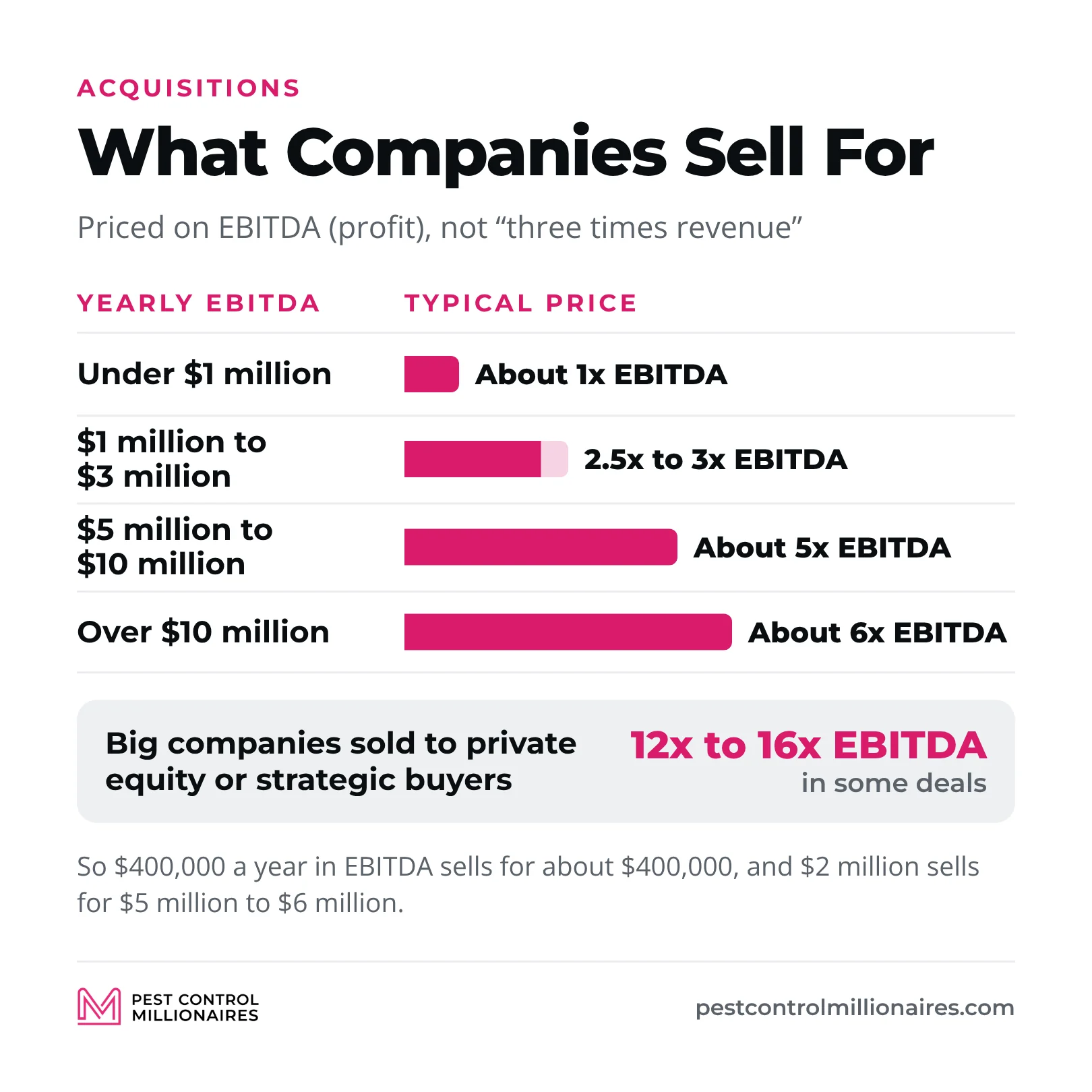
These are the standard multiples I see from normal buyers.
| Company’s yearly EBITDA | Typical price |
|---|---|
| Under $1 million | About 1x EBITDA |
| $1 million to $3 million | 2.5x to 3x EBITDA |
| $5 million to $10 million | About 5x EBITDA |
| Over $10 million | About 6x EBITDA |
| Big companies sold to private equity or strategic buyers | 12x to 16x EBITDA in some deals |
So $400,000 a year in EBITDA sells for about $400,000, and $2 million sells for $5 million to $6 million. Strategic buyers can pay more for a strong brand, and every weakness in the point system takes points off.
Finding Acquisition Targets: Off-Market Deals Are King
In a perfect world, I’m buying off-market, not a deal a broker posted. I’ve paid brokers for deals. Their goal is to get the seller the most money, and they hardly sell any of these companies.
So I start with relationships with owners in my markets, especially older owners getting ready to retire. When they’re ready to exit, they want to hand the business to someone they know. My full off-market playbook is in how I find and buy off-market deals.
How I’ve Personally Found Deals
A few sellers found me because they saw us as an heir. One came through a storage unit. We’d just opened an office in Minnesota, the unit we were going to rent belonged to the dad of one of our guys, and a pest control company renting there was getting ready to sell. I’ve also sent a lot of LinkedIn messages. If you own a pest control company, you may have gotten one from my VA. Friends of mine have mailed letters.
Why Sellers Come to You
Some owners call because they’ve heard we’re buying. Most deals take patience. One owner told me no, then wanted to do the deal two years later. Another took six months just to sit down and come to terms. Plenty of deals have fallen through, and I’ve learned something from every one.
The Door-to-Door Acquisition Strategy
Just like door-to-door sales, I’ve walked into owners’ offices and asked face to face if they’re ready to sell. Nobody asked me to leave; most just weren’t interested yet. All they can say is no, and when they’re ready to exit, you want to be the first person they think of.
The Buying Process: From First Call to Closing
Once an owner is talking seriously, every deal follows the same path, from the first conversation and your team to the NDA, the letter of intent, due diligence, the deal structure and closing. The last month before closing is usually the tense part. The full checklist and timeline are in the pest control acquisition process guide.
The First Conversation
I sit down with the seller myself and ask about their goals after they retire. What will they do for fun, and what will they do with the money? That gets them excited about life after a business they’ve had for 10, 20 or 30 years. I also share my plan for the company, so they’re comfortable with who they’re handing it to.
The Team You Need
Before anything else, hire a business attorney who does acquisitions, not just any attorney, and an accountant or CFO who does pest control acquisitions, not just some random accountant. Anyone can read the numbers, but pest control has nuances a generalist will miss.
The NDA and Letter of Intent
Next, send a non-disclosure agreement. It doesn’t really protect you, but sellers won’t share their numbers without one. Then send our document list and help them work through it.
- Profit and loss statements for the last three years
- Business tax returns and the owner’s personal tax returns
- Bank statements, to see how much money is actually in the bank
- Business licenses and certificates of insurance
- Registrations, VINs and photos of every vehicle, plus photos of the equipment
- Logins to their CRM, so you can count recurring and one-time customers yourself
Our accountant reviews the financials, we work out an offer that fits the seller’s long-term goals, and then we send the letter of intent.
The Due Diligence Checklist
You’re buying their financials, their book of business and their trucks, so verify all three, in person where you can. Don’t pay for conversions you hope to make. Owners always think they’ll move 5,000 one-time clients to quarterly, and less than half will.
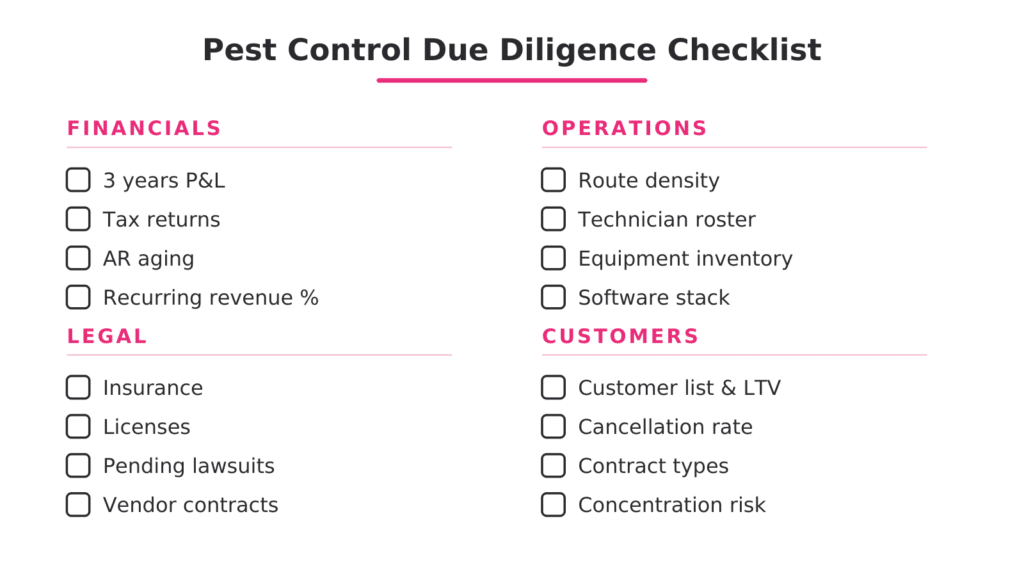 Pest Control Acquisition Due Diligence Checklist
| Area | What to verify |
|---|---|
| Financials | Three years of P&Ls, tax returns, accounts receivable aging, recurring revenue percentage |
| Operations | Route density, technician roster, equipment and trucks, software and CRM |
| Legal | Insurance, licenses, pending lawsuits, vendor contracts |
| Customers | The customer list and what each customer is worth, cancellation rate, contract types, concentration in a few big accounts |
Red Flags in Due Diligence
Lots of accounts receivable means weak billing. You can fix it, but it’s a flag. No profit is a flag you don’t want. A book that’s all one-time customers may not fit your model. And don’t trust the customer base until you’ve seen it. Call some customers, check in on them and go watch some services.
The Critical Metrics
People say you’re just buying the customer list, and it really is that simple. It’s mostly goodwill, the recurring subscriptions, plus some trucks and equipment.
That’s why the customer list can matter more than the P&L. Mosquito Crush was doing about $300,000 a year, small enough that I almost passed. Its CRM showed more than 850 active customers, worth over $850,000 a year in recurring revenue once we imported them, and the company crossed $1 million in its first year with us.
Key Risks to Evaluate
These are the risks I look at on every deal. Each one changes what I’ll pay.
| Risk | What to check |
|---|---|
| Growth | Revenue over the last one and three years, and why if it isn’t growing |
| Retention | 80% or better a year. Average churn is about 20% |
| Profit | EBITDA and profit margins |
| Key man | Does it all depend on one branch manager who might leave? |
| Key client | Three $100,000 clients in a $600,000 company is half the business |
| Single channel | Do the leads all come from one place, like customer referrals or one Facebook platform? |
| Market | Is the market shrinking, or could a bigger company move in and knock doors? |
| Data | Is there a CRM, and will the company move onto your software? |
| Brand | Does the name or website carry weight, and is it worth rebranding? |
| Vehicles | Trucks from 2000 with 200,000 miles could take $200,000 in cash to replace |
How to Finance a Pest Control Acquisition
Most of the deals I see mix an SBA or bank loan, the buyer’s cash and money the seller leaves in the deal. I’ve helped friends buy million-dollar companies with almost no money down, but SBA rules change often (the latest took effect October 1, 2026), so talk to an SBA lender early. Here’s how the main tools work under the current SBA rules.
| Tool | How it works | Numbers to know |
|---|---|---|
| SBA 7(a) loan | A bank loan the SBA guarantees, repaid from the company’s cash flow | Up to $5 million. The business part is repaid over 10 years or less. You put in at least 10% of the project cost |
| Seller note | The seller carries part of the price and you pay it over time | Counts toward no more than half of your 10%, and only if the seller takes no payments for the full term of the SBA loan |
| Holdback | Part of the price waits until you’ve confirmed what the seller told you | About a year on smaller deals. Bigger deals are mostly 95% to 100% cash at closing |
| Retention clawback | Money comes back to you if customers leave after the owner does | With an SBA loan, write it as a rebate to the buyer that pays down the loan. Seller earnouts aren’t allowed |
A few more SBA rules catch buyers off guard. If you pay more than the lender’s business valuation supports, you cover the gap with your own money. Deals of $3 million or more also need a Quality of Earnings report. And the 10% can be lowered only in a few cases, such as when a company you’ve owned for at least two years buys all the stock of another company in the same industry, and only if the lender agrees.
The holdback numbers come from Paul Giannamore, who has advised on more than 650 deals. For the clawback, agree on how customers are counted. Paul’s standard is two take-and-pays, meaning a customer counts once they take and pay for two services after closing, plus a cancel basket for normal attrition. In a clean deal he expects to lose about 5% of customers in the first six months.
Ivan Mardesich and his partner bought a company for about $1.1 million through the SBA with about $72,000 down, and it took eight brokers before one said yes. Walker Rose, who has made five acquisitions, bought his biggest in 2025 with no money down under the SBA rules at the time, using a holdback with the seller to meet the SBA’s equity requirement and negotiating the equipment separately. Matt Railla’s SBA process took about seven months.
The Closing Process
The last month is usually tense, and it’s where I let my team take over. I built the relationship, but now it’s about the numbers, meaning the offer, the payment structure and any add-backs from the owner’s pay. It’s not their money, so they negotiate tighter than I would and show the seller the flaws without beating them up. Most owners value their company higher than any buyer will, and after 20 or 30 years that’s a tough conversation.
What Causes Deals to Fall Apart
Usually it’s price. You won’t go over a number, the seller won’t budge, and you walk away. I lost a big deal I was excited about because the owner valued it higher than anyone would pay. Private equity and strategic buyers like Orkin and Rentokil, which bought Terminix in 2022, pay a premium, but only for a premium company.
The opposite mistake is worse. We get emotionally invested and competitive, push through a deal that looks bad on paper and overpay.
How Long Does This Take?
Every deal is different. We’ve closed deals in three months, six months and a year, and I have friends who sat under a letter of intent for a year and a half. When private equity buys a company, it can put a whole team next to yours for six months of due diligence. The bigger the company, the longer it takes.
Integration: Where Most Acquisitions Actually Fail
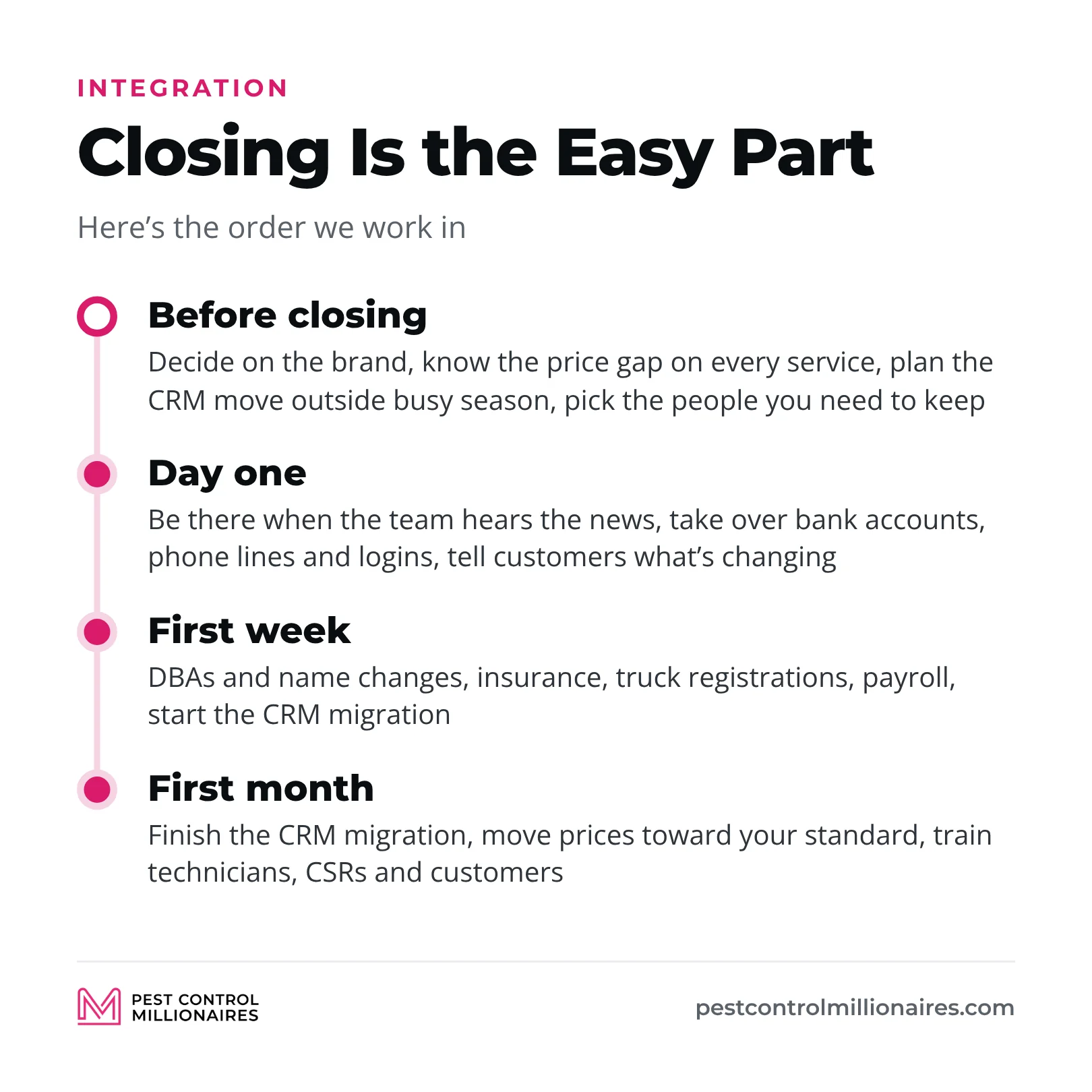
Closing is the easy part. Our integration checklist has over a hundred items, from bank accounts, DBAs and insurance to truck registrations, software and technicians. Even transferring customers’ credit cards is a pain. My rule now is to rip off the band-aid on the brand, the CRM and pricing. Here’s a simple order to work in, and my full integration guide covers each piece.
| When | What to get done |
|---|---|
| Before closing | Decide on the brand, know the price gap on every service, plan the CRM move outside busy season, pick the people you need to keep |
| Day one | Be there when the team hears the news, take over bank accounts, phone lines and logins, tell customers what’s changing |
| First week | DBAs and name changes, insurance, truck registrations, payroll, start the CRM migration |
| First month | Finish the CRM migration, move prices toward your standard, train technicians, CSRs and customers |
The Branding Decision
It depends on how much weight their brand carries. I learned the hard way by phasing one in slowly when our brand was much stronger. On the next deal I rebranded on day one, and it was far smoother. If everyone in town knows their name, keep it or run it as a division. The real goal is a brand of your own so strong that rebranding is the obvious call.
It doesn’t have to cost much. On Mosquito Crush, the invoices and the customer letter were Pest Badger from day one, and a “Division of Pest Badger” sticker carried the old vans until we re-wrapped them.
The CRM Migration
Rip off the band-aid here too. Migrating isn’t fun, but running two CRMs is worse. In a perfect world, they already use your CRM. Avoid busy season if you can. One of our deals closed in the middle of May, and we had to call every customer during spring while teaching people who’d been customers for 20 years a new way of doing things.
The Technician Problem
Most technicians won’t stay. I’d say less than half. They don’t like change, and they’re upset the owner didn’t tell them about the sale, even though the owner usually signed an agreement not to. Some won’t give your pay-for-performance plan a chance even when they’d make more. After we bought Mosquito Crush, every technician and the manager were gone within a few months.
Limiting the Damage
Get the technicians together and be there when they hear the news. Show them what you’re building, bring a couple of your own technicians to meet them, and buy everyone lunch. You’ll still lose some customers, like the 30 friends and family the old owner was giving good deals to.
The Pricing Conversation
During due diligence, look at the average ticket, the packages, recurring versus one-time, ancillary services and room to upsell and cross-sell. Then move prices toward your standard right away.
My downside test is simple. If I doubled the price and lost half the customers, I’d do the same revenue with half the stops, and I’m okay with that. In practice you won’t raise prices that much at once. Raises of 20% to 30% at a time mostly stick. If a service needs $80 to $100 more, expect many of those customers to leave, and price that into your offer.
Training During Integration
Train the technicians, the CSRs and the customers. A company that has run one way for 5, 10 or 20 years doesn’t change overnight.
The Biggest Integration Mistakes
My biggest one was expecting customers to move from one-time to quarterly faster than they did. On the next company there were no ifs, ands or buts. Everyone moved to the program, and it worked much better. Customers who want one-time service can have it at double the price.
Changing how technicians service is just as hard. If customers are used to a power sprayer on the whole house and your technicians treat the foundation with a backpack, explain why, or they’ll think they’re getting less. Do ride-alongs before you buy, and budget for equipment upgrades.
When to Sell Your Own Company
There’s no threshold. It’s up to you. Maybe you’ve lost the passion and don’t want to go to work anymore, or maybe it makes so much money that you keep it anyway.
Either way, pest control business succession planning starts on day one, because how you build the company decides what it’s worth when you sell it or hand it down. The full valuation playbook is in my guide to selling a pest control company.
What Makes Your Company Valuable
Start with the book Built to Sell. When you start thinking about selling, bring in a sell-side firm that does nothing else. They’ll tell you what to fix in your last few years and what you’d get now versus in three years.
Don’t post your company for sale online yourself. A good advisor puts it up for bid properly, the way Paul Giannamore does it, with every qualified buyer invited and a hard deadline for written offers. Advisors cost money, and they get you the best return.
The Multiple Reality Check
You’ll hear “three or four times revenue” all the time. Deals are priced on EBITDA, and owners overvalue their companies constantly. Under $1 million in EBITDA, not revenue, you’re looking at a one-times multiple. From there the multiple climbs with size, as in the table above. If you’re planning to sell, slow growth a little and put more on the bottom line.
Different Types of Buyers
Private equity wants a platform company, often around $10 million, and will buy $5 million companies to add to it. They roll up more pest and lawn companies for three to five years and sell within about seven. They’re the ones paying 12x to 16x EBITDA for $20 million companies, often with part of your price rolled into equity.
Strategic buyers want into your market and pay more because they make it back in drive time and added services. Then there are regular buyers like you and me, who won’t overpay but might be the young, hungry owner a retiring seller wants to pass the torch to.
Easy Ways to Increase Valuation
Get a CRM. You can’t afford not to have one, and it makes you money every day. Then raise your profit, put managers in place, keep good clients and keep churn low. The higher the profitability, the more you’ll get.
The Point System
Buyers score everything. Churn over 20% can cost you about half a point on your multiple. A flat or shrinking company gets less, thin profit gets less, and key man risk (the company depends on one person, usually the owner or a branch manager) can cost about a point. No single item decides it; it’s all of them together. Every company short of huge has some key man risk, but a few clients making up most of your revenue is a risk you can fix.
Keeping the Owner On
Sometimes the seller stays and runs the company. They might keep or roll some equity, carry seller financing, lend you the money themselves or share in a future exit if they help you grow it. Or an employee buys in over time, the way Jim Steed went from sprayer to owner of Neighborly Pest Management, one piece at a time.
Family successions work the same way. Chase Goodeill, who has done 10 acquisitions since 2019, bought out his dad in 2021 with an evaluation, accountants, an attorney and a holding company, and pays him twice a month over 20 years. If an SBA loan funds a full buyout, the seller can only stay as a consultant, for up to 24 months.
The Expert Team You Need
Hire a sell-side M&A firm, one that only helps owners sell. Add a wealth manager for what you’ll do with the money and how to save on taxes, and an attorney who only does business transactions. Specialists cost more and save you a lot more. Nick Bartolo, a wealth manager who works with owners selling their companies, told me the tax-planning window is widest around the letter of intent and narrows every week until closing.
The Biggest Mistakes in Succession Planning
Most owners don’t want to grow, and that’s okay. But if you took $100,000 a year out for 20 years and never grew it, it won’t be worth much, and you may end up handing it to a kid. Build it to produce $400,000 a year in cash and you’ll get good money for it.
The other mistakes are not knowing what buyers want, starting the homework late and having no clear vision. Tony Carder, who sold a $24 million company to Rentokil in 2019, would also negotiate a shorter non-compete (his was five years, and he thinks three is plenty) and a golden parachute for his leaders.
The Acquisition Playbook That Actually Works
The owners who win at acquisitions don’t buy the most companies. They buy the right ones, at the right price, with the right structure, and integrate them properly.
Build relationships now, hire specialists, do real due diligence on the risks, protect yourself with a holdback or seller note and a retention clawback, and walk in on day one with a plan for the technicians, customers, CRM, brand and pricing. Owners buying and selling companies compare notes every day in our free Facebook group, and our book Zip Code Kings covers how to build a company worth buying.
Frequently Asked Questions
How much does it cost to buy a pest control company?
Pest control companies sell on profit, not revenue. A company making under $1 million a year in EBITDA usually sells for about 1x EBITDA, so $400,000 of EBITDA costs about $400,000, and the multiple rises with size. Budget separately for integration costs like replacing worn-out trucks.
What should I look for when buying a pest control business?
Start with profit and the customer list. Check how many customers are truly recurring, whether retention is 80% or better, whether revenue grew over the last three years, and whether the company depends on one manager, a few big clients or one lead source. Then verify licenses, insurance, trucks, equipment and the CRM.
How do I finance a pest control acquisition?
Usually with a mix of an SBA 7(a) or bank loan, the buyer’s cash and seller financing. Under SBA rules effective October 1, 2026, the buyer puts in at least 10% of the project cost, and a seller note can cover up to half of that only if the seller takes no payments for the full term of the loan. Holdbacks and retention clawbacks protect you if the numbers or the customers don’t hold up.
What is the due diligence process for buying a pest control company?
After an NDA, collect three years of P&Ls, business and personal tax returns, bank statements, licenses, insurance, vehicle records and logins to the CRM. Have your accountant check the numbers, count the recurring customers yourself, call some customers, ride along with the technicians and look at every truck.
Should I buy an existing pest control business or start from scratch?
Buying is the fastest way to grow, though it can be the most expensive. It makes sense when the company adds route density in your market or gets you into a new one, and a newcomer can skip the startup years by buying a million-dollar company. Building from scratch costs less but adds customers one at a time.
How do I value recurring revenue when buying a pest control company?
Recurring customers are most of what you’re buying, so count them yourself in the seller’s CRM. Look for 80% retention or better, and don’t pay for one-time customers you hope to convert, because less than half will. Price is still set on EBITDA, and churn over 20% can cost about half a point on the multiple.
What multiple do pest control companies sell for in 2026?
Normal buyers pay about 1x EBITDA under $1 million in EBITDA, 2.5x to 3x from $1 million to $3 million, about 5x from $5 million to $10 million and about 6x above $10 million. Private equity and strategic buyers have paid 12x to 16x EBITDA for big companies with strong numbers. “Three times revenue” is not how deals are priced.
How long does a typical pest control acquisition take from LOI to close?
Anywhere from about three months to a year, and some deals sit under a letter of intent for a year and a half. Private equity due diligence can take six months on its own, and SBA financing adds time; one buyer’s SBA process took about seven months.
When should pest control business succession planning start?
On day one, because how you build the company decides what it’s worth. In the last few years before a sale, hire a sell-side advisor to compare selling now with selling in three years, and plan taxes before you sign a letter of intent.
Related Articles