
I’ve worked with over 400 pest control companies on lead generation, and what’s in this guide is what actually works for the operators I run with every week.
If you’re reading this, you already know the truth: a pest control company that can’t turn on the lead faucet is a pest control company that’s about to plateau. I’ve sat with hundreds of owners doing $150K, $500K, $1M, and $5M, and the pattern is the same. The ones who keep scaling are the ones who figured out pest control lead generation as a system, not a side project. The ones who didn’t, sold the business or burned out.
This guide is the operator’s version of how to get pest control leads in 2026. No agency fluff. Just the channels, costs, close rates, and tradeoffs we use inside Pest Badger, inside our coaching members’ companies, and inside the businesses Dan Leibrandt runs marketing for. If you want the bigger picture first, read our pest control marketing pillar and then come back here.
Table of Contents
ToggleWhat "A Lead" Actually Means In Pest Control
Before we talk about how to get pest control leads, I want to define what a lead even is, because the industry has gotten sloppy with the word. A lead is not a click. A lead is not a form impression. A lead is a real person who gave you contact info and asked for service, or who answered the phone when you called them back inside of three minutes.
Inside our companies, we count two things: form fills with a phone number, and inbound phone calls longer than 30 seconds. Everything else is noise. If your CRM is showing you 400 “leads” a month and you can’t tell me how many of those got a tech on the schedule, you don’t have pest control marketing leads, you have a vanity dashboard.
How To Get Pest Control Leads: The 7 Channels That Actually Work
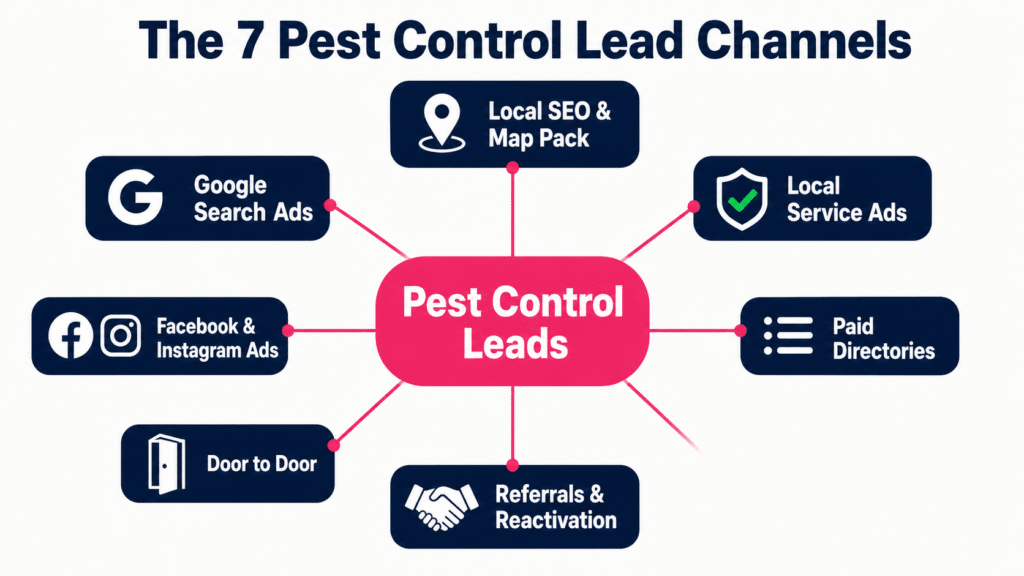
If you’ve ever Googled how to generate leads for pest control, you’ve probably seen a dozen lists with 27 channels on them. The truth is there are exactly seven channels that produce real leads for pest control companies at scale in 2026.
1. Local SEO And The Google Map Pack
This is the highest-ROI channel I’ve ever seen in pest control. Someone Googles “pest control near me,” your three-pack listing shows up, they tap your number, you answer. The lead is essentially free after you’ve done the work to rank, and it closes at 70 to 80 percent because the person is searching with cash in hand. The catch is it takes 6 to 12 months to dominate a market. Our full breakdown is in the local SEO guide.
2. Google Search Ads
Google search ads are the fastest way to turn money into booked jobs. You’re paying $40 to $90 per click in most markets, generating pest control leads at $60 to $150 a pop, and closing them at 70 percent plus. The math works because the customer is already searching for you. I’ve never met a pest control owner running Google Ads properly who wasn’t growing. Full setup is in our Google Ads for pest control guide.
3. Google Local Service Ads (LSAs) And Pay Per Lead
LSAs are Google’s pay per call pest control leads product. You only pay when somebody calls or messages you, and Google’s algorithm rewards businesses with the most reviews and fastest answer times. We see LSA leads coming in at $25 to $60 in most markets and closing around 50 percent. It’s one of the cleanest examples of pest control pay per lead done right, because the lead is exclusive to you the moment they tap the call button. Pair it with a 24/7 answering setup and it prints money.
4. Facebook And Instagram Ads
This is the channel everyone gets wrong. Facebook is interruption marketing, not intent marketing. Nobody opens Facebook looking for pest control, so your leads will close at 25 to 30 percent, not 70 percent. That’s fine, because the cost is right. We run $7 to $15 cost-per-lead campaigns inside our companies and inside our members’ companies all day long. The trick is the offer and the speed-to-lead, both of which we cover in the Facebook ads guide.
5. Paid Directories And Lead Resellers
HomeAdvisor, Angi, Networx, Thumbtack. The big lead resellers will sell you pest control business leads at $20 to $60 each, but here’s the catch nobody tells you: the same lead is going to three or four of your competitors at the same time. Close rates on shared directory leads sit around 10 to 15 percent. They can work as a filler when you’re slow, but I would never build a business on them. We get into the math in the paid directories guide.
6. Door To Door
D2D is still the cheapest way to acquire a customer if you have the stomach for it. A trained knocker can produce 8 to 15 new accounts a week at a true cost of $80 to $150 per customer, not per lead. The reason most owners avoid it is the management overhead and the turnover. The reason the biggest companies in our industry got big is they didn’t avoid it.
7. Referrals And Customer Reactivation
The cheapest free pest control leads you’ll ever generate come from your existing customers and your lapsed list. Get a referral program live, pay $25 in account credit per referral, text every cancelled customer twice a year, and you’ll be shocked how many jobs fall out of it. This is the channel nobody runs because it’s not sexy and it’s not new.
Buying Leads Vs. Generating Your Own
This is the question I get more than any other. Should you buy pest control leads from a lead reseller, or build your own lead generation engine? My honest answer: do both, but in the right ratio.
If you’re under $500K in annual revenue and you have time but not money, you should be building your own. Local SEO, Google Business Profile, referrals, and a tight Facebook ads budget will get you to a million. If you’re over $1M and you have money but no time, you can layer in lead resellers as filler when your owned channels dip. The mistake I see over and over is owners who try to buy pest control leads from day one, never build their own pipeline, and then panic when the reseller jacks prices or cuts off the supply.
The other thing to understand about buying leads: shared leads and exclusive pest control leads are two completely different products. A shared lead is sold to three to five companies at once and closes at 10 to 15 percent. An exclusive lead, where you’re the only company that gets the contact, closes at 30 to 50 percent depending on speed-to-lead. Pay the premium for exclusive every time. The math almost always works out better.
Should You Hire A Pest Control Lead Generation Agency?
I’ve worked with hundreds of pest control owners who got burned by an agency, and I’ve worked with a few who got rich with one. The difference comes down to two things: does the agency specialize in pest control, and is the owner willing to be in the weeds on the offer and the follow-up.
A general home services agency will sell you “pest control lead generation marketing” packages, run a few Facebook campaigns, and disappear when the leads stop converting. A specialist who understands the industry will set up your tracking, your offer, your speed-to-lead automation, and your CRO, and they’ll stick around when things break. The agency we partner with, Pest Control SEO, is the one we trust because Dan and his team only work in this space.
If you’re evaluating lead generation for pest control companies, ask three questions before you sign anything. First, how many active pest control clients do they have right now. Second, can they show you the dashboards from a current client with permission. Third, who owns the ad accounts and the data when you leave. If they hesitate on any of the three, walk away.
Pest Control Lead Generation Cost Benchmarks
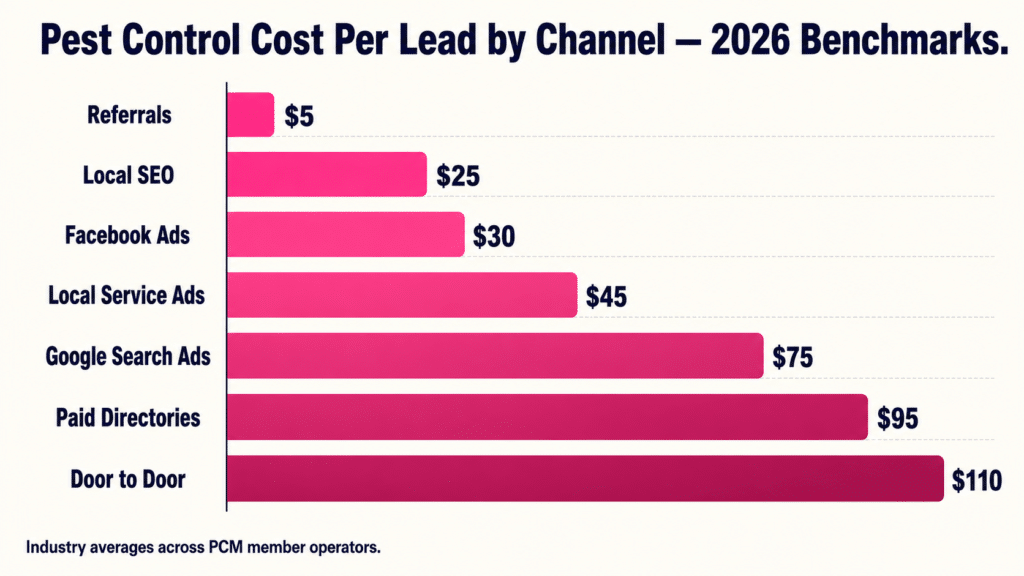
Here are the rough cost-per-lead and close-rate numbers we see across the companies we work with. Your market will vary, but these are the benchmarks we coach to. People ask me all the time which channel produces the best pest control leads, and the honest answer is the one with the lowest cost per acquired customer in your specific market, not the one with the lowest cost per lead.
- Local SEO (organic Map Pack): effectively free after setup, 70 to 80 percent close rate.
- Google Search Ads: $60 to $150 per lead, 70 percent close rate.
- Google LSAs (pay per call): $25 to $60 per lead, 50 percent close rate.
- Facebook and Instagram Ads: $7 to $15 per lead, 25 to 30 percent close rate.
- Lead Resellers (shared): $20 to $60 per lead, 10 to 15 percent close rate.
- Exclusive third-party leads: $50 to $120 per lead, 30 to 50 percent close rate.
- Door-to-door: $80 to $150 per acquired customer.
- Referrals: $0 to $25 per acquired customer, 80 percent plus close rate.
If you average it out across a healthy channel mix, the operators in our program land between $40 and $70 blended cost per acquired customer. Anything above $100 blended and we start digging into the offer, the website, and the speed-to-lead.
The Lead-To-Customer Math Most Owners Miss
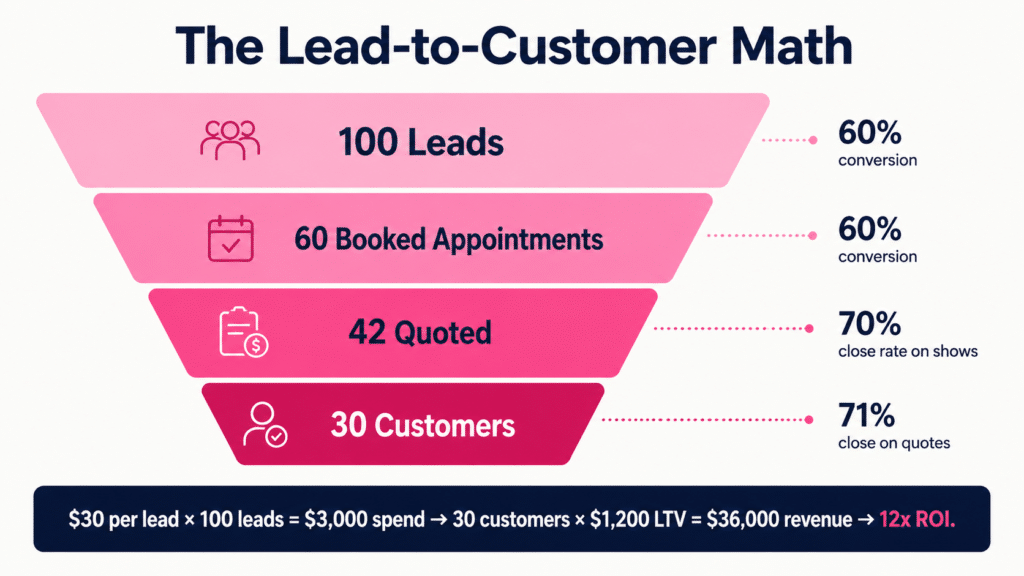
Cost per lead is the metric every agency wants you to focus on because it’s the one they can move. Cost per acquired customer is the one that actually pays your bills. And lifetime value is the one that decides whether you can outspend your competitor.
Here’s the math I run with every coaching member. If your average annual contract value is $600 and your customer stays three years, your LTV is $1,800. That means you can spend up to $300 to $400 acquiring a customer and still hit a 4 to 5x return. Most owners are scared to spend $100 to acquire a customer. They’re also the ones complaining they can’t grow.
If you want to go deeper on the math, read our pest control conversion rate optimization guide, because the cheapest way to lower your effective cost per customer is to close more of the leads you already have.
The Best Way To Get Pest Control Leads In Your First 90 Days
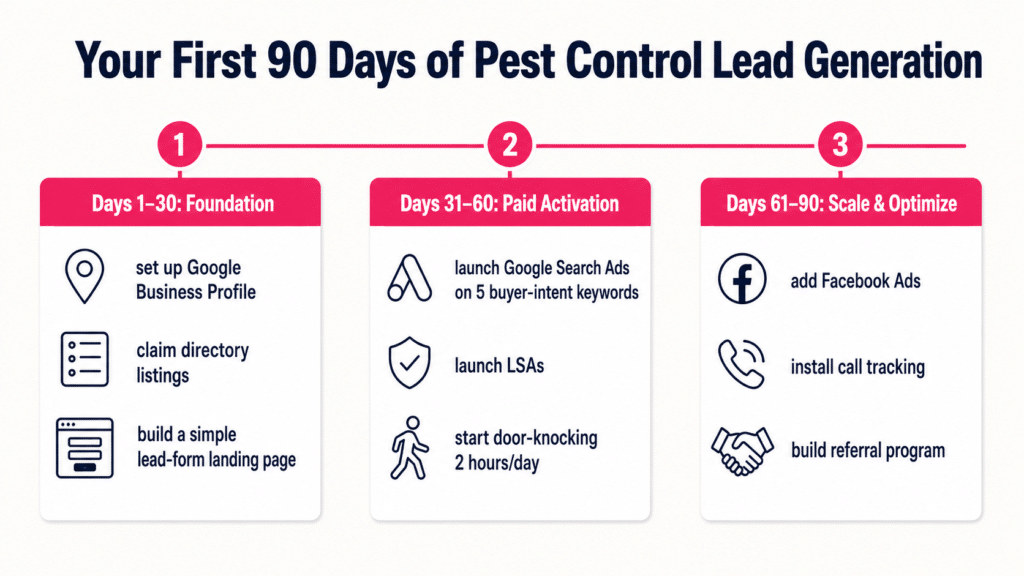
If I had to start over today with zero customers and a $5,000 marketing budget, here’s exactly what I’d do. This is the same 90-day plan I walk our newer members through.
Days 1 to 30. Build the foundation. Claim and optimize your Google Business Profile. Get 25 reviews from anyone you’ve ever serviced. Turn on Google LSAs the day you have five reviews. Build a single landing page with one offer, one phone number, and one call-to-action. We cover the offer side in our offers guide.
Days 31 to 60. Turn on paid. Launch a $1,500-a-month Google Search Ads campaign on three to five money keywords in your service area. Add a $1,000-a-month Facebook ads campaign with a strong offer and a 60-second video of you on a truck. Set up a CRM with text automation so every lead gets a response in under 90 seconds. This is where speed-to-lead beats budget every time.
Days 61 to 90. Layer and optimize. Add a referral program and reactivation texts to your existing list. Test one lead reseller as filler and measure the close rate honestly. Start writing SEO content for your service area so you’re not renting your traffic forever. By day 90 you should have a measurable cost per acquired customer and a clear answer to “which channel do I scale next.”
Common Mistakes I See On Lead Generation Audits
I’ve audited five-figure-a-month ad accounts and I’ve audited zero-dollar accounts. The mistakes are almost always the same.
The first mistake is no speed-to-lead. The data is clear: a lead contacted in under five minutes is 9 times more likely to convert than one contacted in an hour. Most owners are calling leads back the next morning. You can fix this in an afternoon with a CRM and a text template. We cover this inside the pest control automation guide.
The second mistake is a weak offer. “Free quote” is not an offer. “$1 first service when you sign up for quarterly” is an offer. The best operators I know test three to five offers a year and let the data pick the winner.
The third mistake is tracking. If you can’t tell me, by channel, how many leads came in last month, how many became jobs, and what the cost per job was, you’re flying blind. Fix tracking before you spend another dollar.
Pest Control Lead Generation: Frequently Asked Questions
Here are the questions I get most often about pest control lead generation. If yours isn’t answered below, drop it in our free Facebook group and we’ll cover it.
How much does a pest control lead cost in 2026?
It depends on the channel. Facebook leads run $7 to $15, Google LSA leads run $25 to $60, Google search leads run $60 to $150, and exclusive third-party leads run $50 to $120. Shared directory leads are cheaper on paper but close so poorly that the true cost per acquired customer is usually higher than Google search.
What is the best way to get pest control leads as a new company?
If you’re under $150K in revenue, focus on three things in this order: get 25 Google reviews, turn on Google LSAs, and knock 20 doors a day. That combination will get you to your first 100 recurring customers without spending much on ads.
Are pest control lead generation services worth it?
The right ones are. A specialist agency that runs Google Ads, LSAs, and Facebook for you can absolutely pay for itself if you’re over $500K in revenue and you don’t have the time to run it yourself. General home services agencies that treat pest control like a side category are almost never worth it.
How do I generate commercial pest control leads?
Commercial is a totally different game than residential. The channels are LinkedIn outreach, in-person sales to property managers and restaurant groups, Google Ads on commercial-intent keywords, and referrals from your existing residential book. CPL is higher, but contract value is 5 to 20 times bigger.
What is the difference between shared and exclusive pest control leads?
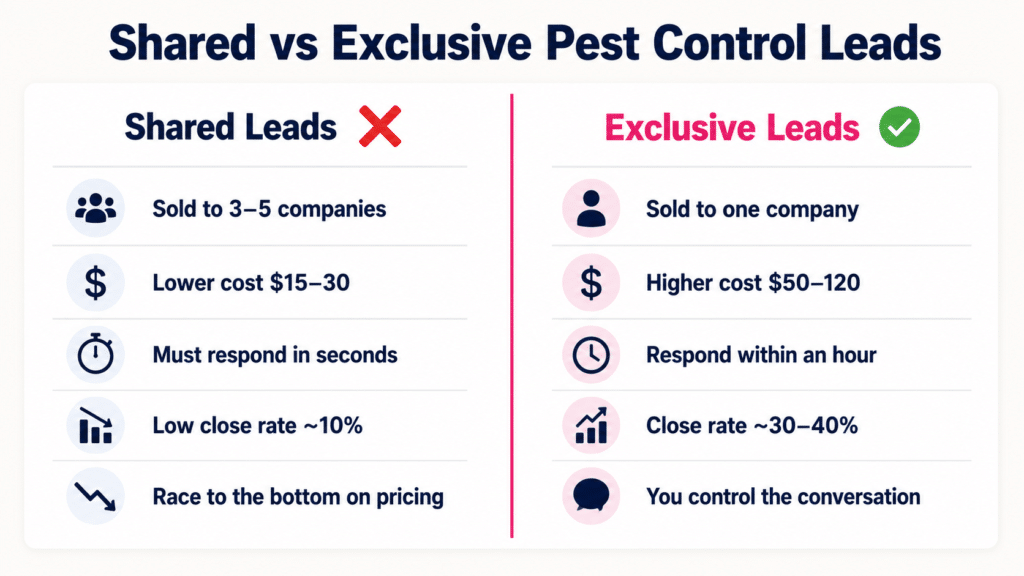
A shared lead is sold to three to five companies at once, which means you’re racing four other operators on speed-to-lead. An exclusive lead is only sold to you. Exclusive leads cost more upfront but close at two to three times the rate, so they’re almost always cheaper per acquired customer.
What is the fastest way to learn how to get leads in pest control?
Hands down, get on the phone with operators who are already doing it. Theory is cheap. We host weekly live coaching calls every Thursday at 6 PM CST inside our program, and our free Facebook group has over 3,800 owners trading what’s working right now.
Can I get free pest control leads?
Yes, but “free” is a misnomer. The cheapest leads come from referrals, organic local SEO, and a Google Business Profile that ranks in the map pack. Those leads are free in dollars but they cost you time and review-collection effort. Worth every minute.
Bottom Line On Pest Control Lead Generation
Pest control lead generation is not a magic channel. It’s a portfolio. The owners who scale past $2M and $5M and $10M run four to six channels at once, measure every one, and double down on the channels that produce the lowest cost per acquired customer in their market. The owners who stay stuck pick one channel, run it poorly, blame the channel, and quit.
If you want help building this out for your company, the team at Pest Control Millionaires has done it inside our own businesses and inside hundreds of others. Book a call and we’ll walk you through what we’d do in your market in your first 90 days. If you’re not ready for that yet, jump in the free Facebook group and ask any question you’ve got. We’re in there every day.
