Benjamin Williams on Getting Out of the Technician Box

Table of Contents
- Being the best tech can put you in a box
- Part-time effort gets part-time results
- Look like a real company before your first customer
- Get around people who are where you want to be
- The hard days nobody posts about
- Your company is a reflection of you
- Treat year five like you inherited the business
- Build systems before you build a monster
- Frequently Asked Questions
Benjamin Williams founded Pest Ref Services in Central Florida in 2020. He calls himself the pivot king. He left high school as a sophomore to work full time and help his mom, went to school for welding and then for driving trucks, and found pest control at a career fair, where Massey Services pitched a career instead of a job. He spent a little over four years there.
We still hadn’t met in person, so before he joined our house at PestWorld, I got him on the show. The big idea is what he calls the technician box. Here is what stuck with me.
This episode is part of the PCM Podcast. For another owner who had to stop being the tech, read Brandon Peterman on pay, profit, and getting out of the truck.
Being the best tech can put you in a box
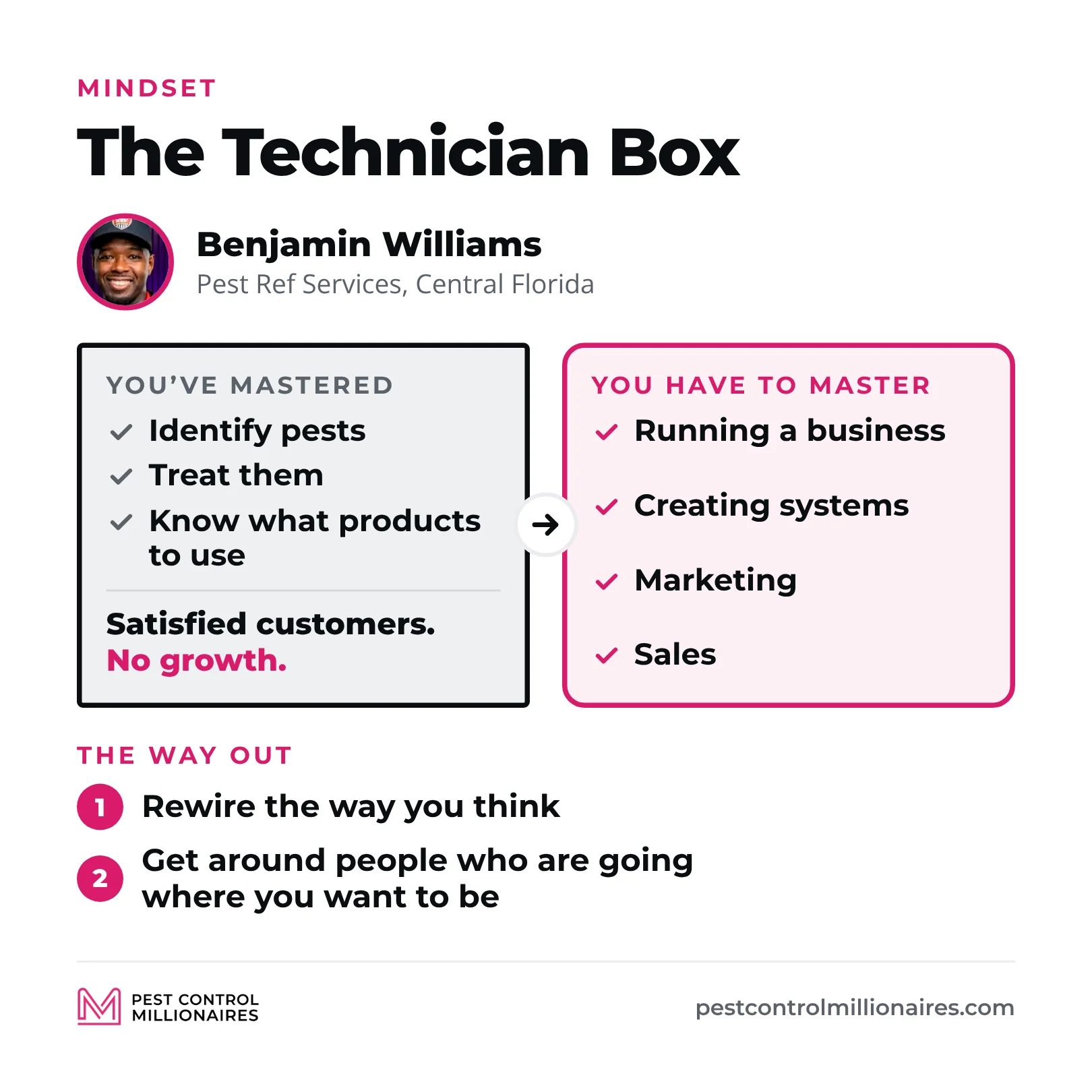
When you start a business, Benjamin said, you jump in with a technical mindset. You know how to identify pests, how to treat them and what products to use. “You’ve mastered the job of being a technician, right? But sometimes that can be a good and a bad thing because it puts you in a box,” he said.
Now you have to master running a business, creating systems and marketing. “If you’re so stuck on being a master technician, then you’re only going to get results that a master technician gets and that’s no growth,” he said. The customers are satisfied. You just sacrifice the growth.
I tell people this all the time. You can be the best service person in the world, but if you can’t market, you can’t get clients. You have to be good at sales.
At Massey he was the lead technician in his office, servicing his route and selling on commission, and then he spent a few months in full-time sales, where you only eat what you kill. “I would tell anyone to do more of the sales role if you ever decide to open up your own business,” he said.
Part-time effort gets part-time results
Benjamin had a non-compete with Massey, so he drove trucks for two years on his class A license while it ran out. He almost talked himself out of starting. His wife told him he’d be crazy not to try after all the time he had put in.
Then COVID hit, right when he had a little nest egg saved. A message on a podcast during one of his drives told him to push through no matter what it looked like. When the non-compete expired, he started the company. With a lot of people home, it was one of the best times for him. I started at the same time.
For about six months he did both, seven days a week. Then a local mentor told him he was only getting his feet wet, and that eventually he’d have to jump in all the way and commit. “I’m a firm believer, you know, part-time effort equals part-time results,” Benjamin said.
He went full-time in the slow season and ended up taking a job at Coca-Cola, where he sat through orientation thinking about pest control. Then a mutual friend called about a possible rodent problem at the new building for her daycare. He took it as a sign from God, left that day and never went back.
Look like a real company before your first customer
Benjamin coached his son in youth football, so for the name he thought about the referee. A referee is knowledgeable and has authority, fairness and integrity, all the things he wanted to be as a service company. He picked Pest Ref Services over Pest Referee once he knew the domain and the email were available.
Before his first customer, he signed up with FieldRoutes, which was PestRoutes back then, and he had a marketing company from day one. I see a lot of people trying to run it all on paper and Excel spreadsheets. You can’t afford not to have it. Go pay the $500 a month. I cover what to set up first in my guide to pest control business software.
Benjamin calls it the best investment he made. “A lot of people thought it was a franchise business initially when I started because everything was in alignment,” he said.
His first 100 customers came fairly quick, mostly from referrals in a rural market where everybody knows everybody, plus Facebook groups. Referrals are still where his best customers come from, and he pushes his referral program hard. But after that first 100, he hit a standstill. What worked at first stopped working.
Get around people who are where you want to be
For years, Benjamin said, being a technician got in his way. So he promised himself he would get out of his box. He joined the NPMA and his state association, the FPMA, and found us and a bunch of other podcasts. He had always listened, but “now I’m starting to apply the knowledge versus listening to the knowledge,” he said.
The NPMA was a game changer. His first conference was a little intimidating, but he built relationships he still has, got into the NPMA’s executive leadership program and serves on a committee with the FPMA.
His last advice was for anyone who came into the industry as a technician. Rewire the way you think and get around people who are going where you want to be. “You are the average of the people that you hang around,” he said. If you hang around one-man shows, that’s all you’ll ever be. “Don’t be afraid to ask questions. Don’t be afraid to be vulnerable. Don’t be afraid to look stupid,” he said.
And when you ask someone for advice, bring something. “When you don’t bring value to value, you devalue value,” he said. We ended the episode on that one.
The hard days nobody posts about
I asked Benjamin about his hardest days. “Questioning myself, man. I was at a point one time where I just wanted to quit and get out of it,” he said. Was it worth the stress, the doubt, the late nights and the early mornings? Should he go back to corporate America? “They have the infrastructure and you’re trying to build the infrastructure,” he said.
Customers move, you win one month and the next is a bunch of losses, and you answer the phone on vacation because you care. “On the outside looking in, everybody makes things look so glamorous because we’re only showing the positive things, our wins, but we don’t show the losses,” he said. There have been times he sat in his truck and cried. I’m the same way. I put the stuff I screw up out there too, because that’s just real business.
His boys are watching, and he doesn’t want to be known as a quitter. One of his favorite songs says it’s not supposed to be easy, and he reminds himself of that every day. “You have to get comfortable with being uncomfortable,” he said. When you feel it, push through, because it’s going to make you better.
Your company is a reflection of you
“I always believe that the company is a reflection of the person that’s running it,” Benjamin said. It’s so true. If you’re bad at the personal things, he said, it shows up in the business.
His book recommendation was The Four Agreements. “That book changed my life,” he said. He recites the agreements every day. Until you unlearn and relearn, he said, you can stay stuck in the same cycle. So he watches what he says, doesn’t take things personally, asks questions instead of assuming and does his best. I told him he should be a preacher someday. He said that’s his next phase of life.
Treat year five like you inherited the business
After five years of ups and downs, Benjamin started looking at his company differently. “I inherited a business that’s making this amount of money every year. Now, how can I take it to the next level?” he said.
So he rebranded with a new logo and a mascot, and he read a Dan Antonelli branding book I had recommended. His research said companies typically rebrand about every five years. We were doing the same at Pest Badger, launching new KickCharge truck wraps with more pink and an updated Buggy at the start of our sixth year. Re-wrapping every truck at once was going to cost a couple hundred thousand dollars, so the plan was to re-wrap them as we phase trucks out. It’s never going to get any cheaper. Benjamin doesn’t have a lot of trucks, but his wrap stands out so much that people think he’s bigger than he is.
He also hired an admin after listening to the podcast, which got him off the phone all day. He brought in Pest AI for lead nurturing, plus a voice agent, Clicki for referrals and Fraction for his books, because knowing your numbers is a game changer. I learned that the hard way. At the end of year one of my lawn care company, I owed the IRS about $10,000 that I didn’t have. You have to know your numbers.
Build systems before you build a monster
When we recorded this, Benjamin’s goal was to be at least a $1.5 to $2 million company in the next one to three years. His biggest focus was building systems with his tech and his admin, so they deliver a great service time after time. Then more marketing, like some LSAs, maybe pay-per-click, and influencer marketing like Nice Pest Control’s, with himself as the brand ambassador.
“I don’t want to grow a monster,” he said. “Sometimes what happens is you get out there, you grow, you grow, you grow, you grow, and then you turn around and it’s more chaotic at a larger number than it was at a smaller number because you never really took the time to build these systems.”
The other half is people. The new generation isn’t signing up to put their heads down for 20, 30, 40 years and retire, so you have to meet them where they’re at. Massey sold Benjamin a career instead of a job, and that’s the message we have to give new people, because you can make a great living even as a tech. “It’s really your people,” he said. If someone is struggling personally, how can they perform at their best professionally?
His son had just graduated from high school and was working for him as a technician on a gap year. Benjamin also started a pilot program to bring in one young person a year, for a year, to learn the industry. It might sow a seed they come back to five or 10 years from now.
Frequently Asked Questions
Who is Benjamin Williams of Pest Ref Services?
Benjamin Williams founded Pest Ref Services in Central Florida in 2020. He spent a little over four years as a technician at Massey Services, then drove trucks for two years while his non-compete ran out. When we recorded the episode, his goal was to be at least a $1.5 to $2 million company within one to three years.
What is the technician box?
It’s how Benjamin describes an owner who stays focused on being the best technician. The customers are satisfied, but you never master running the business, building systems or marketing, so the company doesn’t grow. His fix is to rewire the way you think and get around people who are going where you want to be.
Should you buy pest control software before your first customer?
Benjamin did. He signed up with FieldRoutes, which was PestRoutes back then, before he had a single customer, and he calls it the best investment he made. A lot of people thought he was a franchise. I tell people the same thing. You can’t afford not to have it.
Full transcript
Every word of the episode, from the video captions
Building the business turns you into a different kind of human being.
Realize that failure is a part of the...
I think there's hope out there for all of us.
They say procrastination be the assassination of destinations. That's why we out here grinding with no association with haters and them other crabs trying to put us down. Pest Badger's in the house, boy, don't clown.
Well, welcome back to another episode of Pest Control Business. Super excited about today. Got a really cool guest on. I get to finally meet him in person here in a couple of months. I think it's our PestWorld already a what, month and a half around the corner?
Yeah, that's right.
Yeah, it's coming up fast, man. But yeah, today we have Benjamin Williams, owner of Pest Ref out of Central Florida. Again, he's going to be part of our house down in the PestWorld. And I thought, what better you know, what better chance way to meet a guy before we get down there and like, hey, we'll jump on the podcast. Let's get going. So, we've been talking here for the next next 5 minutes. And of course, a lot of people that just come here that maybe haven't done a lot of podcasts or been listening to the podcast and they have to show up here like, oh, I'm kind of nervous. Like, dude, don't be nervous. It's going to be super chill. It's fun as always. But man, welcome to the show. I appreciate you being here.
Absolutely. Thank you for having me.
Yeah, it's going to be it's going to be fun. So, just take a deep breath and let's just roll. So, of course, I always just ask the ask the same question every single podcast. So, I'm sure if you're a avid listener, you're going to know how this rolls. If you and I were sophomore junior in high school, who was Benjamin Williams in high school?
So, basically, I was a very intelligent kid, but very misguided, right? So, for me personally, as a sophomore, I actually stopped going to And the reason why is because my mom was having a bunch of issues personally. And you know, I had to you know, kind of step up and be the man of my house. And so, you know, you're a kid coming home and you're you know, you don't know if your your lights is going to be on tomorrow, if you don't know where you going to stay the next day, and your mom is just telling you that she's just can't figure it out. I was like, "Hey, what can I do?" So, you know, I had to leave school and go get a job full time so I could help my mom out. And so, you know, I never got to the opportunity to really fully you know, enjoy high school because you know, it was just so much real world things coming at me as as a kid. And you know, to see your mom struggling, you want to see how you can help. So, it's like the best thing I could do is just go get a job and see if I could help her with you know, some of her burdens.
Yeah, that's speaks to the volume of person that you are. Where did you get a job at right away? You're probably 15, 16?
At 15, I was working actually at a It's like a I would say a retirement community. So, basically, what we would do is just we would serve the guests that actually live there. So, they would come and eat breakfast or they would eat lunch. And so, what we would do is go out and you would have these preset menus. And so, you would go out, you'll get assigned these tables. You'll go out, ask them what they want, ask them their drinks, and then you'll go back, give it to the chef, they'll fix it, and then you take it back. I was kind of like being somewhat of a server, but you didn't get tips or anything like...
Right. Got you. So, you did that pretty much How For how long did you do that for? A couple of years?
I did that for maybe a few months, and then I kind of transitioned into some other restaurant gigs like working for you know, a barbecue place down here that's pretty popular called Sonny's, and you know, just you know, McDonald's. Just I was in that restaurant industry for for some time, you know, going from different restaurants to different restaurants. Yeah.
I love it. So, then how do you find pest control, or how does pest control find you? I know that everyone Everyone asked me the same thing, how in the hell did you get into pest control? It's like, well, I never planned on being in pest control, it just happened.
How did it happen for you?
I always tell people a lot of pivots, right? So, I'm probably the pivot so, I went to school right, exactly. So, I went to school for for welding when I was like 18, 19.
Pest control with your brand then.
Oh, wow, okay, yeah. So, I went to school for welding, thought I was going to be a welder. So, you know, you learn all the different MIG, TIG, all that stick welding, and that was back in like '08 when, you know, the we had a financial crisis, and so, I was still in the restaurant industry, and you know, what they were going to pay me I was making more in the restaurant, so I didn't, you know, do that, and then I went to school for driving truck, so I have a class A license. Thought I was going to be a truck driver. And that didn't work out either, and so, one day went to a career fair here, and then found a company called Massey, which is a very recognizable, big brand. They had a tagline as like, why have a career I mean, why have a job when you can have a career, right? And so, my it just resonated with me. I'm like, you know, I need something that I could really specialize in. And so, you know, I filled out the application, and it was between, you know, Massey, and then also a cable company.
The cable company was kind of moving along faster in the process of hiring. Massey was kind of taking a little bit time. They're very tedious about who they actually bring on. And right before I was actually going to start with the cable company, they reached back out and said, "Hey, we had this opportunity for you. It's yours if you want it." And the defining factor was that that office was like 5 minutes away from my house, whereas the cable place I was going to have to drive like 45 minutes, so I'm like this is a no-brainer. So...
One decision changes your whole life just cuz they're happening to closer at...
Yeah. Yeah, so and you know, because I always tell people before then, you know, pest control was a mystery. You never know exactly what they're doing. You just see people, you know, treating yards. You never know what the ins and outs of a pest control is. Everything else as far as like the technical trade industry, you can either go to school for it, but pest control is one of those things that you kind of have to get into it to kind of figure it out.
Yeah, so obviously you took the job with how long you go there for?
Yes, sir. A little over 4 years. I was with them. Yeah. Yeah. Started off doing pre-treats. Well, actually, funny story is when I came in, I was taking a guy's filling a position for a gentleman that was kind of on his way out. And they couldn't actually give up his his job yet because they didn't know if he was definitely coming back or not. And so they kind of put me into the lawn department where I was doing a bunch of aerations and I and I'm not even going to lie, I hated it. It was like I was like, man, I didn't like it at all.
Was it Was it at that at that I was like 2000? I don't know what year this is. 10 10 12?
Like 14.
Okay, cool. Were you Were you using push aerators or were stand-on aerators?
Oh, a push aerator, man, and we was doing like 50,000, 100,000 square foot lawns man, and I was just like dreading every day.
It I've done it so many times.
I was like I'm like, man, I can't keep doing this. And so one day me and the one of the service managers it was got he was a very like I would say a very arrogant type of person and he had a like a attitude and we kind of clashed. I'm like I'm telling my wife I was like, I don't think this is going to work. And so maybe that following day they were like, "Hey, we just got news that the guy is not coming back, so we're going to push you over into the termite {slash} pest route." And I'm like, "Thank god, cuz I was just about to quit."
Maybe if I would have to stay like maybe one or two more days is prob- I prob- wouldn't be talking to you right now. So, I was I was on my way out of there mentally. So, I got over into the termite division, started doing pre-treats, doing you know, spot treatments and stuff like that, running like a partial pest route. And so, that's how I kind of got myself into, you know, that side of the business.
Yeah, it's going then obviously clearly you're still in the industry, so you liked it for the next 3 and 1/2 years that you worked there.
Right, yes sir. So, I always tell people, you know, pest control changed my life, you know, it was really the first time where I felt like, you know, I could really do something some amazing things for my family. I started making more money, you know, it really was one of those things that kind of made me feel like I was doing something great at that point in my life. Before then, everything was just like, you know, a job mentality. It's like, you know, what's next? You're looking for the next opportunity. And when I got into that part of it, now I'm like, I could really learn this and you know, figure this out. And then, you know, of course they have great training. So, you know, you kind of buy into what they have going on. You're not really looking at, you know, other opportunities because I was good where I was at, yeah.
That's cool. So, they had a really good training program for you as well?
Oh yeah, definitely. Great training program and I was under some some guys that were very seasonal in their their job or their career. So, you know, I'm the type of person that asks a million questions and they gave me a million answers. So, you know, I was blessed to be under some season- seasonal guys that had been in the with the company actually for a long time. They're still actually with the company now. So, yeah.
Hold up. Quick pause. If you're running a pest control company or fertilization weed control company you're not in our Facebook group, you're choosing the harder path. Every operator that's in there is skipping years of mistakes cuz people are actually sharing what's working right now. So, stop trying to brute force your way through growth alone. Search Pest Control Millionaires on Facebook or click the link below. And now let's get back to it.
So, during this 4 years that you worked for them, was it ever in the back of your mind like when you're young or the last 4 years that you were ever going to go start your own thing?
So, you know, I've always had that that wantrepreneur bug, right? So, it's like that entrepreneur wantrepreneur life like I want to do this. I want to do that. But, you know, everybody's always looking for the perfect time to do things, right? And so, yeah, I had the I flirted with the idea of you know, start my own business, but just didn't realize what I wanted to actually do, right? I had a million different things on my wife. I always tell her certain things I want to do. She always used to say, "Just pick one." Just like you're giving me all these different Just like you just got to pick one thing, right? And so, Pest Control was like, "Hmm, maybe I maybe I can do this, right?" And so, when I was, you know, running a route, I kind of I became the lead technician in my office. And so, I would also not only service my route, but I would also sell to as well.
So, you know, that was kind of they call it like a double deal, right? So, you know, it was all commission based. So, you know, you make money off of the sale. You make money off of the service as well. So, and so, I kind of became like that hybrid type of technician where I would, you know, do my route and then also sell at the same time. So, upon transitioning out of Massey, I went into a full-time sales role where you know, I kind of got a little bit more of experience of how it is to do, you know, sales on a...
The best pest control companies do not leave growth to chance. They build systems. They have a system for generating leads, system for answering the phone, system for servicing the customer, and systems for collecting payments. But, most companies still treat referrals like luck. They do a great job, hope the customer remembers to tell a friend, and maybe send an occasional text asking for a referral. That is not a system. Kick your referrals towards your happiest customers into active, trackable sales channel for your business. Kick you automatically invites customers into your referral program, gives each person their own referral link, tracks the leads and sales they generate, and makes it easy to reward them when those referrals turn into business. And now, Kick you has launched rewards pass. Rewards pass was a brand referral pass for your company directly inside your customer's Apple wallet or Google wallet. Think about that. Your brand can live on your customer's phone alongside their cards, tickets, and brands they already use every day. Their personal referral link is always one swipe away. You can send push notifications and out special offers, promote events, and stay connected long after the initial service is complete. This is not another app your customers have to download or another login they have to remember. It's your company, your referral program, and your rewards living directly inside their wallet.
If you want more referrals, stronger customer retention, and customer experience your competitors probably do not have yet, go to joinclicki.com/pcm. Book a live demo of rewards pass to get $350 in payout credits. Tell them you heard about it on Pest Control Millionaire. That is joinclicki.com/pcm. Stop having your customers send referrals, build a system that makes it...
So, you were you were so, you transitioned from being a technician, then you went over to the sales side. How long were you in the sales side for?
For a few months. Yeah, for a few months.
I love sales. I love sales. That's I live and breathe air and sales and marketing, so that that's really cool. And how did you like it over those four months that you were in sales?
I liked it, but I don't know. I think if I had like a better and I'll take ownership too as well, if I was more committed in it, you know what I mean? I think I would have, you know, did well in it, but it's like you give that you get that little bit of when you're used to making a certain account of money and you like you don't you have to do work but it's like sales is like hey you only eat what you kill right? And so it at the end of the day they kind of give you a little bit of leverage at first and then you like hold up this is not like how it was on the technician part where I knew you know what I was going to get is like now I got to kind of figure this thing out.
But looking at it 2020 hindsight I would tell anyone you know to do more of the sales role if you ever decide to you know open up your own...
Yeah because like again like that's the one thing you have to be good at. I tell people this all the time like you can be the best service person in the entire But if you can't market you can't get clients like there's no point in being the best the best technician in the world. You have client service.
Have a great service I don't disagree with that. You do have to have a great service but you have to be good at sales for sure. So how do you make that shift like how does that happen in your like I've seen it four months of training and then how do you like how do you make the shift to go like okay I'm going to actually go do this I'm going to go start my own thing?
So basically what I did is you know I had a class A license and I knew that there were certain obligations that I had when I with Massey. So what I did is I just I was looking for another gig found something that was here locally where I could drive trucks. And so my whole goal was to leave and you know do the obligation that I had with Massey which is a non-compete. So I left I left for two years and went and did drove trucks for two years while I build up with start my own business.
Got you. So were the two years you're driving truck but you're also you have your license so now you're going to go you know use that and then obviously your non-compete and then whole time this whole this whole two years were you planning on getting back in?
Yes. Yeah. So the whole two years I went through a process of really to be truth it was an emotional process for me because I really, you know, kind of just told myself maybe I wouldn't do it. I was all in my head a little bit and my wife was like, you know, you'll be crazy. You invested all this time in it, you know, just try and see, you know, right? And so I was like, you're right. You know, you know, I had my license and the 2 years was, you know, going to expire. We got up into the 2020, right? And so And so I had a little nest egg that I had put off to the side to start this And COVID hit. And now I'm all in a frenzy trying to figure out if we were going to even live to see 2021.
It was scary, so much, you know, things going on in the media. You don't know if you should get a shot, don't get a shot. There's so much stuff going on. You're seeing people in your immediate like circle that are passing away. And it's like, man, it was a very scary time during that time. And I'm like, I don't know if this may work. And so I was actually doing podcasts, listening to podcasts a lot as I was driving. And one of the podcast that I was listening to it was a guy that basically had a message and I and I believe that message was for me. It was like, if you were on the verge of doing something, I know it's a scary time right now. It's like, but you got to push through. It's like, no matter what it looks like, you just got to keep going. And so I was like, you know what? I'm just going to keep pushing. And so when my non-compete expired, I started my company.
And it was actually one of the greatest times for me because a lot of people were home.
Everybody was home. I started the same time you did.
Right. Okay. A lot of people were home. And so it was a big push for me. So I actually did both for because the company that I work that I would work like sometimes 3 days, 4 days on, 3 days off or 3 days on, 4 days off. So, I had a little bit of time. So, I would work like 7 days a week for like 6 months before I actually went fully on by myself. And so, I always tell this funny story when I transition full-time, one of my local here local mentors is like, "Hey, right now is like you getting your feet wet." He said, "But eventually you going to have to jump in the water all the way and just be willing to commit."
I'm a firm believer, you know, part-time effort equals part-time results, right? And so, I went full-time, but I think I went full-time at the wrong time. It was during the slow season. So, it's...
You jump you jumped in during the...
Jumped in into and everything slow all the way down. And so, now I'm scrambling trying to figure it out and I told my wife I was like, "Man, I think I'm going to have to get another job to kind of figure this thing out." So, I actually end up going back to a I got a job with Coca-Cola. And I went through the whole hiring process, first day of orientation, get the orientation. And I'm sitting here listening to the people, different people but my mind is thinking about pest control, right? So, I'm not hearing nothing they're they're telling me about the company and all this stuff. And so, I got a call from one of our we have a mutual and she was actually getting a new building for her daycare. And she's like, "I think we have a rodent problem." And in my mind I'm like, "This must be a sign from God."
I was like I was like, it must be a sign for me to keep going. So, I that day I left, went, and I said, "You know what? I'm not going back to that job anymore." And so, ever since then I just been full-time pest control, figuring it out.
That's awesome. Congratulations. What was that I know COVID hit so then it was just a crazy time like you said and then that fall then you get a job at Coca-Cola. How did you like walk me through that first year in business by yourself? It's always it's always a tough one.
I mean you're just out there just trying to figure it out. You know, you don't you don't know. You all right, you know, you're trying to get the you know, didn't really didn't have any mentors or anything. You know, you're just trying to reach out to try to figure out what and you know, pest control is a very unique industry. So you're not really going to find anyone that can give you any specific expertise when it comes to pest control. But that first year it was it was rewarding but it was also a very learning experience for myself. Yes, sir. But you know, it had it up ups and downs but you know, more ups than downs but it was it was just trying to figure it out.
Talk me through those first 100 Where were they coming from? What were you doing to get them?
A lot of referrals. A lot of referrals, a lot of people because I'm in a local mar- like a very rural market. So I mean it's not a everybody knows everybody here basically. And so you know once you know, you get one person and they tell this person and they tell that person and then you know, you're kind of like doing that Facebook doing a lot of different Facebook groups and stuff like that that helped you helped me to grow the business as well. So that first 100 it probably came fairly quick. But then I got to a point where I was kind of at a standstill as well because things that worked initially wasn't working anymore.
Got you. Rewind a little bit. How'd you come up with the name?
Man, listen. If you heard all the previous names, you're probably like yeah, that was a good one. But no, I was just thinking I was coming up with a bunch of different names and I coach actually I was coaching football youth football for with my son. So, I've coached him all the way up since till high until he got to high school. And so I was kind of trying to think about what unique name could I come up with that was kind of different from everyone else. And then I was thinking about the referee, right? And the referee is knowledgeable, you know, has authority, fairness, integrity. So, I was like all the things that I want to be as a as a service and so I came up with the name Pest Ref Services. I was kind of thinking about either Pest Referee or Pest Ref. And so, I was like, Pest, let me I think Pest Ref probably sounds a little bit better.
So, I went the with the name Pest Ref...
How long did it take you?
It took a while. It took a while. And then I'm a very I'm a guy that kind of just always does a lot of different investigative work. So, I wanted to make sure that I could get the domain. I wanted to make sure that you know, I had the email and every all the things kind of aligned. I didn't want, you know, a dot org or, you know, a dot world or whatever. So, I that domain specific domain was available. So, I just went with it.
That's awesome. And then so, your your first 100 customers, are you like on a Are you Are you Were you on a CRM at that time? Were you selling one-times? Was it all recurring from day one? What was that...
Yeah, so from day one I signed up with FieldRoutes. Well, it was PestRoutes back then. Yeah, so day one before I even got one customer, I had started and I was doing a lot of I was doing a lot of research prior to that. And so, I felt like they had the best system out. And so, you know, when I started engaged with them and then I started with the PestRoutes initially. And then also I had I was with Lobster Marketing too as well from day one.
Yeah, got you. That's cool. Here's the hard enough to go do that right after the rip cuz a lot of people I see just they don't have anything. They're just trying to do it all on paper and Excel spreadsheets. But from day one I see the same thing. You can't afford not to have it. Just go pay the $500 a month and just have it.
Right, absolutely. Yeah, I mean it was the best investment that I that I made because it really it allowed me to even though I was a one-man show, it definitely allowed me to be more of a on a professional level, right? Cuz so I kind of stood out from a lot of people thought it was a franchise business initially when I started because everything how everything was in alignment. So, yeah.
Yeah. That's really cool. And then, when you So, you got those first 100 customers and then you go all in and then from there walk me through like the next two, three years. So, I'm in 2021 at this point to 20 So, do I guess we're in 2026 already? Walk me the last few years what it's been like for you.
I would tell you this, right? When you jump into any type of business and I was just telling my wife me and my wife had a conversation about this yesterday. You jump in with a technical mindset, right? And so you know the technical aspect of a business, right? You know how to identify pests, you know how to treat for them, you know what products need to be used, right? You've mastered the job of being a technician, right? But sometimes that can be a good and a bad thing because it puts you in a box, right? To where now you're only focused on being a technician being the best technician, right? And you've mastered that already. Now it's like you have to master how to run a business. You have to master how to create systems. You have to master how to do marketing because all of that is key components to keeping the business moving forward. If you're so stuck on being a master technician, then you're only going to get results that a master technician gets and that's no growth. You know, satisfied customers, don't get me wrong, but then you don't you sacrifice your growth on the other end, right?
And so for me those years were getting in my way of just being a and so, you know, for me my last the thing that I promised myself that I was going to do is just get out of my box, right? And so I joined the NPMA, I joined my state association, the FPMA. So, I'm like, I have to go find the information. I have to expose myself to, you know, different people that are actually doing these things because just having conversation, like I said, with other people that are in different industries, they don't understand what you're doing and what you got going on. And so, I knew that, you know, in order for me to continue to grow as not only as a company, but I have to personally grow as an individual because I always believe that the company is a reflection of the person that's running...
I was just going to I think I have a YouTube video dropping today that talks about this one subject alone. It's so true.
If you are bad at, you know, your personal things, it's going to always resonate to the business, right? So, a lot of it is just personal development, getting yourself together personally in order for you to be an asset to your business. So, that's what I did last year, joined NPMA, joined FPMA. I found you guys, found a bunch of different podcasts. I was always listening to podcasts, but it's just more of now I'm starting to apply the knowledge versus listening to the knowledge.
Yeah, there's so many resources out there now, which is awesome. But, how was NPMA and all that for you? It was a good bunch of really good guys over there to connect with.
It was a it was a game changer for me. It was a game changer. You know, when you're on the outside kind of looking in, you kind of think, man, this people you kind of get in your head, I know at least for me, I was in my head trying to, you know, figure it out, but, when I got in and I went to my first, it was a little bit intimidating, but I met a lot of great people along the way. Some of those relationships I still have to this day. It also exposed me to an opportunity to be part of, or at least to apply for ELP, which is, an executive leadership program with the And I was actually, I got in, and so that's what I'm doing now with the NPMA, and then also I serve on the committee, board with the FPMA as well.
Love that. What's been, just thinking out of the top of my head here, like, we all go just [ __ ] in general, right? Like, business is hard. I was talking to a guy yesterday reach out to me from one of sales guys, he goes, yeah, he's like, man, I actually want to get out of sales and I want to own my own business someday, it'd be so much easier. Hm. And I had I kind of just laughed, you know, and I'm like, you just have no idea what this takes. Yes, sales is very but there's so much more like that goes into it. Like you said, it's the sales, it's the marketing, it's the operations, it's I could go on for days, right? But what's been some of the hardest days you've had so far?
It is.
Questioning myself, man. I was at a point one time where I just wanted to quit and get out of it. I had become so overwhelmed with everything. And just questioning my sanity and just, what am I doing, right? It's like you when you're passionate about something and you want to see something grow, you put in the time, man, you put in the work in, and you just don't know where to go, you know, what to do, how to do it, and it's is this even worth it? Is it worth the stress? Is it worth the doubt? Is it worth the late nights, the early mornings? Should I go back into corporate America and just get a job, you know, because, you know, at the end of the day, that a lot of that stuff is somebody else's job to worry about.
They have the infrastructure and you're trying to build the infrastructure. You know, losing customers, things out of your control, you know, people move and you know, that attrition rate is like, you trying to keep up, you know, you got to win one month, now next month is a bunch of losses. It's like the ups and downs of a business, you know, putting out fires, trying to have family time, going on vacation and, you know, people calling and because you care, you're answering the phone and it's like, you know, it's those things, man, that that kind of question you to see, are you ready for this, you know, because on the outside looking in, everybody makes things look so glamorous because we're only showing the positive things, our wins, but we don't show the losses.
We don't show, you know, the man, there's times I've been in my truck just crying, not, you know, and I'm just keeping it real because it's like...
I'm the same way. Like I like I think people say that all the time, they resonate with me so well cuz they just don't show all good stuff. I throw the [ __ ] out there, too. Just tell you where it's where I [ __ ] up. What happened to us. Like, yes, this guy got into a big accident. Yes, our technicians probably I'm not That's just real business. That's just how it Yeah. Yeah. It's a lot of emotions, man. It's a lot of emotions and, you know, I don't have Well, at least at the at that moment I didn't have, you know, I go home and talk to my wife, but she doesn't really understand, you know, she's as supportive as she can be, but it's like I'm in the I'm on the front lines with it every day, you know, you want to do well for your family, you want to do well for yourself, you want to be a positive role model to your and to those who are looking at you and you're was I can't let these people down, you know, if I if I if I hang it up, you know, what does that speak about myself?
My kids, my boys are looking at me. And so I don't want to be known as a as a quitter, right? So I got to see it through. I got to keep pushing. And it's and it's not supposed to be easy. It's I was running this morning. One of my favorite songs about artists and it's the tagline the chorus is it's not supposed to be easy. It's not. And as long as I remind myself of that every day, it's not supposed to be easy. So this is what it's supposed to be. You have to get comfortable with being uncomfortable. All right.
It's so true and every day. And as soon as you feel uncomfortable, you should know that little you should hear that inner thing in your ear saying, "Oh, I'm uncomfortable right now." And you push through this cuz it's going to make me and it's constantly learning. It's constantly evolving. Constantly bettering yourself. Recreating yourself every single you know, 3 months, 6 months, year. Like it's crazy. I say it all the time. Like which I'm sure you feel the same way. Every 3, 6, 12 months, it's like you're a brand new You're a brand new person. And like you said, the reflection of yourself, running this morning, taking care of yourself, you know, doing really well. Your habits, you're growing yourself, you're growing your leadership skills, growing sales skills. And obviously the business will follow. And as you could see over the past few years, it has, you know.
Right. Absolutely. And I've seen that to be what I what I told myself last year, I was like, you know, cuz I we did a whole rebranding. And I changed my logo. I added the mascot. Thanks to you. You definitely had a lot of influence on that because I'm like, yeah, I got to I got to redo it. But also doing research, companies rebrand typically every about 5 years. They do something kind of different, right? And so I'm looking at my logo and I was I was actually read that book that you recommended to. I think it's called Brand Blanded not Branded or something like that. It's a book that you...
Yeah. So I had it down here. I Yeah, Brandon I blame it on Dan Antonelli.
Right, yeah. So, that was very informative as well, but definitely I told myself I said, "You know what? The first 5 years was a bunch of learning experiences, right? Ups and downs, changes in turnaround." So, I this to me is like, "Okay, now I got this business in my mind."
Set. Yep.
I inherited a business that's making this amount of money every year. Now, how can I take it to the next level? Because it's a different mindset, it's a different ambition. So, now, you know, we're moving forward. Like I said, listening to your podcast, got an admin. And so, that has definitely been a game changer for me as well. It allowed me to be able to be more flexible versus that day-to-day on the phone all the time and it's like that stuff stresses you all the way out, man. I mean, all the way out. Partner with Pest AI. So, we got Pest AI as far as like I lead nurturing. We also use voice agent as well. I got with I got with Clicki with the referral program. Yeah, so we've been with them for over a year now and that's definitely been a game changer for us as well.
I also got with Fraction that does our books as well. So, that was it you know, knowing your numbers, you know, that's definitely a game changer as well. So, I did a lot of different changes over the year to push the company in forward and in a new direction.
Yeah, Fat Pat. Shout out to Fat Pat.
Yes, sir.
Yes, sir.
Right. Yes, sir.
That's awesome. That's really cool. And again, it's just the all the things that you have to do you're doing. Obviously, you're you're trajecting the right way, which is really cool. And then it's funny that you mentioned that every 5 years that that a company goes through a rebrand. Well, we're on the start of our 6th year we are actually launching a new wrap for all of our trucks. We actually we work with KickCharge, Dan Antonelli.
Designed all of our wraps. So, that actually gets launched today, which I'm super excited about.
Yeah, so I'm excited about that. So, yeah, it's cool. Like, just we're always getting always getting better. You know, the brand was really cool when we first started. It still is. The wraps look really good. I wanted more pink, less blue. I wanted Buggy, our mascot, to be a little bit different. And so, we're just kind of updating it from, you know, 2020 to 2026, like you did. So, kind of going through the same thing, I Of course, we have a lot of trucks on the road, so it can get really expensive just wrapping trucks, so...
I see it was like, "It's going to cost us a couple hundred thousand dollars just to re-wrap all these trucks." I'm like, "Well, we're not going to do that." Like, just you know, as we phase trucks out, we'll get them re-wrapped. We'll get the new trucks wrapped. Like, but it's never going to get any cheaper. Let's rip off the band-aid now, like you guys did. Move forward, you know?
Right. Absolutely. And you know, the thing is that really sets you apart from your competitors, right? It's like, you know the people that took time to really invest in their brand and make it memorable, right? Versus someone that just has, you know, such-and-such pest control, which is so, you know, bland to the point where, you know, what people see is all the time. Like, "I seen that truck this way. I already seen it over here. I seen it over there." And, you know, we don't have a lot of trucks on the road, but because the wrap sticks out so much that's like, you know, people think you're bigger than what you what you really are. But, also it too it differentiates you from your competitors as well.
It does. I couldn't agree more. And like I said, and I think Dan says it, too. You know, Dan I Dan actually came up with the concept about like the your brand is the hub. And then all the hub of the wheel, and then all the spokes are your marketing. And I love that. And so, I agree with that. I think he actually came up with that. That's really cool. But, yeah, we're going through the same thing, so it's we're excited about that. And then, you know, fractions obviously super awesome. You got to know your numbers. I think I my podca- or my YouTube video that drops today I talked about that. Like it's so important. When you when you first get into business, I was the same way. I had no idea what COGS, overhead, I had no idea what any of it meant. But again, as you evolve, you have to start learning more skills. Like, okay, where like I'll go back to like year one of my lawn care company. Like at the end of the year I was like, "Oh yeah, you owe the IRS like 10 grand." I'm like, "What do you mean? I don't have 10 grand."
What are you What are you talking about? Well, it shows right here that you made money. I'm like, "Well, where is it?" You know, I was like, "I didn't understand it either." But it's just those things that you learn over time like you have to learn cuz you have to get better at business. You have to know You have to know your numbers. You just do. That's really cool that you guys are doing that. What and I know you guys are obviously growing now, but what's like you said you're doing Clicki, but where is most of your time spent and where are your your best customers coming from these days?
Referrals. Referrals, and also we just have an established brand in our in our area. So referrals, I mean Facebook definitely. We don't do any any marketing with like LSA or I did at one point in time. I did do LSA, but I don't do LSA right now. It's just more of our referrals, you know, a lot of We get a lot of referrals, you know, from past customers, present customers, people that are not customers, and we push a lot that the our Clicki program to as well. So we push that out a...
Love that. What is the I know you guys talked about like went through the rebrand, you're getting ready to launch, going forward to grow that grow to the next level. What is your goal for the next, you know, let's just go with you know, 1 to 3 years?
1 to 3 years. So my goal for the next 1 to 3 years is to be at least 1.5 to 2 million company. Love it. How we going to get there?
Definitely, right now my biggest thing this year is, building systems. So, I built a lot of different systems as far as just to make sure that we can deliver the same all the time, right? So, I'm I built systems with my tech, I built systems with my admin, and just building systems to make sure that we can deliver a great service time after time after time and really hone in on our marketing as well. Right now, unfortunately, I kind of got caught up into a whole acquisition model with the a bigger marketing company. And so, you know, we're definitely at some point probably going to be looking to transition to somewhere else at some point. And so, my thing is just investing more into the marketing side of the business, definitely do some some LSAs, maybe some some paper click, but also too, hone in on the more influencer marketing as well. I like what Nice is doing with their whole influence over there, because I feel like it does really resonate. So, I think for me personally, I'm the brand ambassador for my business and to just continue.
We do a lot of different sponsorships here locally. We do we give back to local youth sports organizations specifically. But yeah, definitely hone into my marketing a little bit a lot more, put more into them on the marketing aspect of it and just making sure my systems are in place to grow to where we want to be. I don't want to grow a monster, right? And so, you know, sometimes what happens is you get out there, you grow, you grow, you grow, you grow, and then you just you turn around and it's more chaotic than at a larger number than it was at a at a smaller number because you never really took the time to build these systems and put these systems in place. And so, I'm I really care about my brand and you know bringing people in and having low turnover, right? And how do we do that, right? How do we bring people in get people to buy in to the company? Like I like what you've done with your business. You know, how have you got people to come in and actually buy in into the business, right? And feel like that they can have a future here, right? Because it's obviously different with the new generation of worker class that's coming up, right?
How do we get them to buy in? Because they're a little bit different than how we were you know coming up. You know, it's like you put your head down, you 20, 30, 40 years and you know, you retire. They're not subscribed to that type of lifestyle anymore. And so it's like you have to definitely meet them where they're at. And how do we do that? How do we bring them in and get them to buy in? And then also too, how do we make pest control, you know, become a industry that people can actually see can be a career for themselves. How do we do that as well?
Yeah, and I think like circling back to what you said when you on board with Massey, like they had great training. They show you had a career. Like you weren't it wasn't just a job, right? That was their language. Their marketing language to the to your customer which in this in this case the customer was you, which is the technician. Like oh crap, I don't want to just have a job. I want a great opportunity. I want to go make good money and in pest control you can make great money. You can make a great living even as a technician. Or a sales or It's such a great industry and it's growing like crazy still. So that's just like the marketing message that you yourself and with your company have to present to the new technicians and new people coming forward, you know?
Right. And it's really your people. You know, I never really understood that. But it's really your people. It's investing in your people. And really just not only caring on the business part, but also on the on the personal part, right? Because a lot of times what happens is when people come in to work, you don't know what they're going through personally, right? And so, I'm like it goes back to...
And we all go through [ __ ] every day in personal life, too, you know?
It all It all goes back to you being a leader of your organization, right? Everything that you do personally resonates to the organization. Same thing with your techs, same thing with your admins, same thing with anybody who has a position within your company. Personally, if they're struggling per- how can they perform at their best Right? So, it's like how can we help on the personal side, that way they can be the best person that they can be professionally, right? And so, if you got great people, those people are going to go out and help you grow your business as well, because they're coming to work, they don't have attitudes, they're focused, they're determined, right? They're seeing the rewards, the fruits of their labor, you know, whatever it is, their goals, like I think that you mentioned that one point in time you get everybody together, you guys do vision boards and stuff like that.
I'm a firm believer of vision boards. I look at my vision board every day every day to hold myself accountable. But, how does that resonate to my team members? To get them on board, to have vision boards, to celebrate their wins, right? To be there when they have losses, right? So, yeah, definitely, I think that is a very important part or important asset as- asset to you growing your business to whatever number that you want it grow it...
Over there, yeah. Hanging on the wall.
I agree. Love that. So, 1.3, 1.5 million in the next 1 to 2 years. Can't wait to see you watch you do it, help you do it. Whether that's, you know, through text messages or via the podcast or however I can help you out, definitely willing to help. Any I know you something that you read books here and there or maybe you're an avid reader, I'm not sure. Any any good books recommendations?
The Four Agreements.
Ooh, that's a good one. Yeah.
Four Agreements. That book changed my Cuz when you think about just the agreements, right? The Four Agreements, most of those agreements are basically a lot of why people suffer in the world, right? We're not impeccable with our words, right? We take everything personal. We always assume and we don't do our best. Right? And so with the old agreements, I recite those agreements verbatim every day. And anybody that I come into contact, I always recommend that book because it just resonates with with it can resonate with anyone, right? Because when you go grow up, you've been indoctrinated to believe have certain beliefs, right? And those beliefs may not be conducive to you being the best version of yourself. So until you unlearn and then you know, you may be stuck in this cycle of just going through things in life and you know, not knowing why you're going through those things and it's really because of the mindset.
You haven't nurtured that mindset as of yet. And so that book definitely allowed me to be able to look at things from a different perspective. And so I'm impeccable with my words. I watch what I Words are power, right? I don't take anything personal because I realize that nothing others do is because of me. It's a reflection of their own reality, right? And I don't assume, you know, have the courage to ask questions, communicate clearly, right? And then also always do my best. As long as I know that I do my best, then I you know, avoid self-judgment, self-regret, and abuse, I believe. Those are the three.
Sheesh, I was just letting you preach there, brother. That was awesome. Give me chills.
Right, yes sir. Yes sir.
Super cool. Good work, I love it. You should be like a preacher someday or something. That's why I'm...
Well, listen, that's my next phase of life. I have this pest control now. My son actually has has joined me as well. So, he just graduated high school. So, he's he's a technician right now. So, he's taking a gap year. So, you know, during this year of him just, you know, taking a break from I'm teaching him the ropes of you know, the pest control industry. Teaching him, you know, the technical part, the office part, the marketing part of the business. And then next year, he's going to revisit whether he wants to go to college or not. But yeah, I started like a pilot program to where I'm going to bring one person in, a young person in once a year for a year just to kind of teach them the ropes of, you know, this particular industry. And you know, you never know. It may, you know, sow a seed right now and they may come back to it, you know, 5 10 years from now. But I want to show them that hey, this is an opportunity as well as other opportunities out here.
Yeah, it's a Pest Control's a hidden gem, man. It just is.
And obviously, it's getting flooded with PE money for for a reason. It's a great industry. It's old. It's slow. But I love it. Yeah, it's a definitely one of the best industries out there. Well, man, we are already at an hour. But so, I'll wrap this up with a few last questions and we'll bounce. Last piece of advice for maybe people who are just getting in the...
My advice would be to if you got in the industry as a technician, to rewire the way that you think. Because that definitely can put you in a box, right? Get around some people that, you know, are going where you want to be, right? Surround yourself around the people that, you know, you could see yourself as because you are the average of the people that you hang around, right? So, if you're around people get that that are, you know, a one-man show, that's all you're ever going to be as a one-man show, right? So get yourself around some people that are doing great things. Don't be afraid to ask questions. Don't be afraid to be vulnerable. Don't be afraid to look stupid, right? You know, just like because at the end of the day, you know what? They say that people you think people are thinking about you, they're not thinking about you. Most people thinking about themselves, right? So it's like get out of your mind, expose yourself to wherever you can expose yourself to. If it works, good. And then also too, bring value, right? Because when you don't bring value to value, you devalue value.
So if you're reaching out to someone to get some advice, bring some value at the end of the day because people got a million things going on. So see how you can bring some value to their life and maybe they can give you some value back as well.
That is awesome. That's we're going to end it on that. That was so great. Well, brother, I can't wait to meet you in person in a couple months.
Likewise. Likewise.
It's going to be in Orlando this year. Yeah, it's going to be fun. We've got a lot of cool things planned out for it. We're really excited. Yeah, it's PestWorld is going to be a whole new PestWorld this year, which I'm really excited for, so.
Man, listen. I love what you all are shaking up the industry, you know, making a lot of noise. Keep doing it. Keep doing it. People are watching. Board. It's like it's you're bringing that fresh new energy, right? And so just keep doing what you're doing.
It's an old, slow industry that needed to be shaken up a little bit.
Right, yes, sir. But change is good.
It is good. Yes, sir.
All right, man. Well, I appreciate you. Again, keep doing what you're doing. Keep your head down, stay focused. Keep learning. I love watching you from afar, but great job with everything. And again, thanks for being here.
Appreciate you, brother. See you.
Yes, sir.
Hey guys, thanks for listening to another episode of Pest Control Millionaire. We don't charge you any money for this show, but the podcast isn't free. Please like and subscribe because a five star review on your favorite podcast app this makes a huge difference for us. If you have any specific questions about your business or your personal life that you'd like answered by me or any of my podcast guest please send an email to And if you want to get in touch with me about our marketing class we do a live version every Thursday night. Check out our website at Thank you guys for listening I'll see you guys in the next one.
Watch the PCM Podcast on YouTube