Jacob Borg on Building Pointe Pest Control to $36M and Selling It

Table of Contents
- The class clown who moved to the front row
- He built a company that made the phone ring
- Partnering with the right person took him from $5M to $36M
- Growth runs on borrowed money, so know the trade-offs
- Paying 100% for door-to-door accounts is a roll of the dice
- Doors built it, but a year-round sales team made it sellable
- What makes a buyer walk away
- He started over, and got his health back too
- Frequently Asked Questions
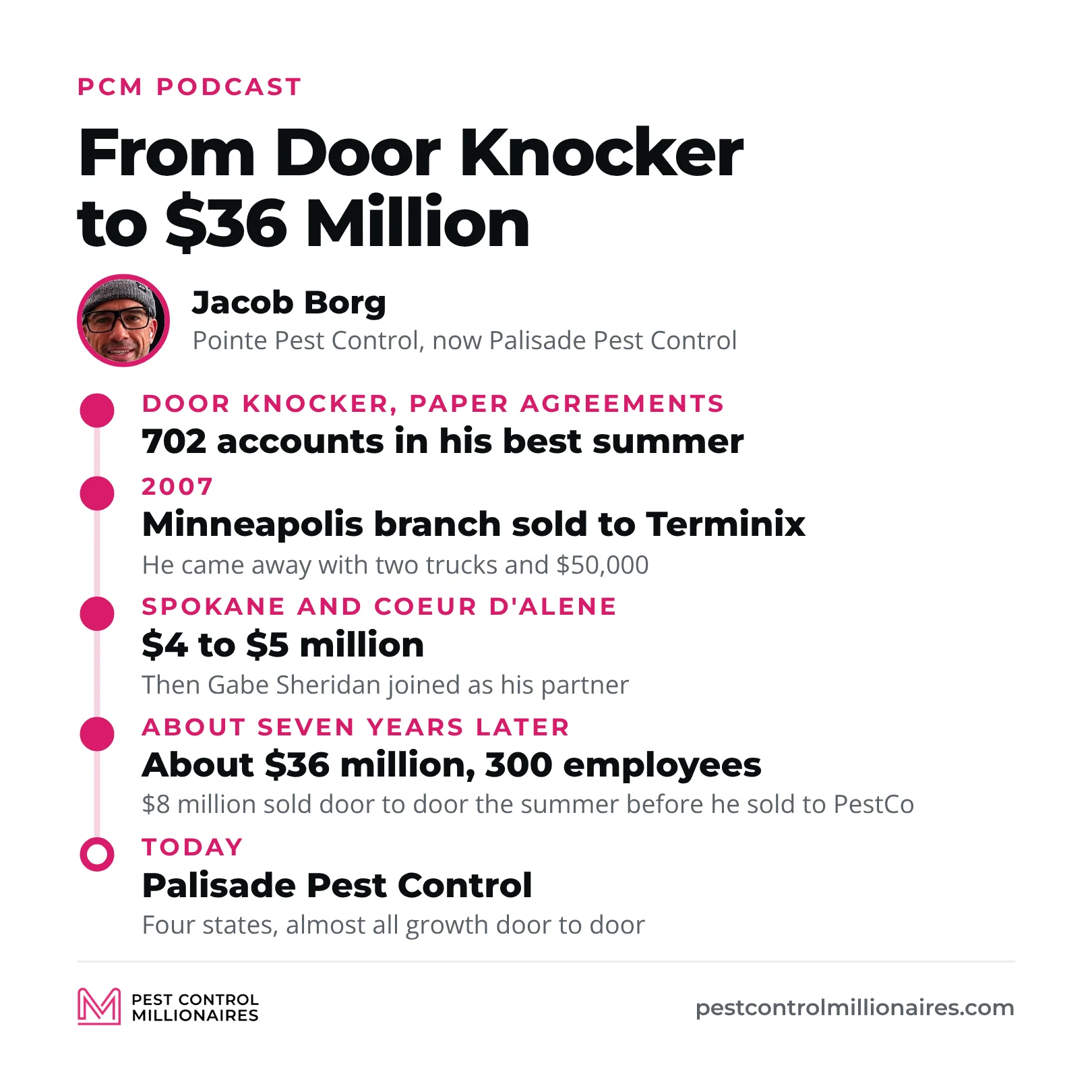
Jacob Borg knocked doors for Terminix and Orkin marketing companies for seven or eight summers, sold 702 accounts in his best one, and then built Pointe Pest Control in Spokane and Coeur d’Alene. With his partner, Gabe Sheridan, he grew it to about $36 million a year across the Pacific Northwest, sold it to PestCo and rolled a big part of the proceeds into PestCo’s equity. He sits on its board, and he now runs Palisade Pest Control, in four states.
We met at PestWorld, through his brother and Chad Louk, and I told him right there we had to do a podcast. We ended up talking for over an hour and a half. Here is what I’d want every owner to take from it.
This episode is part of the PCM Podcast. For the man who ran his sale, read what Paul Giannamore taught me about selling your company.
The class clown who moved to the front row
In high school Jacob was voted class clown. He got C’s, lost every student council race he ran in, and took the same identity to college, where he landed on academic probation after two semesters. Then he spent two years on a mission in Jamaica. On their day off, the man in charge of the mission, David Calvert, a successful developer and attorney, brought the young missionaries into his office and taught them how to be successful afterward.
Three pieces of advice stuck. Get to know your instructors. Sit on the front row. Do the group work with the smartest people in the class. Jacob’s first semester back, he got straight A’s. One of the smart people he partnered with, Jason Harris, turned out to be a talented door-to-door salesman, and Jacob knocked with him almost every day in San Diego the next summer.
“Get in the front of the room, front of the meeting, get to know in your work environment the people that will elevate you the most,” he said. I learned the same thing at Patrick Bet-David’s events. My first year I bought the $1,500 ticket and sat in the back. The next year I paid five to 10 grand to sit up front, and the people around me were the ones who had already done it. There’s a cost to sitting in the front, but there’s a bigger cost to not doing it.
He built a company that made the phone ring
Jacob’s first summer knocking, the company shut down halfway through over licensing problems in California, and he finished the season back home in Boise. He swore he was done and nearly went to work on a fishing boat in Alaska. Then he joined Eclipse Marketing, knocking for Orkin for $50 up front plus a back end. In his best summer he sold 702 accounts, when contracts were around $525, all on paper agreements.
After college he spent three years at the University of Phoenix, enrolling adult students from leads and tracking whether each one converted. He became a director of enrollment and got an MBA, but he didn’t want someone else in control of whether he had a job. So he quit, knocked doors for two more summers to save money (he remembers having not much more than $30,000), and started his own company with four kids and a mortgage.
His first try was a Pointe branch in Minneapolis, set up with Eclipse, which owned the Pointe brand at the time. When the banking crisis hit in 2007, Eclipse had to sell branches to Terminix, Minneapolis included. After paying off Eclipse and the loan, Jacob came away with two Ford Rangers, $50,000 and a team of reps, and took all of it home to Spokane and Coeur d’Alene.
What surprised me is that a door knocker pushed for inbound calls from day one. “Even though I grew up kind of door knocking, I wanted the calls to come in,” he said. The University of Phoenix taught him to track lead conversion, so he did the same with his own leads. That’s the same reason I track what every customer costs by channel.
Partnering with the right person took him from $5M to $36M
At $4 to $5 million, Jacob’s goal was $7 million, with an asterisk. If he partnered with the right people, he would aim higher. Gabe Sheridan, a close friend from Eclipse, came out, took over door-to-door recruiting and partnered with him on the expansion into Oregon and Western Washington. In about seven years they went from $4 or $5 million to about $36 million.
They ran about five branches, closer to eight physical offices, with remote coverage in between. I asked him the right size for a branch. If you can get one branch to $5 million, that’s healthy, he said, though that’s not common, especially today.
The hardest years were the first three and the last few. Running a $36 million company with about 300 employees and a big door-to-door team “requires a different team,” he said, and he’s an entrepreneur who loves the beginning. What kept him up wasn’t only the finances. Payroll is your biggest line item, and he cares about the people behind it.
His hiring rule works at every size. When you’re small, the most important person you can hire is the one who can replace you. After that, it’s “whoever in the moment can take over something that occupies my mind.” Early on that was a service manager, then a sales manager over field and inside sales. At Palisade today he has four key people (a director of ops, an HR and payroll admin, a regional field manager and the sales lead) plus a customer service manager.
Growth runs on borrowed money, so know the trade-offs
Here’s a part of the story people don’t hear. Jacob said the cash he took home was better before he partnered with Gabe, because they poured everything into growth. He sold three rental properties, got out of a clothing business, took a home equity line, and even sold the building he’d built for the business. Toward the end they used Zions Bank, hard money loans and a few individual lenders, then consolidated most of it with one lender who had his own exits, at maybe 14 or 15%.
Banks don’t love lending against a pest company. The trucks were already financed through their fleet agreement, the buildings were sold, and “the customers were the asset,” he said. He never felt overleveraged, but when they sold, the lender got his money first, then the owners.
Would he do it differently? Not much. “There’s always just trade-offs to everything,” he said. A lender costs you interest; a partner or an equity investor costs you a percentage. I’ve had owners on this show whose hard money notes got called and forced a sale, so if you go this route, borrow against a business that can carry it.
Paying 100% for door-to-door accounts is a roll of the dice
At Pointe, his reps earned anywhere between 28 and 60% of what they sold, depending on the rep. At first he ran the door knocking group through the pest company, then split it into a separate marketing company so reps weren’t on the pest control books. Today his marketing company bills every client the going rate, which I’d put at 90 to 110%, and bills his own pest company the same rate so each one stands on its own.
His opinion of paying that rate is blunt. “It’s a big roll of the dice,” he said. When he started, 90 cents to $1.10 per dollar of business was what Orkin and Terminix paid to buy companies. Pay that for door-to-door accounts and “your company, generally, is not going to be liquid or profitable,” he said. You only get the money back if you build a company that can pay for its own growth or sell for more than you paid.
He gets calls from two-year-old companies, full of partners, that sold nearly all their customers door to door the summer before and heard pest companies sell for over two and a half times revenue. His answer is that they don’t have a real company yet. “You have like a half a route,” he said. It’s the same reason door to door is our most expensive channel at Pest Badger. It builds a market fast, but you have to know your numbers. I break mine down in what your customer acquisition cost should be, and how we run our own reps is in how we run a door-to-door sales team.
Doors built it, but a year-round sales team made it sellable
The summer before he sold, Jacob’s door-to-door teams sold about $8 million in annual contract value. By his count the company sold about $15 or $16 million more through a year-round sales team of commercial reps, field reps and inside reps. He went after commercial accounts early, a habit from recruiting students through company HR departments at the University of Phoenix, but commercial was still only about 8 to 10% of revenue. It’s a long, intricate sales cycle, and residential is simpler.
That mix mattered when buyers looked. Jacob and Paul Giannamore ran a competitive process for two companies at once, his at about $36 million and his brother Jared’s Pointe business at around $25 or 26 million. Four groups (by his memory one private equity group and three strategics) flew in for two days of meetings at the Coeur d’Alene Resort.
Jared’s company was doing about a third as much door to door and was more profitable, so it needed fewer adjustments to EBITDA. PestCo bought it as its entry into pest control and paid a good multiple to beat the other bidders. Jacob and Gabe kept going instead. About a year later, PestCo came back with an offer, and in 2023 they sold, rolling a healthy amount of their proceeds into PestCo’s equity. Jacob and Jared both sit on the board, with Thompson Street Capital Partners, the private equity group behind it, and when we recorded this in November 2026, Jacob said PestCo was close to a $200 million business. For what buyers pay and why, read selling a pest control company.
What makes a buyer walk away
Jacob now helps PestCo meet companies it might buy, so I asked what turns a buyer off. Here is his list.
- Spread-out geography. A business in Seattle and Fort Lauderdale makes buyers ask how that works. They want dense routes and dense geography, in their zone.
- Attrition. If you can’t hold on to customers, or can’t show clear numbers on it, that’s a problem.
- No real company. You need a decent revenue base, good profitability and good EBITDA.
- One marketing channel. If it all comes from one source, what’s the next path?
A big buyer can turn on its own marketing, he said, so one channel isn’t always a deal breaker if your customer base is big and attrition is fine. Everything else on the list is on you. Nick Bartolo’s checklist for getting ready to sell covers the same ground.
He started over, and got his health back too
Jacob’s wife played along with a move to Driggs, Idaho, in Teton Valley near Jackson Hole. He’s busier now than before he sold. Palisade started in Arkansas a year before the PestCo deal, almost all its growth is door to door, and his marketing company sends half its reps there. “We come to town with the intention to just, you know, slay it every summer,” he said. He isn’t building it to sell. Having done it once, starting a company with the plan to sell feels like a weird idea to him.
The other change is his health. He’d tried intermittent fasting, Atkins and HCG over the years, then hired a coach from Six Pack CEO and went from 217 pounds to 150. It took three years. He now sleeps on purpose, wears a Garmin his trainer can read, gets protein early with Greek yogurt and protein powder, eats Factor meals, and on Sundays cooks extra meat on the barbecue and vacuum seals it for dinners. “It’s math and psychology,” he said, and like a budget, you plan around the meal that throws you off. Get your energy back and your business gets it too.
Last question. If he had $100,000 and had to start over, how would he get to $5 million? “I’d buy like a very inexpensive small white pickup truck” and go drum up business, he said, in a one-stoplight town or a city of 5 million. “It’s not hard. You just have to be willing to put in the work.”
Frequently Asked Questions
Who is Jacob Borg?
Jacob Borg knocked doors for Terminix and Orkin marketing companies for seven or eight years, then started Pointe Pest Control in Spokane and Coeur d’Alene. With his partner, Gabe Sheridan, he grew it to about $36 million a year across the Pacific Northwest and sold it to PestCo, where he holds equity and a board seat. He now runs Palisade Pest Control, in four states.
How much of Pointe Pest Control’s sales came from door to door?
In the summer before the sale, Jacob’s door-to-door teams sold about $8 million in annual contract value. By his count the company sold about $15 or $16 million more through a year-round sales team of commercial, field and inside reps. Commercial work was still only about 8 to 10% of revenue.
Is paying a door-to-door marketing company 100% worth it?
Not always. Jacob calls it a big roll of the dice. If you pay the going rate, your company generally won’t be liquid or profitable for a while, and you only get the money back if you build a real company that can pay for its own growth or be sold for more than you paid for the accounts.
What makes a buyer walk away from a pest control company?
From his seat on PestCo’s board, Jacob listed customers spread too thin across the map, high attrition or no clear numbers on it, and a company that isn’t a real business yet. Buyers want dense routes and dense geography, a decent revenue base, good profitability and more than one marketing channel.
How would Jacob Borg start over with $100,000?
He would buy a very inexpensive small white pickup truck and go start talking to people and drumming up business. He said he could do it in a town with one stoplight or a town of 5 million people. It isn’t hard, he said, you just have to be willing to put in the work.
Full transcript
Every word of the episode, from the video captions
I gave you 100 grand as all you had to start over at a pest control company, how would you do that? It's difficult, but it's not hard. You just have to be willing to put in the...
I buy like a very inexpensive small white pickup truck, just go start drumming up business. And I and I could do it in a town like mine with one stop light, or I could do it in a town, you know, 5 million people. I would just I would go start talking to people and drumming up business.
Well, welcome back to another episode of Pest Control Millionaire. I actually haven't done a long form podcast in quite a while. The last few have been like business breakdowns. But when we met at PestWorld, I'm I've got to get this guy on this show. And I was like, hey, we have to do a podcast. You were like, absolutely, let's do it. So we connected at PestWorld, actually through your brother. Is it I think it's your brother and Chad, Chad Louk, which is cool. And so I was like I got to get this guy on the podcast, OG. Most people who haven't heard about you like I told you are about to hear about you. But today I have Jacob Borg on the show. And you've done a lot of big things already. You're still young, so you have a you have a big future ahead of you still. We're going to talk about a lot of things. Yeah, you're young. 51 is young. We're going to talk about a lot of things today, I'm sure. I've been through some exits. You're on the board of PestCo, which is obviously a huge brand in the industry.
You have some entertainment stuff that you're doing. You have a [ __ ] ton of snowboards in the background. [laughter] You did a tour of your of your of your office. There was you said like three or 400 different snowboards, so I'm sure we'll talk about that. Your health transformation over the past like five or six seven years somewhere in there. I don't know exactly the date. We'll talk about that. But I mean you said you're up to like 200 plus pounds and you're like a buck 50 buck 70 somewhere right in there obviously I was doing some research on you this morning. But it's so awesome to see you the transformation and not only the business, but then as as your body and your journey. Like you said you like you've had many iterations of yourself it's one thing that I talk about all the time is like every six months there's like a new version of yourself.
But Jacob, welcome to the show. Honored to have you here, man.
Yeah, great grateful to be here, man. I'm stoked to talk to you.
Yeah, I think I forgot to mention you're a father of five, which is cool. So I'm sure we'll talk a lot about you know parenthood as a as an entrepreneur as well. I love my girls. I have all three girls. I have a stepson who not for sure us. But yeah, it's just I love it. It's why we do it. I know none of them will probably be involved at some point in the in this business, but obviously I do it for the lifestyle for them. It's really cool. But first question, which you probably haven't listened to a show and but the first question I ask everybody is if you and I were a sophomore or junior in high school, who was Jacob in high school?
Oh man, in high school? Well, I was I was actually voted class...
In high school. Yeah, so I was I was I was basically That's awesome. [laughter] I was basically a total That I mean that that I was very social in high school. I had lots of friend I had some really close friends, but I also had lots of friend groups in the grade above me, in the grade below me, in my own grade like so I was super social. I wouldn't have described myself as like a driven person. I probably was the furthest thing from anybody ever like thinking like you know at the end of the your senior year they vote you for different things and like most likely to succeed or best body, my friends got those. I didn't get those. I got class clown. And I and I probably got it they didn't show the vote count, but it was probably you know I probably won it but I also joke with people that I was kind of a loser. Like what do you mean you're a loser? I'm like well, like I ran for student council probably two or three times like between junior high and high school I ran for office like cuz I wanted to be in student council and wanted to be the president of something.
Got you.
You know, every time I ran for something I got you know my senior year I know my junior year in high school I went out for the varsity baseball team and I was kind of young for my for my grade and there was a lot of talented and a big group of kids and I got put on the varsity team as an alternate and kind of like you know so I just lost all the time I was a I was the class clown I got C's you know that was that was I had a great childhood and great family and good support and life was good but there there you go.
Yeah I was kind of like I was like I was just I had a had a big group of friends too from all over like I was like I was an advanced choir chorale so I had like the choir like group that I was in then I was a jock so I had like the jock group so I was kind of in the middle too just had friends all over the place very social could not focus on school like I was just super ADD didn't care about school at all didn't pay attention there's nothing that just that I found fascinating about history like at that it was like this is madness and I knew it then like this is not going to do anything for me like I just don't get why I'm here.
So then I went and did school to work so I go to work for 4 hours before school started so I go to work at 6:00 in the until like 10:30 11 and then I go to work from 11 to 3:00 or whatever at...
So when I found work I'm like oh this is cool I like making money I always had nice things in high school and so I grew up on a farm as well like all summer long like you know I was baling hay working with my dad on the on the farm so we had a strong work ethic but I like I never I never once checked out a book in high school ever not one time unless I was forced to like go to the library like hey check out Goosebumps or whatever maybe I read a Goosebumps book. But then once I found business and learning, I was like locked in. Like I've always something that I just absolutely loved like I couldn't get enough information.
That's awesome. That's awesome. Yeah, I worked in I worked in high school. I bust tables for Black Angus, which was a Stewart Anderson...
I worked some construction jobs. I did HVAC actually. And I worked I did a bunch of crawl space work where I would hook up duct work and I did a little bit of frame I did some So I did some construction and I mowed lawns. I started like a little lawn mowing business like but it was mostly just in the neighborhood, you know? So That's that was like that's my background too. I got I did construction. I was in the Carpenters I worked I worked for like 4:12 and we were done on Thursday at noon. And then I was like I tried to start a lawn mowing company when I was like 18 with a push mower and a friend and it just didn't go anywhere. And so I was I was just kind of dabbling in things and then my buddy when I was working those that those 4 10s I got done at noon on Thursday.
He's like, hey, you know, this guy called me. I'm getting out of the business. I got to sell. I got a new job blah blah blah. He said, why don't you just come look at this job for me? I'm like, okay, and I had some money saved up. So went and looked at this office. It was Cooper Office Supply, local company in town. And so he helped me bid it out and I got the job. Then I ended up getting their parents or the owner's houses too. Fast like 10 years later when I sold that company, they're actually still Yeah, I started in lawn care industry as well and then COVID hit, shut us down in Michigan. We couldn't work at all. Super weird time. Never knew during my life. That's not my background. Didn't know what I was doing. A lot of YouTube university. I started driving to Wisconsin and taught myself how to knock doors and thankfully the first door that I knocked it was for lawn care like for weed control or pest control. I didn't really care. I didn't really know at the time. And the lady happened their dog had to be allergic to wasps and I sold my first throw that ever not.
After about throwing up, of course, but kind of like how I found door. Hold up, quick pause. If you're on a pest control company or fertilization weed control company you're not in our Facebook group, you're choosing the harder path. Every operator that's in there is skipping years of mistakes because people are actually sharing what's working right now. So stop trying to brute force your way through growth alone. Search Pest Control Millionaires on Facebook or click the link below. And now let's get back to it.
It's tough. It is tough.
That honestly that's how I was forced to go do something different. So that's how I got to where we're at today. So after high school, where do you go from there?
Well, so I went to school at in Rexburg, Idaho and I had an amazing year going to school. I went to school for a year. Just studied you know, whatever, general education that first year you don't really do anything specific to a major. Made some really good friends. Again took everything I learned in high school, which was basically that I was labeled a class clown and took that to college and continued to like you know perform poorly, like I just I think that was my identity. And so I went to college because that's you do. I had a great time. I screwed around a lot. I got like you know put on academic probation after two semesters and I was motivated like I was kind of hungry and motivated to like make money and kind of create a life for myself, but I just college I don't think I believed in myself that I could actually do well in school and that it could help me at the time.
So it was kind of a weird you know deal, but then after a year of college I left for Jamaica. I went to Jamaica for two years and did a Christian mission there. And so I got like a nice break from you know going to high school, a year at college, which was it was going well socially but not really, you know, helping me move forward academically at all. And so I went to Jamaica for two years. That helped shape me in a lot of ways. There's a lot of things about that two years that shaped me and it was an incredible experience. So I did that and then came back to college after that. I mean so when I came back from Jamaica I learned some things and was taught some things in Jamaica that that changed my own personal belief in myself and about education and I literally like went from being [clears throat] on academic probation before I left spending two years in Jamaica. My first semester back I had straight A's, which was like for me not who I was.
So I kind of...
What was what was that It's probably a multitude of things in those two years, if you give me just a few examples of what changed your mindset.
Well, there was a lot a lot of what I was doing there was talking about Jesus Christ and sharing the gospel with Jamaican people and getting to know them, but we had a day off every week and on that day off the guy that's in charge of our our mission that is over the all the missionaries on the island his name was David Calvert and he would invite we I was living in Kingston, Jamaica, which was a kind of a chaotic city. He would invite us into his office and he was a successful developer and attorney he'd had businesses and he would invite us into his office and give us like post mission training. He's like kind of on our day off be like come in and let's like talk about how you can be successful after you get And he taught me a ton of stuff that gave me some confidence and I came home and I was like I've got to like get my stuff together.
Like I've got like when I came home the monkey business class clown stuff it needed to like be brushed aside and I needed to get serious about life and he taught me a ton of stuff man. I and I could talk about some of the stuff he taught me but it was like in fact it kind of con connected to pest control because one of the things he suggested which may seem really normal for a lot of people he's like listen if you want to get good grades and get something out of your classes get to know your instructors on a personal level meet with them let them know you're interested in doing well in their class and ask if there's additional things you can do like get like get to know your instructor like treat them like a person get to know he also suggested that you sit on the front row of your class and I was a back row guy like I'm like I'll sit on the back row like I'll get on my you know we didn't have phones like I'll just So he's like no more disappearing sit on the front row get to know your instructor and then he said get to know the smartest people in the which will most likely be on the front two rows and he said make sure when there's a group project and there will be cuz that's what all these schools are going to is group work do the group work with the smartest people in the class.
And those three things like actually change like in fact one of the guys that I did group work with was turned out to be a really talented door-to-door pest control salesman Jason Harris who like I he'll laugh at this one like I'm like I think he's probably smart like I should probably do group work but anyway I ended up getting to know him in a class and yeah we got good grades on our group projects which was unheard of for me. And he was he turned out to be a guy that my second year selling pest control, I knocked with him almost every day in San Diego for the whole summer and the same thing applies to what this guy taught me in Jamaica to work like you know get in the front front of the room, front of the meeting, get get to know in your work environment the people that will elevate you the most like it's all it all like is interconnected and those concepts translated over time to more than just school.
So...
The best pest control companies do not leave growth to chance. They build systems. They have a system for generating leads, systems for answering the phone, system for servicing the customer, and systems for collecting payments. But most companies still treat referrals like luck. They do a great job, hope the customer members to tell a friend, and maybe send an occasional text asking for a referral. That is not a system. Clicki Referrals turns your happiest customers into active, trackable sales channel for your business. Clicki automatically invites customers into your referral program, gives each person their own referring, tracks the leads and sales they generate, and makes it easy to reward them when those referrals turn into business. And now Clicki has launched Rewards Pass. Rewards Pass was a brand referral pass for your company directly inside your customer's Apple Wallet or Google Wallet. Think about that. Your brand can live on your customer's phone alongside their cards, tickets, and brands they already use every day. Their personal referral link is always one swipe away. You can send push notifications and out special offers, promote events, and stay connected long after the initial service is complete. This is not another app your customers have to download or another login they have to remember. It's your company, your referral program, and your rewards living directly inside their wallet.
If you want more referrals, stronger customer retention, and customer experience your competitors probably do not have yet, go to joinclicki.com/pcm, book a live demo of Rewards Pass to get $350 in payout credits. Tell them you heard about it on Pest Control Millionaires. That is Stop having your customers send referrals, build a system that makes it happen. And I'll tie [snorts] that to like a business experience that I had as well. You know back in I don't know like three or five years ago I started going to Patrick Bet-David And so the back of the room was like $1,500 for a ticket. But as you get closer to the front, they're up to five to 10 grand a ticket, right?
Well, you have to pay more to get to the...
Right. So after the first year or two or maybe it was the first year, I bought the $1,500 ticket and sat in the back. And as I'm sitting in the back and we're going through all these exercises, like business exercises to do like business breakouts, we have to go solve this problem. In the back of the room, I also want to solve the problems for the whole group, and then we go up to the front of the group and we have the right answers. Then I was like in my head, I'm like, okay, that's cool that I'm going to answer the problem, but like I don't want to be here no more. I didn't come here for this. Like I want to learn. So the next year, I was like, I'm just going to pay the five or 10 grand to get to the front of the group. As I paid more money to be in the front of the group, that's the people that I was surrounded in. So as we doing these business breakouts, I'm not the only one to answer these questions. Like there's like very insightful, smart people, like you said, at the front of the front of the room because they're willing to pay more because they're worth more money. So they're typically not always smarter, very smart people up there willing to pay more money.
So it was kind of just like what you said easily translates into business, like getting up front, hanging out with the smartest people, like you said, and really learning from people who have been there and done it who are super smart, talented.
And there's a cost being in the front of the room, whether it's like you experienced, like the cost was you had to pay, but there was a cost for me when I wasn't paying. It was like you disappear. You had to pay like it there's all these tradeoffs.
Yeah, but there's also a cost whether it's money or of not doing it too, right? The non-tangible things are worth a lot more in like in a way, right? Like the things that you don't learn is going to cost you way more in the long run than sitting in the extra five grand to sit in the front.
Yeah, like in high school, a lot of people, you know, that are even in life, that it's innate, like they just towards being in the front of the room. Like for me, it was I had to I had to like go through like a It was not comfortable for me to make those changes. I But I But I knew that I needed to do it. So I'm like, I'll give it a shot, you know? And I tested the things he taught and it and it translated to the success I was looking for in grades and learning cuz I wanted to get something out of the class, not just like get a good grade. So yeah.
So is that how you found pest control from your buddy in the front of the room or did that come later?
Yeah, so the year before that I was fresh home from Jamaica, I mean, my family was amazing growing up, but like I grew up with six there were six children, five siblings. My parents were doing everything that they could to help us. They loaned me a car to go to But like I was paying for my own way, really. Like they helped me with housing, but it was like I was in charge of like going and building my life and future. And so I was motivated at that time. And this is in like 1990 6 I think. It The years start to blend together, was in...
Where where do you fall in the five or six brothers and sisters. Where are you at?
I'm the third. So I have an older brother and older sister and then then me. Yeah. It went boy, girl, boy, girl, boy, girl. So I went to I went back to school. I was just motivated and I had actually This is what's kind of crazy is before I left for Jamaica, I had heard about some guys that were knocking doors for Terminix in if I remember I believe it was Todd Peterson's group who started marketing and then ended up doing his alarm company that became what you know like whatever the name of the company is now the Vivint Vivint yeah so I'd heard about these guys that were going and knocking doors before I left but when I came back I started kind of asking around and I went to work for a company with some friends some really good friends in and I was just I'd heard about it I'm like yep let's go do it and when I went out there for the summer it was not what I thought like it I ended up choosing a company that was a it was run by a guy that I don't think had really understood what he needed to do to pull off a successful summer we were selling a lot of business but nothing was getting serviced we didn't even know that cuz we were so disconnected from the service company it was like six to eight weeks of a lot of fun and I didn't make any money and at the halfway into that summer the company shut down and sent part of the shutdown was due to the licensing issues that they were having with California was being really strict and we didn't meet the requirements...
Right right. So we all the owner of this company was like you guys all need to go home but I've got some jobs for you if you want to go knock doors for Sales Net which Sales Net was an early marketing company that was mostly marketing for Terminix and so I went back home to Boise and finished out my summer working for Sales Net and the guy I was describing that was in the class with me was one of the top producers for Sales Net...
Got you.
That summer and so I went to Boise spent two months knocking doors for Terminix and at the end of that summer I was like I'm never doing that again I'll find something else I was going to go to Alaska I'm like that was it you know I was going to go to Alaska and work on a fishing boat. It was kind of I made decent money and I sold okay, but I worked for a company that went out of business and then I knocked in my hometown, which wasn't that fun. Anyway, I was kind of over it, but the when I went back to school, I met some of these guys that had had some success with some other companies. One was Eclipse Marketing and they were knocking for Orkin and so I kind of entertained the idea of doing it again and then I...
Yeah, what were the commissions like back then?
Jeez, like that first year I can The first year I barely remember what it was, but the second year, my first year with Eclipse, like we were getting 50 bucks upfront and we were getting a scale probably started in the like 10 to 15% and went up to like maybe 30. Like it was just like not that much, you know. In fact, a couple years in my I went to San Diego that summer and pretty decent with a good group of guys, guys that I'm still friends with today. The following summer I went to Fort and the guy that I sold with in Florida that summer, we used to joke like we were making pretty good money getting 50 bucks upfront cuz we were pretty good at selling and we were like, dude, we would do this just for that...
Because because we were making more money getting 50 bucks upfront we would have doing anything else. And we did have a back end that was you know, that that would come, but like there were times in my existence as a door-to-door rep where I was like, dude, I would do this for 50 bucks it's still better than the alternative.
Yeah, what was it like knocking doors in the early '90s like as far as competition, other companies, like switchovers like was it...
Yeah, there was definitely still other companies knocking. What people experienced today, you know. And it's all I knew. So looking back like what was it like? It wasn't like what I think a lot of people like think, oh it must have been so I mean it was it was good. There was probably low hanging fruit that maybe you don't find today for sure. But you had to develop the same kind of skill set. There was different challenges. So every every cycle of what I've been through has had you know, its own challenges either every area you knock has geographic challenges, economic challenges, competition. There's always some...
Remind everyone, there was no software back then.
Yeah, like and even when I went to Florida that summer, like I was driving a Volks like a 1986 Volkswagen Jetta that I bought in the winter. So when I turned on the air conditioner on that car, it blew cold. So I'm like, okay, I got this nice car with an air And then when I drove the further across the country I got by the time I got to like to Atlanta and then Savannah, Georgia and was headed to Florida like it stopped blowing cold for some reason. And when I got to Florida that summer I was like, this is how naive I was. This AC button is like a placeholder if it has an AC.
So I spent the summer in Florida that year. So what was it like? It sucked, man. I was like in a non-air conditioned 86 Volkswagen and was freaking sweating my balls off, you know, and like the heat And I was a newlywed and I was like it was there was a lot of pressure, you know, it was so it was it was it was tough.
How long do you knock doors for for other marketing companies?
So I knocked you know, the first summer which I hardly count. Then I went to San Diego, I went to Fort Lauderdale, I went to New Orleans. I spent a summer in Richmond, Virginia. So I knocked for like five summers and then and then got my college degree and kind of took a took a break and did a different job. And then after I quit that job and I came back and started knocking again, I went to Seattle. I went to Minnesota and Minnesota I was knocking for my own company, but I really knocked doors for about seven, eight years for someone else and then you know, it wasn't until after that that I that I opened opened my own...
How many accounts did you put on over six, seven years?
Oh, total? I should I should know that. I my best summer I sold 702...
That's amazing. Wow. It's really good. One of the OGs. What was cancellations like back then? Was it better, worse,...
I mean, Frank Well, I frankly I think there was less optics. Like I don't know that like now everything's so transparent because the software platforms are so they're they're built out so well. I don't It's kind of difficult sometimes to even articulate is like, well, I think they were okay because my back end didn't shrink that much. Like that's that is back then I would literally I remember a summer where I would literally be calling the Orkin branch and trying to save anybody that they said to me was going to drop off before my back end hit. It was It was a very analog environment in some ways.
Do you Do you like that model of sales doing their own retention?
Well, I mean, I think that the better the sales rep was connected to helping with the retention it was good. Like in some ways if I saw a picture of the like which they used to fax me This is going to age me, man, when I talk about this stuff. But like maybe we should take a break and tell everyone what a fax machine is real quick. So that so the if I saw a picture of the agreement and could identify the address and like look at my Thomas guide and identify the street, I could remember the person and I would call that person and I remembered what it was like to sell them and I could sometimes save them, man. Like I like it was it was fairly easy for me to kind of connect having been the person that sold them. I don't know that today that type of integration makes the most sense. We like our marketing company now we have a team of CSRs that does everything they can to save people and if the rep is the one saving them at the last minute in order to get a bonus and then you risk that customer dropping off a month after, it's not always the way to handle it.
So Yeah, times have definitely changed from fax machines to carbon copies and then just to have like now it's like you pull up any piece of software, you have all like all the pins, the houses, the names, how many services, issues they're having. I mean all the information they already need, you know, it's pretty Come a long way.
Yeah, for some of the guys that did this when when I started, the best thing on the planet was walking around with like 10 paper contracts with paper clips of And when we would carry them on the front of our clipboard and right out of the gate when we'd turn side by side with people and we'd flip through these people's checks, there was a lot of comfort in them writing us a check what it was like. And the weird transition to like ACH and autopay, it was there was a transition period. It's less like this now because people are used to it, but the transition period there was a lot of discomfort for a while with people giving you a card And so anyways, yeah, we loved freaking walking around with the with the with the checks and the...
Yeah, like back in the day, like there I feel like there was a probably a still a really good advantage of walking around like now like they do ACH, you walk around with a stack of checks. Like back then it was like bunch of carbon copy papers walking around and showing like all the neighbors signed up.
We would flip through them. They would see the names of their neighbors and it was like very physical. It was I mean it took That's how I kind of grew up in the My The year that I sold 700 accounts, I was still filling out paper agreements. And so you know, it was different.
You your last year knocking, what was the final thing that like hey, I'm going to go start my own thing?
Well, so I went to work for a company called University of Phoenix after I from college. I got my degree and I bought a house in Boise and was like okay, time to move on next, you know, next step and I got that job and I enjoyed that job a bunch. It was like a really good learning time for me. I worked for three years for them. Mostly my job was getting leads that were from potential students that wanted to go back to school to finish their degree and I would coach them through the enrollment process and sign them up to finish their classes and then I became the director of enrollment and moved to Spokane, Washington to work for their new remote campus that they had there. And so after three years And they paid for me to continue my education and get an MBA and I learned a bunch there, but one of the things I learned there was I didn't want someone else to be in control of whether I had a job or not. And there were times when I kind of saw the writing on the wall and was like, I don't know that like I want them to be in control of my income and my vacation time and I felt pretty confident in my job.
I was doing a decent job there, but like things could change and I wouldn't have control over it and I did I felt like I had less control and the other thing that happened was I'd convinced myself that I was from Idaho wanted I mean I knew I was from Idaho, but I convinced myself I wanted to live in Idaho and that was it like cuz I love hunting and fishing and Idaho culture and wanted to live in Idaho and I'd convinced myself that even though I knew pest control and I did it all over the US that it wasn't really a thing in Idaho like I knew that there were pest companies there, but I was like I'm not going to be able to like make a run in Idaho. So but my first house was full of spiders and ants and wasps and pretty quick I was like this is a valid thing here and I'm doing this here, you know. So I quit my job and went and knocked doors for two summers to raise money so that I could open my own business and I started basically in Coeur d'Alene, well, that summer like what I like I basically put a bunch of money away so that I could have a truck or two. I had I had enough money for a white truck that I drove and a white Ranger that I bought and I probably didn't have much more than 30 Yeah, I don't remember exactly, but I didn't have it.
I think you saved like 30 grand, right?
But I when I was looking through online this morning that's what I was researching that's what I came across. That was pretty cool like It's awesome.
Little bit of money and a lot of pressure to go...
Perform cuz at the time when I started I had I had four I just had my fourth kid basically. So like I had four kids, a mortgage,...
It was a tough time to leave, right? Cuz you get go to handcuffs cuz you've got to go pay those bills. Most people Most people in your situation don't leave. The question there is like, did you quit and go start this or did you wait till the summer when you were off to go?
No, I quit I Well, I quit the job at University of Phoenix. I went and knocked doors for a summer. Saved the money.
Put some money away and then started but I remember walking over to my neighbor's house who I had a lot of respect for. He was a physician's assistant and I was like, Dan, I'm like, I just quit my job and he's like looked petrified for me. And what's funny is then I told another guy that I knew really well. And this guy mowed lawns for a living for himself and he was a really spiritual guy, great guy. He looked at me and he goes, well, Jacob, he goes, I think you made the right choice. He goes, because God can only bless you as much as your employer is willing to pay you. And I was like, here we go, buddy.
Yeah. [laughter] And what the PA doesn't know is the skill set that you have. Over eight or Well, I mean, at that point it's probably 10 years of knocking so like in your brain, there's really not a whole lot of risk there other than the weekly paycheck. In his brain there, he doesn't have that second skill set that sales you can translate to anything, but you already know the industry is like you know you have the skill set. You know you can sell 700 accounts a year. I don't know what the ACB is at that time. I'm going to guess like I don't know, $5 yeah. Pretty good guess, huh?
Contracts were around 525 about. Yeah, you can put on some revenue in your first summer.
So walk me through that first year. What was that like?
Yeah, so I technically I'll fast forward part of this, but I The first year my I still kind of felt like Spokane and Coeur d'Alene were small markets. There wasn't as much of an opportunity. I know like but I kind of had my sights set on bigger cities that could that geographically I could build a bigger company. So I started a business in Minneapolis. And that was through my relationship with Eclipse Marketing and Pointe Pest, Eclipse owned the Pointe Pest brand at the time, and they let some of the longtime door knockers kind of open these businesses. And so my brother had opened one in Chicago, and I went to Minneapolis and had a partner there, and I ran that business like a year and a half, and then we sold it to Terminix.
And so and then and then I basically was like that ship sailed, and then I focused on my hometown, which was Spokane, Coeur d'Alene, and then all of my energy went into that business, and I took the reps that I'd recruited for and I was kind of a non-traditional recruiter because I recruited some teams from Pullman, Washington and Moscow, Idaho, which was not like a traditional market at the time for recruiting door knockers. And so I had kind of a mixture of personalities that came from, you know, those two schools. And when we closed down the Minnesota location and sold it to Terminix, I brought that team back to Spokane, and then I just knocked with them. Like we had a small company, and I knocked with those those over the course of a few years kind of building that company.
But at the time literally...
Yeah, so when you when you went to and you ran that company, did you have like did you have like a L tip? Did you have equity in that branch? How did that work?
Oh man, like it was basically intended by Eclipse Marketing to be a franchise, but they hadn't finished all of the official franchise paperwork, which is super...
Right, it is cumbersome.
We had like this kind of bridge agreement in place we paid It's been a while, but we paid Eclipse Marketing The intention was that we would be paying Eclipse a small portion of our top line revenue like you would on franchise. And that in the event of an exit, that was the only time that they would realize some of it was not I don't think it was really an equity agreement. It was more of a when you exit a portion goes to them. Yeah, it was kind of a goofy agreement and it didn't materialize and honestly it was probably kind of not legal because it was intended to be a fran it was it was a goofy agreement and when this was during the banking crisis. So basically in 2007 Eclipse Mark yeah, it Eclipse had built a whole bunch of Pointe locations across the US and they had a bunch of notes with the bank that were called and so they had to sell a bunch of their branches to Terminix and we sold the Minnesota branch to Terminix and so anyway it's...
Did you make any money out of the deal?
Dude, here's the crazy thing is when I sold that branch I was in Spokane, Washington and had a brand new company there and I had this one technician that one of my favorite people on the planet his name's Doug Doofer and he was kind of he didn't believe I think he was skeptical that I had this other business in Minnesota. He's like whatever Jacob you know and I go hey Doug I sold that business and we're getting two trucks delivered that Terminix didn't buy. So I had a delivery company bring these two trucks these Ford Rangers all the way to And basically I when that business closed I got two trucks and 50 grand after I paid off Eclipse and the loan that we had. So like what did I get? I got 50 some really good...
Some great relationships, two trucks and 50 grand.
Yeah, but you learned but you learned a ton like you said.
Learned a ton and then those trucks and that 50 grand went towards you know the new company.
Yeah. The marketing company back in...
The Eclipse. What was what was the Eclipse getting for marketing deal then?
Oh man, I dude, I think Orkin was only paying them like 55% like it was not a And Eclipse at the time every year was every two years or every year was trying to like negotiate more because the commission rates rates were climbing. It was getting more competitive and so but early on it was not a lot.
Well, I'm sure we'll talk about where they're at today eventually, but so you're that's your first year back. Recruit some guys, bring them back to your hometown. You go all in?
Yep, yep. Then we just started building our company locally and really like at that time I didn't really anticipate that the company would become what it what it did. I was mostly just trying to create like a job that I could control after leaving my full-time job. I was like I just want to be in control of my own situation. And so we just built a company in Spokane and Coeur d'Alene and then eventually we expanded to Tri-Cities and then we went down to Lewiston and Clarkson. It was mostly in these kind of smaller towns. But I'd learned a bunch while I was at the University of Phoenix about lead and about converting leads and about tracking lead conversion. At the time it was students. The lead was a student and we tracked if they converted to you know going to class and so I learned how to do that and so I pushed hard to make my phone ring right out of the gate. Even though I grew up kind of door knocking, I wanted the calls to come in.
Of course.
So pretty quick I built like a real company that was in the Pacific and we had a good you know good little business, good little like it was probably a you know $4 million dollar business at at that time, you know $4 to $5 million business, yeah.
So then you decided at some point you wanted to exit. Why? And how hard was that for you?
Well, let me give you like a little bit of a gap between that. But basically, when I was a to $5 million business, a real close friend of mine was making a change with his job. I used to work with him at Eclipse. His name's Gabe Sheridan.
That ends up being your business partner, right?
Yeah, yeah. So Gabe came out and we ended up deciding to join forces and he took over my door-to-door recruiting and then we partnered on our expansion into Oregon and into Western Washington. And so I'd set this kind of goal to be a $7 million business. And then I also put this little we kind of set this game plan out. I put this little asterisk on there that said in the event that I partner with the right people, you know, we'll throw this $7 million number out and try to be bigger than that. And Gabe ended up becoming a key part of that. So we went from being a $4 to $5 million business and in about 7 years became like a $36 million business. And big part of that was partnering with the right person and expanding to Oregon and Western and expanding our footprint in the Pacific North West a bunch. And so yeah, we became a different kind So then how did we decide to sell? I mean, every threshold yeah.
How many branches were total within that $36 million?
There there was technically like five branches, but we had remote we had people we covered the geography pretty well in remote locations and stuff like that. So you guys were roughly five [snorts] to six...
Buildings, like physical offices we probably had more like you know, eight, but we would we would you know, at the time maybe Bend, Oregon was part of the Albany branch or you know, it was like yeah, yeah, yeah.
Yeah, I was going to go My next question would be like what is your like in your head what is the perfect size branch?
Oh man, if you have if you have one branch in an area where you have at $5 million. Like, it's really if you can get it to 5 million, then that at least gives you I mean, that's not common, especially today, but have having a branch that's got $5 million in revenue at least is healthy. That's good.
So, we'll kind of fast forward a little bit, but then at some point you and your business partner decide to sell.
Reason you guys decided to sell? Did someone come knocking to put it Like, what happened?
Yeah, it was kind of It was weird. It was uncomfortable to be honest with you. It was like It was not something that neither Gabe nor myself When we opened the company, it was not let me open a company to try to sell it. It was really like I wanted to create a job for myself. But I but I did What When I did open it, there were some guys that I looked up to that had had some exits. And maybe in the back of my mind it was like a little like concept that I knew as a possibility someday. It was kind of more of a possibility someday. So, as the possibility someday, years and years down the road, became a thought that became closer to this possibility. I kind of wrestled with it a bunch. It...
You were like You were at the state You were 47 48 at this time?
Yep. Yep. And so it felt like it wasn't like I was really trying to like stop working. I was I liked my work. I was motivated.
You were making good money at this time? I know your net worth was a lot on paper, but were you making good money?
Yeah, there I To be honest with you, my cash that I pulled in was a little better before I before Gabe and I partnered because what happened was when Gabe and I partnered and we went from like, you know, 4 to 6 million to 36 like all of a sudden...
I sold three rental properties. I got out of a clothing business I was in. I hawked I got a home equity line Like, I basically like leveraged everything from over that seven-year period. And so yeah, so I knew that I was building something valuable, but we and we weren't leveraged uncomfortably. Like we had a good lender. We were paying a high interest rate at the tail end of the of that growth that was not the best, but it was kind of we were kind of opportunistic, I would say. We kind of were like let's throw our hat in the ring. And I'd had a long relationship with Paul Giannamore because we'd interacted years and years earlier when we were both in France on a trip and I'd somehow read one of his newsletters.
And I think at at one point I was like had a conversation with him. I'm like, listen, I'm not married to the idea of selling, but I'm kind of opportunistic and my brother was the same way. So we kind of approached it as like let's see what this looks like. And then it kind of materialized because we timed it decent enough that there was a multiple that was like...
Zion for sure. To get in the industry. It was a great time to it was a great time to exit.
Yeah, and it was it was it was difficult to just ignore the idea of exiting when there was so much value that was being placed on the business by the groups that were looking at it.
Yeah, when you when you said that you had and you raised money or whatever you're paying a high interest rate, was that from a private investor or was it through a bank? How did you guys do...
Yeah, so I won't disclose his name on the call, but I but I went I had between me paying for stuff and using my home equity line and selling rental properties and I ended up actually selling the building I had built for the business that I owned. I sold it and got the equity. Real estate definitely helped me finance my business, but at the tail end of that growth we were doing so much and growing so rapidly that I needed Zions Bank helped me. I did hard money loans. I had a couple of individual lenders, but at the end we consolidated most of our lending to one guy who had some exits with Pest and with another company. And that guy was my lender and like I think he was charging me at the time like maybe 14 or 15% on a note that was like you know it was basically a hard money loan you know because you know banks there was no physical assets the trucks were leveraged yeah the trucks were leveraged through our enterprise agreement the I sold all the buildings like there was just yeah the customers were the asset but banks don't like you know you know they don't love that so anyway so we had a lender...
Through that I guess this is a good point to make I mean you say you're highly leveraged but not in an uncomfortable way we have a HELOC on your on your on your house sold all your buildings so you're all in anything that you learned through that period that you would have done different or you've done all the same or things that you know people can process through that good bad ugly not do or to do...
Yeah I mean looking back it's hard to it's difficult to unravel what I went through I the things I went through I learned so much I don't know that I would change a lot of it because it's been part of what has given me the exposure and experience that I have but there was no magic wand when it came to partnering with the right person or finding the right lender it's no matter what you're like if you partner with the right person or bring on an equity partner who's going to give you capital then you're giving up a percentage so there's always just there's just trade-offs to everything and for me...
When you're paying that 14 or 15% you didn't have to give up any equity you're just paying high interest...
That deal no that deal was a...
That rate was the rate and there was not an equity play I probably could have approached that but you know when we sold the business and we took that top line number that we got, that guy got his money first.
Right, of course.
And then the other owners, which on the cap table for that business was me and Gabe, you know, we had to pay our lenders off first and we had a we had a pretty good note that we had to...
It's great.
Pay off, you know, but...
Because I mean I've had people on the podcast who did the same thing to hard money loans and those notes were called and they were forced to sell.
Yeah, luckily I mean I this guy this guy in particular the value of a pest company and I wasn't overleveraged. Like it was...
And at that time like this is 3 years ago when you end up selling, but what were the commission rates then that you were paying well, I'm sure we had reps that landed anywhere between you know, 28 and 60% like that that's their pay depending on...
For door-to-door reps?
Were you running your marketing company through your like...
It yeah, it evolved where the marketing company wasn't a marketing We just ran the door knocking group through our pest company and then eventually we created a separate marketing company where the marketing company was billing for you know, the rate, but because we were...
You like that model of like almost like double dipping on both sides of the of the business? Let me tell you how I did it and then you know, you basically Yeah, yeah. Like today the marketing company we run we bill all of our clients the going rate for the door knocking crews.
Which is like in here from I'll throw it out there like 90 to 110% ish.
Yep. So it's a real business that we that we you know, do that for, but because we also own a pest control company you know, we set the rate for that company and we do it for the going rate so that that business can be a standalone business. But we didn't do that out of the gate. We didn't learn those lessons out of the When we first started, we were kind of using the marketing company as almost just a pass-through organization to differentiate We didn't want like door-to-door rep on our pest control books. So we so we separated. Yeah.
Yeah, no, it's super smart, but that's just why I asked. That's what people should do. I guess this a good time to like to we talk about commission rates today. Like I said, what they're going for now. You have some deeper pockets than most people because you've been through an exit, right? To make it work in your new company. But how do how do you how do how do you make the math math paying 100% commission? What do you think the retention rate has to be for you two to actually make some...
Are you referencing what the reps commission is or what we pay for a marketing company to do? Yeah, yeah. Dude, like this my general opinion about this is it's no matter what, if you're doing door knocking and you're paying the going rate that a marketing company charges, which you just gave a range of what those rates are today, it's a big roll of the dice. It's like you're definitely rolling the dice because, you know, I grew up through pest control where it was very common, no matter what size company you had that, you know, Orkin and Terminix were paying between 90 cents and a dollar 10 for every business that they bought. And just because the last like, I don't know, six, seven years, those...
There's been there's been an increase in value placed on these types of service businesses and especially pest. It's dude, if you're paying that same that was the historic acquisition rate, it's a roll of the dice and your company, generally, is not going to be liquid or profitable if you're paying that. Like, it's just you're the dice that you're rolling is do I have the cash to build a scaled business that eventually can pay for its own growth or potentially can be acquired and you can recoup that money, but you won't recoup it unless you build a company that's actually worth more than what the marketing rates you're paying are, which that's why it's always so funny cuz I'll get companies like we just started this company, we're two years in, I've got all these partners, it's like we've got all these customers, you're like well almost all those customers were sold last year door-to-door, so like why would I pay anymore than what my marketing company charges for that company?
And they're like well we heard that you get like over two and a half times revenue and you're like well yeah, but like you don't even have a real company, you have like a half a route.
Oh yeah, well that we get on a soap box there for sure. I do the same soap all the time. Did PestCo come to you? Did you go to PestCo? Did did I'm assuming that Paul put that deal together, put out to market and they were...
Yeah, yeah. So I had known Paul for a while, I trusted him, I Jared and I because we both owned Pointe locations that were left over from when Eclipse sold, so we owned these Pointe Pest Control branches that a lot of people didn't really understand the relationship, but those were separate businesses. His business was doing somewhere around 25 26 million in annual revenue. We were actually our marketing company was doing door-to-door sales for his business, so Gabe and I were sending reps to him. Our business was about 36 million, so the combined businesses were pretty good size and so we decided with Paul to do a competitive process and it's actually kind of amazing. We did meetings, initial meetings in Coeur d'Alene, and we had I believe four different companies fly to Coeur d'Alene.
Off the cuff, it was maybe one private equity group and three strategics that showed up. And we did we did like two days of meetings at the Coeur d'Alene Resort, and they all came to us from all over the country, and we did like sessions with each of these groups. And they all knew that there was other groups coming. So...
Was it the highest bidder or was there just or did you like the PestCo's deal structure better? You don't have to obviously say numbers, but you guys picked PestCo?
Yeah, I mean it was an interesting time, and I'll just speak like kind of generally, but Jared's business was doing less door-to-door, and he'd built a really great business that was really more profitable than my business because I was doing like three times as much door-to-door as he was. And so his business you know when when you look at like having to do less adjustments on EBITDA, it was a very attractive business for PestCo. And so Jared's business was sold to PestCo after those meetings. Jared and Kyle agreed to sell to PestCo, and because it was PestCo's entry into Pest Control, Jared probably capitalized on that and got a really good multiple from them. In order for them to be competitive from these other guys, they had to pay a good amount for his business. And so Gabe and I after that process actually decided to just keep going and keep our business.
So Jared's business sold to PestCo a year before mine, and then after PestCo kind of got their feet under them and like started trying to do more acquisitions, they called Gabe and I and kind of gave us you know, an offer the about a year later.
Yeah, did you have an earnout or is that something that you didn't want to do? Was that part of the deal? What was that...
I mean our deal we rolled equity. So we basically are Jared and I Jared so the Jared, Kyle, and myself are large equity holders in PestCo today. I don't know if we're the largest, but we're we're shareholders in that business and Jared and I have board seats and we participate monthly and quarterly in operating in the president's operating call and a board call and so we're so it's not an earnout necessarily, but we rolled a healthy amount of our proceeds into their business and we're with PestCo. They've gone from you know, basically Jared and I's business were their biggest platforms. They've they've they've bought quite a few businesses since then. They're probably I they're close to a $200 million business today.
Have you learned a lot through that experience as well?
A ton. It's actually it's been well going through the process essentially where one one process we chose not to sell and then the second process where we did and we had to deal with all of the due diligence and it was a taxing process where I learned a lot and then moving into a situation we participate like I've been able to go to potential businesses and help facilitate PestCo purchasing them and building relationships with people. I've been able to do that. Yeah yeah, it's been fascinating being on the other...
And now being in the board meetings the Thompson Street Capital Partners is the private equity group behind PestCo these guys have been awesome man. Like you know they've done what they said they're going to do it's been really fascinating to like just learn from sitting in a board meeting and watching their team that they put together go to work. Yeah, it's been...
It's cool. If you're walking into just any business in general go to build relationships, what are three two or three things that would really turn you off to make you walk away?
Oh, like for a potential business that they want to acquire?
I mean they have like geography obviously is like really simple. It's like dude you're not in our If you if you're not a real company and you're not in our zone, it's a real stretch to even look at you. So I sometimes companies that are spread too much geographically, you got a business in Seattle and Fort Lauderdale, it's kind of like wait a minute like tell me how this work like so density, you know having dense routes but then also having dense geography is Certainly attrition rates are massive. If you can't hold on to customers and you don't have good optics on that like attrition rates I mean I know you've talked about this on your podcast and this is very common today for people to know about. You've you've got to have a decent revenue base. You've also got to have good profitability and good EBITDA but your your customer you know retention's got to be good. You got to have multiple marketing channels.
You know if you're just relying on okay, but what's the next path? You know and it's not to say that like you know some good groups that purchase you purchase companies they might be able to fulfill that side of it and they can accept if you have a big enough customer base and your attrition rates are fine they can turn on their marketing. So that not always a I a total turn off for them if you're if you're not...
Wait, when you sold If you just did a revenue split and accurate numbers, but how much came from the doors versus through traditional marketing like online?
Yeah, so I'll try to explain this so it's clear, but we were doing about 36 million in annual revenue.
And then the year that we sold we sold about 8 million dollars in contract sales door-to-door the summer before. So that was the annual revenue of the contracts we sold. And we sold about I think 15 or 16 in recurring revenue well in it wasn't all recurring, but probably 90% was in full-time year-round sales. So we'd actually built like a year-round sales force that was we were producing a lot of sales not...
So you're talking like to the phones, current upsells, existing customers.
Yeah, we had commercial reps, field reps, inside reps. Yeah.
Yep. When did you start the B2B?
I mean right out of the gate really because because of what I did at University of Phoenix, we used to go to businesses that had a tuition reimbursement and generate leads at those businesses through our relationships with HR departments. And so I understood the concepts behind going to a business and generating leads through businesses. And so early on we were we were pushing to get commercial business even when we were pretty small restaurants and...
The revenue split which was how much was B2B versus residential?
I mean still what but when we sold because we still grew mostly through door-to-door and residential, we were probably like maybe only depends on if you count bed bug, but a lot of our bed bug was commercial. So if you include that, it might have been you're still mostly residential.
10 10 8 to 10%...
Yeah, cool. Love that. Which side of the business do you like better, B2B or residential?
I mean the commercial is a really long sales cycle. It's really intricate. Like in order to do commercial right it's there's a massive amount of work involved to like perform commercial pest control the right way. It's very nuanced. Every business is different. It's a great business but residential is more simple. You it has its challenges too, but yeah. Very like less AR, right? Collect your money on at the end of service where you're in 30 to 90 days in You get a long business cycle, but it's consistent work year round. You know what it's like in the middle of winter like in Washington. People probably want to push off service or whatever that may look like. So you get it all. Now which which part of the business in your opinion was the hardest?
Or let's just say 1 5 10 20 somewhere in there. Like what for...
The size of it? What part was hard?
I mean I probably was stretched the most at the end. Like...
Oh really? Yeah, stretched as in capacity, mental capacity or...
Guess the very beginning and the very end. Like the middle I was able to kind of get through all these thresholds and lean on the right people, learn the right things. I'd gone through enough in my door-to-door life, my educational life I'd built a good enough network that I had good people to lean on. You the first couple years were very difficult. Exiting my relationship with my business partner in Minnesota was tough. Like the first three years were really tough. I'd say years like four through 10 were probably you know less difficult. And then 10 like towards the tail end it became tough. Like running like a 36 million dollar business with 300 like dude it's and a big door-to-door team it's a lot man. It's complicated. You need different yeah I'm an entrepreneur I like starting things I'm I love I love the beginning...
And running something that big it requires a different team and I and I plugged good people in that were helpful to me but it was it was a stretch for me for sure.
What kept you up at night then?
Yeah I think the finances keep me up at night the keeping up with the technology and having really good information for employees to make good decisions and really like when you're running a business I guess I don't know that keeps keeps me up at night is the right way to say it but you're in charge of a lot of people and they're they're I care about the people that work in these businesses are a massive part of my life and man like I care like that's maybe that's what probably I'd probably rank that even higher like my employees and their lives and their livelihood and...
Yeah they a couple hundred trucks on the road and accidents and insurance and...
Yeah yeah their paycheck their their opportunities yeah the employees and in pest control like it's your biggest line item is payroll and so your people are just like important not just as because you care about people but they're they're a massive part of your business you know it's like...
What are what are the key employees not names specifically but job job titles that super important that you really relied on to hire.
Well every every threshold's different so like if you're brand new if you're brand new yeah from...
But it doesn't...
Well no, but it like it's a great question because when when you're small, the most important employee, I think when when you're small, like for me it was I wanted to make sure I had a because I didn't mind servicing homes, but I knew that that wasn't the best use of my time. So like so the most important that you have is the one that can replace you as as you grow. So like so and you can apply that formula throughout the whole process. So...
Is there is there a few people besides your business partner that really moved the needle when you hired them like from day one?
Yeah, yeah my one of the key people like when I when I started Pointe, I got a key employee named David Eisenberger and I really dude, it's hard to pinpoint one person because as soon as I say his name like I've had so many good I've had so many good people but like really it's whoever in the moment can take over something that occupies my mind. And so every single person that I've plugged in that takes space from me and can perform moves the moves the needle, you know. So my when I had when I hired a sales manager that helped me with all the field sales and inside sales and you know that that was the biggest difference. Earlier it was when I hired a service manager. Today like if I fast forward my business today I'm running another company today called Palisade Pest Control and it's in four states and like today I have really four key people.
I have a sales I have a director of ops and I have an amazing HR payroll admin and then I have like a field you know manager that's a regional manager. I could keep going down the line of like an incredible customer service manager like so really it's like customer HR payroll admin, you know overall service team and then the sales team, you know. And those the reason I like even knew to hire for those positions were from my own experience working at a like big company after I you know got out of college like when I worked at University of Phoenix like that's how they were built like there was HR and there was ops and there was finance and so over time I grew into those you know silos.
Yeah what was it like when the first paycheck check from the exit was wired here?
Oh man. You know I have a like super special friend who did like when you said that this is what came to mind. One of my closest friends who inspired me along the way his name's Tim Stark and Tim started a pest control company in Florida. He was one of the original guys that worked at Eclipse, one of the first guys to break away and start his own company and he started a company and at one point he called me he's like hey you should consider starting a company with me in Florida and I was like no I want to live in Idaho you know and so I didn't do this business with him. And so once I quit and started my company he'd already built and exited his own company and was doing real and so we talked a lot and he encouraged me along the way and I called him and sent him a screenshot of the of the wire and he was just totally blown away like he just and part of it was like he also saw what I'd built but he'd encouraged me but he was also blown away that it was possible in Idaho, Washington, Oregon, and Montana cuz he was in Florida where it was really And anyway Tim like you know he comes to mind but he passed away like close to a year and a half ago surprisingly from a health issue that he'd he'd had he had surgery had a stint put in his leg and it traveled into his heart.
He had a heart It was like a horrible story. It's hard for me to talk about. But Tim I shared with him the direct deposit and he was someone that I could be open with that wasn't like it wasn't like weird or douchy that I was sharing like this dollar figure that hit my bank account with and Tim was a special part of that. I actually got to see him in Florida before he passed away and we there's a video of me and him feeding fish in his koi pond and kind of just laughing that this all like started from us knocking doors together in Fort Lauderdale and we were just like almost just kind of chuckling and laughing cuz it we were overcome that you know a couple of college kids could build these incredible businesses and have such...
Did you and your wife do anything special? Did it change your lives at all really? I know it's life changing money forever but did did you do anything crazy? I know you bought a car or whatever. Did you do anything like that?
We moved. We moved. We moved. So What's that? No. No. You know what? There was probably never like really there was never dude we're I think both me and my wife and our my family were pretty down to earth. Like there was never this like some big pur- there was never some big purchase that we're like as soon as that hit we're doing this. Like we were so still consumed with nothing changed initially. We were still working. We're we're helping transition with PestCo. We've got kids. We've got busy lives. We just kind of just kept doing our thing but we did move and I just built a house that was kind of our dream house and within 6 months we're like okay I'd always wanted to live in Eastern Idaho and I live in Driggs now which is kind of by Teton by by Jackson Hole Wyoming. It's in Teton Valley and she played along and oh, it is like Jackson, the Jackson hole airport's legit. It's legit. It's bougie and it's like you come out and like the mountains are there and...
Was your partner, ever, by the way.
Oh yeah, and the antlers they're all walking in.
Yeah. So that's my backyard. So we so we I guess we moved, you know, it was like my kids I had two kids left at home. We decided that if we weren't part of the day-to-day ops for that business, we had some flexibility, where do we want to live? And we chose to move down here and that's been that's been And then really it wasn't a few years later when I, you know, made a couple of big purchases, I guess. I've invested in a few things that I certainly wouldn't have invested in if exit wouldn't have happened.
Why did you start another pest control And obviously PestCo probably has places that you can't go or can't operate.
Yeah, we have some formal agreements with them so that there's not a...
Like it's all going to go back to them eventually anyway. I mean, I'm sure you're building it to sell again, right?
Well, it's again because I went through this once, it's kind of a weird idea to start a company with the with the plan to sell. So right now that's like that's not top of mind. And we have to put that...
Oh yeah, it's almost it's a massive amount of doors. So that company was born actually. So when we when we went through that process that first year and they bought my brother's company, we decided to start another pest control company. Having gone through that process and thought, okay, well, maybe in the Pacific Northwest this business gets sold someday, we thought, well, let's start another business. So we started that business in you know, in Arkansas initially a year before we were acquired. So that company actually existed before PestCo acquired.
So no, is your partner in this and your...
No. So, this business is Gabe is my partner and then I have two other partners. Yeah, yep. But yeah, we pump that business with almost all of our growth is door to door. Like it's almost all door to door and our marketing company that we have sends half of our reps to that company and we come to town every summer in all the locations that we exist at that company and we come to town with the intention to just you know, slay it every summer and put the hurt on in that market and sell as much pest business as possible. Yeah, yeah, yeah.
So then I'll rewind the clock a little bit a year and a half ago. Your friend had the scare, passed away or whatever. Is that when your health journey started or sort of after that, before that?
It was around it was it was around the it was actually just before that when I started actually. In fact, him and I we were the same age so we were talking about health and he was taking some steps to improve his health and another acquaintance of mine that I got started it eclipsed with his name's Aaron Peterson had hired a health and I saw his like before and after pictures at some point like on Facebook and I was like Aaron like and I was good I was good friends with Aaron so I approached him. I tried lots of stuff over the years. While you're raising a family and running a business, it definitely is difficult to kind of carve out time and focus on your health but I definitely I didn't know what to do and in hindsight, I wish I would have hired a coach earlier because I did all sorts of stuff for my adult life. You know, I did fasting, intermittent fasting, Atkins diet, HCG diet.
I did like dude whatever I could do. I was always trying to lose a little weight. I had a I had a tendency to overeat and pack on pounds. Like it was just like I thought it was how I was built. I kind thought that it was part of me thought I wasn't sure I could do something about it, you know. So, around that time I hired that that coach. His name's Maro. His company's called Six Pack CEO. And I was really I just hired him basically. I said, you know what? I just want to lose 50 lbs. I was 217 and I saw what my friend did and I'm like, dude, I've done a lot of stuff. Like, I've got to like figure out this health stuff. So, I hired a coach. Yeah. Yep.
And then what happened?
And so and just well, I went from I mean, fast forward I went from 217 to 150, which is which is kind of crazy to lose 67 lbs. And initially I mean, I'm a slow learner. It took me it took me 3 years. So, that didn't happen that fast. But my coach taught me a ton of stuff. A lot of it was stuff that you learn in health class in, you know, eighth and ninth grade about what it mean what a calorie is and what a deficit is and how to track your fitness level and you know, I remember in like I don't know when they stopped doing this, but for sure in junior high and early high school when you had PE classes, you would like you know, do pull-ups and push-ups and sit-ups and there would be a contest and anyway, like I it was really a lot of basic things, but he taught me how to eat, how to you know, what to say no to, when to eat.
I mean, I do I do it's you know, we may have to do a whole another I it's hard not to be long-winded when it comes to my health journey because the last 3 years I've learned a lot. I track my activity level through steps to make sure that I'm in a calorie deficit. It was initially very difficult for me to track my food and understand that, but after 3 years now I'm kind of like Steve Jobs, where I call it like the black turtleneck. Like, I don't do I don't do that with my clothes as much as Steve Jobs, but I do it with my food. Like, I don't vary Yeah, I don't vary There's not a lot of variation in my food. Yeah. In fact, you're going to laugh at this. What's your drink right now? What is...
Girl of mine.
So check this out. So I This was part of my identity. Like, everyone that knew for the last like 10 years it was like I drink for sure one of these a day, sometimes two, and sometimes these. And I part of the evolution of my own health has been like stopping drinking out of cans. Like, I basically am trying to also stop eating processed food.
I definitely occasionally drink a Diet Coke, but it's like hardly ever.
Yeah, I went I went seven years without drinking energy drink or a soda or so for seven years it was just straight That's all I ever drank. And now I'll drink one, maybe two energy drinks a day, along with a gallon of water.
I fill up this mug of three of these, but I fill up this three two to three times a day minimum with ice water, and then I mix this yerba mate drink in it that I get that Aaron told me about, and it basically helps curb my appetite. It has a little bit of caffeine. But I Dude, I've changed everything my hydration, my sleep, my activity my workouts, my food. Those five things are...
Spend a ton of time on it, but like what's your let's start with sleep. Like, talk about sleep. How do you track that? And when do you go to bed? What time do you wake...
So my Garmin watch tracks my sleep. I used to like wearing like a nice watch, and now my trainer can see all the data from this watch. So if I'm not sleeping we could get into that, but if I'm not sleeping for a certain length or for if he if he sees the indicators that I'm not getting good sleep, then he'll talk to me about it, you know? But I've had to like I'm kind of a late night guy and I could easily stay up till 12 or 1 on even any given night and then wake up at 7:00 or 6:30 or something. But so I've actually I've moved my I sleep a little more and it's been difficult because I am married, I have kids, like it's it is it impacts other people, but sometimes I'll literally go get in bed at 11:00 and be like, I'm ready for bed.
Lights are off. I my blanket's on, whether my wife's in there or not, like I'm like I've had to like and focus on like, I have to go to sleep and I care about it and before I didn't care about sleep. I just I went to sleep out of like necessity, not out of purpose. Like now now I'm purposeful about sleep. So that's one. Yeah, sleep I put more energy into it.
I'm the same way though. Like I have nice watches too, but I never wear them. They always sit in my safe and I always just have my Apple Watch on the track while I'm working. Just how I am and like all my friends see it. I don't have a coach, but all my friends see it. Like you know, competition with my friends, my sister.
Yeah, anybody that's listening though, if they ever want to hit me up on Facebook or Instagram or LinkedIn and ask me questions, like it's...
They will have all your I have everything LinkedIn the podcast too.
I wish that I knew what I knew now when I was building my business because I think I would have saved time. I would have had more energy. I my eating is so simple now and I'm hitting macros and it's I thought that was the most complicated sounding thing on the planet and it's actually it's not that...
It's not. Like I said, I track like again for a year and a half what I did like I told you this at PestWorld, I tracked every food that I put in my body for a year and a half. And I was just like I to the point where it's like, okay, I know what I can eat during the day. I don't have track it anymore. This is what I eat. And toast for breakfast. There's chicken for lunch and something protein for dinner. Rice and that's just about it every single day for the most And for from time to time I'll you know I'll have a slice of pizza at a football game or a hot dog. Very very seldom. You know what I mean?
But if you know how it's just like business, it's a budget, man. Like if you know how to budget for it, like if I'm going to eat something that I know you know throws off my macros, I just budget for it. It's crazy. And you and I were talking about it before we started the podcast, but it's like it's math and psychology. And if you can figure out the psychology the five things I described, the sleep, the eating, the exercise like...
Like we said at the very beginning like before we started recording, that is the hardest part for probably us and most...
It's like learning to say no to those things like whether it's alcohol bad food...
Eating late at night was a big one for me. Like I would I would end up yeah, I try not to eat after I mean I definitely ebbed and flowed even during my program. That's why it took me three years, but I consciously try not to eat after 7:00 for sure. Yeah.
At 7:00 at night.
Yeah, I usually will have dinner probably between 5:00 and 7:00 I'd say. And then the only thing that I eat at night is one protein bar and that's it. Something I've always done for years, but it's tracked. Literally was built in my program. It's cuz it's just I like it. Like a chocolate fix that's sweet. I like it.
But it's built right into their program. So as far as food, what do you typically eat throughout the day? Do you like five, six meals a day or is...
I'm like a lot of people that are probably like focused on their business and try to be I'm I get wrapped up in trying to be efficient with time and so cooking is difficult for me. I'm never I'm not a guy that's going to cook breakfast, but in order for me to start my day right, I knew that I needed to get protein in early. And so I like three years ago I probably never would choose to have Greek yogurt. And now I eat Greek yogurt at least four to five times a week, and I eat one or two of those little Oikos yogurts, and I basically have I mix my protein in with that, my protein powder with it. And so and then I have like a core power like I get a lot of protein in the morning, but it's mostly from Greek yogurt, protein powder, and then a protein drink. So like that's a standard morning for me, and helps me like not feel bloated in the morning, keep my energy high. And either right before I work out or right after, depending on what time of day I work out, I eat a factor meal.
So I have meal delivery from Factor. And I get four of those a week, and they like they've saved so much time, helped me eat so much better. Like I enter in my app, I eat that, and then and then usually my last meal of the day is something that I've prepared. Mo- most of my food prep I do on Sunday. And I don't like my food prep is basically cooking meat and then vacuum sealing and freezing the meat. So my dinner is usually meat with some rice or something. Like my vegetable I get in my factor meal. So food prep even is not that difficult cuz all if I barbecue on a Sunday for my family, I just throw extra meat on and then I and then I vacuum seal it, and that's what I eat. So I the thing that's been difficult, Jonas, is that I used to eat out a lot with my family, my wife, like and I now that I don't do that it that's kind of disruptive cuz I'm everyone wants to eat out, and I'm like, I've already kind of got my food figured out for the day.
So anyway, it's...
But I feel dude, it's like crazy crazy...
It's amazing. Like I think we mentioned this, you know, at PestWorld too, it's like as we get older like you just think that you're supposed to be tired and it's just part of being older. You just think it's normal. And then you get healthy and you're like, oh Like it doesn't have to be that way. You have so much more energy. Yeah, I don't have as much energy as I did when I was 15 by any means, but I have a lot more energy now that I'm healthier.
I'll end with a few questions cuz I know we're like we're already two hours in, which is what are you chasing these days? I know it's not money. You sold companies, you started new ones, you have investments. But this stage in the game, 51 years old, you don't need anything. What are you chasing now?
Well, I'll tell you what my next two weeks are going to be and then I'll try to unravel it. But basically tomorrow I leave for Miami and I'm going to this health event with my buddy Aaron and it's the six pack CEO coaching group that I'm part of. I'm going down to Miami for their in-person event. They're they're remote like my trainer is an online guy and I interact with them on Zoom. So I'm going to meet them in person for the first time. So I want my health to be a priority. So I'm going to that event. And then right after that event, I'm going on the reggae cruise. And that cruise goes to Jamaica and my one of the investments I made is connected to the guy that puts on the reggae cruise. His name's Dan and it's the business that I invested in is connected to the Marley family.
It's a it's a whole another topic. It's this entertainment thing I'm doing, but it's so I have a couple of investments that I'm monkeying with that are fun and I sit on the board with this new company that we're forming that's going I think change entertainment in a lot of ways. It's going to provide artists an opportunity to monetize some of their intellectual property that will be unique and I won't get in a lot of it. So I'm kind of doing a few fun but I'm running the pest control company. I'm still helping PestCo and want to see them be successful. The first thing that came to mind though when you said that is like what notice like I really want to spend a lot of time snowboarding and hunting. I want the second half of my life to have a lot of that. I love spending time with my family, my brothers, my friends like but I but like day to day dude like I'm actually probably busier right now than I was before I sold My partners that are running the door-to-door company and helping me run the pest company are incredible humans that are motivated and hungry and I'm helping in both those businesses that take a lot of time.
And so life is good and full and at some point I'm sure there'll be some changes and I'll be doing less work but I'm actually I love work right now man. It's I've got some interesting I've got some interesting work stuff happening and some incredible people at all my businesses that I work with and so but besides work yeah I want to be like you know I'd love to be screwing around more but that that's all right.
Cool. Last question. If I gave you 100 grand and that was all...
To start over at a pest control company how would you do it to get it to 5 million?
Oh man I'd buy like a very inexpensive small white pickup truck and I and I and I would just go drumming up business and I and I could do it in a town like mine with one stop or I could do it in a town that's got you know 5 million people. I would just I would go start talking to people drumming up business and...
Not hard. It's typical but it's not hard. You just have to be willing to put in the work.
Cool. Well you're a stud. I won't take up any more of your time. It's been 2 yeah you too. I appreciate you being on the show.
Dude it's nice getting to know you man.
Look forward to see your business in the...
Awesome, awesome. Just stay connected. I appreciate you.
Right on.
Great to take care of you. Hey guys, thanks for listening to another episode of Pest Control Millionaire. We don't charge any money for the show, but the podcast isn't free. Please like and subscribe and give us a five star review in your favorite podcast app. This makes a huge difference for us. If you have any specific questions about your business or your personal [music] life that you'd like answered by me or any of my podcast guests, please send an email to And if you want to get in touch with me about our marketing class, we do a live version every Thursday night. Check out our website at Thank you guys for listening. I'll see you guys in the next one.
Watch the PCM Podcast on YouTube