
How to Scale Pest Control Business Without Working 80-Hour Weeks


Table of Contents
- How to Scale a Pest Control Business Stage by Stage
- Virtual Assistants: Your Secret Weapon for Scaling
- Strategic Partnerships: The Fastest Path to Growth
- Training Team Members: Building the System That Scales
- Delegating Marketing: Getting Out of the Weeds
- Hiring A Players: Building Your Dream Team
- The System That Ties It All Together
- Frequently Asked Questions
- Related Articles
How to scale a pest control business without 80-hour weeks comes down to replacing yourself one job at a time, starting with the phones. Hire a virtual assistant ($3 to $10 an hour overseas, versus about $25 for a US CSR) once your scripts and SOPs are written, add a strategic partner to increase pest control revenue, put every hire through a set training timeline, and never stop recruiting A players. Growing is getting bigger by doing more yourself; scaling is getting bigger through systems and people, so revenue rises while your hours don’t. I’m Jake Sheldon, the original founder of Pest Control Millionaires; I own a few pest control companies and have helped 400+ pest control companies with lead generation.
How to Scale a Pest Control Business Stage by Stage
Whether you want to grow a pest control company from $500K to $2M or from $2M to $10M, the principles are the same. Here’s the growth framework in one table. The breakpoints are where systems tend to break: what works at $300K won’t work the same at $800K, and what works at $800K won’t work at $2M.
| Stage | Next hires | Systems to build | Owner’s job |
|---|---|---|---|
| Under $300K | A VA for email and missed after-hours calls; a first hire chosen for culture (no promises of half the company) | A script for every service, call recording, a few simple SOPs | Run routes and sell; get clients and systems in place before chasing a big partner |
| $300K to $800K | VAs on day-to-day calls, scheduling, routing and lead follow-up; help with social posting and video editing | SOPs a third grader could follow, Slack or WhatsApp, Hubstaff, a CRM such as GoHighLevel | Get off the phones, add a strategic partner once your team can handle the volume, always be recruiting |
| $800K to $2M | Techs on salary plus commission with a path to six figures; CSRs trained on a set timeline | Recorded training (Trainual or similar), ride-alongs, spot checks, morning huddles, cost per acquisition and return on ad spend | Rewrite the SOPs that broke, spend a week with each department, top-grade your C players |
| $2M and up | US-based managers for large teams and financials; team leads and branch, regional and district managers promoted from within | The same recorded training at every location, coaches for your leaders, a career path all the way to partner | Train the trainers, protect the culture at every branch, keep painting the vision |
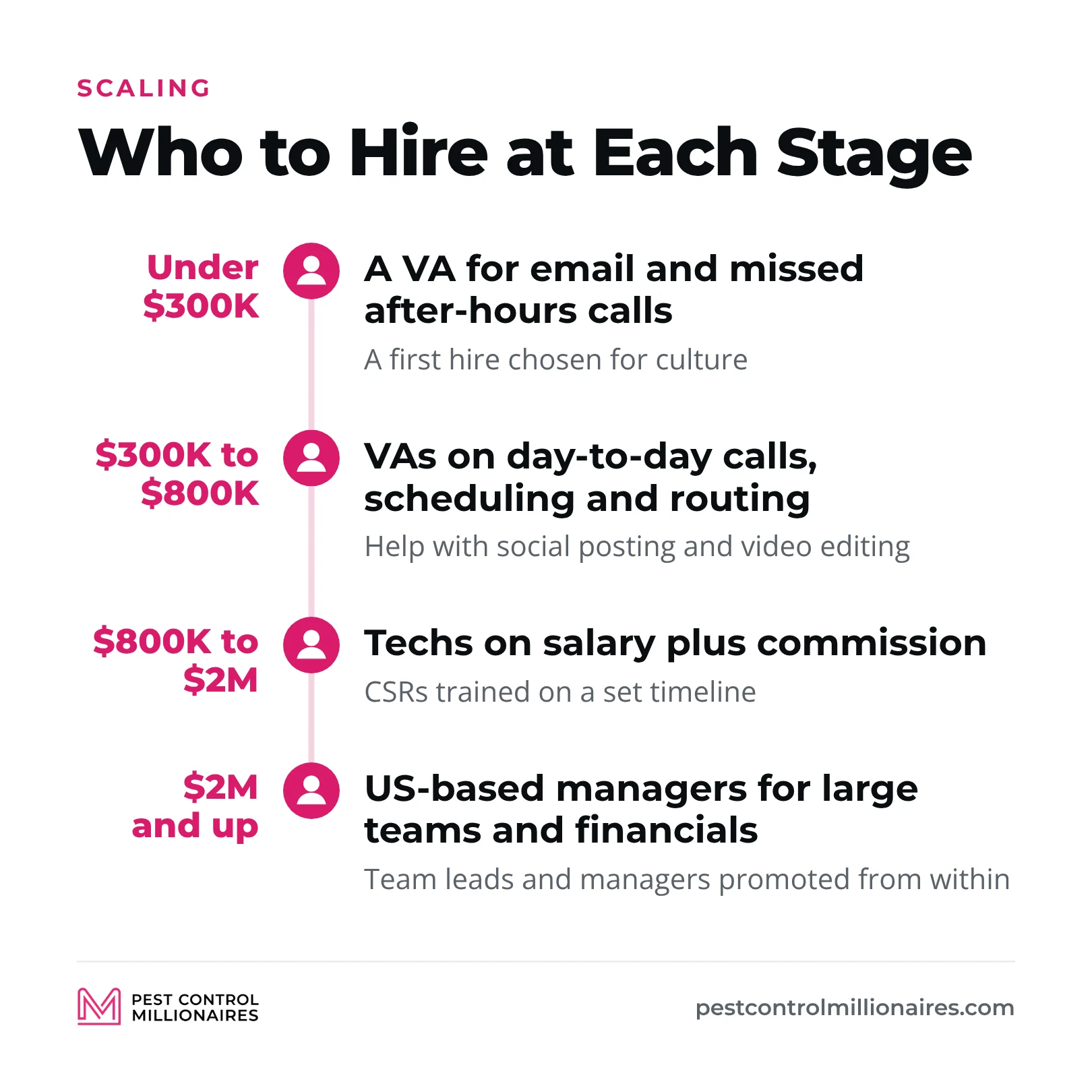
The second row is where most owners get stuck and where pest control business burnout sets in: $300K to $500K a year, 60 to 80 hours a week, answering phones at 8 PM and doing estimates on weekends.
Virtual Assistants: Your Secret Weapon for Scaling
A virtual assistant (VA) works for you remotely, in the US, Mexico, the Philippines or anywhere else, and can do almost any job that doesn’t need a truck: phones, scheduling, routing, billing, ordering chemicals from Veseris, even booking flights. My VAs do virtually everything, including calling every lead, and since they cost a fraction of a US hire, they can make far more follow-up touches.
I got into this out of panic. When my Kansas City CSR told me she wasn’t coming back after having her baby, a buddy said to try a VA. After trying people in Pakistan, India and Honduras through about eight companies, I found a staffing company in Mexico that worked. One VA became three, for the price of the one American CSR I’d lost. That’s still the math: about $25 an hour for a US CSR buys three equally skilled VAs in Mexico.
The catch is that a VA can’t succeed without scripts and SOPs. If your answer to “What do your CSRs say when people call in?” is “I don’t know,” write that down before you hire anyone. The brothers behind Southwest Weed & Pest learned the same lesson; their first VA was a grind to train, and today five VAs cover their office from 7 AM to midnight, seven days a week.
Everything on hiring, pay and management is in my pest control virtual assistant guide.
What Roles VAs Can Actually Handle
Start a new VA on simple tasks, like your email and the after-hours calls you’re missing. Then move them to day-to-day calls, scheduling and routing, and after that to ordering chemicals, inbound and outbound sales and lead follow-up.
Mexico vs Philippines vs USA
There are great people everywhere, but for pest control I’d hire in Mexico or the Philippines. Mexico is my pick for phones and sales: they’re close by, many speak Spanish, and they come across naturally to American callers. The Philippines can be even cheaper, with really high-quality people for back-office work.
| Where | Typical pay | Full time (40 hours a week) | Best for |
|---|---|---|---|
| United States | About $25 an hour for a CSR | About $4,330 a month | Managers, large teams, financials |
| Mexico | $5 to $10 an hour | About $870 to $1,730 a month | Phones, lead calls, inbound and outbound sales, Spanish-speaking customers |
| Philippines | $3 to $8 an hour | About $520 to $1,390 a month | Scheduling, routing, data entry, customer service |
The Domestic Advantage
US hires know our culture, and background checks are much easier. I’d keep every manager role, anyone running a large team and anything touching the financials in the US.
Responding to the “Cheap Labor” Criticism
Yes, I want to be more profitable, but wages should be judged against the local standard of living. If someone in Mexico makes $3 or $4 an hour and I pay $8 or $9, I’ve more than doubled their pay, and the Christmas cards thanking me for changing their family’s life mean a lot to me.
The Three-Step Vetting Process
Every VA goes through three interviews, and the higher the role, the more you vet. Interview one covers who they are, their background, their skills and weaknesses, plus a background check; interview two is a skills test with real call scenarios to see if they can think on the spot; interview three is one more skills check plus why they want the job and whether they fit the culture.
Tracking VA Performance
When the cat’s away, the mice will play, even with a great VA. I use Hubstaff to track their work minute by minute, so if a VA says they were scheduling at 3 PM, I can check their screen instead of wondering about Netflix.
Communication Tools
We run our teams in Slack channels, and WhatsApp works just like texting for quick messages.
My VA Story
Three VAs for the price of one CSR is why I ended up buying that staffing company with a buddy; now we help other owners find VAs, run the interviews and set up their communication channels. Full disclosure: I co-own NextGen Staffing, a virtual staffing company for pest control that sponsors PCM.
The Biggest VA Mistakes
The biggest mistake is poor communication, and it starts with having no systems. Before anyone hires a VA to take calls, I ask to see their script; without one for general pest, mosquito, termite and everything else they sell, the VA will fail, because nobody learns your business in a week without SOPs.
Where to Find VAs
You don’t have to go through my company; Upwork, Fiverr and OnlineJobs.ph (Philippines only) are all good places to find VAs. Vet them properly and set your communication standards up front, so you never find out two weeks in that “they picked their kid up at three o’clock and never told me.”
Strategic Partnerships: The Fastest Path to Growth
A strategic partnership is the fastest way I know to increase pest control revenue. You team up with a reputable local company that serves the same homeowners without competing with you, text each other’s customers, and both win. You get exposure fast, and it makes money while slower pest control marketing channels like SEO and ads ramp up. It’s the first thing I do in a new market.
My best partnership started as my worst mistake. At about 300 customers, I messaged a lawn care company on LinkedIn that didn’t do pest control and had about 4,100 customers. We partnered, and I texted their whole list in the first week. So many people wanted service that my team couldn’t get back to them in time, and we had to hire fast and get a loan for trucks. It worked out, and we’re still on good terms, but get your systems in place first and don’t text a big list all in one week.
Done right, a partnership is a cheat code: you can put on hundreds of accounts within 90 days. Pretty much everyone who goes through our Pest Control Millionaires program ends up with one. Member Couri Leuschner (lawn and tree care) has more than 15 partners and pays them $200 for every closed lead.
My pitch and the shared pipeline setup are in my strategic partnerships guide.
When Should You Start Partnering?
If you’re brand new, get a few clients and your systems and processes down first, because a good partner can send you more business than you can handle. Once your phones, scheduling and service can absorb a rush, go find one.
Which Businesses Make the Best Partners
Partner only with reputable companies (good reviews, ideally a few years in business) that will sign an agreement not to take each other’s customers, since you’ll share customer lists. Any service business that goes into the same homes can work.
| Partner type | Why it works | My take |
|---|---|---|
| Lawn care (no pest control) | Same homes, same buyer, no overlap | My top three |
| Moving companies | When a customer cancels because they’re moving, you send them to the mover | My top three |
| Pool cleaning | Same homeowners, same price point | My top three |
| Property managers | Manage lots of properties that need pest control | Great fit |
| Real estate agents | Work with buyers and sellers who need pest control | Great fit |
| HVAC, plumbing, roofing | Already in homes every day | Great fit |
Commission or Trade Exposure?
Pay commission; handshake deals (“I’ll send you business if you send me business”) leave most of the value on the table. We load the partner’s customer list into GoHighLevel and text their customers on their behalf (“Hey, my name is John, I’m with ABC Lawn Care, and we just partnered with Green Day Pest Control”) with a coupon, so both companies see every message.
How to Track Partner Referrals
Give your partner a login to the same pipeline, send the offer by text, and record calls on both sides so everyone can see what closed. If you’re the smaller company (say 300 customers to their 4,100), sell them on the dream: you’ll grow by thousands of accounts and send them every customer who needs their service. You only need one good yes in town.
Email Lists vs Text Lists
Get the texting list if you can, because people respond to texts more than email; an email list still works if it’s big enough. If a partner has no CRM, export their customers to a spreadsheet, save it as a CSV and upload it to GoHighLevel.
Red Flags to Avoid
Walk away if their reputation is bad (look for 4.5 stars or better on Google) or if they won’t sign the agreement. If they only have ten or so customers, look for a bigger company.
Success Stories
One member of our class landed a partner with a list of 12,000 customers; if just 1% converted, that’s 120 new customers for a company that had about 800 to 1,000 at the time. Line up four partners (say pool cleaning, HVAC, lawn care and moving) and you’ve built your own referral group in town, like BNI without the 8 AM meetings.
Common Mistakes
The two biggest mistakes are no transparency and handshake deals: you need software you both can see, and you need to text each other’s customers instead of trading business cards. Don’t worry about bothering customers; Jonas and I contact ours all the time, and people care far less than you think.
Training Team Members: Building the System That Scales
Training sounds basic, but a lot of companies throw a new hire into the job and then complain that they’re doing it wrong, when the real problem is how little training happened. Over-train people. Build every SOP and every training so a third grader could follow it; that isn’t demeaning, just simple.
Jonas Olson runs 20 locations, so a lot of this section is his. His biggest lesson: “The further the service got away from me, the worse it got.” He trained a manager, that manager trained the next one, each handoff dropped a few things, and when he went back out on ride-alongs he couldn’t believe how far it had drifted. The fix is the same recorded training for everyone, so a tech at any location says the same things, starts in the same spot in the house and services the same way, just as every McDonald’s follows the same recipes.
CSRs train for about two weeks before they take a call, and techs ride along for three weeks to a month and go solo around week five. Record every call, and review a new CSR’s calls with them daily for the first two months.
The rest, including how to train for culture as well as skills, is in my guide to training new pest control team members.
The Ideal Onboarding Timeline
Here’s the onboarding Jonas described, laid out as one timeline for each role. Even a tech with 15 years in the field does the ride-alongs, partly so they learn to get around your city.
| Week | CSR or inside sales rep | Technician |
|---|---|---|
| 1 | Handbook, online training and common questions; listens to past and live calls with the CSRs and sales team; daily Zoom check-ins start (no phones) | Three to five days in the office on culture, the career path, training videos and basic tests; licensing or certification if your state requires it |
| 2 | More training and call listening (no phones) | Ride-alongs with the lead technician |
| 3 | Takes live calls with a CSR or the office manager sitting with them | Ride-alongs with the lead technician |
| 4 | Same as week 3 | Runs the route with a manager riding along to check quality |
| 5 | Takes calls alone | Services alone, with branch manager spot checks all week |
| After that | Daily Zoom check-ins and call reviews through month two, then weekly, every two weeks and monthly for good | Spot checks for good |
Technical Skills vs Company Culture
Technical skills are the easier part: the books, lots of time with the lead technician, and expert help (Jonas keeps entomologists on retainer and records their sessions for training). Culture is harder; Jonas can walk into any of his branches and feel when it’s off. Build it with constant talk about core values, a morning huddle at every branch and proof that you care; employees won’t care until they know you do.
Start Culture Early
Culture starts with your first hire, so hire people you’d want to hang out with; you spend more time at work than at home. When a friend called Jonas complaining about his own company, Jonas told him “Well, then fix it,” and the friend admitted nobody had ever told him that. You own the company; if you don’t like something, fix it.
Pre-Recorded Training Videos
Put every role’s training on one platform, Trainual or whatever you use, so everyone gets the same videos, systems, processes and scripts, and train your trainers too (Jonas pays for coaches for his whole executive team). It works like a franchise model: every Chick-fil-A team says the same things and uses the same equipment, so you always know what you’ll get.
The Biggest Training Mistakes
The biggest mistake is not training enough, or at all. Jonas has walked into his own offices and heard “we don’t do that here” about steps nobody had shown them. If you’ve stepped back from the business on the way to $1 million, spend a week each with your CSRs, marketing team and retention department, and a week on ride-alongs.
Standard Operating Procedures
Write your SOPs while you’re small (it doesn’t get easier as you grow), and let ChatGPT draft the first version. Jonas paid a consulting firm to write all of his and is still glad he did. Don’t overbuild them, because what works at $300,000 won’t work the same at $800,000, and what works at $800,000 won’t work at $2 million.
Delegating Marketing: Getting Out of the Weeds
Most owners are already servicing accounts, answering phones and wearing every other hat, and marketing is the last thing they want to do. That’s exactly why it belongs on your delegation list: you can’t focus on growth if you’re focused on the day-to-day tasks.
My order is social media posting first (a VA can take it over almost right away), then video editing (neither Jonas nor I edit our own videos), then SEO. You can handle basics like your Google Business Profile, but off-page SEO gets technical fast. Ads are different. Most owners can learn pest control Facebook ads in a couple of hours, and I still run my own because I’m good at them. Google Local Services Ads are easy to set up yourself, while Google Ads for pest control are worth handing to someone who runs them well.
Dan Leibrandt, our SEO and Google Ads guy at PCM, has a simple rule: under about $500K a year, put your effort into your Google Business Profile and LSAs, plus cheap channels like door knocking, Facebook groups and referrals; past about $500K, add Google Search ads and SEO.
Whatever you hand off, learn enough to follow the conversation (click-through rate, cost per lead, customer acquisition cost, organic versus paid). My full playbook is in how to delegate marketing tasks for pest control.
Which Marketing Tasks to Delegate First
Social posting first, video editing second, SEO third. Keep Facebook ads and LSAs if you like running them, and hand Google Ads (pay-per-click) to someone who’s good at them; Upwork and Fiverr have some effective people.
Ensuring Quality After Delegation
Check your numbers: if cost per lead jumps after you hand off ads, catch it fast. Hubstaff shows me what each VA worked on during the day, and our training platform shows whether someone who says “I watched module three” really did.
Agency vs In-House
There’s a time and place for both. Bringing work in-house can save tens of thousands of dollars, and every owner should know a little about everything, both to avoid getting burned and to understand their own business; SEO is where an outside specialist usually makes the most sense, because it’s technical and hard to hire for.
The Advantage of Hiring an Agency
An agency’s real advantage is focus: a team that only does SEO for pest control companies, like Dan’s agency Pest Control SEO, has seen what works across many of them. If you’re an owner with two techs and no time, or you don’t want to learn this stuff, an agency for Google or Facebook ads may be the better use of your time.
The Downsides of Agencies
Many agencies don’t specialize in pest control, and some charge $2,500 a month for Google Ads with no idea whether you’ll get leads, so ask for client results, testimonials and some kind of guarantee. Then check your own sales funnel before you blame them; when I ran my agency, clients said “your leads suck” when they hadn’t called those leads in four days.
How SOPs Help Scale Marketing
Without SOPs, training becomes the telephone game: your first CSR half-remembers the pitch and teaches the second one even less. When I built my agency, every Facebook campaign was copy-paste, with the same targeting, copy and headline, because we knew it worked.
Tracking Marketing Performance
Watch your ad performance, and above all cost per acquisition and return on ad spend. Every platform has its own dashboards, but the real question is whether you’re getting customers profitably.
The Biggest Delegation Mistake
The biggest mistake is delegating without SOPs. Write every role at a third-grade level with every script laid out, so that if you left for Italy tomorrow, your team would know exactly how each job runs and what to say in any situation.
Hiring A Players: Building Your Dream Team
Jonas Olson says it all the time: A players bring other A players, and they don’t like working with B and C players. Not everyone is an A player every day, but that’s who you’re hiring for.
Watch the first-hire trap. Every time I’ve started a company, I was sure my first employee would be with me forever and become a partner someday. That person can usually only take you so far, so pick well, but don’t hand them half the company.
I hire for attitude, because you can train skills but not attitude. I want people who are relentless, competitive (athletes often do well, but so does anyone with a competitive streak) and putting in work outside of work, like reading, going to events and getting certifications. Those people become your managers. You also have to be an A player yourself; John Maxwell’s law of the lid says a leader who’s a six or seven can only lead a five.
My best hires came to us or were referred by our own team, not from Indeed or ZipRecruiter. To keep them, pay for performance, give every tech a way to make six figures and show a clear path from tech to partner. And always be recruiting, because the most common mistake is hiring a C player out of desperation.
The full playbook is in my guide to hiring A players for pest control.
The Traits of A Players
A relentless mindset and a good attitude come first; we don’t want complainers or whiners, and Jonas has a sticker on his office door that says “No negativity beyond this door.” Hire for attitude and culture, then show A players a clear path to their big goals.
You Have to Be an A Player First
If you show up with a bad attitude, don’t go the extra mile for customers and don’t knock that extra door, you’ll attract B and C players. Lead from the front and keep working on yourself.
Where to Find A Players
Build the right culture and they’ll come to you; Jonas taught me that. A players want to work with their friends, so your best hires will come from referrals by the A players you already have.
The Three-Interview Process
We run a rigorous three-interview process that includes a skills assessment and a culture-fit check. I ask about the hardest thing they’ve done, their biggest obstacle and their goals, and I look for people who can think on the spot, want to learn, help their teammates and have empathy for customers and coworkers.
Compensation and Growth Opportunities
We pay techs salary plus commission (a switch I made after talking it through with Jonas) and reward reviews, sales and referrals. Lazy people never hit pay-for-performance numbers and weed themselves out, while the ones who stay say things like “I want every one of my friends to come work here.” Every tech has numbers to hit to move up, from team lead to branch, regional and district manager and eventually partner.
Painting the Vision
Before the sit-down interview, we give each candidate a couple of minutes with a sheet showing our vision (the offices, the trucks, all of it), so they’re already picturing where they fit when we start talking.
The Biggest Hiring Mistakes
The biggest one is hiring a C player because you need someone right now, after someone quits or no-shows and there’s nobody on the bench. Always be recruiting (ABR): keep interviewing when you’re not hiring, and trade numbers with the great server or bartender who took care of you.
The Top Grading Strategy
When you meet an A player and have a C player on the team, hire the A and let the C go. I met two college athletes at a Pieology counter who hated the job and were great with customers; we swapped numbers, and now they’re going to knock doors for us.
The Hundreds List
The hundreds list is an old recruiting method: put 100 people from your phone contacts and social accounts in a spreadsheet, pick the 10 who’d be great at the job and reach out. Have every new hire make their own list; with five people on the team, that’s 500 names before you even post on Indeed.
The System That Ties It All Together
Scaling isn’t about working harder or doing more yourself. You can’t scale yourself; you can only scale systems, and most owners don’t have any. They have a job where they happen to be the boss.
Each piece of this guide does one job:
- Virtual assistants take phones, scheduling and routing off your plate for a fraction of what a local hire costs.
- Strategic partnerships put you in front of thousands of potential customers without paying for ads.
- Training keeps quality the same as you add people and locations.
- Delegating marketing frees you to work on the business instead of in it.
- A players run all of it at a level that lets you sleep at night.
None of it works without SOPs, and you can’t hire A players without a vision and a path for them to grow. Doing more of what got you here (more routes, more hours, more hustle) isn’t scaling; it’s just getting bigger and more tired. Real scaling is when you can take a two-week vacation and come back to a business that grew while you were gone, because you’re not the bottleneck anymore.
For the software side, see the pest control business software Jonas would set up first. The complete blueprint is in our book, Zip Code Kings.
Frequently Asked Questions
What is the difference between growing and scaling a pest control business?
Growing is getting bigger by doing more yourself, with more routes, more hours and more hustle. Scaling is getting bigger through systems and people, such as scripts, SOPs, VAs, partners and trained managers, so revenue keeps rising while your hours don’t.
At what revenue should a pest control company start scaling?
Start building systems while you’re small: a script for every service, simple SOPs and call recording. Most owners hit the wall at $300K to $500K a year, working 60 to 80 hours a week, and handing the phones to a VA is the first step out. Expect to rebuild those systems around $800K and again around $2M.
How do I build a management team for my pest control company?
Promote from within: give every tech and salesperson the numbers they need to hit to become team lead, branch manager, regional manager, district manager and eventually partner. Hire managers of large teams or the financials in the US, then train your trainers and give your leaders coaches.
What systems do I need to scale a pest control business?
You need written scripts and SOPs for every role, a recorded training platform such as Trainual, a CRM such as GoHighLevel for leads and partner campaigns, call recording, Slack or WhatsApp plus Hubstaff for remote staff, and a few KPIs such as cost per acquisition and return on ad spend.
How do I maintain service quality while scaling pest control?
Give every new tech three weeks to a month of ride-alongs before they go solo, then keep spot-checking for good. Put everyone on the same recorded training, review recorded calls and hold a morning huddle at each branch, because the further service gets from the owner, the worse it gets.
Can I scale a pest control business to multiple locations?
Yes, if every location runs the same way. Record your training so every tech says the same things, starts in the same spot in the house and services the same way, give each branch a morning huddle and a manager doing spot checks, and line up a strategic partner first when you enter a new market.
What is the hardest stage of scaling a pest control business?
The stuck stage, usually $300K to $500K a year, when the owner is still the tech, salesperson, scheduler, marketer and billing department and working 60 to 80 hours a week. This is where pest control business burnout sets in. The way out is writing scripts and SOPs, then handing the phones, scheduling and routing to a VA.
When should a pest control company hire its first full-time office manager?
Hire a VA first. Start them on after-hours calls and email, then day-to-day calls, scheduling and routing, at $3 to $10 an hour overseas versus about $25 an hour for a US CSR. When you need someone to manage a large team or the financials, hire that person in the US.
Related Articles
- How to grow a pest control business by maximizing customer lifetime value
- Pest control KPIs: the numbers to track as you scale
- Why your first pest control hire should not be a tech
- Jonas’s 25 pest control business tips from running 20 locations
- The $3 million inside sales leak Jonas found at Pest Badger