How Much to Pay for a New Pest Control Customer (My Real Numbers)

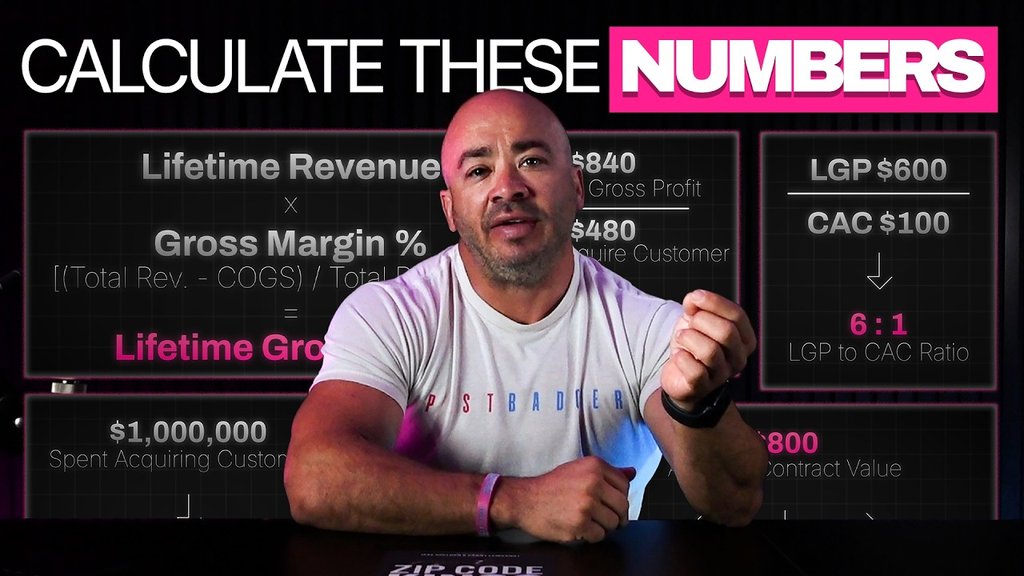
Table of Contents
- Start With Gross Profit, Not Revenue
- What the Ratio Tells Me to Do
- Why a Blended Number Can Fool You
- Why I Still Pay $480 for a Door-to-Door Customer
- Stop Asking What Percentage of Revenue to Spend on Marketing
- The Payback Period Decides How Fast You Can Grow
- How to Calculate Your Own Numbers
- The Four Numbers I Want for Every Channel
- Frequently Asked Questions
One of our biggest customer acquisition channels at Pest Badger costs us about $480 per customer. Google brings us customers for around $100. And I still spend millions of dollars on the expensive one.
That sounds like a terrible business decision, but there’s a reason for it. Our blended LTV to CAC ratio is 8.8 to 1. We spend about $96 to acquire a customer who’s worth about $840 in lifetime gross profit. If you own a pest control company and don’t know these numbers, you don’t really know how much you can afford to spend to grow.
These are our real numbers from when this video came out in October 2026. I’d been in the service industry for 17 years by then, and we were in our sixth year of building Pest Badger, with 20 locations.
This video is part of PCO Tips. If you want the basics first, read customer acquisition cost for pest control.
Start With Gross Profit, Not Revenue
LTV is the lifetime value of a customer. CAC is your customer acquisition cost, what it costs you to get that customer. A lot of owners don’t know either one, or they calculate them in a way that makes the business look better than it is.
When I decide how much I can afford to spend on a customer, I don’t care about the revenue they bring in. I care about the gross profit. If a customer pays you $1,000, you don’t really have $1,000, because you still have to go service them. There’s technician labor, product, fuel, vehicle expenses and merchant fees. I want to know what’s left after we deliver the service.
For us, the average customer produces roughly $840 of lifetime gross profit. Our blended CAC across all of our acquisition channels is $95.86. Divide $840 by $95.86 and you get 8.76, so call it 8.8 to 1. For every dollar we spend to acquire a customer, we get roughly $8.80 back in lifetime gross profit.
What the Ratio Tells Me to Do
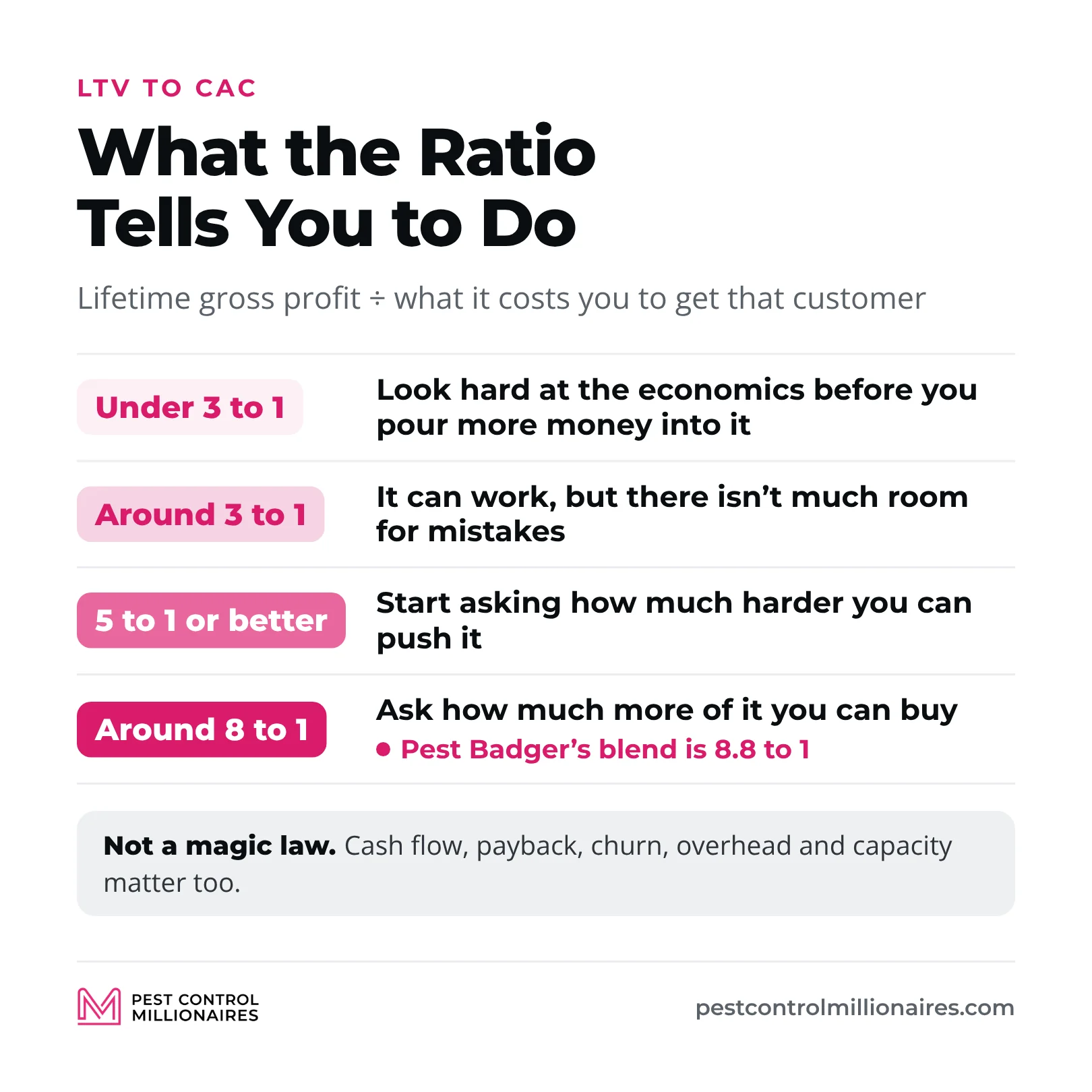
You’ll hear 3 to 1 thrown around as the benchmark. Here’s how I read a channel’s ratio.
| LTV to CAC | What I do with that channel |
|---|---|
| Under 3 to 1 | Look hard at the economics before I pour more money into it |
| Around 3 to 1 | It can work, but there isn’t much room for mistakes |
| 5 to 1 or better | Start asking how much harder we can push it |
| Around 8 to 1, like our blended number | Ask how much more of it I can buy |
At 8 to 1, my first thought isn’t how do I lower my marketing spend. It’s how much more of this can I buy?
Those numbers aren’t a magic law. Cash flow matters, and so does your payback period. Churn matters, because if you’re losing customers out the back end, it doesn’t make sense to keep pouring them in the front. Overhead matters. Capacity matters too. If you got 100 new customers, could you actually service them? But if you’ve never looked at your LTV to CAC, that benchmark gives you somewhere to start.
Why a Blended Number Can Fool You
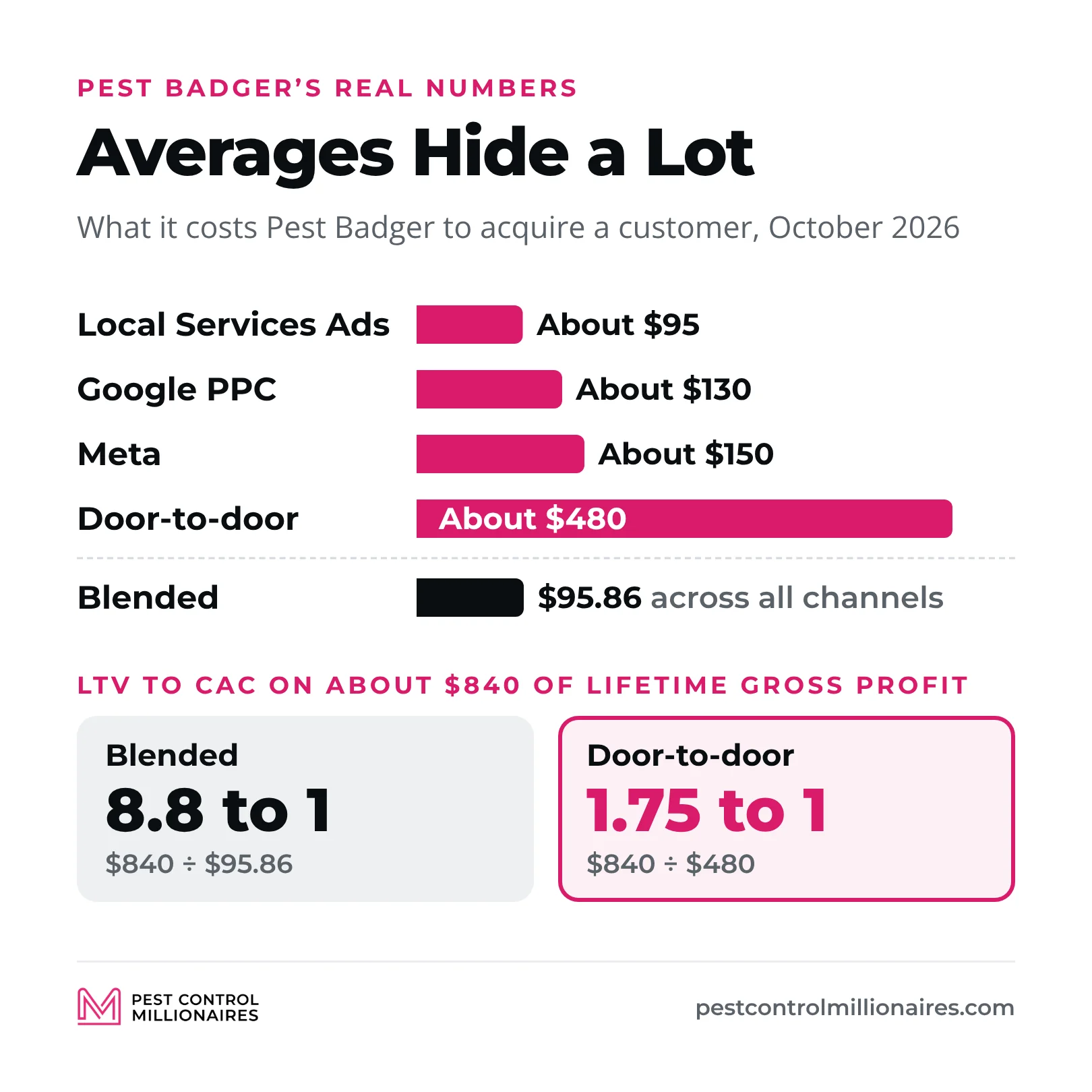
An 8.8 to 1 blended ratio sounds awesome. Break it apart by channel and it tells a different story.
| Channel | What it costs us to acquire a customer |
|---|---|
| Local Services Ads | About $95 |
| Google PPC | About $130 |
| Meta | About $150 |
| Door-to-door | About $480 |
| Blended, across all of our channels | $95.86 |
Door-to-door costs so much more because of the way we pay our salespeople. Run the math on that channel by itself. A customer worth $840 in lifetime gross profit who costs $480 to acquire is 1.75 to 1. You’d never see that if all you looked at was our blended 8.8 to 1.
Averages hide a lot. One channel can be absolutely crushing it while another one is eating your lunch.
Why I Still Pay $480 for a Door-to-Door Customer
So why spend millions on door-to-door at 1.75 to 1 when Google brings us customers for around $100? Because they don’t do the same job.
If I open a brand new Pest Badger location tomorrow, I can’t just tell Google, “Hey, I need 2,000 customers in this service area. Please send them on over.” Nobody knows who we are yet. We don’t have Google reviews, Pest Badger trucks driving around town or years of search history building up our SEO. And only so many people are searching Google for pest control on any given day.
Door-to-door lets us create customers instead of waiting for inbound leads. I can put 10, 15 or 20 sales reps into a market and build thousands of customers much faster. I walk through a full day with that team in how we run a pest control door-to-door sales team.
All those customers create route density. Instead of a technician driving all over the place to service a handful of customers, we’re stacking hundreds of customers into the same area. Routes get tighter, drive time comes way down, and we get more trucks on the road. People start recognizing the brand and the pink trucks, we build up reviews and customer referrals, and the market gets easier. When you first start up on Google, it’s a customer here, then here, then here, and your technicians have so much windshield time that it’s hard to make any profit.
Do I love paying $480 for a customer? No. I’d much rather pay $95. But I’ll pay more for the channel that builds a market faster than a cheaper one can.
Stop Asking What Percentage of Revenue to Spend on Marketing
People ask me all the time how much to spend on marketing every month. Is it 5%? Is it 10%? I don’t look at marketing that way.
If I could spend a million dollars in a month acquiring customers and the economics stayed at 8 to 1, why would I stop because I hit some arbitrary percentage of revenue? I wouldn’t. What I want to know is how much cash we have, how quickly we get it back, whether we can service all those customers and whether the economics hold if we keep spending. If all of that works, I want to spend as fast as possible.
You can’t double your spend forever and assume your CAC never moves, though. I promise it will. You use up the easiest opportunities, and your CAC might go from $100 to $120, then maybe $150, then past $200. At some point the economics change enough that I stop pushing that channel. I’m watching the economics so they can tell me when to stop, not an arbitrary percentage.
So when somebody asks what percentage of revenue to spend on marketing, I think they’re asking the wrong question. Ask what you can profitably pay to acquire a customer. If I can profitably pay $300 for a customer and the company competing against me can only afford $100, I’ve got a lot more room to go get customers than they do.
The Payback Period Decides How Fast You Can Grow
I also need to know how quickly I get my money back. That’s the payback period, and it matters because you can have an awesome LTV to CAC ratio and still run yourself out of cash.
Say I spend a million dollars acquiring customers and they eventually produce eight million dollars of gross profit. Sounds amazing. But what if it takes three years to collect? I still have payroll next Friday, trucks, rent and all the same bills.
Now say I spend $100 on a customer and get it back really fast, maybe the same day, maybe on the first service. I can take that money, buy another customer, and do it again and again. That’s why two companies with the exact same LTV to CAC ratio can have completely different abilities to grow. Company A gets its cash back on day one and has enough to keep reinvesting. Company B takes two, three or four services to get its cash back and is always starving for cash.
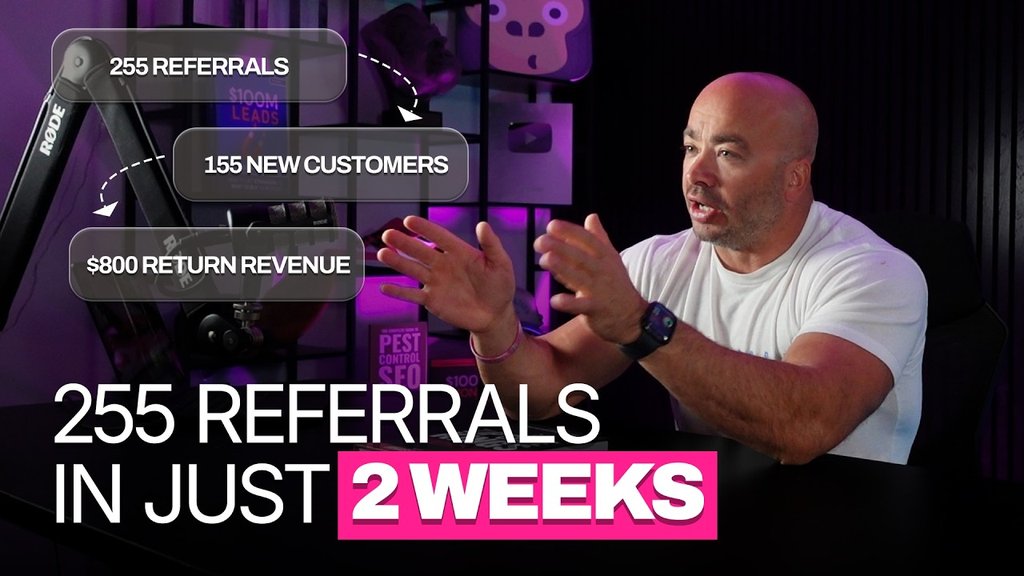
It’s also why I love referrals. We ran a referral campaign at Pest Badger that generated 255 referrals and 155 sales. We paid customers about a dollar when someone clicked their referral link and something like $50, $75 or $100 when a referral became a customer. Not a credit, either. Real money, sent through Venmo, Cash App or whatever app they used.
How to Calculate Your Own Numbers
- Figure out what your average customer is worth. Take your average annual contract value, then figure out how long customers actually stay with you. Not how long you hope they stay. If you’ve been around a while, use your churn data. If you’re newer, use market averages until you have your own numbers. Say a customer pays you $800 a year and stays for multiple years. Now you can calculate their lifetime revenue.
- Turn it into gross profit. Apply the real gross margin from your P&L to that lifetime revenue. If you don’t know that number, can’t find it or don’t trust it, fix that first, with a fractional CFO or your CPA. Otherwise nothing you calculate after this means much.
- Work out your CAC. Pick a period, like a month, and look at what you actually spent acquiring customers. Spend $10,000 on Google in a month, get 100 new customers, and your CAC is $100.
- Divide one by the other. Lifetime gross profit of $600 against a $100 CAC is 6 to 1.
- Do it for every channel. Google, Local Services Ads, Meta, door-to-door, door hangers, whatever you use. Blended, we’re at 8.8 to 1, and door-to-door by itself is 1.75 to 1.
There are two places I see people mess this math up. The first is using revenue as LTV. A customer who pays you $2,000 over their lifetime isn’t worth $2,000 to you, because you still had to do the work. Use gross profit. The second is leaving acquisition costs out of CAC. If you pay a salesperson a commission, you can’t just look at what the lead cost in your Meta account. That commission came out of your bank account too, so count it.
The Four Numbers I Want for Every Channel
When you’re done, I want four numbers for every major acquisition channel.
- The lifetime gross profit of the customer
- What we paid to acquire them
- The ratio between those two
- How long it takes to get our money back
With those, I can find the actual problem. Maybe we’re paying way too much for a customer. Maybe the acquisition cost is fine, but we’re losing customers on the back end. Maybe our pricing is too low, or our margins are bad and we have to raise prices. Or maybe one channel is crushing it and we’re barely spending any money on it. I want to know that before I decide what our marketing budget should be.
Our pest control KPIs guide covers the rest of the numbers we watch, and marketing KPIs for pest control covers how we track leads, close rates and CAC by source.
If you’ve never done this for your company, do it now, and don’t overcomplicate it. Stop asking what percentage of revenue to spend on marketing. Ask how many customers you can go profitably buy, and how fast. That’s the number I care about.
Frequently Asked Questions
How much should a pest control company pay for a new customer?
As much as you can pay profitably and get back fast enough to keep reinvesting. Know each channel’s lifetime gross profit per customer, cost to acquire a customer, ratio and payback time. At Pest Badger, a customer worth about $840 in lifetime gross profit costs about $96 blended, an 8.8 to 1 ratio.
What is a good LTV to CAC ratio for pest control?
The benchmark you’ll hear most is 3 to 1. Below it, look hard at the economics before spending more; around it, a channel can work with little room for mistakes; at 5 to 1 or better, push harder; and around 8 to 1, ask how much more you can buy. Cash flow, payback, churn, overhead and capacity matter too.
How do you calculate LTV to CAC for a pest control company?
Multiply your average annual contract value by how long customers actually stay, then apply the gross margin from your P&L to get lifetime gross profit. Divide what a channel cost you in a period, sales commissions included, by the new customers it brought in to get CAC. Then divide lifetime gross profit by CAC, so $600 against a $100 CAC is 6 to 1.
Is door-to-door worth it if it costs more per customer?
It can be. Door-to-door costs Pest Badger about $480 per customer, a 1.75 to 1 ratio, against about $95 on Local Services Ads. But 10 to 20 reps can build thousands of customers in a new market much faster than inbound leads can, and that route density brings tighter routes, reviews and referrals.
What percentage of revenue should a pest control company spend on marketing?
I don’t set marketing as a percentage of revenue. I want to know what I can profitably pay for a customer, how fast I get the money back, whether we can service the customers and whether the economics hold as we spend more. When CAC climbs far enough that they don’t, that’s when I stop.