Pest Control Offers: How to Structure Pricing That Gets You $850+ Per Customer

Table of Contents
- Why Most Pest Control Companies Price Themselves Into Poverty
- Service Plans: Why Recurring Revenue Changes Everything
- The $850 Benchmark: What Should You Actually Charge?
- Structuring Your Service Packages: The A, B, C Framework
- The Life-Changing Pricing Realization
- Creating Irresistible Pest Control Offers (Without Discounting)
- The 6 Components of a High-Converting Offer
- Guarantees That Actually Work (Without Saying “Guarantee”)
- Using AI to Build Your Offers (The Right Way)
- Tailoring Offers: New Customers vs. Existing Customers
- Your 12-Month Pest Control Marketing Calendar
- Applying This Framework Everywhere
- The Widgets Concept (What Dan Kennedy Taught Me)
- Final Thoughts: Stop Leaving Money on the Table
- Frequently Asked Questions
- Related Articles
Pest control offers that get $850 or more per customer have three parts: a recurring plan (monthly, bi-monthly or quarterly, never one-time), three packages where most people pick the middle one, and a value stack of free add-ons instead of a discount. Set your pest control pricing from your own numbers, raise prices 3 to 5% every year, bill so you get your acquisition cost back fast, and time every promotion to pest pressure with a 12-month marketing calendar. I see companies making $200 per customer that could make $850 with the same work. I built Pest Badger to over $20 million a year, and this is how we price.
Why Most Pest Control Companies Price Themselves Into Poverty
Most pest control companies are broke because they price like technicians, not CEOs.
The Technician Mindset Trap
Most owners ran a route for someone else, decided they could do it on their own and then undercut their old company’s prices. They price by averaging their competitors and landing in the middle or at the bottom. But you know the service like the back of your hand, and people should pay for that knowledge. I cover how that mindset shows up in your name, trucks and look in the branding chapter.
Why Low Pricing Kills Your Growth
Cheap prices seem fine when it’s just you in your own truck with no payroll. Then you need a second truck, a technician, a CSR, more product, taxes and software, and there isn’t enough money left at the end of each service to pay for it. It’s hard to hire another technician if the math doesn’t work.
People Buy Value, Not Price
The more value you give customers, the easier it is to sign them up. People buy on value, not on price. If you’re competing on being the cheapest, you’re fighting a losing battle.
I don’t like giving discounts, because as soon as you give someone a discount, that same customer always wants a discount. They see you as a discounted service, and they have no emotional buy-in. The higher the price you charge out of the gate, the more attached they get. When it hurts a little, they think, “Ooh, they must be charging those prices for a reason.” Give them something super cheap and then expect them to see you as premium? That’s not how psychology works. I go deeper on this in my guide to pest control premium pricing.
Service Plans: Why Recurring Revenue Changes Everything
Your service plan structure is the foundation of everything else in this guide. I go deeper on plan design in my guide to building a pest control service plan.
The One-Time Service Problem
I don’t like one-time services. A lot of newer owners start that way, and plenty of older companies, especially in the Midwest, still sell one-time or twice-a-year service. Those customers can still count as recurring when you sell the company, if they’ve come back for three, five or ten years. But I want my customer acquisition cost to pay off, and that means making each customer’s lifetime value as high as possible.
The Math That Makes Recurring Essential
Here’s a real example from a company I bought. They had 1,400 customers worth about $650,000, roughly $464 each. The same number of my customers, 1,400, were worth about $1.5 million, roughly $1,070 each. Same number of customers, more than double the revenue, because mine were on recurring plans with higher lifetime value.
You have to go get customers anyway. If you’re going to get 1,000 customers, do you want them to be worth $600,000 or $60,000? It’s up to you. You know what I’d do.
What Recurring Actually Means
As long as it’s recurring, I don’t care which schedule you use:
- Monthly service
- Bi-monthly service
- Quarterly service
The key is that it’s automatic and ongoing. You keep showing up on the schedule until the customer cancels.
Why Customers Want Recurring Too
Customers hire us to prevent problems before they start. Most people think of pest control as reactive: “Crap, I have an issue, come take care of it.” The right message is, “Get pest control so you never have to deal with it.” Whether it’s termites, inspections or exclusions, they’re paying for peace of mind, a safe house and a safe family. I tell people to sell it like insurance for the home. A recurring plan means we show up every 30, 60 or 90 days so they never have an issue to begin with.
The $850 Benchmark: What Should You Actually Charge?
The number I use is about $850 a year per customer. That isn’t from a study. It’s what I see running Pest Badger, where our average contract is roughly $1,000, and across the many owners I’ve interviewed and coached. If you’re above $850, you’re doing pretty good. If you’re below it, rethink your offer. I’ve seen companies charging $300, $200 or even less per year. If this one section changes how you price, it’s worth it.
Here’s what $850+ looks like with the numbers in this guide:
- Package B, pest control plus mosquito. A $240 initial service, then $210 a quarter. The first 12 months come to $870 ($240 plus three quarterly services at $210). Every year after that is $840, or $865 to $882 once you add a 3 to 5% yearly increase.
- Add one upsell. A mosquito plan sold off a free first treatment, rodent bait stations in the fall or termite bait stations raise the same customer again with no new acquisition cost.
- Price from your own numbers. Your cost of goods, your operating expenses and the profit you want. I walk through that three-step math in my pest control pricing breakdown.
Monthly vs. Quarterly vs. Annual Billing: The Cash Flow Trade-Off
How you bill decides how fast you get your money back. Selling pest control subscriptions at $67 or $70 a month is easier than selling a $210 quarterly service. But monthly subscription billing has the highest cancellation rate. Alex Hormozi’s team looked at over a billion dollars of revenue, and monthly subscriptions canceled at about 12.5%, quarterly billing at about 6% and prepaid at 2%. Everyone has subscription apps now, and a pest control charge every month is an easy one to cut when they aren’t seeing bugs. When I checked that against our own customers, we moved every new customer to quarterly billing the same day. I break down how we keep those customers in my guide to selling pest control subscriptions.
Here’s how the three options compare:
| Monthly subscription | Quarterly billing (how we bill new customers) | Annual prepay | |
|---|---|---|---|
| What the customer pays | $67 to $70 a month | A $240 initial, then $210 a quarter | The whole year up front, about $850 at the benchmark |
| Value per customer | About $840 a year | About $870 in the first 12 months, then $840 a year | About $850, all on day one |
| When you get back what you spent to win them | Around the third month | Sooner, because the $240 initial comes in on day one | The day they pay |
| Cancellation risk | Highest, about 12.5% | About 6% | Lowest, about 2%. Prepaid customers almost never cancel mid-year |
| Best for | The easiest yes | Cash up front and fewer cancellations | Cash flow and retention |
With monthly billing at $70, you wait until about the third month to get back what you spent on the lead and the first service. That’s why I like the bigger payment up front, and why prepaid is best. If a customer won’t prepay, bill quarterly or charge the card on file as soon as each service is done.
The Coke Machine Analogy
Think of it like a Coke machine. Every time you put in $100, it gives you $850 back.
Everyone asks me what to spend on marketing. A lot of companies set it as a percentage of revenue, 8 to 10%, or 15% or more when they’re pushing hard to grow. I don’t. My thing is this: if I could put $100 in and get $850 back, I’d keep doing it over and over again. The only question is how much I can afford to keep doing it.
The problem is usually cash flow. You can’t get the money back fast enough. In lawn care, prepaying the year is normal. In pest control it isn’t as common, but in mosquito control a lot of companies reward customers for prepaying the year. When a customer prepays, it’s like putting $100 in the machine and getting $850 back that same day. That’s how you get your customer acquisition cost back as fast as possible.
Why Prepayment Offers Work
People will prepay for the year if you give them a reason. That isn’t a discount on the work. It’s a trade for cash up front, and I build it into the regular price so it doesn’t cost me margin. It can be a small percentage with a deadline, like “pay by February 3rd and get 3% off,” a free add-on like a mosquito or flea and tick treatment, a simpler way to pay or a locked-in rate. Make the offer at the last service of the year, while customers are happy with you, the way TruGreen does. A spring letter gets people thinking about canceling right when they shop around. At one of our locations, 60% of customers prepay the entire year, and that cash pays for our products and marketing before spring.
Tateum O’Hanlon at Summit Pest Control flips it around. He quotes the full year first, and only brings out a per-visit price, which costs more, if someone pushes back.
Structuring Your Service Packages: The A, B, C Framework
Don’t wing it on pricing. Structured packages guide customers to the right choice.
Why You Need Three Options
I like three clear service packages: A, B and C. Customers usually pick B. That’s human psychology. They don’t want the cheapest, and they don’t want the most expensive. They want the middle option.
| Package | What’s in it | What it’s for |
|---|---|---|
| A (Basic) | Basic pest control. Exterior service and interior as needed, monthly, bi-monthly or quarterly | The entry point |
| B (Recommended) | Pest control plus one more service, like mosquito control or flea and tick | Where most customers land, so make it your best value |
| C (Premium) | Everything bundled: pest control, mosquito, flea and tick, even fertilization and weed control | The highest lifetime value |
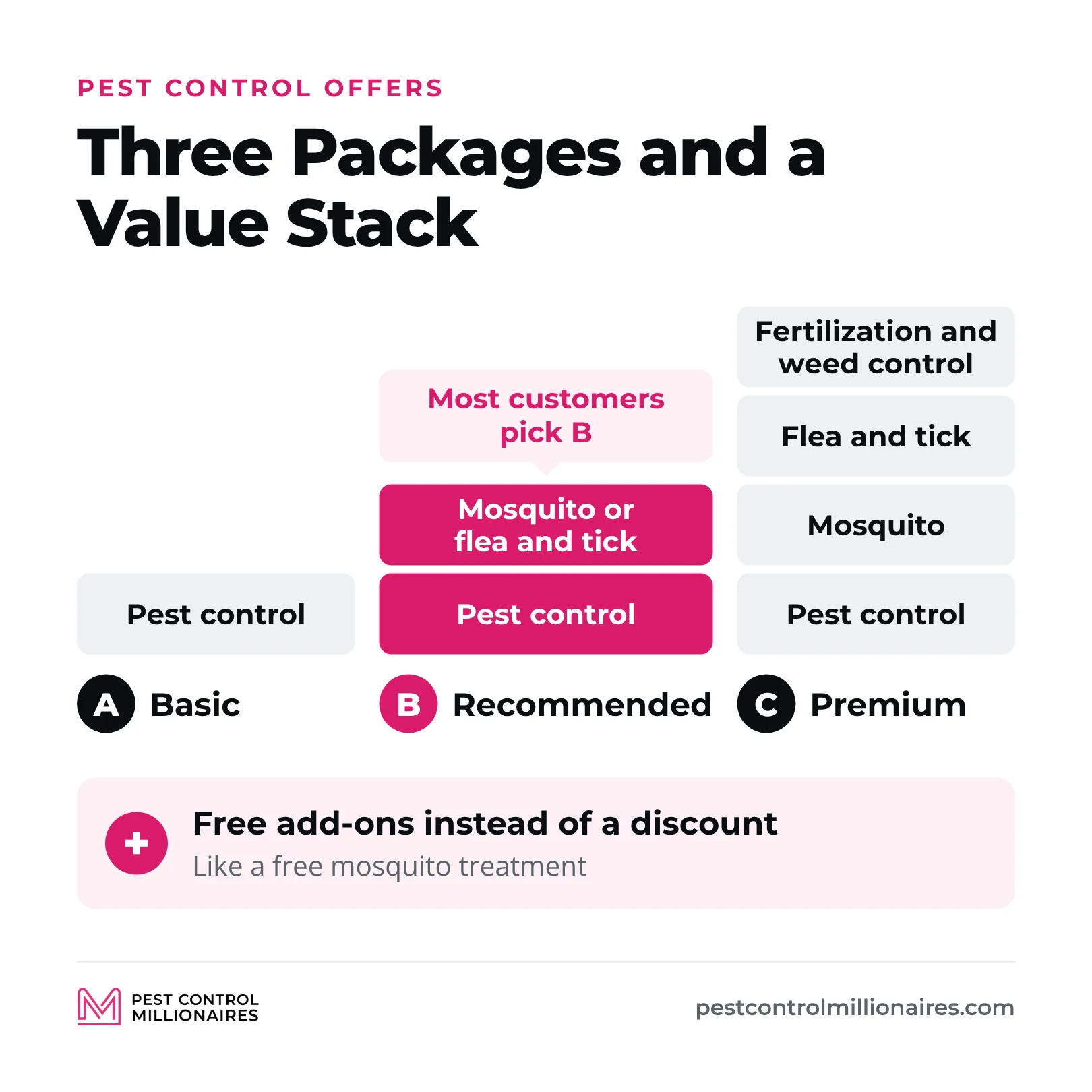
Pre-frame it from day one. Show them what each package covers, how many times a year you come out and that you’ll come back if they have issues in between. Setting expectations up front prevents cancellations later.
What to Include in Each Package
Think about all the services you could bundle:
- Basic pest control
- Mosquito control
- Flea and tick treatment
- Fertilization and weed control
- Aeration and overseeding
- Termite inspections
- Termite bait stations
- Exclusion work
- Foundation inspections
How can you bundle these so homeowners get everything taken care of through you, while you raise the lifetime value of every customer?
The $60,000 to $100,000 Hidden in Your Current Customers
You can grow $60,000 to $100,000 with the customers you have now, without a single new one, by upselling and cross-selling them into higher packages. Steve Delaney at Yard Boss sent one text about fungus to his existing customers and sold $10,000 to $13,000 in fungus treatments in a single afternoon.
The Life-Changing Pricing Realization
Let me share something that changed my entire business. I helped a pest control owner who was averaging only $500 to $550 per customer per year. I told him, “If you doubled your prices and lost half your customers, you’d still have the same revenue with half the customers.”
Here’s the math. Say you have 1,000 customers paying $500 a year. That’s $500,000. Double the price to $1,000 and lose half of them, and 500 customers at $1,000 is still $500,000. Same money, half the stops, fewer technicians and much better margins.
Why This Works
Your profitability goes through the roof. The first time I raised prices, I was scared. I sent out letters and emails and thought, “Oh my God, are these people going to cancel?” Maybe three or four pushed back. We explained why, and that was it. Nick Russler raised his main subscription from $600 to $1,100 a year after joining our program, and his conversion to subscriptions went up roughly 400%. Here’s exactly how we raised Mosquito Crush customers from $50 to $129 a service.
Every year you should be raising prices 3 to 5% anyway, just for inflation. Customers who’ve trusted your brand for years expect a raise every year. Everything else is going up too.
The One-Time Service Pricing Strategy
If you do sell one-time services, here’s my rule. A one-time service should cost at least double a quarterly visit. If a quarterly visit is $150, a one-time job is at least $300. If you do a bi-annual service and your average annual ticket is $850, charge $425 per visit.
I don’t want those one-time customers. I’ll take them at that price, but it makes the recurring plan the obvious better value.
Think About Your Technicians Too
Sell a bunch of one-time or twice-a-year services and April and May are crazy. Then June and July hit and you’re asking, “Where’d the work go?” A recurring model keeps your technicians busy all year, not just in the spring.
Creating Irresistible Pest Control Offers (Without Discounting)
You see pest control offers everywhere, and they’re all the same garbage: “10% off!” “50% off your first service!” “$29 initial!” “$47 initial!” I’m not the discount guy. I hate giving discounts.
My One Rule on Discounts
Don’t lead with a discount in your ads and mailers. Win strangers with value. A price break is only OK when it buys you something you need, like a year of cash up front, a referral, a slow-season booking, a lost customer coming back or a customer you won on the doors yourself.
That’s why you’ll see a prepay incentive at our last service of the year (built into the regular price), a discount on the first service for friends our customers refer, a small break for booking a big job into our slow months and strong offers in our win-back campaigns. On the doors, I’ll take a little off the first service, because knocking myself costs me a fraction of what online marketing does to win a customer. What you won’t see from me is “50% off your first service” in an ad to strangers.
Free inspections are the same trap. Charge a small inspection fee, $50, $100 or $200, and credit it back on the bill if they book the service. It filters out the price shoppers and positions you as the expert instead of the free option.
Why Discounts Don’t Work Anymore
Everyone has used discounts so much that they mean almost nothing. When I see “10% off,” I don’t even look at it. And as soon as you give someone a discount, they always want a discount. They see you as a discount service.
The Value Stack Strategy Instead
What I like to do is value stacking. This comes from Dan Kennedy and Russell Brunson. What can you do on the property that adds so much value the customer just can’t say no? It would be stupid to say no. I go deeper on value stacking and billing in my pest control pricing strategy guide.
- Lawn care. If you sell fertilizing, add a free aeration, free overseeding and a free soil test after the first service. You’re already out there, and they’re easy to do.
- Pest control. Sell the initial service, then include a free flea and tick treatment and a free mosquito treatment. You can fog for mosquitoes while you’re doing the general pest service. It costs you a little time and a little product, and you just won a customer who pays full price.
Tateum O’Hanlon does the same thing at Summit Pest Control. Instead of a plain $100 off, he puts a price tag on each piece of the service (exterior spray, bait stations inside and out, granular treatment, de-webbing) and stacks most of them in for free, so the offer reads like a thousand dollars of value.
The Follow-Up Strategy
Here’s what happens next. A month later, the customer has more mosquitoes. You didn’t sell them mosquito service. You just did the first treatment for free. They already know it works, so they call back: “Hey, I want another mosquito treatment.” Now you say, “Cool, this is the package for that.”
The free treatment fades after about 21 days to a month, right when they start missing it. You’re not discounting. You’re putting the next service in their head.
The Email Follow-Up
In the meantime, send an email or text campaign about that mosquito service. They read it and think, “Oh yeah, I do have mosquitoes. I need to get back on that. It worked really good.”
The 6 Components of a High-Converting Offer
I study Alex Hormozi closely, and I’ve read all his books more than once. I’ve also read the old-school Dan Kennedy books, like Magnetic Marketing. The framework is basically the same, but I like how Alex phrases it. Every offer you put out needs all six of these, and I go through them one by one in my guide to the components of a pest control offer.
Component 1: The Customer’s Dream Outcome
For pest control, the dream outcome is zero issues with bugs. Alex’s value equation says an offer is worth more the bigger the dream outcome and the more likely the customer is to get it, and worth less the longer it takes and the more effort and sacrifice it costs them.
So make it easy. Ideally they go to your website, book a call (or schedule without talking to anyone) and you just show up. Be honest about the outcome. There will always be some bugs out there, but we can cut what they see by 90 to 95%.
Component 2: A Great Headline
David Ogilvy said five times as many people read the headline as read the body copy, so when you’ve written your headline, you’ve spent 80 cents of your dollar. That’s how important it is. Knocking doors is the same thing. You get about three seconds before someone shuts the door.
Your headline should name the problem the customer is having and how you solve it.
Component 3: Social Proof
Reviews, and the best ones are tied to the area you’re marketing to. “XYZ Pest Control did our service. It’s amazing.” Then her name and “Chicago, Illinois.”
People follow the crowd. If Mrs. Jones down the street uses you and you have 1,000 five-star reviews, they think, “Dang, this company is pretty good.”
Component 4: Urgency and Scarcity
Urgency is a reason to buy now. There’s always a reason to buy now, and if there isn’t one, make one. Scarcity is pretty easy: only two slots left today, seven neighbors on their block already signed up, or you’re only taking the first 50 homes in their neighborhood. Just make sure it’s true.
Give them a reason to call now. They should think, “My neighbors already did it. I need to get on this list.”
Component 5: Clear Call to Action
People are trained to follow directions, so tell them exactly what to do next: “text this number,” “click this button,” “watch this video.” Make it easy to track. We’re not big enough to spend money on brand awareness campaigns we can’t measure, so every piece of marketing has to earn a return.
Component 6: The Offer Itself
What are they getting? What does it cost? What’s included? Make it crystal clear.
Guarantees That Actually Work (Without Saying “Guarantee”)
Guarantees have been played out. What works is a unique selling proposition that tells customers you’ll stand behind the work, in a specific way, with no risk to sign up.
The Old Way vs. The New Way
- Old way. “100% satisfaction guarantee.” Okay, cool.
- New way, for lawn care. “You’ll have no weeds in the next 30 days, or I’ll come back and do the service for free.”
- New way, for pest control. “If you’re still seeing ants inside in the next 30 days, call us and we’ll come back and re-treat for free.”
Which sounds better? You’re guaranteeing it without saying “100% money-back guarantee” or “I’ll pay you double.” Just don’t promise they’ll never see another bug, because when they do, they’ll think you lied.
Using AI to Build Your Offers (The Right Way)
ChatGPT has helped a lot of people write ads, but you still have to prompt it correctly.
The Problem with AI-Written Offers
People are getting better at using AI, but a lot of their ads look too AI. You can tell when you see 6,000 emojis. I’m not saying don’t use ChatGPT. Be intentional about what you ask for, because if you don’t ask good questions or tell it exactly what format you want, it won’t give you what you need.
How I Actually Use ChatGPT
Give ChatGPT the framework in this guide, word for word, and it’ll give you a pretty good first response. Then keep prompting until it’s right.
I talk to ChatGPT every day, and it knows my voice and my tone. I keep a folder just for marketing with the exact wording I want. You can tell it, “I want this to sound like David Ogilvy,” or Alex Hormozi, or Russell Brunson, or “I want it to sound like me, not AI.” Then ask questions like:
- “What am I missing on this?”
- “What can make it better?”
- “What can make it convert 1% more?”
I still write my own ads. ChatGPT guides me.
Tailoring Offers: New Customers vs. Existing Customers
Your offers should be different depending on where someone is in the pipeline.
For New Customers
People who don’t know you yet need a reason to trust you, so the offer needs all six components:
- The dream outcome, clearly stated
- A strong headline
- Social proof
- Urgency and scarcity
- A clear call to action
- The offer itself, with a value stack
For Existing Customers
Existing customers already trust you. You don’t have to give them discounts. Just tell them what they’re missing out on. The structure is roughly the same, but the message is different.
Seasonal Upsells: The Real Story Strategy
The best time to market is right before the pain point peaks. If you’re thinking about what’s happening right now, you’re already behind the eight ball. That’s why we plan the whole year on a marketing calendar (it’s below), and why my best upsells are real stories.
One of my best upsell campaigns started on a walk around my block. I was getting attacked by mosquitoes, so I wrote the email on my phone as I walked, in a hurry because my daughter had wrestling at 9 a.m. I sent it to my team, and it absolutely crushed. If I’m getting carried away by mosquitoes and I don’t even have mosquito control at my house, everyone else is too.
It hit the pain point, and it made me a real person. Within a minute, someone replied, “You’re going to your daughter’s wrestling this early?” Use the real stories you and your customers already have.
The Stink Bug Example
A pest control owner in Kansas City had Facebook ads that were killing it for months. Then the offer died. He looked at what people in his area were searching for on Google and talking about, and it was stink bugs. He made a stink bug offer, and it worked for another month or two.
Think through every season you’ll go through this year and every pest you’ll solve, and build those campaigns now.
Your 12-Month Pest Control Marketing Calendar
Here’s the calendar we plan from. Each month has one focus, and everyone from the techs to the CSRs pushes the same offer. It’s built for a northern market like Wisconsin. In the South, start each row about a month earlier, and expect some pests, like mosquitoes in Florida, to run nearly all year. Mail the same 200 target homes in March, May, July, September and November, so they hear from you five times a year instead of once.
| Month | Pest pressure | Offer to push | Channels |
|---|---|---|---|
| January | Rodents and overwintering pests inside | Prepay follow-up before the deadline; charge annual termite inspections to cards on file | Prepay reminders by email and text, calls to canceled customers and open quotes, commercial cold calls |
| February | Rodents; quiet outside | Prepay deadline; win-back offers for last year’s cancels | Text and email follow-up, phone calls, ads while costs are low |
| March | Spring starts; grubs in lawns | Grub control; mosquito and lawn customers back on the schedule | Postcard 1, local Facebook groups |
| April | Spring rush (ants, wasps starting nests, grubs) | A, B, C plans with a free add-on; book big jobs into slow months | Door hangers, door knocking, yard signs after every service, Facebook ads |
| May | Mosquito season starts | Free first mosquito treatment with a plan; win back last year’s mosquito cancels | Postcard 2, reactivation texts and emails, door knocking |
| June | Mosquitoes; wasps building nests | Summer referral contest | Referral links to every customer, social posts, door knocking |
| July | Wasps peak; mosquitoes | Wasp removal upsold into a plan; mosquito add-on | Postcard 3, a real-story email or text, yard signs |
| August | Wasps and other stinging insects; late-summer mosquitoes | Stinging insect service into a plan; aeration and overseeding if you do lawn | Tech and CSR upsells, a text campaign to existing customers |
| September | Fall invaders like stink bugs and Asian lady beetles | Fall invader prevention; next year’s prepay at the last mosquito service | Postcard 4, Facebook ads switched to the pest people are talking about |
| October | Rodents moving in as it gets cold | Rodent control bundled into their plan; bait stations and exclusions | Tech upsells with photos, CSR phone upsells, email and text |
| November | Rodents; overwintering pests | Exclusions, crawl space encapsulation quotes and rodent bait programs | Postcard 5, commercial cold calls |
| December | Rodents; quiet outside | Next year’s prepay, offered at each customer’s last service of the year | Build every campaign for the year, recruit, clean up the CRM |
Applying This Framework Everywhere
Every piece of marketing you create should follow this structure, whether it’s:
- Facebook ads
- Google Ads
- Door hangers and direct mail (see my postcard and door hanger playbook)
- Flyers on bulletin boards
- Email campaigns
- Text campaigns
Keep it consistent across every platform. Each channel gets its own chapter in our pest control marketing guide, but this is the structure I want on every piece. And every piece of marketing that goes out has to have an offer.
The Widgets Concept (What Dan Kennedy Taught Me)
Dan Kennedy calls the pieces of a value stack “widgets.” A widget is one of the extras you build into the offer, something you can do on the property while you’re already there, like a free flea and tick treatment, a free mosquito treatment or a free soil test. Each one costs you a little time and product, and stacked together they make saying no feel stupid. Alex Hormozi and others have their own names for it, but it’s the same idea. It’s magnetic marketing, and it’s been done this way for a long time.
Any good marketing company knows this. If you’re not running an irresistible offer, start. You don’t have to discount your services to get volume. You can be profitable and busy at the same time.
Final Thoughts: Stop Leaving Money on the Table
Most pest control companies charge $200 to $300 per customer when they should be at $850. They sell one-time services when they should have recurring revenue. They discount when they should value stack. They wing their pricing when they should have A, B and C packages.
Here’s what I want you to take away:
- Structure your service plans for recurring revenue. Monthly, bi-monthly or quarterly. Just make it recurring.
- Price for value, not for being the cheapest. You won’t grow a real business competing on price.
- Use the A, B, C package framework. Make B, the middle option, your best value and your best profit.
- Stop discounting and start value stacking. Free add-on services cost you little and create massive perceived value.
- Use all six components in every offer. The dream outcome, a headline, social proof, urgency and scarcity, a clear call to action and the offer itself.
- Tailor offers to new and existing customers. They need different messages.
- Plan your seasonal campaigns in advance. Use the 12-month calendar and be ready before the pain point arrives.
You have to go get customers anyway. Make sure each one is worth as much as possible. If you want the full marketing and sales playbook, it’s in Zip Code Kings. Now go fix your offers and start charging what you’re worth.
Frequently Asked Questions
What types of offers work best for pest control companies?
Offers that stack value on a full-price recurring plan: three packages where most people pick the middle one, a free add-on with signup like a free flea and tick or mosquito treatment, and seasonal campaigns timed to pest pressure. I don’t advertise discounts to new customers. The only price breaks I give are for prepaying the year, for friends our customers refer, for booking big jobs into slow months, for winning back customers who left and a little off the first service when I’m knocking doors myself.
How should I structure pest control service pricing offers?
Use three packages. A is basic pest control, B is pest control plus one more service like mosquito or flea and tick, and C is everything bundled. Most customers pick B, so make it your best value and your most profitable plan.
Should pest control companies offer free inspections?
I don’t. Charge a small inspection fee, $50 to $200, and credit it back on the bill if they book the service. It filters out price shoppers and positions you as the expert instead of the free option.
How often should I change my pest control offers?
Keep your core plans the same and rotate the promotion with the seasons on a 12-month marketing calendar: grubs in early spring, mosquitoes in May, wasps in July, fall invaders in September and rodents in October and November. When an offer stops working, switch to the pest people in your area are talking about, the way a Kansas City owner did with stink bugs.
What is the best way to present pest control pricing to customers?
Show three clear packages (A, B and C) and walk the customer through exactly what each one covers, how often you come out and what happens if they have issues in between. Most people pick the middle package, so build it to be the obvious best value.
How do I create pest control offers without discounting?
Stack value instead: on top of a full-price plan, add services that cost you a little time and product while you’re already on the property, like a free flea and tick treatment, a free mosquito treatment or a free soil test. Then add a specific guarantee in your own words, a real reason to buy now and a clear call to action.
What is a good average contract value for a pest control customer?
I use about $850 a year per customer as the line. That number comes from running Pest Badger, where our average contract is roughly $1,000, and from the many owners I’ve interviewed and coached, not from a study. If you’re below it, rethink your packages and your pricing.
Should I bill pest control subscriptions monthly, quarterly or annually?
Monthly subscriptions at $67 to $70 a month are the easiest to sell but have the highest cancellation rate. In data from Alex Hormozi’s team, monthly subscriptions canceled at about 12.5%, quarterly billing at about 6% and prepaid at 2%. So we bill new customers quarterly, like a $240 initial service and then $210 a quarter, and the best cash flow and lowest churn come from customers who prepay the whole year.
Related Articles