
Local SEO for Pest Control Companies: The Complete Guide to Dominating Your Market


Table of Contents
- How to Rank Your Google Business Profile in the Google Maps 3-Pack
- The Timeline You Need to Understand
- Why Your Website Actually Matters (More Than You Think)
- The Pages Your Pest Control Website Actually Needs
- The Website Setup Mistakes Killing Your Rankings
- The Keywords That Actually Matter for Pest Control SEO
- How to Actually Find and Prioritize Keywords
- On Page SEO: The Four Places Your Keywords Need to Be
- Internal Linking: The Strategy Almost No One Gets Right
- Images and Videos: The Conversion Factor
- Backlinks: The Long Game That Pays Off
- How to Actually Get Quality Backlinks
- What You Can Do Yourself vs. What You Should Hire Out
- The Tools That Actually Matter
- The Mistake That Kills Most Pest Control SEO Efforts
- The Bottom Line on Local SEO for Pest Control
- Frequently Asked Questions
- Related Articles
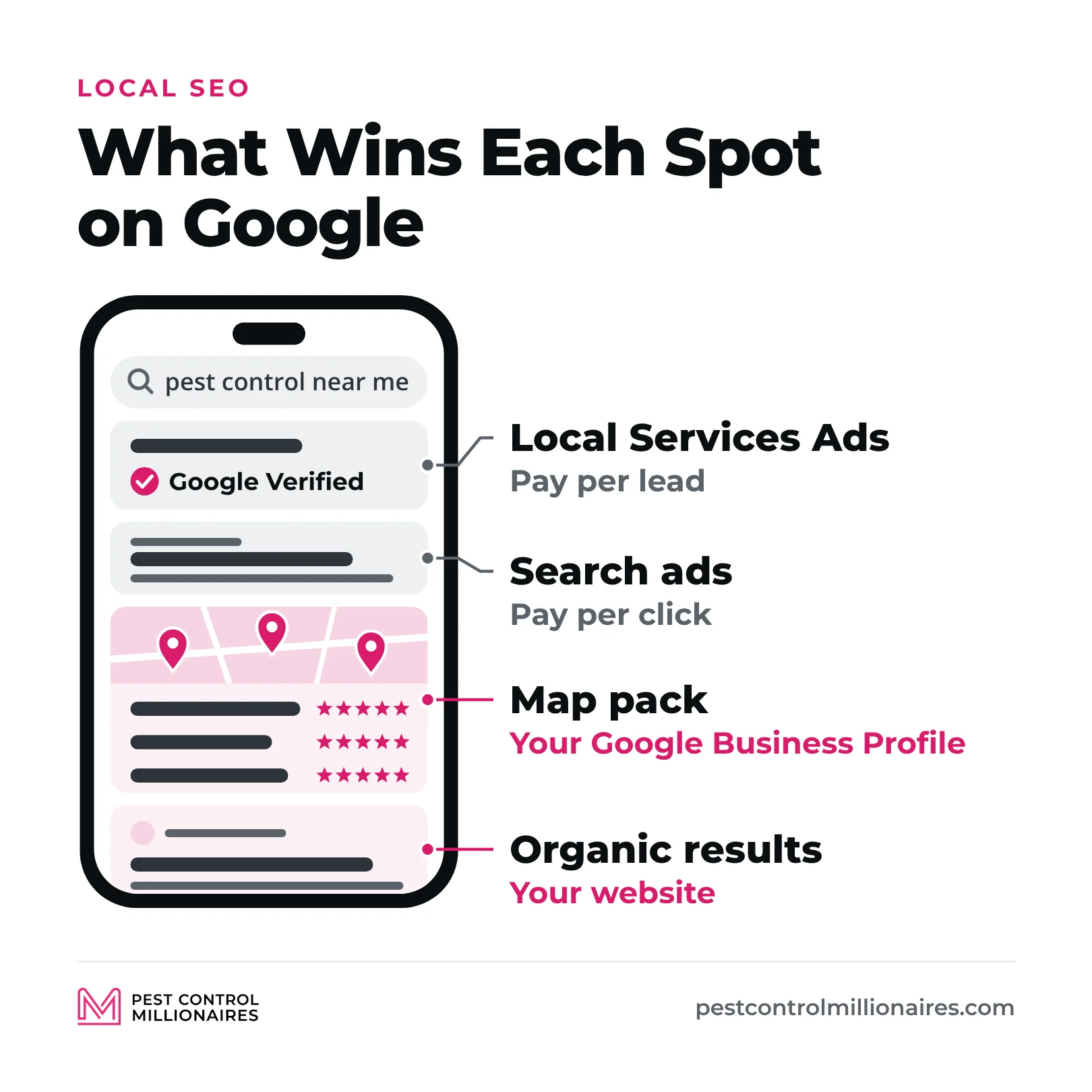
Local SEO for pest control companies means showing up in two places on Google, the map pack and the organic results under it. Your Google Business Profile wins the map pack. Set Pest control service as your primary category, list your services and products, post an offer every week, keep your name, address and phone identical on every listing, and get new reviews every week. Your website wins the organic results. Build one page per service and city, make it fast on a phone, put the keyword in the URL, H1, title tag and text, and link your pages together. I run Pest Control SEO, an agency that does SEO for pest control companies only.
How to Rank Your Google Business Profile in the Google Maps 3-Pack
The map pack is the map and the three businesses under it that show up when someone searches “pest control near me” or “termite control Chicago.” Your Google Business Profile is what ranks there. Unlike your website, which takes months, you can optimize your profile in an afternoon and start seeing results within weeks.
To get in, sign in to Google Business Profile with the email that manages your profile and click Edit Profile. If you can’t find it, search your company name while you’re logged in to that email and your dashboard pops up. Then work through this list. The step-by-step version is in my pest control GBP optimization guide.
| What | What to do | How often |
|---|---|---|
| Primary category | Pest control service | Once |
| Secondary categories | Lawn care service if you also do lawn care, plus any other service you really offer | Once |
| Services | Your main services plus the city you’re based in | Once, then check Google hasn’t changed them |
| Description, hours and social links | Fill out every field, with keywords used naturally | Once |
| Products | One per main service, named with your city and linked to its page | Once |
| Posts | An offer, a testimonial or a top service | Every week |
| Photos and videos | Real techs and trucks, at least 50 photos and five videos | New photos every month |
| Citations | The same name, address and phone on every listing | Once, then whenever anything changes |
| Reviews | Ask every customer and reply to every review | Every week |
Pick the Right Primary Category
In Whitespark’s local search ranking factors survey, your primary category is the number one map pack ranking factor, and for a pest control company it should be Pest control service. I’ve audited pest control profiles with Lawn care service as the primary category, and that’s the first thing I fix. If you also do lawn care, add Lawn care service as a secondary category, and add others only for services you really offer.
Your business name matters too. If you’re just starting out, a real name with Pest Control in it helps you rank, which is one more reason to think hard about naming your company. Just never add keywords to the name on your profile that aren’t part of your real business name, because Google treats that as spam.
List Your Services and Products
The services section is huge and most people ignore it. Add your main services with the city you’re based in, like Pest Control Chicago, Termite Control Chicago and Bed Bug Control Chicago. Only optimize for the city where your address is, because that’s the only city Google can really expect to rank your profile in. While you’re there, fill out the description (keywords used naturally, not stuffed), your hours and your social links.
Then add your main services as Products, and make them local. Instead of Termite Control, name it Termite Control Chicago and link it to your termite control Chicago page. Products sit near the bottom of the profile and won’t move rankings much, but they connect your profile to your website, and if a competitor has 20 products and you have none, that small gap can tip a customer their way. I’m honestly surprised Google still offers Products to service businesses, so use it while it’s there.
Post an Offer Every Week
Google Business Profile posts are free advertising, so treat them like a billboard, not like social media. Post every week and rotate your best offers ($50 off your first service, a free termite inspection), a top testimonial or one of your main services. Most of your competitors aren’t using posts well, which makes this an easy edge.
Use Real Photos and Videos
Add photos of your actual team and your actual trucks. Never use stock images or AI-generated images, because Google and customers want to see real work. Aim for at least 50 photos and five videos (follow a tech around for a day and you’ll have them), then add new photos every month so Google sees the profile is active.
Keep Your Name, Address and Phone the Same Everywhere
Citations are listings of your business on other sites, like Facebook, Yelp, Angi, Thumbtack, the BBB and your chamber of commerce. Your Google Business Profile is technically one of them. Two rules cover all of them. Fill in as much information as each one allows, and make your name, address and phone number (your NAP) exactly the same everywhere.
Start with the data aggregators (Data Axle, Foursquare and the YP network), which feed your details to other sites. When you move or change your number, update every listing. If you also pay for leads on sites like Yelp or Thumbtack, the paid directories guide covers which ones are worth it.
Get New Reviews Every Week
Reviews are the big one, for ranking and for getting the call. People land on your profile and look at your reviews first. If you have 50 and your competitor has 500, guess who they’re calling?
It’s not just about volume. It’s about recency and consistency. I’ve seen a company with 150 reviews outrank one with 1,000, because the smaller company got two or three new reviews every week and the bigger one hadn’t gotten a review in six months.
Ask every customer, not just the happy ones, and ask before you leave the house. Most techs ask, walk out, and the review never comes. Hand them a link or a QR code and offer to show them how, then let them write it themselves. Google’s rules are clear on the rest. Don’t pressure anyone, don’t tell customers what to write, and never give them a discount, a gift card or anything else for a review, because Google removes reviews it sees as incentivized and doesn’t allow asking only happy customers.
Paying your technicians a bonus for the reviews they earn is fine, and I recommend $10 to $20 per review. If you had a machine that printed reviews for $20 each, you’d press that button all day. Pay it on every review, whatever the stars, so nobody is tempted to skip the unhappy customers or coach people on what to say.
Reply to Every Review
When someone leaves you a review, reply. Don’t write one word and don’t paste in a ChatGPT reply. Take 30 seconds and write something real. If someone thanks you in person, you say you’re welcome. Same thing online. Replies are more of a conversion factor than a ranking factor, because prospects read how you treat your customers.
Keep the Profile Active and Check Where You Really Rank
Log in regularly, add photos every month and check that Google hasn’t changed your services. Google can see when nobody checks a profile, and I’ve seen profiles get suspended partly because nobody had touched them in forever.
Then check where you actually rank. Map rankings depend on how close the searcher is, so you might be first near your office and fifth across town. A map scan tool like Local Falcon or BrightLocal shows your rankings as a grid across your whole service area.
Show Up in AI Search Too
More homeowners now ask ChatGPT or Google’s AI answers to recommend a pest control company, and the same work carries over. Companies that rank well on Google tend to show up in AI answers too. Three things help most.
- Use the exact same company name on your Facebook, Instagram, YouTube and LinkedIn profiles and link them all back to your website. That builds what SEOs call your entity.
- Get reviews on Yelp, Angi, Thumbtack and Facebook as well as Google. Google still matters most.
- Get listed in “best pest control companies in [your city]” articles.
Jonas and I went deeper on this on his podcast, in how I win at SEO in the age of AI search.
From the PCM Facebook group
How many customers do you get from AI search?
15 of 19 owners already get customers from AI search like ChatGPT.
The Timeline You Need to Understand
Here’s the reality of search engine optimization for pest control companies. Your Google Business Profile can move within weeks, but your website is the long game. If you’re starting from zero, a new page might take three months to rank, or it might take 12. That’s why your pest control company SEO plan should match your size.
| Your revenue | Where your marketing money goes | Your SEO work |
|---|---|---|
| Under about $500K a year | Google Business Profile and Local Services Ads, plus cheap channels like door knocking, Facebook groups and referrals | Do the profile and reviews yourself and keep the website fast and clean |
| Past about $500K a year | Add Google Search ads and real investment in SEO and your website | Hire out the website, technical SEO and link building |
Under about $500K, you want channels where you can see what each customer costs you right away. Local Services Ads bill you per lead and usually cost less than search ads, and door knocking, Facebook groups and referrals are cheap ways to add customers. I don’t recommend dumping a ton of money into SEO before you have capital built up.
Past about $500K, add Google Search ads and invest in SEO for real. At that point you have the capital, a lot of content to work with and an established brand, and SEO becomes one of the most powerful lead sources you have because it compounds.
Why Your Website Actually Matters (More Than You Think)
A lot of owners treat their website like a business card. Check the box, move on. That’s a huge mistake, because your website is your digital storefront. If someone clicks your site and it takes 20 seconds to load, looks like it was built in 1997 and has broken images everywhere, they hit the back button and call your competitor.
Trust is everything in this industry. You’re asking people to let you into their homes to deal with things that freak them out, like bed bugs, termites and roaches. Jonas talks about having a premium brand all the time, and a big part of that is a premium-looking website that matches your trucks, your uniforms and your direct mail.
A good-looking website isn’t just about conversions, though. It’s also how you rank.
The Pages Your Pest Control Website Actually Needs
A website is a collection of pages, not one thing. A lot of owners say “rank my website number one,” but Google ranks pages, and each page should target one concept. I got that rule from Kyle Roof, one of the top people in on-page SEO. Pest Control Chicago, Chicago Pest Control, Chicago Exterminators and Pest Control Services Chicago mean the same thing, so they go on one page. Pest Control Chicago and Pest Control Northbrook are different cities, so they get different pages.
| Page | What it’s for | Optimize it for |
|---|---|---|
| Homepage | Where most people land from your trucks, mailers and referrals | Your brand name |
| About and contact | Shows Google and customers you’re a real company | The basics |
| Privacy policy and terms | Another sign of a legitimate business, and ChatGPT can draft them in a minute | Nothing |
| Service pages | One for each main service, like termite, ant, mosquito and spider control | The service |
| Location service pages (money pages) | One for each major city you serve | Service plus city, like Termite Control Northbrook |
| Blog | Every post under yoursite.com/blog/ | Informational searches |
| Pest library (optional) | Pages on ants, mosquitoes, bed bugs and termites that build topical relevance | The pest |
Location pages are the ones that make you money, and they’re where most companies mess up. Some cram everything onto one page. Others copy one page for every city and swap the name, and Google may rank only one of those pages or none of them. Make every location page unique with the most common pests in that city, a job you did there and photos from that area. Put them under your service pages, like termite-control/chicago-il, to show depth. I walk through the full build in the pest control website guide.
The Website Setup Mistakes Killing Your Rankings
These are the four I see most, followed by how I build sites now so they don’t happen in the first place.
Optimizing the Homepage for Too Many Keywords
People try to rank their homepage for Pest Control Chicago, Termite Control Chicago, Bed Bug Control Chicago and five other keywords. Stop. Optimize the homepage for your brand name (in the H1, the title tag, the headings and the text) so it shows up first when people search your company name, and let your other pages do the heavy lifting for specific keywords.
A Slow Website
I run sites through Google’s PageSpeed Insights all the time, and I see pest control homepages taking 10, 15, even 20 seconds to load. No one waits that long. If your site takes more than three to four seconds to load on a phone, you’re losing customers. Huge images are usually the biggest culprit, so resize them to the size they actually show on the page. The pest control website page speed guide covers the rest of the fixes.
Not Building for Mobile First
Most searches, about 60 to 70%, happen on phones. If your site looks terrible or loads slowly on mobile, you’re dead in the water. Build for mobile first and desktop takes care of itself.
A Messy Site Structure
Your site needs a clear hierarchy. Homepage at the top, service pages under it, then location pages under those. Then connect them with internal links, which I cover below.
How We Build Fast Pest Control Websites
I build new sites on Astro, which turns your pages into plain, fast files. They’re hosted on Cloudflare Pages, the code lives in GitHub, and Claude writes and updates the pages. That’s how we build client sites at Pest Control SEO. Pages load fast, hosting costs almost nothing and there are no plugins to patch.
If your site is already on WordPress, you don’t have to rebuild it to get fast. Use Rank Math for SEO, WP Rocket for speed and Imagify to compress your images.
The Keywords That Actually Matter for Pest Control SEO
There’s a funnel of keywords, and you start at the bottom.
| Funnel stage | Example searches | What to build |
|---|---|---|
| Bottom (ready to buy) | Pest Control Chicago, pest control near me, exterminator near me, termite control near me | A dedicated page for each, first |
| Top (looking for information) | how to get rid of ants, signs of termites | Blog posts and pest library pages, later |
“Pest control” plus your city is always going to be your biggest keyword. In Chicago, Pest Control Chicago gets about 2,400 searches a month and Chicago Pest Control about 720 (Semrush, October 2026), so the page targets the bigger one and works the variations into its headings and text. It’s the same if you brand as an exterminating company, since exterminator near me is one of the most common searches in the industry.
Those money keywords are the SEO keywords every pest control company should build pages for first. I see too many companies writing about how to get rid of ants while ignoring the searches that actually pay. More on choosing them in the pest control keyword research guide.
How to Actually Find and Prioritize Keywords
Start with what you already rank for. Google Search Console is free and shows the searches you already show up for, with your position and clicks for each. Google Analytics shows what people do after they land, not the keywords. Then use Semrush to see search volumes and what your competitors rank for, and search your top keywords in an incognito window to see who actually shows up. If it’s Orkin or Yelp, you know how hard it’s going to be.
Prioritize keywords where a page already ranks around position three to five. That’s much easier to improve than ranking a brand new page from scratch, and the payoff is big because clicks drop fast as you go down the page. In Backlinko’s study of 4 million Google results, the top organic result got about 27% of the clicks and the top three got 54%.
On Page SEO: The Four Places Your Keywords Need to Be
When you optimize a page, your main keyword goes in four places.
| Where | Example for a Pest Control Chicago page | The rule |
|---|---|---|
| URL | yoursite.com/pest-control-chicago | Short, with the main keyword |
| H1 | Pest Control in Chicago | The main heading, usually the biggest text on the page |
| Title tag | Pest Control Chicago, with your brand after it | What shows up in Google’s results |
| Body text | Used naturally through the page | Present, never stuffed |
Then put secondary keywords like Chicago Exterminators and Pest Control Services Chicago in your H2 headings and text, so the same page ranks for the variations. The free Chrome extension Meta SEO Inspector shows any page’s title tag, meta description and headings, so you can check your work. The full checklist is in the pest control website SEO guide.
Internal Linking: The Strategy Almost No One Gets Right
Internal links are links from one page on your site to another, and they show Google how your pages relate. If your Pest Control page links to Pest Control Chicago, Pest Control Northbrook and Pest Control Glenview, Google sees they’re all about pest control in the same area. That’s how Google learns, by association, the same way you understand Northbrook because you know it’s right next to Chicago.
- Location pages link to each other.
- Service pages link to their location pages, so Termite Control links to Termite Control Chicago and every other termite location page.
- Blog posts link to the service pages they relate to.
My mentor Dennis Yu showed me a shortcut. Give Gemini or ChatGPT the list of pages on your site (your sitemap works) and ask which ones should link to each other. It can’t reliably see every page on its own, but with the list it gives you a fast first draft of your linking plan.
Images and Videos: The Conversion Factor
Images and videos aren’t a big direct ranking factor, but they’re huge for conversions, and they show the experience part of Google’s E-E-A-T guidelines (experience, expertise, authoritativeness and trustworthiness). You prove experience with photos and videos of your real team doing real work. For alt text, just describe what’s in the image. If it’s Steve doing termite control in Chicago, say that. Turning visits into calls is its own chapter, pest control conversion rate optimization.
Backlinks: The Long Game That Pays Off
Backlinks are links from other websites to yours, and they work like votes of confidence. If you want to rank for competitive pest control SEO keywords, you need quality ones, and the harder a link is to get, the better it usually is.
| Good links | Examples |
|---|---|
| Local | Local sponsorships, charities and your chamber of commerce |
| Authoritative | Industry publications like PCT Magazine |
| Relevant | Home service or pest control companies in markets you don’t compete in |
What you don’t want is bulk link packages. If someone is selling you 10,000 backlinks for $100, run away. Those are garbage links from garbage sites, and they can hurt you. More in the pest control backlinks guide.
How to Actually Get Quality Backlinks
For local links, start with sponsorships and charities. A lot of local organizations have sponsor packages that include a link on their website. Don’t email them asking how much for a backlink. Say something nice, like “Hey, I have a pest control company in town. I really believe in your cause and I’d love to help out. Do you have any sponsorship opportunities?” They know what you’re asking for. Depending on the organization, a sponsorship might run anywhere from $200 to $1,000.
One caution. Google’s spam policies count buying links for rankings as link spam and say a paid link should be marked as sponsored. So sponsor groups you’d be glad to support anyway, for the goodwill and the local visibility, and treat the link as a bonus. Never buy links from sites that sell them to anyone who pays.
For most pest control companies, I recommend building three to five quality links a month. Not 100 garbage links. Three to five good ones.
What You Can Do Yourself vs. What You Should Hire Out
You can absolutely do your Google Business Profile yourself. Spend an afternoon filling everything out, then make reviews and replies a routine your team runs every week.
The website, the technical SEO and the link building are where most owners should get help, because SEO gets complex fast and you don’t have time to become an SEO expert. If you hire, find an SEO expert who understands the pest control industry. A specialist knows the keywords, the buyers and the map pack better than someone who also works on roofers and chiropractors. When you compare agencies, compare what each package includes, not just the price.
Either way, know enough to ask good questions and hold your agency accountable. You don’t need to do everything yourself, but you need to know what should be happening.
The Tools That Actually Matter
You don’t need many.
| Tool | What it’s for | Cost |
|---|---|---|
| Google Search Console | The searches you show up for, your positions and clicks | Free |
| Google Analytics | What visitors do on your site and which pages bring leads | Free |
| Semrush | Keyword research, rank tracking and competitor research | About $140 a month, or 10 free searches a day |
| PageSpeed Insights | How fast each page loads and what’s slowing it down | Free |
| Meta SEO Inspector | Title tags, meta descriptions and headings on any page | Free Chrome extension |
| Local Falcon or BrightLocal | Your map rankings across your whole service area | Paid |
And honestly, just use Google. Search your top keywords and see who’s ranking and what they’re doing.
The Mistake That Kills Most Pest Control SEO Efforts
The biggest mistake is trying to do everything at once and not sticking with anything long enough to see results. People optimize their website for a month, don’t see instant results and give up. They build two backlinks, nothing happens right away, and they stop.
SEO for a pest control business is a competition. The question isn’t whether you’re perfect. It’s whether you’re better than the other pest control companies in your market. If your competitors are a five out of 10 on on-page SEO, you need to be a six. If they have 50 backlinks, you need 60. If they have 200 Google reviews, you need 250.
You don’t have to be perfect. You have to be better, and you have to stick with it, because SEO compounds. The work you do today might not pay off for three months, but when it does, it keeps bringing in leads.
The Bottom Line on Local SEO for Pest Control
If you’re under about $500K a year, focus on the basics. Get your Google Business Profile dialed in, make sure your website looks professional and loads fast, and collect reviews like your business depends on it, because it does.
Past about $500K, invest in SEO for real. Hire a trusted expert, build quality backlinks, create great content, optimize every page and be patient.
Local SEO works best layered with paid ads, social and traditional marketing in your overall pest control marketing plan, and Jonas, Jake and I cover all of it in our book, Zip Code Kings.
Frequently Asked Questions
How long does it take for local SEO to work for pest control companies?
Google Business Profile changes can show results within weeks. A new website page starting from zero might take three months to rank, or it might take 12, which is why SEO pays off most once you’re past about $500K a year.
What is the most important local SEO factor for pest control?
For the map pack it’s your Google Business Profile, starting with the right primary category (Pest control service) and a steady flow of new reviews. Recency matters as much as the total, and I’ve seen a company with 150 reviews outrank one with 1,000 because it got two or three new reviews every week.
How many Google reviews does a pest control company need?
There’s no magic number. You need more than the companies beating you in the map pack (if they have 200, aim for 250) and new reviews every week, because a profile that stops getting reviews loses ground.
Should pest control companies create city-specific landing pages?
Yes. Build one page for each major city you serve, because Pest Control Chicago and Pest Control Northbrook are different searches, and make each page unique with that city’s common pests, local jobs and local photos instead of copying one page and swapping the city name.
How do I optimize my Google Business Profile for pest control?
Set Pest control service as your primary category, fill out every field, add your main services and products for the city you’re based in, and upload real photos. Then post an offer every week, keep your name, address and phone the same on every listing, and ask every customer for a review and reply to each one.
What local SEO mistakes do pest control companies make?
The big ones are optimizing the homepage for a pile of keywords instead of your brand, slow sites that aren’t built for phones, location pages copied from each other, a different name, address or phone on different listings, and quitting before the work has time to compound.
Do backlinks matter for local pest control SEO?
Yes, quality ones do. Go after local sponsorships, charities and your chamber of commerce, industry publications and home service companies outside your market, aim for three to five good links a month, and stay away from bulk link packages.
Should I hire a pest control SEO company or do it myself?
Do your Google Business Profile and reviews yourself, since that’s an afternoon of setup plus a weekly routine, and under about $500K a year that’s where your effort should go, along with Local Services Ads. Past about $500K, hire a pest control SEO agency or an SEO expert who understands the pest control industry for the website, technical SEO and link building.
What do pest control SEO services actually include?
When you compare SEO packages, look for keyword research for your service area, Google Business Profile optimization and posting, citation cleanup, a review system, service and location pages, on-page and technical SEO including page speed, internal linking and local link building. If a package is mostly reports and cheap links, keep shopping.
How much does pest control search engine optimization cost?
It varies with your market size and how much competition you have, so compare what each package includes, not just the price. Be careful with very cheap packages, which are usually bulk links and citation spam, and if someone sells you 10,000 backlinks for $100, run away.
Related Articles