
How to Grow Pest Control Business to $10M+ (Without Spending More on Ads)

Table of Contents
- The 7 Levers at a Glance
- Lever 1: Upsell Every Customer Until They Say No
- Lever 2: Pay Technicians to Sell
- Lever 3: First Impressions, Where Customer Retention Actually Starts
- Lever 4: Referral Programs That Can Grow You to $300K Without Ads
- Lever 5: Keep Customers Paying Year After Year
- Lever 6: Get Seasonal Customers to Prepay
- Lever 7: Win Back the Customers You Lost
- How This All Fits Together
- Frequently Asked Questions About How to Grow a Pest Control Business
- Related Articles
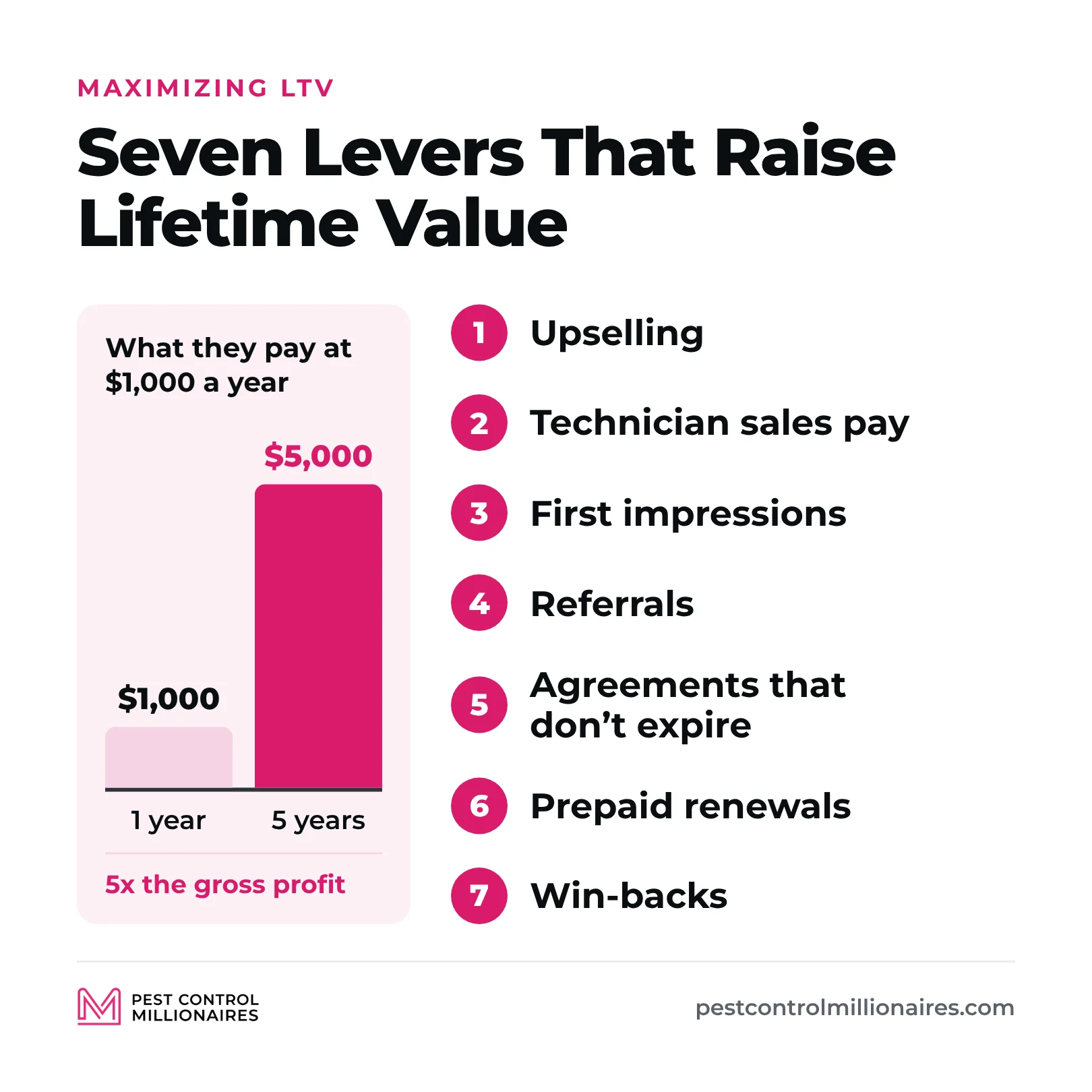
The cheapest way to grow a pest control business is to raise the lifetime value of the customers you already paid for. Lifetime value (LTV) is the gross profit a customer brings you over the whole time they stay, what’s left after you pay to service them. At a $1,000 yearly contract, a customer who cancels after a year pays you $1,000, and one who stays five years pays you $5,000, five times the gross profit for the same cost to win them. These are the seven operator levers we use to raise it: upselling, technician sales pay, first impressions, referrals, agreements that don’t expire, prepaid renewals and win-backs.
I’m Jonas Olson. I built Pest Badger to over $20 million a year in about six years, and these levers come from running it and from the owners I’ve coached.
The 7 Levers at a Glance
| # | Lever | What it raises | The number to remember |
|---|---|---|---|
| 1 | Upsell until they say no | Revenue per customer | Techs take 10 to 20 photos on every job to show customers what they found |
| 2 | Pay technicians to sell | Upsells and tech retention | Our goal is techs earning close to six figures |
| 3 | Nail the first impression | Years on service | A forgiven mistake can turn a one-year customer into a three-year customer |
| 4 | Run a referral program | New customers at a low cost | One giveaway brought 148 referrals and 47 new customers in a week |
| 5 | Keep customers on agreements that don’t expire | Years on service | At a $100 acquisition cost and a 50% gross margin, LTV to CAC goes from 5 to 1 after one year to 25 to 1 after five |
| 6 | Get seasonal customers to prepay | Spring renewals | Prepaid customers give us the best churn rate we’ve seen |
| 7 | Win back canceled customers | Customers you already paid for | Expect 1% to 3% to come back, starting about two weeks after they cancel |
Lever 1: Upsell Every Customer Until They Say No
The fastest way to increase pest control sales without more ads is to keep selling to the customer who just said yes. Most techs and sales reps close a sale, get excited and leave. The customer didn’t say no. You stopped selling. I train my team to go for no: keep offering the next thing until the customer actually says no, not until you get uncomfortable. The full playbook is in my guide to pest control upselling and cross-selling.
Why the Second Sale Is Easier Than the First
The first sale is the hardest one you’ll ever make with a customer. After it, they trust you, they like you and they’ve already decided to buy, so the next sale is just asking permission to solve another problem.
What This Actually Looks Like in the Field
A sales rep just signed a customer at the door and walks around back to show them the property. Mosquitoes are eating him alive. “Man, who takes care of mosquitoes around here?” Nobody does. “We do that too. We can add it to your monthly package and handle both.” Nine times out of ten, they say yes.
The Technician Upsell Is Even Easier
A tech on a regular service spots gnawing marks or droppings. He takes pictures, 10 to 20 on every job, and shows the customer at the end: “I handled everything you called us out for, but I also noticed this while I was here. We can set up bait boxes before it becomes a bigger problem.” That isn’t pushy. It’s solving a problem they didn’t know they had yet.
The Phone Upsell: Timing Is Everything
A customer calls in the fall about Asian beetles. Winter’s coming, and rodents are about to move indoors looking for warmth, food and water. The CSR offers to bundle rodent control with their service before it gets cold, and the customer doesn’t even need to be home for it. You’re upselling based on the season and what you know is coming.
The Pictures Strategy Changes Everything
We upload every photo to the customer’s profile in our CRM, but the real magic is showing them in person. Customers can’t say they don’t have an issue when they’re looking at bats flying into their attic, missing screens or rodent droppings. That isn’t salesy. Solving problems is the job they hired us for.
When to Add More Services
Not at first. Business is complex enough. Stay focused on general pest control, take it to scale and then add services. There are plenty of upsells inside pest control itself: termite bait stations, termite treatments and guarantees, rodent bait boxes, mosquito control and exclusion work.
The Monthly Focus Strategy
We plan a marketing calendar for the whole year starting January 1, with one upsell focus each month. Setting sales goals gets simple when everyone, from technicians to CSRs to the office, pushes the same offer and is paid to go for that next sale. We stick to the plan instead of switching every few weeks. A simple version by season:
| Season | Upsell focus |
|---|---|
| January and February | Rodent control, because it’s cold |
| Spring | Mosquito and tick control |
| Summer | Outdoor pest control packages |
| Fall | Rodent prep for winter |
Adjust it to your market.
Lever 2: Pay Technicians to Sell
Upselling only works if the people in front of customers want to do it. Every technician should be sales trained, a hundred percent of them, and paid for performance. That’s how they make more money, and it’s how you grow.
The Sales Training Your Technicians Need
My goal from day one is techs earning close to six figures. Service work alone can’t get them there, so their pay stacks up three ways:
- Service pay for the work itself.
- Commission on every upsell and add-on they sell.
- Review bonuses for the reviews customers choose to leave. The bonus goes to the tech, never to the customer. Google doesn’t allow offering customers anything for a review, and techs ask every customer, not just the happy ones.
Tech selling is easier than door-to-door. The customer is already there and already trusts you, you’re the expert and you’re selling what you can actually see. Door-to-door reps have to be more assertive, handle more questions and work harder to get in the door. The office works the same way: CSRs, sales reps and managers should all be paid to hit the next level.
Lever 3: First Impressions, Where Customer Retention Actually Starts
First impressions aren’t just about looking professional. They set expectations you can deliver on, then build so much goodwill that customers forgive you when you mess up later, and everyone messes up eventually. I cover the first visit step by step in my guide to first impressions in pest control.
Why First Impressions Fix Churn
Most owners try to fix churn at the end, with a discount when someone calls to cancel. That’s too late. Churn is fixed at the first service. Nail it, and the customer sticks with you through a mistake or two. Miss it, and they cancel after the first one.
It Starts Before You Even Show Up
Your wrapped truck, your uniforms and your ads should all match, so the customer sees the same brand that got them to call. At Pest Badger we wear pink shirts and black athletic joggers, a young, fun look that’s our brand. Techs should be clean and in uniform, and if they have a beard, it should be groomed.
Setting Expectations at the Door
Tell the customer exactly what you’re going to do, and be honest: “Nothing is an overnight solution. You’re going to see some bugs.” On a first application they’ll see more bugs at first while you flush everything out, and if activity comes back, you come back for free. Mosquito control is a reduction service; we can typically cut mosquitoes by 70 to 80%. Never promise they’ll never see a bug, and walk them through the agreement from A to Z before you start.
The Picture Documentation System
Photograph the front yard, the back yard and every issue you find, like a before and after of the wasp nest you took down from the eaves. Put it all in the customer notes so the next tech knows what happened. Then show the customer what you found, ask if they have any other issues and make sure they’re happy.
The One Act of Kindness Rule
Every tech does one act of kindness beyond the service, even if the customer never sees it. Bring the Amazon package from the garage to the door, roll the trash can up from the curb, put the kids’ toys on the porch or blow the leaves out of the front yard.
The Dog Name Strategy
Like UPS, we give dogs treats. Put the dog’s name in the notes so the next tech can ask, “How’s Floppy doing?” Customers are blown away that you remembered.
Welcome Packages That Wow
We used to mail envelopes with a branded flyswatter, a review card and coupons. Now we build welcome packages in-house and drop one off after the first service, ideally 24 to 48 hours after it. At Mosquito Crush, a company we bought and later folded into Pest Badger, the vans were orange, so new customers got a can of Orange Crush soda after their first service. Customers don’t expect that from a pest control company.
The Retention Math
You’ll never get rid of churn. People move, pass away and lose their jobs. But cut churn by 3% at 10,000 customers and you keep 300 accounts, about $300,000 a year at a $1,000 contract. And when a customer who would have canceled over one bad experience in year one forgives you and stays the average three years, you’ve tripled that customer’s lifetime value without spending much up front.
Communication Before and After Service
Send call-aheads the morning of the service, give a window and show up inside it. When a tech leaves one job for the next, an automated text goes out: “Hey, we’re on our way. We’ll be there in the next fifteen to twenty minutes.” Running late? Call and tell them. Customers understand late. They don’t forgive a no-show.
The Door Hanger Note
When the customer isn’t home, leave a door hanger with a real note: what you found, what you did and what to watch for. One of our technicians writes a full paragraph every time, and the gifts, food, drinks and tips she gets are unbelievable. Add detailed notes and photos to the account too. Even a 12-minute visit looks thorough when it’s documented.
It’s Hard to Fire Jonas the Technician
It’s easy to fire Pest Badger the brand. It’s really hard to fire Jonas, the technician who’s serviced your house for two years and knows your dog’s name. Your techs are the front line on churn, so when we’re hiring A-players, we hire for empathy and culture fit. I can teach the rest.
Lever 4: Referral Programs That Can Grow You to $300K Without Ads
I genuinely believe you can grow a pest control company to $300,000 a year on referrals alone, with no Google Ads, no Facebook ads and no door knocking. It’s the cheapest way to grow, and it brings the best customers you can get. Jesse Beltran is a good example: he grew Drop Dead Pest Solutions mostly on word of mouth in a small Wisconsin town and is at about $400K a year. The full system is in my guide to getting more pest control customer referrals.
Why Personal Referrals Close at 80%+
When a friend personally refers someone to us, more than 80% of them sign up. You’re not paying Google, Facebook or your sales reps; you’re paying your customers, which is way better. Count link referrals separately. A link shared on social media also reaches friends of friends, and in the giveaway below, 47 of 148 link referrals (32%) became customers in the first week. In a 14-day campaign to every customer in September 2026, 155 of 255 (about 61%) did.
The Math on Referral Growth
At a $1,000 average contract, $300,000 a year is about 300 accounts. Start with five customers who just got a great first service and ask each for three to five people who could use your service. Say each gives you two names and you close 8 in 10 of those friends. After that, ask every customer again each round, and say half of them give you two names:
| Round of asking | Customers asked | Names you get | New customers (8 in 10) | Total customers |
|---|---|---|---|---|
| 1 | 5 | 10 | 8 | 13 |
| 2 | 13 | 13 | 10 | 23 |
| 3 | 23 | 23 | 18 | 41 |
| 4 | 41 | 41 | 33 | 74 |
| 5 | 74 | 74 | 59 | 133 |
| 6 | 133 | 133 | 106 | 239 |
| 7 | 239 | 239 | 191 | 430 |
Referral rates drop as you ask the same customers again and again, so treat this as the ceiling, not a forecast. The point holds: ask every customer, every time, and the base compounds.
The Giveaway Strategy
We’ve run giveaways for years to get customers sharing us with their friends and on social media. In the summer of 2025 we gave away a $3,000 trip, a cruise or anywhere else the winner wanted to go. In the first seven days after launch, before it was even on Facebook, it brought in 148 referrals and 47 new customers. At our roughly $1,000 average contract, that’s about $47,000 a year in new contracts from one week. The cost was the referral payouts plus the trip, which we cap at $3,000.
How the Giveaway System Works
Every customer gets a referral link, and we track every referral. At the end of the summer every referral becomes an entry on a digital wheel, and we spin it live so everyone can watch. Then we create content with the winner, like their family packing for the trip, and reuse it the next year. Referred friends get a discount on their first service, because we’re paying our customers instead of anyone else.
The Clicki Software Advantage
My buddy Kendall built Clicki (one of our sponsors), software I’d been saying for years someone needed to build. Each customer gets a unique link and tracks their referrals in real time, and you can run a leaderboard for the summer. Customers earn a dollar for every click on their link and $50 to $100 in cash, sent by Venmo, for every referral who signs up, and each referral is another entry in the giveaway.
Customers as Paid Affiliates
Your customers already use your service. Now you’re paying them to be affiliates and using the giveaway to push them harder. Everyone in the business needs an incentive to hit the next level: customers, CSRs, sales reps, techs and executives.
What If You Don’t Want to Do a Big Giveaway?
Work up to it. You don’t even need software. At the end of the service, ask: “If you know anyone who could use my service, can you give me three phone numbers of friends or family?” Text them right there so they have your number: “This is Jonas Olson from Pest Badger. Send me those referrals when you can.” Then reward it with real money, not a free service or money off their next bill. Pay $100 in cash for every referral who signs up. Four referrals cost you $400 and bring in four customers paying $1,000 a year each, or $4,000. That’s a $100 customer acquisition cost, and I’d take it all day long.
ROI Is All That Matters
It all comes down to customer acquisition cost. Don’t worry about spending money to reward customers; you’re probably spending more than that on Google or Facebook already, and I’d rather pay my customers than give Google more money. A customer who got $400 in cash for four referrals will keep referring next year, because it’s working for them too.
Starting Small with Referrals
You don’t have to be a big company to do this; it’s almost easier when you’re small. Ten customers can become twenty, and a hundred can become two hundred.
The Two Biggest Mistakes
The first is not having a referral program at all. At a couple hundred thousand in revenue, that’s a million-dollar mistake. The second is not tracking it, so record the referral source on every customer in your CRM. Beyond that, there isn’t much you can get wrong. Ask, reward and track.
Lever 5: Keep Customers Paying Year After Year
The pest control business model runs on recurring revenue. You’ve paid to acquire the customer, so the longer they stay, the more you make, and the stickiest customer is the best customer. Treat the plan like a membership, not a contract: one agreement, a card on file and service that continues until they cancel. The details are in my guide to pest control selling subscriptions.
LTV to CAC Explained
Lifetime value (LTV) is the gross profit a customer brings you: what they pay each year, times how long they stay on average, times the real gross margin from your P&L. It isn’t revenue, because you still have to service them. Customer acquisition cost (CAC) is everything it took to win them, maybe $80 in online ads plus your sales rep’s commission, call it $100. With a $1,000 yearly contract, a $100 CAC and, say, a 50% gross margin:
| Customer stays | They pay you | LTV (gross profit) | LTV to CAC |
|---|---|---|---|
| 1 year | $1,000 | $500 | 5 to 1 |
| 3 years | $3,000 | $1,500 | 15 to 1 |
| 5 years | $5,000 | $2,500 | 25 to 1 |
| 5 years, plus upsells like mosquito, rodent, termite or insulation | Up to $20,000 | Up to $10,000 | Up to 100 to 1 |
3 to 1 is the usual benchmark. Under it, look hard before you spend more; at 5 to 1 or better, push harder; and around 8 to 1, ask how much more you can buy. Our blended ratio at Pest Badger is 8.8 to 1, about $840 of lifetime gross profit per customer against $95.86, and door-to-door alone is 1.75 to 1. Cash flow, payback, churn and capacity matter too, but the jump from 5 to 1 to 25 to 1 comes from the same customer simply staying longer. Price moves it too, and raising your pest control prices raises LTV directly: Nick Russler at Honorable Pest Control was charging $600 a year for his main plan when he joined the program, and it’s $1,100 now.
We Want Lifetime Customers, Not Annual Contracts
We don’t sell a twelve-month agreement. We want to service a home until the owner moves or dies, and then convert the new homeowner. Customers go on an annual agreement, and we keep showing up every year, monthly, bimonthly or quarterly, until they cancel.
The Old School Problem
Some old-school companies run one-time, bi-annual or tri-annual services and have to resell every customer every year. A company I bought a few years ago had 5,000 clients, and every spring the CSR called each one to say “we’re coming out this year,” checking them off on a yellow pad. Every one of those calls is a decision point, a chance for the customer to say no. I’d rather show up on schedule every quarter until they call to cancel.
When Recurring Contracts Make Sense
Some services need annual agreements: lawn care and mosquito control in the Midwest, annual termite inspections and bat work. Keep the card on file and charge in the off season. January and February are slow, so that’s when we charge annual inspections, say $200 each, and then do the inspection.
Multi-Year Contracts: My Take
A lot of big companies use multi-year contracts with cancellation penalties, and they’re massive for a reason. It just isn’t my philosophy; people are sick of being held hostage by contracts. You do need a signed service agreement. It’s your proof the customer agreed to let you service the property, and some states require one for certain work (Florida, Georgia and Louisiana do for termite treatments). That’s different from a contract that penalizes them for leaving. If customers want to cancel, we let them go and try to win them back later. I don’t want a bad reputation online.
Marketing Without Contracts
In heavily knocked, sales-driven areas, put “no contracts” on your flyers, direct mail and postcards. People don’t want to be locked in, and in my experience it helps.
The Biggest Retention Mistake
Not having an agreement at all. It should spell out what the customer pays for and the terms, and give you permission for things like photographing the property for pest control social media posts. Have a lawyer write it, not me. This isn’t legal advice.
Lever 6: Get Seasonal Customers to Prepay
For mosquito control and lawn care, the biggest churn hits in early spring, when renewal letters go out. The fix is prepayment. The best churn rate we’ve ever seen comes from customers who prepaid for the year. They already paid, so when you show up for the first service, why would they cancel now? Prepayment also brings cash in before the season starts.
The Renewal Email Strategy
Every year we send renewals to these customers with a discount for signing up and prepaying for the year, and a lot of customers want to pay for the year when you offer one. Make it a real discount, and cover it by building the cost into your standard price so your margins hold.
Timing Those Renewal Campaigns
Send the prepay offer at the last service of the year, the way TruGreen does, while customers are still happy with you. A renewal letter in early spring, especially one with a price increase in it, gets people thinking about canceling right when they shop around, so put any price increase on the invoice instead. With fertilization and weed control, let every customer know at that last service that you’re coming back next season, and offer the discount for prepaying or signing up for the year again. Some customers will still try someone else. These tactics help you keep more of them.
Lever 7: Win Back the Customers You Lost
You’ll always have cancellations. The job is to prevent the ones you can and win back the ones you can’t, and having the right software stack in place makes both easier. My full reactivation playbook is in my guide to reconnecting with old clients in pest control.
Preventing Cancellations First
Someone might text or email to cancel, but always call them. If you have a branch manager, send them to the house. Most people just want to be heard, so get on the phone or in person and see if you can fix the problem and the relationship.
The Question That Saves Customers
Ask why they signed up in the first place. They’ll name the problem they had, and you can say, “I’m glad we took care of it, and here’s how we keep it from coming back.” People think of pest control as reactive. Your job is to teach them it’s preventive.
Why Customers Actually Cancel
If someone is moving, you probably can’t save them. But customers lie too, and you can check whether the house is actually listed for sale. Some door-to-door reps will even call to cancel a customer’s service before the customer knows what’s happening. Make sure the real customer is the one canceling, from the phone number on file or with the last four digits of the card on file, so you get a chance to talk it through.
The Nurture Campaign for Canceled Customers
When you can’t save them, they go into a nurture campaign that runs in the background all year. You’ve already paid the acquisition cost. About twice a month they get a text or email about the bugs of the month and what people in the community are dealing with. Then fall comes, they have stinging insects or mice, and they remember who’s been staying in touch. We win back quite a few people this way.
The Two-Week Start Point
Start the nurture sequence about two weeks after they cancel: not immediately, but soon. From then on, keep the messages coming about twice a month, all year.
When to Use Discounts and Offers
If you really messed up, comp the service you messed up. If they lost their job, show empathy: pause them for three months, keep servicing them and skip charging that quarter, or drop them from $40 to $10 a month to keep the subscription active. Once they’ve canceled, send a crazy offer. You already paid to acquire them, and getting them back restarts their lifetime value.
The Nature and Nurture Email Strategy
Nature is telling them what’s going on out there; nurture is giving them a reason to buy from you again. Share a real customer’s problem from that month and how you solved it, then add an offer: a free initial service, a free inspection or a free bait box install. Send emails and texts, and call too. If a thousand customers canceled in the past five years and nobody’s touched them, have your salespeople or yourself call them in the off season.
What Actually Gets Them Back
Usually it’s a mix of the offer, the timing and a problem they suddenly have. A lot of customers avoid confrontation and cancel by text without saying why. Two months later they finally answer, tell you the real reason, maybe a tech who upset them, and you can fix it. Most of the time they just want to be heard.
Win-Back Percentages
Win-back rates are small, about 1% to 3%. Don’t compare that with your churn rate, which is a percentage of your active customers; count accounts instead. If 1,000 customers canceled over the past five years, winning back 1% to 3% is 10 to 30 accounts, about $10,000 to $30,000 a year at a $1,000 contract, from customers you already paid for. Time the offers to the pain. Hit last year’s canceled mosquito customers in the middle of May, when mosquitoes are insane, and they’ll think, “Why did I cancel that?”
The Biggest Reactivation Mistake
Zero follow-up. Very few companies run a reactivation campaign or call their canceled customers, because “these are people who left us.” But you already paid to acquire them, they’ve seen your service and they know your brand. Find out why they left.
How This All Fits Together
Growing a pest control business isn’t about having the biggest ad budget. It’s about getting the most out of every customer you acquire:
- Upselling makes every customer worth more.
- Technician sales pay keeps your team selling.
- First impressions keep customers longer and get you forgiven when you slip.
- Referrals bring in new customers for a fraction of what Google or Facebook charge.
- Agreements that don’t expire keep customers for years instead of months.
- Prepaid renewals stop the spring churn on seasonal services.
- Win-back campaigns give you a second chance with customers who left.
Could you grow to $300,000 on referrals alone? I believe you could. Could you get to a million by doing all of this well? Without question. It’s a big part of how we built Pest Badger past $20 million a year. For more of the day-to-day moves, see my pest control business tips and tricks. The full playbook is in our book, Zip Code Kings, and if you’re doing $150K or more a year, the Pest Control Millionaires program is where we put all seven levers to work with you.
Frequently Asked Questions About How to Grow a Pest Control Business
How fast can a pest control business grow?
It depends on your market and how much you spend, so there’s no standard rate. Pest Badger grew to over $20 million a year in about six years, and a big part of that came from keeping, upselling and getting referrals from the customers it already had.
What is the fastest way to grow a pest control company?
Get more from the customers you already paid for before you spend more on ads. Upsell every customer until they say no and ask every customer for referrals; a referral rewarded with $100 in cash costs about $100 per new customer.
How do I increase pest control sales without spending more on ads?
Sell more to the customers you already have. Sales-train every technician and pay commission on upsells, have techs photograph the problems they find and show the customer, and pick one upsell a month that techs, CSRs and sales reps all push.
How do I grow my pest control business past $1 million?
Keep the customers you have while you add new ones. Put customers on agreements that continue until they cancel, pay technicians to sell, track every referral in your CRM and run win-back campaigns; at that size small retention gains are big, and cutting churn by 3% at 10,000 customers keeps 300 accounts.
What is customer lifetime value (LTV) in pest control?
LTV is the gross profit a customer brings you over the whole time they stay: the average yearly contract, times the years they stay, times your gross margin. A Pest Badger customer is worth about $840 in lifetime gross profit, 8.8 to 1 against our $95.86 blended acquisition cost.
What services should I add to grow a pest control business?
Few at first. Get general pest control to scale before you add service lines, and start with upsells inside pest control itself, such as mosquito control, rodent bait boxes, termite bait stations and treatments, and exclusion work.
What software do I need to grow a pest control business?
A field service CRM that keeps cards on file, keeps agreements running until the customer cancels and stores photos and notes on every customer, plus a way to track where each referral came from. Referral software such as Clicki adds unique links, payouts and a leaderboard.
How important is recurring revenue for pest control growth?
It’s the base of the pest control business model. A customer on an agreement that continues until they cancel pays you $5,000 over five years at a $1,000 yearly contract, against $1,000 for one who leaves after a year, five times the gross profit from the same $100 acquisition cost.
What are the biggest obstacles to pest control business growth?
Losing the customers you already paid to acquire. Fix churn at the first service, stop creating renewal decision points, get seasonal customers to prepay and hire technicians with empathy, because customers stay for a tech they know.
Related Articles