
If you’re trying to start or grow a pest control company or any service business in 2026, your systems matter more than anything. I’m going to show you the exact pest control software stack and pest control apps that we use across 20 locations and what actually runs the business, from our CRM and pest management software to the pest control mobile app that keeps every technician on the same page.
My name is Jonas Olson, the founder of Pest Badger. I’ve been in the service industry for 17 years. Over the last five years, we’ve grown a pest control company from one location to 20 locations across six states. I use my channel to document how I think about building service businesses and what actually has worked for us. I wish my mentors would have documented their journey, so I’m documenting mine for you.
Table of Contents
ToggleWhere I Started (And Why It Broke)
When I started out, none of this ever even existed for me. I had a lawn care route. I had a notebook. Had a phone. I was scheduling in my head most of the time. Google Sheets were a thing, so I think I was using Google Sheets. Maybe it was even Excel back then. I was following up pretty good when I remembered, especially out of voicemail and text messages. Collecting money when I could, which didn’t happen a lot.
And that worked honestly until it didn’t. Jobs started to get missed. Callbacks were a mess. Scheduling was off. I forgot things constantly, and lots of money just fell through the cracks. Lots of AR. I just didn’t even realize how much money I was actually losing.
Start With Pest Control CRM Software
If the problem is systems, the first place to fix it is where everything lives, and that is your CRM. When people ask me about the best pest control software or the best pest control app to start with, it’s always the CRM. This is the first thing you need before you have customers, before you have any volume going through there, before you have anything.
I get it. Most people will say, “Well, I can’t afford it.” Especially if you’re just starting out. But honestly, you can’t not afford to have it because the second you start getting customers, things start to break. You forget the jobs, you miss follow-ups, you lose track of billing, invoicing, and work orders. You need one central location to run the entire business from. Your customers, routing, billing, text messaging, email, all in one place. A good pest control customer management software should replace your notebook, your spreadsheet, and at least three other apps on day one. Think of it as the hub for your pest control work order software, pest control billing software, pest control invoice app, and pest control scheduling software all in one place. The best pest control CRM apps will pull all of that into a single mobile pest control app your team actually uses.
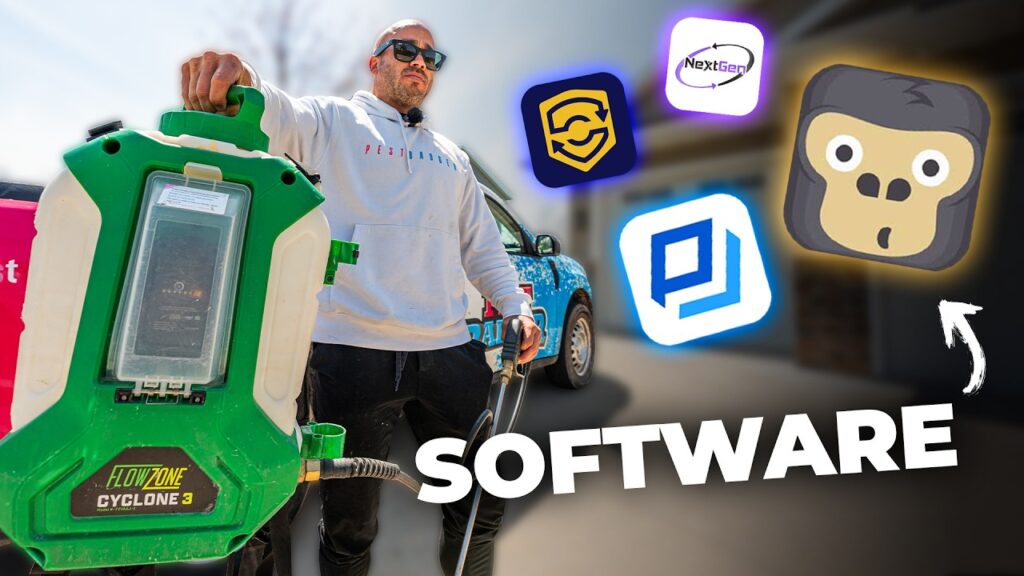
If I was setting this up today, I would probably use Gorilla Desk, and not because it’s the only option out there, but because it’s founder-led. They’re pushing fast on AI. And honestly, most pest control management software platforms have all been bought by PE and they just start to move slow. Think of like a big ship in the middle of the sea. The bigger the ship, the harder it is to turn. Or you have a smaller ship that’s easy to turn. What I love about Gorilla Desk is it’s still being built and worked on by the founder every single day.
This is where you turn a lot of your time and money into efficiencies. Our business is all about efficiencies. A good pest control scheduling app lets you see your entire day in one place. A tech knows his exact route without even calling you. Clock in, clock out, automatically bills the customer, keeps credit cards on file.
Most of the pest control software programs on the market today overlap in a lot of ways. Whether you call it pest management software, pest control service software, a pest control business app, or just pest software, the real test is whether it handles the day-to-day without breaking. You don’t need the most advanced pest control business management software out there. You need a system that actually works. Most people spend time switching software instead of actually using the software that they have. If you’re not using a CRM, I promise you’ll be the bottleneck for a long time until you get one.
Fix What Happens When the Phone Rings
The next thing you need to fix is what happens when the phone rings. Because if that part breaks, none of it really matters. I see this all the time. I look at businesses every week and I get into their call center or whoever handles the phone and I start looking at their phone system and how they actually handle phone calls.
You need some sort of phone system. You don’t need the most lavish phone system right away, but make sure it has the capability of call routing and the ability to transfer calls. There’s even something simple called Lawn Phone. It’s super simple, easy to track, records all your calls for you. You can transfer calls, you can set it up where it automatically answers for you. Press one for sales, two for service, or however you want to set that up.
A modern phone system plugs right into your pest control dispatch software so a call turns into a scheduled stop without anyone re-typing it into another tool. Most of you don’t need anything super complicated here. Just get something in place. The biggest thing is just make sure the phone gets answered. If you hire a VA, if it goes to you, you can set up for a specific time to transfer the calls to the VA and once the day is done, it can transfer back to you.
This is honestly where I see most of the leads fall through the cracks, especially early on.
Speed to Lead Is Everything
Once your phones are actually set up correctly, now you can actually start handling pest control leads a little bit better. And this is where I see a lot of the leaks in the boat. If there is one big hole you can plug in your boat right away, this is usually one of the biggest ones. It’s not typically marketing here.
I use a system called NextGen Leads. It is built for home service because most systems don’t handle speed to lead the way that we need to. It keeps all of our inside sales all in one place. It has built-in lead follow-up, sales pipelines, everything all in one system. This is the piece most pest control lead management apps get wrong. They treat a lead like a contact record instead of a live opportunity.
Speed to lead is just what wins in our industry. Soon as a customer fills out the form, they hear from you in minutes. You set autoresponders, set up automations that text the customer, message the office, let them know there’s a lead there. If you miss a call for some reason, you can set up a text that goes out saying, “Hey, we’re busy. We’ll be back to you within the next few minutes.” Leads that come in at night get handled. There’s AI agents ready to answer the phone for you for after-hours service or if you have a big spring rush and can’t handle that much volume with one or two CSRs. It’s a good way to back up with AI agents answering the phone and selling these jobs for you.
If you’re checking leads a few times a day, honestly you’ve already lost. If you wait 10 minutes, you’re probably still behind. And if you wait an hour, you’re honestly out. Most of the customers have already went on to someone else. They already filled out multiple lead forms. They already called multiple people. If you’re not responding right away, the odds of you closing the customer are slim to none.
Also, go look at how many missed calls you had last week. Even if it’s 20, that’s 20 chances that you’ve already paid for or got referrals to or wherever the calls came from. Even if half are service calls and half are sales calls, and you’re closing at 50%, that’s still five jobs you missed. That could be potentially $5,000 in revenue or more.
Track and Coach on Your Calls
Now you got the leads coming in and you’re responding pretty fast. The next thing is understanding what’s actually happening on those calls. Even myself early on, I didn’t do a great job of this. But at this point, we track everything. We track missed calls. I’m a firm believer that I don’t want any missed calls, period. With AI agents for overflow and after-hours, even live phone calls I want them answered all the time. 98% isn’t quite good enough.
We track call recordings, call length from sales calls to service calls, how long they are, how fast the response time is to answer the phone, the ring time.
Good pest control reporting software should make these numbers obvious, not buried three menus deep. When you’re shopping around, don’t just look at pest control software cost. Look at what reports you actually get out of it. A cheap tool that hides your data costs more than a slightly pricier one that shows it.
We didn’t even track this part at first either. People were calling in, they’d hit one for service, two for sales, and they were hanging up before we even talked to them. We didn’t even realize this. This is called an abandonment rate. If you have a phone system, make sure you’re checking if there’s any calls that drop off before they hit one or two. Even if you had 10 people call in and one person dropped off, that’s still a 10% abandonment rate. Once we noticed it, we started sending a text message to the office saying this person called in and they didn’t even transfer, so one of the CSRs was able to pick up the phone and call them back right away. If they don’t come through your phone system, you never even get a chance to sell.
Now with the recordings, you can actually improve your team. This is probably something I didn’t do very well from the very beginning till I realized this is a big part of coaching. It’s super simple. Just go listen to 10 calls or make your manager listen to some calls and you’ll honestly hear it right away. It could be a sales guy just talking too much, not asking for the sale. There’s no urgency, no confidence at all. CSRs not handling things properly. Maybe someone had a complaint, maybe they called in a second, a third time about the same complaint and they just weren’t taking good notes.
We had a rep that thought he was doing great, been there for a while. Pulled his calls. He never even once asked for the sale. Not one time. So we talked him through that, coached him up, and it helped this person a lot.
You just find the gap and you can’t fix what you can’t hear. Take the time to go in, spot check your sales guys, spot check your CSRs, make sure they’re answering correctly, make sure they go through the script correctly. It’s an easy tool for training. You can record good calls, have new hires listen to them. Have them listen to some not-so-good calls too.
I’ve said this a million times: you don’t need more leads if you don’t even know what’s happening on your calls. Tracking your pest control KPIs is what separates growing companies from stuck ones. If you can’t close a call, then why increase the budget? I had a friend call me last week who had a CSR that took 60 sales calls. She’d been there for six to eight months and closed zero of them. Not one. Obviously a pretty big red flag. He ended up getting rid of her. But if you’re not tracking these things, not following up, and not listening to the calls to see what’s going on, it can get away from you fast.
Most people avoid this honestly because it’s uncomfortable. And when you’re uncomfortable, it’s probably something you should be doing. This is how you level up as a leader.
Reputation Management Drives the Next Job
After the job is done, this is what drives the next job. We use a reputation management platform to drive reviews. Every time we get done with a job, our technicians go talk to the customer, make sure we did a good job, see if we solved their issues. The technician talks to them about leaving a review and how he gets a tip. The customer basically gets a text after the service, they click on the link, and it leaves us a review with one star through five stars. Majority of the time we do a good job, so it’s a five-star review and then it tips the technician for doing a good job.
If you’re not consistently getting reviews, your marketing just stays hard. This is one area where pest control marketing software pays for itself fast. The more reviews you get, the more trust you gain, the more people see your reviews, the higher you rank in local SEO for pest control companies, top of Google and things like that because you just have more reviews and stick out. People go to your website, they go back to your reviews, check out reviews, and they go back to your website and fill out the form and wait for you to respond with an estimate.
Here’s a good quote I picked up from somewhere: if you’re the best option in an area but you look the worst online, you lose. You probably have the best service if you’re watching this, but make sure your online reputation precedes your service and your company. If you’re not consistently getting reviews, your marketing dollars just don’t go as far. The higher the reviews, the higher your rank, the less marketing money you have to spend. We use Bravo for this. We really like it.
Referrals Should Be Your Number Two Lead Source
Now that you got the customer, serviced them, got a review, the next thing we like to use is Clicki for referrals and giveaways. One job just doesn’t end. It creates the next job. I think your number two lead source should always be pest control customer referrals. I hear a lot of people say there’s not a great way to scale referrals. Well, using Clicki is a great way to help scale referrals. You can get leads for $13 to $17. It’s one of the cheapest ways to get leads.
There’s net promoter scores built in. It’s a fantastic tool. Maybe it’s not something you get day one, but as you get technicians, I highly recommend switching over to a platform like Clicki. It tracks everything on a dashboard, shows you which people are going to refer, shows you your best people that are referring. You can drive competitions through there. It’s super awesome.
Maybe it’s not your first tech, but maybe it’s your second or third technician. It’s an easy way to drive referrals to help grow your business. It’s going to cost a couple hundred a month, but honestly, that couple hundred a month is going to generate you 10 to 15 new customers plus wherever you’re at in business a month. Highly worth it. Every single customer you talk to probably knows someone that can use your service as well.
Communication Tools for a Growing Team
As your team is growing, things can start to break and that’s where communication comes in. Group texts, I’m not a huge fan of. Although it does work early on, you know, if you have to let somebody go and you have one person in there, back in the day, if one person had Android and you all had iPhones, no matter if you wanted to kick that person out or not, they always were in that feed. It’s just not a great way.
We use communication tools like Slack. There’s some free ones out there. Channels for dispatch, sales channels, specific location channels, specific department channels. This is a piece a lot of pest control company software platforms and pest control company apps don’t cover well, so pairing a messaging tool next to your CRM helps a lot. You have a good place to communicate with all your technicians, your sales people. It keeps everything on one app and everything is in one place. You can set notifications, you can set alerts so that no one can read anything below in the comments until they read the alert and approve it. It keeps communication all in one spot, makes sure everyone’s on the same page. You don’t have to have a ton of meetings all the time. You just have better communication all around.
This is not a day one thing. It might be two, three, four technicians. I think there was an app called GroupMe that’s free. Use GroupMe for a while, see if you like it, and then switch into a more professional or upgraded version that has more tools as you scale up.
Fleet Tracking and Pest Control Routing Software
Even on your first truck, you should get a GPS and a fleet tracking system. Pest control routing software is one of those things that pays for itself fast. There’s a million of these pest control routing apps out there. Pair it with a pest control mobile app your techs use from their phone, and suddenly their truck, their route, and their work orders are all talking to each other. Use the one that’s best for you. I like audio and video so that you see forward and back-facing screens with video. You can hear audio in there. It’s not like you have to monitor every single truck all the time, but if something comes up where you need to check on a technician or something’s going wrong, it lets you see where your trucks are located, if routes are actually running properly, idle time, drive time.
You don’t need to do this day one, although it’s not a bad idea because if someone steals your truck, at least you know where it is. In fact, we had a truck stolen this year in one of our locations and within maybe an hour or two, the person that stole the truck didn’t realize there was a GPS and we were able to find it within a couple hours. Pretty crazy. One of our technicians woke up and the truck was gone and we were able to find it. Thankfully, nothing had happened to it.
You can also set it for specific geo tags where every truck starts at a specific time. If it’s outside of working hours like midnight or 1:00 AM, it’ll automatically send you an alert or text. It’s just a good idea to start tracking all of your fleet.
The Cycle That Runs the Business
Now if you take a step back, this is what all of this is doing. Leads come in, you handle them fast, the job gets done, the customer leaves a review, they refer someone else, and then it just repeats. That’s the cycle of business. If any part of that breaks, you feel it. You start to get missed calls, slow follow-up, bad routing, no reviews. That’s where the gaps are. And these are easy ways to fill in those gaps.
Automations That Scale With You
At the enterprise pest control software level, once you’re running multiple branches, everything becomes about integrations. Your QuickBooks pest control software sync, your pest control QuickBooks apps, your pest control estimating software, your pest control inventory software, and your accounting software all need to talk without a human forwarding a spreadsheet every Friday. Older pest control computer software handled one thing well and ignored the rest. Modern stacks don’t have that excuse.
This is also where pest control invoice apps and pest control accounting apps start to matter. If your invoicing app pushes payments straight into QuickBooks and your client portal apps let customers pay and reschedule on their own, you stop losing time on busywork.
As you scale up, there’s obviously more you can layer in. You start getting pest control KPI dashboards built for every technician, every sales guy, basically every department. At the touch of a button you can see any office at any time all in one dashboard, from reviews to technicians to everything all in one spot.
One of my favorite automations for the entire year of 2025 was automations to track churn and prevent churn. We use predictive analytics through a company called Churn Solutions. They tested 2022 and 2023 going into 2024, and within those two years it predicted within 80% of what was going to cancel in 2024.
It has playbooks that are all automated that text the customer, call the customer, and create a to-do for the CSR. It can save you tons of customers. It’s so much easier and cheaper to keep a pest control customer than it is to go get a new one. It’s going to tell you all the reasons why a customer is going to cancel and it has a playbook created around those reasons. Maybe they weren’t happy with the service, maybe they had called into the office a few times, maybe it was a billing issue. It takes those reasons and reaches out to them for you or creates a to-do for your CSR to follow up. Maybe you offer them a free service for being such a great client or put them in a premium package. It does all this almost automatically.
One of the coolest things going into 2026 that’s going to change our business. Even if it only saves you 5% of your churn, it’s going to be absolutely amazing. When I say 5%, not of your whole churn, but let’s say your average churn is 20%. 5% of that 20%. That’s still amazing. That could be thousands of dollars, hundreds of thousands of dollars, or for a bigger company, millions of dollars.
If you run a specialty arm like termite, rodent, or IPM, make sure whatever you pick handles it. A lot of integrated pest management software and termite and pest control software options layer on extra graphs, diagrams, and inspection modules that a generic CRM just won’t do. Pest inspection software is another one. If you’re doing WDO reports, real estate work, or commercial accounts, having the inspection piece inside the same system saves hours a week. A handful of pest control services software vendors package all of this together; most don’t.
Don't Overcomplicate It
You’ll see a lot of pest control software reviews and pest control app reviews online comparing every platform out there. Cloud based pest control software, web based pest control software, commercial pest control software, free pest control software, even paid pest control software programs. Don’t get lost in the spreadsheet. If you’re super early on in business, don’t overcomplicate this. The best pest control software for small business, and the best pest control app for small business, is whatever you’ll actually use. Just get a solid CRM. Make sure your lead follow-up is fast. Know your numbers. That’s enough to start building momentum. As you grow your pest control business, your software and your apps will have to grow with you, or you’re always going to be the bottleneck.
At this point, it’s honestly not about working harder. It’s about building something that actually runs without you. Most people don’t have a business. They just have a job that depends on them. But if you start to work on the system, you start to fix the system, all that starts to change. You fix this and everything else gets easier.
Frequently Asked Questions
What is the best software for a pest control business?
FieldRoutes, GorillaDesk, or PestPac for routing/scheduling/billing, paired with GoHighLevel for marketing and lead nurture. The field service CRM handles ops; GoHighLevel handles speed-to-lead, automation, and reviews. Running both gives 90% of what enterprise stacks deliver at 20% of the cost.
How much does pest control business software cost?
$50-$150/month per user for FieldRoutes/GorillaDesk, $97-$497/month for GoHighLevel. Total stack for a 5-truck operation usually runs $400-$900/month, which is 1-2% of revenue at $500K and well worth the productivity gain.
Do I need pest control software as a solo operator?
Yes, even at $50K revenue. GorillaDesk’s solo plan ($49/month) handles scheduling, billing, and customer records better than spreadsheets — and the time savings (5-10 hours/week) pays for itself instantly. Skip the free pest tracking apps; they break when you scale and migration is painful.
What features should pest control software have?
Route optimization, mobile work orders, integrated payments, automated review requests, customer portal, recurring billing, chemical/usage tracking, and reporting by tech/route/source. If any are missing, you’ll outgrow the software within 12 months and migration is brutal. Buy for where you’ll be in 18 months.
Should pest control companies use FieldRoutes or GorillaDesk?
GorillaDesk for solo operators and small teams (under 5 trucks) — simpler interface, lower cost. FieldRoutes for growing companies (5+ trucks) — better reporting, stronger commercial features, and better integration ecosystem. See our software stack breakdown.
Quitting too early
I get messages every day from people saying it’s too hard to get customers. And I get it. The first 100 customers are genuinely hard. You’re going to knock a whole street with nobody answering. You’re going to hear no more than you hear yes. You’re going to question yourself for the first 60 days.
But the people who win this industry are the ones who are willing to stay in it and scale a pest control business and endure the pain for 15, 20, 30 years. You can get paid very well the whole time. It just takes longer than most people are willing to wait.
The Simple Summary
The short version of the pest control software and pest control apps stack: a CRM for customers, a pest control scheduling app for the calendar, pest control billing software and a pest control invoicing app so you actually get paid, pest control accounting apps (or a QuickBooks pest control software integration) on the back end, pest control routing apps and a pest control mobile app in the truck, pest control reporting software on top so you can see what’s working, and pest control dispatch software tying the phones to the schedule. You do not need all of it on day one. You just need to pick tools that work well together.
Pest control is simple. I never said it was easy. Get licensed. Get insured. Buy only what you need. Don’t overbuild. Don’t spend months on branding before you’ve got a single customer. Don’t try to take an entire city. Pick a neighborhood and execute.
Here’s the recap for how to start a pest control company the right way: Get licensed in your state through the Department of Agriculture. Get general liability and commercial auto insurance. Buy basic equipment and chemical inventory. Get a truck or use what you have. Set up a CRM from day one and get payment info upfront. Pick one or two neighborhoods and run the Law of 100 every single day. Stack density, do niner rounds, put yard signs in every lawn, and ask for referrals from every customer.
Your first 100 accounts should come from pure effort. Call everyone you know. Text everyone. Post on Facebook, LinkedIn, everywhere. Knock doors. Talk to businesses. Make videos on your phone. Layer the awareness until your name is everywhere in that zip code.
Once you hit 100 to 150 customers, then you start adding things like pest control conversion rate optimization, local service ads, and targeted Facebook ads for pest control. Those tools will amplify what you’ve already built. But you have to build the foundation first.
Pest control is not glamorous. It’s not the kind of business that looks impressive at a dinner party. But it’s recurring. It’s stable. It’s recession-proof. And if you’re willing to show up and do the work for long enough, it will pay you very well.
If I had to start over tomorrow with $20,000, this is exactly where I would start, with one good CRM, one solid pest control app for my techs, and a phone system that actually answers.
Once your software stack is dialed in, spend your windshield time with the best pest control business podcasts and keep learning from operators a few steps ahead of you.
And once the software stack is set up, the next question is who’s actually working the leads inside it — here’s how a dedicated pest control inside sales team turns a CRM full of leads into closed revenue.
