Jonathan Pototschnik on AI, Top Tier Clients and One Business

Table of Contents
- Don’t sell your business out of fear
- The fastest way to grow is more of your best clients
- AI will widen the gap between big and small
- Where we use AI on the phones
- Why companies stall at a million
- One business, all in
- You can’t outlast anyone if you feel terrible
- Get around people who are ahead of you
- Frequently Asked Questions
Jonathan Pototschnik, JP to me, is the co-founder of CitiTurf, a lawn care company in Plano, Texas. He started mowing lawns at 14, built Service Autopilot and sold it in 2019, and he has taken more than one business well into eight figures. He has been my mentor for going on 14 or 15 years. When I first got around him, my company was doing right around $250,000 a year.
This was episode 200 of the podcast, so it had to be JP. We scheduled an hour and went almost three. He is back at CitiTurf working on nothing but marketing, and we covered selling, AI, why companies stall and what he would tell me not to do over the next five years.
This episode is part of the PCM Podcast. JP has been on before, and his case for the long game and not selling is a good one to read next.
Don’t sell your business out of fear
After my episode with Nick Bartolo on what’s happening with pest control valuations, owners reached out asking if now is a good time to sell. I told them no. JP went further.
People hear something scary about AI or the economy and think they should cash out. JP’s question is what you do the day after. “The very same thing that will hurt your business is the very same thing that will hurt every single thing that you could potentially invest in,” he said. Stocks are just businesses. Real estate depends on people having money. And you can’t sit on it either. “Cash is truly the worst place to have your money,” he said.
Selling also makes you start over as a different person. You spent years learning to build a business and manage people. After you sell and pay the government its share, you have to learn to invest and to control your emotions so you don’t sell at the wrong time. JP has watched it happen. Within about 60 days of the big number landing in the bank, people have a new worry, which is how not to lose it.
He isn’t against selling. He’s thankful he got to do it once. But he said it’s close to impossible to time, and it isn’t the only way to get the life you want. A great business doing somewhere between $5 million and $10 million a year can pay its owner a million dollars a year. “You just build the very best business you can build,” he said. If it works out that you sell it one day, wonderful.
People ask me what my exit plan is all the time. I don’t have one, because I don’t know what pest control looks like in five years. I’m optimistic, and I’m building.
The fastest way to grow is more of your best clients
I asked JP what marketing strategy is underused in home services. His mind went to direct mail and offline marketing, and the reason is the useful part.
He has ranked every CitiTurf client into four tiers. He warned me he was going from memory, but about 900 clients out of almost 12,000, less than 10%, make up almost 25% of the revenue. The bottom tier is about half the client base, almost 6,000 people, and it drives, call it, 25% of the revenue.
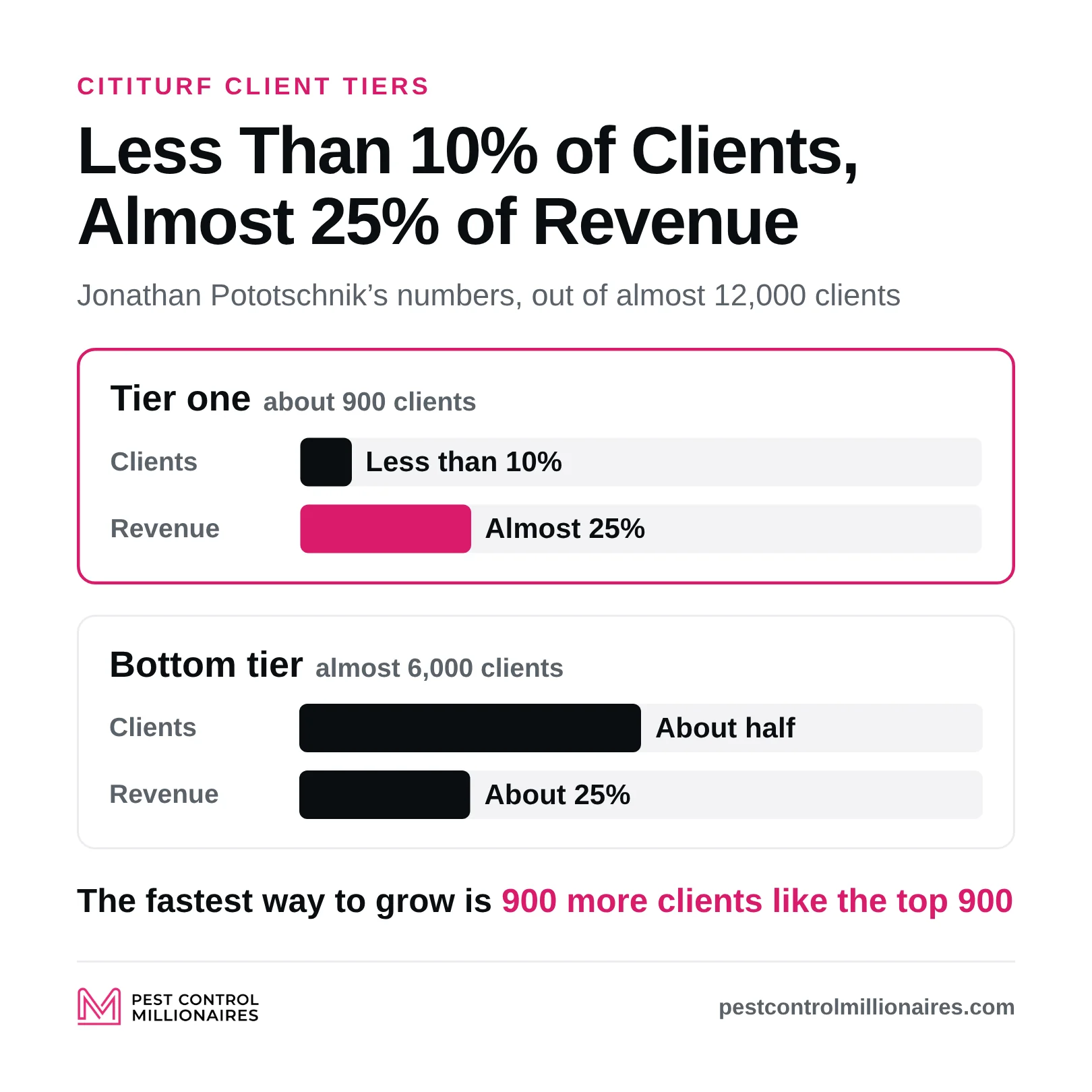
“The fastest way to grow the business is to go get 900 more clients just like the top 900. There’s no faster way,” he said. If he keeps running the same Google Ads and Local Services Ads, he gets the same mix he has always gotten. He knows who the tier one clients are, where they live, what they care about and what they worry about. So the question is how to get in front of them. That could be postcards, door hangers, door knocking or the neighborhood Facebook group, each with offers and copy written just for that group.
He was also clear this is not for most owners yet. He called direct mail “the fastest way to set money on fire” and said he’d tell most people not to do it. Get your Google Ads right first, bring that cost down and buy more traffic. At $3 million to $5 million, he isn’t worried about an owner leaning on Google, because that owner probably hasn’t finished optimizing it. You add channels as you get bigger. That fits how I think about what to pay for a customer on each channel.
AI will widen the gap between big and small
JP called AI the most exciting thing he has seen, and he also said nobody knows where it’s going, no matter how sure they sound.
His best case for service companies is that tools show up that drive down operating costs. The owners who adopt somewhat quickly, not too early, get an edge for some number of years. Then everybody adopts and it normalizes. His worst case is not robots doing the work. It’s AI hurting the white collar customer who is our best buyer, so the company does everything right and the customer isn’t there. He has no idea if that happens.
He doesn’t think we’re there yet. The way he put it, AI is “just a brain,” an intelligence layer, and most of what he wants needs something built around it. CitiTurf has two or three hundred cameras on its property. AI could scan every truck coming through the gate for damage, an expired registration sticker or missing equipment. The intelligence can do that today. What’s missing is the system that feeds it and flags the problem to the right person. He isn’t going to build that himself, because a software company will, and he’ll buy it for a couple hundred dollars a month. So he’s waiting.
I asked if that helps the little guy catch up. He said it widens the gap. Bigger companies have the money, and they have the free time to work out which tools are real. He can write a $150,000 check for someone who thinks about it all day. The small owner is in the truck trying to survive.
Two more things from him. First, don’t accept what AI tells you. He uses it every day, runs models against each other and still catches it being wrong every day. “I’m thankful that I’m 50 and not 20 using AI because I wouldn’t know the difference,” he said. Second, forget the idea that it gives us our time back. “We’re just going to do 90 more things,” he said. “This isn’t about to get easier.”
Where we use AI on the phones
When JP asked where I’d start with AI, I said the phones, and only overflow. When every CSR is on a call, the next call goes to the AI instead of an outside answering service, which was costing us about $3,000 a week in the heavy season. It doesn’t take sales calls or cancellations. Our people still handle those.
The number that shocked me in our test was that only 22 callers asked for a real person. When we tried AI before, people swore at it. I wrote up the whole test in how AI replaced our backup call center.
JP’s team tested a batch of voice AI tools a while back. He listened to the recordings and wasn’t impressed, so he plans to look again in the off season. He also thinks that once everybody has AI on the phones, a human who answers and a person on the property could become the advantage. I agree. To pay a bill, I don’t need to talk to anyone. With a problem, I want a person.
Why companies stall at a million
I asked why so many companies hit their first million and sit there for years. “People. It’s just people,” JP said.
Either the right operations person isn’t in place, so too much still falls on the owner, or the person in the role can’t take the company to the next level. A lot of owners promise that job to their first technician because they love the guy, and he turns out not to be wired for it. Not everyone finds a Philip, who runs CitiTurf for JP.
The second reason is math. You lose some number of clients every year, and if the marketing budget isn’t scaling, you can’t replace them and grow. The third is the owner chasing the next shiny object. I wrote more about this stage in why pest control companies get stuck at a million dollars.
What has to change is the owner. Up to about a million, you’re the hero. If a guy doesn’t show up, you jump on the truck and save the day. At $3 million, you jumping on a truck does almost nothing for the day’s revenue. You have to become the trainer, coach and leader who builds the people who run it. When the quarterback gets hurt, the head coach doesn’t go in to finish the game.
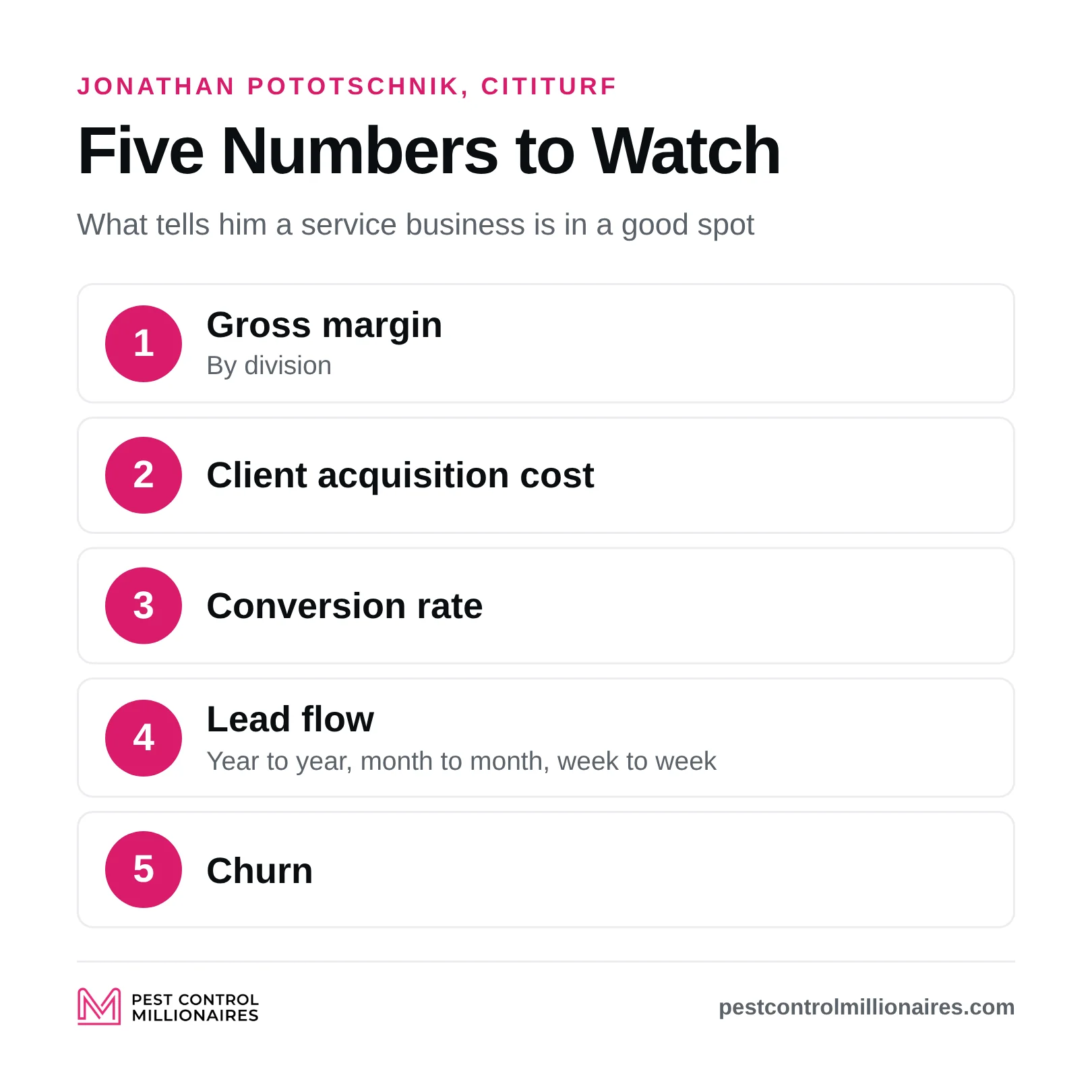
I asked JP for the numbers he would watch to know the business is healthy. He gave me gross margin by division, client acquisition cost, conversion rate, lead flow and churn.
One business, all in
I ask JP the same thing every time we’re together. Where am I going wrong? I asked it on air so you could hear the answer.
His answer hasn’t changed. If you want to create wealth, the only thing that matters is the one business. He pointed to Tommy Mello, who spent the core of his career on A1 and not on a pile of other things.
Then he told a story on himself. While he owned Service Autopilot, he ran a coaching program called Academy, which I was in. He said it brought him some of the most satisfaction of his life and that, purely as strategy, it was a mistake, because the hours it took came out of the software company that was creating the real wealth. He counts everything that way. He could buy the house in Telluride he always pictured, and he won’t, because even if he never goes, it spins in the back of his mind. “How can you get everything out of your life where there’s less noise in your brain?” he said. “That’s what you’re optimizing for.”
I told him my content is different, because it is Pest Badger’s driver. It’s how we get franchisees, and the three to five franchise calls we have a week come from it. He agreed content is not the same thing, since his Lawn Care Millionaire channel was how he grew Service Autopilot.
His list of what not to do over the next five years was short. Don’t let door knocking be the only major channel, because a marketing-based business is a better business. Don’t try to build Pest Badger so I don’t have to be there, because that isn’t how you reach a goal as big as mine. And don’t sell too soon. The fastest way to build wealth is from where you are to bigger, not from zero again. “This is your ticket and you need to see this thing through,” he said.
You can’t outlast anyone if you feel terrible
We spent a while on health. JP would start with food and sleep, since most owners in the field are at least on their feet. Pick one and dial it in. When you eat badly and don’t sleep, you don’t have the energy or the optimism to solve hard problems. For most people, more sleep means getting off social media at night.
His weakness is sugar, so it doesn’t come in the house. I carried a small food scale everywhere for a year, and people laughed at it at events. This business is seven days a week, and you can’t outlast people eating at the gas station every day.
It’s also why I plan my travel around my girls. I’ve never missed one of my daughter’s wrestling matches, and part of why I’m getting my pilot’s license is so I don’t miss them when she goes to college.
Get around people who are ahead of you
I ended by asking what he’d tell the owner who is still in the truck and wants more. “Start hanging out, spend the money to get around the people that are living the life, the business that you want, because they have all your answers,” he said.
It’s about belief more than tactics. When he was young, JP read the business magazines and wanted that life without believing it was possible for him. “The way you believe is to be around it,” he said.
That is exactly what happened to me. Every time I got in a room with people running bigger companies, I walked out more confident. I once asked JP when business stops feeling so messy. Never, he told me. They’re all messy, no matter how big. “If you feel like you need everything really well put together and organized in perfection before you keep going or you get to the next level, you’re wildly wrong,” he said.
The first thing he ever told me was to think bigger. I came from Escanaba, Michigan, and I’m still finding out I wasn’t thinking big enough.
Frequently Asked Questions
Should you sell your service business because you’re worried about AI or the economy?
Jonathan Pototschnik says no. Whatever would hurt your business would also hurt the stocks, real estate and other places the money would go, and cash is the worst place to keep it. His advice is to build the very best business you can. If it works out that you sell one day, wonderful, and if you never sell, a great business can still pay for a great life.
What is the fastest way to grow a home service company?
For Jonathan at CitiTurf, it is getting more clients like his best ones. About 900 of his almost 12,000 clients, less than 10%, make up almost 25% of revenue. He tiers his clients, learns who the top tier is and where they live, and builds offers and copy just for them.
Why do pest control and lawn companies stall at $1 million?
Jonathan’s first answer is people. The right operations person isn’t in place, so too much still falls on the owner. The second is math, because every company loses some clients each year and a marketing budget that doesn’t scale can’t replace them and grow. The third is the owner chasing the next shiny object.
Will AI help small service companies catch up with the big ones?
Jonathan thinks it will widen the gap. Bigger companies have the money and the free time to figure out which tools are real, and they can hire someone to think about it full time. He expects companies that adopt somewhat quickly to get an edge for some number of years before everybody catches up.
Full transcript
Every word of the episode, from the video captions
And so every time that I had conversations with people who are doing bigger things than I did, I got more confident in myself.
Oh, interesting. Very interesting.
Because they're not the level of people who I thought they were, because they, like you said, they say dumb stuff, they don't always know what they're talking about. Not that I know everything, because I don't.
And I'm still constantly learning and I'm very vulnerable to say like I don't know I don't know the answer to this. Like I'll ask someone. But then I seen like these people who are running these big businesses and like they don't always know what they're talking about. And they do say some really dumb things. Like okay, they can do this, I can do...
I often feel like these really big or bigger companies just have it dialed in and it's really well put together and then have hired some people from these big companies and they're like those places are a disaster. Like I don't mean this about me, but they'll be like this is better ran than that thing is ran. Those If you get really big, I there's a level up where you're in the hundreds of millions or billion. You just I just pictured things being better ran and better organized. And I've come to believe that is not the case. And so for somebody that's building, here's the point.
Welcome back to another episode of Pest Control Millionaire. Really excited about today. Got the one and only JP on here, my mentor from I don't know, I think it's going on 14 15 years at this point, somewhere in there. It's crazy. It is been a while.
It went by fast, you know, looking back at it. I knew that episode 200 was coming. You and I talked about it. I was in Dallas a month ago. So hey, I'm happy to It's already been that long? Two months...
Months ago. Yeah, because I've been in Alaska and I've been home for two weeks now. So yeah, it's that that was a month just that. So...
Wow. So yeah, I've been two months that I was in Dallas. It's been a couple days with you down there. Had a good time as always, learned a lot. Always fun giving back at this point too. It's cool just to be able to, you know, give value on my end, which is cool. And so yeah, 200 200 episodes. I mean, man, I remember when this thing just started and I was just doing it for fun because Academy had just finished. And everyone's like, oh, let's just keep it together and someone just start a podcast. I'm like, I'll start a podcast. And then here we are 200 episodes later. So circling back to it all again, JP, welcome back to the...
Yeah, hey, good to see you guys always, of course.
Real quick, I'll let you do an intro for yourself. I mean, you've accomplished a lot. I have a lot of questions, but I'd say make it quick, but nothing you and I do is quick. So let's just do do an intro. Just let her know you know what your past is like, what you've The fast version is I started mowing lawns when I was 14 and that's what gave me the bug and showed me, hey, I want to figure this entrepreneurial thing out cuz that's how you make money. I ended up building a bunch of companies along the way. The first many companies in the early days were frankly me trying to figure it out. And then probably about 20 years ago now, I got to a place where everything I was working on was really All of it got big. All of it got to eight figure well into the eight figure businesses I've just built a bunch of stuff in a bunch of different industries.
Yeah, I mean started in lawn care. You were out of CitiTurf like right around that million dollar mark if I remember. You ran into however you got so lucky. You know, we talked about for years. You found Philip from day one. He runs the company now. It's obviously a sizable company. The new one you built, you know, Service Autopilot, you exited out of that. It's been what, six years? Has it been longer than that? Seven years?
Been over seven now.
You exited out of that. Then you went on a hiatus for five years.
For quite a while.
Traveling the world?
I mean, you've done it all. Like you've helped so many entrepreneurs along the I know we you know, I talked about this a lot too. Probably everyone does with you. Like the amount of people that you've helped that you don't even know with your, you know, Lawn Care Millionaire channel, like people know who you are just walking down the street. It's really but I mean, you've you've done it What fee was you to keep going today?
I just like this stuff. I mean, I feel like I'm going, I feel like I'm barely going today, frankly. I feel on many days I'm like, golly, I'm under-performing here. I should be doing more, but I have to keep reminding myself like working all the time isn't necessarily a life well lived the long...
Yeah, and that's actually brings up first question.
Oh, really? Okay, yeah.
And so like I've thought about this and I've heard it I don't know if it's just I don't I don't you know me, I don't I don't scroll social media, but the things that I turn on like lately it's been like at the end of your career, like people aren't saying I wish I would have worked more or blah blah blah. Like what is important to you now? Cuz I remember I remember why you left Service Autopilot, remember why you kind of why you sold, remember why you stopped Academy. I know you kids are graduating, promised them you travel. But like looking back at all of that, like what's important to Jonathan today?
Today I just want to I think when I look back there are two things that are going to matter cuz I frame things in exactly that way. The two things that are going to matter to me well, there's a lot more than two things, but I'll name two. Like a third thing I'm not going to mention is I don't want to I want to have a good marriage. I want to still be married, have a great marriage. I'm expecting that to be the case. So there's lots of things like that I could mention. I'm not going to. The two things I think about though are I think I'll be the happiest and I'll feel that I lived the best my best life if I continue to help a lot of people. If that's what I look back If I look back and I've just accumulated a lot more money cool, I'll take it. But that is I don't think I'm going to look back and say that really mattered in any meaningful way. It's more about am I going to be able to look back and maybe have a bigger version of what I've already done from the standpoint of people that maybe I've never met that have a better life. And then the second one is my boys.
Help my boys get to go or go where they want to go. So I often think about like what can I do when they're ready, if they're interested, to help them build the life, the career, the business, whatever they choose to do and get the success that they want. Those are really the two single biggest things that I think...
Yeah. I'm right there with it, because obviously, you know, I have the girls that I pour my heart into as well. So I think that maybe again, just me, but I don't know if it gets talked about enough, like parenting while trying to run a company and trying to grow a company, how much tax it can be on that those relationships.
Try you know, like you like from day I'll give you credit, like you've always told us like you know, your kids are number one, don't ever miss anything, pour your heart into them. And so I've done that. I haven't missed a thing. I think you and I have talked about that a lot. I get there's just some things that I just won't do. I'm willing to risk it all, and you know...
There's just one thing that I won't do, and I won't miss my girls stuff.
But I just don't think that it's talked about enough of how much we have to give...
To be able to do that?
Enable in order to grow something so something this big. It's like it's it is it is seven days a 12 to 17 18 hours a day. It doesn't stop, doesn't slow down. But just taking the time to make sure that you spend with family with you. So like when you do when you look back on those things, like you said your boys and my girls, you look back, you can't say like I gave it all up just and I missed so much during the come up, you know? Cuz the kids Macy's almost Macy's a junior this I only have two years left with her.
Trust me, I know. How do I have two kids in their 20s? That's like how did I get...
And I'm so I'm thankful that I took the time and I've never missed anything, but it's like all those people that are out there, could I go faster? Probably. But am I willing to miss those things? I'm just not.
Yeah, no. I do think that had I been single theoretically, who knows? I could argue both sides of this. There's also I will do the single thing. I could argue the other side that actually being in a good marriage that with a supportive spouse does enable you to go I've observed that there's a bunch of guys I've observed in my life that are single, that are always thinking about how they meet the next girl. That's time consuming.
It is.
So I can argue well that that's a time that's a time suck.
I have kids that work for me from 18 to 35 years old, so I hear the same thing every day.
Yeah, yeah. So when you're married, you know, that part's solved, but you do kind of need to still show up in your relationship. And so I don't know. I don't know which way allows you to go faster, but there's no question in my mind that having kids does take up so much time that that theoretically could slow you down from the building process. And I think a lot of people make the decision that the business is they don't maybe consciously make the decision. They sort of make the decision through their actions that the business is the only and most important And you take somebody like an Elon Musk to do what he's done, that's kind of what you have to do, frankly. I just wouldn't want to do that. And so I've just heard too many stories over the years of it going sideways and somebody like they've made movies about this stuff. You wake up and you don't have any relationships.
I just I knew that young enough, probably a little bit of how I grew up, just like I didn't I grew up with a good family structure. I mean, I just grew up with this awareness. And I didn't want that. And I think people need to be really aware of their actions versus their words. Like a lot of people say they're not going to sacrifice these things, but if you look at their actions, they do. And it's a risk.
Yeah, and again, I had a obviously it was forefront of me and remember you and I talked about this a lot and it's like tell me to just make sure you don't miss those things and I've and I've heard it from other people at the same like you've obviously been there since day one when I started this thing and I've heard, you know, from from our mutual friends that you've said like, hey, I see Jonas is traveling all the time, but he still makes time for his girls. And so like even if I'm gone traveling and I know Maisie has a wrestling meet, like my whole travel plans are are always around the girls. So if like they're at their mom's house for two or three days, that's when I'm gone. If there was a wrestling tournament coming up, like I'm making that I have my travel plans figured out so I have back time. In fact, crazy stories, like the things that you do for your kids, like I had I had flown back and I landed in my flight was delayed. It wasn't going to get to Maisie's wrestling time, so I flew into a different airport, got an electric car, electric truck, I should say, and then I was I was going Chicago to Green Bay, which is like a two and a half hour drive.
And I'm like, is it going to make it all the way there? Like, oh, no problem, no issues. Like, okay, cool. I got halfway there, JP, and this thing was dead. And so like I was like I didn't know what I didn't know where to go. I've never had driven an electric car, so I'm like on Apple Maps trying to figure out where to go plug it in. I go plug it in, plug it in for 45 minutes, and it doesn't move at all. So now I'm like so now I'm frustrated because like I need to be there like in two hours. I end up just doing whatever you can to figure it out. Like I called like the next place, ended up trading the truck in, got a different truck, drove like an hour and a half in the opposite direction to get a vehicle.
As I walked into the gym, Maisie was just stepping on the mat. So there's just things like that like that come up like I'm willing to do whatever it takes. I've never missed a match, and I don't plan on missing one And so like they're kind of circling back. We'll probably talk about this later on, but like one of the reasons for me getting my pilot's license is so that when she goes off to college, I still don't have to miss those things. Hold up, quick pause. If you're running a pest control company or a fertilization weed control company you're not in our Facebook group, you're choosing the harder path. Every operator that's in there is skipping years of mistakes because people are actually sharing what's working right now. So stop trying to brute force your way through growth alone. Search Pest Control Millionaires on Facebook or click the link below. And now let's get back to it.
We talked about that when you were in Dallas house the pilot license going. Have you been flying in the last month and a half or two?
I fly three times a week still. And then last Tuesday I took my written...
And of course I was nervous about that like always. I was like I'm not ready. I'm not ready. Talking to mutual friends of ours that have their pilot's license and they're like yeah, when you start scoring like 90s on your tests like you're good to go. The day before I was I was in the app and just asking me all these crazy questions that I've like the app never didn't even go through. Like I have no idea what any of this is. So then I went back and reverted to the textbook. Started like just studying out the textbook, the holographs then formulations that come up with. And I felt pretty confident. And then that next day went took my forgot my plotter which is like this tool that you use to measure like your like from distances in nautical It's kind of like a compass. Yeah, it just tells you like which like which degrees you're flying, headings you're flying. And I forgot it. And they're like well I would still take it anyway. I'm like I'm not going to take it without a plotter cuz you could get 12 questions that are on just like all on charts that you have to plot. And so I was like is it okay if I just leave? And I ran to the airport which is like a half hour away, grabbed a plotter from there and then came back.
Is it like a compass?
And then of course I didn't have one single question. Not one. I didn't but I ended up passing it relatively pretty easy honestly. I thought it's I studied for I took a week off basically a week off work.
Higher. I still worked of course here and there but I took a week off just to study. And I ended up getting 89% so I ended up getting like seven wrong or something like that. Most of the tests are only 60 questions but I heard of some people getting an additional five questions because they're they're testing five new I got the extra five questions and I still thought it was really easy. And so when I got back when I got done with it I had like flagged eight questions that I was unsure of. It's like so I just went back flagged them and then I went back through those ones and I felt pretty confident of like four of them. Ended up getting like seven or eight wrong total. Yeah, so then it was done and all I have left is I'm going flying tomorrow night. I got to do one cross-country flight at night. So we're going to leave tomorrow night.
And then after that let's go meet with my DPE, do my flight oral exam. That's it. It's a wrap and I should be done here in the next couple of weeks.
So you can fly solo after this?
I can fly solo now as long as as long as I let my instructor know where I'm going. He can he'll sign me off.
So have you flown solo?
Yeah, I've been I've been So I've been flying solo for quite a bit. And then so I have a hangar here in my hometown. And he's about an hour And so I was having to drive back and forth every time. But now it's just a 20-minute flight there and back, which is pretty cool. The best pest control companies do not leave growth to chance. They build systems. They have a system for generating leads, system for answering the phone, system for servicing the customer, and systems for collecting payments. But most companies still treat referrals like luck. They do a great job, hope the customer remembers to tell a friend, and maybe send an occasional text asking for a referral. That is not a system. Clicki Referrals turns your happiest customers into active, trackable sales channel for your business. Clicki automatically invites customers into your referral program, gives each person their own referring, tracks the leads and sales they generate, and makes it easy to reward them when those referrals turn into business.
And now Clicki has launched Rewards Pass. Rewards Pass is a brand new referral pass for your company directly inside your customer's Apple Wallet or Google Wallet. Think about that. Your brand can live on your customer's phone alongside their cards, tickets, and brands they already use every day. Their personal referral link is always one swipe away. You send push notifications and out special offers, promote events, and stay connected long after the initial service is complete. This is not another app your customers have to download or another login they have to remember. It's your company, your referral program, and your rewards living directly inside their wallet. If you want more referrals, stronger customer retention, and customer experience your competitors probably do not have yet, go to joinclicki.com/pcm, book a live demo of Rewards Pass to get $350 in payout credits. Tell them you heard about it on Pest Control Millionaires. That is Stop having your customers send referrals, build a system that makes it...
Okay, so when I saw you were already flying solo. Okay. I was thinking you were doing all of your flights with the instructor...
Yeah, so yeah, it's been it's been fun.
Okay, that's awesome.
When I was there and it's there's a lot there's a lot of information. It's like It's like one of those things where you're the same way. It's like we want to learn something we'll just go all in and learn as fast as we possibly can and we'll have it done within a couple days. This is just not one of those things. You just have to build time.
I can imagine.
Build time and build experience and the more you do it, the easier it gets.
Oh, cool. Congrats on the pass. That's...
Yeah, it I mean I had a friend that was like I really want to fly with a B plus student. Better than a D, I guess. It was kind of funny. And so like I always watch these YouTube videos before I go to bed and I just study and they're all about plane crashes.
And I go through them so because you And but a lot of times when the person crashes, like they go back through like the investigation they go back to like when they first took their first And then they'll say like if they passed or failed and like I don't ever if that if they ever made a video about me I don't want them to say that I failed my first exam. After I sold Service Autopilot, several friends said you should get a plane and you should learn how to fly and the predominant videos I watched were plane crash videos when I was like do I want to do this? Is this something I'd really be interested in that I want to spend time on? So I that that the weather stuff like all the exceptions are what caught my attention in the plane crashes.
Yeah, and I think it's those decisions that were made in the...
95% of all the crashes are typically weather related.
People just didn't check the weather for the day, they didn't check the weather at the next airport. They just get complacent, they jump in the plane and they go and they get into bad weather and they're VFR which means they're they're basically visual flight...
They get into IMC which is like bad weather where they're supposed to be instrument rated, and they're not, and they get into bad weather, and they don't know what to do.
That's the majority of it. Less than 5% is actually the issues with the plane or the pilot. But I mean, you there's ones on there where like the pilot like passes out and has or has a heart attack. And then and then there's the passenger who's not a co-pilot, just a passenger, has to figure out how to fly the plane and land it. And like ATC walking through it. There's a lot of cool stories, too. But with all the new automation coming out these days, like basically at this point, the newer planes they will just fly and land And that's kind of where the whole aviation is going to end up anyway next couple of years, like just touch a button and you're just going to go.
Yeah. Yeah, there's a whole angle right is it VTOL? It's the helicopters that are like drone essentially. But it's the concept is it's opening up this investment thesis where you can start buying remote land such as islands or mountaintops or different places that nobody would bother with these places because they're too hard to get there. But in the future, they're going to become highly accessible because I can spend 3 million bucks to buy a helicopter that will essentially fly itself. And so now I can get to my...
And so these properties that are really epic but hard to get to are suddenly investment opportunities where you buy them in anticipation of eventually a lot of wealthy people having these types of craft or whatever you call them, helicopters. And they'll be buying outside of core market. So like maybe you're like, oh, I want to own in Jackson Hole, Wyoming, but you don't want to spend but it's going to cost you 25 million bucks. You could buy just outside the area for far cheaper and buy one of these helicopters, hypothetically, and just go back and forth and not buy where the real real super expensive or buy even more epic real estate that, as I said, would be too hard to drive to normally.
This is going to change a lot of stuff.
Pretty cool. Exciting.
The automation in general, AI in general, I'm sure we'll get to a lot of that during this topic or during this chat. With you with you traveling a lot, and I know that I know the answer to this, but you've had a lot of chartered flights as well. You had when you especially when you're when you're selling SA, did they pick you up in their private jets? Did any of that did any of that interest you to want to keep flying...
Yeah. I mean, flying private's cool. I've done it a bunch of times. I think the reason why I don't care that much is because I live in Dallas. And I have DFW Airport. And I can be at the airport in 35 minutes. I can valet my car or I just have a like a hot super high-end car service that'll pick us up. It's no effort. I can be through TSA in 15 minutes. It's just it's and I fly business class. It's just easy. And so the idea that I'm going to spend like when we fly back and we were flying back and forth to Telluride, I think it was 40,000 bucks on a on a Citation 10 or a Challenger 300. XOJET raised it. So my business partner John had a jet card. They raised it where it's going to be like a 2 and 1/2 hour minimum each leg, even though the you could get there in under 2 hours. My point is then it became a 50 or $60,000 flight to fly there and back.
I can fly that commercial flight first class for 900 bucks. It's like so it gets to the place where it's like really like it's that's a big spread even though I can afford it. And it's cool, but it's not like I live in some remote area where I have to take take connections or I have a long drive to the airport. So for that reason, I just it's hard for me to justify it. I just don't I never think about it. It's not something I care about. Not to mention almost all of our travel is outside the United States. There's not there's I don't I don't know how much money I'd have to have to spend $350 to $450,000 to fly overseas. I'm not I mean I don't know what kind of money that would where I wouldn't care about just blowing 400 grand on a flight.
So I just it's not something I think about that much. It's cool, and I just don't do it. Not anymore.
Yeah, I think that I already knew the answer, but for me it's the total opposite. I'm the one who has to Totally different.
I have to I'm the one who has to travel far to get to the airport to travel And then I live in the remote location where it's not near anything, but I do have an airport basically like a landing strip with a garage outside right outside my house. That's an advantage. And then just be able to hop skip and around and get to the places and just buying back my time.
Yeah, it's a totally different thing. That's been my conclusion. I now understand why so many people feel so compelled to fly private and spend that kind of money it's a different situation than I'm in. I can be in Rome non-stop. I can be in Tokyo non-stop. I can fly to I can fly all the way to New Zealand non-stop out of Dallas. I just again, I wouldn't take private for any of those flights, but it just doesn't seem like it's worth it. Now I do think I will probably fly a little bit more private in the future at some point. I live 8 minutes from a private airport that's making some pretty big changes which will make it pretty compelling. But even then, I think it'll just be here or there and probably more likely when we're going somewhere with friends and it's not just Tiffany and I in an airplane. But again, it's not even something I think about. I just people complain about the commercial travel.
I just it's so easy for us to go to the airport. I leave an hour and 40 minutes ahead of time, valet the car. I'm I've never missed a flight. It's just easy. So, and then there's services that will ship your luggage ahead for you. There's a lots of ways to make travel way easier.
Yeah, I agree. I guess we'll get back to the podcast again. So, you know, obviously you were gone on hiatus for five or six years and now you've been back at CitiTurf basically full time for the past year, year and a half. What's that been like and do you like being back into the industry?
Yeah, I'm quite happy. I'm really happy to be back. Maybe I'm happy to be back in the business because there's a lot that I had forgotten or not been exposed to that was going on in the business. So it's just it's nice to be back in the loop on a lot of things inside the business and refreshes my knowledge level just a variety of things. So that's But I really like marketing and it's nice to be back at doing that type of stuff and thinking about it. And so my basically what I do is I predominantly just work on the stuff I want to work on and I don't mean that I only work on marketing stuff I want to work on, but I don't do anything in the CitiTurf business other than marketing activities or something that 's related to marketing activities. I 'm not involved in anything else and I 'm not planning to get involved. They don't need me to be involved. But this is my unique skill set that I happen to really like.
So this is what I'm working on in that business and so I'm quite happy doing it. I'm not going to do it I'm not going to do it at the level I'm doing it right now forever. I'm going to go do other stuff. But I've got a ways to go until I get to a place where I feel like I'm ready to hand this off to a team of So they the summary is I'm liking it,...
Yeah, so off the stuff at high level, not nitty gritty, but someone could ask like what could you work on for a year and a half just on marketing? They obviously you know, you and I sat down and had long conversations all the things that we're working on, but just off the top of your head, what could you list a few things that you've that you've worked on?
Oh, I mean, I could work on it for the rest of my life. It's like how much money do you want to make? Cuz marketing is what brings in the leads. However, I can also get the thing to a place where I can put a leader in place, which I could do it now, but you could put a leader in place that will keep the machine spinning and moving, but have done everything to go to the basics from the I reworked on rebranding the trucks, the mask like redoing the logo like re like nailing down all the colors so there's just complete consistency across the business. Like the I've rewriting the emails that go out, the customer service emails that go out like all like all the way down to the basics, the footers on the email and where the footer of the email takes a person. Like this is just the elementary basic stuff all the way to moving through to more advanced stuff like what is the first impression when a client becomes a What happens when we don't sell a prospect on the phone?
Like and exactly what is the language and the copy and the USPs and the guarantees by service? What are the offers? I mean, it's what are what's the imagery? What's the video that needs to be captured? Like what's the feel and the brand like all of that I can there's so much.
Yeah, and then you and you go down add level you go to go from several ads, different personas, different landing pages for the capture of the specific for that problem to that specific landing page. It could go on and on and...
It Yeah, it's just like how deep do you want to go with this? And so that's how you could spend a very very long time on this and so it's just going to take me a while and even after I get to a place where I'm like, okay, I am ready to hand this off to a leader to run all this. There is no done. It'll it'll continue on. And then we're entering a time right now where everything is going to change faster and faster, and I don't know what it's going to look like moving forward. And so somebody's going to have to be thinking about marketing channels, marketing angles, all of this from here. A lot of tactics that work right now are going to stop working at some point because because AI's going to change so much or the consumer's going to get tired of certain looks and messaging because of AI, I think. Who knows? And so that's why you've got to stay involved in this stuff long term. It's going to be ever evolving and I believe it's going to evolve pretty fast.
The only thing that I don't think is going to change in is the underlying psychology of a human and how we make decisions and what we care about, what we worry about. Those types of things are going to stay true, but how we talk to the consumer, how we market to consumer, how we get in front of the consumer, those things are going to evolve and they're going to evolve faster than they have in the last 20 years, which has been through a significant evolution over the last 20 years because of social media, including in video and things of that sort. We've had a lot of change in But I think that change is going to be faster than what we've experienced. And that's why you can't just do it and be...
Yeah, I agree with that. Which I have two questions off the top of my head that I think of. So you've you've watched a lot of service business owners through the What are you seeing right now that really concerns you when talking to a lot of people?
The in that own service companies...
Specifically? I don't think it's anything new. It's the same thing I've been concerned about since I started to understand the reality of a lot of these businesses and it's that the businesses aren't as good as they appear. So the conversation and the about how's your business on the surface sounds good, the top line revenue number sounds nice, the you hear a few metrics they sound good, but it's always it's often part of the And there are just underlying flaws and a lot of these businesses and there are underlying flaws in my business too. We all have it. That's the progression of business. You can get things to a really great place and then you grow the thing much bigger and all kinds of things break. Those are flaws. That's normal. That's the business. It never gets easy. It never it's never perfect. That's a pipe dream. But more what I mean is I just continue to believe that a lot of people have fundamental issues inside their business that lead to lines of credit increasing, credit cards going up, the home equity loan, all the things they have a hard time understanding, the aging of the fleet, the aging of the equipment.
And a lot of people got bailed out years ago by the ERC money. And they got bailed out by all these other initiatives and the systemic issues inside their companies never got fixed. And so I continue to think that's a concern. And it's not just a pricing concern. It's an operational efficiency concern. It's a it's a lot of things like that. And we don't know the economy's going, where the market's going. I tend to be fairly optimistic in the shorter over the next many years, but in the longer term I, you know, there are reasons to be concerned, I suppose. And if you don't run a really good business and there's a downturn of sorts, you can get hit pretty hard. And so I just it's generally financial operational things that I worry for people.
Yeah, we've talked about a lot of things on a deeper level in academy like basically black swan events. Talked about that over and over and again. Welcome packages, like what happens after the person doesn't sign up, like all those simple things. So my follow-up question is over the last five years, what are you optimistic about that you haven't been so optimistic about maybe in the last few years?
Just in general or in service? Yeah.
Yeah, AI and services, yeah.
I mean AI is the most exciting...
Thing that I've ever seen outside the I mean it's just like...
And I remember and I remember you telling us back in the day like you were like one of the first ones on the internet like one of the first ones running Google ads and you happen to be in the right place at the right time and you're like I don't know if I could ever pull it off again what we pulled off because you happen to be in the right spot right...
Your website went through the roof like crazy put on a ton of leads do you do you think AI ChatGPT is that next thing?
Yes but in a different form and I can't a lot of people are there's a lot of noise people talk like they have like very wealthy people very experienced people tech people everybody talks like they know where this is going or what's going to happen nobody knows like it's impossible so I'm very optimistic but I can't see the path I just don't know I mean we it could this is we could go way down this rabbit trail we could be sort of screwed from a business standpoint in the next few years in some some ways or it could be just incredible opportunity I have no idea I tend to be a little more optimistic but I can be optimistic for AI as a whole but it could be negative to some of my business stuff it could in other words as a whole for society it could be a good thing hope but it could be hard on specific businesses and it might be hard on something I own it might be negative for some investments I have while on the whole it's good nobody knows it's really hard to figure out where this is going and how fast it's going to progress so I remain super optimistic and I look at this and I think this is like the 90s all over again when I was 20 and the internet was started becoming a thing and I just missed so many opportunities then because I didn't see I know I should have been buying every domain name I could buy.
You know, and neither did most people. I didn't know that it was okay to keep my investment Amazon even though they bled money like no company had ever bled money before. Like there were all these things that you couldn't see in the moment. And so I'm constantly saying, well, what are the parallels now? What are all the things that are going to happen? What's coming next? You know, back in the '90s when '80s and '90s, if you were playing a video game, the video game was text-based. It was you talked to the video game much like you we'll call that more '80s. In the early computers, like I'm a little kid, I just remember you talked that's the interface we now have to chat with these computers and solve problems. We're kind of back to the early video games or even in the early days of the operating system DOS, you typed or Unix, you typed everything as a Or later when we so you had your video games that were this interface, you had the computer that was this interface, and then when you wanted to browse the web, it was the interface.
We're back to the exact same interface I've seen three other times since I was like 6 years What's this world we're living in now where we're interacting in the way we interact look like in the future? Probably not this. Like and so my point here is like what are you can see parallels, but I still can't get clarity on where it 's going. And trying to understand where it might be going is how you make the bets to get lucky to be in the right place. Like I was doing SEO hardcore at the right time early in CitiTurf. I made the right bet on cloud and automation and some other things in Service Autopilot based on where I thought things were going. I have ideas of where I think it's going now, but it's really hard to where it's really going and so it's really hard to make those bets.
Right. So give me for service business in general, give me best case, worst that you see.
Best case, we will have lots of new technologies available to us that we can buy and that will massively drive down OPEX or operating costs inside the business for some period of time and give us competitive advantages and then those will fade away over a period of years because everybody will start to adopt. The home service industry, like most businesses, is very slow to move. It's very slow to adopt. So I see that it will give me at specifically at City or you or somebody who adopts not too early, but somewhat quickly, competitive advantage for some number of years, but then that advantage will fade. But in that time with that advantage you will have more profits and you will be and if you reinvest those profits, you will be able to grow way faster than other people.
I also think there's going to be if all that happens, there's an opportunity to acquire companies. Unfortunately, companies are starting to get expensive because a lot of people are starting to have this same thesis, but it there's an opportunity to acquire companies and make them extremely And so I think there will be this period of time where profits go up in our businesses. Ma you'll be able to outgrow competitors a little bit more easily than normal and then it will kind of return to status quo. It'll it'll kind of normalize again. So I think there's a period coming to be optimistic about, but you got to be ready for it. We're not seeing it yet. We're seeing seeing glimpses of the possibilities, but to really drive down operational expenses, we need a lot of tools to be built around AI that just don't exist yet. I think a lot of people are like they hear the AI story, but they it's like yeah, I hear it and yeah, it's cool.
It's like a better Google and I can do some really cool things. I know you can write code. I could build some cool stuff for my business. I get that, but they don't understand and they're not seeing the level of progress that they thought they'd see or they're being promised. It's just going to take a while to build all of those tools, but they are coming. And so we're still so early. There's a lot of stuff coming that I think people are going to be very surprised by, and when it arrives, that's when we'll really be ready to that's when we'll really be able to implement technologies that will truly drive down costs inside our organizations.
We're just not there yet, but I it's coming and I'm 100% certain it's coming. Did that make sense?
Yeah, perfect perfectly good sense. Now go worst case.
Worst case for home services? The consumer gets massively hurt by home AI in some way and the highest level of...
So you take my market, you take CitiTurf's market, our very best clients are exactly the people that will be hurt by and they get hurt where we've done everything right at CitiTurf. The margins are there inside the business, but the consumer's no longer there. And we already have a debt issue. Consumer debt is rising, so you have a scenario where there are more layoffs, more consumer debt, and we're in a really bad situation where the very best buyer's no longer the buyer. That's the that's the single biggest risk, I think.
Yeah, so it's not it's not automation with robots taking over blue collar job. It's more of the white collar jobs going away because of AI. It's like the customer's just not there anymore, can't afford it.
Is that is that the real is that going to happen? I have no idea.
Right, you have no idea.
But if it happens, it's a disaster in a lot of different ways.
Yeah, I mean you listen to Elon. Elon kind of talks about this currently, saying that in the next 5 to 10 years everyone's just going to be on income from government. We're not going to have to work. We're going to have plenty of money, but what does that look like? Who knows? Like I have no idea. So which I'm sure you get asked this a lot too. Like everyone's like, oh Jonas, what's your exit plan? When are you going to sell? I'm like I have no idea because I just don't know what the industry's going to look like in 5 years. I don't know what pest control's look like in the next 3 to 5 10 years. I have no clue.
I'm optimistic. I think the future looks bright. Like that's just how I'm like I'm wired. But I also have to be open-minded to be like, okay, can I see the writing on the wall at some point?
I my attitude based on everything I just said is I'm not I'm not worried about selling. That's not what I'm optimizing for because there's a second side to this that people don't talk about. So people hear they hear fearful things that create...
In themselves. And so that's when the they might think about, well, maybe I should sell my business. But they the way that's framed is, oh, there could be something bad coming, so I should sell my business so I can get my money. Okay, great. You got your money. Now what do you do? Cuz the very same thing that will hurt your business is the very same thing that will hurt every single thing that you could potentially invest in. And so you might say, well, I'll leave my money in cash. Cash is truly the worst place to have your money. You are going to get destroyed if you sit in cash or you sit in a money market fund. You're just going to get destroyed in the future. You can't be there. So you if you sell your money and you hope to have any chance of living on your money, your money has to get invested.
So where do you invest it that is not going to be disrupted by the very same thing that would disrupt your business? Is it real estate? Doubt it. Like cuz if all the people with money have less money, what happens to the value of real estate? Is it stocks? Cuz stocks are just businesses. That's all a stock is a business. Like so yours is a business. A stock's a business. It's just a business. They got the same problem as you except for maybe a handful of stocks. So you could just go down this chain of all the places you could place And so and most of them could be at risk if your business is at risk. So then the all so are you just going to put all your money in gold? Like I it like it's really complicated. And so the idea that you hear something negative could be coming and so you think I should sell the business is a terrible way to approach it. And I would highly discourage selling your business because you're fearful of what's coming. You're just going to have a new problem and a worse problem, frankly.
Yeah, so on a podcast last week I was talking to Nick, and he said that Rentokil or it was Rollins or yeah, Rollins was down 30% or 20 23% last year. So like they're trading at a much lower evaluation on the stock market. So ultimately that's going to affect us in the past few years cuz people aren't they're not going to pay the biggest company. Let's just go with 20 times EBITDA. And they're and they're not going to pay us 20 times EBITDA cuz they're paying over the largest company. So we're going to trade at a much smaller evaluation. So I've heard people even recently in the last couple weeks or last week since that podcast drop that people are already reached out and be like, hey, should would now be a good time to sell? I'm like, no.
We're not saying that. It's fluctuations, you know? That's just the market in general.
Yeah, the reason that so many people and Nick probably would have talked about something like this, but the reason so many people think don't understand the stock market and think it's highly risky because of the fluctuations in the in the stock market that they see. But those fluctuations happen everywhere in life and in business. And so there's so much that goes into when you sell a business and timing that I think it's almost impossible to get it right. It's impossible to nail it. And so you just build the very best business you can build. And if one day it happens to work out that you get to sell that business, wonderful. If you have you built something good enough that can weather storms and generate enough money that you can live an epic And you never sell it, fine. I mean, I just don't I don't having been through it, I think selling a business is cool. I'm glad I had the experience, but it's not in any way imperative.
And just build a really fantastic business. And if it works out, you can sell it, wonderful.
Tell us a little more on that. Because you said it's not imperative if you sold it or not. Like I get what you're saying. Like I get. Go a little bit deeper on that for me.
Okay, so I'll use some really I'll use big numbers. Like somebody these numbers are probably going to be too big for most people listening and so I don't what I mean by that is like maybe you have your a hard time imagining yourself in this let's just say you build your business pretty big, you sell it, and now you have enough income on your money to be able to live on spend a million dollars a year living. That's cool. But you can also build a business that will generate you a million dollars a year to live on. Like you don't even have to hit you don't even have to build a $10 million business to make that kind of income. Like some people do it at 5 million. Now, probably a little bit bigger I'd argue because you might be taking spending all the money of your business, but somewhere between 5 and 10 million dollars a if you build a great business, you can live on a million dollars a If that business is serving the right kind of client in the right kind of market, maybe even diversified across client types, diversified across that is a really really good business.
And so my point here is that you can build your way to having an incredible You don't have to sell your way to get...
And then the other problem with selling for most people is when you sell your business, everything in your life changes because you have to become a completely new person. So over a long period of time, you learned the skill of building a business and managing people and figuring out when to invest money back in the business. You learned all these skills. When you take all that money off the table, give a big chunk of it to government, you're left with the smaller pile of cash. You have to learn a completely new skill that you've probably never learned, which is how do you invest to protect that money through all the different things that are coming. AI, the next black swan event. I think there could be many, you know, there's probably going to be a number of black swan events in the world of AI and past technology progress. And so you've got to figure out how to navigate all that stuff. And how do you know a lot of people say, well, I'm just going to put it in real estate.
What's the future of real estate look like in a driverless car world? I we could go down all these rabbit trails of discussing all these different places that historically have been great places to put money that may not be as good a places to put money moving forward in the new world we're coming into. How do you become really smart at that? How do you get really good at controlling your emotions so you don't sell at the wrong time? Like there's a huge number of skills that have to be learned to become a really great investor. And so that's another reason why I say the dream of selling your company doesn't give in my observation people the level of comfort they think they're going to have because they're just picturing a big number in their bank account. But within about 60 days of that big number, they're going to have a new concern in their life, a different concern. And that is how do I not lose this money? How do I protect this money? How do I grow this money? What's coming? The news is telling me it's all about the end.
What should I do? Like at least now you can't just sell your company like that because you heard some bad news. Valuations are down. Imagine if everybody could just get in and out of their businesses all the time. They a lot of people benefit from being stuck in the business. When you start investing, you're not stuck in anything. You could sell it tomorrow based on fear. And that's how most people lose a lot of money. And so yeah, so there's a variety of reasons why selling of the business just creates a whole new set of challenges in life and a whole new set of things you have to worry about and learn. So it doesn't bring most people the peace that they think it's going to bring them.
Yeah, I don't know how it feels, but I can...
If we talk about it.
And I And I'm not talking it down. I not saying don't do it. I'm saying I'm incredibly thankful that I got to do this in my life. I don't necessarily have to do it again. I mean will if like some crazy opportunity came along, sure, maybe, but I don' really care. I had that experience. I would not tell anybody not to go through it, but I've also see the other side of it. And it's been a pretty I like investing, so I'm wired a little different than a lot of other people. And I'm pretty calm. And so I don't do crazy things like sell my stuff, but boy, I'm surrounded by people that do. Get really nervous. And so I would I'm not talking anybody out of the idea. I'm just saying, hey, there's another side to this to be aware of.
I'll take this back to marketing cuz it's kind of where we left off. If Google leads doubled tomorrow, what would you do?
Google leads, like as in LSA or Google Ads or what does it matter?
Yeah, let's go with Google in general. Say they doubled tomorrow.
Meaning I...
Let's just say your let's just go with your CAC right now was for for fun, let's say it was $200.
And then tomorrow it went to 400.
Oh, the cost of leads doubled. Oh. I continue to do what I'm doing now, which is thinking about all the other ways that we can grow this business without Google.
Now I'm not trying to fully live in that world, but if that's another when you ask like, well, what do you work on for years? Well, I have a general belief, right or wrong, that I can actually acquire clients through other methods that will be more efficient than Google. It doesn't mean I won't use Google in the future. Of course I'll do it all, but I do not believe in having I think you could focus on a channel or two for a while, but I do believe in...
Key key channel risk, right? Like people just dump all their money into one thing, and if tomorrow it's gone, they're screwed. Company goes backwards. Do you think people rely too much on Google currently?
No, because I don't think most people hardly actually spend any money on...
Okay. Fair enough. Cuz they're not going to spend I was listening to a podcast yesterday. The one one of the podcasts that you put me on to two years ago, and I still listen to it. It's really but I think it was the owner of I am eight is spending like $12 million a month on Facebook ads right now or something crazy like that.
Huh, wow. Yeah, well that's that would be channel risk right there if that's the only channel.
Absolutely more, but yeah...
That doesn't mean you don't do it Yeah yeah.
You said that they have 100 and or I haven't butchered this. But it's like 1,500 different ads on Facebook ads on Facebook that they're running currently every single day constantly testing and it's like 12 or $13 million a month that they're spending on Facebook ads.
That's impressive.
Yeah, it's pretty impressive. So we talk about marketing spend yeah most people aren't going to spend that. And most smaller businesses aren't going to $50,000 a month. So...
But the people that let's just go with the people who are growing 3 to 5 million, do you think they spend too much time around Google?
So they're they're at 3 or 5 million in...
Yeah, let's just go with there just building their company, getting the base you know first you know first million to 3 to 5 million. You don't think they're just too focused on Google in general? I feel like the people that I talk to you ask them what they're doing for marketing, it's either nothing like you said or it's like I just do everything I think at 3 to 5 million you still have a pretty small marketing budget and there's I don't think the why I'd say I don't think they're spending too much is I don't think there's this risk that Google's going away. I don't think there's a risk that Google's going to necessarily double the price So I think that if that's working for you have so many other things to do, it's okay. But in the future you want to be adding additional channels, but at a 3 to 5 million dollar business, I 'm not too worried about it because it could become distracting adding too many other channels from optimizing Google. Most likely, if you're only doing three to five million a year in revenue and you're acquiring your clients on Google, you've probably not spent enough effort even optimizing Google to bring down your overall cost.
So that's why at that size I'm not worried about it even now. But I think as you if your goal is to keep growing this into a really big business, you do want to think about other channels as you progress and you want to start testing other channels.
What do you think is one marketing strategy that is underutilized in home service? My I don't know if this should be the answer. My brain immediately goes to direct mail or offline activities. The reason for it is...
I mean this goes back to Dan Kennedy days and you're a Dan Kennedy guy,...
Yeah. Yeah, and this is where I got a lot of my just a variety of the Dan Kennedy type guys back in the day are where I learned these ideas and I implemented them and had success and I think they're still relevant And I'll give the end It's like I want That's why I want to say direct mail, but there's probably another different way I could answer. There's a lot of different ways I could probably answer, but my the first thing That why I went with this. The first thing that came to mind was direct mail. Now I don't actually like direct mail because it's the fastest way to set money on fire because it can go really and it's hard to figure out. There's just It's tough. Like that's why everybody does Google. There's a reason everybody's doing Google. You could turn it off tomorrow, you could test really fast. There's so many advantages to digital, but here's the problem.
And this is why my brain first went to direct mail. When I look at my client base like so I've tiered all of my CitiTurf clients into four tiers and so I and by a variety of ranking. And when I look at my tier one clients which make up something like 900 clients make I'm going to get the number wrong, 26% of our revenue. So 900 of almost 12,000. So less than 10% make up almost 25% of our revenue. The bottom 49% of clients make up 20 something percent of revenue. Something like that. And so what's the fastest way to grow the business next year? The fastest way to grow the business is to go get 900 more clients just like the top 900. There's no faster way. If I'm just doing the same marketing I've always done, I'm going to get a So for the next thousand people I get that some number of them will be tier and the majority of them, 50% will be tier four call it almost 6,000 people drive, call it 25% of my revenue.
So if I want to make more money faster and have a better business, I'll take bottom tier clients. They're still good clients. I'll take them, but I really want to spend almost all my thinking and my effort getting tier one clients or maybe tier two clients. That is the fastest way to grow the business. Well, how do I get to them? If I just continue to run the same Google ads and the same LSA ads and do that like nothing's going to change. And so how do I go get them? The only way I know how to go get that specific client is through a non-digital approach or an offline approach. And while I direct mail for a whole ton of reasons and I would tell most people do not do it, not now, not in your business, it is one of the best ways I know to go accomplish what I'm talking...
Because when you're top tiered tier A, it's like their income level, it's where they live. It's how many it's how many services they're buying. It's property size, all the above.
It's all that. And how do you to they live.
Yeah. You know where they You know I know exactly who they are. I know where they live. I know how to go find more of them. So I got to go to them. And so that's what so you're so what happens is...
Personas, right? Like you know how to specifically talk to that persona.
To that group. Yeah, that great point. And that's how this is how you spend a lot of time on marketing. It's like, okay, I did all the analysis to figure this out. I did all the work to tier all my clients. I did all like there's a lot of it's a lot to think through this. Okay, now I know who they are. Now for all the stuff I'm like you're running Google Ads, you're like let's just there's all the different ways you could do marketing. Well, I need to do those all those marketing methods, but now I need to do them all with completely different offers and completely different copy to talk to that exact group. I have very specific language that I've concluded that matters to those people more than it matters to a whole different group of people. So I've got to create all the material just for them. That's a lot of work.
And so this is how you spend a lot of time on marketing, but this is how you go faster. This is how you make more money. It's just a tremendous amount of work. And so you know I used the example of postcards, but I would say it postcards was just my example. If you think about the analogy I just gave, I know who my best buyer is. I know where they live. I know what they care about. I know what they're worried about. I know how they The question is how do I get in front of So it's not use postcards. It's like what is the way I could get in front of and there could be a variety of ways you get in front of them. It could be the neighborhood Facebook group. That's digital. It could be postcards. It could be door hangers. It could be door knocking. It could be it could be some kind of really aggressive campaign within the neighborhood where you're incentivizing other clients to recommend their friends in the neighborhood. There's a lots of ways you could do this.
And so you have to just think through what is the very best way for that particular area to that particular client to get in front of them. I use postcards as an example, but it doesn't need to be postcards.
Agreed. And it's just a whole another level of marketing that people just need to get to and it takes time.
Yeah, and everything I just described is not something most people should even be thinking about right now. Like that's one of the challenges I like you had alluded to this idea of a welcome I spent a tremendous amount of work on building our welcome package. You we talked about it when you were here. That's not something the vast majority of people should even think about. That is so far down the list in priorities. Like get your Google Ads right and killing it first. Bring down that cost, buy more traffic. Like all that matters way more than a welcome package. A welcome package is down the down the list of operations. And so this you know we're not really talking about, but it's really important to be clear on where you're at in business and what are the priorities based on where I'm at now. What's going to move the needle the most to make me enough more money so that I have more money to invest in the next thing that more marketing, more people.
Yeah. And I would like to try to stay ahead of the listeners a little bit, but at the same time bring it back to them. So going back to Academy days, like you talked about things that were way too big for us more than most of us. But then you fast forward two three years you're like oh I remember talking about that. Let's go back to that session and we'll re-listen to that So you planted it early early on. It maybe too big for a lot of us then. Some people were up probably there, but as we started catching up those things made sense. So I try to do the same thing on the podcast too. Like try to stay above them, but then also bring it back home so they can go implement a few things like a welcome we don't want to go super far into detail, but we you know we look at each other's what we're doing today. Like how much things have changed from last 10 years. A lot of it's still the same.
Mhm. There's similarities.
Yeah, but a lot of things have changed...
Yeah, I think what you just said I think is important for two reasons about talking about bigger things than where the audience is at or where everyone was in Academy. I went a little too far with it in Academy because I was living in a pretty big world even then. It's one of the good things about me getting back involved and having conversations this and just not being in the weeds as much. I'm I think I've had a little bit of a realization I got a little too out there on like talking about big stuff, but I would wouldn't dial it back too far for two reasons.
One, I think it's really important to in your consume information like this where you're talking about what could be coming in the future because it does two things. It gives you confidence that people are running ahead of you and having success and if they can do it, you can probably do it. It also gives you confidence that hey, when I start to get to this place, I'm going to have a general idea of what to do and then by planting these seeds, what happens for most people is their business grows, they don't know what to do, they don't know what questions to ask, so they stall, they plateau. Well, now as you grow the business, if you've heard this type of conversation over and over again, some of this will come back to you and you'll be like, oh, this is what I need to do or I have a general idea of what I need to do. Now I need to go seek out an expert in this area to help me and you don't plateau for as long. Your your business will continue to grow a bit. So it's really for that reason I think it's really important to continue to be exposed to big ideas, but just don't let yourself constantly get caught up in the idea of bouncing from thing to thing because you heard another cool idea listening to a podcast like and that feels like the new most important thing when in fact it is I would go before I go I have I have a couple more marketing questions and we'll switch something else, but since we're talking about you know, let's go with SA tech tech company to or SAS company to service based company.
One is probably more like a hockey stick with growth where like service industry is like slow and more flat line slowly gradual over time. Would you agree with that? You just it like the service industry it seems like it just takes a lot longer to...
Maybe. It can be. Service autopilot wasn't a hockey stick. Even from the outside it looked like that, I guess.
Yeah, it didn't feel like that. It felt like it actually felt like we were just finally when we sold the business starting to get to the place where it could be a hockey stick.
You were what, 10 years in?
I just around just over nine, yeah. Now, it was growing. When we sold the business we were we were at 40% top or 39% growth the year before or something like that top line. So, the problem with the software business is that and it's very it's vastly different today than what when I did it, which is insane cuz it's only been 7 years, but AI has changed everything. But what happens is in the software business there's two problems that people don't understand and one of the problems is getting is changed dramatically now. It takes a tremendous amount of money to build the technology. So, if you kind of think about when we started SA I needed multiple six figure people to build for years to have a to that we could even sell. This is why everybody raises money because you have to burn so much money to build.
So, it was very expensive. Even what in 2010 when we were building was vastly different than 2017, which is vastly different than 2021, which isn't even in the same realm as today. There is no comparison between when we were building and today. You don't have to burn money like that. The examples would be today you can go put a credit card on file and you can have a server with Amazon. We had to buy all of it. We had to build up all of our stuff and spend all that money in advance for all the hardware or sign these huge leases. That's gone. So, and then you had all the software development. Other examples I use is now somebody just uses Stripe and they have their whole payment system built so they can charge your credit card and the system generates invoices. We built all of it from scratch. So, back in the day you just burn tremendous amounts of money. So, there were in the early days of Service Autopilot, John and I didn't I didn't take an income for over three years.
John didn't take an income for probably two years. We both invested a bunch of money and then I put 20,000 a month into the business. And so, we just it was brutal. I don't know how else to put it. It was brutal. And it's a very different thing today. So, that's why it never felt like a hockey stick. It was in years of investing we were three years in to that business when we realized, oh wow, a whole bunch of bets that we made in the underlying architecture of our system were wrong because there was no system to look at. We were doing things that hadn't been done, so there was no system to look at and like, oh, I'll just swipe those ideas. So, we had to rearchitect the system in 2013. So, that so yeah, I think in 2013 we had like 1,700 clients or something like that. Yeah, we had a bunch of clients, but we were only like 2 million bucks a year cuz they were small clients. I don't remember what the math was. And so, it just kept it like so it felt like we were growing at a nice pace compared to the normal company, but it never felt like a hockey stick.
The hockey stick happens once the tech is built. That's part of it. But then the distribution is like really dialed in. And this is the thing that today I still don't see being done right. So, everybody's now spinning up software apps. I know about a whole bunch of software apps that are coming to market or on the market, but everybody, I think, has this belief that if you build it, they will come. So, everybody's looking at now this AI can write my code and they think, if I build a cool piece of software, everybody's going to buy it. I can tell you even back when I was doing it, when you have a cool and unique piece of software, not everybody buys it. It's really hard to sell for a whole ton of reasons. And so, the hard part to get to a hockey stick, whether it was back then or today, is going to be, have you exceptional distribution, meaning you are just attracting a massive number of people. And that is almost nobody's doing that, almost nobody.
I love that you said that because it would bring me to my next question after this one with a statement because what I what I what I would have said also is that with the service industry, I think you can make a lot of money relatively quick. Like the owner can make decent amount of money year one, two, three, and five. Where like you in the software world like yeah, you were investing 20,000 a month pouring into it, but then fast forward three, five years started grow pretty fast then hockey stick or I think service business is just that slow and steady pace every single year for years. But the owner can make relatively good money like you said at $8 million roughly you can make a million bucks a year.
Yeah, you don't have to burn money, you don't have to go into crazy debt if you do it right. You don't need investors and you can live from the early days of that business on. And that's the big difference. Now you can grow a services company really but if you look at how most of them are grown like you take for example Tommy Mello's company, I don't know all the details, but one of the reasons for the really fast growth is acquisitions and that takes a lot of money. And so you can grow these really quick. The service businesses with a lot of money, but if you think about software, how do they grow their companies really quick? Exact same story. They raise a lot of capital. They raise a lot of capital to build the technology way faster than if you didn't have capital. And they raise a lot of capital to go for the go-to-market to do all the marketing and they outspend all the competition market. It's the actually it's the exact same story whether you're a service business or a software And so I didn't find that either were necessarily a hockey stick very quickly well, I didn't raise any capital.
If I raise capital, it would be a very different story. You can turn either of them into a hockey stick.
Right. I agree with that. Which kind of brings me to cuz you brought it up, almost brings me to my next topic of how important do you think it is to build a personal brand the owner these days?
I think it's my actions don't show it, but I believe it's pretty critical. I am kind of doing it, but I'm not doing it.
Cuz you were there early on, so everyone...
Oh Oh yeah, early, but now to starting over I like I as important as it is, I'm not spending...
How important cuz the only reason cuz I kind of brings all this together. So you said it was hard to sell. Like software is hard to sell. People aren't just going to build it and they'll come. You were working on the Lawn Care Millionaire YouTube channel for a long time.
It was part of my distribution model, yeah. Yeah, that's like one of the reasons we had the success we had. I think the personal brand even today and arguably today is as important as it's ever been. It's just really hard to build it.
It is. It's a lot of work.
Really hard to build at Home Services. I again I will readily admit I am not spending almost any money on this. I probably spend about $100 a week. I spend no money on this. Like total expenses to me to do what I do like you like to put the videos out. Don't spend enough of my time on it, not even close cuz I 'm working I'm cuz my number one priority I'm trying to be focused on CitiTurf, but yet I believe it's absolutely imperative. And so I think frankly that this deserves hundreds of thousands a year from me. And I'm just not doing it cuz I'm focused on the CitiTurf business. I just I think this is the thing to spend your time on if you want to build a distribution channel. It's one of the most important legs of the business. But even then it's going to be really hard. As an example, I look at other people that have had big channels for a long time that have hundreds and hundreds of thousands of followers in home services, their videos still only get like 3,000 views a week when they total.
Like most people that had success at one point in the past are not having much success now. And for those building right now, it's really hard. So one of the reasons why I haven't spent a lot of money on this and more time on it is because the approach I'm taking right now is not the strategy for the future. And I don't have the time to dedicate to figuring out that strategy right now. I have theories. And so that's why I wanted to say my actions don't support what I'm saying, but I would tell you that if you want to build something big, the personal brand is But again, how's AI going to disrupt it? Don't know. We all have theories, but we don't know.
Yeah. And so like with AI in the software that they have now, they can clone your voice, they can clone your your yourself, they can put out content without you even doing it. So I've talked to people who use it a lot and spend millions of dollars a year in doing it and it's and they're still not having super great success with it. I don't know why, but it's just not there yet. But it will be, you know? It's really hard. So I mean yeah, it's so when when you say a couple hundred thousand dollars a year for the audience, of course is you know ads, building the team.
Yeah, it was heavily team, heavily team. That yeah, I think I could spend more than that. You could I mean Alex probably spent millions...
Well, he just had a video that came out the other day that his or maybe it was the email that I got or message that I got from his team that his long form editor is like doing 400 long form videos a week with AI right now.
And it was like I can't remember how many shorts. It was like thousands of shorts a day with AI. The amount of content that they're putting putting is like what do they say, a couple hundred posts a day per channel. That's just a level you got to get to. And there's a lot of work, but now with AI it's make it obviously a lot easier.
But they're still they're still spending a massive amount of money at...
Tons of money.
Like I said, millions. And that strategy's probably not going to hold up. I mean I don't know, but it just there's no reason to think that that amount of saturation will work for another decade. It's like some at some point they're going to have to pivot pretty signifi- and he will. He'll be the exact kind of person that will will do that, but this is going back to the beginning of our conversation where I'm like it's impossible to know where this is going and how do you how can something consume you forever? How can you constantly have to work on marketing, whether it be talking about the CitiTurf business or we're talking about bringing a personal building a personal brand? Cuz this is going to evolve so fast that you're going to constantly have to pivot your strategy is my belief. And that's why it's all consuming to build the personal brand or to build the just the revenue side of your services business or to build a software company, it's all consuming because things are going to speed up. This whole idea that AI is going to make our lives it's going to do stuff for us or do stuff in our business is the dumbest freaking idea.
It will. We're just going to do 90 more things. Like you and I are not going to be like, oh cool, it's doing all this stuff for me, I'm going to work 5 hours a week now. We're going to be like, cool, now everything I was doing is only taking 5 hours a week. How can I do another 50 hours or 60 hours a week to outcompete all these other people? That's what we're going to do. So we're just going to pile all the work. We're just going to do more than we've ever done before. This isn't about to get easier. This is not it's only going to it's going to remain hard. That's not going to change.
Yeah, and so what so again what I what I keep thinking of I see these big media companies or they're they're companies like He's a service company still, but he did media company.
Do you see that being which I think so. Do you see that being the game, in home service or now? Almost becoming a We know we have some other similar friends all in and content have big content teams, build massive companies relatively fast. Do you see that as a strategy going...
For home services selling to Miss Smith?
I do, but I don't have absolute clarity on how to do it right because I don't see anybody doing it incredible. I see people doing it good, but I don't see being I don't see the Alex Hormozi equivalent. Although he's sort of like at the top of the food chain of content across everybody. So he's a bad example, but I don't see whatever the mid tier content producer is, I don't see even a lawn care millionaire level of success to which was small, but big in terms of revenue to city service autopilot. I don't even see that in home services. Like that's something that's generating that's growing home services companies by millions a year potentially. Like I it's it probably exists somewhere. I just haven't found something that's working that well. Most companies are still first and foremost SEO, Google Ads. The content media side is a lesser producing lesser results.
And so that's where I'm like, yes, I believe that idea, but I don't see a great example of it. I feel like there's a massive amount again, how could I spend a tremendous amount of time in 2027 doing marketing? I think I could spend a massive amount of time just doing that. Just that and nothing else for CitiTurf.
You and I have talked when I was in Dallas, like my number one goal this year was to figure out the one strategy that that we were working on when I was there. And my next strategy for this next year is all in on content.
Yeah. Yeah. I think it needs to be And if you could run a few months ahead of me and then just tell me what to do, I'd be grateful.
I'll be out at Alex's in the 30th and the 1st and then I'm back out there on the 9th. So that's all I'm going there for is marketing. Yeah, I'd yeah, it'd be good.
To hear about that.
I guess we can I don't think I think of any more marketing questions. These are some good ones, though. I know you not talked a lot of you know, whenever we're together that we do is talk about marketing. So we talked a lot of Facebook when we're together. We talked about a lot of different ad strategies that we'll run for next year. How about we move into AI? We kind of touched on a little bit. What do you think AI will disrupt first? Or maybe not disrupt. What do you think where would you use AI if you were in your home service today? Start there. I have I have a good one that I'll after you go well, I'll talk.
I mean, where would I use it first?
I mean, first like the simplest application, the no brainer is to have it help you craft copy...
And write and improve the writing of your company and the language of your company. I was like that's just this most simple and obvious use case that's existed for a while. So that would be my first. I guess I'll volley to you. You can give yours and then we'll come back and I can expand.
Yeah, I would say probably answering calls. Not full time. Like I'm not saying like get rid of all your CSRs, but as you scale, you add thousands of most of those people all have a question once a week or whatever every other week or whatever, right? And so and they all call and they never space their time like they just call same time.
You just can't have thousands of people on the phone, right? Because you still have a business run relatively lean. Got to keep overhead down. And so I think AI is getting to a point where you know, we've been testing it for a few weeks and it's good at overflow. And so yes, they make call centers. We have a really good friend that owns a call center. They do a fantastic job. But if we're spending 100 grand a year on a backup call center and you're missing let's just go with 100 calls a week, but they're getting answered and 78% of those are getting resolved by AI, I think it's in a pretty good spot. So probably where I would start.
So we haven't tested that since last And I think we tested 10 different I may be mistaken, but I think it was And I listened to a bunch of call recordings and I was not So but I also know that late last year we had some pretty massive invest changes towards the end of the year from Anthropic that were very meaningful and a lot of these voice models are built on using a variety of different LLMs or models. And so I'm imagining that there's been a huge step up and I haven't we haven't I haven't looked at it since. When I listened to the call recordings back then it really felt that the caller didn't know how to interact with the AI or didn't like it or there's just they completely changed the way they talked. Like it was weird.
There was like 200 total there was like 276 calls that it answered but during business hours it was less than 100. Funny enough most of the people would call before we opened up in the morning. We had like 90 some calls all missed the hour prior. They probably just don't want to talk to anyone is what I'm Or they're busy trying to get up to date but they don't really want to talk to anyone so they're just calling to leave a voicemail. And then next spike was at like 5:00 p.m. Like course, right? Like everyone's getting home done with work, they're on the way home going to call. Out of those 297 people only 22 or 21 or 22 people asked to speak to a real...
Probably the number that I was most surprised by. And I was like dang. And then the other 70 some percent all were the AI was able to answer all those calls like answer all their questions other than specific questions like getting into like the CRM and like knowing exact dates blah blah blah but like hey I need a re-service, this is where I had issues, this is my phone number, don't need to call me back whatever, right? They would resolve that. But if there's like a billion thing pretty easy to take care of. But and so we had reached back out to them to let them know that we got their message blah blah blah. And then we also have a feature on there where if they just want a callback instead of waiting online from hold or whatever, had a callback feature. So that was some really it was used but not as much as I thought it would be either. We had rather only 22 people out of those 270 calls wanted to talk to a real person, which I was most shocked about.
When you say it handled billing, was it tied back into a billing system in some way or is it more that they were sort of leaving a message about what they wanted to do from a billing standpoint? Do you...
That's probably what I so with our software yet they it's not integrated fully to our CRM because it can't but it will be shortly I think soon or that it will be able to answer those billing questions and take care of it. But I liked it better than a voicemail because like it feels like with voicemail you almost play phone tag like they call like hey hey I've you know this is Bob John from so and so I got this issue call me back.
You call him back and he's at work can't answer then he texts you like hey blah blah it's like back and forth where with AI it captures all that all the all those data points like you know when they want us to come back out it can reschedule on that day. So let's just say they wanted to be scheduled on Thursday okay I have a wasp nest it's above the garage door I want to be scheduled on Thursday Thursday AI can handle all that.
But it has to be tied back into your CRM to be scheduled.
Can't do any of the billing stuff yet.
Okay. Oh it is connected to your CRM.
It just it can't handle the billing side of things yet so but not yet but soon I think it will be able to hopefully.
I there's no question in my mind that this is going to be fantastic at some point. I just hadn't looked at it recently to know if we're there yet, but the key to a lot of it is being connected to the CRM or being connected to the billing system or...
And just for all the listener well this I actually have a YouTube video dropping on this whole thing this week on Thursday on next Thursday. Yeah so that's next Thursday but...
This one come up for a while. That's probably what I was most surprised by. Some people like I thought cuz when we tested it last year, the year before, whatever it was, everyone like you said, every single person was swearing at it, was mad, wanted nothing to do with it. And so I think people are starting to slowly adopt it.
I believe it. I just didn't know what the timeline is going to be. I mean I've never doubted this is the future. I think it'll get good enough where it'll be fast. Why would I want to wait for a human if it's connected to all my back end systems? But it probably necessitates I'll probably take another look at it then maybe over the off season. Might be time to look at it again.
Because like our our weekly bill was roughly 3,000 bucks a week during heavy season, you know? And it's just I should mention that too. It does not answer any of our sales calls. It does not answer any of those. This is recurring customers that have issues. Nothing sales related, nothing no cancellations, nothing like that. We're handling all that still. There's still things that like we actually need our team to do, but that's what team is there for to answer your questions, whether it's billing or they want to cancel their service or they want a new service. Like that's a real person stuff that does that. And it only answers when people like all of our CSRs are on on the line. So if all we have 15 agents and they're all busy, goes to AI after all those. So I should probably state that. These are just overflow calls that the CSRs just couldn't answer.
The first use case we wanted to solve for was eliminating our answering...
Right. So like I said, our our bill was in heavy seasons about $3,000 a week. And against 24 hours, it did a great job. And it makes sense for a lot of people. Like I'm not I'm not taking that away from you know the call center companies. Cuz if you know like if you have a technician or owner operators out in the field working, I think it's a good idea for them to have a call center to answer those sales calls. I really do.
I agree. Yeah.
Go go...
I also wonder if in the longer term, don't know how long this will last, if a lot of people move to an AI model, where there'll be a competitive advantage to having human answer and a human interaction, a human like there may eventually be reason for CitiTurf to have more people at the client's property than we have now to have that human element, that human interaction that could become a competitive advantage.
I think Pizza Hut is probably one of those things one of those companies right now that's seen the benefits of Dave, do you remember do you remember Book Its at all?
Yeah, do you remember that like back in grade school like we so when I was in school, maybe a lot of listeners will know this too like when we were back in school like we had to read a book during school. Once when we read a book, we get like this Book It. And the Book It was like a pin that we wear to Pizza Hut. When we went to Pizza Hut, we get a free pizza for reading the and so like back in the day it was like Pizza Hut was booming all the time. It was always busy. They had...
Huh, okay, no.
They had like the old chandelier lights from the '80s, '90s and they had like the cool buffet. Like it was popping all And over the last let's just go 15 years-ish, it totally went away from all the original stuff. They went to just...
Made it work.
Made it they made it all online, delivery, blah blah blah. And their sales plummeted. Now in the last two years, they brought all those same stuff at the first company that did it was like in first Pizza Hut that I that I heard about it was their company in Missouri or yeah, in Missouri it started to back up. And it exploded. And so now all the Pizza Huts around have all done the same thing. So then you go to our local Pizza Hut here and I had heard this I don't know a year ago or something on a podcast and then I was like huh, I wonder if our Pizza Hut's doing it. So I went to our Pizza Hut, local Pizza Hut. They went back all old all the old chandeliers, they got the buffet back, doing the Book Its again. Now that place is busy all the time. So I think the more we that we try to push AI onto people, I think it's me and I can be wrong. I think people are going to resist and push back like you said. And the people who are there to have more people on on the property, have more people answering live calls is probably ones that are going to win eventually.
I agree with you.
We'll see. It's hard to know. There's the counter I mean, that's tends to be where I think the future I feel confident in this bet. The future is going to be in person and experience. That's going to be the competitive advantage. Will from a phone standpoint, will it be a competitive advantage for sure for a while, but will we eventually get to a place where the AI is so dang good that the minute you call your question is answered in 2 minutes you're off phone, you're going to prefer the AI. So I feel like it's going to probably happen in phases. There's going to be you know, things that for a while it's a competitive advantage to keep working the phones and that will fade. But I do think the in person is going to hold up for a long time because we're going to it's going to get my theory is we're just going to get tired of all the tech and the AI at some point. Like it's just too much and so we still crave Like I'll give you an example. I was in Alaska and I had a guide where we were we helicoptered up to a mountain and we hiked down to a glacier and I was with the guy for a couple days doing a bunch of hiking stuff and he's talking about AI and I'm like your business is not going to get impacted at all.
I think your business is going to grow. More people are going to want these kinds of experiences. So I think that kind of stuff is going to hold up the in person, the human element.
Yeah, I agree. And so like I could put myself in the position of the consumer. If I have to pay a bill, I don't really want to talk...
I just want to call if I have to call hopefully I don't have to call, but if I have to call I don't really want to talk to anyone. Just let me jump on the automated thing and pay my bill quick.
Be done fast. Yeah. That's why we want to text versus call.
Right. But now if I have an issue and the AI could be really good, but let's just say that it's not yet. If I have an issue and I want some solved and I have an issue like I want to talk to That's where I'm at today. I don't know if you hear...
I think so as well and I think it evolves over time because we'll have to, we'll eventually and it's going to like some companies are going to be really, really great at this. Like meaning you talk to an AI, you get a good resolution. You talk to a good AI, then a human comes and solves the property or problem. Other companies are going to not be good at it. And so it's going to take a while in society for people on a whole to become comfortable with AI. They call one company that has a massive amount of money and a big budget and they solve using technology correctly, you get a good outcome. But four other companies give them a lousy outcome with AI. So they still feel apprehensive about the AI solution. But eventually it'll all get so good that we'll all get trained to believe that hey, when I call in and I talk to AI or I interact with AI, I get the outcome both digitally or physically. Meaning I called in and talked to an AI and there was a guy in my backyard fixing the problem the next day. So the it gets reinforced and that's just going to take a long time for that reinforcement to happen throughout society.
But once it gets reinforced enough that across lots of companies I deal with I get a good outcome, we're going to prefer it.
The question is that going to happen in a year? I'd say not in a no chance. Is it going to happen in five? Don't know. Is it going to happen in by 10? That's kind of and so it's just going to take a while. This is why kind of going back to the earlier part of the conversation, what am I optimistic about with AI? Eventually we're going to have so many technologies available to us, we don't see any of them yet, that they're going to allow us to drive down the cost structure of our businesses, we're going to make more money. That's going to only last for a while because eventually everybody will adopt and so it will normalize again. It's sort of a similar concept here while it's going to be messy for a while and eventually everybody will adopt and then it will be good.
And that's so I expect eventually we're going to generally prefer to deal with an AI model than we are going to be to deal with a human.
Where do you think that people are using AI way too much right now? Where do you think they overdo it?
I don't think I have a good feel for what how people are really using it and how much they're using it or how well they're using it.
When someone posts online that it's AI?
I don't go online. I don't know. I don't have anything on my phone. Like I don't I don't look at it at all.
Much either but I can tell if a friend posts and I'm checking my notifications at the top I can tell when people use it or when they make a Well there's Okay, I do go on YouTube and I and I've we've used AI recently for some of our thumbnails...
Do we? We always use one. Yeah.
Yeah. And I and they have done I mean I guess it's low volume so the testing's only so good but they seem to do but when I've gone on YouTube I can see a lot of AI stuff. Some of it's good, some of it's not so good. So I do I have been aware of that but I'm I've literally never look at Facebook or X or Instagram. So that's where I probably missed it. I can only imagine what's going on. I mainly personally see it in emails. Emails that I receive that are completely AI written and a lot of times it's people trying to ask me something or communicate something to me and my brain shuts down as soon as I see that. Or they're overly technical and smart and I'm like this person's not that smart on this topic and that's a turn off to me as well. That's where I've mainly noticed it. What my theory is to answer your question is where people are making mistakes is they're not challenging the AI models enough and they're accepting what it says as truth and the even in the new models the amount of time it's incorrect whether I'm working on something that's design code or copy related the amount of time it's incorrect in all those areas and code is what it's the one of the it's probably best at.
It's just every day I use it's wrong. And so almost like a yes man, though. It wants...
It wants to it's It is. It is and it's wrong.
Yeah. And so I'm thankful that I'm 50 and not 20 using AI because I wouldn't know the difference.
And so my theory is that people will get I mean the I've had so many incorrect answers come back from a data standpoint looking at numbers. It's made incorrect conclusions. Now, I'm acting like it sucks. It's phenomenal. I use it every day and I spend a lot of money I have multiple models and I spend money on it, but I still do I still use my brain alongside the AI and I question everything and I challenge it. I run multiple models against each other. My point here is to answer your question, where do I think people are maybe overusing it or getting it wrong? They're accepting and not challenging or they're writing with it and it's not their voice. It doesn't sound like them. It doesn't sound like their company. That's all bad. And that's where I suspect a lot of people are making mistakes.
Yeah, I would I would second that. I can I can just tell when it's AI written. Like there's just so many AI tells me like just drives me crazy at this point.
Is there anything that you wouldn't let AI do in CitiTurf right now? Like they're hard no?
Not really Well, I mean there there's nothing I wouldn't try using it for. Now, Philip would disagree with me. An example where he would disagree Yeah. He I'm more willing to give data to AI. He's going to be more protective. And like as an example, I was talking to Laura in accounting and I said, you know, if you have a problem with something in QuickBooks, just like dump it into AI.
You can't can't reconcile. She's like, oh, I don't think Philip would go for that. And I understand completely why he would be concerned about it. Whereas I take a different approach and I'm like, there's never been privacy. Anything you send via email or text is sitting on a drive or drives all over the world. Like there there's nothing that's not...
A QuickBooks or whether you put it in...
It doesn't matter. Yeah, QuickBooks is going across the cloud, across all It's going It's like all It's There is no privacy. If someday we crack encryption, we're all going to be found out for whatever. And so my point is that I don't worry That's one area where, you know, I can understand the argument against it, but I'm more flexible. And I think there's a strong argument against being very careful with what you do give to AI, which is why I believe we will eventually run a lot of the models in house in our companies versus running them over the cloud. I think there will be data that we route in house and there will be data we route over the cloud. Especially big companies will think about it this way. So that's one example, but really I would say I would give AI almost everything else. I just can't because if you think about AI, it's just a brain. It's just an intelligence layer. It's just the intelligence. The problem is you can't use it in most cases because there's some action that has to precede it and some action that has to follow.
So the example would be if I want like a great use of AI would be that if you were to I think you've been to CitiTurf, but you've got to drive through these gates. It's the We got two ways in or out, but we keep one way shut all the time. The other way you have to come through these gates. We got Like I think we have two or 300 cameras on that property. Like no exaggeration. And there's cameras everywhere. Well, theoretically, AI should be able to when I pull through my gate automatically do all kinds of scanning of the truck. Is there anything that's happened damage, registration sticker? Like they could look for a million different things. Did it leave this morning and come back with the same equipment in the truck bed? Like there's a tons of ways you could use AI and it could do all of that right The problem is what you would call the harness. In the harness would be the apparatus around the intelligence. So the problem is I need a camera system that's smart enough and capable to pass to be told this is what we're looking for, these are the rules, this is the output I want, and take all that data that it's collecting as my trucks are driving through and pass it to LLM and then flag things that need to be dealt with and then surface those things to somebody in our organization.
So, the intelligence is there right now. This would work right now, but somebody has to build what happens before the camera system and then what happens afterwards. And that's a perfect example of when I say people are looking at AI and saying, well, great, it can write code and it can write words. This is cool, but it's not that impressive. Well, what we're waiting on are these harnesses to be built or the physical world, the atoms of the world to be built around the process I just described. The intelligence is there now. We just need all the stuff around it and people are going to start delivering that and that's when this whole thing gets amazing. It's just going to take a while to build all that stuff out. So, to go back to your question, I would give it almost everything. I just don't have a way to give it most everything cuz I don't think it makes any sense for me to build this stuff. Like I would love to just build my own software to run CitiTurf, but that's a dumb idea because there's going to be some other company that 's going to put 20 people on this job and a $2 million token budget a year and they're going to think about technology every day of the week forever.
They're going to build something better I can build than I can build. And the same is true with my video example. I could technically get somebody to build that solution right now, but why? I'm going to be able to buy it for 200 bucks a month in the...
And so, I'm just waiting. I'm in a state of waiting for most of these cool things and so I can't apply technology in the way I want to now.
So, do you think technology makes it easier for the little guy to compete with the $100 million companies or do you think it widens the gap even more?
Widens the gap.
Tell me why. I mean, I agree with you, and who, I mean, who has, it's the guys,...
Who has the money? And money.
It's not, it's who has the, it's the problem, it's not just who has the money. It's multiple other things. It's who has the free time in their business to think about The little guys just trying to survive. It's a miserable, difficult time and they're doing the work and they're trying to do all the other stuff. I don't have to tell anybody what it feels You don't have time to pay attention to what the opportunities are. You don't have time to learn how to buy the, like what technology should I be even be using? What are what's actually working? What's a bunch of hype? Like most everything on, oh, going back to what where do I see AI and it drives me crazy? Like most of the a ton of websites are clearly built by AI now, which I have no negative on, but they look like they're all starting to look the same. Software products are starting to look the same because AI is building this stuff. I'm just really noticing like, oh yeah, that's AI, that's AI.
You can see it. Well, there's so many, I've looked at some of these websites that were so big and verbose in their language and there's so much information. They sound great. AI built those things and I bet the software behind them isn't nearly as good as...
Or what well, what I know what I mean by that is like you could, I'll use a software example, you could write you could have AI write you a killer website for how awesome your software is, but did you really build your software to be that good? Okay, where I 'm going with this is now it's even harder for the consumer to look and say what's the best product to be using. So I go back to the little guy. It's like it's just too much. Like they there's like when should they adopt the technology? What's the right technology? Is the promise that they're reading online legit? Like it's just that's why it's not just money. They just have no time to implement this stuff or come up to speed on it or even know what to do. The big guys can can I can go write a $150,000 check to hire somebody that spends every minute of their life thinking about optimizing my business. That's why I think applying all these technologies in it will happen faster inside a bigger company, which gives the bigger company a competitive advantage.
And have you been noticing the same thing, that gap has just widened over the last few years?
I don't think it's widened as much as it's going to. I actually am not convinced it's widened that much. I may be way wrong on that, but I don't think it has.
I just feel like there's so I feel like there's not a lot of like the medium guys left. Like maybe there's maybe there's a thing. But you know, from like the 15 to 30 gone. It's like all...
Oh, oh, oh, okay. Oh, that that's been widening for a harder for the million dollar companies, one to three million dollar just even compete at all.
So I haven't...
All right. So I don't know if I've ever told you this or said this publicly. It was one of my ways cuz I didn't I wasn't wanting to sell Service Autopilot. It's actually one of the ways I got comfortable with selling Service...
That was my thesis back then. This was before we even knew AI was coming. That gap has been widening and has nothing to do with AI. And so when I was answering your question and I said I don't see it...
AI on your was AI started to catch up? Was AI on your forefront when you sold?
A No. I like Not not a chance. Didn't see it, didn't know, hadn't was No, not even slightly. I think it's been widening for a completely different reason. When I was answering your question, I was answering, is it widening right now because of AI? And that's what I was saying no to. I don't think so yet. It will. It's coming. I don't know if it's coming in 27 or it's coming by 29. It's when all those technologies I've been talking about start getting delivered,...
That's when it's going to widen. There's a whole phase that we all have to go through where we see this technology. It's exciting, it's scary. We have to get comfortable with it. We have to learn about it. It takes a long time to get to a place where we can really start adopting it and then we're waiting on the market to build a lot of stuff.
Now going So that's why I said no, it's not widening yet in my opinion. Like where it's where it's going to where it's been widening for a long time is my thesis back So I sold SA in 19. My thesis back then is the whole home services space is moving to small companies or big companies.
We're talking about this at your house.
Yeah, and I have believed that for a probably 10 years. And that's why Service Autopilot was more positioned in the middle.
The way that you and I talked about it was home home cleaning companies. Like do we have a massive company that we're using right now or are we just Chuck in a truck? And both of us you know we're both both of us are using Chuck in a truck because we like them and trust them. It's easy to same. Oh you want to know what's funny...
It's been cleaning my house for 17 our house is but yeah.
Guess what my cleaner's name is? Okay yeah. Yeah, so I think that labor is one of the single biggest reasons why this has happened. It's impossible to find enough It's really hard to scale people. And so that has been the similarity to the technology divide. The companies that have got big have spent a massive amount of time and money solving for the labor problem. And the companies that don't shift to that don't. And so it kills the middle road. It kills kills the middle ground. And so I think labor is why we've seen the change. If I could find if we could find we'll just use a simple example lawn mowing. If I could find plenty of people to mow lawns, we'd have 20,000 lawn mowing clients right? I could have them I could hit 20,000 lawn mowing clients in just the next few years.
The problem is doing that in one market and getting enough people to do it. And so the labor has created the problem.
Which you've tried the H-2B route, you tried the contractor route. There's not a great way to solve either of them.
No, I think the best model again it's not really about the best model for well no I don't want to say the best model. I think the model that does you do see success with a guy in a truck with a couple employees or a guy with a couple crews or several make two or three crews. He can they can find that amount of people. But as they try to get to a place where they could run a hundred mowing trucks, you just don't you don't see it that...
Not in residential. In commercial, you'll see sophisticated big commercial companies finding a lot of people. But the other thing you have to remember is they're using big equipment which reduces the number of people that a typical residential company needs. So again, this isn't really about mowing, but it's an example of the people problem has created such a problem for the typical business owner that they've been unable to grow their business very because it's so hard and expensive and they haven't spent the time and money on it. And that I think is one of the biggest arguments for the widening gap. And then the other one is technology. A lot of people have been very slow. Like it's like when we were starting Service Autopilot, the adoption of technology was like it was green field. You couldn't believe the volume of people that did not use anything more than a very elementary...
Yeah and still don't today, but it's vastly better today. So again, you take a big company that's applied technology in lots of different ways. That and the labor, that's how they've gotten big while everybody else has stayed small. And so that's the gap. I don't see that reversing and I so back when I had SA, I thought the market was going to be across most trades. Now private equity is changing this a bit, but private equity only represents so much of an opportunity to sell to like if you're selling software. It so I thought throughout most of the trades it's going to be small companies. And so and I didn't want to own a software package catering to just the really small software companies. And Service Autopilot was built to be too advanced for that group and we weren't taking it down to that group. So that was my thesis back then.
So are you saying that most people sell let's just go with you know 20 million to 30 million or 15 to 30 doesn't matter. You think that's why most people sell there because they can't get the Can't scale the people portion of it or just does the owner typically want to take some chips off the table? What do you see?
I think the numbers start to get pretty attractive and they've been doing this thing for 20 years and they're tired. And they imagine what looks like if you bring them a big pile of cash like wow, this is this would be game changer, life changing. I'd And so I think it's that I think it's a combination of I've done this forever. Now I could get this big pile of money. I could do something different. That's exciting. That's why they sell.
Yeah. So I agree. Do you want to Do you want to stay here on the building the business side for smaller operators? Do you want to go to health? What do you want to talk about?
It's that simple.
It's your show, man. You tell me. I'm oh, are we? Oh, we sure are. Yeah. I'm good with health. I mean we talk about business. You probably talk about business most on the show, so.
We're already two hours in. This is...
Maybe I'll just I'll ask a few more questions on the business side and then we'll roll into health for like maybe the last 15 minutes or so. You see this a lot. I see this a lot. You probably seen it way more than I've seen it. But those companies get to their first million. They plateau there for years. Why do you think that is?
People. It's just people.
Do you think because the what do you say people is it they don't hire good enough people to grow with them?
Do you think that the owner's the Is that what you're saying?
Yeah, yeah. Two and I two two things. I'll call it people and I'll call So from a people front, you haven't put the right operational person in place. You might have one, but they may not be the right one. And so too much stuff's still falling on the owner, so you're bottleneck or the capabilities of the people who are now in somewhat of a management leadership role just aren't good enough to get the company to the next level. That would probably...
They were their first technician that was going to be their operator. Okay, not everyone has a Philip. Okay, let's Oh, sorry.
I mean it's huge. It's been a big thing.
But it's like hey, we got the first technician. He's so awesome. We love this guy. He's going to be our whatever, CEO, president, guy, whatever. They put him in the operations role cuz he's that guy, the first hire. They promised that role, and then they put him in that role, and he's just not talented enough.
He just doesn't know what to do. Either you're not giving him the training he needs internally, or you're hiring somebody externally to train it him or they're just not capable, or they get in that role and they're not even wired to be the human that could do that kind of role and be great at it. Like there's a million reasons, but that's an example of why these companies plateau. The other one would be you know it's a simple math that you know you've got a thousand 500 clients and you're just going to lose some number of them every year. And so as the market if the marketing budget isn't really scaling up, you're not bringing in enough leads to both replace them and grow the business. And so that tends to be the other reason companies stall out. There's lots of reasons, but those are two. A third one is the owner, typical entrepreneur, loves the new next shiny object, loves the next idea. And so we're just doing lots of different things, and that's why it doesn't grow. I mean we there's a whole list, but those are probably towards the top...
Frustrating one because I have traveled a lot, you know I talked a lot of people as well. And they're like yeah the business is doing really good. I haven't been here for six months. It's been awesome. I'm like oh cool. I go what's your goal? So I want to get this thing to like three to five million. Like didn't you just say you've been off for the last six Oh yeah. Well why isn't it growing? I don't know. Because you're not working on it and thinking about it every minute of every...
A little two more questions. What changes with the owner from one to five to 10 million?
From one to five to 10 million for five to 10 yeah what changes about the owner?
Oh about the owner themselves.
Yeah. Well obviously up to a million the owner is sort of the hero of the business. Probably past that number to some degree they're they're the ones that can do everything, answer you know it's basically a team of people that are coming to you for advice constantly and what do I do? How do I do this? They can jump in, and when they jump in they can actually make a difference. They can move the needle. As it starts to progress into the that's how like the whole thing unravels, because if they're still the hero of the business, they are so busy and so consumed that people aren't the team doesn't have the intelligence or the ability to build the thing, and the doesn't get the answers they need because the owner's so consumed. And then also when the owner needs to jump in and help with something like kind of imagine if it's if you got two crews and you can't get out if one of your guys doesn't show up to mow a lawn that day, you can hop on the truck and you can get the work done. When the company's 3 million and a guy doesn't show up, you hopping on the truck has almost no impact on the revenue of the day. Like it's that kind of a thing and it just gets bigger and bigger. So you've got to really shift from this hero to more of a trainer, coach, leader of the business where you're building the people to run the business.
Yeah, it's just like it's sports analogy, like make it easier for listeners, right? Like if, the quarterback gets hurt, the head coach doesn't jump in to go finish the game. He's got someone who So to bring it easy down to...
Listeners, like that's just the easy analogy like a sports analogy to bring it into that level. Go with one more. Trying to think of I had another question that I was thinking as we were talking and I just lost my brain. If there was five numbers that you had to look at, every single day to make sure that the business is in a good spot, what would you want to see?
Per day?
Yeah, per day, per week.
The five numbers I think about would be COGS or gross margin.
At a high level. Ideally I'd want to see it by division and then we can zoom in if there's a problem. So that that creates more than five numbers because it's by division, but it's the same number. CAC, client acquisition cost, conversion rate, lead flow from year to year, month to month, week to week.
Would you churn? You want to see that?
Thank you. Thank you. Churn's my other one. Yes. That's Yeah, churn.
Yeah, that's probably what...
I would have gone to. I just couldn't get there. I kind of knew you headed there. Yeah, that was just again just you know some operational things that I just wanted to chat about.
We'll just kind of we'll switch gears over to a little bit of health and I have gone through crazy journey ourselves. I've changed a lot, you've changed a I mean even back to Academy days like wearing the you know your I don't know what you had your your watch that you were wearing at the time.
You whoop. You still wear that?
Whoop. W, I'm back to it.
Oh, nice. We talked about that too. I'm back to it for a year and then I'll get rid of it when my subscription ends at the end of the year and go back to...
Better than me. I still pay for my subscription and haven't...
Yeah. I went to I went to take my watch off like a month and a half ago. I was like okay, I'm done with this thing. I got the data I needed and then I was like ah crap, I've already prepaid till December. I'll just keep wearing it. Again you and I talked about health in general a lot. Yeah, Academy we talked about a lot. And it's just one of those things that as we get older too it just doesn't get any easier. So all you guys that are in your 20s, early 30s enjoy it while you can.
And protect it.
Protect it and you feel like you're cuz you feel like you are you pretty much are at that point. But as you get older things start to slow down. Obviously I mean I'll let you talk about this. You talk about it so much. Where do Where where would you start?
I mean the for me I think you...
Consume is a I think it's the I think you start with food. I mean there's an argument that maybe exercise or sleep is more important than food, but I think a lot of the individuals we're talking to if you're a smaller business you're getting some amount of exercise even if you're not lifting and you're not technically doing cardio you may be in the field, you may just be on your feet all the time so you're getting some amount of exercise. And so I do think the single biggest thing that I under optimized for was sleep.
Which you...
Aren't great at and I'm not great at. I go to bed I go to bed earlier than you.
Yeah, it's yeah, I'm still not great. I'm way better than I was, but still not great. And so, you know, I would tell you I think food and sleep are probably the top two to think about for most people, but really I think you just pick one and try to dial that thing in a little bit because that one can change how you and both food and sleep and exercise, but I think again, I gave my case for why I think I'll put exercise a little lower on the list for a lot of people listening. You might still be getting some, but if you just change the way you and sleep, but if you change the way you eat, you will feel so much better. It makes everything you want to do possible. When you're just when you're eating terrible and you don't feel that good and you may not know what good feels like, you don't have the optimism and you don't have the energy to go attack in attack the day, solve the hard problems.
And that's why I tend to like the food element, but sleep could do the very same thing to you. If you're not sleeping enough, you're just in a foggy state, you're in a less optimistic mindset, and for that reason, you're not going to perform. So, I think one of those two things right there, if you dial them in, it's like that domino that now because you're feeling better, you're thinking more clearly, it makes it easier for you to for you to attack the next thing. So, if I were to give two pieces of advice on the food, I would just massively clean up the diet. We can talk about that. And on the sleep front, I would just really work hard to get more sleep. And for most people, that probably means get off social media at night.
That's simple. Let's let's start with food. Start with food because it's a good it's a good topic to start on. What do you typically like to eat? What did you use to eat? What do you what do you try to eat now? How clean do you eat? Yeah.
I eat super clean. And I have been a good for a long time, not to the level I like at this moment. If we're talking about how I'm eating right now, yeah, I'm eating vastly better. But even for me, like I was on a call with one of my team members the other day, he works with me. He's like And I had a I was drinking my green shake. He's like, oh, you're still drinking green I've been drinking a shake with vegetable like vegetables and protein powder and stuff in it since 2010 or I don't know how long. Like from the beginning of SA. So it's not like I've been a bad eater compared to most, but my weakness has always been sugar. And so we just can't have it in the house because the reality is if we have it in the house, then about 10:00 at night I just go crazy. Like I mean, I just fall off. I Like I could fight it all day long and then at about 10:00 at night I can't help myself. And so if I'm around that stuff, I would eat it.
And we just we've always had to generally keep it out of the house. And so I'm a little more hardcore these days about trying not to ever eat that kind of stuff or almost never.
But you're not you don't tracking your macros and you don't go crazy, right?
I am on and off. Again, back so I will track things to get me back on track and to then I kind of know what I can be eating and I kind of I just kind of know where I stand. But if I'm going to And so it's usually tracking to get back on track because I'll come home like I'll say I get home from a trip. I need to track my macros just to remind myself. It's like it creates the habit. I need a few days of the habit again and then I'm back to it because if I track my macros and I notice like okay, I'm at I'm at 2,200 calories and I'm at you know, 80 grams of protein, this is this is wrong. It just it's like the tracking is what keeps me from making the bad decisions, like seeing the data that says I'm out of goal today. I can't have anymore today.
Keeps me from doing more eating more junk or eating not even junk. Like I love peanut butter. I don't think peanut butter's going to kill you, but peanut butter it will destroy your your numbers.
So, it would is an example would just be my reminder. I can't have any peanut butter cuz I'm already at my numbers and that act right there creates the habit over a few days and then I don't really need to look at my macros again cuz I know what to eat to stay within my numbers. It's that kind of a thing. That's how I use them. But for somebody who's never done this before, and it sucks to log your food.
I you know, I have a scale that I put in my pocket or that I take everywhere with me. Yeah, just a small foldable one. Take it up. I can check everything. And I haven't done that in probably three or four months to this point, but all last year I did it everywhere I went. Every event that I went to I'd have it under my seat. People would just of course laugh at it.
That's how you hit goals.
Yeah, but this is how you do it and I feel like I'm in a good spot. But it's like, you know, with business in general you have to outwork. Another one is outlast, right? How do you outlast people? You can't outlast people if you're eating like eating the at the gas station every day, eating garbage, not getting good sleep, not drinking water. Like, you just can't outlast anyone. Like, the level of competition is at its highest. Like, and how do you outlast people? You got to take care of yourself.
Yeah, at any age.
I had to learn, too. Yeah.
Yeah, I'm amazed at how little energy and hours so many 20-year-olds put in. Now, there are 20 people in their 20s who are just rock stars, but I just look at a lot of people who have a lot of desire to be really successful and I'm like, you work a fraction of what I did. Like, a fraction. You're more you're you're really more hoping it's all going to work out, but you're not you don't even have the energy to do what it's going to take to get there cuz you have so much to figure out. You're going to get so many things wrong cuz you just have to figure it out. You need a lot of energy to work extend it. Like, I have the advantage to generally have an idea of what to do, but the world's changing so fast we never know exactly what to do. And so I can work fewer hours than other people because I worked so many hours before figuring out what works and what to do and what not to do.
Like when you're in your 20s or 30s it doesn't whatever you have to just put in like such a huge percentage of your time is frankly wasted time, but there's no way around that. That's how it has to be cuz you're trying to figure it out. You're trying to learn. If you start a new business, I don't care how smart you are, you're going to I don't care how much money you have, you're going to burn incredible amounts of time and money just figuring it out. And so I look at most people and like you have no And the reason you probably have no chance is because of the way you're living your life. You have don't have the energy.
Yeah, and like I said at the beginning of the podcast, it's 7 days a week, 12 to 16 18 hours a day. It's not part time. It's two it's two full-time jobs. It just is. And so if you if you treat it like a parent like you're if you're parenting, if you want to parent five days out out of the week and then go F off two days out of the week and make yourself look like an idiot, you're not a good dad in my opinion.
Very true.
So it's the same thing as being an entrepreneur or a CEO. Like if you want to go F off on Friday, Saturday, Sunday go screw up with friends at the bar. Like I've been there. I've done it before, but the business didn't scale.
I'm not saying that you have to go do those things, but you just have to be ultra focused on what I'm getting back to you. Like you have to be all in.
Yeah, I agree. And so back to the health what sets up the ability to be able to do that, both the physical ability and the mindset to be able to do it? It's how your body feels, how you feel, and how do you set that up? That's the you know the three things that matter, diet, sleep, and exercise. So...
And when you when you travel so much, is it hard to stay on track?
It's like it's honestly almost...
With you? Do you take your vitamins with you? Do you pack them? Do you buy them when you're there? Do you get off track?
Yeah, yeah. Yeah. I really this is truly my biggest reason why I dislike travel and it's my biggest frustration with myself and it's my biggest in general, is I don't really know how to travel and not get off track. And there's a part of me that like I actually am okay traveling and getting off track. The problem is when you travel all the time it's a real So I do think for example being in being in France, I'll use France. I think France is probably some of the best food in the world. You have missed a huge part of being in France if you're not eating the food of And that's like food is a huge part of our social lives. It's a huge part of life. And so I'm comfortable giving myself permission to do that while I'm there and then just clean it up as soon as I get home.
And then but the problem is in our case we travel all the time. So to go from one trip to the next trip to the next trip with that attitude is a real problem. So as an example when I was in Alaska for a couple weeks, this last trip I only had sugar and one or two drinks four times. And so now what I'm trying to do get better and better at is vastly limiting the amount of time on these trips that I'm letting myself have junk. So I'll still do it some. I just can't do it for weeks on end.
So I don't want to say too much cuz I know too much. But I know you got really close close to the health world for a while. Did you Did you Have you Did you ever try peptides? Did you ever go down that route? I know you tried testosterone once.
Yeah, yeah. You probably won't say too much cuz I recently put a 5 for 50 video up about this cuz several people had been asking me. So on the peptides, yes, I've done peptides. I've done I've got a torn supraspinatus that kind of comes around here. So I've done peptides there. I've done peptides on my I've done peptides on a bunch of stuff that I cuz I dirt bikes and all that kind of stuff. I've crashed a of stuff.
I don't know what the YouTube video said and how close you got to...
Yeah, I didn't I didn't get into any of that stuff. I just talked about used a longevity doctor, performance doctor for three years, that kind of thing. So, I never I've never done testosterone. I did lightly talk about that in the video. I'm open to it. I just haven't done it.
But it weren't you going to weren't you going to try it then like you got...
Yeah, I didn't talk about all those the details, yeah. Yeah, basically I did yes, I did growth hormone and some of my other numbers went way out of whack all the and that created some concerns. I may have mentioned this in the video that and ultimately ended up with me having to do two MRIs with contrast over a couple year period cuz we didn't know what was going on. We don't know if it was a growth hormone or not, but that really reframed how I think about testosterone. And so my testosterone's actually not bad. So, I haven't done it, but I will do it someday when I have to, but I'm putting it off as long as I can cuz once you start it, you're on it forever. And I just don't know you we just don't know what the negatives could be. Like there shouldn't be, but you don't know. And so I'm very cautious on that front. But peptides I'm a believer and I've done them, but I haven't done them proactively. I've done them all for BPC-157 is I think the peptide I've used the most.
Yeah, for yeah. So, I did the same thing. I tore something in my right shoulder. And so I was supposed to go in and get an MRI. I was supposed to you know, probably get surgery and the a couple friends of ours like, hey, just try BPC-157. Take it for like nothing is going to happen for like three to four months. Probably won't notice anything, but just try it before you go get MRI.
Thank gosh that I did. They I think I was taking like 25 mLs a day or something like that. And like took like five, six months like it started to feel a good better and now I'm lifting back to normal. Try not to do heavy weight, but no surgery.
Yeah, that's exactly my scenario.
Yeah, it was like to the point I think might have told you like I couldn't even sleep on that night.
It was that bad.
I think we talked about it similar to what I had. I couldn't really lift my arm quite right. I mean just a whole variety of things. And it would And I would It would get better, but then it would just keep coming back every time I went back to trying to lift weights. So for me it was a combination of BPC-157 and hiring a person to come to my house and really work on all the muscles around the area to really strengthen so that cuz I heard it lifting. I went back to trying to list lift heavy too on this really...
Like That was like on your new machine, wasn't it?
The ARX. I think it was an ARX machine. It was epic epic machine. And I really liked it. In fact, I liked it so much It's like 60,000 bucks. I liked it so much I was like I want to buy one of these if Tiffany will let me take up the room it takes. But then I got hurt doing it cuz you could just Anyway. And so what it what I learned from that is I jumped in too fast and I really need to strengthen all the muscles around the area. And so I worked on that with It was So it wasn't just peptide for me. It was a combination of the two. And then to this day I have to be careful how I lift and how much weight I lift cuz I don't want to have to do surgery.
What is your routine like now?
For workouts?
My probably the only consistent part of my routine is I would lift four to five days a week. But my When I say that, I'm only doing like 30 to 40 minutes a day. So it doesn't feel like a ton. I would I'll probably up that more. I was running once or twice a week, but I've cut that out for the time being. I ride the bike twice a week. I will do like some interval training off the Tonal or you can do it with Peloton, not on the bike, but they've got So I'll kind of mix it up. So I row sometimes and then I walk a ton on my treadmill. I'm on I have my stand up So it's quite a few different things. I try to work out every day.
I guess we can switch gears to 5 for 50. How How's 5 for 50 going? What's What's on on the horizon for that? And for all the guys that don't know, like John has a 5 for 50 channel. Do you ever look at your old Lawn Care Millionaire videos? Is that still technically yours or is that SA's?
When you sold the SA and I think you talked about this now, when you sold the SA, how did they how did they say this content's ours?
The 5 for 50 or Service Autopilot owned the Lawn Care Millionaire channel and brand and maintained it. So that's how I mean we owned the domain. Service Autopilot owned the domain, all of that.
Was that of any importance to them when they bought it?
Yeah, I think they wanted to keep all that stuff going. Yeah, they it's like the they wanted to keep Academy going, they wanted to keep that channel going, they wanted to keep they liked the strategy that we were using to grow that business was very unique compared to all the strategies they had seen with their other software...
But when you're the persona, how do they how do they think they were going to recreate that?
I don't know at the time. I don't know what they were thinking they were going to do. We could have talked about it. They were hoping I would continue it for a while. I actually don't know. We probably talked about it. Spent too long now.
Yeah, but there was nothing set in stone like saying hey, you had to go create this many videos, blah blah blah. Nothing like that?
No, I mean there was nothing. I We were in a really good leverage position. So when I sold, I didn't have an earn out. I could have left day one. So there were I was not bound to The only thing I had was a three-year non-compete that's been expired forever. And I had no other limitations whatsoever.
So typically when a company gets bought out any size, they have a year earn out typically. How like how do you get in a position where you don't have to work for the company for a year?
Have a bunch of companies want to buy you so it becomes a negotiated item.
That's how we nego Everything got negotiated. Like everything's negoti...
Was that on the table for you? I know maybe John, but no. No, but I just wanted complete...
To leave that quick? Wait, so you that was one of the things that you negotiated that you didn't have to be there?
Day one?
Mhm. And but I never I think they knew that was not one of the biggest things we negotiated. Somehow it just got negotiated. It was not It was I wouldn't have said I'd be there for 3 years, but I frankly when we sold, I was very open to staying for 3 years. I wasn't in a rush. I was really optimistic about the business. I wanted to stick around for the team and our members. I was I was actually not imagining I left way sooner than I thought I would, which is a kind of a common story, but I wasn't in a hurry to get out, so that wasn't a very important point to me, but I just I do like optionality in life cuz you never know, and I didn't want to be trapped, but I wanted to stay cuz I had left a money on the table and I wanted to turn the money I left into a lot more money and I wanted to make sure the product went in the right direction, so I was planning to stick around.
So that wasn't a big thing, but yeah, it got negotiated like everything Everything's negotiable. I think I guess as an example, when we negotiated our deal, we got all the money in our company, which was millions of dollars that was sitting in our bank accounts. We got all that money out of the company. We had prepaid for things like Salesforce and HubSpot, so maybe I prepaid 35,000 bucks for HubSpot. I got all my prepayment money back, so if I had like we it was all I got it's everything's negotiable. And so you know, that it's you just got to just it all comes down to how much leverage you have and what you think you can negotiate, so we negotiated everything we could. What's the future of 5 for 50?
Really nothing's changed. I really do want to build the brand up, as I said earlier, I'm just not sold that this talking head video approach is the angle anymore. And also I don't like it anymore. I don't enjoy recording the videos. Like I got to get one done today.
Too. And I started before I jumped on here and I was like, I don't have enough time. Every excuse not to get done.
I generally know what I'm going to do, but it's like I kind of feel like I'm I love being out in the field with my guys and recording out there. That means I just have to travel more. So it's just one of those things.
That's the that's like that like I don't mind doing this stuff right here.
I at all. This is easy. I enjoy it. This works. Being live with somebody and having conversation, great. Love it. Being out like if I was standing at CitiTurf with the team we were having a conversation in front of the camera, great. I'll do it. But I don't want to travel all the time.
It this is the problem with where I'm at in life. I don't have to do anything. Oh, I don't have a plane. Yeah. You know how much that video would cost if I was like on a challenger flying out to like it'd be like a $80,000 video plus the team like to fly to and from on the private like so the math wouldn't even start to make sense. But my point is I like all that. I don't like this process or the process of me sitting here just recording a video. I like the process of you've got a problem. Tell me what the problem is. Let's fix it. This idea if I sit here and I tell you about something I think might matter to you, I don't know what's going on in your life today.
I don't know where you're at in business. I don't know what you're worried about. I'm just giving you a piece of information that may or may not help you today. It's that's good. It's not bad. It's just I don't get the satisfaction out of it in the same way. And then I also struggle because I feel so much accountability to give good advice. And I don't know your situation. You're getting a 20 minute clip from me that may or may not take into account all the scenarios happening to you. And I don't love that. But it's still better than nothing. It's still good and valuable content. But it's not my preferred approach. And so I would like to do this very different. But my struggle is to do it very different means a massive time commitment and I can't focus on CitiTurf. And I preach focus.
So I'm in the season of City Sometime next year, I expect later next year, unfortunately, I will I've been completely wrong in my promising about I'm soon I'm going to do 5 for 50, but I just like, hey, this what matters most is CitiTurf, then I will shift over to this. And when I shift to this, I will do a much bigger concept. This concept I'm doing right now is just like biting my time.
We're going on two and a half hours already, so we'll wrap it up here I'll ask you the same questions that I always ask you. Like we're in person, I'll do it live.
Just because I'm always open like that. I'm like wear my heart on my sleeve. I don't hide anything. I think you know that about me. Where do you think I'm going wrong right...
I don't know if you're we'd have hm See, this is an example right here where I have to ask a lot of questions. So I mean I would tell you it's the same thing I've told you before, but I don't know if it's perfectly accurate to where we're at now where you are now, okay? Cuz I know you're always evolving and I but I would tell you that the only thing that matters if you want to create wealth the best business. Nothing else Period. Like look at if for example I'll use Tommy Mello. I know he's done a variety of things, but if you think about the gist the core of his career, it's all been spent on A1. He didn't do all these other businesses. He didn't do coaching. Like he's done a little bit more. He kind of did social media, but he didn't really do social media in a big way.
He did do a book. I never asked him if like he had a ghost writer. I don't know how he did the book, but he was very focused on that business. That's how he's created the outcome that he's created. And so that's always when we've talked over the years, that's always been my thing is like you have this opportunity every minute of every day on this opportunity. And when you work yourself out of one job, you go back through the other jobs in the company to make sure you have the right leaders and those things are functioning and you just keep moving through the business. And so I would I would hold to that.
Yeah, and just so the listeners know like this is all the stuff that he's told me in person too. So I know what's coming. So I just like the reason I'm asking it like publicly is because I want everyone to hear the information that you would give me.
And so like going back to, you know, the million dollar operators who like myself, like yourself, entrepreneurs, like shiny syndrome, we want to go chase the next thing. And I was that way too. You were that way too. You told me years ago like this is just act one, which was my first company. Act two, there's be a bunch of different acts as we grow. And as we grow, the bigger that we get, the more opportunities that we'll always And so some of the hardest things that what you need to learn, the skill you need to learn is just to learn to say Cuz these things sound like a good opportunity. And we've had many conversations of the things that I've had opportunities to go do. You're like nope, nope, nope, nope. So I'm only I'm only asking you publicly so other people can put themselves in these shoes. Like hey, I just need to stay focused on this...
Let let me go a little deeper on that one and I'll make it a little bit personal to me. So I have multiple friends who have good businesses and are doing coaching now. And I think almost none of them should be doing coaching.
I just posted I know you're not on IG and I don't I don't scroll, but I posted this today and you might like it, maybe you won't. I posted if you can't build it, coach...
Oh yeah, I agree. Okay, there's two sides to this. I wasn't actually going that direction. That in the broader world is true. Like so I've got friends that should be that have the ability to be doing coaching. I've got friends that shouldn't be go doing coaching for that very reason. I was more speaking to they have a good business that could be a killer business and they're doing coaching. Coaching is never going to be a big giant sellable incredible. It's going to make you maybe a nice paycheck, but it's never going to be a massive wealth creator. It's just not. And so they you know, it's like well, it only takes 5 hours a week or 8 hours a week or 10 hours a week. That is five or eight or 10 hours a week that is not spent on turning your other thing into a massive empire that will create you massive wealth. It's a distraction.
Yeah, and what another friend told me that you're good friends with that very capable guy who runs a very very big organization. He said you can't value your time at what it is today. You need to value value your time as what you think you could exit for.
I agree with that.
So roughly it's you know five to $10,000 an hour that I'm every hour that's not spent on Pest Badger, which I think like content for me is Pest Badger cuz that's my personal brand. It's how we get franchisees. It's how we get...
How you That's part of Lawn Care Millionaire was my strategy to grow Service Autopilot. That's why you do that.
Be like people like oh wait you're doing all this stuff but like yeah I get that the content's my driver for my company though.
Like my customer avatar is a little bit different. Like I'm not constantly making content that's going for the pest control consumer anymore. Now like hey we're building a franchise. We have you know three to five franchise calls a week and it's all comes from my It is.
Content is different from coaching. It's like it's a different thing. I mean I'll give you Like let me do two say two more things. So if I were to say to somebody a friend why are you out there mowing your lawn? That's you know an hour a week you're not thinking about your business. They would immediately like yeah I could pay 40 bucks. That resonates. And I'm like why are you cleaning the house? Why are you I could rattle off all these things and they would and a lot of people would be like I agree. Like I'm making $9 an hour. I'm making $25 an hour cleaning the house. I'm making hundreds of dollars an hour building my company. But they don't apply the same concept to actually delivering a coaching service. I made a million dollars a year doing coaching while I owned Service It was a giant mistake. I should not have done it. This is where the advice is coming from. I should not have done Academy. I loved Academy, but I should not have done it. Every That took a I know. And I loved it. And it's probably actually and I'll get to another point, but that's probably one of the biggest areas of satisfaction I've actually gotten in my life. But I traded millions and millions and millions of dollars because I was distracted from Service Autopilot.
And so if I could do it all over again and I was just purely optimizing for the best strategy, I would There is no doubt in my mind there's no chance I would do Now, the inverse of that is the cool thing about being an entrepreneur is you get to say I'm going to make this stupid decision and it's going to cost me $20 million and I don't care because I just want to do this thing. That's the cool thing about being an entrepreneur. You can do the wrong thing for a for your own reasons. Academy was the wrong thing. No question about it. I should not have done it, but I did get a lot of pleasure out of it. If I could do it all over again, I would not have done Academy. I would have done way more and I would have done Academy after I sold the business. And that's my argument to most people we what we do is we walk around and like we mow the lawn. I know most guys aren't mowing their lawns. We clean the house.
We Our wife stays home. She cleans the house, but somehow a bunch of stuff falls on us that we have to do. She's like, hey, can you do this? Can you do that? Can you do this? So now we end up doing them. That's two more hours done. We're already trying to show up in the family. That's X number of hours gone. We're like making meals. That's X All these things are little cuts. And there's cuts in our personal life where we're going out and you drink too much on Friday night with your friends. Saturday, you feel like crap and you don't work on Saturday. Like you could just go through the list of these We do the And we can see those things in our personal life, but we don't see them in our business. For every additional thing on our mind is another cut. Academy, a coaching business, it's a Whatever you could apply it to, building your own software for your business, you could apply it to starting a new division. You could have started, you could apply it to hiring a guy that's going to implement AI in your company.
That may be the right thing, but that person's going to consume all kinds of your time for a while because you got to outline the project. Like all these things take away from what is going to most get you to where you want to go. Now, you're the owner. You can make all those decisions to do the wrong thing because that's just what you want to do and have fun. But if you want the advice of how do I get to where I want to go as fast as I can get there and create the greatest amount of wealth possible, I'm telling almost everybody based on my experience, I have made a bunch of mistakes, you should only be doing one thing all in. And everybody doing coaching is wrong. They should not be doing it. It's only a paycheck. It's not wealth creation. And that's And so that's where my advice And I wanted I was This is not me talking to you. We've had this conversation, but this is me elaborating. And I want to give the example of all these cuts we're making is like It's like I always thought I'd have two homes or three you know more another home in the mountains. I always thought I'd have a house in Telluride. And I just look at it now as like I can easily get a house in Telluride, not a problem.
It's just going to be a distraction. It's like one more thing. I got to deal with different problems that come up. I got to think of the It's like Even if I don't have to be there, it's spinning in the back of my mind. Is this getting done? Is this being maintained? Oh, there's a storm. Is there this Like has anybody checked on the pipes? Like there's all these things. Just that noise spinning in my head, just that is enough to keep me from spending five more hours a week or whatever the number is on my business. And so how can you get everything out of your life where there's less noise in your brain? That's what you're optimizing for. And everything you add personally or in business is noise. That's my...
Great. Love it. Two more questions and we'll wrap it up. What would you tell Which kind of follow up with what you already told me but what would you tell me not to do in the next five years?
You know the one one other thing I would tell you that I've told you that I would the second thing I was going to and it's kind of goes along with not to do, but I think you're you're already doing it, and that is really work to build the marketing side of this business where it's not dependent on door knocking. Not because door knocking not is not going to end is going to end. It's because it's a better business if it's a marketing-based business than it is a door knocking. So we've talked about this. So the what to do and the not to do one of the not to do is similar. Don't let don't be so attracted to the door knocking that that's the only major channel. We've talked about that one. Another not to do in the next five Hmm. I'm not sure what you're doing that I would tell you not to do. I mean, I would I would generally just say just keep doing more of the same.
The not to do is doing anything other than than more of the same. Yeah. I would tell you not to get I would tell you not to try to build your company where you don't have to be cuz that's not the goal. Your goal is to build be you back in the day you said you wanted to build a $100 million Well, so if that's the case, there is no option on the table for you to build a to do what I did with City That's not how you get to $100 million. You have to stay incredibly involved in this business and you have to be ruthless about constantly improving the aspects of the business cuz you're going to get one thing running really well, you're going to move on and then that thing's not being paid attention to enough and you got to come back in, pay a bit of attention to it. Like and you just got to keep moving through this company and figuring out where you have holes, where you need new leaders. Like you have and so that...
Sit with each per each team member for a week concept.
Yeah. Yeah. This is why you can't get to a place where it's like why I want to get to a lesser work week or I want somebody else running the company. None of those are your go none of those are your goals right now. Yeah. So it's like it's more of the same foot on the gas just like it's always getting more and more clear on the best markets, the best clients, the best operators you can hire. It's just it's that. It's what you're already doing and not letting anything else in the next five years come into the business that distracts you. Cuz I mean you're it's if you were to sell and the other one is I'd tell you and I don't know if it's five years but don't sell now. Like it the idea of selling this and then starting over there's a high probability you never do this again. Like this could be your one. It might not be. Like there will be multiple acts. There will be multiple things you do but this may be the thing. Like this is the wealth creation event that like you may never do this again and you may never do it again simply because you don't want to give up 20 more years of your life.
And so not that you're not capable. So the idea that you were to sell this, take enough money off the table where you're golden for life but you really feel the need to have to do this similar thing again is it's so hard to do it again and it's so hard to have no team, no people, no nothing and start from scratch. You forget how hard all that is. So if you think about like what's the like zero sum from today, what's the fastest way to create the next 40 million in wealth? It's not from going zero to a new company. It's from going what you got now to whatever is bigger to get you the next Like the fastest wealth creation event if we're optimizing for wealth is from where you are today to bigger. Same with me. The fastest wealth creation event for me if I want to it's what not exactly what I'm optimizing for is to take CitiTurf to two or three times the size it is today versus me start a new service That's the faster wealth creation event for me cuz that thing's got momentum, it's got people, it's got everything.
And so that's the other side of this like don't I wouldn't I don't know that it's five years but I'd say don't sell too soon. It could be very tempting but this is your ticket and you need to see this thing through. Talk about that a lot too. You've watched me build this basically since day one. What do you think has changed about me the most?
The thing I from the time I've known you, that's changed the most is you've always like we've both been competitive. You've always been competitive. I've always seen you as very competitive. I think cleaning up your and I don't you know when I say clean up like I think you've talked about...
Shy about anything.
No, it's not that. I like getting the drinking out of your life and I feel like you've alluded over time that maybe drinking was a bigger problem than I ever saw. That's where I was hedging as a in case I'm wrong. But I never saw like some big problem, but you know but we're not together all the time. I just knew that I just know that getting the drinking out of your life the healthy habits that you've put in place have moved you to a new gear. I also think that you see yourself in an even you I think you always saw yourself in a good way. That'd be my perception. You've always I've always seen you as high confidence, hardcore go for it. But I think there's another level that's happened. And so my observation is you have reached another level without question. And I think one of the catalysts was probably not stopping the But I think you've made plenty of other changes as well.
And so I think that's maybe one of the single biggest things I've seen change. Your mindset's bigger. Everything's bigger. You were never living as You were never like I would never describe you as like just like floating through life from my observations around you. You always wanted more, but I feel like you made some changes that have enabled it in a massive way. I also think you've switched shifted to a new gear where you will spend money to get solutions and buy answers where most people won't. And that's highly advantageous to the success That's one of the reasons why you're seeing the success you're seeing. And I think you probably see yourself differently now than you saw yourself 12 years ago. And that is just Yeah, it just keeps creating more momentum. So, you're stacking all these things that are creating the version of you today, which will create the version of you in the next 24 months.
Yeah, and I think the very first, I mean going back to the JP I can literally remember where I was where I was laying in bed when I signed up for SA and I didn't have the money to do it I put on a credit card. But then waiting the 3 months that took me to get my first session and it's like recorded version of Google My Business. And it was like I found that five whatever $400 or $500 or seven whatever whatever it was $800 whatever it was at the time. But I found that to go by that and like solve my problems with money is like oh that make that makes sense to me. It's like okay, now I have this one big problem which you and I have talked about outside of this like multiple times I have this one big problem and I don't need to go I don't need a coach to go do this but this person knows that problem. Let's go pay that person to solve that problem.
Yeah, and so I agree 1,000% I think that's what everyone should start doing if they don't have a coach maybe go find a coach maybe go into a program or whatever it may look like to go buy back that time buy back that speed and then as you get bigger you have more money you go solve bigger problems. And it's like you ultra focus for a year on that one thing to solve that big thing and then just keep circling back like you said until the rest of the business make sure that you things didn't disappear move off the needle from there. So, yeah, I agree 1,000%. And as far as way that I look at one of the first things that I mentioned this in the podcast before with you is whether you remember telling me or not the very first thing that you told me was to think bigger.
And maybe you didn't mean maybe maybe you didn't mean it towards me but coming from Escanaba, Michigan.
No, I probably meant it towards you in the sense of where the yeah, the world you were living in at that time. Yeah.
Right. And then I seen like 3 months later or 6 months later I'm in Dallas, Texas and a whole new world like whole this is a big world out there. And every time that I think I'm...
Thinking bigger, I get there and I'm still like, man, I still wasn't thinking big enough, you know?
Yeah, I mean, that's how I feel.
And I And another thing that I remember specifically asking he's like, when's enough enough? You're like, I don't know. I'm not there yet. I think it's the competitive way that we're wired,...
Yeah, and also I believe you train this behavior over time. You're learning, building, building, learning, reinvesting. And so to kind of shut that down and say I've arrived at a place where I'm good is really difficult. I actually think there's I actually respect somebody that can do I think that's like a pretty big power move to be able to shut it down say I've got this. I don't need to be a hero to people anymore. I don't need to be seen as this person anymore. I don't need more whatever. That's a very hard game to pull off and I highly respect it. And it's I just it's really hard to pull off because everything that allows us to get to where we're at today in contrast to that moment of saying we're good. I'm shifting gears. I'm going a new direction. I'm going to do something completely different with the rest of my life.
Crazy that it's been like 15 years or whatever it's been.
Probably 15 years. It is crazy. I mean, it's in I mean, I was just thinking I just saw some Service Autopilot people last Tuesday. They came to CitiTurf like the new ownership group and it's like driving to that over there was like I started this company 17 years ago. I've been gone for seven. I can't believe it's been 17 years, which that's why it's been 15 years that we've known each other or whatever that is. That's just it's like mind boggling it's been that long.
Yeah, when I think I think I was right around like $250,000 in revenue.
It's incredible.
That we do in like a week is it's just you know, like it's just I remember I remember it was a I don't mean to mention his name he's no longer around in the industry, I remember he said one time like it was something good that he said. He's like cuz I was frustrated but he's like, you got to remember like you're doing more in a month than you were doing in a year when you first got into this thing. I was like oh puts it in perspective, Yeah. The frame I yeah, yeah. I think I thought I knew where you might be going. The frame I like to use is I think about Service as my example. So from 2010 to 2019 the so I think I started Service Autopilot when I was 33 or 34.
You drove green trucks if that helps...
Yeah, probably 33. But if you just isolate so from 33 years old to call it yeah, 43 I think is when I sold it. So it's about right. The amount that changed in my life in only a 10-year period. So I like to frame things like that. So the amount of wealth that was created, the amount of new friends that was created, I got to do a company that I loved, I got to do the coaching in that thing, the amount of stuff I learned. Like I like I always think about that frame and then I think about how much progress CitiTurf made in spans of time. Like five-year jumps or 10-year jumps. And if you think about where you are today and you're like man, if I do that or more just in the next 10 years, like think of all that you've done in 10 years.
Now if you triple that or quadruple that or whatever in the next 10 years, you think about where you're at. That's It's like that's always been the frame that's just like always been a wow to me. It's like wow, in just that period of time, this is how much I transformed my life. And I've had multiples of those cuz the first transformation started well there's been a lot of them, but this when I started CitiTurf, that was a transformation. And when I started Service Autopilot, major transformation. It's like it's incredible what can be accomplished in five or 10 years.
Yeah, and I think you know that we're going on like as of June or July, we started year six of this thing. It's crazy.
Think about what six more years means of going even faster.
That would be five or 10 times as fast.
I'll ask you one last question we can wrap it up. We're going on three hours,...
All right. We first When we first started like, well, I have it on schedule for an hour. And then Tiffany asked you how long is it going to be? You're like, well, I don't know. Could be an hour, could be two hours. And I'm like,...
I didn't say I didn't say an hour.
And so when I was like, well, I have to pick up my daughter at two, but I was like, actually she's getting off the bus. So I think I got like three hours. So we're going to She'll she'll be off the bus in like 10 I want to I want to end this one a little bit differently. Cuz I mean you've you've seen it all from for for the most part in the service industry. Talking to a person, you know, that's still in a truck, you know, early early on in the industry, maybe they've been in the truck for years, it doesn't matter. Let's say they're still a guy in a truck. But he's got big goals to go do something more than just be the guy in the truck. If you could leave that If you leave that person one piece of advice over what would you tell him?
One just one piece of advice?
Piece, yeah.
Start hanging out, spend the money to get around the people that are living the life, the business that you want, because they have all your answers. And they also have all the encouragement you need to keep your foot on the gas when you're tired, unsure, doubting them. It's like it's really that simple. If you get with it with the right people, you'll see the path and you'll believe the path. The believing is kind of the most important part. A lot of It's like maybe they look at where I'm at and they're starting out in business and they're like, well, that's cool. That that worked for you, but maybe they imagine I got lucky in some way or maybe they imagine I had advantages that they don't They don't know anything about where I came from, but it's easy to know very little about a person that's way ahead of you and think, well, they something different happened for them that just not going to happen for me.
And I'll be frank, I was very ambitious from a young age. I look back and I'm just amazed at how ambitious I was and different than everybody else. But I didn't have those advantages.
But I also didn't have the mindset to believe this was possible for me. I remember looking at the magazines, like Inc. Magazine and Entrepreneur and Success Magazine back then, thinking, gee, I wish I could have that, but that's a skill that I've never seen anywhere in my world. It didn't even like I saw it and I'd say I wanted it, but I didn't believe it. The way you believe is to be around it. And you get to know the person you're like, they're kind of smart, but they're not that smart. And they do a lot of dumb things and say some dumb things and they still built this thing. Like that's what you kind of need to be around it. And so that's the longer explanation for the simple idea that you got to find the people that are ahead of you and you need to get near them. And the way you get near them for most of us is to write funny thing, the only times I've shaken the Magic 8 Ball to see if I was going to hit my goal.
To get into...
How those times that I've shaken the Magic 8 Ball to see if I hit my first million dollars, you know what I mean?
Like explain that. I don't actually I don't think I'm fully comprehending it.
Magic 8 Ball that you're like you're like, hey, will I ever will I ever hit a million dollars? And I...
Oh, to see what it says? I like...
It's like just like trying to like was I always believed too as I was super...
And I always I was ultra confident. And I think I always believed too. I just didn't have the right vehicle to take me where I wanted to go. Or maybe and I also probably didn't have the network. I didn't have the business acumen either. So getting around like you said the right people like yourself...
Amongst you know the whole Academy group, you in general. But just yeah, paying paying to play too.
I think I think I believed and I think there are probably a few people that a lot of people that believe, but you only believe to a level.
Probably. I mean at least that's the case for me cuz I just didn't know any really wealthy people. I didn't really know entrepreneurs. My dad was an artist. So he's in a sense a business owner and entrepreneur, but he didn't have employees, he didn't go to an But I didn' see that he had a job. That was helpful. Or I saw that he didn't have a job, he could do his own thing. But I somebody like living at a super high level. And that's where I say I'm not sure if I believe like and that's where I'd say you probably believed like me, but did you believe you could create $100 million in wealth someday? Like you would believe that now.
Yeah, no.
No, probably not because you probably hadn't seen it. Like you like yeah, yeah, you could almost give it lip service, but at your core, did you feel like this is happening? It's just a matter of time. That's more what I'm trying to articulate. And then and so being around the people is what makes it feel like yeah, this is going to happen because I'm doing the stuff and I'm seeing the...
And you and I have had also had this conversation too where you know, behind the stage where I've had conversations with people that run a really big business, successful business and from and so I always thought every time that I went into I've told you this before every time that I went into this mastermind group or every time I went into this very large business, like I always thought there was a JP behind the Cuz that's the level of entrepreneur that I'm used to like for the last 15 years. I got I got the mind of JP like in the in my in my in the back of my mind like what would JP what would he do? What would he say? So that's the that's the level of operator that I always thought was behind these companies.
And I've told you this like as I went into them and talked to these people, I realized that they're not that. And so every time that I had conversation with people who were doing bigger things than I did, I got more confident in myself.
Oh, interesting. Very interesting.
Because they're not the level of people who I thought they were cuz they like you said they still did some dumb stuff. I don't know why I'm saying stuff. I mean myself my own podcast. And so they do dumb stuff. They say dumb stuff. They don't always know what talking about. Not that I know everything because I don't.
But and I'm still constantly learning and I'm very vulnerable to say okay, I don't know I don't know the answer to this. Like I'm going to ask But then I seen like these people who are running these big businesses and they don't always know what they're talking about. Do you say some really dumb things. Like okay, I can do this. They can do this. I can do this. And I've told you that in the past, so.
Yeah, I believe that. Another one that I've come to believe over the years is I often feel like these really big or bigger companies just have it dialed in. It's really well put together and then have hired some people from these big companies and they're like those places are a disaster. Like I don't mean this about me, but they'll be like this is better ran than that thing is ran. Those And I just always had this perception that you know, to get really big or I yeah, I think I had the perception that if you get really big I know there could be a lot of mistakes made in corporate America where they have so much revenue you can mask the mistakes. They do dumb things, but I like a level or a public company, but there's a level up where you're in the hundreds of millions or billion. You just I just pictured things being better ran and better organized. And I've come to believe that is not the case. And so for somebody that's building here's the point if you feel like you need everything really well put together and organized in perfection before you keep going or you get to the next level, you're wildly wrong.
Yeah, I remember asking you specifically I'm like at what point does business not seem so messy? You're like never. They're all messy.
Yeah. Like they're always messy. No matter how big they are, they're messy. I'm like oh okay. Well, that's good to...
If you pause the thing and clean everything up then you have a new problem. Yeah, you should slow it down, clean things up, but then if you stay there and stagnate then the market forces move against you, competition moves against you, changes in technology or society or buyer behavior move against you and the business declines. Like so you always have to be moving the business forward and therefore it's always going to be in a state of some disarray where things get out of balance and you got to clean things up. That's You got to get comfortable with that.
Well, we're on 3 hours.
All right, we nailed it.
Just hit 3 hours. We hit it. So as always, JP, appreciate you. Appreciate your friendship.
Yeah, same.
The whole last 15 years are the best.
I appreciate that and you as well. So all right. See you, Jonas.
Yeah, talk to you soon. Hey guys, thanks for listening to another episode of Pest Control Millionaire. We don't charge any money for the show, but the podcast isn't free. Please like and subscribe and give us a five star review on your favorite podcast app. This makes a huge difference for us. If you have any specific questions about your business or your personal life that you'd like answered by me or any of my podcast guests, please send an email to And if you want to get in touch with me about our marketing class, we do a live version every Thursday night. Check out our website at Thank you guys for listening. I'll see you guys in the next one.
Watch the PCM Podcast on YouTube