Pest Control Marketing in 2026: The Operator’s Playbook to $10M

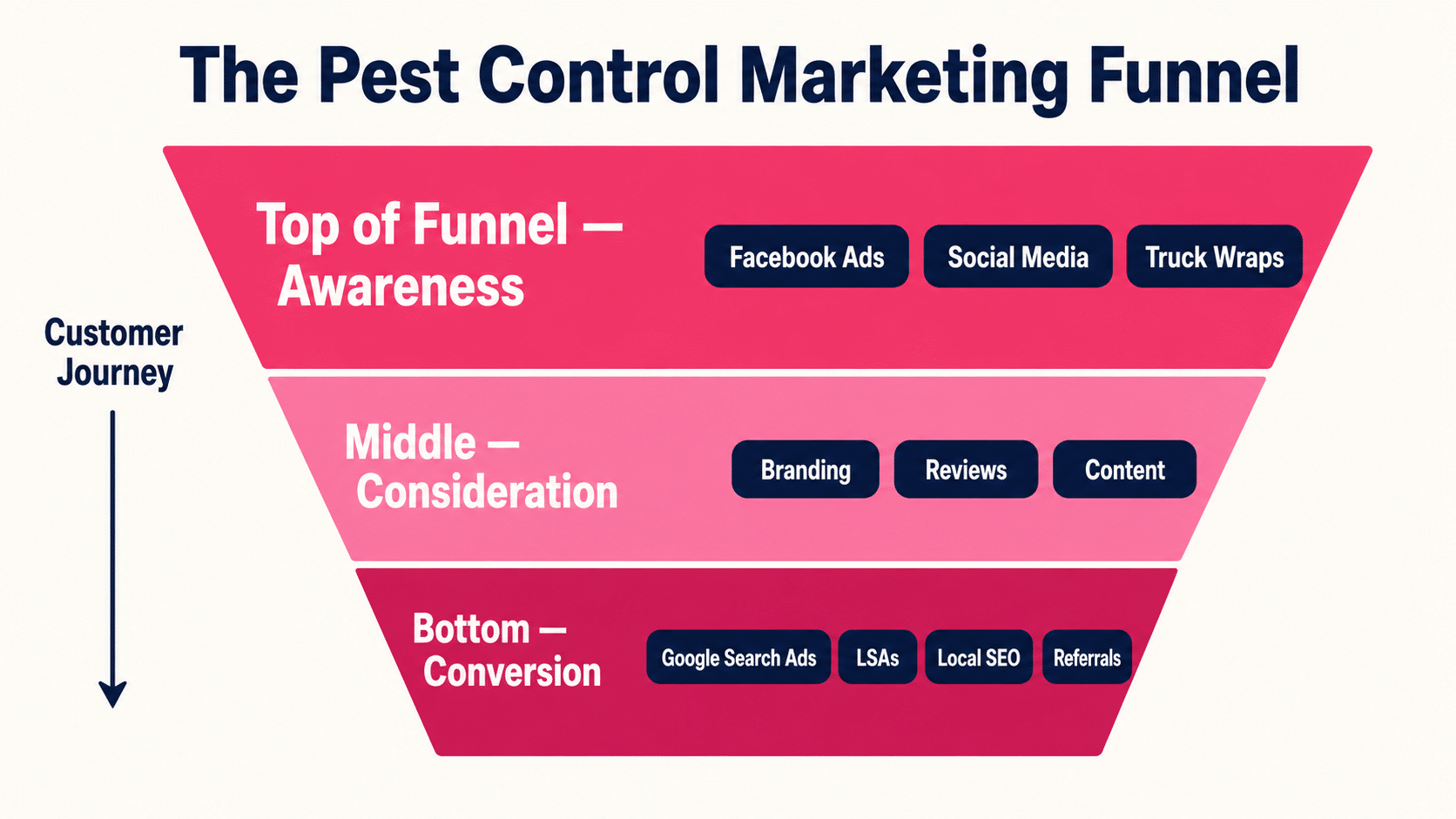
Table of Contents
- The 11 Pest Control Marketing Channels at a Glance
- Why Pest Control Marketing Is Different From Every Other Industry
- Pest Control Branding: The Foundation Everything Else Sits On
- Your Offer Is More Important Than Your Ad
- Local SEO: The Highest-ROI Pest Control Online Marketing Channel
- Google Ads for Pest Control: Bottom-of-Funnel Money
- Facebook Ads: Filling the Top of the Funnel
- Social Media and Video Marketing: The Trust-Builder You’re Underestimating
- Traditional Marketing for Pest Control: Still the Quiet Winner
- Conversion Rate Optimization: Don’t Buy More Leads, Close More
- The Pest Control Marketing Budget: What to Spend and Where
- Do You Need a Pest Control Marketing Agency?
- Pest Control Marketing Ideas and Tips That Work Right Now
- Putting It All Together: The Market Saturation Framework
- Pest Control Marketing FAQs
Pest control marketing works when you point a few channels at the same neighborhoods until homeowners can’t forget you. Get the foundations right first (a brand people remember, an offer worth acting on, and follow-up within five minutes), then add channels by stage. Under about $500K a year, focus on your Google Business Profile, Local Services Ads and cheap channels like door knocking, referrals and Facebook groups. Past about $500K, add Google Search ads and SEO. I don’t set marketing as a percentage of revenue. I spend as fast as the economics allow. I built Pest Badger past $20 million a year in about six years with this playbook, and 300+ owners in our paid program run it today.
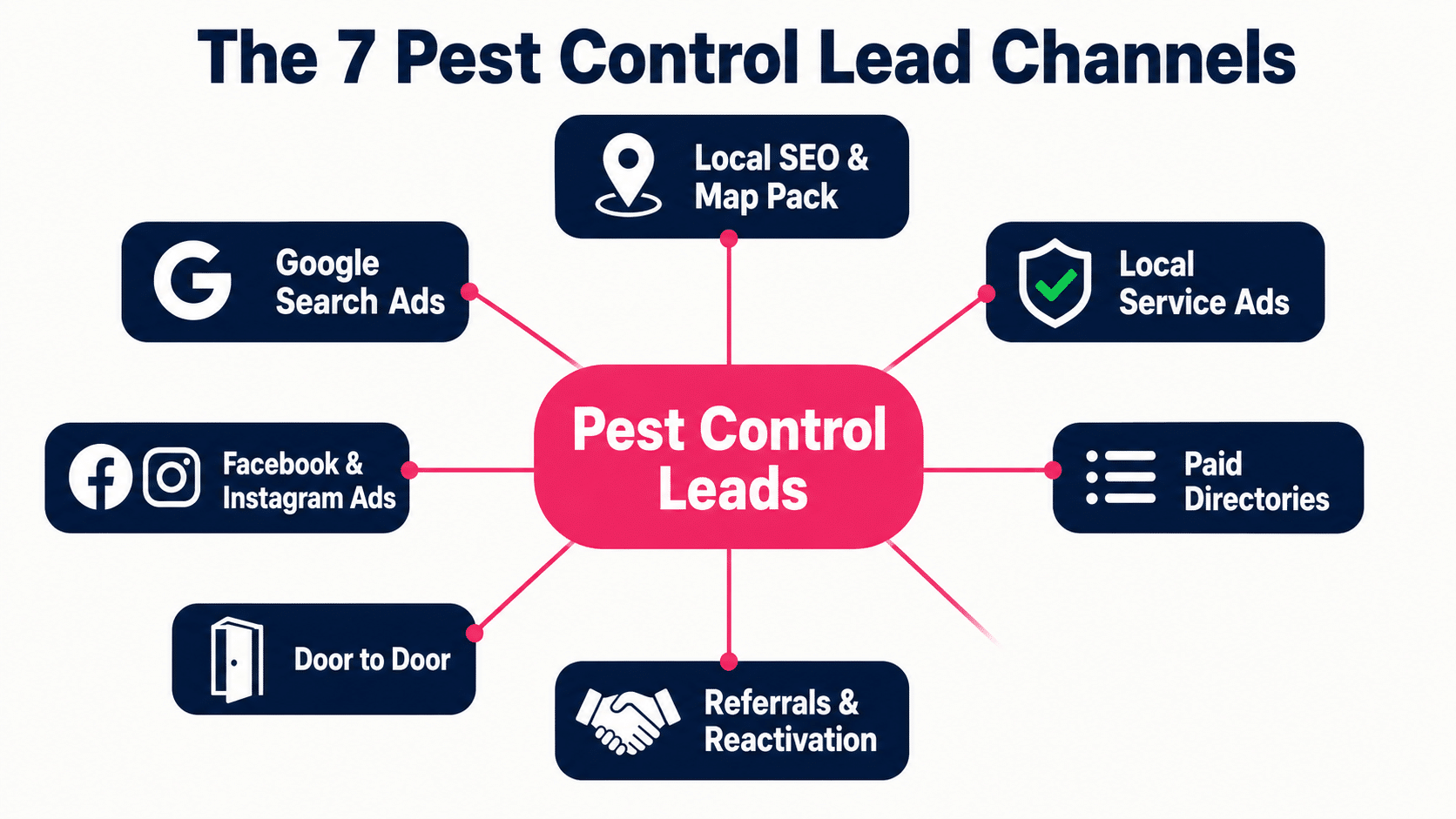
The 11 Pest Control Marketing Channels at a Glance
These are the 11 channels that drive pest control company marketing, with what each one costs and how long it takes to pay off. The costs come from our channel guides, and your market will vary. Branding, offers and conversion aren’t on the list because they aren’t channels. They decide how well every channel works, so each gets its own section below.
| Channel | Best for | Cost | Time to results |
|---|---|---|---|
| 1. Google Business Profile and local SEO | Free calls from the map pack, at every stage | Profile is free; SEO is your time or an agency retainer | Profile changes in weeks; organic rankings in 3 to 12 months |
| 2. Local Services Ads | Your first paid channel | $25 to $60 per lead in most markets, billed per lead | As soon as Google verifies your business |
| 3. Google Search ads | High-intent searches once you pass about $500K a year | $40 to $90 per lead; $150+ in expensive metros | As soon as campaigns go live |
| 4. Facebook ads | Creating demand with a strong offer | $10 to $20 per lead; at least $600 a month | Commit to at least 90 days |
| 5. Facebook groups | Free leads from local community groups | Free (your time) | A few weeks of steady, helpful posting |
| 6. Social media and video | Trust that makes every other channel convert | Free (a phone and your time) | 6 to 12 months to build a local audience |
| 7. Door-to-door | Building a new market fast, with route density | Your time, or about $480 per customer with paid reps, our most expensive channel | The first day |
| 8. Direct mail and door hangers | Repeat touches in your target neighborhoods | Printing and postage; 0.5 to 1.5% response (EDDM), 1 to 3% (door hangers) | One season of repeat drops |
| 9. Yard signs and truck wraps | Passive impressions on every street you work | Signs under $10 each; wraps $3,000 to $4,000 per truck | Months, and they keep working for years |
| 10. Referrals and reactivation | The cheapest customers you’ll ever get | Real money, such as $50 to $100 in cash per signed referral, paid automatically | As soon as you start asking |
| 11. Paid directories | Filling gaps while your own channels grow | $20 to $60 per shared lead | Give one directory three months |
Want cost per lead and close rate side by side? Our pest control lead generation guide breaks every paid channel down to cost per customer.
Why Pest Control Marketing Is Different From Every Other Industry
 The Pest Control Marketing Funnel: Top to Bottom Channel Mapping
Pest control marketing does not follow the rules that work in most service industries, and that is exactly why so many owners struggle with it. Three things make it unique. First, the business is hyper-local. You are not competing nationally, you are competing for the 500 homes inside a single neighborhood. Second, the lifetime value is enormous. A recurring quarterly customer at Pest Badger is worth about $840 in gross profit over their lifetime, after what it costs to service them, which means you can (and should) spend aggressively on acquisition that would bankrupt a one-time-service business. Third, trust is everything. You are asking strangers to let you into their home to spray chemicals around their kids and pets. If your brand looks cheap or your reviews are thin, no amount of ad spend will save you.
The operators winning at pest control marketing understand that it is not about picking one channel and hoping it works. It is about market saturation. That means getting in front of your ideal customer seven, ten, even twenty times across Facebook, Google, yard signs, door knocking, mailers, and your trucks until they cannot help but think of you first when a bug crawls across their kitchen floor. That is the framework everything below is built on.
That is also why most advice on marketing for exterminators misses. It is written by agencies that have never sprayed a baseboard. Everything in this guide comes from operators running pest control companies.
Pest Control Branding: The Foundation Everything Else Sits On
Before you spend a dollar on online marketing, your brand has to be right. Branding is the single most underrated growth lever in this industry, and most pest control companies are invisible because of it. White trucks with magnetic signs, a generic name like “ABC Pest Solutions,” and a logo that looks like it was designed in Microsoft Word. If that is you, every other marketing channel will underperform.
A strong pest control brand does three things for you. It attracts premium customers who are not shopping on price. It generates leads passively from people just seeing your trucks and signs around town. And it positions you as the obvious local choice before a customer even asks for a quote. That starts with a memorable name and mascot (ours is a badger, one of our members uses a skunk, another uses a bright pink elephant), a bold color palette that stands out on a residential street, and a professional logo applied consistently across every truck, uniform, yard sign, invoice, and piece of direct mail.
The companies charging $60 a service are fighting over scraps. The companies charging $120 with a waitlist have almost always invested in branding first. Your customers cannot tell if your chemicals are better than a competitor’s, but they can absolutely tell if your brand looks more trustworthy. Get this layer right before scaling any paid channel.
Read the full Pest Control Branding guide →
Your Offer Is More Important Than Your Ad
No pest control marketing campaign will outperform a bad offer. You can have the best Facebook creative, the highest-ranking website, and the most aggressive door-knocking team in the state, but if your offer is “call us for a free quote” you are going to lose to the guy offering “a year of pest control plus free mosquito control.” Period.
The best offers in pest control solve a specific pain point, remove financial risk, and create urgency. The strongest ones stack value instead of cutting your price, like a free mosquito treatment with an annual plan, a free flea and tick treatment at signup, a fresh take on a guarantee, and honest scarcity like “only 10 spots left on this route this month.” Each one lowers the barrier to try you and gives a worried customer a reason to act today instead of tomorrow, without training them to expect a discount. You’ll find more of these in our program members’ stories.
Your offer also needs to match the season. A grub-control offer in July is dead on arrival. The same offer in April sells. Build an offer calendar around the pest pressure in your region, then deploy different offers into the same neighborhoods at the moment the pest pressure peaks. Here is how a typical season runs for us in the Midwest. Shift the months to match the pest pressure where you are.
| Months | Pest pressure | What to promote |
|---|---|---|
| March to May | Grubs and spring lawn damage | Grub control |
| May to June | Mosquitoes | Mosquito treatment, such as a free first treatment with an annual plan |
| July to August | Wasps | Wasp and nest removal |
| September to November | Rodents | Rodent control and exclusion |
Read the full Pest Control Offers guide →
Local SEO: The Highest-ROI Pest Control Online Marketing Channel
If you only pick one pest control internet marketing channel to invest in long term, make it local SEO. Nothing else compounds the way SEO does. A Google Ads campaign dies the day you stop paying. A ranking in the Google Map Pack keeps feeding you leads every day for years at roughly zero marginal cost. Your Google Business Profile is free, so set it up on day one. Paying for SEO and a new website makes the most sense once you pass about $500K a year.
The wins that actually move the needle for pest control SEO come down to four things: a fully optimized Google Business Profile, a fast and professional website, city-specific service pages, and consistent reviews. Your GBP needs a complete description with your primary service area, every service category that fits (pest control, termite, rodent, mosquito and so on), weekly posts, and real photos of your team and trucks. Not stock images. Your website needs to load in under three seconds, have a service page for every city in your service area, and include your keyword in the title tag, H1, first 100 words, and image alt text.
Reviews are the tiebreaker, and a steady flow beats a big total. Dan Leibrandt has seen companies with 150 reviews outrank companies with 1,000 because they get two or three new reviews every week. Set up a post-service text that asks every customer for a review after every job, never only the happy ones. A small bonus for techs who earn reviews is fine, but never pay, discount or reward the customer for one. Google’s rules ban both review gating and review incentives. Jorel Solis, one of our members in Texas, passed 200 Google reviews by asking on every job. He went from page five to page one, and about half his calls now come from Google without paying for SEO.
Do not expect overnight results. Google Business Profile changes can show up within weeks, but organic rankings take 3 to 12 months depending on your market and where you start. The operators who started two years ago now book a big share of their new jobs from organic search and pay almost nothing per lead. Read the full Local SEO for Pest Control guide →
Google Ads for Pest Control: Bottom-of-Funnel Money
Pest control Google Ads are the fastest way to buy high-intent leads. When someone types “exterminator near me” or “wasp nest removal” into Google, they are actively looking to hire someone today. That is the holy grail of lead quality, and it is why Google leads close at 70% or more while Facebook leads close at 20 to 30%.
The mistakes that burn most pest control Google Ads budgets are the same every time. Targeting the whole country when you serve two cities. Running one messy campaign instead of separate campaigns for each pest type. Sending all the traffic to the homepage instead of a dedicated landing page that matches the ad. Ignoring negative keywords and paying for “pest control jobs” or “how to kill ants yourself” clicks that will never convert.
Done right, the structure looks like this. One campaign per pest type (general pest, termite, mosquito, rodent, bed bug), tight geographic targeting to your actual service radius, dedicated landing pages for each service with a strong offer and a phone number above the fold, call tracking on every campaign, and negative keyword lists you update weekly. If you hire out the ads, look for PPC management for pest control companies only, and keep the ad account in your name.
Run Local Services Ads (LSAs) alongside them. LSAs sit at the very top of the results with a Google Verified badge, which replaced the old Google Guaranteed badge in October 2025. You pay per lead instead of per click, the leads usually cost less than search ads, and for most companies under about $500K a year, LSAs should come first.
Once you are past about $500K, $3,000 to $10,000 a month is where most of our members’ search budgets sit. Healthy campaigns produce leads for $40 to $90 in most markets, or $150 and up in expensive markets like California. At a 70% close rate, that is roughly $60 to $130 per new customer. Read the full Google Ads for Pest Control guide →
Facebook Ads: Filling the Top of the Funnel
Facebook is not intent-based. Nobody opens Facebook looking for an exterminator. That is exactly why it is so powerful once you understand it. Facebook is where you interrupt people who do not yet know they need you and drop a demand-creating offer in their lap. Done right, pest control Facebook ads bring in leads at $10 to $20 each.
The framework is simple but almost no one executes it. Start with still images, because they are faster to make and test, and only move to video once your image ads convert. When you do use video, raw footage of a tech on a job beats polished studio content. Lead with a sticky offer (like the free mosquito treatment from earlier). Use a lead form that captures name, phone, address, and pest type. Geo-target tightly to your actual routes, not the whole state. Spend at least $600 a month ($20 a day), or the algorithm never learns who to show your ads to, and give it 90 days. Then follow up fast. Text new leads within 30 seconds and call within 5 minutes, or your close rate collapses.
The biggest mindset shift is that Facebook leads are not Google leads. Expect to call them many times before you reach them. Jake’s team makes six calls on the first day and keeps calling and texting every day for a week. Expect 20 to 30% close rates (we run 22 to 25% at Pest Badger), not 70%. And expect some of them to have already forgotten they filled out your form. The low cost per lead makes up for most of it. A customer from Meta costs us about $150, against about $130 from Google.
Read the full Pest Control Facebook Ads guide →
Social Media and Video Marketing: The Trust-Builder You’re Underestimating
Organic pest control social media will not replace your ads, but it quietly does something ads cannot. It builds the trust layer that makes every other channel convert better. When a Facebook lead Googles you before answering your callback, what they find on your Instagram, TikTok, YouTube, and Facebook page is often the deciding factor.
The content that works for pest control is not glossy branded graphics. It is gross, satisfying, weirdly entertaining footage of actual jobs. Close-ups of wasp nests being removed. Time-lapses of a rodent exclusion. Technicians reacting to the worst cockroach infestation they have ever seen. Pest Badger has had single organic videos hit 10 million views. That is not an accident. It is the format the algorithms reward right now.
Pest control video marketing can be this simple. Post consistently across three platforms: short-form video on TikTok, Instagram Reels, and YouTube Shorts. Repurpose the same footage across all three. Add captions so people can watch with sound off. Include your city name in the caption so the algorithm serves it locally. Over six to twelve months, this builds an audience of people in your service area who already feel like they know you, and that audience converts better than cold traffic from ads.
Read the full Pest Control Social Media guide →
Traditional Marketing for Pest Control: Still the Quiet Winner
Everyone is obsessing over digital, which is exactly why traditional pest control marketing is quietly making operators rich. Door knocking, yard signs, postcards, door hangers, truck wraps. I have friends running multi-million dollar pest control companies where yard signs are their number-one lead source. Above Facebook. Above Google. Above everything.
The reason it works is frequency. People need to see your brand seven to twenty times before they convert. One postcard to ten thousand random addresses does nothing. Five postcards into the same two hundred homes across a single season creates a neighborhood where your brand is everywhere. Their mailbox, the corner yard sign, the truck in the driveway three houses down, the door hanger on the handle. When a bug problem hits, you are the only name they can remember.
Get the fundamentals right. Every yard sign needs a pain-point headline, your logo, and a phone number. Nothing else. Every mailer and door hanger needs a headline, the pain point, an offer, social proof from a neighbor, a picture of your team, urgency, a guarantee, and a clear call to action. Every door-knock pitch needs an icebreaker, introduction, justification, offer, and close, in that exact order. And every piece of traditional marketing should point at the same small set of target neighborhoods as your digital ads, so the saturation compounds.
Read the full Traditional Marketing for Pest Control guide →
Conversion Rate Optimization: Don’t Buy More Leads, Close More
Most pest control companies do not have a lead problem. They have a conversion problem. Before you spend another dollar acquiring leads, ask whether you are converting the ones you already have. Most operators are leaving a lot of revenue on the table inside the funnel they already built.
The three leverage points are speed-to-lead, follow-up cadence, and the booking experience. Text every new lead within 30 seconds and call within 5 minutes. Most pest control companies call back hours later, which is why their Facebook ads “do not work.” Build an automation (we use GoHighLevel, but any decent CRM works) that sends the text and queues the call the moment a form comes in. Then call and text at least once a day for a week, and move anyone who still hasn’t answered into long-term follow-up. Jake lays out the whole sequence in our pest control automation guide.
On the booking side, make it impossible to hesitate. Show real pricing on your website. Allow online booking directly from service pages. Include video testimonials on your offer pages. Add a risk-reversal guarantee above the booking form. Every one of these lifts conversion with zero additional ad spend.
Read the full Pest Control Conversion Optimization guide →
The Pest Control Marketing Budget: What to Spend and Where
I don’t set the marketing budget as a percentage of revenue. People ask me all the time whether it should be 5% or 10%. If the economics hold, I want to spend as fast as possible, as long as we have the cash, we get the money back fast enough and we have the capacity to service the customers. Your cost per customer will climb as you spend more, from $100 to $120 to $150 and past $200, and that is what tells you when to stop, not an arbitrary percentage. The split that works best across our program members looks roughly like this.
| Bucket | Share of budget | What it covers |
|---|---|---|
| Paid digital | 40 to 50% | Local Services Ads, Google Search ads, Facebook ads |
| Traditional | 20 to 30% | Mailers, yard signs, door-knocking labor, truck wraps |
| SEO and content | 15 to 20% | In-house work or an agency retainer |
| Brand and creative | 10 to 15% | Photography, video, signage, uniforms |
Percentages are only a starting point, though. My real rule is payback. If a new customer pays you back double what they cost to acquire within 30 days, keep reinvesting, whatever the percentage says. The math is in our customer acquisition cost guide.
Where the money goes depends on your stage, because advertising a pest control business at $150K looks nothing like it does at $2M.
| Revenue | Where to put your marketing |
|---|---|
| Under $150K | Very little paid advertising. Door knocking, referrals, reviews, your Google Business Profile, Facebook groups and Local Services Ads |
| $150K to $500K | Local Services Ads are your paid core. Facebook ads come next, once you can commit $600 a month for 90 days |
| $500K to $2M | Add Google Search ads and real investment in SEO and your website |
| Over $2M | Acquisitions, new markets, and scaling into new cities without breaking your unit economics |
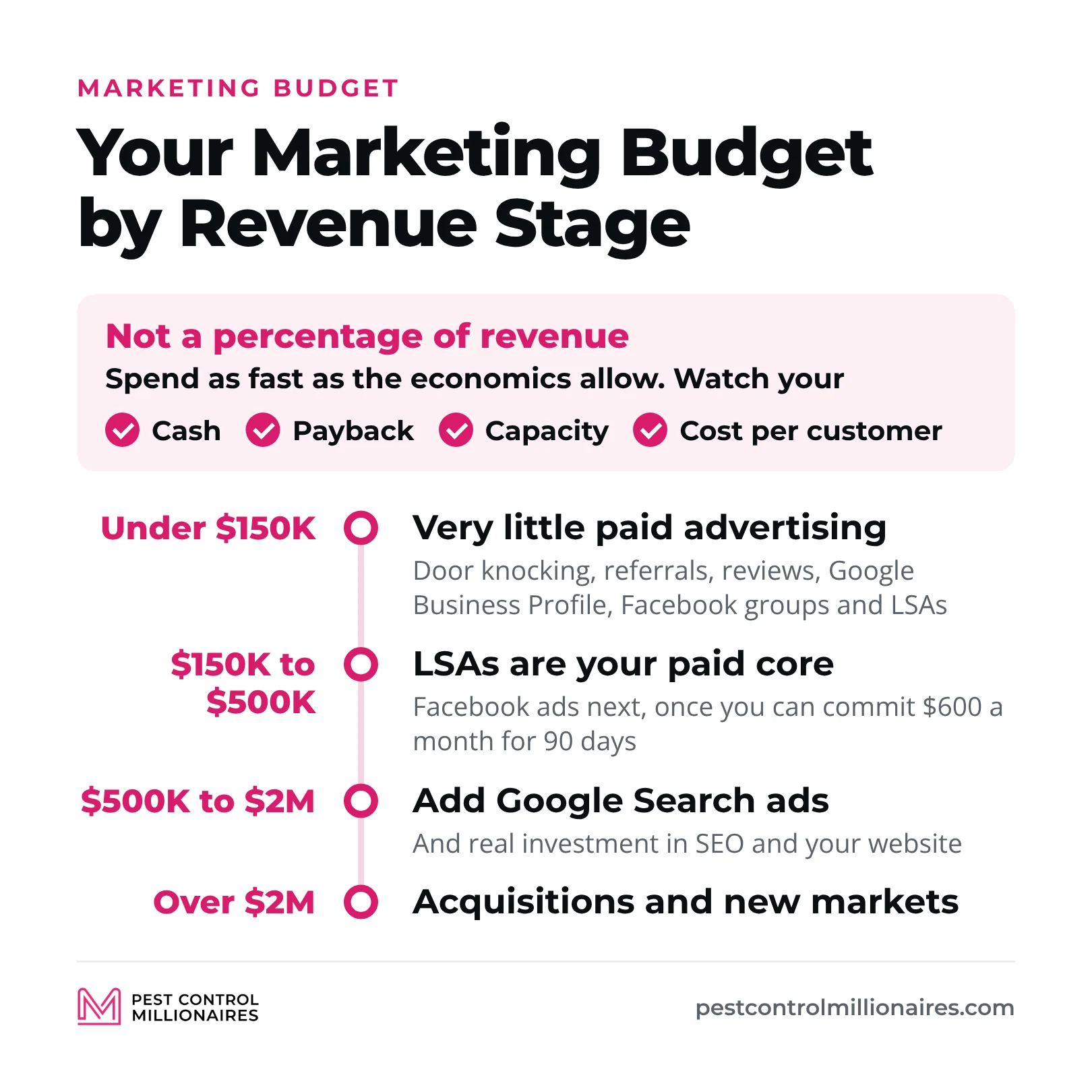
Most of our members are between $150K and $2M a year, which is where paid channels start to pay off.
Track it with real numbers, meaning cost per lead, cost per booked job, close rate per channel and lifetime value by source. Not vibes. Read the full Pest Control KPIs guide →
Do You Need a Pest Control Marketing Agency?
 Pest Control Marketing: Agency vs DIY Decision Matrix
This is the question we get more than any other. The honest answer is that it depends on the channel and the stage of your business. SEO and paid ads, from local SEO to pest control PPC management, are the two areas where a specialized pest control marketing agency is usually worth the money. They are technical, they require daily attention, and the opportunity cost of you doing them badly is brutal. Branding, content, and traditional marketing can and probably should stay in-house, because nobody understands your market and your brand like you do.
When you hire a marketer or an agency, the rule is simple. Do not hire a generic small-business marketing agency that works across 40 industries. Marketing for pest control is too specific. The keywords, the seasonality, the landing page patterns, the offer structures. They are all different from plumbing, HVAC, or roofing. Hire a pest-control-specific agency, ask for case studies from companies your size, and make sure you own your Google Ads account, your Facebook Business Manager, your domain, and your website. If an agency will not let you own those assets, run.
Walker Rose, who runs Turf Chief in Louisville, learned this the expensive way. He spent over $100,000 on marketing agencies and got almost nothing back. One agency took $40,000 and landed him exactly one job. Then he learned to run his own Facebook ads with Jake inside our program, and now he runs all of his marketing himself and knows where every dollar goes.
For the owners who want to learn this themselves rather than outsource it, that is exactly why Pest Control Millionaires exists. We teach operators the same pest control marketing strategies we are running in our own companies, with a live coaching call every Thursday to answer whatever comes up.
Pest Control Marketing Ideas and Tips That Work Right Now
Here are ten pest control marketing tips you can put to work this week. They work for any exterminator, and most cost little or nothing.
- Ask every customer for a Google review with a pre-written text link, not just the happy ones.
- Put a yard sign in every customer’s lawn after service (check HOA rules first).
- Wrap your trucks. At $3,000 to $4,000 a truck, it is the one big-ticket item on this list.
- Pay $50 to $100 in cash, never money off the next bill, for every neighbor a customer refers who signs up.
- Post a helpful bug of the week in your local Facebook groups, with no sales pitch.
- Shoot one raw phone video a day of your team on a job.
- Partner with three local realtors who will recommend you for move-in and move-out services.
- Post to your Google Business Profile every week.
- Set up Local Services Ads at a budget you can afford.
- Send a handwritten thank-you card after the first service.
For more, browse our pest control tips. Stacked together, these add up fast for a company doing $300K to $500K. The operators who compound wins like these quarter after quarter, and keep growing what each customer is worth, end up running the dominant brand in their market.
Putting It All Together: The Market Saturation Framework
 The Market Saturation Strategy: Five Layers Around Your Service Area
The best marketing strategy for pest control companies is not picking a channel. It is picking a neighborhood. The operators who win identify the 500 to 2,000 homes where their ideal customer lives, and then they point every channel covered in this guide at that exact footprint. Google Ads geo-targeted to the zip code. Facebook ads run to the radius. Every mailer sent to those routes. Every door knocked. Every yard sign planted. Every truck route pushed through the same streets.
Aaron Huskey, one of our members in Oklahoma, says that if he started over, he would knock every door in one neighborhood for a year and try to sign at least 30% of the homes before moving to the next.
Within six to twelve months, the residents of that neighborhood have seen you so many times that when a pest problem hits, you are the only company they can name. You have built the kind of route density that lets a single technician knock out 25 jobs in a day without driving more than two miles.
That is how you build a $1M pest control company. That is how you build a $10M pest control company. Jake, Dan and I wrote the whole system down in Zip Code Kings, and it is the playbook we coach inside Pest Control Millionaires every week.
Pest Control Marketing FAQs
How much does pest control marketing cost?
It is not a set percentage of revenue. I spend as fast as the economics allow, as long as we have the cash, get the money back fast enough, can service the customers and the cost per customer still works. Our program members split what they spend roughly 40 to 50% paid digital, 20 to 30% traditional, 15 to 20% SEO and content, and 10 to 15% brand.
What is the best marketing strategy for a pest control company?
Saturate one neighborhood at a time with several channels at once. Under about $500K a year, that means door knocking, a review request to every customer, your Google Business Profile and Local Services Ads. Past $500K, add Google Search ads and SEO, with fast follow-up on every lead behind all of it.
How do I market a pest control business with a small budget?
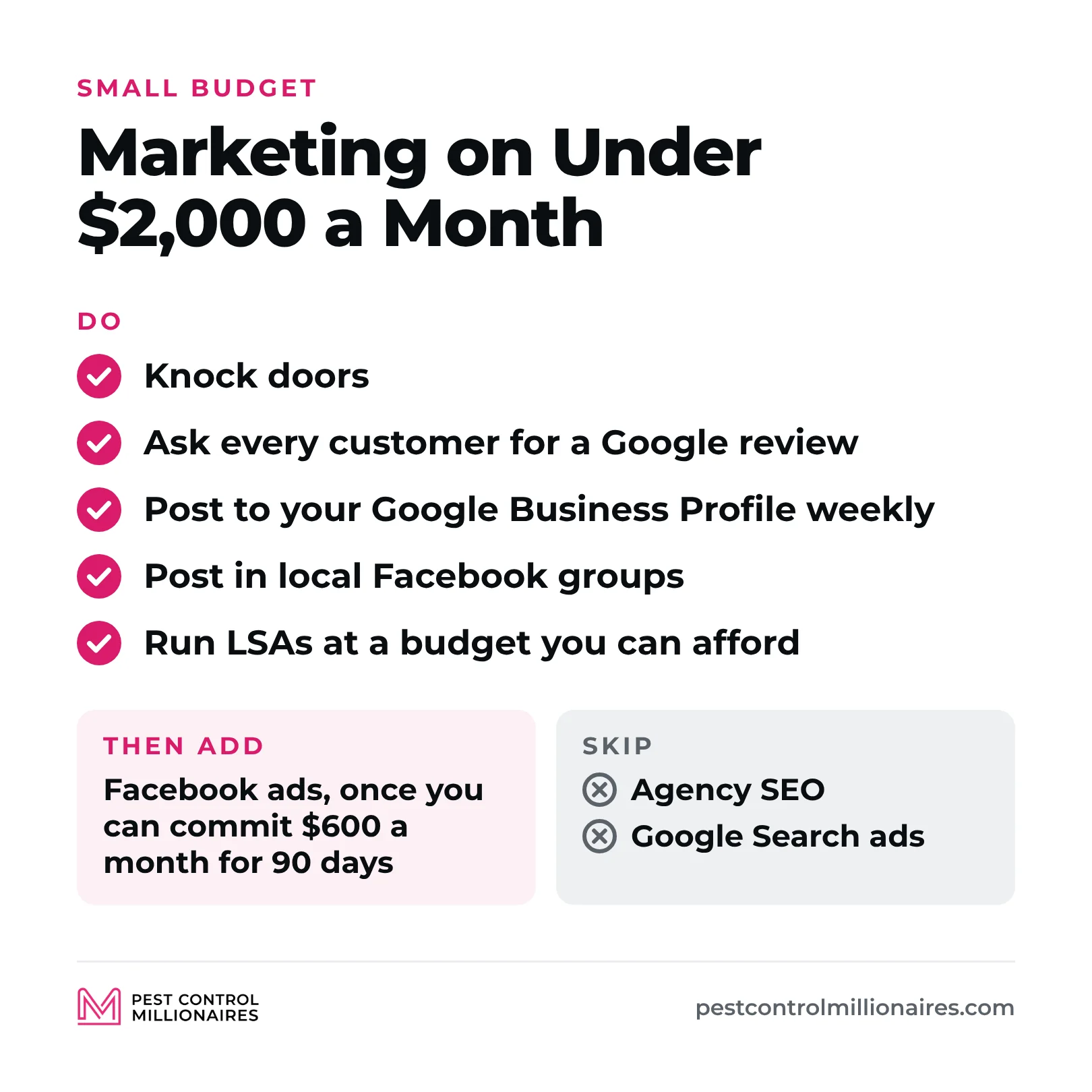
Under $2,000 a month, skip agency SEO and Google Search ads. Knock doors, ask every customer for a Google review, post to your Google Business Profile weekly, post in local Facebook groups and run Local Services Ads at a budget you can afford, then add Facebook ads once you can commit $600 a month for 90 days. Door knocking converts at 3 to 5%, and most of the rest is free.
How long does pest control SEO take to work?
Google Business Profile improvements can show results within weeks. Organic rankings take 3 to 12 months depending on your market and where you start, and a steady flow of new reviews speeds up map pack gains.
Do I need a pest control marketing agency?
Not for everything. A pest-control-only specialist is usually worth it for SEO and paid ads, which are technical and need daily attention, while branding, content, door knocking and traditional marketing should stay in-house. Whoever you hire, make sure you own your ad accounts, domain and website.