
Pest Control Social Media: The Complete Guide to Building a Brand That Gets Millions of Views

Table of Contents
- The Platforms That Actually Matter for Pest Control Companies
- What to Actually Post (Without Running Out of Ideas)
- 50 Pest Control Social Media Post Ideas
- How Often You Need to Post (And Why Consistency Beats Perfection)
- A 30-Day Pest Control Social Media Calendar
- How to Actually Go Viral (The Formula Nobody Talks About)
- The Content Strategy Nobody Follows (But Should)
- The Hook That Makes or Breaks Everything
- The Mistakes Killing Your Social Media Growth
- The Tools You Actually Need (Spoiler: Not Much)
- The Long Game (Why Social Media Compounds Over Time)
- The Content Mindset (How I Think About Every Piece of Content)
- The Reality Check You Need to Hear
- Frequently Asked Questions
- Related Articles
Pest control social media works when you film the questions your customers already ask, post on a fixed schedule and study what worked. Start on Facebook, where your posts reach homeowners in your own town, then post the same video on TikTok, Instagram and YouTube. Begin with one video a week, keep short videos to 20 to 30 seconds (a 3-second hook, the reveal, a quick tip, a call to action) and add posting days once filming gets fast. Below are 50 post ideas and a 30-day calendar.
I’m Jonas Olson, CEO of Pest Badger (over $20 million a year, built in about six years) and co-founder of Pest Control Millionaires. Several of our organic videos have passed 10 million views.
The Platforms That Actually Matter for Pest Control Companies
Which social media platform should you be on? Eventually, all of them. But if you can only pick one, start with Facebook.
Facebook is still the largest social network, with about 3 billion people on it, and its users skew older. People who own homes and have money to spend on pest control. When you post there, your friends and your town see it. Most of your audience is local, so the leads are way higher quality. Jasmine Almeter, who runs RC Pest Pros near Rochester and Buffalo, told me half of her customers come straight from Facebook. Facebook is also where your local community groups are, and Jake covers that free lead source in the Facebook groups chapter. When you’re ready to add paid leads on top, his pest control Facebook ads guide covers setup, targeting and testing.
TikTok and YouTube work differently. When a video goes viral there, it goes viral across the country, maybe across the world. That’s great for building your brand, but if you’re a local pest control company in Green Bay, Wisconsin, views from California and Texas don’t turn into customers.
Here’s how I use each one.
| Platform | Best for | Why |
|---|---|---|
| Leads | Older homeowners, and your posts reach your own town | |
| TikTok | Fast growth | Ours blew up fast because few pest control companies were on it yet, but the reach is national |
| YouTube | Views for years | Videos rank and keep getting found. Some of mine from two years ago still get thousands of views a month |
| A younger crowd | We get a lot of leads there. Reels and carousels both work | |
| Commercial work | Business owners, property managers and facility managers are there, and every comment shows your post to that person’s connections |
I slept on LinkedIn for way too long. If you do any commercial work, that’s where you need to be.
Don’t let five platforms overwhelm you. The beauty of short videos is that you can film one and post it everywhere. As you grow and get a team, you can start making different content for each platform. I compare them in more detail in the best social media platforms for pest control.
What to Actually Post (Without Running Out of Ideas)
This is where most pest control owners freeze up. They think they need a genius content strategy or a full production team. You don’t.
Your customers have questions. Tons of them. How much does pest control cost? What does a technician actually do when they show up? How long does a treatment last? What’s the difference between quarterly and monthly service? How do you get rid of bed bugs? What about termites? What about ants?
Those are all videos. Go through the questions that come into your office every week, the ones your CSRs answer on the phone and the ones your technicians get at the door. Then pull out your phone and answer them.
Short videos cast the widest net. That’s anything up to about a minute, and the ones that go viral for us run 20 to 30 seconds. Long videos are where you teach and build trust. Think of short form as the trailer and long form as the full movie.
For short videos, keep moving. Show the bug. Show the house. Show the service. Don’t just sit in your truck talking to the camera. For long videos, you can sit down and go into detail.
You should be in the video most of the time, at least early on. I was the face of the brand at first, but I didn’t want the whole platform to depend on me, so I started filming my technicians. Some of our best videos now are our techs, not me. Film them doing the service, answering questions, in action.
And don’t worry about perfect. Every job is a little different. The house is different, the customer is different, the level of infestation is different. You’re out doing inspections, mosquito jobs, termite jobs and ant jobs all day long. You have the content. You’re just not filming it. I go deeper on this in what to post on pest control social media.
50 Pest Control Social Media Post Ideas
Here are 50 ideas, grouped by type, all drawn from what has worked for us. Every one fits the same formula (a 3-second hook, the reveal, a quick tip and a call to action). Pick from a different group each week and you won’t run out.
Customer Questions
- How much does pest control cost? Walk through what changes the price.
- What does a technician actually do on a visit? Film one from the driveway to the last step.
- How long does a treatment last?
- Quarterly or monthly service? Explain the difference.
- How do you get rid of bed bugs?
- How do I know if I have termites?
- Why do ants keep coming back inside?
- The question your office heard most this week. Ask your CSRs and techs every Friday.
Education and DIY Tips
Showing people how to handle small problems themselves sounds backwards. It builds trust, and they call you for the big ones.
- The mosquito dunk demo. Say what it does, then toss it into the standing water. One of our most viral videos was a tech doing exactly this at a pond.
- Dump the standing water. How one walk around the yard cuts down mosquitoes.
- How to spot carpenter ants around a deck or a woodpile.
- How to keep mice out of the garage.
- How to keep stink bugs out of the house.
- The bug, up close. Show it and name it. You want people saying “what is that?”
- The nest or the damage. Show it and explain what caused it.
- “The one thing pest control companies don’t tell you.” Then answer it honestly.
Seasonal
- Spring. Ants and termite swarmers, and what to look for.
- Summer. Mosquitoes and wasps in the yard.
- Fall. Rodents and spiders moving inside.
- Winter. Indoor pests, and what to do now to prevent next year’s problems.
- “With the weather warming up, I’m seeing a ton of [pest] activity.” Then one quick tip.
- What’s calling in most this week. The pest your phones are ringing about right now.
Behind the Scenes
- A day in the life of a pest control technician.
- One full service, start to finish, cut into short clips.
- An attic or crawl space inspection, filmed as it happens.
- New equipment, first try. “Hey, I just got this brand new aerator, never used it, come check it out” was my first video to hit 100,000 views.
- Drone shots of a tech treating a yard, or your trucks on the road.
- A hotel room bed bug check the next time you travel. I film everywhere I go, from airports to cruise ships.
Results and Proof
- “This is the craziest infestation I’ve ever seen.” Your worst job of the month.
- “You won’t believe what we found.” The surprise in an attic, a crawl space or a wall.
- Before and after of a treated lawn or yard.
- Same pest, two houses. A light case next to a heavy one.
- A customer video. Thirty seconds in their own words, with their permission.
- A thank-you post when neighbors from a local group sign up. Only post it when it’s true.
Your Team
- A technician answers one customer question on camera.
- The winner of your weekly best-video contest. We give swag or a cash bonus.
- Meet the tech who’ll be at the customer’s house.
- Who you are and why you started the company, with a family or pet photo.
- B-roll your techs shoot on their routes. No talking needed.
Community and Local
- An introduction post in each local Facebook group (Jake’s template is in the Facebook groups chapter).
- A priming post. “Has anyone been seeing [bug] in their house lately?”
- A video answer to a question someone left in your comments.
- A shout-out to a local business, with your truck and their sign in the photo. Kirk Slack does this every day in Tyler, Texas.
- A referral partner, like a lawn care or HVAC company you send business back and forth with.
- A LinkedIn post for commercial accounts. What you do for property managers and facility managers.
Remix Your Winners
- Your best video with a new hook.
- A winner remade with one small change, posted two weeks later. People don’t remember.
- A video that already worked for me. Copy it. I mean that.
- Your long video cut into three short clips.
- A long explainer turned into an Instagram carousel.
How Often You Need to Post (And Why Consistency Beats Perfection)
This is the number one question I get. When you’re just starting out, post one video a week.
Your first 25 to 50 videos are going to take you forever. You don’t know how to film yet. You don’t know how to edit. You’re going to be embarrassed and overthink everything. Try to post every day right out of the gate and you’ll burn out in two weeks. One video a week lets you learn the process.
Then ramp up. Once filming and editing get fast, move to three to five fixed days a week. Right now Pest Badger posts about one video a day across all our platforms, but it took us a long time to get there.
What matters more than how often you post is consistency. Pick a day and a time and stick to it. If you post every Monday at noon, post every Monday at noon. Don’t miss weeks. Think of it like a TV show. When you were a kid, your favorite cartoon came on Friday nights at 8, every Friday, and you knew when to expect it. Your followers are the same way.
The algorithm rewards it too. Post three times one week and disappear for a month, and when you come back, nobody sees your content. Stay consistent, even at once a week, and it keeps pushing your videos.
Does the time of day matter? Not as much as you’d think. We’ve tested it. Mornings, lunchtime and evenings all work, because that’s when people are scrolling. What matters is the same day and the same time every week. More on this in social media tips for pest control.
A 30-Day Pest Control Social Media Calendar
This calendar is built for owners who are just starting. One video a week, posted on the same day at the same time, with small daily jobs that keep you filming. By day 30 you’ll have four videos live and more in the bank. The last column points to the 50 ideas above.
| Day | What to do | Ideas |
|---|---|---|
| 1 | Write down the 20 questions your office and techs hear most. Ask your CSRs. | 1–8 |
| 2 | Set up your Facebook business page and claim the same name on TikTok, Instagram and YouTube (and LinkedIn if you do commercial work). | — |
| 3 | Film your first video on a job. Hook, reveal, tip, call to action. | 1 |
| 4 | Edit it in TikTok, Instagram or CapCut and write the caption. | — |
| 5 | Post day. Pick a day and time you can keep every week. Post on Facebook first, then TikTok, Instagram and YouTube. | 1 |
| 6 | Reply to every comment. Save the good questions. | 42 |
| 7 | Check the numbers (views, average percentage viewed, stayed to watch). Write down one thing to do better. | — |
| 8 | Film a technician answering a customer question. | 35 |
| 9 | Film a DIY tip on a job. | 9–13 |
| 10 | Edit this week’s video. Tighten the first three seconds. | — |
| 11 | Ask your techs to send you clips from their routes. | 39 |
| 12 | Post day (same day and time as day 5). | 35 or 9–13 |
| 13 | Reply to every comment. | — |
| 14 | Review the week. Where did people swipe away? | — |
| 15 | Film a tip on the pest that’s most active in your area right now. | 17–22 |
| 16 | Film an inspection as it happens. | 25 |
| 17 | Edit this week’s video. | — |
| 18 | Start a weekly best-video contest for your techs. | 36 |
| 19 | Post day. | 17–22 or 25 |
| 20 | Reply to every comment. Turn one question into a future video. | 42 |
| 21 | Review the week. | — |
| 22 | Film a before and after, or a “you won’t believe what we found.” | 30–31 |
| 23 | Film a day in the life of one of your techs. | 23 |
| 24 | Edit this week’s video. | — |
| 25 | Film one extra video for next month so you start ahead. | Any |
| 26 | Post day. | 23, 30 or 31 |
| 27 | Reply to every comment. | — |
| 28 | Monthly review. Which of your four videos did best, and why? | — |
| 29 | Remake your best video with a new hook for next month. | 46 |
| 30 | Pick next month’s four ideas from the list. Stay at one a week until filming feels quick, then add days. | — |
Already posting every week? Keep the same rhythm and add fixed posting days, three to five a week, filling them from the list.
How to Actually Go Viral (The Formula Nobody Talks About)
First, what does viral even mean? For some people it’s 10,000 views. For others it’s 100,000. For us, if a video doesn’t hit at least 10,000 views, we consider it a bad post. Our viral videos hit 100,000 to 10 million views.
When I first started, my first viral video hit 100,000 views and I thought I’d won the lottery. I had just bought a brand new aerator I’d never used. I filmed myself walking backwards toward the machine saying, “Hey, I just got this brand new aerator, never used it, come check it out.” Then I turned around, jumped on the machine, showed how it worked and explained what it does to the grass. Maybe 20 or 30 seconds total.
I thought it was the dumbest video ever. Then I went back and studied it, and I realized it was the hook. Every viral video has the same structure.
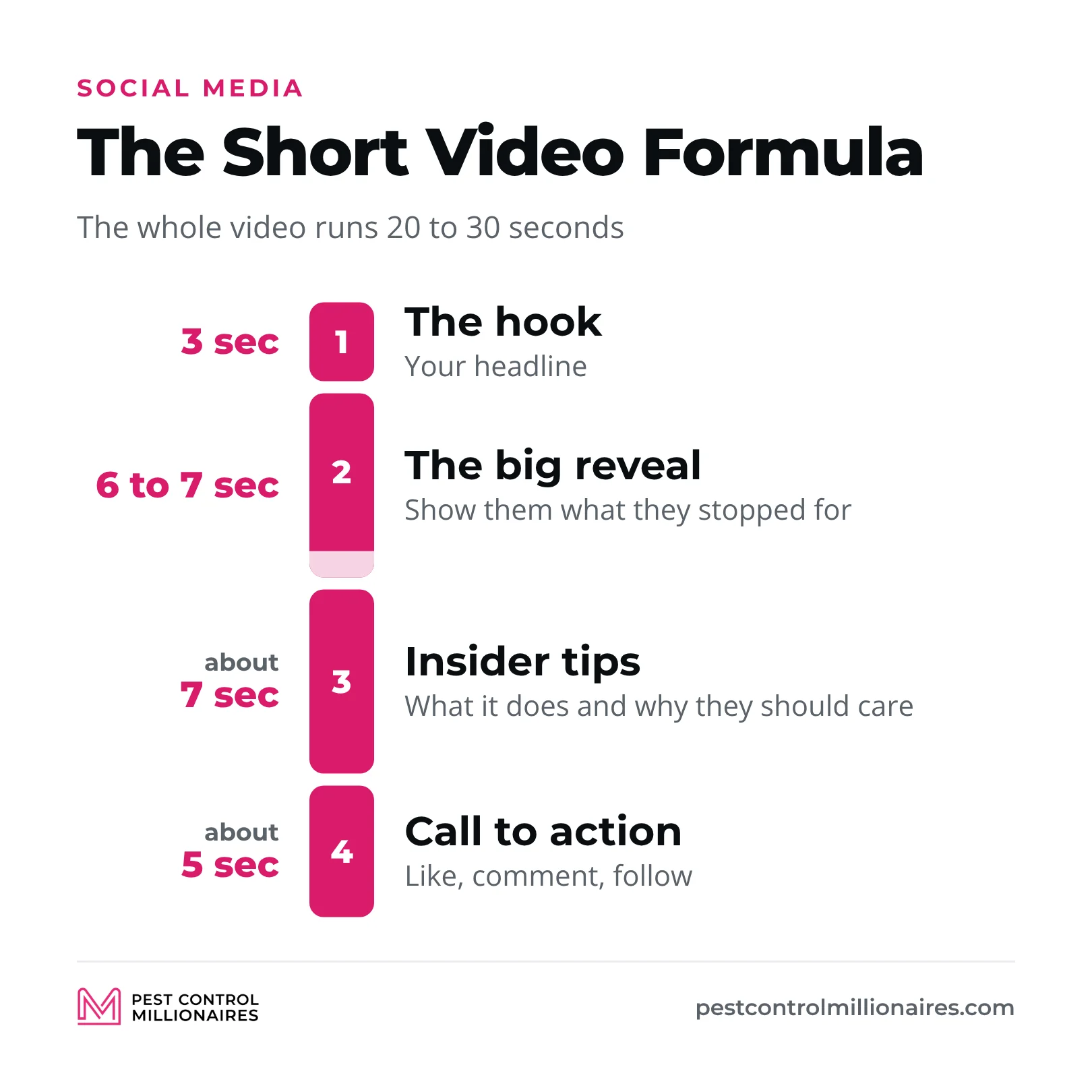
| Part | Length | What happens |
|---|---|---|
| The hook | 3 seconds | Your headline. In the aerator video, “I’ve never used this thing, let’s see what happens.” |
| The big reveal | 6 to 7 seconds | Show them what they stopped for. Me jumping on the machine. |
| Insider tips | About 7 seconds | Quick education. What it does and why they should care. |
| Call to action | About 5 seconds | Tell them what to do. Like, comment, follow. |
The whole video runs 20 to 30 seconds.
Three numbers tell you whether a video is taking off. All three are in YouTube Studio.
| Number | Applies to | My target | What it tells you |
|---|---|---|---|
| Average percentage viewed | Short videos | Above 100% | People are watching it more than once. Our viral videos run 110% to 120% or higher. |
| Stayed to watch (vs. swiped away) | Short videos | 80% or more | People who saw it in the feed kept watching instead of swiping away |
| Click-through rate | Long videos | Above 10% | Your thumbnail earns the click. You can A/B test thumbnails now. |
Hit those numbers and the algorithm pushes your video to a lot more people. I break down a 10-million-view video in pest control content marketing.
The Content Strategy Nobody Follows (But Should)
Going viral isn’t about one video. It’s about the system.
My first 50 to 100 videos? Nobody watched them. A few hundred views each. That was my training ground. Then one hit 100,000, and I studied every detail of it. What was the hook? Where did people drop off? What kept them watching? I made more videos like it, a few more hit big numbers, and I started to see patterns.
So after you post, go back and look at the data. See where people dropped off, what the click-through rate was and how long people watched. If a video did well, make more like it. If it did terribly, figure out why. At the end of every week we go through all our short videos, and at the end of every month we do the same with the long ones.
Two tricks most people don’t use.
- Change the hook. Take the same video, put a new hook on it and post it again. Sometimes a different hook makes all the difference.
- Remake your winners. Take a video that did really well, remake it with a slight variation and post it two weeks later. People don’t remember. If it worked once, it’ll probably work again.
I tell all my friends in the industry to just copy my videos. Seriously. I’ve already done the work of figuring out what works. Why reinvent the wheel?
The Hook That Makes or Breaks Everything
Your hook is your headline, and I’d say 80% of a video’s success comes from it. David Ogilvy wrote that five times as many people read the headline as read the body copy, so once you’ve written your headline, you’ve spent eighty cents out of your dollar. Same thing applies here.
You have three seconds. If you don’t grab someone in three seconds, they’re gone. Good hooks come in three kinds.
- Curiosity. “I’ve never seen this before…” “You won’t believe what we found…” “This is the craziest infestation I’ve ever seen…”
- Shock value. Show the bug. Show the nest. Show the damage. Make people go “oh my god, what is that?”
- Direct value. “Here’s how to get rid of ants…” “The one thing pest control companies don’t tell you…”
And it’s not just what you say. The caption, the thumbnail, the music and what’s on screen are all part of the hook.
One of our most viral videos was just one of my technicians standing in front of a pond holding a mosquito dunk. He showed the dunk and said what it does, then threw it in the pond and explained how it kills mosquito larvae. Twenty seconds. Filmed on his phone. No tripod, no fancy camera. Millions of views.
Why? Because the hook was clear and the video delivered on the promise.
The Mistakes Killing Your Social Media Growth
Let me save you some time. These are the biggest mistakes I see pest control companies make on social media.
1. Not Being Consistent
This is the number one killer. People post one video, don’t get results and quit. Or they post for two weeks, then disappear for three months. For us, it’s almost a full-time job now because our channels are so big. We can’t stop. But when you’re starting out, once a week is fine. Just stick to it.
2. Overthinking the Equipment
People think they need a $10,000 camera, professional lighting and a full crew. So they order all this stuff, it sits in a box, and they never use it. The majority of my content, if not all of it, has been shot on an iPhone. Pick up your phone and film.
3. Low Energy on Camera
You almost have to become a different person on camera. More energetic, louder, more personality. That’s hard to get used to at first. My videographer used to make me redo the hook five times because I wasn’t energetic enough. You get comfortable with it over time, and when you do, that’s when your content starts to pop.
4. Posting and Disappearing
Early on, respond to every comment. Even the dumb ones. Even the negative ones. Thank people for watching. The more engagement a video gets, the more the algorithm pushes it. Now that my channels are huge, I just post and go, because there’s so much negativity in the comments that it’ll ruin your day. But when you’re starting out, engage with everyone.
5. Not Tracking What Works
If you keep posting random content without looking at the data, you’ll never improve. On your short videos, check average percentage viewed and stayed to watch. On your long videos, check click-through rate. Those numbers tell you what to make next.
The Tools You Actually Need (Spoiler: Not Much)
This is another area where people overthink it. To start, you need three things. Your phone, a $30 lav mic and a $30 tripod. Everything else can wait. I go through what to buy and what to skip in social media tools for pest control.
Editing Software
When you’re starting out, edit right inside TikTok or Instagram. If you want a little more, CapCut has a free version. My daughter lives on CapCut. She’s better at editing than I am. Don’t spend money on editing software until you’ve made at least 100 videos.
Camera
Use your iPhone. I have a $10,000 camera setup in my studio, with multiple cameras and drones, but the majority of my viral content was shot on an iPhone. Older iPhones work fine too. Honestly, phone videos often perform better than the ones from a professional camera, because they feel like they’re coming from the actual person.
Microphone
Get a lav mic. They’re about $30 online, and the sound is way better than your phone’s built-in mic.
Tripod
If you’re filming by yourself, get a cheap tripod. They’re $30 to $40 and fold up small. I carry one everywhere. I’ve made content in airports, hotels and on cruise ships.
Drone (Optional)
If you want B-roll, a tiny drone like the DJI Neo (it launched at $199 in 2024) will follow you and film you. You don’t need one to start. DJI stock in the US has been tight since the government restricted new foreign-made drones in December 2025, so check what’s available.
Scheduling Software
When you’re starting out, skip it and post by hand from your phone. Once you’re posting three to five times a week, a tool like Loomly can push one video to every platform at once. I still upload YouTube videos by hand out of habit. YouTube says its recommendations are based on how viewers respond once a video is public, so there’s no reason to think a scheduled upload gets held back. If scheduling keeps you consistent, use it.
The Long Game (Why Social Media Compounds Over Time)
Social media marketing for pest control is a long game. Your first 50 videos are going to suck. Your first 100 might too. Nobody’s going to watch them, and that’s okay. That’s where you get good, and you can’t skip it.
Once you build a following, it compounds. Every video gets easier to push because you already have an audience, and every new follower makes the next video more powerful. After a while, you can look at an idea and know whether it’s going to hit or flop.
I remember the first time someone recognized me at Pest World in Boston. Two guys walked up and said, “Hey, you’re the TikTok guy!” I had no idea what they were talking about. But that was the moment I realized this was actually working. Now it happens all the time. People have seen my content. They trust me before we even meet.
That’s the power of pest control social media marketing. When someone in your area needs pest control, who are they going to call? The company they’ve never heard of, or the one they’ve been watching for the past six months?
The Content Mindset (How I Think About Every Piece of Content)
I’m going to share something personal. My dad passed away a few years ago, and one of my biggest regrets is that we don’t have more videos of him. I don’t have hours of content where I can hear his voice and see his face.
That’s how I think about everything I film now. I’m filming it for my kids, so that long after I’m gone, they can go back and see what I was thinking, what I was doing and what I cared about. You film it once and it’s there forever.
So yes, social media is great for marketing, your brand and leads. It’s also about creating something that lasts.
The Reality Check You Need to Hear
The hardest part of all of this isn’t the editing, the equipment or the algorithm. It’s picking up your phone and actually filming.
Everyone’s busy. I get it. But you’re already out in the field every day doing the work. You just need to film it. A video takes about 10 minutes to record. My first ones took two hours. Now I can rip through them in five minutes because I’ve done it so many times.
Make it fun. Bring your kids. Bring your technicians and turn it into a competition for the best content each week. Don’t take it so seriously. Just document what you’re doing.
In one 28-day stretch in May and June 2025, our content got about 4.5 million views. That’s 4.5 million times someone saw our brand, our trucks and our technicians, and learned something from us. Buying that in advertising would cost tens of thousands of dollars, maybe hundreds of thousands. It cost us zero, because we filmed what we were already doing.
So yes, social media for pest control works, but only if you actually do it. Stop overthinking it. Stop waiting for the perfect moment. Stop buying equipment you don’t need. Pick up your phone, film yourself answering a common customer question, and post it. Do that once a week for the next six months and I guarantee your business will never be the same.
Social media is one channel in a bigger pest control marketing plan. We lay out the whole plan in our book, Zip Code Kings.
Frequently Asked Questions
Which social media platform is best for pest control companies?
Start with Facebook. It has about 3 billion users, its audience skews older and owns homes, and your posts reach people in your own town. Then post the same video on TikTok, Instagram and YouTube, and add LinkedIn if you do commercial work.
How often should a pest control company post on social media?
Start with one video a week, on the same day and at the same time every week. Once filming and editing get fast (your first 25 to 50 videos take the longest), move up to three to five fixed days a week. Pest Badger posts about one video a day across all our platforms, but it took us years to get there.
What are the best pest control social media posts?
Answer the questions your office hears every week (cost, what a technician does, how long a treatment lasts), film your techs on real jobs, show the bug or the damage up close, try new equipment on camera and post seasonal tips. The 50 ideas in this guide are grouped by type.
What type of social media content works best for pest control?
Short videos that answer the questions customers already ask and show real jobs, like the bug, the house and the service. Teaching beats selling. Show people how to handle small problems themselves and they’ll call you for the big ones.
How long should a pest control social media video be?
Keep short videos to about 20 to 30 seconds. That’s a 3-second hook, a 6 to 7 second reveal, about 7 seconds of tips and a 5-second call to action. Use long videos to sit down and teach in depth.
Should pest control companies use paid social media advertising?
Yes, alongside your organic posts. Facebook ads for pest control usually cost about $10 to $20 a lead, need at least $600 a month ($20 a day) to work, and a 20 to 30% close rate on those leads is good. Jake covers setup, targeting and testing in the pest control Facebook ads guide.
How do I get more followers for my pest control social media?
Post on a fixed schedule, reply to every comment while you’re small and check each video’s numbers. When one takes off, remake it with a new hook. Get your technicians filming too; a weekly best-video contest keeps the content coming.
Should I hire a pest control social media company?
You don’t need one to start. Film on your phone, get your technicians involved, and have a family member or a local college student help with editing and posting. We have a team that handles our social media management now, but the content still comes from our own jobs and our own people.
Related Articles