Greg Young on Using AI to Predict Customer Cancellations

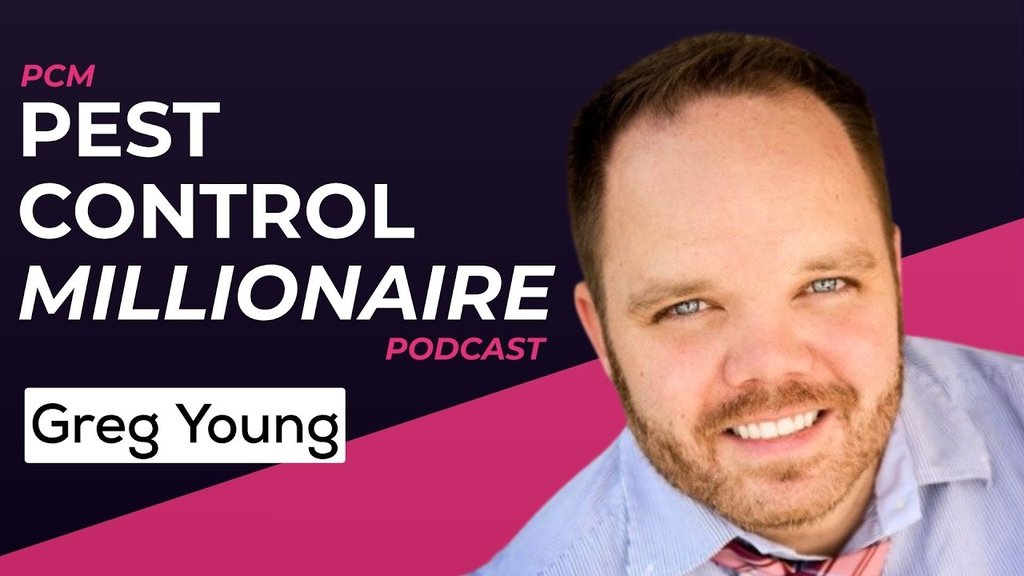
Table of Contents
- He sold accounts for other companies first
- They put on 22,000 accounts and lost them out the back
- Their AI flags customers before they cancel
- Retention starts in your marketing
- Secret service keeps customers and employees
- Door-to-door can’t be your only channel
- Buy companies that pay for themselves
- Frequently Asked Questions
Greg Young is a co-founder of Natura Pest Control. He and the buddy he started it with spent years running door-to-door sales teams for other pest control companies before they opened Natura in California in 2012. After selling the California business to Terminix, they started over in Reno, Nevada, in 2017 with a plan built around keeping customers. When we recorded this, Natura was about a $7 million company with a goal of $20 million by the end of 2028.
I had his partner, Andrew Burress, on the show about six weeks before Greg. Greg went deep on the thing I most wanted to hear about, an AI that tells you which customers are going to cancel before they know it themselves. Here is what stuck with me.
This episode is part of the PCM Podcast. For another owner putting AI to work, read Antoni Hoshino on speed to lead, AI and a $100k lesson.
He sold accounts for other companies first
Greg went to college for graphic design, and he designed Natura’s logo and all of its marketing himself until about six months before we recorded this, when he decided it wasn’t his highest and best use anymore. Letting go was hard, he admitted.
Fresh off a church mission, Greg turned down a buddy who asked him to come sell pest control door-to-door, and worked at a furniture store that summer instead. The buddy, who would become his co-founder, came back with about $30,000, and Greg figured if his buddy could do it, he could too. He sold for a company called Elite Marketing from 2005 to 2008, back when you had to twist a pest control company’s arm to let you take credit cards. Then the two of them ran their own, Spark Marketing, from 2009 to 2013. They never got past 80 or 90 reps, because they stayed too deep in the day-to-day.
By 2012 they were growing all these pest control companies without owning any of the accounts, so they started Natura in California. His co-founder came up with the name, and Greg designed the logo.
They put on 22,000 accounts and lost them out the back
“If I’m just being totally transparent and honest, I think we were really kind of arrogant,” Greg said. They thought going from door-to-door to operations would be easy. In 2014 they moved everything into Natura and went from one office to five or six in a year. In three years in California they put on about 22,000 accounts and lost them out the back, because none of the owners were operators. Churn ran 30% to 35% a year, 40% in the worst year. If they had stopped knocking doors to bring in new cash, they would have gone under.
In late 2015, Greg built a plan with Andrew Burress, then a branch manager, to turn a sales-centric company into a customer-centric one. “Really we’re just a summer sales company,” Greg said. He figured the change would take three years. Then in late 2016, Terminix offered to buy them. Greg didn’t want to sell, but his partners did, and it was the right call. “If I was coming to look at our California business, I would not buy it,” he said. Terminix paid about dollar for dollar, 97 cents on the dollar, for a $3.5 million company.
Watch the clawbacks when you sell. After the deal, the team that took over started canceling customers, and Terminix changed Natura’s clawbacks. Under the original agreement, Greg said, they would have had almost nothing. Paul Giannamore walked through take-and-pays and cancel baskets on this show. Greg and his partners signed, walked away, and two months later opened in Reno with the customer-centric plan ready from day one.
Their AI flags customers before they cancel
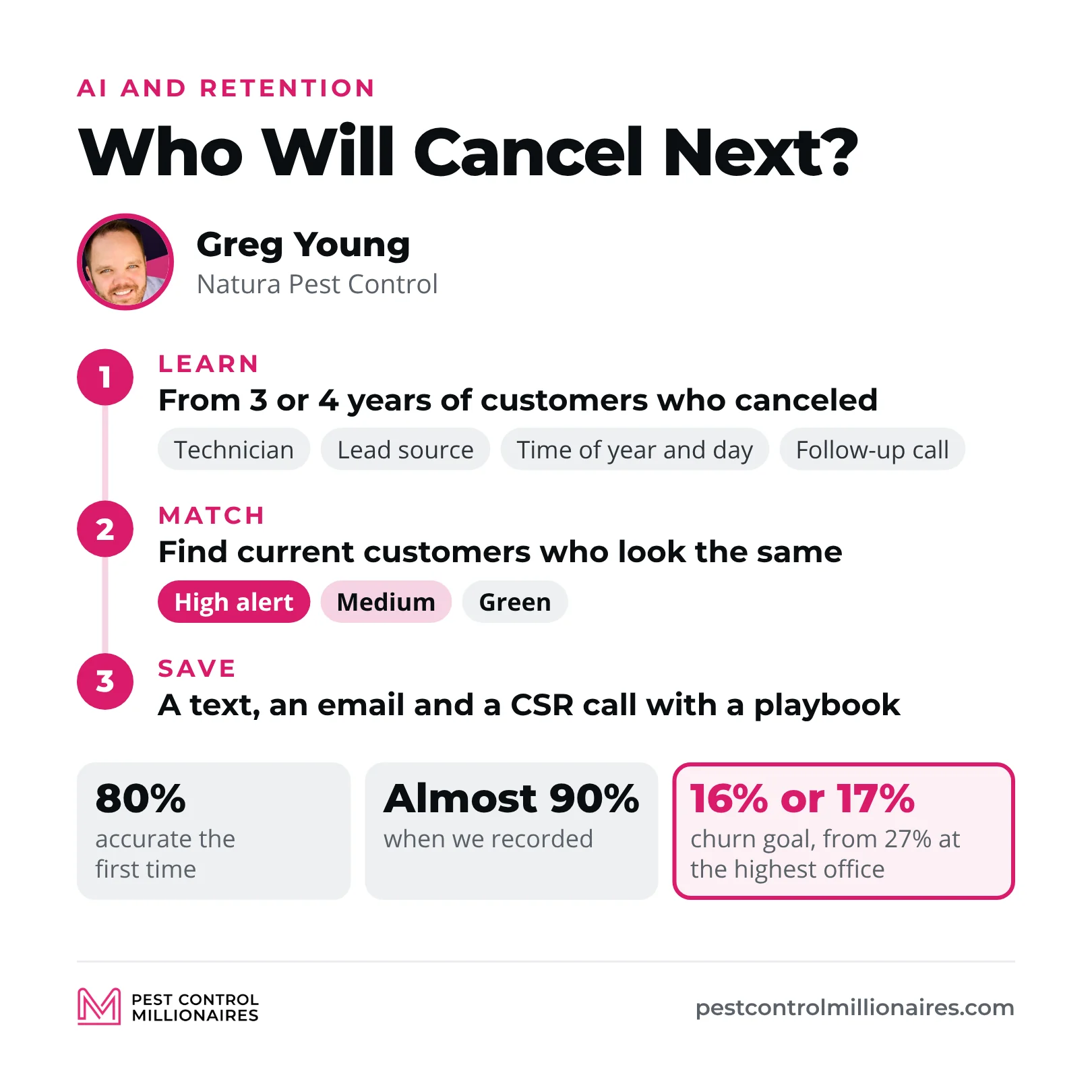
In the six months or so before we recorded this, Greg’s team built an AI platform that predicts churn. They fed it three or four years of data. The first time they ran it, checking 2023 and 2024 against 2025, it was 80% accurate. By the time we talked, it was almost 90%. It finds the people who are going to cancel “before they even know they’re going to cancel,” he said.
It studies the customers who already canceled. Who was their technician? Did they come from door-to-door, Google or Facebook? What time of year and what time of day were they serviced? Was there a follow-up call? Then it finds the customers in the current database who look just like them and sorts everyone into red for high alert, medium or green.
A high alert sets off a sequence. The system texts the customer, emails the customer and creates a to-do for a CSR to call, with a playbook already built for how to save them. Natura’s highest churn rate at any office was 27%. The goal was 16% or 17%, against an industry standard Greg put at about 20%. Their AI grades their phone calls too.
They ran the same analysis on their best customers, the ones who never left. Now their customer avatar is dialed in, down to the neighborhoods and cities.
If the data says someone is about to cancel, pick up the phone. Offer them a free service, send them a gift or put them in a platinum tier. It is so much easier to save a customer than it is to put on a new one.
Greg isn’t sure consumers are ready for all the AI that’s coming. If I’m paying a bill, I don’t want to talk to anyone, but if I have a problem, I want a human. Use AI to make your best people better, and keep people where the customer needs one.
Retention starts in your marketing
Greg thinks the industry treats retention as a one-time event, the save on a call to cancel. That’s reactive retention, and “that’s a losing battle,” he said. “Retention begins in your marketing and it goes on forever.” Set the right expectations in your marketing and your sales process, wow customers on the initial service, your first real interaction with them, and be consistent after that. Tell the same story all the way through. When you mess up, respond fast, fix it quickly, show a lot of empathy, and make the customer feel like “it’s our fault, we’ll fix it.” Our guide to first impressions in pest control covers that first visit.
In Reno, that meant the basics. They stopped rescheduling current customers to make room for new sales, kept an extra tech for initials and one available in case someone called out, and did what they said they would do. “We just fulfilled expectations,” Greg said.
They also keep a few things secret on purpose, so they can surprise customers later. Natura’s internal response time is 24 hours, but customers never hear that, so a visit within 24 hours, 48 at the latest, feels like going above and beyond. And “just because something isn’t our fault, that doesn’t mean it’s not our problem.” When a customer blamed a tech for a broken pool pump, they’d have a professional check it, and even when the pro said the tech couldn’t have broken it, they’d offer to pay.
Secret service keeps customers and employees
What really set Natura apart, Greg said, is something they call secret service, an idea from a customer service book he loved. CSRs and techs collect FORD, a customer’s family, occupation, recreation and dreams, and use it to do something special. One tech asked a customer’s four-year-old daughter what she wanted for her birthday. Pink headphones, she said, and her mom said that wasn’t happening. The tech bought pink headphones and brought them back to the house. When a customer calls to cancel because they’re starting chemo, Natura gives them free pest control and sends a chemo kit.
“We stopped just caring about growth. We started caring about our customers and just running a good business,” he said. We try to do the same at Pest Badger. If someone calls in after a family member dies, we send flowers. Simple things count too, like putting the dog’s name in the customer notes. We want customers for as long as they own the home, and even after, if they move within our service area.
It compounds. “Your employees don’t want to work for a transactional company,” Greg said. They get excited to deliver pink headphones or a chemo kit, so you keep your employees longer too. There are no shortcuts.
Door-to-door can’t be your only channel
Reno taught Greg what makes a new door-to-door branch work. If you can sell $1.2 million to $1.5 million and your compensation isn’t out of control, you can pay everyone out and still show a profit. In Reno they added about 2,500 accounts, around $1.2 million, paid the back ends and were never in crisis mode.
When we recorded this, though, Natura was moving more of its sales online, for two reasons. Even running door-to-door in-house, it was hard to keep the cost under 100%, and the program cost 124% the year before. And door-to-door had been their only channel for so long that when they lost too many first-year reps, there were no levers to pull. With conventional marketing, if an offer isn’t working, you change it. “We aren’t against doing door to door,” he said. “It just can’t be our only thing.” I agree 1,000%.
Business is war, but do it ethically. If I hear anyone on my team lie or talk bad about another company, they won’t work for us anymore. Greg makes a point of meeting every pest control owner in his markets. A competitor in Reno once called to ask whether Natura’s customers had heard anything negative from his reps. Greg told him, and they stopped. When another company brought a big marketing company into Reno in the middle of the summer, Natura got nine or 10 cancels a day, and as long as they talked to the customer, they kept them.
Buy companies that pay for themselves
Natura grew out of Reno through acquisitions Greg calls opportunistic, ones that increased EBITDA right away. First came one in Eastern Washington, then one in Boise he had worked on for a few years, then a second in Boise about four months later. They all came from relationships. Greg doesn’t go looking for acquisitions. He just likes talking to other owners.
Then they put door-to-door teams on top. The Washington company’s prices were really low, so they added 2,000 new accounts at the new price and raised the old customers’ prices after a year. They bought in Boise in 2024 and put a team on it in 2025, and the Boise acquisitions went from about a million dollars to close to $2.5 million or $3 million. It’s the same idea I wrote about in raising pest control prices.
Greg overpaid for one of the Boise companies, and it was still the right move. The seller took no money up front and let Natura pay over 10 years at 2% to 3% interest, so it cash flows by itself. Greg gets emotionally invested fast, so Andrew, his integrator, makes the final call. He has never regretted an acquisition. The offices he regrets are the ones they opened in Oklahoma City and Tulsa after Reno. To get from $7 million to $20 million, he was building a high-certainty sales engine and looking for more deals. Our pest control acquisition process walks through one from first meeting to close.
Frequently Asked Questions
Who is Greg Young?
Greg Young is a co-founder of Natura Pest Control. He ran door-to-door sales teams for other pest control companies before he and his co-founder started Natura in California in 2012, sold the California business to Terminix and started over in Reno, Nevada, in 2017. When we recorded his episode, Natura was about a $7 million company aiming for $20 million by the end of 2028.
How can AI predict pest control cancellations?
Natura’s AI studies the customers who already canceled, like their technician, lead source, the time of year and time of day of their service and whether they got a follow-up call, then finds current customers who look the same. It was 80% accurate the first time and almost 90% when we recorded. A high-alert customer gets an automatic text and email and a call from a CSR with a playbook.
What is a good churn rate for a pest control company?
Greg put the industry standard at about 20%. Natura’s highest churn rate at any office was 27%, and the goal was 16% or 17%. In California, before the changes, Natura lost 30% to 35% of its customers a year.
How do you keep more pest control customers?
Greg says retention starts in your marketing. Set the right expectations in your marketing and sales, wow customers on the initial service and stay consistent after that. When you mess up, fix it fast and with empathy, and go above and beyond with things like secret service.
Full transcript
Every word of the episode, from the video captions
Building the business turns you into a different kind of human being. Realize that failure is a part of the journey. I think there's hope out there for all of us.
Welcome back to another episode of Pest Control Millionaire. Got another stud on today which I'm super excited for. I think we've been planning this for a couple months. Back and forth, back and forth. So finally worked out. I'm a quick start. So I'm like, "Hey, want to run a podcast tomorrow?" He's like, "Absolutely. Let's Let's roll." So worked out pretty good. We have Greg Young on here. He's founder of Natura Pest Control. There's branches pretty much all over the country at this point, but we'll talk about that. Super excited to have you on today, Greg. Thanks for being here with us today. I know I had your partner on a couple weeks ago, Andrew Burress. That was pretty cool. We had We talked shop for a while. I think he was out of Reno, right? That's right. Yep, Andrew lives in Yep. And he invited me out there. So at some point I have some friends that live in Reno. Told him that I would when I go out there I'll do a shop tour of your branch out there. I think it'd be really fun. Be cool. Yeah, that's cool. Well, I appreciate you letting me jump on with you. I've watched It's been fun watching Pest Control Millionaires blow up and I've watched the podcast.
And so I'm happy to actually be sitting sitting with you and chatting. Yeah, it's really cool and it's fun. I get to It's so cool cuz I get to meet people like yourself pretty much every single day. And the amount of relationships that I've built over the last whatever it's been, almost 200 episodes at this point, is pretty incredible. Like It's awesome. Like just to be able to reach out, talk to friends. Any It seems like every state that I go into, I know someone who lives there, city I can go pop in, say hi. Arizona, I know a bunch of people. Popped in and said hi when I was out there. It's just really cool. That's awesome. That's awesome. It's just a bunch of high-level dudes that are doing big things and just, you know, what's working in your market versus our market. It's just cool to be able to, you know, like if we're running into a situation where I don't know how to solve it, never ran into it before, reach out to people like yourself. Like, "Hey, I ran into this. You run into it?" Yeah, that's how you solve it. Cool. Pretty awesome. Well, that's actually one thing I like about our industry as a whole. Like I feel like it's Maybe this Maybe it's always been this way.
I feel like it's happened over the last 8 or 10 years where there's this really strong feeling of abundance amongst a lot of pest control owners where we're willing to share and be open and just share what's working, what's not working. I don't feel like it's always been that way. I feel like I like I said, I think that's happened in the last 8 or 10 years. Yeah, so I came from the lawn care world. And when I was in the lawn care world, they were super open. Like everyone is willing to help everyone. No matter where you went to, there was YouTube channel like already started. People giving out information. This is a long time ago, by the way. It's 2014 or 12, somewhere in there. And then I got into pest control and I didn't feel like it was the same 5 or 6 years ago. And I reached out to people they were super quiet. Maybe it's just the people that I ran into. But it was like hush-hush and no one would talk about it. I'm like, "This is so opposite than what I'm used to." So when I got into pest control, I was like, "Dude, I want to just put this whole industry upside down and just like give away as much free information as I possibly can." And I feel like maybe I didn't make the shift or help make the shift, but I feel like definitely been headed that way for sure.
That's a good point cuz it was about I mean I About 5 years ago, suddenly And maybe it was always this way. Maybe it's just as I grew and got bigger, the people I was around became more abundant. I don't know. Like I think maybe when I was a little smaller, I had a lot more like, "Oh, these are my secrets. I can't tell anyone." I which is not real, obviously. But like But I think I do feel like our industry and I feel like people like you are definitely helping like It's just helping with that. Helping people feel open, give out the free stuff. You're always giving out free stuff, free information, this podcast. It's cool. It's really cool. But yeah, I just want to say thanks for being with us today. And real quick, if you got if you and I are juniors, seniors in high Who are you in high school? What were you like back then? Dude. So I would you would find me trying to be in a band with my friends just so I could be included or just because I want to hang out with my friends and I never really liked playing the bass.
I was I loved football but couldn't play cuz I had a kidney removed. And so my two favorite sports were football and hockey. And suddenly I couldn't play any contact sport. So I joined yearbook and I got into graphic design in high school. Awesome.
And yeah, I did a lot of Yeah, I was I was into being yearbook editor. And then went to college for graphic design, all that stuff. But yeah, that was That's really cool. Decided I didn't There's not a lot of money in graphic design. When did you get your kidney I was 9 years old. Oh, wow. Cuz as I started growing and getting bigger like my kidney was just it never developed. And so it was creating a lot of pains as I was starting to hit puberty and stuff and found out there's no kidney there. Or there It was It was an infant. It was a baby kidney. So they had to remove Got you. So then you go off to college, go for graphic design. Do you still play around that stuff today? All our own stuff. I designed our logo, all marketing stuff.
In fact, just about 6 months ago I realized like you need to stop being the guy that designs everything. Like that's not your highest and best use anymore. And that was a hard one for me to let go which is sounds so dumb, but that was hard for me to let go. It's cuz you enjoy it. You love it. It's your passion. So Yeah, and I feel like I'm the one that's dialed it in for so many years and like I had that that dumb thought in your mind you're like, "No one else can do it like me." And then There's obviously way better There's way better. Yeah, for sure.
Yeah, better better than me. Yeah, and then how did you find pest control or how does pest control find you? Yeah, I was in college. I just got done serving a mission for my church and my buddy come knock doors and sell pest control. I'm like, "No." No, that sounds so dumb. So then that summer I sat at home and did like I worked at a furniture store. And my buddy came back and he made like 30 And I was like he who would actually end up being my co- the co-founder. His name's Danny. He and I started Natura But he recruited me to go sell after I saw that he did 30,000 that first year. I'm like "Well, you can do it, I can do it." And I we worked for this marketing company for a lot of years called Elite Marketing back back in the day. This is 2005, 2006, 2007, 2008. Paper contracts, you know, you got the Oh, yeah. You got the carbon copy. You know, when you're knocking and you have all the checks, you know, all your sales checks listed across the clipboard for your bandwagon clothes yeah, those were the simpler times.
I remember having to like twist the pest control company's arm to let us do credit card. Like we had to write in our contract one year that they would allow us to do credit card. That's funny. They were. But after that, I started my own marketing company. He and I started a company called Spark Marketing. And we did that for a lot of years and we did that from 2009 to 2013 and we're like 2012 and we're like, "Dude we're growing all these pest control companies." But you don't own the accounts, yeah. So in 2012 we started Natura in California. How was How was owning the marketing company? How did you like it? So that was a lot of fun. I really liked that. I didn't appreciate it at the time, but that's so much simpler of a business, in my opinion, than the pest control company.
You know, like for me it was just I would just find buddies. We just become friends and they would eventually ask me what I do for a living and I tell them what I do and then I'd get them to come with me and like it was just having fun. Like it was just really We did We The criticism I'd give to ourselves in that is we never got over like 80 or 90 reps. Like we could never break through that I think my the my co-founder and I we were just a little too in the day-to-day. We never elevated above it. But that was a lot of fun. It was a fun doing that. But dude, it was crazy. Like compensations back then were so little compared to what they are now. What were the commissions back then? What were you guys paying? What were you What kind of marketing were you doing? 32%. Like if you were getting paid 32%, that's pretty big. I remember one year I negotiated when I was selling and that was big. And then when we started our own thing, we were charging companies like I remember we moved a client from 52% to 60%.
And almost lost the client almost lost the pest control company over it, but that was just the going rate at the And it's crazy. Like we're getting 60 to 62% as a marketing company. That was our That was our marketing fee. And we were still super profitable. Yeah, how did How did How did you pitch that to the to the pest control company? I remember we were We were offered 60% by another client. And we wanted to stay with this with the client we sold with the year before. He was paying us 52% and we just I mean we just said like, "Hey." And his name's Ben. Good dude. Really good dude. And said, "Hey, we've got an opportunity to go sell for someone else. We're going to go take that opportunity." And he's like, "Well, why?" And I said, "Well, they're going to pay us 60%." And he's like, "We can't do that." And I'm like, "I know. That's why we kind of came to the table kind of assuming that he would go." Kind of a little bit trying to get him to see if he would chase us or not.
And he did. He's like, "Okay, I'll match it." And then he matched it he was not happy about it, but we performed for him every year. We put on a million dollars for him at least every year. Cool. And so as as the marketing how do you Do you like pitch them how this is how you make this work? This is how you make the numbers work?" Or do you say, "Hey, like we're just going to knock doors and you're going to give us 60% of the reserve?" Did you have to sit up sit them down and be like, "Okay, this is how many accounts we're going to do. This is how long we're going to stay on for." Like the math works. No. By the time we were fortunate enough So, we have had to do that. We have had to do that much later in our in our journey. In the early years, we were selling to with clients that knew this model really well. And so, like Ben, the guy that I was talking to talking to you he came up in door-to-door. And then he switched didn't want to recruit anymore, so he brought us on.
So, he was really comfortable with the model. And then we eventually you know, Clark's Pest Control Clark Pest Control. So, there's Clark's South, which is separate than anyways. And then we sold for Clark's South for a long time. And again, I think they started door-to-door back in the day. So, they were really comfortable with the with the arrangement. As we branched away from those people, then you have We actually had many opportunities where and my partner Danny would do the guy that did this stuff. But he'd sit down with with the owners and say, "Hey, this is how much money you need in your bank account. This is how long it's going to take to be profitable. These are the margins that you're going to be looking at. And sometimes that foreshadowing worked worked really well for the clients.
And sometimes it didn't. Like we had we had clients that were like it worked out similar to what we what we explained and that but the reality of it was like, "Oh I'm never doing this again." And back then did they have to put like a payment down for you guys to get rolling? We take retainers. We would do a retainer you know, during the recruiting season, you know, October and take a 20 $30,000 And during the summer. Right on. So, you do that for like 4 or 5 years, you said, from 2009 to '13, right? Yep, that's right. Yep. Hold up. Quick pause. If you're running a pest control company or fertilization weed control company and you're not in our Facebook group, you're choosing the harder path. Every operator that's in there is skipping years of mistakes cuz people are actually sharing what's working right now. So, stop trying to brute force your way through growth alone. Search Pest Control Millionaires on Facebook or click the link below. And now, let's get back to it. You put in all [snorts] these accounts and you're like, "Hey, like we're probably better off owning these accounts." Yeah.
So, walk me through that shift and how that was starting Natura and where did you come up with the name? Like just walk me through all that. Yeah, so credit to Danny, my co-founder. He's the guy that came up with the name. We played with a bunch of different names. We had like Suntech. We had Evergreen. We had all these different names, but he pitched Natura and I'm like, "Dude, that's great. Like that's perfect." And so, I designed the logo. He came up with the and I think I'm If I'm just being totally transparent and honest, I think we were really kind of arrogant. We were thinking like switching from door-to-door to operations is going to be easy. Yeah. And when we made that switch, the first year we kept selling for Clark and our own company. And then the second year, 2000 2000 really the third year, 2014 is when we shifted everything into Natura. And we went from one office to six offices or five offices all in one year.
And I mean, I'm sure you can guess how that went. I've been there and slapped in the face a few times. And we let me just say that by the time we realized what was happening, it was too So, I mean, like we were putting on accounts like crazy. I think I think in those 3 years in California with owning Natura in California, we put on like 22,000 accounts. But we were just losing them out the back because none of there was none of us that were actually none of the owners were actually operators. And so, finally like in 2016, late 2015, I'm like, "Guys, our retention is terrible. Like we're losing our customers." And I built out this plan actually with Andrew Burress, who was our branch manager at the time. Built out this plan to like we've got to revamp the whole op operation. Like it's got to become customer-centric cuz right now it's not. We're sales-centric company. Like we're we're summer sales. Really we're just a summer sales company and we're just making I mean, we're just hoping and praying that they get serviced. And so, we built out this whole operational platform of how to shift to a customer-centric business.
And I remember looking at that thinking, "This is going to be a 3-year and then so, we worked on that with with my partners and late 2016, Terminix was like, "Hey, we'd like to buy you." And I was really annoyed at that idea. Like my partners wanted to sell and I was like, "No way. Like I got this plan. I'm really excited by it." And they said, "No, we got to sell." Ended up being the right thing to do. Selling to selling getting out of California was good for us. But and then it just gave me and Burress an operate an opportunity to start that plan from day one in Reno. So, we opened up in Reno We already had our operational platform, our customer-centric platform built and ready to go. And it has been great. It's been great. But yeah, that transition that was rough, dude. We got our butt kicked.
We lost I remember one time I remember looking one time and we lost 40% of our customers in one year. Yeah, I was just That was my I was writing down that question to ask what the retention was back then. So, lost 40% Yeah. Yeah. 40 was the highest, 28 was the lowest. Like it was we were right in that 30 to 35% yearly just churn. And so, I mean, we were doing so much that if we didn't keep doing door-to-door to get the new cash flow, we'd lose we'd go under. Which is I not not a place you want to be. So, speaking of retention, what are some things that you shifted? I know you said more more like customer-centric. What did you guys do to help implement and stop some of that churn? Like is it just training reps or is it more on the operation side or a little bit of both? Yeah, so that's a great question.
I think I think the common misconception about retention is that it's in our industry and maybe I'm wrong here. You have way more experience with people than me. So, correct me if I'm wrong, but I feel like my sense is that we view re the industry views retention as a one-time event. When the realization for us was that retention begins in your marketing and it goes on forever. Like And so, that was a shift for us is it wasn't just oh, we have to be better at saving customers on a call to cancel. That's reactive retention. And that's a losing ga that's a losing battle. Like you'll lose that every day of the week. Right. And so, the question is how do you provide the right expectations upfront in your marketing, in your sales And then how do you wow them during your initial service?
Cuz that's your really first real interaction with the And so, how do you exceed expectations and then how are you consistent that was that was a shift for us is like we've got to be telling the same story all the way through the customer And then when we mess up, like we don't save them that chatting with them over the phone or making promises to them. We save them by having really fast response, correct it really quickly, show a lot of empathy, and make the customer feel like we hear them, we get it, and it's our fault, we'll fix it. Of course. No one's ever perfect, but if they knew how much work we put in the back back end, right, of this of this company, they would realize, "Okay, they're not just trying to take our money. They're not trying to give us shitty service." Like but again, of course we always mess up. But at the end of the day, like we put a lot of work into this thing and we want to save customer as much as possible. Over the last I'd say 6 months, maybe a little longer, built out a platform that predicts it's a AI and it predicts churn.
And it we pulled all the we pulled we pulled all the data from the past, you know, 3 or 4 years. And we have it right now to almost 90% accuracy. The peo the people who are going to churn before they before they even know they're going to cancel. Jonah, that is so that is actually something that I've been working on in the side with an AI buddy of mine. I would love to pick your brain on that sometime because that is yeah. Yeah, it is. I could not like of course it's AI, it's awesome. But the first time we ever pulled it pulled all the data and put it in and compared like 23 24 I think it's 23 24 to 25. The very first time we ran it through, it was 80% accurate. First time.
And now we have all 19 offices in it and absolutely incredible. And it funnels it up for like red is, you know, like high alert, medium, and then and then green. And so, the high alert has a specific sequence and it builds out playbooks for your retention team. Saying, "Hey, this person's going to cancel. This is how you save them." It automatically texts the customer what we want it to say. It'll email the customer what we want it to say. Then it creates a to-do inside of Fuse for our CSR or whoever you want it to call the customer. And then the playbook's there like pre-built out. Just save your customer. And it is n- next level. Like our our churn rate, which was already good, like our highest churn rate for any of our offices was And so, if we can get that our goal is to get that down below, you know, we want it to be like 17 16. The industry standard's like 20. So, if we can get it below sub-20, it'd be awesome.
So, that's our goal with it. What are What are the main levers that you're finding, the main flags or indicators that are letting you know that like someone's on the cusp of cancel. Yeah, so there there's so many different options, right? So it could be the could be the technician. Right? Could be a specific technician, it could be a source, it could be from door-to-door to could be from Google to Facebook pulls that data, the time of year that it's serviced, the time of day that it's serviced, like all these factors go into it. When the next follow-up was there a follow-up phone call? And it checks all the data and says, "Hey, here's your customers that look just like these customers that have all these same same information that are all just like And it takes all that data and spits out in the front and saying, "Hey, these customers look just like this." Yeah, yeah. So essentially, if I'm hearing you right, you took your data and said, "These are the people that have already Here's all the identifying measures, or you know, measurables about that person, time of day."
I mean, all that stuff.
Yeah, time of year, whether it's, you know, early spring, summer, fall, do they cancel in the winter? Like, yeah, all of it. And then find mirror customers in my current database, and that that triggers for you. Absolutely. That's beautiful. That's awesome. And what's really cool is like we took the same information and said, "Hey, these are all the best customers that have never left." Give us the same information as those, so now like our customer avatar is dialed. It is amazing. You got to think of like it pulls the data for the neighborhoods, the areas, the cities that you're in. To say like it pulls everything, which is it's been incredible. Like it I am blown That's awesome. That's really cool. Do you Do you have it Have you got to the point where you're having your AI listen to phone calls and grading them? Yep. Yeah, that's cool. Yeah, so every phone call gets graded.
And then it just kind of tells you the same thing. Like, this customer's happy, not happy, you solved this problem. We pull that data every single day, too, and we go over it through our meetings once a week. But yeah, AI is going to change the game, for sure. I don't think I don't think it'll replace people. It maybe it will. Maybe not yet, but it could replace people. But I'm saying like it's just helping people. Like it's helping it We have We have We have way better data than we've ever had. It's a thousand times better than we've ever had. It but people are still working that data so to make the phone calls. We have some We have some AR bots, too. We have So instead of putting our, you know, one of our CSRs or couple CSRs on AR constantly, we have we have some AR bots that are built in that are collecting AR for us. So I think it's going to help, but it's going to take you know, our CSRs that we're paying, you know, whatever, you know, 50, 60, 70, whatever they get paid, a year, like on bigger tasks that we can let the AI stuff handle that's not really doesn't need a human to do that.
But then the CSR can analyze the data and then do all like the touch points. They It's say, "Hey, this person's going to cancel." Like they Like in my opinion, if a person's going to cancel, you We need to pick up the phone and call that person. Talk to them, see what's going on. Maybe we offer them a free service. Maybe we send them a free gift. Okay, we just really love you. We want to put you put you in our you know, you've been with us for XYZ, you know, terms. Like we want to put you in our platinum status. You get this, and this are free. Like any anything you can do to save a customer. It is so much easier to save a customer than it is to put on a new customer. If you don't have that data and you can't tell and you have 40% churning off your back and you don't know it, like how you going to know?
Yeah. Well, that's exactly That's so cool. My thought on AI is I'm not sure consumers are ready for the type of AI optimization that will be available. I think the consumer have to catch for the technology does. I think it or I should say the technology will get there quicker. We treat AI very similar to you. We're We haven't expanded it as far as you have, that's for sure. I am I've been trying to build I've been playing with that build, but haven't haven't pulled it off. And that's awesome to see that you have. But what we use it as a tool for sure. And it just gives our best people in the opportunities to be so much better. Absolutely. Yeah.
And that's just a win-win. Yeah, so last year we last summer we demoed AI as an answering service, and it was just like after hours, and then, you know, anything extra. Cuz we wanted to see what see what it was going to do. And my opinion is it's more like an expensive voicemail at this point. It works, does do some really cool stuff. But like you said, reason I said it cuz you said the consumer isn't ready for it. And I think there's some people like us, maybe maybe not even me, but tech savvy, a little bit younger that understand the this kind of way that the world's But yeah, we had a lot of people just pissed off and like swearing at them cuz they're all recorded, swearing at the thing. And I get it. Like there's sometimes, like myself personally, I'll make a phone call and if I have to pay a bill online, like I don't want to talk to someone. Like I can just I can just punch in my number, my credit card real quick and pay a bill. Awesome. But if then if I have a problem and all I get is this AI thing and I got to talk to this AI bot, now I'm upset. Exactly.
I just need to talk to someone. So I think if you think like that, I think that, okay, maybe the consumer's not ready, maybe but we're not ready. If we want to solve a problem, we got to talk to human. But if you want to just pay a bill. So it's like think of like that as you're running your business. Like as a consumer, I think you're right. They're not quite there yet. And I still like I love talking to people, so. Well, that's what I think like I also feel like as a as it ends, I'm trying to branch too far away from pest control, but I just think as commun as as a people, as a community, like we are we have been we've isolated ourselves so much. And I actually think that people are away from that right now. Where they want contact, you know, like I was talking to my And this is a small data point. Read into this what you want, but I was talking to my buddy that my watch buddy that sells watches. Cuz few years ago, like I was like, "I got to I'm done with the Apple Watch. I can't have that on my wrist all the time." And he was He's like, "Dude, everyone is coming to buy watches because they don't want the constant notifications on their body all the time."
And I just think I think that I actually I guess I hope. I hope that trend continues. I hope that we continue to leverage technology in a way that helps, and then also provides us as a human community to connect more because I don't know. I love I love people. I love chatting. I want to talk all day like with people. I'd love to be around people all day. So I hope we as a people are moving more into face-to-face interaction again. Yeah, I think of like I We were talking before the podcast started. Like my daughter's And so I watch what she does, obviously, on on social media. And she doesn't have it. She's like, "That stuff's so dumb." I know. So like 16-year-old kids like you know, they're not really on any platform. They have like these, whatever they are. But they're not they're not scrolling through Facebook or Instagram or They're just She doesn't like that that group doesn't like care for it. That's so cool. So it's just it's different.
And then I asked her We were talking about AI. We were talking about Google and time. She's like, "What She's like, "Dad, I don't I don't search Google." I'm like, "What do you mean?" She's like, "I just put in what I want in the Google and I go to the top left and it says AI mode. I click that and it tells me what I need to do." I'm like, "Interesting." Yeah. Yeah, I think the world of I think we're leaving SEO and moving to AEO. Yeah, and I think that all the SEO you've done in the past is going to help with AEO and putting it all together. Like the more SEO done in the past is all going to help now. But yeah, the world Marketing in has not changed in 40 years, or maybe probably 20, 40 years, not that I would know 40 years ago. But still the last 20 years it hasn't really changed. These last year, 2 years, it is changing And so the older operators have been not paying attention to the podcast or not, you know, not looking, they're going to get left behind.
So I think it's just smart to, you know, keep always keep learning, hang out with younger people that know a lot more of this information than what we do, and stay connected to what's really going on out there. They're smart, so I agree with you. Yeah, I think it's I think you're spot on. So that was We went down a rabbit hole on AI there for a bit.
But yeah, if you ever want to just check out, you know, what I got, I'll more than willing to jump on a call and show it to you. It's pretty amazing. For sure going to take you up on that. That sounds really exciting. And then I'm going to I'm going to circle back to the Terminix deal. Cuz a lot of times you don't hear about you know, recently, maybe, about maybe Terminix or whatever you bigger companies that wanted wanted to buy a door-to-door company. They came in and looked at everything. How did that go? Like walk me through the process. Did they talk about your churn? Yeah, so they Yeah, so it was interesting. The time that we sold to Terminix, I think we were the last deal on cuz that board of director during our deal got shifted, got changed, got pulled and totally changed. Our deal was far enough that they kept our deal going. They would have rejected They would Had we come in a month or two later, the new board would have not even have touched it.
They had, you know, whatever the name was at the time, had done so many of their their churns. They used to be What were they? They had all these different names. I'll Yeah, doesn't matter. I can't remember. Yeah, so And I think rightfully so, like I'm not sure that we were a good operation to buy. If I If I We've done We've done three acquisitions in the last 5 years. If I was coming to look at our business on my our California business, I would not buy it. You know, and so And they didn't pay a lot for it. We paid They paid dollar for dollar on it. Which I think it was like actually 97 cents on the dollar. Is probably probably about right. I will say that I don't believe Terminix, that area, that region knew how to do acquisitions very well. They hadn't had a lot of them. And they didn't handle it well. And that actually worked out better for our benefit cuz Terminix luckily we had a good in with the team there and they noticed that the operational team wasn't doing a good job. And so they actually changed our clawbacks.
During the deal or before the deal? After the deal. Yeah. Yeah, because the operations team just started canceling people willy-nilly. Like really willy-nilly. And luckily they changed the clawbacks and they just called it good and we didn't have the clawback original clawback agreement cuz we would have had almost nothing if that was the But yeah, I mean that I'm really grateful they bought us. I'll say that. I'm grateful we got out of California. California's not a great place for us to operate. Outside of like outside of just not being as good as we should have been on the operation side, we got sued four times by the same three employees over just bogus stuff. And you just have to settle that crap we were happy to get out of California. And I'm grateful that Terminix I'm grateful that deal went through. That was really good for us. So I'm sure you had like you said like a when you were dealing with them did you work them for like a year?
No. You just the day you signed you were done walked away? We were done we walked away. They Yeah, I mean we were only three and a half million dollars big you know, when they bought us. So I mean they Yeah, it was sign papers walk away. We started a new office two months later in that's been great. That's been killing. I mean we have great retention there. We have great growth there. But...
Yeah, let's we can kind of we can kind of transition to that. I know what California and transition not the same thing. Not the same transition. We're talking about business here. Let's let's just say like yeah. So yeah, you I mean which is really cool because you got to learn so much from your first business, right? In the pest control you returned you caught that you like okay, we got to we know something how to fix our operation now. We get to now we get to start over Right. Tell me what you did different in Reno from California. How you started it. I know you I know you guys started out door-to-door. I know you guys slowly moved or slowly moved away from or slowly moved away from from what Andrew said. Walk us take talk me through what you what some of the biggest changes that you made from California to Reno.
I know Reno's been a really good branch that I had a whole podcast with Andrew you talked on the side of that podcast. Guys are crushing it there. Obviously what your changes worked really well. But yeah, talk us through all that. Yeah, so the biggest thing and I don't know if this is exactly what you're looking for, but anyone that's starting a branch from scratch with the thing I learned in that Reno branch. Now compensations are different. But essentially if you can if you can sell 1.2 to 1.5 million dollars and your compen your compensations are are not out of control you can afford to pay everyone out and show profit. That was that was the big realization for us is we went in and added I don't know two 2,500 accounts that ended up being about 1.2 million dollars. And we were able to pay back ends and that set us up on a trajectory operationally we were never in crisis And so that is one of the things that just helped us right off the bat really really nice really good.
Well, it got us going. Number two is we just had a complete we used to just have all our emphasis on the sales rep making sure they get their we have a capacity for making sure that they can get their services done sell reschedule current customers to make more capacity for you know, new new customers. We stopped doing that. So operationally we had to be better We stopped rescheduling customers for any bogus reason. We always had an extra guy that doing initials? Yeah, we had an extra guy doing then we typically had a guy that was just available in case someone called out. That that could jump in. And so what that ended up happening is this is and this is so simple. We just fulfilled expectations. You know, we had a really good sales And then we just went through and did what we said we were going to do. We showed up on time. We did a great service. We went above and we reserve a few things that we don't tell the customer about that so that we can surprise them later by going above and beyond. Like internally we have a response time of 24 We never tell our customers that. Ever. That way when they call up, you know, we're there within 24 maybe 48 hours at the very So keeping little pieces little for customers a secret and then that helps us go above and beyond.
The other idea that we adopted is just because something isn't our fault, that doesn't mean it's not our And so you know, you go to a someone's house and they're like we experienced this with a customer and they're like my pool pump broke. Your guy was last one here. You guys broke it. And so like not our fault. We know we didn't do that. But it's our problem. How can we fix it? And so once and so what we'd very often do is we'd have a professional come out look at the problem say yeah, there's no way a guy hit this with a web with web foam broke it. And then we'd offer to pay for it. And little things like that help us go above and beyond. I would but I think the thing that really set us apart is we started a thing called secret Comes out of a book called I can't remember the name of the book all of a sudden. It's a customer service book that I loved. Shoot.
I don't remember the name. But it's this idea of secret service. So when you find out something personal about a customer. So we're always collecting what's called FORD. Family you know, family recreation occupation and dreams. So our CSR's on the phone, our technicians out in the field they're collecting those things and those provide us opportunities to go deliver something special for a customer. I mean like one time a technician found out a customer a customer it was a it was a the customer's four-year-old daughter's And our technician's like what do you want for your birthday? And he's like she's like I want pink headphones. And the mom's like that's not happening. I didn't get her pink headphones. So our went out and bought pink headphones for and brought it back to the house and gave it to her. And so teaching our employees to do that stuff empowering our employees to do that really moved the needle.
Like somebody calls in and they like hey, I got to cancel cuz I have cancer. I'm going to Like we just give them free pest And then we have a chemo kit we send out. You know, like blanket and all that stuff. So I mean all this to say is we stopped just caring about growth. We started caring about our customers and just running a good business. Yeah, I love it. And we try to implement the same thing. I wouldn't say that we're always the best about it either. But again if someone calls in had a family member die, we're sending out flowers to them. Our guys in the doors do the same thing. It's simple things too like you mentioned like if you can remember their dog's name put it in the notes customer Hey, how's Sparky doing today? My pest control my pest control guy just remembered my dog. And if you bring it you top it you bring it like a doggy basket. They're like wild. It's simple things like that. Yeah. So I think it's super smart. And that's how you retain customers. It's not just about taking their money. It's about building relationships with them.
See we don't want these customers for 12 months, 18 months, 24 months. We want them for as long as they own the home and even after if they move within our service area. Like we want to build a relationship with them for a lifetime not just 12 or 24 months. So that's where your your CAC to LTV changes completely because like you said start focusing on your customer. And I'm not saying that I learned this all right away too. But I you know, read some good books had some good mentors. And you really had to put an effort to keep your Yeah. It's just [clears throat] not I mean it's not like and that that was that was the biggest learn thing I learned from California starting my first pest control company is we had this air like I said earlier we had this arrogance about us.
It was like oh, we can grow a pest control company. That's the hardest part. We're going to do great. Yeah, like let's just even just sort of throw simple math at it. Let's say you're doing 3 million And let's say you lost 40% you'd have been doing 5.5 million roughly off the top of my head. I'm not a math genius by any means. But so that basically cost you know, 100,000 dollars throughout the summer to do all these little things maybe retain 30% of that 40%. Now you have an extra an extra 1.5 million dollars in revenue. Like you just offer X Y like all would have compounded. So yes, it might cost you extra money during the season. But long-term like that's what you got to think about. Not just about today in this year. It's about one year, two years, three years, five years, you know, for how long you own your company. Well, that's exactly right. And the thing that's on top of that and it becomes synergistic is because your employees want to work for a company that does that stuff. For sure.
You know, like your employees don't want to work for a transactional company. And if they do, you might have the wrong employees. Like but like you want to have employees I mean your employees will be excited when they get to go deliver pink headphones or you know, a chemo kit or a dog biscuit. Employees like that better. And then you keep your employees. I mean everything's compounding. There's no there's just really no shortcuts. I agree. There's not. Like I said it's so much easier to keep a customer than it is to get a new one. It really is. So you guys started in Reno built that up and now Andrew is your branch manager. We have talked about that a whole podcast. Then how do you guys branch out from Reno? Yeah, so we had strate we had acquisitions pop up. We had an acquisition in Eastern Washington.
That we were able to grab. That was a good I call that an opportunistic acquisition. It's an acquisition that immediately increased our EBITDA. And then same thing happened in Boise. We had an acquisition that I'd been working on for a few years that finally came available and we bought that company and that was another opportunistic acquisition. Increased EBITDA immediately. And then we did a second acquisition in Boise about 4 months later. [clears throat] so through some and then and then we threw door-to-door teams on top of all that. I did. In all the markets or yeah? Yeah, yeah, yeah. I'm all the mar- well, we would we would move our team strategically around our three offices depending on where we needed them but like right after we bought that Washington office their price was not optimized. It was really, really low.
But you go throw in 2,000 new accounts on top of that at the new price and then increase your old customer's price after a year. Nothing optim- that becomes well optimized really quickly. Same thing in Boise. We bought Boise in 2024, threw a team in on top of it in 2025 and I mean you go from you know, when we bought the operation, we bought both acquisitions ended up being about a million dollars and now we're close to like two and a half three million dollars there and it's great. Yeah, how did you find those So, it's just relationship based. I mean, I like I don't go out trying to find acquisitions. I just like chatting with other pest control owners and so we sit down and chat and there's been a few times I'm again, happens every doesn't happen all the time but a few times someone will be like, oh hey I'm looking to sell. I'd like to sell to you. I'm like, cool, let's see if we can work something out and work it out.
Has there been anywhere you sat down did the deal and it just didn't work out or maybe you did the deal and you just closed the deal like, damn, maybe I shouldn't have done that one. So, the yeah, yes and no. Yes yes and no. The Short-term pain in the ass, long-term good. So, well, let me say we overpaid for that one of the businesses in Boise. We overpaid for it but the payment terms were so good that it was it was easy to do. So, we paid a lot for it but he didn't require any money up front and just let it ca- I mean, over over and we just pay pay on it over 10 years. Like so it's I mean, at two two and a half 3% interest. So, like I mean, it's do we overpay for it? Sure.
Is it still the right move? Absolutely. Like it cash flows by itself easily. So, I haven't had any I've gotten close. I get I get overly excited by acquisitions and Andrew has...
All do, right? And we then we're emotionally invested. Oh, I get I get emotionally invested so quick. From day one like, hey, you want to sell? You're like on it. Like for yeah, let's go yeah. So stupid. And then I've had Andrew Burress like, this isn't a good deal. Like this is like will will like it's not enough revenue or they want too much money or like so I'm grateful to have somebody that balances me out like Andrew, my integrator, you know, like he I'm glad he makes the final call. So, luckily I feel good about all of our acquisitions. However, I'm perpetually optimistic so maybe ask Andrew if all our acquisitions are Yeah, I'm the same way. It's just who we are as people and I said I have a CFO on my team like, yeah, this one is like I don't know. He's like, this just isn't a great deal. I'm like, yeah, you're probably right but I was like, but the way I look at it is like, okay, we can fake numbers. Right? Just I'll just take it for it. I'm just throwing it out there like, we can pay a dollar dollar for it and then we roll them up, it's arbitrage overnight. Now that same dollar for dollar for us is worth $10, $15. That's kind of how I look at it. He's like, no, you're not wrong but still not a great deal.
I'm like, I realize that. Cuz I can buy it for a dollar and a dollar and I can sell in 5 years for you know, 20x like it's worth it to me. We're going good on that rabbit hole but I just that's how I look at it too and so it's good to have people pushing back on us. That's what they're there to do. Like, this is a constraint. Let's not do this one. This is a bad deal. I'm like, yeah, you're probably right. And out of the market that we want to open up and like a bad deal has come up that are in Dallas. I'm like, oh, it's a great deal. Perfect size company. I'm like do I have anything in Dallas right now? No. Are we anywhere near Dallas? Well, we're in Oklahoma. It's not quite close enough. So, yeah, there like if I can find some that are in my local markets that we yeah. I've never done an acquisition that I regret. Have I opened offices that I regret? Absolutely.
Tell me about one. Oh, yeah, dude. We after after we opened in Reno, we're like, oh, we got this and then we opened a branch in Oklahoma City and then one in Tulsa and like dude. There's just no markets there. Oh, they're great markets but control was an issue that we didn't understand and yeah.
Don't even get me going. I could I that's a wormhole we could go down deep...
Yeah, and there those mar- all markets are saturated these days but Oklahoma City, Tulsa, they are saturated. Yeah, yeah. Oh, yeah. There's some pressure there and again, the door-to-door game so strong that you have to be really, really good at keeping customers. I'm these door-to-door guys are good. Like they're quick on their feet. They're smart. Obviously, we have a bunch. Do you have a bunch? And they are good. They are so good. So, I'm not taking anything away from them. I think the industry has gotten to the point where maybe these marketing companies, they don't really care about any other company. They don't care about your company. They're just coming in to make money. Not all. But I hear so much stuff. I've seen so many recorded videos that are are online of these reps. Not all reps are the same way either. So, I'm not I'm not saying anything bad about door-to-door but just like the lies, the misconceptions, like the fraud that's involved.
Like I don't like I don't love that part of it. Like if you're going to go sell, just be honest. There's nothing wrong with it. Like first thing I tell anyone on my team, if I hear you talking bad about any other company you will not work here anymore. I don't care if it's Aptive or Greenix. I do not care but if I hear you lie or hear you say one bad thing about another company, you will not work here. That's just how we operate. Yeah. I love that. I think that's why one of the benefits I've try I try proactively to go meet all the pest control owners in my in my so like for example, I'm good friends with some guys that started door-to-door company in Reno. I like these guys a lot. Really good dudes. We compete with each other full on. They're probably in my opinion outside of us the second biggest best pest control company in Reno. But like they hear that we're saying crap on them or I hear we're they're, you know, vice versa. We just call each other and be like, hey, like dude, your guys and like, oh, I didn't know that or he even called me one time.
I thought that was really cool of him. He even called me and he's like, hey, have you heard anything negative from your customers about things we've been saying? I said, a couple things. He goes, what is it? And I shared with him and he's like, okay. What we were actually saying is this. It's being heard this way. I'm like, well, yeah, it's hurting us. And he's like, cool, we'll stop. I was like, that's like I think it's I think it's interesting having those relationships kind of like what you're saying in the beginning. Having relationships with people I think like and being abundant is really, really, really crucial and it helps so much and it help it helps stay away from all the contention and frustration that can exist in competitive markets. Yeah, and I think door-to-door like I said, it's great. I'm not saying anything bad about it. And I think switchovers are great. Yeah. I have nothing wrong with it. Like it's I mean, business is war, right? May the best man win. All I'm saying is like do it ethically. That's all. Dude, we had so we had a company, I don't want to say names. We had a company drop in Reno last year and their door-to-door team didn't go well. So, then they hired a bit like middle of the summer hired, you know, a big big marketing company to bring some of their best guys into Reno and we felt it immediately.
We were getting nine or 10 cancels a day and as long as we talk to the customer like we keep the customer because they were just really pushy and really unethical and making just making stuff up. And I don't know if you get this but you get like the same email like the...
Yeah, yeah, of course. The template. You know it's coming. Yeah. Exactly. So, we built an AI that would read those emails and automatically respond as a 404 undeliverable Yeah. And so like It make them call. Yeah, made them call. Yeah. That was that was a good little good little side hack we did. That's I love that. Sales process. Yeah, it's smart. Yeah, and like I said, just keep it ethical. That's all. Like business is war at the end of the day. May the best may the best man win. That's cool. These big companies come in, they're just everything not everything. Majority of what they say is just a lie and it's and then you see it like they can't even lie about it cuz it's posted online from a Ring door camera. It's like whatever. Again, rabbit hole but just like across the board just keep it ethical. And I think I think 99% of the business owners out there want to do that way. And then they're bringing these reps, they bring marketing companies and they just they all they care about is their 80, 90, 100 and 4%. Which again, it's probably a rabbit hole we could go down because some of these numbers are getting crazy. Like I get it like dollar for dollar that we buy a company for.
Like I get it but paying 100% is just it is over plus 100% is crazy to me. No, I mean that yeah. I if you want to do it ethically and you want to pay under 100% you've really got to bring it in half on your on your own. And even then doing it under 100% and getting good reps can be difficult. For sure. And thankfully, we've gotten lucky, recruited really well, built our own teams and That's great, dude. It's been awesome. And I don't come like I don't come from that that background. That's not who I am but it's been going really well. So, I love it. I don't we don't even have much time, but I'll just I'm going to ask two more questions. One, what is making you guys transition away from door to door and go more online? So, okay, two things. We found it difficult to stay under the 100% threshold even doing it in-house. I think last year we paid 124% to run our program in-house.
Which isn't unovercomeable. You just fix that by getting the right first-year reps and doing Yeah, there's a lot there. Then number two was the biggest reason for me is because it's our only it has been our only channel for so long that once something starts going wrong like it did last year, we lost too many of our first-year reps. There were no levers for us to pull when crap hit the fan to change anything. Whereas doing more conventional even a mix of national look or you have a lot of levers you can pull. Oh, this offer's not working. Let's do this. Oh, this is like But with door to door really it's like, "Hey, let's try an Let's you know like let's try free initials." Like you start trying some things, but at the end of the day if your door to door reps aren't mentally strong and aren't out there to really you got problems.
And a lot of times you don't find that out until it's too late. Yeah, I think Alex from what he calls it chief chief key channel risk, right? You like all your sales are coming from one channel and you don't have a second channel or third channel to keep Exactly. Right here. Yeah, it is. Same book? Yeah, same book. That's funny. Well, yeah, so I just chief it's key channel risk. So, make sure that you have you know different channels that you can market through and still get customers in, right? Yeah. We aren't against doing door to door. We'll door to we'll like we'll do it. It just can't be our only thing. Agreed. 1,000%. Yeah, and then what's the next the next 3 years look like for you? Yeah. So, we're working our hardest. Our goal is to grow by is to be a $20 million business by the end of 2028. Awesome. So, I mean and that's exciting. Like that's really exciting to us.
So, right now we're focusing really hard on building our our new, you know, really Now, what's the word I want to use? High predictable sales engine. High certainty sales. We're working on building that. We're going deeper on our customer experience and then we're just actively looking for acquisitions. To hit those numbers. So, it's been fun. We're we're about $7 million right now, so that's a $13 million growth over the next 3 years. Awesome. Love it. Cool, man. Well, I don't I don't want to cut you off early for the for the podcast. I got to stop for about an hour I have a driver's test today and we got to go practice in 40 minutes and that's in an hour and a half, so. No, that's great, man. Thanks Thanks for your time. You're a stud. When I get out to your neck of the woods, I'll definitely hit you up.
We'll go have lunch, check your operation out there, too. I think it'd be super cool. Thanks for everything you do for the industry. You're a stud. I know you're you're highly active in it, so again just thanks for being here. Yeah, thank you. Appreciate you, man. Yeah, we'll have to circle back maybe next year and just kind of see follow up see where things are at. I'm down. Yeah, let's do it. Awesome. I appreciate you, Thanks, dude. Peace. Hey guys, thanks for listening to another episode of Pest Control Millionaire. We don't charge any money for this show, but the podcast isn't free. Please like and subscribe and give us a five-star review on your favorite podcast app. This makes a huge difference for us. If you have any specific questions about your business or your personal life that you'd like answered by me or any of my podcast guests, please send an email to And if you want to get in touch with me about our marketing class, we do a live version every Thursday night. Check out our website at Thank you guys for listening. I'll see you guys in the next one.
Watch the PCM Podcast on YouTube