Jonas Olson on Equity, Execution, and a $100 Million Goal

Table of Contents
- I put coaching I couldn’t afford on a credit card
- I sold a $3 million company to go all in on pest control
- Give equity when you don’t have cash
- Marketing is a machine, not a percentage
- Pick markets with data, not a hunch
- Grow 40% and keep 10%
- My most expensive distraction
- Every leader gets a coach
- Frequently Asked Questions
This one flipped the show around. Jason and Jeremy Julio, the Blue Collar Twins, host The Boardroom Buzz, which Dan Leibrandt ranks No. 4 on his list of the best pest control business podcasts, and they had me on to tell my story. We’d met at PestWorld in Denver two years before, and at PestWorld in Florida I made one of them eat a bug. They built and sold their own company, which they told me about in Jason and Jeremy Julio on scaling and selling a mosquito company, so they asked the questions an owner asks when he’s thinking about the long game. Equity, marketing budgets, picking markets, how fast to grow and what I got wrong.
When this came out on my channel in March 2026, we had just opened our 19th location. By October 2026, Pest Badger was at 20 locations in nine states, doing over $20 million a year.
This episode is part of the PCM Podcast. For the whole story of how Pest Badger started, read how we built Pest Badger from one truck to 20 locations.
I put coaching I couldn’t afford on a credit card
I started a lawn care company part time in 2008, while I worked out of town Monday through Thursday for the Carpenters Union. When my first daughter was born in 2010, I knew I wasn’t leaving that girl, so I quit a job paying about $30 an hour with benefits. To be honest, I couldn’t really afford the bills.
At about 200 customers and one employee, I was still running everything on paper and Google Sheets. I found Service Autopilot, bought it that day and stayed up until 4 a.m. putting my customers in. Then an ad for a coaching group came across my screen, two owners talking about where they’d been and where they were a year later. They were speaking my language.
It was $797 a month. I didn’t have it. I had a credit card with a $5,000 limit, and it was month to month, so I put it on the card. I was doing about $250,000 when I got in, and the very first session was on Google My Business. I was hooked on knowledge. I had never even read a book before. That’s when I started. About a year, a year and a half later, we were up to our first million.
The coach was Jonathan Pototschnik, and he’s still one of my best friends. He’d tell us, “Hey, this is what I did. Go copy this.” Some people did it and some didn’t, and the more you executed, the more he poured into you. “If you have to go pay someone $100,000 to teach you some massive concept, go do it,” I told the twins. I’ve done it several times, and it’s worked out every single time.
I sold a $3 million company to go all in on pest control
My hometown is 12,000 people, so I kept adding services to grow, and I built that lawn company to about $3 million. To be candid, we did $2.99999 million that year. I didn’t have a CFO, just a CPA who gave me my financials three months later. If I had known, I would have sold my grandma something to get over $3 million.
Then COVID shut Michigan down, and I started knocking doors in Wisconsin. Pest control was a light bulb moment. I always knew I was going to do something big, and this was the vehicle, because it’s scalable. Lawn care has higher costs, more equipment and way more overhead, and every Tom, Dick and Harry with a mower competes on price.
In 2021 I ran both companies side by side. Then I sold the lawn company. Nobody up here had the cash to buy it outright, so I was basically the bank. They gave me a decent deposit, nothing crazy, and when we recorded this they were still paying me every month. I went all in on pest control.
Give equity when you don’t have cash
I sat my first five guys down around a folding table in my unfinished basement and cast the vision for where we’d be in five years. Three of them are still with me, and I gave those three equity in their own branches, because I had equity and didn’t have cash. How many great employees have you lost because they capped out working for you and started their own thing? I wanted them working with me instead of against me. The other way is to pay them $100,000 a year, and I didn’t have the capital for that. They worked side by side with me for two years, started their own branches in the third, and we doubled the size we said we’d hit in five years.
Once we could afford it, we stopped giving equity and just paid people more. So by the time we recorded this, we ran a blend. Some locations had equity partners, and some we opened as corporate, with a branch manager on a good salary and a sales incentive.
Marketing is a machine, not a percentage
The twins asked a question I see in the groups all the time. Is your marketing budget 5% of revenue? 10%? I disagree with the whole question. I know my numbers, CAC against LTV.
Here’s how I put it when we recorded this in March 2026. If I can get double my CAC plus my cost of goods back in the first 30 days, I’ll always have money to buy the next customer. Say a customer costs $100 to get and my cost of goods is 30%. That’s $130 to get the job and service it, plus another $100 for the next customer, so I need $230 back in the first 30 days. “Every time I put this $100, I’m getting $800 back and I’m covering the cost of the next customer, I’m going to keep pumping that $100 in,” I told them. By October 2026 I had exact numbers on it, $95.86 blended to get a customer worth about $840 in lifetime gross profit, in how much to pay for a new pest control customer.
The other mistake is handing it all to an agency and then saying ads don’t work. They probably don’t know your market or your service, and they’re running the ad that worked in Florida in Chicago. Learn it yourself, especially early on. Spin up six or eight ads, see which one works and triple down, because one ad can make you a million bucks.
And run everything at once. Your brand is the hub in the center, and every channel is a spoke, from Facebook and Google to truck wraps, lawn signs, every door direct mail, postcards and door hangers. If one or two spokes are missing, the wheel won’t turn. When people see you everywhere, your cost to get a customer comes down.
Pick markets with data, not a hunch
When we started opening markets, I didn’t do any research. We picked a town that looked good and said we were going to take it over. It worked out pretty well, maybe partly luck, but we learned. Some neighborhoods don’t have the disposable income, so the pitch at the door sounds great and then they cancel. Pretty soon you see all your churn coming from the same markets, and you stop going there.
So we started looking at median household income and home values, and we want the whole street to fit, not one or two houses. We look at whether the market is growing, like Florida, where everyone’s moving and there’s constant new construction. And we ask what share of the market we’d need, 10%, 20% or 30%, and whether that’s actually attainable.
Then we stack the neighborhood. Windshield time is everything in a service business. If a technician can stay in the same neighborhood three, four or five days straight, he makes more money, he’s happier and so are we. That’s why I wrote Zip Code Kings, a book I almost said no to until Dan Leibrandt offered to do the legwork. Every channel points at that neighborhood, from videos in front of the neighborhood sign to door hangers, every door direct mail, Facebook and Google.
Grow 40% and keep 10%
They asked how fast a location should grow. Year one is super easy. Years two and three can still grow 50%. Around $2 million, it gets harder to keep growing 50%. A good split is about 20% profit and 20% growth, but I don’t like that model. I’d rather run 40% growth and 10% profit, and my COO and CFO pull me back a little, which is a healthy balance. I’m pushing them and they’re holding me back.
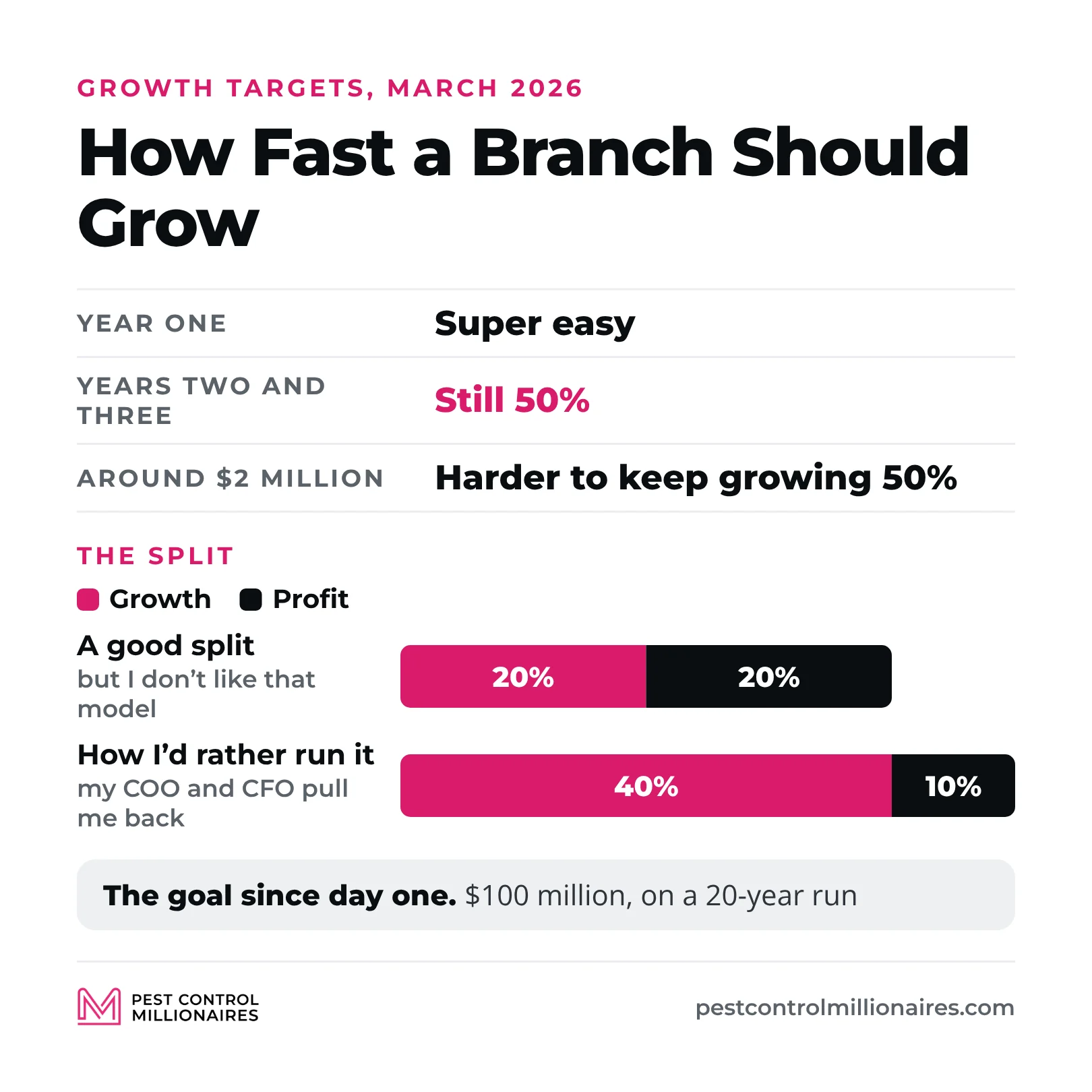
My goal since day one is $100 million, on a 20-year run, and when we recorded this I was five years in. Five of the 19 locations were brand new, and getting each of them to $500,000 to $800,000 or a million would be a good start. I wasn’t in operations anymore. My days were strategy, new markets, partnerships and executive hiring, plus a 15-minute mini EOS meeting every Thursday with each branch manager on that week’s top KPIs, sales first and churn second.
I walk through one of those days in a day in the life of an 8-figure pest control CEO. By then, in May 2026, the numbers I was modeling were $50 million, $70 million and $105 million over the next five years.
Deals come along too. At a leadership event in Arizona, one of our guys told me about a mosquito company doing about $300,000, and I almost passed. We closed two weeks after the offer and took that branch to a million in less than eight months. At that size, rebranding is a no-brainer. With the one before it, I wish I’d ripped the band-aid off right away instead of rolling it out slowly. Buy a $2 million to $5 million company, though, and you might not need to rebrand at all.
My most expensive distraction
I come up with a lot of ideas, and I execute fast, which isn’t always good. One year I started building ice-melt sprayers, 500-gallon tanks on GPS with flow meters that spray when the truck starts moving. It was cool. I put $200,000 to $300,000 into it, and a year later I said, this is dumb.
That usually hits around a million dollars. You finally have three or four technicians doing the work, you have more time and more ideas than you’ve ever had, and you go start the next thing. Now you’re doing two things halfway. Focus on the one thing that’s making you money, get super good at it and blow it up.
My first year in a new market, I also spent $80,000 on hotels. That one paid off, thankfully. Things work, things don’t. If they don’t, shut them off and try something new. A good batting average in baseball is .300. If I’m batting .500 in business, we’re doing pretty good.
Every leader gets a coach
Somebody asked me how many of the people who started with me at a million are still here. Three. The people who got you to a million probably won’t be the ones who take you to three, five, 10 or 20. A couple of years before this, I had to tell my leadership team, “You guys either need to get better, or I’m going to have to replace you. You guys choose.” Then I asked myself what I had done to help them get better. If I need a coach, they need one too. So every one of my executives got a coach, and we pay for classes and courses too. We didn’t have a single employee quit in 2025. We fired some, but nobody quit.
I don’t go to the big hype conferences either. “I don’t need more ideas. I need more execution,” I told the twins. I do read 45 minutes to an hour every morning. That’s only 4% of your day, and if you do it for five to 10 years, you’ll be in the top 1% of your industry.
Wrestling taught me that. I started at three years old, and I had more mat time than almost anyone, but I still hadn’t won state by my junior year. My senior year I was up at 4 a.m. for the gym, worked from 6 to 10:30, went to school and practice, then hit the gym again, and I lost once. You can have all the talent in the world, but if you don’t go work hard, the results will be subpar.
Frequently Asked Questions
How did Jonas Olson start Pest Badger?
I ran a lawn care company in Michigan and built it to about $3 million. When COVID shut Michigan down in 2020, I started knocking doors in Wisconsin, saw that pest control was scalable and sold the lawn company in 2021 to go all in.
How much should a pest control company spend on marketing?
I don’t use a percentage of revenue. When we recorded this in March 2026, my rule was to get double my CAC plus my cost of goods back in the first 30 days, so there’s always money to buy the next customer. If the numbers work, keep putting the $100 in as fast as you can.
Should you give employees equity in a pest control branch?
Sometimes. Early on, I gave three of my first guys equity in their branches because I had equity and didn’t have cash, and it kept them working with me instead of against me. Once we could afford it, we stopped giving equity and paid people more. When we recorded this, we ran a blend of both.
How fast should a pest control branch grow?
Year one is easy, and years two and three can still grow 50%. Around $2 million it gets harder. A common split is 20% profit and 20% growth, but I’d rather run 40% growth and 10% profit.
Full transcript
Every word of the episode, from the video captions
Building the business turns you into a different kind of human being. Realize that failure is a part of the journey. I think there's hope out there for all of us. Jonas Olson, welcome to the Boardroom Buzz. I've been super excited to get you on here. I mean, we met, I think, 2 years ago out in Denver at PestWorld. This past PestWorld down in Florida, we bumped into each other and you made me eat a bug. That was That's messed up.
I did. Thank you.
But, you're a you're a well-known person in the industry, the pest control industry. A lot of people know who you are. Let's get this podcast started with telling everyone your story. Tell everyone where you started, how you got into pest control, and what got you in here.
I probably got in different than most I didn't come from Orkin, Terminix. Didn't come from the door-to-door side. That's how I was like I come from the third world country. So, back to thing I started a lawn care company in 2010. Like 2008. Yeah, 2008 it was part-time. Mowing lawns, and then I had a full-time job in the Carpenters Union. And I worked Monday through Thursday, so I got done at Thursday at noon. So, I'd work out of town. I was usually like in Wisconsin somewhere. I was traveling a lot. Then I come back home and I work Thursday through Sunday mowing lawns. 2 years later, fast forward 2010, I had my first daughter. I always wanted to be a dad as far as I could remember. Like I just always remember like I can't wait to be a dad. I can't wait to be a And so when I had my daughter, I was like I'm not leaving this girl like You guys know like I'm just not. And so I decided that I was going to quit my full-time job. I was 25, 26 years old, probably making like 30 bucks an hour, full-time benefits.
And so had this part-time gig, you know, like mowing lawns. Couldn't really afford the bills to be honest, but I knew it was worth not seeing my daughter, maybe going backwards a little bit. At that same time, one of my best friends, he's actually my gym trainer shout out to Jason Dicks. He was getting out of lawn care. He's selling his company. He's like, "Hey, I have this really good client. Would you like to meet him? I know you're getting in the lawn care. Like would you want to What do you What do you want to come check them out?" And I was like, "Sure." So he took me out of there. Did my first job. And then I got their office and I got two of their houses. Fast forward, when I sold the company in 2021, they were still customers of mine, which is cool. During that time, you know, I built up a pretty successful, maybe a mid-size, small small business, I should say. And got a really good mentor along the way. Super lucky. Just happened to be searching the internet back then and like YouTube was just coming into be a thing, you know. And then like software wasn't really out there yet either, like web-based I was doing things I was like on paper and then Google Sheets.
And anytime a customer called and they're like reschedule, like pull my hair out. Like what is going on? Like this sucks. And I probably had like 200 customers and one And so I just happened to be searching online and the Service Autopilot thing popped up. And I was like, "Oh, what's this?" And then I found the software, quick start. So I jumped in, bought it that day, started implementing customers. That's what I used to stay up like 4:00 a.m. Put all my customers in. Same time, maybe the next night, I was laying in bed, and there's this thing that came across the top of the screen for Service Autopilot. It said Service Autopilot I was like, "Oh, what's this?" I clicked and watched the video. Super good marketing tech by Jonathan. It was basically these two guys, Jordan Webb and John De Castellane, John De Castellane, which are two of my really good friends now. And they're talking about their experience of going through this academy. Like where they were, the struggles that they were having with family, with business, whatever. And then like to where they are at a year later by going through this academy.
I was like, "Oh my god, like these these guys are speaking my language. Like I'm having all these same issues. I want to be part of that." And it was So, I clicked on the link and it was like $797 a month. And I was like, "I don't have that money. I don't know what I'm going to do. I can't afford it." Like I just couldn't. I'll be honest with you. But I was have this credit card with like a $5,000 limit that could afford it. So, I was like, "I'll go put this thing on a credit card and see what And I remember looking back to my ex-girlfriend at the time, or ex-girlfriend now. I was like, "What do you think?" She was like, "Yeah, I don't think you should do it." I'm like, "Well, it's month-to-month. So, if I don't like it, I'll just cancel." She was like, "Okay, sounds like a good idea. Put it on my credit card."
And then they have to like do this vetting process for over like a 2 or 3 week period to make sure you're a good And then they obviously approved me. I think I was doing like $250,000 revenue when I got in there. And then the very first session was on Google My Business. So, again, this is remember this is 2000 12 or 14, somewhere right in there. So, Google My Business was like just a And to that day, like I was hooked like on knowledge. Like the wealth of knowledge that this guy was pouring into For $797 a month, it was like, "Oh my gosh." And it was like once a month or whatever, right? Then they had all these old recorded calls that I could go back and watch. So I was like consuming content. I've never even read a book before. Like I always knew that like I didn't know everything, but I was willing to put myself out there. And as soon as I like I found this little world, like I couldn't consume enough knowledge. That's when I started reading books.
I started listening like podcasts weren't really a thing then. But now I listen to podcasts. And so yeah, I just got into this academy and then I think like a year later we were up to like our first million.
A year later? So you went from 200 to...
Yeah, it's probably like a year, year and a half. Yeah. Wow. And like I always felt like I was a pretty good operator, you know, but I just I didn't know what I didn't know. I was in a small market, like I told you guys before. Like my hometown is 12,000 people. And so like I knew that I could only get my business to so big and then I added all these services. I'll get to that in a little bit. Well, anyway, so I ended up building like a $3 million company. We did like to be honest with you, I'll be I'll be candid, that's just who I am. We did like 2.99999 million dollars that year. Like if I had known that we were going to because I didn't know at the time. I didn't have my CFO, you know, I was just relying on my CPA that would give me my financials 3 months later.
If I had known that then, I'd have been like selling my grandma something, anything to cross that $3 million. Well, anyway, so COVID hit and Michigan is just a really really weird spot to be in. We couldn't do anything. Like we were shut down. We could go plow snow cuz we were technically essential, but it just didn't snow that year. We had enough contracts just to base basically break even. So when you're coming out of spring time, like it's my daughter's birthday is March 16th. And so we're going on like this mini vacation for her birthday and all of a sudden we call down there the or the hotel calls us and they say, "Hey, you guys can't come here because there's this COVID thing going on." Like, "Oh, So I was like, "Okay, well, whatever."
And all of a sudden business gets shut and we didn't know what was going to happen. Like we didn't know all this PPP like we didn't know anything. Like we were just stuck in this weird time. So as far as pest control goes, we made if you look at like my five-year plan from like my EOS sheet back in the day, I wanted to have like four routes of pest control. We probably have like 100 pest control clients.
At that point in 2019? Yeah, 2019 2020 probably right in there. 2020, yeah.
So at this point did you already sell the prior lawn the land?
Not yet. So in 2020 is when COVID and we're shut down in Michigan, can't work. My back's against the wall, can't do anything. Previously I had talked to my mentor and said, "Hey, my goal next year is to do this town, this town, this town and this town eventually get to Green Bay, Wisconsin." He's like, "Well, why Green Bay, Wisconsin?" I was like, "Well, it's the closest biggest town that I can get to within like driving distance like 2 and 1/2 hours." He's like, "Well, if that's the case, why don't you just go there first?" I'm "Yeah, good point." So COVID hits and shut down in Michigan, but Wisconsin border is 45 minutes away from me. We can They're They're essential there. I'm going down there. I had already come up with the name Turf Badger, right? Cuz I was going to go sell lawn care cuz that's my background. Get down there. Get I don't come from the Mormon culture, don't know how to knock doors. Like YouTube University 2021, right? Like figure out what to say at the door.
So I get it at the door and I had you know, practiced my pitch like for a couple weeks and I during COVID. And I get down there. It's like I'd say early June by this point cuz I didn't know it was new company and the COVID thing like should we be knocking doors? Like I don't know how to knock doors. Anyway, the first door that I knocked on, their dog was allergic to wasp and they had a ground wasp nest in their backyard. And I sold my first count that I've ever knocked before.
But that you said that's got to be risky, right? Because COVID had COVID had just happened. People I mean, were you masked up? Was it like a like...
It was super weird. I didn't I didn't know what to do. That's why I waited. Hindsight 20/20, knowing what I know now, I would have never stopped. I just went on there right away. But, I didn't know. It was new new company, new new state, new reg- like everything's...
And what made you go ahead and say, "All right, well, we're going to never done this before. Let's knock doors."
I didn't have a choice. We couldn't work here. I still have a family to feed. What am I going to do? So, I didn't have much of a choice. I could start selling off all my equipment, but then I would need it here shortly, hopefully. I was hoping. I didn't really have a choice, to be honest with you. I didn't There was no other plan B. It was like, I got to go do something. Yeah, I knocked first door, and I remember walking up to her. She single I think she's single. Yeah, I can't remember. I can't remember her dog's name. I shouldn't, but I about threw up. I'm not going to lie. I took a deep breath. Like, I've never knocked doors. And I walked away. I mean, I knocked doors like when I was younger, like door hangers and stuff or whatever. When I first started out with mowing, but yeah, I'd never like actually had to close someone on the door.
God, whoever, you know, I whatever happened, right? Like, was watching out for me, and I sold my first account. And I think I ended up selling like two more accounts that day. And I was like, "I could do this. This isn't that bad." So, I think by the end of that summer, I think I had sold like 400 accounts. You know, by like May...
So, you continued to you continued to knock doors.
Yeah. So, I continued to knock doors that summer.
Is going to work.
This is going to work. And I like I was you know, so I was knocking doors, selling the accounts, servicing. I had no like they weren't signing contracts. They it was reoccurring, but there was like no contract in place. So, if they wanted to cancel, they could And so, I was like, I could do this. And yeah, I think like in June, the business opened back up. By the end of that year, I think I had sold like 400 accounts myself. I brought down my operations manager, cuz they weren't doing anything, cuz they couldn't work up there. So, I'm like, I have people that are working with me. They're selling the services. I'm servicing them because no one else is licensed or certified down there. My license was reciprocated so I could do that. So I was the only one who was certified to actually apply. So I'm like servicing, selling, doing all that I could just to keep this thing At the end of the year, I think we had I don't know. I think we might have ended at like 450,000, 500,000 dollars in revenue. And I was like, "Huh." And it felt like I was pretty like even in my old my old company, I felt like I was a pretty good operator. I knew what I was had I always knew that I was going to do something big.
I just didn't have the vehicle to take me where I needed to go. And when I found pest control, it was like there's a light bulb moment. Like, There's this is scalable. I like this. And so now I'm going to new services, which you guys know pest control is a whole different animal than lawn care. And then so I'm in new area, new services, new everything. And then in the 2021, I had a I had a couple sales guys to go out there that I could teach go with me. I think we I think our second full like our first full year, second summer, I think we ended like right around like 800 or million. So at the end of that year, 2021, I had both companies side by side. And maybe it was like 800,000, something like that. It doesn't matter.
And so I had this company back home so it was doing like 3 million bucks. And that's where I said like, "You know I'd probably burn that company down or gave it away. I didn't care. But I was like I'm just going to sell this thing and just whatever happens happens." And I ended up selling. So you go from making you know from doing 3 million dollars a year so living a decent lifestyle, you know, like it was a pretty healthy business and then to sell that thing. And it's not up here that people just had the cash to go buy it. So I you know, I was basically the bank. I bankrolled it for them. They gave me a decent deposit but nothing crazy. Nothing like get rich by any means. And then they're still paying me monthly today.
But yeah, so I just decided to sell that and just go all in on pest control. And so in the fast forward and in last 5 years, yeah, we just opened our 19th location. Like last year, five of them are new this year, by the way. So, 14 were active as of last year. Five new as of this year, so we're at 19. And last year we ended up like 100 and I think at our peak we're like 168 employees and moving fast. Yeah, that's the kind of the evolution.
How many employees? 116 employees?
We had 168 last year.
Wow, that's incredible, dude.
At our peak, yeah. Hold up. Quick pause. If you're running a pest control company or fertilization weed control company and you're not in our Facebook group, you're choosing the harder path. Every operator that's in there is skipping years of mistakes cuz people are actually sharing what's working right now. So, stop trying to brute force your way through growth alone. Search Pest Control Millionaires on Facebook or click the link below. And now let's get back to it.
So, what would you say the major differences between lawn and pest control are?
The difference between the two I would say this. Obviously like cost of goods sold and like mowing services are a lot higher. There's more equipment, right? There's more maintenance. Way more overhead. So, there's just a lot less profit. Honestly, every Tom, Dick, and Harry has a lawn mower series It seems like everyone's always competing on price and everyone wants to go plow snow at 2:00 a.m. For 50 bucks. They want to go mow a lawn for 30 bucks. And we didn't do that. We you know, we sold services at a really healthy margin, but and same thing with my area and I can't I can't I hate saying that cuz it's not just my area, but it is. Like there's just only so many people who could afford our services here. So, like a $2,000 service a year versus a $1,000 service a year is just it's a different beast, you know?
Now, I see what you're doing with Pest Badgers with your marketing aspects. I mean, you're bright. When you guys were at PestWorld, you guys were I don't think you guys had the pink overalls on. Now, did you do anything like that with the Lawn...
We were bright green. So, kind of the same thing. Marketing's always been my thing. I've always been really good at marketing, loved it, always natural at it. Sales was always like the last thing that came, which I wish I would have learned sooner. But, yeah, we were lime green. So, we stuck out like a sore thumb. That was a pull point. It was just to stand out. Everyone's just white trucks driving by. Same thing with pest control. Problem was when I got to Green Bay, it's Green Bay, so everything's green. So, at the same time I was reading a book and I can't remember what book it was, Gary V book or something, and they're talking about this delivery vehicles that they had. I can't gosh, I wish I could remember the book. Long time ago. But, it was downtown New York, and they had this delivery vehicle that was pink and it had like a like a something on the top, some creature of some sort on the top. And everyone always said that they always seen this vehicle. They just stuck out like a sore thumb.
So, I was like, I'm going to go with pink, and that's honestly why it was That's why I went pink, and then, you know, doing my research, I found out that less than 1% of all vehicles were pink. I'm like, if I want to stand out amongst everyone that's green, to be different, how could I be different? And at that time, like, no one was pink. And then, yeah, so we chose pink just to stand out.
Yeah, it's a great idea. I see I like you, I love marketing and I'm always driving, my head is always on a swivel seeing what other people are doing, and I'm not sure if you've ever heard of the moving company Piece of Cake. They used to be called Piece of Cake Moving. Same thing. I mean, it's a fairly new company. These guys are all over the place, but the number one thing is their trucks are so visible. You see them coming from a mile away, and they're pink.
Do you know where they got that from?
Don't tell me they got it from you or anything, did they?
I know those guys.
I love it. I love it. They're not wearing pink overalls, though.
No, they should be though.
They should. So dude, you're scaling Pest Badger is pretty quickly. Now, within the last like three or four or five years, what are you doing in order for this to happen? I know you have some guys that you that are just like all-stars that you're putting in these different Do you have a specific specific strategy as to how you're hiring these type of A guys, or is there a way you're structuring deals with these guys where they get equity? How are you doing it where these guys are so committed to growing Pest Badger's throughout the different states that you're in?
Yeah, this is one of one of those other pivotal times in my life. Like I sit in this basement that I'm in today. It wasn't even finished then. Sitting around a literally like a folded up table. Like a literally like folding table. The folding chairs. My first five guys, three of them are still here. Two of them ended up not working here. And so we're all three of us were five of us are sitting in this basement. Of everyone that works with me today, those guys are still here. From day one and yeah, I mean I cast the vision early on the basement. Said this is where we're going to be at in five years. And they bought the vision. I did give up equity early on to those three because I had less money than I have So it's just like a stepping stone. Like hey, if I want to keep these guys, I think all of us probably go through that evolution too. Like how many guys have you guys lost that are probably really really good employees?
And it's like, oh man, I just lost such a good employee. And what's he going to go do? He's going to go start his own. Cuz they just get capped out here. So how could I incentivize those guys to work with me instead of against me? So yeah, that was like part of the plan to give the give the give away a little bit of equity so they can go start their thing. I wouldn't say that it's golden handcuffs, but you could say that. But, it's like or you could pay them really well, right? You could pay them, you know, $100,000. You I didn't have the capital to do that then. Be honest with So, but I but what I could do is I could give them equity in their branch and help them go business thing, but the first 2 years, you know, they just work for me side by side.
Then they're the third year, they went on and started their own thing. And then now we talk about vision that we had back then and we double the size that we thought we'd do in 5 years. So, it's been pretty So, yeah, so I think that just early on I had to give away a little bit of equity in those branches. Then as we move forward, we didn't give away equity. We just pay people more.
Mhm. So, I agree with that because, you know, I think if you pay someone like a high salary, they're not as bought in, right? There's a cap there. I mean, I'm sure they there's incentives and bonuses and you can structure it certain ways like that, but when someone actually has equity in something and they know that it's going to their hard work is going to correlate into more money or more just the it's going to grow and they're going to be compensated for it, I think it goes a long way for sure.
Yeah, and I think that just like I said early on, I mean, you keep beating this up, but I just I had more I had equity and didn't have cash, to be honest with you. So, I gave away a little bit of equity, some sweat, and they earned their sweat equity. And again, I don't know how I got so lucky. Again, I found two of them. It took me 6 months to recruit this one kid. One came through another person and then one found us. And like if you put those guys against any of the sales guys in the country, they're still some of the top best in the country. I don't know how I got them. Like in the middle of no BFE, Michigan, I found them and they found me and they're killers. So, I got super lucky. Someone was Someone was watching out for me for sure.
Tell the listeners more about your business model with Pest Badgers. I know you have these satellite locations. Now now all these people on these satellite locations, do they have equity in the business? How how does it work?
So every location's been a little bit different. So like I said early on, some of these satellite locations do they do have equity in and then some of them that we just open up with corporate that people don't. So as we got bigger, we could afford to pay more people. So if you got like a branch manager or regional manager or whatever you want to call it and then they're really good at sales, we could give them incentive structure and pay them a really good salary to go out there and keep selling. So yeah, we've kind of blended both models. Again, early on, I just didn't have the funds that we do now. So it's been Yeah, I think I wouldn't say that it's a mistake because it depends who you talk to, but I wouldn't say that it was a mistake early on because that's just what I had to do. And it was a learning curve, you know, for me.
One, running multi-locations was a learning curve and then having partners was learning curve. But man, I've gotten so blessed, honestly. I've been so lucky.
Are they doing door knocking in those territories in those in those markets?
Yeah, so some of them do. You know, we built a big call center, too. So our call center puts on a lot a lot of revenue, as well. Again, I'm marketing's kind of my thing. So we're doing a little bit everything like from door hangers to lawn signs to every door direct mail to Facebook ads, Google ads, like or TikTok, we're all over the...
This question came across one of the groups yesterday. Ad spend, what's your what or your marketing budget? Is it 5%? 10%? What do you keep it at?
I'm so glad you guys asked me that. And I see the same question asked all the time, right? I just look at marketing totally different. So I see the same thing. Yeah, it's 3%, 5%, 6% and then if you're super aggressive, it's 8 to 12% of your growing growth mode, right? Love it. Like but I disagree. So I just know my numbers so well. My CAC versus LTV, right? So I know if I can get double my COGS plus or double my CAC plus my COGS in the first 30 days, that I know that I'm always going to have money to buy the next customer. So, break that down for you. This gives you be super simple. Let's say I can get a customer for $100. Let's say my COGS are Let's just go with 30%. So, I know it's going to cost me $130 to go get this job and then get it I also know that that same customer is going to cost me another $100 for the next customer.
So, if I can get $230 back in this example and back in the first 30 days, I'm always going to have money to buy the next customer. So, how many times have you put $100 in this machine, this customer machine, and it gave you back $1,000? How many times did you put that $100 back in that machine? As much as you possibly can, so, when people ask me about what my percentages is, it's like I don't I just don't look at marketing that way. I look at as I look at the data and say, this is what it cost me to get a customer. This is how long they stay. This is what my turn rate is. Now, I know that every time I put this $100, I'm getting $800 back and I'm covering the cost of the next customer, I'm going to keep pumping that $100 in every single time, as fast as I possibly...
For sure. I mean, that's the one thing I try to dial in immediately is that customer acquisition cost, you know, you want to know how much you're spending to get and land that customer. I don't I don't care like how many how many I want to know conversion. I want to know what it's going to cost me to convert a customer into an actual a lead into an actual customer. And then once I know that and if that number makes sense, I am throwing money all over it, right? But that's the hardest thing is that people don't dive into it enough to do it. They expect the marketing companies just to kind of go out and do it. They expect...
That their marketing company didn't give them like all the my marketing company sucks or agency suck or they say, I've tried ads and it just doesn't work. Well, like for one, they probably don't know your market. For two, they probably don't know your service. And so they're using the same ad that works in Florida trying to make it work in Chicago. It just doesn't work the same. So, you have to do your own part to go learn marketing, get good at it. So, like hey, I can go spin up six eight ads at once, see which one's working, and triple down on that ad. That one ad can make you a million But if you're not testing any of you just giving it to your agency to do all the work for you and then just blame it on them like yeah, I mean that maybe they could be part of the blame, but I think you just got to take the role on yourself, especially early on.
Do you find one thing works better than the other for you?
No, I think I think so, this is how I look at marketing. It's a big wheel, right? And so your brand is the hub in the center, the hubcap. Every other spoke in the wheel is part of your marketing. So, whether it's digital, Facebook, Google, let's go with truck, you know, truck wraps, your lawn signs, your every door direct mail, your postcards, your your door hangers. They're they're all spokes. And if one or two of those spokes are missing, that wheel's just not going to turn. So, they all work together is what I'm trying to say. So, if you deploy all these strategies at the same time, be seen by everyone, everything's just going to work better. And your customer acquisition cost will just come down cuz everyone's starting to know who you are.
Hi, I got a question about expanding into new markets. What type of market research are you doing before you enter that market?
That's a great question, too, because I'll be honest, as usual, and I didn't do any of it at first. I was just like, we're just going into this market we're going to take over. That was our goal. And although it worked out pretty well in our favor, there was a some lessons learned, too, right? So, as you guys know, you get into a I wouldn't say sketchy neighborhoods, just maybe neighborhoods that just doesn't don't have the exposable income that some markets have, right? And so you just see a higher churn rate in those markets. So, you like you quickly realize like, "Hey, all of our churn is coming from these same exact markets. Like, let's not go there no more." So, it's like in those market what are the things that came into that market? Okay, well, let's just say average home value is 250,000. Again, I'm making these numbers up. Just you know, as an example. Say the home value of these is 250,000 and median income is $30,000.
Or is it Yeah, $39,000 for the average median income for these houses. Like, "Oh, that's why they're churning because the idea on the door sounded really good. They probably need a pest control or whatever, right?" and then you go to a different market. Let's say the median annual household income is 150,000 and the median house is 500, 800,000 and you have 5% churn versus 15% churn. It's like, "Okay, well, we need to do more markets like this." when you start looking at like holistically and as you grow, it's like, "Okay, well, now we know that these are the markets that we're going into and we don't want one or two people on the street that have these median incomes and median household or house houses, right? We want everyone on the street have the same exact metric."
So, again, early on, we weren't doing that, but now as we open and expand like these this is the data that we're looking for. It's like the same thing like is the is the is the market It's like the rising tide lifts all boats, right? If there's constant like Let's go with Florida. It's a good example. Everyone's moving to Florida, right? I want to move to Florida. I get It's like there's going to be so much work there because so many people are moving there. Constantly new construction. Like, it's like rising tide lifts all boats. Those are the markets you want to look for, you know? Like, is the market expanding or detracting? Is the median income good is the household good like is there a lot of households is there enough household like is there market penetration let's say let's just say we're going with 10% or 20% or 30% is it is it actually attainable in those markets so that's kind of what we're looking at as we go into these new markets as we expand for...
So you're saying you do now do some more market research prior to jumping into locations.
But originally you didn't.
No we were just winging it. This town looks good send it and again we did really really well there honestly maybe partial luck but there was some I wouldn't say that I was just winging it cuz we kind of knew what we were doing but not to the level that we're at today for sure.
Are you guys growing with like route density in mind originally you know I'll explain kind of how we're doing it with our our dog waste removal business we have like we're we're between two two territories and we're not right now kind of we understand that our windshield time's going to be a little bit higher and our efficiency's not going to be great but we're going to grow from the outside in versus from the inside out but we're able to do that we have the long we have...
You have more cash than you had when you first started too.
Correct exactly. So we understand we're we're willing to kind of sacrifice margin now for for bigger I guess range and territory. How how do you guys approach it?
Yeah I think that kind of going back to what I just said we know that our industry right like any service industry like it's all about windshield time. So if you can get a technician in the same neighborhood for three four or five days straight. He's making more money, he's happier, we're happier cuz he's traveling less people. So, yeah, route density is obviously key. Like that's why I wrote the book. I'm not plugging my book, but it's literally just right here. Like everything that we can do like I said, from Facebook ads to running like doing videos in front of that neighborhood, in front of their sign, directly targeting that specific neighborhood with door hangers, every door direct mailers, Facebook ads or Google campaigns, everything focused on these specific markets, neighborhoods, like cuz we want to just keep building out our efficiency.
I'm glad that you mentioned your book, Jonas, because...
Mean to. It's just right here.
No, no. Well, no, it was something that we were going to bring up anyway. Number one, I want to say congratulations. It's a great book. And anybody who has a pest control business that's looking for, you know, advice or how-to, and you know, the game plan, the step-by-step plan of how to build a business, I recommend this book highly. Jonas, you gifted it to us when we saw you and it and it's a great book. So thank you.
Yeah, of course. Thank you.
How How was that experience writing that? Was it was it challenging? Would you do it again? Are you into it? How What you...
I actually told them no the first time. I was like, I just don't have the time. I got all this stuff going on. Appreciate it. Then I took a step back and I did really think about it like, does this make sense for the brand? Is it a good idea? And then I'll give Dan a shout-out. Like he stepped up to the plate. He's like, "Jonas, I'll do all the leg work for you. I'll put all the chapters together what I think we should talk about. I'll put it together. I just need you to do the rest." I'm "Okay, what does that look like?" So, we would kind of talked back and forth for a couple months. I was like, all right, I can do this. And so, what happened is that they put they structured the book. I obviously I had my input when we started getting into it. And I was like then I started getting excited, right? And so, as I was getting excited, then I was like putting more effort into it. And then they came here to my house in my studio. And we recorded for about 4 days.
3 and 1/2 4 days, something like that. Like 12-hour days. Of all the chapters do like basically it was an interview style. So, they were asking me questions and I'm just ripping off top like my head of like what I want to talk about. So, what happened from there is they just took all that and they pulled all all the script the tran- all the Pulled it all out and basically formatted for the book. So, it was like me talking not physically writing. It was me talking. They pulled the transcripts and turned it into the book, which is super...
That is very interesting. That's pretty cool concept. I would have never thought of that. That's great.
So, as far as me being into it, yeah, now I am. That that's super cool. And then I'll I never never ever in a million years would I ever thought I was going to be an author. Like I still don't consider myself an author. I just do not. Put that out there. But now that I've done one, I have the second book named and I have the concepts already dialed in. So, yeah. I think it's pretty cool.
And can you get that book on Amazon?
On this one? Yeah. The cooking's, yeah, you can.
Do you know how many sold?
I know the last time I looked there was over or 500 or 600. And I to be honest with you, I thought we'd sell 50. I didn't know. I had no clue. I was like, whatever. If it sells, it sells. If not, I don't really care. It's cool. And then yeah, and then like the title I came up with. And then what I did is I actually posted on my Instagram a couple different titles that I had, a couple of different the Alex Hormozi thing that he taught me. And then like I came up with a couple of the visuals and I posted on my Instagram and let and my Snapchat and let everyone vote on it. And it was a hands-down winner every single time. I'm like, "Oh." And then yeah, that's how it happened. And then of course I had the colors picked out with the pink, you know, kind of kept that that same theme. And, yeah, and now the second book I'm actually looking forward to. Like I've been like every month I break down like what I learned in the month that whether good or bad, and then I put it in my note section and I'll like walk or either be talking or walking and I'll talking into my phone to the concepts that I learned that month, whether it's good or bad, and put it in my phone to go forward for the book for the next one.
So, yeah, it's pretty cool.
It's very cool. I love it. It's like Jason says, it's an amazing book and definitely recommend to any, pest control owner out there who's definitely starting a business or just has any, you know, questions or needs...
I think you could take a lot of the concepts and put them into a lot of the different service-based businesses that are out there.
1,000%. It's not just like because I'm in the pest control niche, that's kind of why I stuck to this niche. Maybe my next one probably won't be as niche, but more towards the service industry, but, yeah, you could take all every single concept that's in this book and put it towards any any service industry business, for sure.
Yeah, don't have an off switch. Number talking about that, let's, talk about like, yeah, give us your, your daily routine, you know, cuz a lot of people don't realize, you know, it takes a lot of work, right? You're going from early in the morning, I see you, Jason and I up at 4:30 in the morning, and we're going all day long every single day up until, you know, like you said, 3:00 in the morning. Wake up, your brain's just going, right? So, give us, lay it out for us.
Don't have an off switch.
Yeah, so I'm usually I don't set an alarm. I haven't set an alarm in I know, 10, to years. I just wake up naturally. So, I just wake up whenever I wake up. You Usually that's between 5:00 and 6:00, somewhere in there. Like, I just don't I don't ever set an alarm. I just wake up. Between 5:00 and 6:00, wherever whenever I wake up, I just wake And then from there, it's usually I'll go straight to a book and I'll probably try to read for like 45 minutes to an hour every single day. If you read an hour a day, it's only 4% of your day. That 4% of your day will change your life for the next 10 years. As long as you did that every single day for the next 5 to 10 years, you'll be top 1% of your industry, by far. But most people won't do it. Don't know why.
So, that's how I start. And then from there, it's usually getting my girls ready for school. So, as you guys probably see a lot, I'm I spend a lot of time with my kids. It's just a non-negotiable for me.
How old are your daughters?
Maisie is 15, going to be 16 in on the 16th. So, her golden birthday's coming up. And then Kinsley is 10 and then Laney is 6. And that's just a non-negotiable for me. Like, whenever they have something going on, business is always there. And I don't follow the I'm going to go on off on a tangent like I always do. But, I just don't follow like the work-life balance very well. I think it's just sometimes, you know, the business needs you more than family does and sometimes the family needs you more than than your business does. And I think that just evolves as you as the company grows, too. But, I'm not I'm not like work-life balance kind of guy. Like, sometimes I'm like you guys, like it's working 16, 18 hours a day. And with my kids, 1 or 2 hours a day. Then there's days where I'm with my kids, you know, 12 to 16 hours a day and that business 1%, 1 hour a day. But, from there, usually drop the kids off at school. Cuz it's what I love to do. Sometimes I'll take them to Starbucks in the morning. We'll have a little breakfast, ready to go to school.
And then from there, I'm headed to the gym. Usually at the gym by like 7:30. And I usually spend an hour, hour and a half there. You know, you usually I'm lifting or do some sort of And then from there I'm headed to the office to work. Usually from depending on which day, I usually work till like 4:00, pick up the kids, bring them back home, spend a little time with them, have dinner, and then back to work till 8:00, 9:00, 10:00, sometimes midnight, 1:00. So, yeah, it just depends. Every little day Every day is a little bit different, but I'm super structured, too. Like, I walk out the door the same exact time I walk in the gym the same exact time. Like, I'd be really easy to kill, honestly. That's typically what my day is.
And then travel days, too, you know, to the other offices. Working on getting my pilot's license right now. Which is super fun.
Dude. That's so cool. How do you like...
It's super challenging. It's probably why I like it a lot. But for me, everything's far here. Like, where you guys are down there, like, to go like 10 minutes takes you an hour. Here it takes you an hour to go an hour. So, it's just further away, you know? We don't have much traffic. So, if I Well, if I want to go visit an office, it's like a 6-hour trip there, and then spend the day with them, and then a 6-hour trip back. And it's a 45-minute flight. I'm like I My truck's a 2020 or 2021, I don't even know. And it's got 220,000 mi on it, cuz I just constantly drive, drive, drive. And it's just I'm so over driving. I was like, if I can just speed up my time buy a little bit of time back by traveling across the water, like, I'll do that. But yeah, that's typically what my day looks like, and you know, then I'm having meetings during the day. Every Every Wednesday we have a leadership meeting with my executive team. Then every Thursday we have like mini called the mini EOS meeting.
So, we're running like a 15-minute EOS meeting with meeting with each of our branch And we're just going over top KPIs for the week, just making sure everything's good each one of the branches. Yeah, and it's kind of what it looks like.
What are the top KPIs you guys track in your locations? Off the top of my head, I would say you know, sales for me is always number one, churn is number two, conversions for sales is in there. Payroll really doesn't change a whole lot. You know, we pay for performance, so that always stays about the same. What's at the top of my head? Those are probably other than stops completed, things like that. But there's like five, six that we're going over every single day or every single week. There's like I'd say five or six that we're looking at on a weekly basis.
Revenue per route, things like that, but...
What type of growth do you look to get your year over year per location?
That's a that's a tricky question. But yeah, I'd say year one is super easy. Year two is Year two and three is still 50%. As they get to that $2 million mark, is like when it starts to get a little bit harder for them to keep growing by 50%, but I'd say a good split is like 20% profit, 20% growth. Although I don't like that model, cuz I'd rather be like 40% growth and 10% profit. That's how I operate. My COO and my CFO like to pull me back a little bit, which is a good healthy balance. I'm pushing them and they're holding me back, so it's been good.
Right. You need that yeah, definitely. That that push and pull is very important and when you surround yourself with a good team, you know, that tends to work out. Yeah, cuz I asked that because I'm always looking to grow and double and you know, I just you know, you ask yourself what's realistic, you know, at the end of our game we're at 5 million and it's like, all right, well, we're not going to double, but some people would double. Some people would, you know, look to Yeah, like I mean right. And that's mindset, right? We knew that we were kind of tapped out at that point. We're ready to go and we wanted to exit and take advantage of that opportunity. But there's people at 10 that are like I talked to you, they're like, "No, I want to keep working until I'm at 30 million, 50 million." I'm like, "Wow, that's crazy."
It can be done.
Yeah, and my goal since I started this My goal since I started this from day one is a 100 million. And you And if anyone's going to do it, you're going to do it.
And I said I was going to go on a 20-year run. I'm in 5 years in, and we're a third of the way there. So, I don't We're not slowing down. I'm not slowing down. All gas, and just keep pushing the team, and yeah, it's been awesome. Like, I don't I don't even honestly like I don't even like take credit for any of it. My team is killer. The only time The only place that I'll give myself credit for helping build the team, but they execute, and they're so good. What do you contribute to your success?
Having a really good mentor. Knowing that you don't know everything. And you can learn something from everyone. Pay to play. Like, if you have to go pay someone $100,000 to teach you some massive concept, go do it. I've done it several times in my life, and it's worked out every single time. So, just invest heavily in yourself. Invest in your team. All my executives have coaches as well. If I need a coach, they sure as hell need a coach. And as I said earlier on, I probably didn't grasp that concept. And so, I had a question earlier on today, like, how many people how many people that started with you at a million are still there today? And there's only three. And so, like, that's just the evolution of a business. The people who got you to a million probably won't be the people to take you to a three, five, and 10, And so, but I it took myself like I had I had to take a step back and like, "Okay, I had to have a conversation with my leadership team a couple years ago and be like, 'You guys either need to get better, or I'm going to have to replace you. You guys choose.'" And it's a tough conversation to have, but it's like, "What have I done to make sure that they're getting better?"
And I was like, a lightbulb moment, like, "Okay, well, if I'm working on my leadership skills, like, they need to have a coach, too." So, I ended up getting those all those coaches, too. All my like your team coaches as well. Whether that's going back to college, paying for them to take online courses, whatever that may look like in acquisitions or whatever, right? Which I've done. My CEO has a coach from a really really successful company. And so I say if I like if I would ever give myself a pat on the back, is just put myself out there to and to execute the things that I do learn. Like people go read a book and they'll just read a book and they'll take a lot of information from the book. Knowledge is power unless it's not executed on. So I just say like you just have to be crazy in your execution, too.
Surround yourself with really good people. And if you have that bad egg, I don't know what's going on here, but like I've just been through this a lot. And so even if it's a relationship that's in your household, like if they're slowing you down, sometimes you got to walk away from those, too. So if I say if I ever give my So where do I get my successes from? My team. They're amazing. And I had some really good people in my corner. And I had some really good coaches. So I'm Yeah, that's what I would say.
Who was your Who or who is your mentor?
I had the same mentor for a long time, Jonathan Pototschnik. I don't know if you guys know him or not. He was a lawn care millionaire.
Oh, John's great. John's amazing.
Yeah. So he was my coach since I mean I mean still one of my best friends today. But yeah, I found him in 2012. 12 or And that was the coaching group that I was in.
He was the long the lawn care millionaire or something, right? So yeah, I got super lucky. I feel like I've been blessed in a lot of places and right time, right place, put myself out there. He was who I was telling you that I couldn't afford to be in his group. I couldn't afford $797. So he was the coach and yeah, and I think that he would go tell us to do something. I mean he paved the like he literally showed us like, "Hey, this is what I did. Go copy this." And then I went copied it. But then over time it's like the same people kept doing the same like he would tell you to go do it and then some people would execute. And then people who would go execute that growing is the more time he put into you like more he would pour into you cuz like you're obviously willing to do the work. And so that just evolved over time where he put more time into us and it became more of a friendship and now we're hanging out outside of these things and I was just at his house a couple months ago just spending like you know three or four days with them just as friends. We talk on the phone once twice a month text back forth if not weekly you know every two to three weeks we're texting back and forth.
So yeah, he's he's a mentor of course a really good...
So it's like trust in the process right? Like you know you talk to people on a regular basis and I'm sure you coach a lot of people and talk to a lot of people in the industry. It all comes down to just like again trust in the process. There's guys that are like, "Uh-huh, yeah, okay. Yeah, yeah, sure." And they don't do it. But like you said if they do it and they just copy what you're what you're telling them to do and just run with it and work hard at it they're going to be met with success.
And then just fail fast honestly. Because the more times you fail the faster you are going to succeed And so I could maybe I'm just too dumb or naive. Like I have failed I didn't really care I'll just keep going forward like whatever that was yesterday. We'll work on today now. But yeah, so and then I you know I you know like I said and then I had Alex Hormozi paid to his team last two years we're close to with their team and he's a wealth of information. His team is a wealth of information and that's like where you see like Patrick Bet-David too did all their stuff and it's like you go into those companies and the level of sophistication the level of Like you just man they're the level that they're at the level that their team at is like is far beyond what you could believe until you see it and it's like aha.
And they're they're going you know they're paying these people four or five hundred thousand dollars a year for a reason but they're so good and that's just where you got to get to, you know?
Do you see yourself doing anything other growing a hundred million dollar pest control business? Okay, cuz I've been down this road before and Jonathan told me many times it's the bigger that you get, the more you put yourself out there, the more opportunities you're going to have. I get asked to coach if not daily, at least a couple times a week to be someone's coach. And sometimes it's two three times a day. And I just think coaching will always be there for me. It's just not it's not who I am yet, it's not what I want to do. It'll always be there for me when I want it to be there for me. So my number one focus is growing this thing. The podcast is obviously what I love to do as well what do we get to do on a podcast? We get to learn from the person that's on the other side. And everyone just gets to listen and learn at the same exact time. And that's why I started the podcast like just interviewing friends and buddies learn from them and then all of a sudden it turned into this big thing that I didn't know was going to happen.
And I'm just literally learning what's working well in other markets from some of the best industry leaders that are out there. It's like I can take one golden nugget and give five golden nuggets along the way. Like it's the rising tide lifts all boats thing, you...
So I love the fact of that executive for what you're saying. I believe in learning through making mistakes obviously but I also like to learn through other people's mistakes so I don't have to so I don't have to make those mistakes as well, right?
What are a few mistakes that you've had to go through or some black eyes that you had to take through your journey of being a business owner.
Yeah, so being distracted was one of the ones that that cost me a lot of money. I'm very I come up with a lot of ideas and then I have a high execution. So one year I decided to go start this spraying business like building Actually building these big like ice melting sprayers basically 500 gallon tanks. They're all on GPS. Trucks start moving, they start spraying. All all regulated by flow meters like it was And I built these I built them and started selling them. I put two to $300,000 in this. And then like a year later I'm like this is dumb. Like I Like it's dumb. Like I spent so much time and effort and money into this thing although it could have been really cool. I probably could have sold it. Whatever like I just like this is so dumb. Like just stay focused. So I've been down that rabbit hole chasing like these the shiny objects. We all go through because we get bored. Especially like around that million dollars, right?
So you're going for working your tail off every single day. You're in the being a technician. And then all of a sudden you have four technicians, three four technicians and now they're doing all the work for you and you're like oh I have a little more free time. I got to have more ideas than I do more I have more ideas than I ever used to and I have more time than I ever used to. So I'm going to go start this next thing. I see all the time. Now they're doing this half-assed and this half-assed. It's like if you just say focus on that one thing, coming from on the one thing that's making you money, just go execute, get super good at this one and just blow that up. And yeah, it's going to take you 30 40 years to make 30 40 million dollars. Like I get it. Or this other thing coaching thing could make me 3 million dollars in this year.
Which sounds super cool. It's a lot of cash up front, but there's nothing in the back end or if I just built HQ bigger and all my money will come in 20 years or 10 years, whatever that my exit's going to be, to make a hundred million or two hundred million or three hundred million. I think the leverage is there, you know? So, I would say just through distractions is probably where I had to learn. Another funny one is like my first year starting in my new market, I spent $80,000 on hotels. That wasn't fun, but thankfully it paid off. But yeah, just stupid things like that that I've done. You know, just trial and error, things work, things don't work. If they don't work, shut them off and then start new, you know? And I'm still like again, I don't know everything. I don't take it that like I'm still learning every single day. I still screw up. I just feel like I just feel like I like I have a better batting average than I used to that.
Like a good batting average in the real world is like 300, right? So, if I'm batting average is 500 in business, we're doing pretty good. You know, you're you're open-minded, you're learning every day, you're a normal dude that works hard, right? Like Yeah, we're all like and when you I think the problem happens when someone thinks they know it all, right? And then and then they hit a hit a wall. You're open to learn new things. That's why like you said, you mentioned you have your podcast and you're learning from other people on a regular basis. So, kudos to you, man. That's great.
Yeah, and then just like the level of network networking that I built like getting to talk to you guys is incredible. Like thank you for having me on here. Thanks for meeting me in person, like the relationships that I've built you get that you guys are building through your podcast. Or like you probably talk to so many people who are much larger than you guys are, right? But it's like, "Hey, we're having this problem." You reach out to any one of the people that you've networked with over the past year with a simple text, "Hey, we're running into this. What did you guys do?" With the one text message, you just solved your problem. Like the building your network is so massively important. Cuz like Grant Cardone says, which is super cliche, but it's true, like your network is your net worth and it's truly is.
Do you do any of those large those large conferences like the Tony Robbins or the Cardones? Although I love it, I don't need more ideas. I need more execution. So, I love getting ideas. I'm an idea guy. I guess it's a visionary, but I just need more execution. So, like the way I look at things these days, and this is comes from another good friend mentor of mine currently. He says, "Like, if your end goal, Jonas, is a hundred million dollars, that means every single one of your hours is worth $33,000." Basically, I think that was the math. And so, it's like, "Am I going to go spend three days? It's going to cost me, you know, two hundred whatever $200,000 whatever to go to this thing to go hooray? Like, I don't need more hype. I just don't need hype." I just need to execute what I already know. And so, like most people are constantly grasping for new ideas, trying new things, which is great. Most of those things Not all. I'm not saying Tony Robbins is bad. I'm not saying Grant Cardone is bad. I think there's a place for everyone.
But for me, I just don't need hype. I just need more execution. So, I feel like those things cost me $200,000, you know, to go to, honestly.
So with the execution in mind, you're at 19 Pest what do you want by the end of What's execution? Well, before So, 19 locations, how many trucks total? Like, I'm just trying to get a an idea here.
I wish I knew the answer. I knew we had over a hundred trucks last year, hundred and some. I knew we added 35 trucks last year. I know we're probably going to add just as many this year. So, yeah, it's getting there.
I don't know the exact number of trucks, I'm not even in operations anymore.
So, what's your goal to have by the end of 2026?
As far as what?
So, locations? Are you going to add any more locations? Of the like I said, those 19, five of them are brand-new, so we're starting from scratch, zero with five new ones. If we can get each of those, you know, 5 to 800,000, million, it would be really cool. Yeah, I think it'd be a good good start. Something always happens throughout the year, as you guys know. This deal will come by and we can't pass up that's really good. Good example, it happened to us last year. It just came across like just happened one of the We were at a one of our leadership events out in Had this guy, one of our guys, say, "Hey, join us. I have this mosquito company that runs through my dad. They're looking to sell." I'm like, "What's his revenue?" He's like, "Uh around 300,000." I'm like, "Ah, I'm not really that interested."
And then the more I thought about it, I'm like, "Okay, well, that's it's at least worth looking at. Let's just look at it." So, I looked at it and I was like, "Oh, there's something here, you know?" And again, this deal happened, made made the math math, we made him an offer, he said yes, we ended up getting it 2 weeks later, closed on it. It all happened pretty fast. We took that branch from $300,000 to a million in less than 8 months. So, it worked out pretty well.
And do you rebrand that? Do you rebrand that that acquisition there?
I think that's a great question. So, yes, we will. The brand is super cool, though. I actually loved the brand. I loved what they were doing.
It was It was It was Mosquito Crush. And so, all their trucks were wrapped...
Ah, I know them. They're out like in like Seattle. They're up by you, like Wisconsin area.
In Minnesota. So, it could be different.
Minnesota. No, no. I They're an older couple, right? Are they an older couple? Yeah, I had conversations with them years ago.
Worked at the He was like a marketing director at a college.
And so, he built this company. It's super cool. And they would every time they get a new customer, they'd leave a six-pack of Orange Crush on the doorstep. And I loved it.
And I think it's super awesome. That I think that someone could go grow this brand. Our our just our brand carries way more weight than theirs does. So it would be we slowly started phasing it out. And I think every deal is a little bit different. Now, if you're buying a two to five million dollar company, I don't think you have to rebrand it, in my opinion. At that at 300,000, I think rebranding is a no-brainer for us, you know? But I learned the hard way, like knowing what I know now with the with those companies, which we did with this one, but the one prior to that, I'd just go rip the band-aid off right away and just get it over and done with instead of like the slow rollout. At that size, like it's just not worth your time. My opinion. And I can be wrong. It's just what I've learned through my...
So with something so big as what you have right now, what do you focus on specifically day-to-day? You have operators that are dealing with the technician issues, and what do you focus on every day within the businesses?
I'm still highly involved. Very highly involved. I'm not over operations. I you know, I check in with my sales my sales guys. I check in with my leadership team. Check in with the call center. Talking to my leadership team. But mine's more strategy. These days more than anything. Just focus on strategy. New markets. Maybe new maybe new partnerships with you know, with different brands and just things like that. That's the majority of my time. More talking on the phone and meetings than anything. Like death by meetings, but Yeah, that's the majority of my time is just really focusing on execution. Really dialing in the team as well. So like as far as technicians, like I'm not hiring technicians or anything like that. But as far as hiring like executive level, I come in on that stuff, you know? So a lot of a lot of that. So we're hiring another regional manager this year. Over operations. So I'm highly involved in that. Things like that.
And then like again, just like networking with other really big operators, learning from them, and going to see their operations, and taking away anything that I possibly...
I want to see you more on social media. I want to see more videos of you and the guys out and promoting the business. You do a good job of...
Actually my YouTube strategy is doing a full like 180 360 this year. And my goal for this year is to highlight all of my guys. Is to really highlight them, really show what they do, because people have a hard time resonating with who with me. Maybe because not because I'm successful, but maybe I'm further ahead than what they Where like some of my guys are young Where they could be like, "Oh, that that is me. I can go be that guy, but I couldn't be this guy." So I think highlighting my team more and show them like where they started their journey, really highlighting them, will really speak to my YouTube audience more than Cuz I think like that the people who watch me, the age range is, you know, was from like early 20s to like 40. And so really highlighting my guys will I think will drive home the target audience that we're trying to hit. So my YouTube strategy is going to change completely for this year.
The talking head style is cool only because it's cold, and I don't want to be outside when it's -30 trying to shoot content. And so I have to do a better job of stacking more content during the summer to roll out through the winter.
What would one of your employees, how would they describe you?
I'd say this, we didn't have a single employee quit last year. Not one. We fired some, but we didn't have anyone I think they would say that I'm very ambitious, very energetic. I think that they would say I wish I could call one. I should. I should call one, right? Are you live? See what they would say. And I think that I'm very driven, and I hold a really high standard. That's what I think that what they would say. But I also I feel like I'm very compassionate, I think I have a lot of empathy in me. Like I give a lot of grace to my to my cuz you have to give grace to yourself, too. And I give grace to my people. We're just We're just human beings at the end of the day. None of us are I think that's what they'd say.
I want to go work for I want to go work for Jonas.
I'm ultra-competitive, too. They'd tell you that. Like with my girls, with myself, with my daughters wrestling, like ultra-competitive.
Were you a wrestler?
I was, yeah. Yeah. Long time ago.
I think I think it's great that your girls are wrestlers.
Me, too. Like I never thought One, I never thought my oldest daughter would wrestle ever. She's like so quiet and timid and shy and man, she's a beast. And then now my middle child is more like me. She's a she is just a super aggressive crazy athletic. She's just starting out. It's her fourth practice yesterday cuz she I've always asked her if she wanted to do it. She always told me no. She loved dancing and cheer. Cool. Go be good at that. And then all of a sudden she said she wanted to go to wrestling. She went to wrestling practice once and she loved...
After seeing that video yesterday, I'mma tell you right now, keep her in keep her in wrestling. Keep that heavy on her head. That's a mat mixer with there.
Yeah. She's tough, dude. Like and that's her fourth practice ever and she's...
You know what's great about wrestling is that you have nobody to point fingers at other than yourself.
It's not It's a team sport, but it's more individual, you know? And so why it's good and bad. It mentally it's hard. It's like knocking doors in a way. It's super mentally hard. And it's physically hard, too. And yeah, you can't you can't point your finger and blame it on anyone else. It's like it's you versus yourself and you versus another person. And it's like business, too. Like if you don't believe in yourself whether you think you can or think you can't, either way you're right. So, if you go out there with a bad mindset of I can't I can't beat this guy or I can't do this, you're not going to do it. You go out there thinking that you're going to win, will you win? Maybe not, but the odds of you winning are pretty good. And then again, it's like anything else though, like if you treat it as a part-time thing, you're going to get part-time results. If you treat it as a full-time thing, you're going to get full-time results. My heart breaks is the people who put in full-time and get part-time results, honestly. And there's just people who, no matter how hard they try at something, they like me, I'm never going to be in the NBA.
I'm 4' 7". Not really, but you know what I mean. I'm never going to be in the NBA. No matter how much I go practice that thing, I'm never going to be in the NBA.
Jonas is not really 4' 7". You know, he's really not 4' 7".
But if you go like, I'll just say that it's like you have to try a lot of things. And if it's like it's funny cuz I feel like eventually life finds you and guides you down the path. And then you find something that you just love and that you're so passionate about. And if you go all in on that one and give it everything that you have, it'll pay off. And so like where people have a hard time is like delayed gratification. You know, they get to that million, two million, three million dollars and they want to go buy this thing, which there's nothing wrong with it. Like I get it. But if you can just push that thing off for a little bit and put that extra thousand or two thousand dollars a month into the business and ad spend or whatever to keep growing. Like it's really, really hard. I get it cuz I've done it too.
It'll pay off in the long run.
And what that is discipline.
Yeah, and I think going back to wrestling, I think that's where that's where a lot of my discipline comes from. You know, I was not that I was good, but you know, I started wrestling when I was 3 years old, weighed 27 lb. And so we're like always watching my weight, like not really like back then, but as high school got there, like I wrestled my entire life and I was I was really I was athletic, but I was only really good because I had so much mat time, more mat time than most people cuz I started when I was 3 years old. My siblings, my brothers and sisters all wrestled, so I was just there and I Well, what else am I going to do? So, they just had me wrestle. So, I had so much mat time. By the time I got my I think I had my 6th, 7th, and 8th grade year, I don't think I ever lost.
And then my freshman year, I think I lost nine times or seven times. And then my sophomore year, I think I lost like six times. My junior year, I lost like three times. But, I never won state at that point. And that's when it's like when it really hits you. It's like, "Okay, you have all this talent in the world. But, if you don't put in the work more than everyone else does, you no matter how much you talented you are, you it's not going to work out." So, my senior year, it's like I got super Start waking up at 4:00 a.m. I go to the gym, then I go to work. I work from 6:00 a.m. To 10:30, then go to school. And then I'd go to school from 10:00 to 3:00, and then I'd go to wrestling practice. And after wrestling practice, I hit the gym again and go running. Once I started compounding it like hard work with talent, is like when the results started paying off.
I think I only lost one time my senior year. I actually didn't lost that, but it's my own fault, so. And again, those days are long long gone. The only reason I bring it up is because it's like, you can have all the talent in the world, but if you don't execute and you don't don't go work hard, the results will just be subpar.
100%. I loved it. Hey, listen, Jonas. This been This has been an amazing podcast. Learned a lot. I'm looking forward to the next time we see each other. Maybe we'll do a PestWorld this year. Are you guys What do you What was that Pest the real PestWorld house. That was a really cool idea.
The real PestWorld house? Yeah, we're it's going to be it's going to be big this year. It's pretty cool. We have a lot of people same people coming together. We have a lots of people sponsoring it. We're going to be holding a big kickoff show like on Thursday night or Friday night. I think there's like 150 people that are going to be invited to a like a kickoff party with a dinner, having a big barbecue. I don't think we have the actual house picked out yet. We were trying to get a few places like a ranch and nothing's really worked out. We're taking applicants right now. People can go to our website and apply. I think it's the real PestWorld house.com and apply. We take people from all over the They're just starting out. We had a guy last year that we all sponsored.
Joe. Joey, he's a New Jersey guy. Nice...
Super awesome guy. We sponsored him to be there. We paid for his meals, paid for his flights, paid for him to be in the Again, we take everyone from every We want We just want to see everyone win. You know, there's a you know, a lot of big companies in there. But it's like you can't compete with us because we want to see you win, you know? So, it's pretty cool. Really really fun to be a part of that. Honored that they asked me to be a part of it. It's been really really cool. So, we have a board. There's like seven of us that are on the board. It's been a really fun experience to give back to a community and to a into an industry that's given us so much, you know? So, it's pretty cool.
Jonas, thanks a lot, man. Listen, if anyone's going to hit a hundred million dollars in annual revenue, it's going to be you, man. And I can't wait to see keep working hard, keep doing what you're doing. Pest Control Millionaire, great book. Thanks for the time and keep in touch, man. Thanks.
Yeah, you guys too. Thanks for everything that you guys are doing for the industry. The Boardroom Buzz is obviously a staple. You guys are studs. The twins are the coolest guys ever. I appreciate what you guys are doing. Again, going back to the rising tide lifts all boats. You guys are giving away free information. You're You're bringing up everyone along with you. And it doesn't go unnoticed to anyone. So, I appreciate what you guys do. Thanks for having me on. And again, I apologize I was late for my other meeting. So, thanks for bearing with me.
Hey guys, thanks for listening to another episode of Pest Control Millionaire. We don't charge any money for this show, but the podcast isn't free. Please like and subscribe and give us a five-star review on your favorite podcast app. This makes a huge difference for us. If you have any specific questions about your business or your personal life that you'd like answered by me or any of my podcast guests, please send an email to And if you want to get in touch with me or about our marketing class, we do a live version every Thursday night. Check out our website at Thank you guys for listening. I'll see you guys in the next one.
Watch the PCM Podcast on YouTube