Jason and Jeremy Julio on Scaling and Selling a Mosquito Company

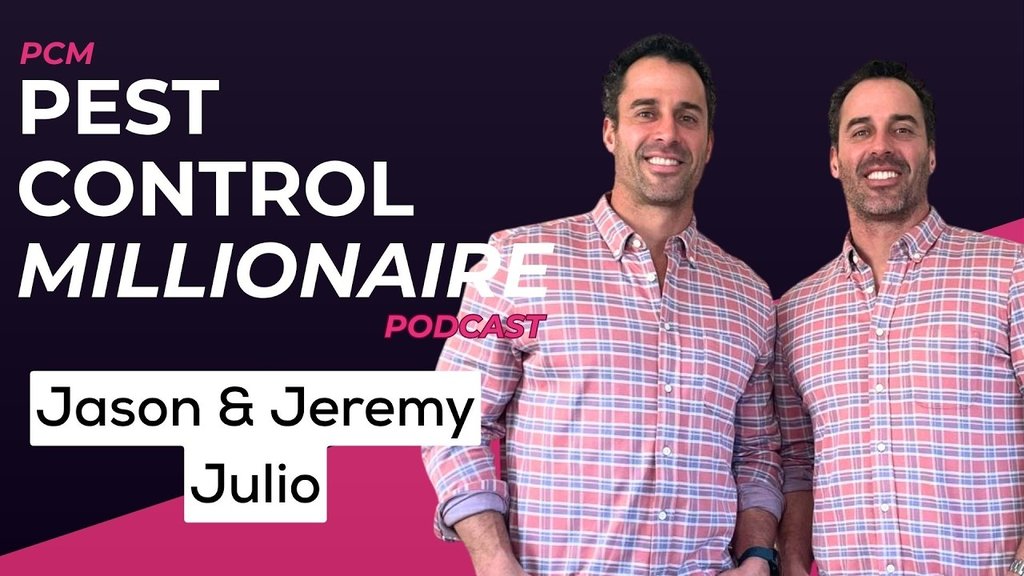
Table of Contents
- They built it without quitting their day jobs
- Ask the people who already did it
- Look like a franchise from day one
- Every contact in your phone is a lead
- Hire people who will answer at 10 at night
- Decide what enough looks like
- Get an advisor before you take an offer
- The year after the sale
- Do it again, faster
- How they ended up hosting The Boardroom Buzz
- Frequently Asked Questions
Jason and Jeremy Julio, the Blue Collar Twins, are twin brothers from Monmouth County, New Jersey. In 2012 they were teachers and coaches who also managed a beach club, and they were making maybe $90,000 in total income, which in Monmouth County means barely surviving. So they started a mosquito control company on the side, Last Bite Mosquito Control. They added a pest control company, Total Home Pest Control, and in 2023 they sold both to Viking, an Anticimex company. They never quit teaching.
They also host The Boardroom Buzz. I’d been on their show a couple of weeks before, so when we recorded this in March 2026, I got to be on the other side and hear their story.
This episode is part of the PCM Podcast. For the episode where they interviewed me, read Jonas Olson on equity, execution, and a $100 million goal.
They built it without quitting their day jobs
The twins didn’t come from much. Their mom was a waitress, and they grew up on Section 8 and welfare. “But I really think that made us the people who we are today,” one of them said. They always worked hard, and one of them treated every job as a step to the next one, from lifeguard to head lifeguard, beach club manager, teacher and administrator.
One night in 2012, over drinks at Jeremy’s house in Ocean Port, Jason brought up starting a mosquito control company. He’d seen the Mosquito Authority franchise in a magazine. He didn’t know if the product would work, and he didn’t know anything about pest control, “but I knew if we focus on customer service, our employees, and created a cool brand that people would kind of lean into a little bit, that we may be on to something,” he said. Jeremy didn’t want territories and royalties on something that might not work, so they did it on their own.
Mosquito control in the Northeast is seasonal, and they used that. They came up with the idea around June and were operating by the following spring. They never meant to run routes themselves, and one of them figures he could count on one hand the times they had to. The off-season gave them time to break down everything that happened that season and plan, and that’s when they made big changes, like moving from Jobber to FieldRoutes with over 1,000 customers.
Most owners I talk to worked in the field before they started. Jason and Jeremy never did, and they kept their teaching jobs the whole time. I think that’s how a business should be run, from a bird’s eye view, going off the data and not getting too emotional about it.
Ask the people who already did it
Jason reached out to 20 or 30 people around the country who had already started mosquito control companies. One owner in Georgia got back to him. He vetted Jason first, to make sure he wasn’t moving into his territory to go after his customers. Then he came up to New Jersey and showed him the applications, the products and the equipment. They still travel together.
They also found another mosquito company’s SOPs and copied its launch, 100 free treatments. Somebody once told one of them, “you never steal, but you can steal with your eyes and your ears.” And the help went both ways. The twins say those relationships are how they got started and why they’re still in this industry after selling.
Look like a franchise from day one
They didn’t want to be the company that throws a magnet on the side of a car and shows up. They wanted to look like a franchise, with the guys in uniform and a real brand.
Jason says he came up with the name Last Bite from a page of ideas in a notepad. A friend who’s a graphic designer sketched about 10 logos and taught him that fonts and colors matter. They narrowed the 10 down to three and sent those to their friends and family to vote. The winner is a girl on a swing under a big green tree, inside a bubble that keeps the bugs out. The green says nature and clean.
Jason built the website himself by studying what other companies charged and how often they serviced. They bought a used truck with low miles for about $7,000 and parked it where people would see it, like wherever the fireworks were on the Fourth of July.
Every contact in your phone is a lead
They also reached out to every person in their phones to introduce the business. I tell new owners to do the same thing, and they look at me like I’m crazy. Even if you haven’t talked to someone in 10 years and they’ll never use you, they can pass the word along. Alex Hormozi talks about it in $100M Leads. Send 100 a day by text, email, Instagram and Snapchat. It’s free, and when you’re starting out you have more time than money.
The first 100 treatments went out free, a friends and family offer to get things started. Then came old-school guerrilla marketing. Door hangers. Yard signs everywhere, until people saw them on their neighbors’ lawns and wanted one on theirs. Twenty dollars on a personalized Visa card for every referral. Green Frisbees with the logo, thrown out the truck window into yards. Parades, stickers, water bottles with the logo handed to cops working outside on hot days, and good t-shirts, the kind people actually wear, given to everyone, police and firefighters included.
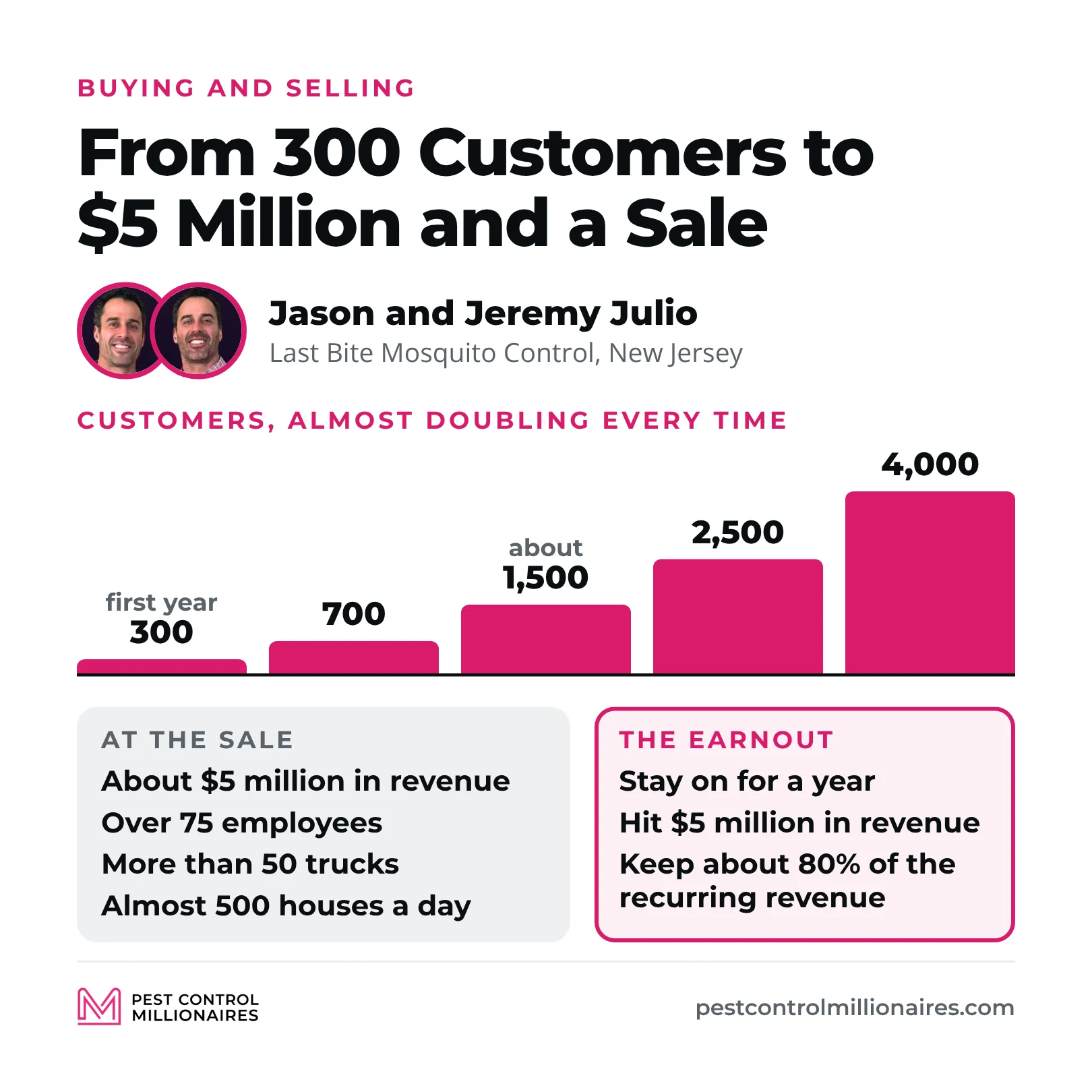
It worked. They had about 300 customers the first year, then 700, about 1,500, 2,500 and 4,000, almost doubling every time.
Hire people who will answer at 10 at night
Until year three, the twins came home from school and did the scheduling, the technician calls and everything after hours themselves. Then came a few key hires. One started part time on the phones, scheduling and routing, and turned out to understand their vision and their passion. She’d pick up the phone at 10 at night if someone called. Margo Rappel, who became their operations manager, bought in right away with the same mindset.
They promoted from within. One tech became a lead tech and then an operations manager, and they never hired an experienced outsider. For the seasonal techs, they hired a lot of former students from the community college, and about 80% came back year after year. But for every 100 people they interviewed, they kept five.
Decide what enough looks like
By the time they sold, they had over 75 employees and more than 50 trucks treating almost 500 houses a day, and they were still teaching full time. They could have hired a COO who had scaled companies to anywhere from $15 million to $40 million. But hitting $5 million and knowing they could exit at a very nice multiple was a home run for them, like hitting the lottery. Some owners are happy with a $20 million earnout, and some want $50 or $100 million. “I can’t knock them for that, right? That’s their mindset and that’s what they want. And that wasn’t us,” one of them said.
Size also brought liability. They had major vehicle accidents, employee problems and lawsuits. A contractor tried to sue them over $70,000 of dead landscaping when they were servicing about 350 accounts a day, and it wasn’t them. “The bigger that you get, the more targets you get on your back,” Jason said. It’s stressful, and one of them had a family, a good teaching career and other opportunities. He was good where he was.
Total Home came from their own customers asking for general pest control. After three or four years of referring that work out, they bought a local pest control company for about $100,000, renamed it and built it into a million-dollar company.
Get an advisor before you take an offer
Buyers came knocking early. They sat down with Lawn Doctor at about seven trucks, but they weren’t ready. Then a friend who had sold his own company introduced Jason to Potomac and The Boardroom Buzz. Jason started listening, got interested in M&A and got on the phone with Paul Giannamore. Paul and Franco Villanueva-Meyer walked them through their goals and built an exit strategy with them. Before that, Jason didn’t know what an exit strategy was. He figured they’d keep growing and collect as much as they could until people stopped buying mosquito control or something bad happened.
Before Potomac, the offers they were getting were millions of dollars less. Potomac’s network of buyers and the process it ran got the multiple up, even for a seasonal business, where there are fewer buyers. “Franco’s a bulldog,” as one of them put it. Paul walked me through how a sale works in what Paul Giannamore taught me about selling your company.
The year after the sale
They stayed on for a year with two goals. Hit $5 million in revenue and keep about 80% of the recurring revenue, and for every percentage point they came in under, they’d get less. They were confident they’d hit it, or they wouldn’t have agreed. And the buyer wants you to win too, because nobody wants a bad deal.
They told only their key people, the managers and long-term employees, the day before the new owner came in, over breakfast, lunch or dinner. They said they’d sold, asked them to stay, told them what to expect and promised them money if they helped hit the goals. There were a lot of tears, happy and sad, and a handful of those people still work there.
Customers were the other worry. When a big company buys a local one, some customers don’t like it, so the news stayed under the radar and the twins stayed the face of the business for that year. The buyer promised business as usual and kept its word.
And the money? They were already making close to a million dollars a year each, and for one of them the first deposit wasn’t a big deal. It felt like winning a state title in high school. Then, now what? The cool moment came after a birthday party the night they closed. Waiting on his kitchen island was a Rolex and a handwritten letter from his brother, thanking him for the journey. If you’re thinking about selling one day, start with how buyers value a pest control company.
Do it again, faster
They’re still teachers, and they love it. Jeremy says he’ll be done teaching by 55 at the latest, and Jason may step back when his kids go off to college. But Margo, who no longer worked for Last Bite or Viking, spent more than a year bugging them to start something new. So they started a pooper scooper company. It’s recurring, the market isn’t saturated, it’s easy to get into and hardly anyone does it with a real brand and real customer service.
Three partners run the day-to-day, and Jason gave them equity from day one. “They’re people I trust, I respect, and it’s sweat equity,” he said. It had about 200 customers its first year and about 500 by March 2026, when they’d just picked up their fifth truck. Mosquito control once got a boost from Zika. This one got a snowstorm that stuck around for a month and a half, and when it melted, everyone’s backyard was a disaster. The phones rang off the hook.
The goal is another exit like Last Bite, faster this time. Once they know what’s working and what a customer costs them, they’ll throw more money at it. But not if it stresses them out. This one is supposed to be fun.
How they ended up hosting The Boardroom Buzz
After the sale, Paul and Franco took a group of owners they’d sold for to Puerto Rico. One of the twins told Paul that someone should interview him, after all the deals he’d been part of. The twins did, for the 200th episode of The Boardroom Buzz, and then they were asked to keep hosting. It keeps them in pest control, meeting people. Dan Leibrandt ranks it No. 4 on his list of the best pest control business podcasts.
Frequently Asked Questions
Who are Jason and Jeremy Julio?
Jason and Jeremy Julio are twin brothers from Monmouth County, New Jersey, known as the Blue Collar Twins. They started Last Bite Mosquito Control while they were teachers, added Total Home Pest Control and sold both to Viking, an Anticimex company, in 2023. They host The Boardroom Buzz.
How did Last Bite Mosquito Control get its first customers?
They reached out to every contact in their phones, gave the first 100 treatments away free and used old-school guerrilla marketing, like door hangers, yard signs everywhere, $20 for every referral, Frisbees and good t-shirts. They had about 300 customers the first year and almost doubled from there.
How do you tell employees you sold your pest control company?
Jason and Jeremy told only their key people, managers and long-term employees, the day before the new owner came in, over breakfast, lunch or dinner. They asked them to stay, told them what to expect and promised them money if they helped hit the earnout goals.
Should you hire an advisor to sell your pest control company?
Yes, in the twins’ case. Before they worked with Potomac, they were getting offers for millions of dollars less. Potomac’s network of buyers and the process it ran got their multiple up, even for a seasonal business, where there are fewer buyers.
Full transcript
Every word of the episode, from the video captions
Building the business turns you into a different kind of human being. Realize that failure is a part of the journey. I think there's hope out there for all of us. Welcome back to another episode of Pest Control Millionaire. I don't think these guys need any introduction, but I'm going to introduce them anyway. You got Jason and Jeremy Julio. They're obviously the host of the Boardroom Buzz. They've had a couple successful exits already in pest they're obviously super successful. They're really good at podcasting. And they actually just started a really cool business doing pooping scooping, so we'll talk about a lot about that. Super excited to have you guys on the show. You know, I was on your podcast a couple weeks ago. And it was a lot of fun. Like I said before we Before we started the podcast, we were just talking about me being on the other side of it is kind of cool. So now I get to hear your guys' story. Which I've never heard before. So I was just I'm really excited to hear it. You guys are studs. We finally got to meet at PestWorld. You got me to you guys eat a bug with me for a challenge. That's...
Hey, but you guys got a book out of the deal, so it's probably worth it. I took some pictures.
Book, by the way. Great book. I appreciate it. And got to take some pictures you guys. And we had a good time for short time that we got to spend But both of you guys, welcome to the Thanks, Jonas, for having us, man. Super pumped. Yeah, it's so cool like we're all in the same industry. We're doing We're all just like willing to help each other out, which is so cool. Like that's what I love about this industry. That's what I love about podcasting. Like it's just super cool to see. So it's I love it. So thanks for being here. I think that's I think that's a great point. You know, between all the guys podcasting, between you and Draper, and us, it's like you know, people ask, "Well, you had these exits and you built the business, and why are you still like getting involved?" I love, you know, talking to you guys, being involved, going down to like PestWorld and seeing everything and everybody and what's going on.
You know, I think one thing that one one of the things that attributed to our our success with Last Bite and Total was the relationships that we built, you know, throughout the years. You know, I can name a handful of people that, you know, when we first started that I reached out to, maybe not immediately, you know, getting off the ground, but I think once we were in that like growth phase, reaching out to Ryan Claterbaugh of Mr. Mister, Brian Hopkins at Quick Pest Control in Georgia, Luke Lewis down Florida. You know, all those guys are awesome guys and were able to give back to us and it wasn't just a one-way street. It was something that we were able to kind of like, you know, go back and forth with where, you know, we actually helped them just as much as we helped as they helped us, you know. So, it was kind of a two-way street, but you know, putting ourselves out there and building those awesome relationships is was like the foundation of, you know, how we kind of jump-started our business, but then also why we're still involved today.
Yeah, and again, I think I mentioned your podcast, like we all get to learn together, and then we have the benefit of the listeners getting to learn at the same time, which is super awesome. And I mean, there's so much information out there. Like, yeah, it's cool if you have coaches. Coaches are great. There's some awesome coaches like out there like you guys. But there's so much free information there. If you can't afford, you're just getting going, all this information is there and it's so cool like the amount of messages that you guys probably get that we get that are helping all these newer entrepreneurs out is super rewarding for sure. Yeah, you guys just started that that Facebook page that has a ton of information and it's great because people go on there and ask questions all the time and you know, you get all this great feedback. Yeah, I can't believe how fast the thing has grown. Like we just started it like I think at PestWorld last year we had like 300 people in it. I was like, okay, we have to get this thing rolling active. And now where it what day is it today?
Today is the 19th of March, I think, And we're like at three like 3200 people already. Like so it went fast which is super cool. Yeah, and then if you're not in if you're not a member in that group or are listening to this podcast and you're in pest control, shame on you. Right. And it's interesting that you said that because one of the things that like kind of comes to my attention is you know, when when we first started, we didn't have these groups. We had similar groups, Pest Cemetery and other pest owners, whatever groups and I would reach out and people are very helpful. But then I'll talk to other people outside of you know, our industry out in the real world and they're like, "Hey, you do that? You ask them? You talk to these people that you don't know over social media?" I'm like, "Yeah, they're great. They answer my questions. They help me get through these problems, you know?" And I think like some people didn't feel comfortable doing that and I think some people still today are kind of hesitant of doing stuff like that.
I don't know why but You don't think my competitors in my local markets listen to my podcast or my groups? Like I let them in my group and they're my direct competitor. I do not care. There's enough work for everyone. It's a big world out there. Yeah. And they might not all like me but it shows that they're listening to the podcast and they're watching the YouTube channel and in our group that they that they might not like me, but they respect me. Who's not going to like you, Jonas? Come on, man.
I don't know that. Yeah, I'm just saying. You know what I mean? Like, yeah, I don't know. But, I'm sure like we all have haters and if we don't have haters, we're not doing something right. Right. Right.
Sometimes you just wake up and you piss in someone's Cheerios you didn't even I'm sorry. I didn't know I didn't know we weren't friends today. I don't know. It's a small world, you know, like getting getting these small markets too and just running into a lot of people and again, I think they all respect what we're doing, but I'm sure like we all have haters. So, it is what it is. I don't even think about twice about it. Well, I was thinking back to the question. You know, when when you serve the market and you and you kind of are innovative and you're doing the different things that you're doing, right? And you're creating a vibe, that could be similar to pissing in someone's Cheerios again, right?
I'm not going to mention any names in here, cuz I'm sure he listens to the podcast and I remember when I first came into this market until he heard what I was trying to do. He's like, "That guy will never He doesn't know what he's doing. He'll never pull it off." Now he's selling his company. He's like, "F and we have pulled it off." So, it is what it is. All right. Yeah, one of the things I believe in is if you're not innovating and if you're not moving, if you're not moving forward, you're going backwards. So, you always got to be doing that. My grandpa told me that I don't I don't know how long I've been in business like say 15 years ago. And my grandpa was a business owner, too. He's like, "Jonas, keep dreaming cuz if not moving forward, you're dying." I'm like, it's that simple, honestly.
Show up every single day, work hard, be a good person, and good things will Like, don't make this harder than it needs to be. Some people make it so Hold up. Quick pause. If you're running a pest control company or fertilization weed control company and you're not in our Facebook group, you're choosing the harder path. Every operator that's in there is skipping years of mistakes cuz people are actually sharing what's working right now. So, stop trying to brute force your way through growth alone. Search Pest Control Millionaires on Facebook or click the link below. And now, let's get back to it. Okay, we're going to go We got to rewind the We got to rewind a little bit. I just like to start the podcast out this way. For juniors, you know, sophomores, juniors, seniors in high school, who were you guys in high school? Mhm, that's a good question. Well, we were we were the good-looking athletic twins. Still are.
All the girls loved us. In all the towns. And you know what? We had a large network of people growing up, and we were, you know, we weren't afraid to talk to people. We're very social. Which also I think really helped out with our success as well. But yeah, we played three sports in high school. College football players. You know, we didn't come from much. Our our mom struggled, you know, she was she was a waitress, lived We lived on Section 8 and welfare. But I really think that made us the people who we are today. But we always worked hard. Always worked Yeah, I remember my teachers always always told me that I was never going to amount to much cuz I talked too much. Like, what the f do you know? Like, you're teacher making 40 grand a year, shut up. Nothing wrong with teachers, I'm just saying. We're teachers, by the way, Jonas. You know that, right?
That's fair. I understand. I'm just saying. It was my It was my high school I mean But our salaries are definitely well They're over 100,000, okay? They're not $40,000 anymore. I'm just saying. It was nothing against teachers in general. I just feel like my teachers like I remember the I remember one specific teacher tell me that. Like, I can still remember his face, like what he's wearing, everything. I'll never forget it. He said, "Uh you just talk way too much. You'll never amount to anything." And like, what he told me like then, I was like, "He's not wrong. I do talk a lot. I'm always in trouble for talking too much." And I would just middle of a test, I'll just pick up my desk. I'd slide it next to my best friend, and put my desk next to hers just to piss...
But we if we asked your coaches, what would they say about you? That my freshman year, my coach said, you have running backs like Jonas that are too small, so by the time he's by the time you guys are in juniors and seniors on varsity, that you won't have guys like Jonas as running And again, it's one of those times I'll never forget, just that feel inside of me to prove them wrong. And I'm And I guess what? When I was in It was a long time ago. But when I was in varsity football, started both ways, junior, senior, and I'm still a running back. So, I was fast as hell. Right. Even though it was a long time ago though, Jonas, those are the moments that shape us also as...
Absolutely. That's I mean, that's why I remember them. Like the my teacher told me that I talked too much that I wouldn't amount to anything. And the football coach, which loved me, by the way, he didn't mean anything personal by it, but I took it personal. He said, "Jonas is too small. He's fast, but he won't be a running back in the in your varsity." And I'll never forget it. It's like, cool, you doubted me. Like the banks that doubt you, the people that doubt you, they all force you to be better. Like cool, bet against me, awesome. Now, those same banks that told me no from day one, when I needed the money, they're like begging for the money now because cuz I don't need it. Well, no, I'm definitely not going to give you my business now because you didn't want to work with me then. But if you if you asked us when we were juniors in high school if we would see ourselves in this situation right now where we're at, the success that we've had, do you think that you would What do you think you would have thought at that point? Do you think you think it would have been a...
We would I would have said that we would have been successful, not at this scale, though. Right. Right. You know, us becoming teachers and coaches and managers of our, you know, local beaches, that was our success in 2012. 20 up to 2012. That we had families, we lived in okay neighborhoods, we had our careers, and that was success for us, but you that wasn't enough. We wanted more. Yeah, and then Jason came to me. One night we're drinking at the house, my house in Ocean Port, and he brought this crazy idea up. He's like, "What do you think about doing this?" What was this? What was this?
Starting a mosquito control company.
Got you. And he brought up some different franchises. I'm like, "Wait a minute." I didn't even know there was a thing like that that really even existed to treat them. I know there's obviously pest control, but not mosquito control. This is 2012, so like it mosquito control was probably just coming to the market like right around then. Maybe...
Was. Yeah. Yeah. That was exactly when it started because the Mosquito Authority was the franchise that I had I had seen like maybe in a magazine or something, and there's like, "Huh, I you know, this is interesting." And then we had a friend, Holly Macveigh who started a coffee shop, and her thing was all about branding and marketing. It was coffee shop. She crushed it. She's got 15 20 shops. It's well-known in our area, and she does really well, but her main thing was branding. So, I knew that with our network and our that, you know, we'd get support. I didn't know if the product was going to work. I didn't know anything about pest control. I didn't know anything about mosquito control, but I knew if we focus on customer service our employees, and created a cool brand that people would kind of lean into a little bit, that we may be on to So, I brought it up to Jeremy, and Jeremy was like, "Huh, what's this?"
Like, I don't I'm not digging the whole franchise thing because you have What do you have? You have territories, you have royalties you have to pay. Like, I'm like, "I'm not into that." Not even knowing if this thing would ever work. So, I was like, "Let's I'll do it, but we'll do it on our own. So, then...
Good employees? Were we good employees?
Yeah. Like before before the business. Oh, yeah. Great. Yeah. We So, with every position that I've ever had, it was always to strive to get that next position. You know, lifeguard, head lifeguard, beach club manager, teacher, administrator, you know, I always wanted to pursue more and more, right? So, you know, as sports, you know, always wanted to be the starter, always wanted to be the best, always wanted to, you know, Again, I know a lot of people don't like to compare themselves to other people or other things, but I always wanted to make sure that, you know, we were performing at a level of not just a league, like top. We always wanted to be at top. Right. So, I would say, yeah, I think we're good employees, yeah. Cool. Did you guys like being told what to do? I didn't need to be told what to do because we did what we were supposed to do, right? And we'd always go above and beyond. And Yeah, we were doers. We never had to, you know, we were never just standing around doing nothing. We always were doers. Always going above and beyond. Yeah, so that's why I'm asking the question. So, you guys have full-time jobs, careers, then you go off into this entrepreneurial world that you just you just bet it on yourself, right?
You have no clue if it's going to work. So, that's why I was just trying to get a feel for like where this fuel where the entrepreneurship came from. Well, you know, working those the being a teacher and a coach and managing this beach club. At that point, we were maybe probably making in 2012 maybe $90,000 or, you know, total income. And in Monmouth County, New Jersey, you're barely surviving. So, we had to do more. We had to figure out something else, you know? And this was it, you know, and it was a little investment.
Control that we didn't even know anything about. No idea. And then I mentioned Brian Hopkins, and he was a one of the really awesome guys in our lives, and I'm so dear friends with him today. We travel Down in Georgia, he had the startup company, but he knew pest control. He worked for pest control company. I reached out to maybe 20, 30 different people across the country that had already started a mosquito control. He was one of the guys that reached back out to me, vetted me, making sure that I wasn't in his territory trying to steal any of his customers. But trusted me, came up to New Jersey, kind of showed me what to do, told me what to do in terms of applications, product to use, equipment. And so we learned that from him, you know, that was one one piece that we learned. And I was thinking about this the other day like our brand and our logo But you knew from the very start that we wanted to be we didn't want to be that company I say it all the time that just throws a magnet on the side of a car, just shows up. We wanted to be that professional company that looked like a franchise that was super professional, the guys coming up all in uniform and all about that branding.
Yeah, I like that. But then you said, "I'll do this, but I don't want to do the franchise. I want to do this on my own." Yep. So then walk me through the next few months. So we came up with the name, Last Bite, right? I don't know how we ended up landing on Last Bite. We probably brainstormed on a bunch of different things, but...
There was no ChatGPT. No, there was no ChatGPT. I actually came up with the name Last Bite Mosquito. I remember in a notepad just writing down a bunch of different things. I think we all did it. And then, you know, we came together and we're like, "All right, I think that's the one, Last Bite." Another buddy of mine's a artist. Well, he's a graphic design guy from NYT and super art like awesome artist. He created the logo for us. And at that point, I didn't know that font mattered. I didn't know that color mattered. I didn't know about all these things, but he taught me these things. He showed me he and he sketched out maybe 10 different logos. And then we took those 10 logos, we narrowed them down to maybe three of them, and then we sent them to our network...
Of friends and our family we said, "Hey, what do you guys think about this one? Which one do you like the best?" I love And then through that process, we landed on our logo. And if you look at our logo, you have a girl in a swing under a big green tree with a bubble around it like a half circle. And it's like it's a genius, you know? She's playing outdoors and she's got this bubble around her so there's no insects and it has Last Bite next to it.
And then the color green, right? Nature and clean...
Clean, yeah. So, that played a part. And then the font also is specific for, you know, flow and So, all this stuff really matters. Yeah. So, then I build out the website. I had no idea how to build out a website. Jeremy and I had zero business Actually, we had no idea how to operate a business or where to start. But we did was we wrote everything down. We looked at other people's websites. We kind of said, "All right, well, this is what services cost. This is how frequent the services are." And we started plugging away building out that we Yeah, we even I got to the point where I even found another mosquito control companies like SOPs and like looked at it and kind of like dove into it and saw what they were doing. I think one of was one of the things they were giving away 100 free treatments.
Possibly, yeah. And I was like, "Oh, we got to do that." So, we gave 100 free services out. We had our brand, we had our website, and We bought our first truck. It was a used truck. I think we got it for like...
$7,000. And it was a great truck, had low miles on it, and Yeah, so then that that was it.
So, we were still you know, we were still young. You know, we went to a Christmas party. I rolled up to this Christmas party in this truck at this Christmas party. Told everybody about it. I think I gave was giving cards away. It was awesome. Just hustling. Just hustling. I love it. I like that you said that you brought it to your network and you showed it to your friends and family and just let them help decide. I love that. So, like the cover of the book...
The car all over the place. We'd park it in strategic locations, different times of day just to kind of get like eyeballs on it. Yeah. Fourth of July, we'd park it out where were the fireworks were. We did a really good job also getting involved with the We did a ton of networking events, got involved with the community, gave back to the community, did a bunch of sponsorships, gave a lot of gift baskets out. I want to We didn't say this, though. I mean, we also went as far as on our phones reach out to every single person on our phone and introduce the business. I tell people this all the time we're starting a new business and they look at me like I'm crazy. I'm like, "Dude, you have these numbers in your phone for a reason. Reach out to every single one of them, every single one of them and introduce I don't care if you didn't talk to them last 10 years. Talk to them and introduce the business to them. And if even if they're not going to use you, they can pass the word along."
It's like I think Alex Hormozi talks about it in $100 million leads book, right? Like you have the You have the contacts in your Send out 100 a day. Text messages, emails, Instagram, Snapchat. Like everyone know that you're starting a Yeah, and that's free.
That hard. It's free. Exactly. You have more time than You have more time than you do money when you first start out. Well, that's what blows my mind is when I see people who have businesses and they have like three reviews. I'm like, you got You know more than three people, but come on, like, put a little effort into this. This matters, you know? Yeah. So, from from idea to launch, how long of a span is that? A week? 3 weeks? 3 months? I think we did a nice job at slowly rolling it out from when we built the website to coming up with the business plan. So the best thing This probably all happened maybe let's call it like and by the next spring is when it was operating, right? You know, so we had some time and that's the best thing about mosquitoes the mosquito business in the northeast is that it's seasonal. Yeah, cuz you guys were teachers, right, at the time? That that, right, we're teachers at the But, we also had in mind that we weren't going to be operating the business, either.
We weren't servicing jobs ever unless we had to. And in the beginning, we had to at times because of But, not many.
Not many. If, you know, we had a respray that we had to do, a special event, someone called out, whatever. We I probably count on one hand how many times we had to run a route. But so, the seasonality is huge because you have a break. You have time to kind of game plan for the next season. You have time to break down everything that happened that season and plan. You know, when people get stuck in the day-to-day every day and there's no break, there's no time to really like make corrections or fix things, right? Or like, you know, we change our That was one of my questions. Did you guys have a CRM you want? We were using FieldRoutes? No, Google calendar at first.
Calendar at first, and then we got into We used Jobber, and then from Jobber we went to FieldRoutes. And when we changed from get Jobber to FieldRoutes, I want to say we had over 1,000, maybe 2,000 customers at that time. And that was a big to do. And if we had to do that in the middle of a season, that was just like operating, it would have been very cumbersome and hard and challenging. But we had that off-season, and that's when we implement implemented those changes. So Yeah. So, how did you get your And I you kind of talked about it already, but how did you get your first thousand customers, first hundred thousand? I know you talked about the contacts in your phone, reaching out to everyone like that. Then some referrals. I'll let you guys tell the story, but So Jeremy mentioned, you know, the first hundred, you know, we offered like you know, the friends and family thing to you know, the first hundred people are free.
And that that kind of jump-started us. And then we were very strategic about door hangers, yard signs, the you know, spray signs that Chad makes down in Florida. He's a great guy. He made It's a rematch. Yeah, yeah. Yeah. Yeah, that's right. We got to a point where I really feel that people were seeing our signs on people's property, and they were like I want that on my property. What is that? Because there was It was all over the place. So, it became so familiar, people were like almost like fear of missing out. Like, what is that? And So, I thought that was a The yard signs definitely helped out. But when we first started, we also did gift cards, right? We did We had personalized Visa cards that we gave out to people for referrals. That's right, and they were getting 20 bucks. Right, we did that.
I think the door hangers are big. The yard signs We flooded everywhere with yard signs.
Frisbees. We would drive around towns and throw Frisbees out our window into people's yards. You know, imagine you walk outside your yard, pick up a nice green frisbee with the logo on it, you know, what's this, you know?
The parades helped. Just old school guerrilla marketing. Yeah, I mean a lot of guerrilla marketing. We had stickers we stuck all over the place. We even had water bottles made with our Last Bite logo on it. And if we ever saw a cop outside working on a hot day, we would give it to them.
Dude, I was so bad. I was so bad. I'd be in Home Depot with my business cards and I'd be sliding them into like off boxes and stuff like that. Yeah. It's just what it takes early on, you know, it really does. Yeah. We gave out a lot of stuff, too. We would make a lot of t-shirts. And t-shirts not t-shirts that people wouldn't wear, but t-shirts that you know, that are nice, good quality. And we gave them away to everyone. We during wasn't during COVID, we made Last Bite t-shirts for cops. Yeah, police, fire. Yeah, I think so, yeah. So, I want to say the first year we did what, about like...
300. That's a good first year.
Right? What it was...
300 customers, not 300,000. 300 customers, right? And then from there we just like we're doubling. We went from 300, I want to say to 1,200...
No, we went from 300 to 700 to about and we just kept on almost doubling.
Okay. And then 2,500, 4,000. Yeah, we were growing very quickly. And you know, what a couple things that attributed to our success after, you know, year three was really important hires. You know, we had some really good key hires that we kind of we onboarded and they were first looked at as like as a part-time employee just kind of help us with the phones and scheduling and routing. And then this person turned out to be like this amazing person that would, you know, you don't want to bother your employees like after hours, but that was something that was important for me and us as we were growing and building because, you know, again, we were teachers and we had to deal with a lot of stuff in the after she was on board for it. She understood our vision. She understood our passion.
She understood the importance of simply picking up the phone at 10:00 if someone called. I mean, we went that far. And Jason and I, we were the ones who actually did all that prior to this hire. I mean, we were coming home from school, we were scheduling, we were talking to our technicians, we were we were doing everything. And then, you know, these key hires such as Margo, you know, she came in and she bought in and she was she jumped right on. With the same mindset. As far as technicians, cuz they're only let's say 7-8 months out of the year. Do you get the same ones come back every year? Do you have had to find new ones? What are the challenges with that? So, in education, I was fortunate to be in education, I was fortunate enough to build a lot of relationships with a lot of kids who went to the community college. So, we were able to hire a lot of my ex-students.
And I was always always had the right for these guys year after year. Some stayed on, you know, college lasts 4 years. Some stayed on a little bit longer after that, but we always had a good group of kids who were able to join the Last Bite family.
That was an advantage for us. It was definitely challenging, you know, as we as we grew, right? And it's seasonal employee employment.
Some of those schools don't get out till like early June, but you guys are spraying in May, so Right. Right. And so, you know, I we had a good amount our retention was really good with our employees. I want to say I'm going to say about 80% year after year. You know, during those hiring seasons it's a revolving door, you know, it's like you know, I mean for every and it was literally these stats are probably dead on for every 100 people we were like interviewing we had kept five. And how was how was licensing there? Like was it hard to get them certified? No, they had to sit through a class what is it like a 4-hour class or something like that?
They had to do a yeah. Basic core? Yeah, the basic core class they'd sit through that. Insurance is tough, you know, getting them approved as you know, all those you know, struggles you know, it's difficult. But we made it we made it work again and not only Margo we had we hired another guy Anthony Misha who is a great tech for us and then he got promoted into a lead tech and then into an ops manager. Marissa who is amazing with dispatching and you know, those are all key hires that started with us as like you know, employees who worked their way up and that was something really important to us also is to kind of hire within and that's something we didn't we never hired somebody from outside that had experience and you know, maybe we kind of I'm very happy with the decision we made of exiting the business when we did.
But who's to say you know, we're at $5 million revenue and we're like all right, let's you know, double down on this and hire a you know, a COO or like this guy who has experience of scaling growing businesses even larger to you know, 15, 20, 30, 40 million dollars, right? That you know, us hitting that $5 million mark knowing that we could exit at you know, a very nice multiple was like a home run for us. That was like our our us hitting that you know, that that lottery. But who knows you know, if we if we sat down and interviewed some some really talented people. That could have been a different opportunity, but I always talk to people about what's important to them, right? You know, I know guys that are happy to make a $20 million earnout after selling their business. And other guys like, "No, I want 50.
I want 70. I want 80. I want 90. 100." Right? I'm like, "Oh, okay. Well, you know, they're my and I can't knock them for that, right? That's their mindset and that's what they want. And that wasn't us. You know, again, we came from nothing. Not that these other guys don't, but this was good enough for us, for sure. So, what ultimately made you guys decide to sell? Like, what was the decision? You know, the liability is huge when you get to size of a business that we had. We had over 75 employees. We had over 55 trucks on a road. So, that liability itself was it was good enough for me and I was happy with that number. Where we're at to say, "You know what? I'm good." Cuz it's stressful, right? And I have a family and I know I had a good career teaching and some of my summers off and had other opportunities. So, I was good where where I was at. I have two questions.
One, why do you guys only stuck to mosquito control, never got sidetracked into pest control, which is pretty cool.
So, that's So, we had two businesses. So, we started originally off with Last Bite Mosquito Control and we ran that operated that for about 3 years, 4 years. And we had so many customers asking us, "Do you guys take care of general pest control?" And we referred that business to another lady called that worked owned a company called Turner Pest Her The old man passed away and she was selling the business and it was a good opportunity for Jason and I to buy it. I think we got it for like $100,000. So, now we had a sister company that we ended up naming Total Home. So, we had Last Bite Mosquito and Tick Control and Total Home Pest Control. And we built that up to a million-dollar company. So, when you sold, did you sell both or did you only sell the mosquito company? We sold both. You did? Yeah.
We sold both, yeah. So, did you take I'm assuming that you took like your again, just guessing that you know, your employees from Mosquito that want to stay around and put on the pest control route for the winter? No, we had separate we had a couple guys that bounced back and forth or that we promoted into pest control role for Total Home. But, we had experienced pest control technicians that actually knew pest as a as technicians for Total Home.
So, did someone approach you guys to sell or did you guys together be like this is super stressful, it's hard?
Well, so that's a good question. So, you know, throughout our tenure of operating the business, you know, Jeremy mentioned about, you know, stressful situations. We had major accidents and vehicles. We dealt with like situations with employees and lawsuits, you know, where the guy tried to sue us for killing $70,000 of landscaping on his property, which wasn't us, you know, at that point I think we were servicing like 350 accounts a day and that one house happened to, you know, all the stuff died on his property. He was a some contractor guy that was just like nasty and dirty. I wouldn't be surprised if someone just went to his house and sprayed Roundup on everything. But, finger got pointed at us and you know, we had to, you know, go through that and that was stressful. Very stressful. And the bigger that you get, the more targets you get on your back. Right. And each time we had, you know, and we were very big on social media and getting out there and you know, and the more we did that, like you said, the more targets you more visible you are, more targets you get on your back.
So, throughout the year, mentioned Ryan Claterbaugh earlier in this recording, you know, he was another guy that he was about a year ahead of us and we had really good relationships within business. And he had sold his business and you know, he introduced me to Potomac and the Boardroom Buzz and I started listening to the Buzz and I started getting interested in you know, M&A and what that looks like and what the possibilities are. So you know, he went through the process. I you know, got on a phone call with Paul Giannamore and started talking about our business and you know, going over you know, our goals and what we possibly would want to exit for and he kind of guided us between him and Franco. You know, we came up with exit strategy and at that point prior to that I didn't even know what exit strategy was. I thought we were just going to continue to grow the business and you know, and collect as much money as possible until either people stopped using mosquito control or something bad happened. Who knows? And were you guys on the same page like hey, let's let's go bring us to market? Yeah, yeah, we were both on the same page for Yeah, I think Jeremy may have been a I think he was ready a little earlier than I was but can be, yeah.
Who's the older? I'm older. I know it doesn't look that way but I'm older.
Curious like by how by how much? 6 minutes.
6 minutes. Yeah, and I hold it to him. That's funny. So you were ready to sell first? Yeah, so there was an opportunity there but I'm happy you know, we did what we did and went through Potomac and they did a great job of guiding us, yeah. Yeah, so he brings it to market for you guys. You guys start getting offers. Before that we had people knocking on our doors, you know, just like everyone else who's growing they're getting letters in their mail, people are reaching out to them, knocking on their doors. We had Dr. Who was that? Lawn Doctor. We sat down with them in the earliest stage. I think we might have had like maybe seven trucks on the road at that point in time, but we weren't ready at that point. But, when we got, you know, when we had 50 trucks on the road and 75 employees and, you know, you're treating almost 500 houses a day, that that's a lot of stress. Yep. And you guys still have full-time jobs at that point, too? Yeah, we never stopped. And we again because we had a great team of people. Right. I think with the systems and the procedures we put in place and the guys that we have operating the business on a daily basis, and the expectations we set, I think we created this awesome, situation for us in the way the business ran.
But, you're asking about our exit and how that went. You know, we sat down with We actually sat down with Paul Bergmann prior to us exiting. That's another guy we sat down with who essentially bought us down the road. But, you know, we were getting offers for millions of dollars less, you know, prior to working with Potomac. And with Potomac, they were able to get that multiple up. They I think it's the network of buyers that they have access to. And the strategic, process that they kind of put together for you in an exit. So, you know, I attribute a lot of, our success with our exit to them. You know, because we were seasonal, also. That was another hard thing about us, too, is that the seasonality is like, you know, that that market kind of shrinks a little bit more, too.
The fact that we were able to get the multiple we got was probably because Franco's a bulldog. He's, you know, you know Franco, right? I mean, come on. It's a good tandem there. So, you guys exit and then do you have like is your exit say, "Hey, you have to work with us for a year?" Or when you day that it assigned to you get to walk away? Walk us through that. That's an interesting, you know, process. So we stayed on for a year, and we had a few different type of goals. We had to hit 5 million revenue.
5 million in revenue, but we also had to retain, I want to say, 80% of our recurring revenue, right? So that that was another factor, and then there's also another caveat. If we didn't hit that $5 million in revenue, for every I want to say I don't know if it was like every 100,000, or for what was it? It was like a percentage. For every percentage under the amount, like it got the multiple with how much less we would be getting. But luckily, we were very confident in hitting, our numbers, cuz we wouldn't have agreed to it. And then, also, whenever you're being acquired, the people who are buying you want to see you successful also, because, you know, they don't want to have that negativity or that bad blood between, you and them at the end of the day, because then it doesn't make them look good, either, right? They don't want to have a bad deal. They want you to be successful just as much as they want to be successful.
Yeah, so how was the first deposit? How did How did you Did it change your life? Like, what was that feeling like? I didn't, though. I mean, at that time, I think we were we were making close to a million dollars a year each. Yeah. And, I'm funny when it comes to money and stuff. It's not like, it doesn't doesn't didn't make me feel anyway. Yeah, I mean, I was happy and I attributed this I said this also, like, we won states in back to high school, right? These little moments, right? You win state championship in high school. We were probably we were pretty big parts of our team. And, it's all right, now what? Like, it's like, now what's next, right? Like, what are we going to do now? Like, you know, I don't know. No, you're right. It didn't It was just like, all right, the next day. It wasn't a big deal. I'll tell you a cool moment, though. We had a I had a sell I We didn't have a celebratory dinner, but I had a birthday party at a country club that I went to the night we closed.
And Was I there? No, you weren't there. No. No, he wasn't there. It was a birthday party. He wasn't invited, too. And I get home, and there's this package on my kitchen island. And I open it and it says Rolex. And a handwritten letter. And it's from my brother, just saying thanking me for this awesome journey that we went through. And so, that was a really cool gift from this whole experience. The money thing, the wow factor of, you know, that. I A lot of it I'm doing it for myself and I'm doing it for my family, you know, for them down the road. And I'm still trying to, I guess, navigate that a little bit.
They'll be celebrating when you're dead. So, then you guys like, how was it working for them for the next year? Did things change? Was it harder? No. You know what? Again, I give Paul Bergmann a lot of credit because he was great. He's a man of his word and He guaranteed that it would be business as usual. Nothing's going to change. And they kept their word on that.
We were concerned because, you know, whenever there's a big event like this and you have a company like Anticimex coming in and taking all your customers, some customers don't like that. And we felt if that word got out, we're going to lose customers. So, that was a fear of ours, but they did a really nice job of keeping that like under the radar. And we maintained the face of the business. We continued to operate in the business for that next year. And everything went really well. How do you break the news to your So, that happened the first day and It happened the night The day before. So, Were you both there for that? Yeah, and we only did it to our key employees. Like, we did it to key key long-term employees. We sat them down for either lunch breakfast or dinner that day and we let them know that tomorrow we are Vikings coming in and that we're going to, you know, we sold the business, but we want you to stay on.
This is what to expect. And if you help us hit these goals, we're going to give you x amount of dollars. And there were we were there significant earnouts. Goals for them. So, you know, they were kind of tied to it and they appreciated it. And it was strategic. It worked out really well. And there was definitely a lot of tears. Right. Happy, sad, all the above. Yeah. Yeah. Are any of them still there? There's a There's a handful of people still working for them, yeah. Still work for them for a year. Obviously, everything goes good, get the second deposit. Doesn't really change your life. But then how do you go How do you stay motivated to do your next Cuz obviously money the money's there. You don't have to You don't have to wake up as early, right? No, I mean, we did because we were still teachers. We didn't We didn't give that up.
You asked You asked if we're good employees. We're We're really good We love what we do as educators. Could Do we have to do what we do as educators? No, but I do and I know Jason does. We really enjoy what we do. Do you still teach now, both of you? We still teach, yeah. But why do we go back into business?
Business. It's service. This new company called Ruff Stuff, it's a pooper scooper company, is because we had a great team of people who no longer worked for for Last Bite or Viking, and we had an opportunity to start a new business with them, and they were knocking on our door for over a year, about bugging us to start Not not all of them. One of Margo, I love her.
Do you Why do you choose pooper It's a great industry, but what makes it What was exciting about that? Exciting. I don't know if there's anything really exciting about it, but I think the fact that it's recurring base, right? And there's No one's in the market. The not saturated. It's just like an easy thing to do. I feel like it was It's kind of like what Low entry. There's a low entry to market, and there's not a lot of people doing it the way we would do it in terms of like creating a brand, off sending us amazing customer service, this awesome experience. So, you know, we were we ran with it.
Cash to throw into it to grow faster. You're in a different spot. You can hire You can You can pay $10,000 a month if you need to pay employees. You can get it off the ground, and definitely easier the second time Right. So, Jeremy mentioned our team. So, we have four three other partners outside of Jeremy and I who really help with the day-to-day stuff. So, we gave them equity in the business, and they're operating the business. Is it Is that Do they have to earn equity or do they Do you just give it to them right off the rip? I just gave it to them. They're people I trust, I respect, and it's sweat equity. They're working. Yeah. So, year one, what are we in? Like at maybe 200 customers, but this year really came around. We're about 500 customers. We just picked up the fifth truck yesterday. Still early, and same as spring, yeah. I know. Well, so I said this to someone the other day.
When we first started mosquito control, we had a big event with Zika. Zika was like a big thing and that was all over the news and we were able to highlight that and that kind of like all right, well, we got this awesome service that could protect you from mosquitoes. Boom. We had this crazy snowstorm like you did this year, but it was so cold the snow stuck around for like a month, month and a half. Such a long time. And everyone's dog it pooped all over their it melted and their backyards are disasters. Like and here we are we're just feeding, you know, the algorithm and social media meta and our phones ringing off the hook. Boom, boom, boom. We have phone calls from our team, you got to turn this off. We can't we like this is what you wanted. You wanted this. Let's go. Come on. Like figure it out. So we're buying new trucks, hiring more people, but that I mean it was on the news. Like there's everywhere. There's on the sidewalks. Like it was so yeah, it was all over the place. So I think something like that kind of helped us a little And now with like our trucks rolling around town and our signage and our social media presence, I think it's you know, it's getting legs.
Are you doing anything different than you did with the pest control company as far as getting it off the ground? Same guerrilla style marketing online? Same guerrilla style marketing online. I have not dove into as much of the networking groups as I should. I mean after this I'm going to jump I'm going to jump over to one just to introduce it to people because that's the thing, right? You have to make people knowledge knowledgeable about this service. How people can still know about it. Yeah. And then tell me about the podcast with about buzz? How did that ever shake out? Paul and Franco had us down like as a celebr- celebratory thing down in Puerto Rico. Had a bunch of the guys that they sold down there and they were recording a series for their podcast.
I remember when you I was actually invited there. I should have went. You should have went. It was great time. A lot of fun. Is that the same time like Seth was out there and then like all those guys? Was Seth out there? No, I don't Seth wasn't out there, no. No, Seth wasn't there at the time. Kyle was there? Kyle was Kyle Turner? Yeah. Ben was there.
Big Ben. There's several of us out there, but What's his name? What's Aquaman's name? Was he out there then? Andrew. Yeah, he was there. Yeah, yeah. He's the best, yeah, yeah. Yeah, I was I was invited there. I should have went. Dang it. We'll make it happen. We'll we'll have do it again. So, you know, Paul's just finishing up an episode with somebody and I'm just like talking to him. I do like he someone's got to interview you, man. You're like you like you're so interesting yourself. Like you're part of all these amazing deals. He's like, "Yeah." He's like, "God, you want to interview me?" I'm like, "Ah, I don't know. Like I guess. I guess I can." So, he made it happen. So, we set up a time and I think he did one.
Do we interview him after Yeah. And then No, we did it once. We did the It was the 200th episode of the Boardroom Buzz. Right. So, we interviewed Paul and then from there, after interviewing him, they asked us to kind of continue, you know, hosting it and getting operators on and I'm like, "All right, this is pretty cool way to kind of stay involved and, you know, you know, keep our our feet in the pest control industry." Meet new people, network. Right. So, that was it. That's just how it happened. That was it. That was it. That's all That's all That's the whole side of that story is that, you know, I asked him if he ever wanted to be if he if he ever been interviewed or done a podcast, someone interviewing him. And so, that's what happened. Is he going to come back on soon? We mentioned maybe he'll do some guest appearances. Yeah, that's the That's the plan, trying to get him on like, you know, maybe a quarterly or monthly basis, but you know, he's so busy and everything else that he's doing with all the deals that he's working.
So, you know, we'd love for him to come back on whenever he can, yeah. I'm not sure exactly when, but the goal is to get him back on. Yeah, what's the goal for you guys for like next year personally and business with the new company? You know, for for the business, the business goal is to, you know, have a similar event that we did with Last Bite. I don't know the time frame of that realistically would be, if it's 5 I think you guys can do it way faster this time. No, you're right, exactly. So, you know, once we kind of have all of our like KPIs dialed in terms of, you know, what's working marketing-wise and how much customer acquisition costs are, we'll throw more money at it for sure. But you know, our my thing is like I don't want to be stressed out, you know, doing this. This is supposed to be something fun and exciting. Yeah. He actually mentioned the other day, second he's like, "I'm done. I can He's like, "I can sell this tomorrow. I don't have to do this podcast. I don't need to be stressed. I'm okay." It's true.
But as long as we're having fun and we're growing something I think we'll continue to do it.
Yeah. And you asked like, you know, that's the business goal, but personally it's just kind of continue to be the best version of myself, help as many people as possible, be involved in, you know, as many things realistically without burning myself out, have fun, you know, be an amazing husband, an amazing father, to my wife and to my kids. And just, you know, again, just continue to grow in and move in the right direction. Yeah, just continue to be the best version of ourselves. Yeah. Yeah. You guys will being educators forever? Forever? No, I mean, not all about What's that plan look like? So, I don't know. I mean, so 50, I could be 55 years old and be done teaching. I'll definitely I'm not definitely won't go anything longer than 55. I can maybe what am I going to do if I'm not teaching? I got to do something. It's like a part-time job. You know, I am done teaching by 2:00. I'm, you know, it's I start teaching at 9:00. I have like three periods off. I give all I can to these kids and then I go home and then I have my kids and we have the summers and the breaks.
It's a great career. I really enjoy it. So, to give that up to do what? What am I going to do? Start another business? Like No, it's I mean, like we with Jeremy said, 181 days out of the year, you're working till 2:00, you get the vacations, it's great. I think about, you know, when my kids go off to college, I think that may be a time I step back from education and spend time traveling more toward my kids are at, depends on where they're in where they end up, but you know, again, I don't know what I'm going to do every day all day. Until that point, so that's why I was asking you about your your pilot stuff cuz that always interested me.
Lots of questions. I assumed there was a question for a reason. Yeah, you got we got to do something. You have to do something. So, till I find that other something, I'm going to continue doing what I know I enjoy. Cool, I love that. Where did you guys learn to grow the business? You're obviously doing it, but did you Did you have any help along the way? Like how to grow the thing, how to do marketing, like No, it was just all by, you know, someone told me once you never steal, but you can steal with your eyes and your ears. So, I always was a very like I always watch what other people do or what like the people that were ahead of us were doing and grabbed ideas and watched how they did it and I'm like, all right, let's do this and turn maybe you know, change around a little bit.
So, you know, we learned by doing, we learned by asking questions, by building You know, leaning into other people, but there's no true like class that we learned how to do this. Again, the only way you really learn how to do it is by doing it. Yeah, and there's very very few people that I know, but there I know a that started a business and didn't work in a field from day one. And you guys pulled it off.
That's a good point. I mean, a lot of people that we've had on just the podcast is thinking about a lot of people in pest control. They had knocking experience where they worked for Orkin back in the day. They always had had some type of experience. But you guys kept full time but every time that I hear the same story like kind of repeats itself. Most of those guys had other jobs, other careers, and started this on the side. Some of them left when they got to a certain period of revenue and came work in the company, but you guys stayed up the entire time. That is that in its own is impressive. It's cool. And I think that's how businesses should be ran so you can look at that from bird's eye view all the time and don't get so like over emotional about it. Like you just have the data, go off the data, use that to judge your performance and all your people and you guys did a great job of it, so Thank you, man. Super cool. Well, I know that I told you that we'd only go like 45 minutes to an hour and we're already over an hour, like going on an hour and a half, so I know you guys are busy people, but I just wanted to say thank you for being here today.
I appreciate you guys. I love what you guys are doing for the industry. You guys are obviously well-liked, well-received. Just keep doing what you're doing, and I appreciate you guys. You're the man, Jonas. Thank you for having us on. Jonas, I appreciate it, man. Thank you. Talk to you guys soon. Peace. Thanks, brother. Later. Hey guys, thanks for listening to another episode of Pest Control Millionaire. We don't charge any money for this show, but the podcast isn't free. Please like and subscribe. Leave us a five-star review in your favorite podcast app. This makes a huge difference for us. If you have any specific questions about your business or your personal life that you'd like answered by me or any of my podcast guests, please send an email to And if you want to get in touch with me about our marketing class, we do a live version every Thursday night. Check out our website at Thank you guys for listening, and I'll see you guys in the next one.
Watch the PCM Podcast on YouTube