Ryan Tate on Growing Rogue Pest Solutions With Home Builders

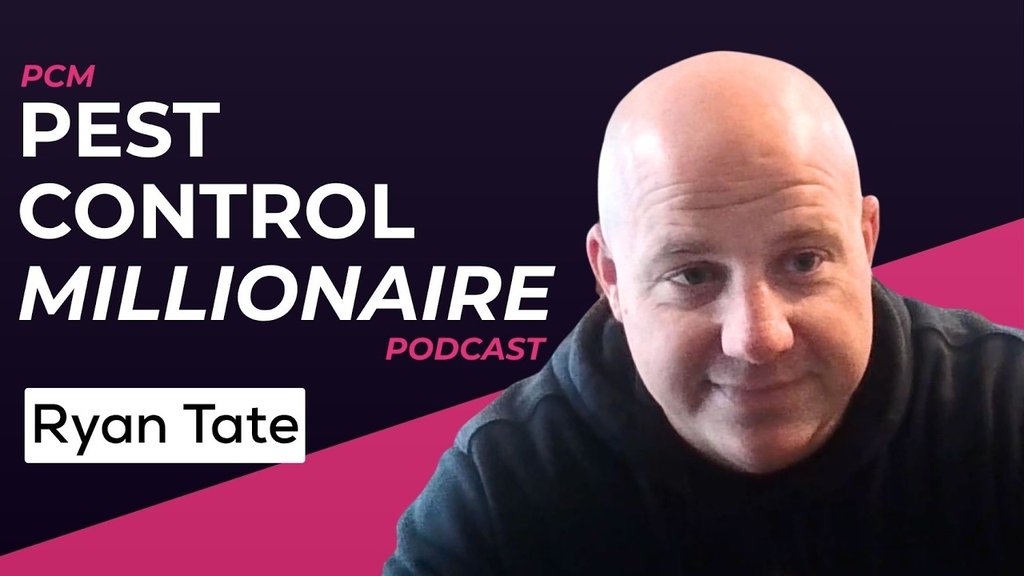
Table of Contents
- Start as a tech and learn to sell
- Don’t be the smartest guy in the room
- Think like a businessman, not a bug man
- Grow your people before you grow the company
- Bet on yourself before 40
- Build on builders, but don’t stop there
- Make your customers hard to steal
- Count new customers for every cancel
- Frequently Asked Questions
Ryan Tate is a partner at Rogue Pest Solutions and leads its market in Huntsville, Alabama. Rogue started in Birmingham in 2017. Before he joined it, Ryan was at Waynes from 2014, where he went from a supervisor in Huntsville to vice president of operations while the company grew from $8 million to $28 million, and then, after Anticimex bought it, to $88 million between 2019 and 2023. At 38, he walked away to bet on himself.
Rogue did $1.8 million in 2023. When this episode came out in March 2026, Ryan expected about $6.5 million for the year, most of it built on one lead source, home builders.
This episode is part of the PCM Podcast. For more on what changes when an owner stops thinking like a technician, read why pest control companies get stuck at a million dollars.
Start as a tech and learn to sell
Ryan played a year of junior college baseball just north of Nashville before his arm gave out. His dad, the general manager of a car dealership, gave him a summer selling cars, then told him to go find something else, because he didn’t want his son always at the dealership and missing his kids’ ball games. A friend said pest control paid about $28,000 a year, which sounded like a lot of money, so Ryan jumped in a truck.
He was a tech for two years at Kirkland’s Pest Control, a fairly large regional company, then moved into sales, sales management and branch management. He’s honest about the sales part. “I wouldn’t call today what I did back then sales,” he said. He was an order taker. The company had a great name and sent him warm leads, and he sold termite, pest, mosquito, crawl space encapsulation and attic insulation off them.
Don’t be the smartest guy in the room
By 2013 and 2014, Ryan had the entrepreneurial itch and was looking at businesses for sale on Craigslist. One deal fell through because he couldn’t come up with the money and the seller wouldn’t finance it. Around then, Shawn Hollis, who ran Waynes branch in Huntsville, walked into Ryan’s branch asking for a sponsorship for his daughter. When we recorded this, Shawn was the president of Waynes, which Ryan says is a $100 million company, and one of Ryan’s mentors.
Shawn told him about a supervisor job, and Ryan was blown away by the people he met at Waynes. “They weren’t bug men. They were business men,” he said. A man at his church had told him that who you become is a combination of the books you read and who you hang out with. At his branch, everyone looked to Ryan for the answers, and you never want to be the perceived smartest guy in the room. So he kept calling Shawn until he got hired. “Look, man, this is how much money I need to make. Get me there and I promise you it’ll be the best thing you ever did,” he told him.
Waynes was owned by an accountant. As supervisors, they looked at P&Ls, talked about churn and were responsible for growing their own business. Ryan learned to know his numbers and how to change them, not just read them. “I got to cut my teeth spending somebody else’s money,” he said.
Think like a businessman, not a bug man
Ryan was at a best practice sharing event in Tampa a couple of weeks before we recorded, and he could hear it in the conversations of the owners at $500,000 and under. Great guys, servant-hearted, excellent bug men who know more about the biology than he does. “They’re just not business mindset,” he said. Most people get into this business to kill bugs and serve people, and nobody signed them up for the rest.
At some point, the owner has to put people in place to lead the $20 to $40 an hour work so he can do the $100 to $1,000 an hour work. “I think what limits us is we work in the business too much not on the business enough,” Ryan said. I’d add the other half. The difference between one service company and the next is the people.
Grow your people before you grow the company
Ryan’s rule is to grow yourself, then grow your people, and challenge them to read, ask hard questions and come with solutions instead of problems. Investing in people early means the company lags at first. “But when you finally get to the place that you break through,” he said, what could have been a bottleneck “ends up becoming this huge funnel that allows you to blossom and grow when you’re ready to do it.” Get people on the bus first, then in the right seat, then keep pouring into them. He saw it in Huntsville, where people who worked under him became regional vice presidents, and a former technician went on to take the vice president of operations job Ryan left.
Rogue’s pillars come straight from that. Service comes first, serving employees and then customers. Then safety, then giving back to the community and to their own people. “We’re ultimately in the people business,” he said. He delegates even when someone does the job 5% worse than he would, and coaches them until one day they do it better than him. “If you want people to follow you, model selflessness,” he said.
Bet on yourself before 40
Ryan watched his dad, a devoted manager his whole career, hit a ceiling around 35 and stay tied to a desk. Ryan wanted freedom of time and money. “I wanted an influence building tool and a wealth building tool that was not capped,” he said.
Leaving Waynes was one of the hardest decisions he ever made. His best friends were his bosses and the people who worked for him. But he was 38 with 40 coming, and he figured he needed a decade. If he wanted to spend his life from 50 on doing what he felt called by God to do, he had to get busy now, or somebody else would be telling him where to go from 50 to 65.
He did it the right way, with an exit plan he worked out with Shawn, the right people in place and a non-solicit he honored. While he waited it out, he spent about six months consulting for small companies with a friend who had been a CFO in the industry.
What scared him most about going solo was getting stuck in a truck with no money to hire anyone. Then Rogue’s founder called. He had been Ryan’s boss at Waynes, the operations manager, until he left to start Rogue in 2017, and he and his partners, all Waynes people Ryan had worked with, wanted to be in Huntsville and Nashville. They laid out a plan for the next 10 to 15 years, and when Ryan’s best friend, Waynes vice president of business development, decided to join too, that was it. “It has been a NASCAR race ever since, but it’s been a NASCAR race kind of on a gravel road,” Ryan said.
Build on builders, but don’t stop there
Rogue’s founders grew slowly from 2017 to about 2023, aiming for a $1 million or $2 million business in Birmingham that didn’t need them every day, and they saved the cash it threw off to invest in people. Then came the chance to chase home builders.
The model works like this. Rogue does Sentricon for the builder, turns that into a termite contract with the homeowner and then cross-sells pest and mosquito control. The partners’ builder relationships go back more than 20 years, and you get one builder, then another. If things went right, Rogue expected 7,000 to 8,000 new construction homes in 2026, a little more than in 2025. Matt Railla found the same opening in new construction pre-treats out in Southern California.
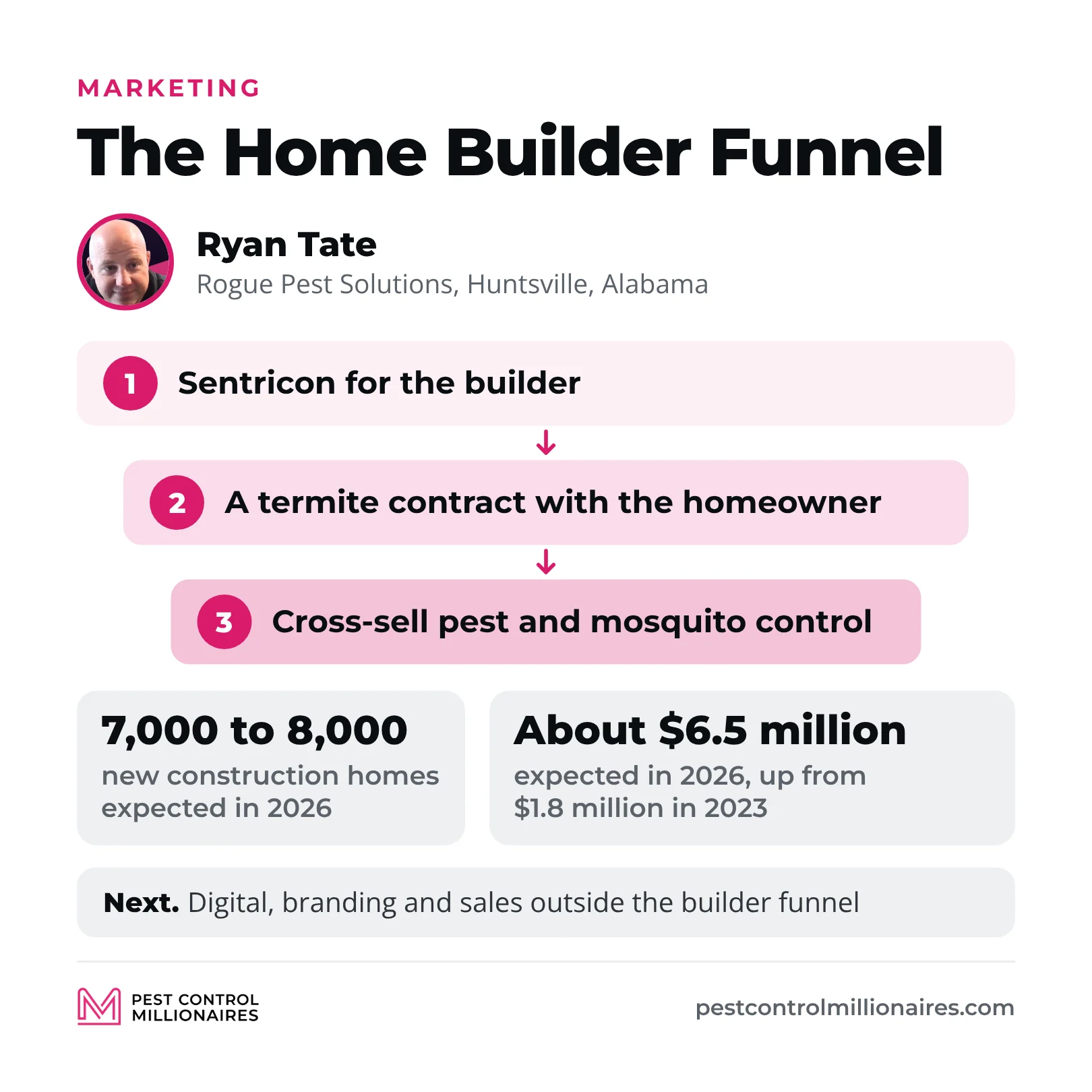
Rogue’s revenue is spread across a lot of recurring customers, but its leads aren’t. “Our marketing source is very siloed,” Ryan said, and they don’t want to wait too late to fix it. The plan for 2026 and 2027 was to invest in digital, branding and sales outside the builder funnel. At Waynes, the first sales budget he built with his best friend was $7.5 million and the last was $32 million. “There is not one lead silo that will feed 32 million,” he said. You better be good at 10 different things.
Ryan was learning marketing from our book, Zip Code Kings, so nobody can dupe him when Rogue has real money to spend at $10 million, $15 million or $20 million. Here’s the growth hack I gave him. On day one, tell your agency to show you everything it does, in a meeting once a month or once a week. You learn the whole time, and if you ever bring it in-house, you already know how.
He knows the other gaps too. Rogue is great at operations and at closing builder leads, but not at marketing or cash flow, so in the next 18 months they wanted a CFO-type person and an in-house marketing leader at the executive level.
Make your customers hard to steal
New construction neighborhoods are where door-to-door companies knock, so they hit Rogue’s homes first. Rogue starts with a good process the moment a family moves in, making sure they know they have Rogue’s termite coverage and then layering on other services.
The real defense is the technician. Ryan heard some of the golden door guys put it this way. If a homeowner can’t name their pest control company, they’ll probably steal it. If the homeowner says Rogue, there’s still a good chance. But “If they tell me, ‘Oh, I don’t know, but Jim’s my guy,’ you’re not stealing that customer,” Ryan said. So they send the same person every time and build a relationship so the customer won’t fire Jim.
They also warn people that a thousand reps will knock on their door, and to call Rogue with any concern. They know the cancellation email the door-to-door companies send, and when one comes in, they offer one more free reservice to fix whatever the customer thinks is wrong. If the customer still goes, Ryan doesn’t fight. He invites them back when their agreement ends. “Fighting and arguing with customers is a losing proposition,” he said. I agree. These sales reps are good, and you won’t save every one.
Count new customers for every cancel
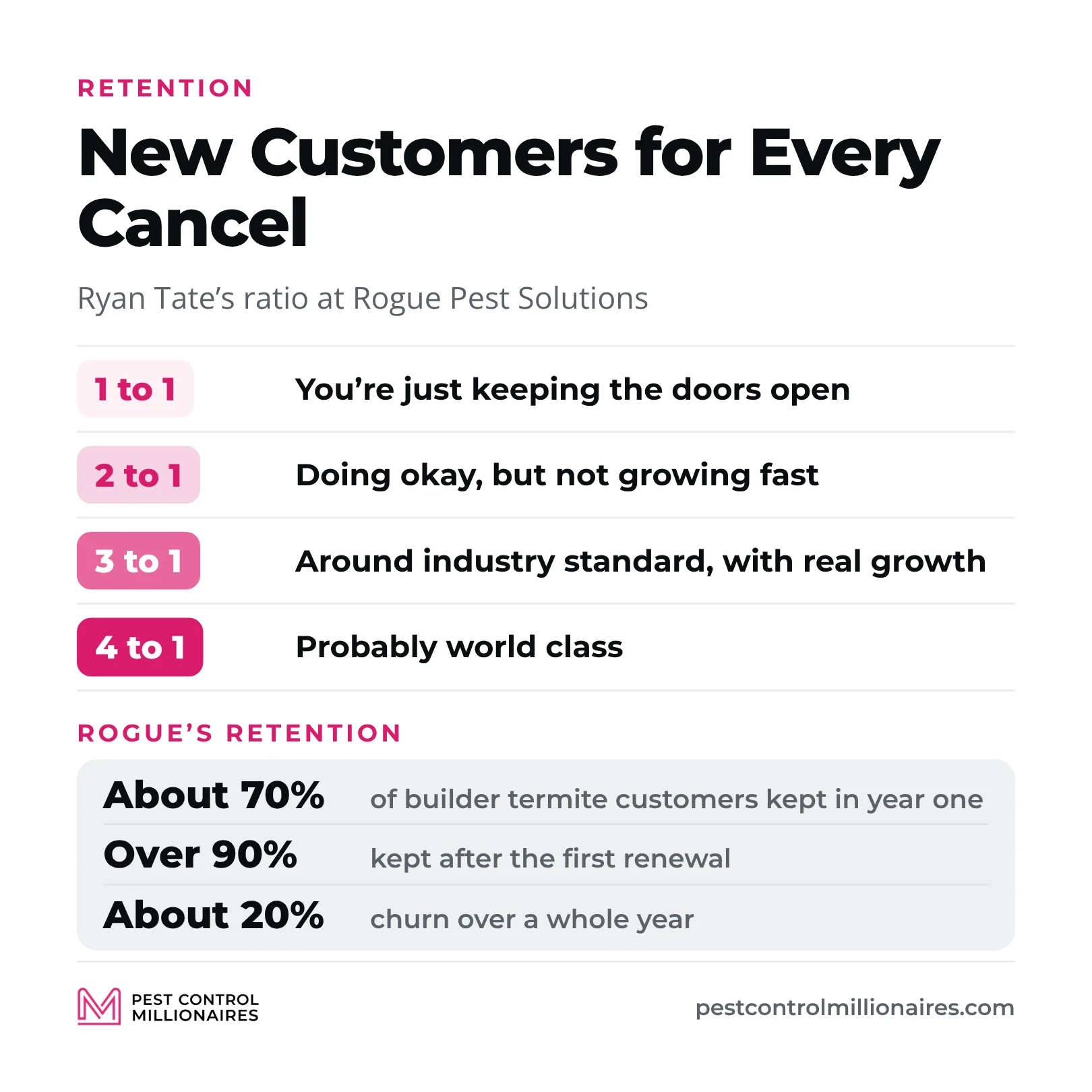
Builder termite customers drag down Rogue’s first-year retention, at about 70%. Once they renew the first time, they stay over 90%, because termite contracts are sticky. Over a whole year, Rogue hovers around 20% churn, which is about the industry standard.
Churn is hard to move, so Ryan shifted his focus to the ratio between new customers and the ones he loses. One to one, you’re just keeping the doors open. Two to one, you’re doing okay, but you’re not growing fast. Three to one is around industry standard, with real growth. Four to one, you’re probably world class. And if you focus on service, he said, retention kind of takes care of itself. Our pest control KPIs guide has how we track cancellations by tech, route and branch.
At Pest Badger, predictive analytics changed the game. We flag the customers who look like past cancels and automate the response. Ryan built Power BI dashboards at Waynes down to the technician and route level, but at Rogue it was still manual, until a customer who works in data analytics for an Ivy League university offered to build it.
In Huntsville, growth had been 50% to 60% a year with very little EBITDA, and over the next 18 months Ryan wanted it closer to 30% to 40% so the margin could climb. Birmingham was closing in on $3 million in 2026 and throwing off cash, and he credits the founders for doing the hard things in the first five years. If you’re in a big organization thinking about going out on your own, Ryan has one warning. The marketing team and the finance team you can call today won’t be there. It’ll all be on you.
Frequently Asked Questions
Who is Ryan Tate of Rogue Pest Solutions?
Ryan Tate is a partner at Rogue Pest Solutions and leads its Huntsville, Alabama, market. Before Rogue, he worked his way up at Waynes from supervisor to vice president of operations. Rogue did $1.8 million in 2023, and when his episode came out in March 2026, he expected about $6.5 million for the year.
How do pest control companies get customers from home builders?
Rogue does Sentricon for builders, turns that into a termite contract with the homeowner and then cross-sells pest and mosquito control. The builder relationships go back more than 20 years, and Rogue expected 7,000 to 8,000 new construction homes in 2026.
What is a good ratio of new customers to cancellations?
Ryan Tate’s rule of thumb is that 1 to 1 just keeps the doors open, 2 to 1 is okay, 3 to 1 is around industry standard with real growth, and 4 to 1 is probably world class. He says if you focus on service, retention takes care of itself.
How do you keep door-to-door reps from stealing your customers?
Send the same technician to every service so the customer knows them by name, warn new customers that reps will knock and over-promise, and offer one more free reservice when someone cancels. Never fight with a customer who leaves, and invite them back when their agreement ends.
Full transcript
Every word of the episode, from the video captions
Building the business turns you into a different kind of human being. Realize that failure is a part of the journey. I think there's hope out there for all of us. They say procrastination be the assassination of destinations. That's why we out here grinding with no association. We'll hate us then them other crabs trying to put us down. Pest Badger's in the house, boy. Don't clown. Welcome back to another episode of Pest Control Millionaires. Today we got Ryan Tate. He's from Rogue Pest Solutions. I know you guys have multiple locations, so we'll get into that a little bit, too. But yeah, thanks for being with us here today and thanks for also sharing the same haircut. I love it. Absolutely. You know, it wasn't by choice, but we'll roll with it. Yeah, funny enough, like I had planned to go overseas and get transplant done.
And then I was sitting down with my mentor and a couple of friends. We were at a lake together. And we were talking about wearing hats, and I always wore a hat. I hated wearing hats. And Jonathan's like we were talking about hats. He's like, "You hate wearing hats?" I was like, "Yeah, I hate it." He's like, "Well, why do you wear a He's like, "I was I used to have a receding hairline." He's like, "L- Just shave your head." And I was like, So, we were at the lake and we went to Walmart and I was like, "Yeah, at 11:00 at night, grab some some clippers or whatever." And then came back and we all shaved my head. And they're like, "Damn, you look really good." And then everyone went back. So, now everyone's like, "I can't imagine what you look like with hair." So, it's really strange.
Yeah, I should have given up on my hair a few years I look back at pictures and I'm like, "What was I hanging on to there, you know?" Yeah, felt the same Wish I'd done it years ago. But funny enough, just pretty pretty cool. So, but yeah, I was going to go get transplant done. I had it all planned And then clearly I didn't go. And now I would never even never even consider it. But real quick, I always start the podcast this way. Which you probably Ryan and I are, you know, sophomores, junior in high school. Who was Ryan Tate in high school? Yeah, so I listened to the podcast, so I knew it was coming. And so I thought a little bit about it, and you know, I played a lot of sports growing up. Real competitive with sports, played multiple sports. And in high school, really started focusing on baseball.
Spent my whole high school years, you know, at a baseball field, you know, practicing, playing, taking BP, working on being a better catcher. I was not very athletic. I was not not very talented, so I had to work really hard. So, I pretty much spent my time at the baseball field or hanging out with who is my wife now, who's my high school sweetheart, who I who I married. But yeah. Really? You married your high school sweetheart? Yeah, well, we actually started dating, if you call it dating in the seventh grade, in the seventh grade. Unreal. Crazy.
Long have you guys actually been together? So, that was 2001 when we were seventh, eighth grade, so since then. So, we've been married for 17 years, and been together for 20 plus, so yeah. Wow. Do you guys have kids together? Yeah, we got four kids. Oh, yeah. Boys, girls, what do you got? So, I got three girls. The youngest girl is eight. My next daughter is 12. My son is 14. And then my oldest daughter is 16. So. We're in the middle of it.
You're busy. Yeah. For sure. How do you How do you manage both, you know, the wife, kids, work? How do you manage that? I think empowering good people to do their jobs and do it right, so that you can take the time to, you or to be a good dad, being a husband, prioritizing those things first and then kind of working your calendar off of that, I think is super and super important. Make sure you prioritize things right. So, having four kids, you know, for me it's my relationship with Christ first and then my relationship with my wife, my relationship with my kids, and then business stuff comes after that. I think keeping those priorities in line helped me a lot. Love that. Are the kids Are the kids in sports? What do they do for So, yeah, oldest daughter's into tennis. Son's just transitioning out of middle school into high school, so he's stopping playing all the sports and just going to focus on baseball.
My middle daughter is a basketball and soccer and my youngest daughter's gymnastics and dance. So. Sounds very familiar and it's just every night something. Like tonight I have dance for my youngest and then wrestling practice for my middle child and just my oldest my oldest daughter she just got done with wrestling season for high school. She'll get into like club wrestling here in a couple weeks, but yeah, she We just left Detroit. She placed fifth in the state. She lost She lost twice by a total combined points of three points. She was one point away from making the finals as a sophomore, so it's so much fun. I just I absolutely love watching her. The kid shines. So Yeah, you think you're passionate about sports when you play Oh man.
And then your kids start playing sports and you're like there's a whole 'nother level of excitement and fear sometimes, you know, for your kids, you know, and you know, a love for seeing them grow, seeing them work hard and that's what I've always tried to tell my kids. I As a person who wasn't very talented from an athletic standpoint, I felt like it just taught me to work really hard and how to lose, how to win in right way, how to show up the next day no matter what, and you know, if my kids can learn that through sports, I feel like I've won as a dad. Yeah, I agree with everything you just said and sports, tennis or tennis is another one, individual sport, you can't rely on anyone else but yourself. Baseball, you know, it's a little bit more of a team sport, but wrestling, tennis, like it's all on you. You got to you got to learn to win, you got to learn to lose and be good at both, you That's how I always told her, too, like I don't care if you win or lose as long as you go out there and work hard and try your best, I'll be proud of you know? And there's obviously that competitive side that you know, when if she does lose, I'm like just I'm mad for a little bit, but I don't show her.
I've tried to do I've tried to get better you know, as a leader or coach for her is be more of a dad this year and less of a coach. I try to separate that a little bit and now of course I coach here and there, but she has a coach, you know? So, I just try to be more of a dad there to support her, just let her know that I love her no matter what and it's been she had a good year, so it's been fun to see. I mean, I man, I could go on and on about this sport. But yeah, you're right, like it teaches you so much. So many life skills. Yeah, so many life skills and as a as a dad, what you just said, I would I would tell people to do as early as they could, you know, my son, I quit coaching him at 12 and I just realized I needed exactly what you're saying. I was always his baseball coach, coached him in travel ball, coached some of the school ball stuff it put an added a bit of pressure. I'm glad I did it.
It was really fun to go out there and compete with him, but it seemed like it put more pressure on at the time when, you know, friends would talk about dad and playing time, that bothered him, so it's been really good the past 2 years just being dad, you know, just being his dad in the stands, rooting him on, you know, help him understand maybe how he could do things a little differently to be better, praising for what he's done wrong or I meant for what he's done right, but at the end of the day I think just being able to be in the stands and be dad has been a breath of fresh air for me. And probably for him, No doubt. Yeah, I agree. And then with with her, too, I just like And I still sit on the sidelines as coach. I'm coaching while she's wrestling. But like I just remember like looking back like I'd get so upset if she'd lose and then I got I probably have like a bad reaction on the mat where I was proud of her cuz she wrestled good, but like the competitiveness in me just would shine through first. And so I've learned to get better at that where I just don't let her show that makes me mad or let them upset in the inside.
Although I'm probably dying on the inside if she loses by one point. Like she wrestled so good. I'm so proud of her. Like I just don't let that stuff shine through But I'm still human, you know what I mean? Like of course I have emotions and I just try to get really good at controlling my emotions in front of them now. Something I had to learn, too. So I think just a phase that we probably all go through coaching our kids and just letting the coach really do his thing, you know? For sure. No doubt. Circling back to high school days. You played sports, played baseball. One thing you said that that I really like, too, is that your son is transitioning from, you know, all the sports just focusing on one. And then I told my daughter I tell all my kids that. I've told my stepson that for years. He didn't listen. Told my daughter my oldest daughter for years. She hasn't listen.
It's like if you want to get good at one thing, you want that one thing to be your sport in 2026, that's just what it takes. You have to go all in on this one thing. And I get the other side of it. Like they just want to be with their friends and they want to like learn and play everything. Like I get that. There's nothing wrong with it. I'm just saying if you want to go to play at the next level, D1, D2, whatever, like you're going to have to do this full-time. It's just what it is. It's just kind of like in business. You just do a thousand different things and you don't you know, you don't focus on one or two. You're just not going to be very good at any of them. So, I tell her the same thing with sports. So, I think she's like, "Dad, I'm not going to play I'm not going to do track this year. I'm not going to cheer this year. I just want to wrestle all through a long like Finally, as a junior we're getting somewhere. But, she like I kind of like made it her idea at this point, you know, I can only teach tell her what to do so much, but if you like just keep instilling things and like watching them watch like see you lead and what you preach what you talk about, and then like they make it their own idea, then it's easier.
Like, "Oh, yeah, I can go do this." Way more fun. So, I like that you said that. Really Hold up. Quick pause. If you're on a pest control company or fertilization weed control company and you're not in our Facebook group, you're choosing the harder path. Every operator that's in there is skipping years of mistakes cuz people are actually sharing what's working right now. So, stop trying to brute force your way through growth alone. Search Pest Control Millionaires on Facebook or click the link below. And now, let's get back to it. And then going back to you played sports, what happens after high school? Where do you go from there? So, after high school, I got the opportunity to play a little college baseball at a junior college in just north of Nashville. Played there for a year. Ended up having some arm trouble, but you know, it was a transition for me. I felt like I was always told I would never get a chance to play college baseball, and so that was like my that was it, right? That was the goal. And once I got there, it was like I've kind of achieved the goal, so I kind of goofed off a lot.
I probably wouldn't have got to play either way anyway. I was pretty self-aware that I could be a bullpen catcher, but probably wasn't going to get to play much, so I turned into more of the you know, the team clown, kind of enjoyed the time, enjoyed being there for that year, then had arm trouble, and my wife needed to needed to finish up her master's cuz she was a year ahead of me a couple years ahead of me in school, and she got done with her bachelor's, and that's when I was like, "Look, I've got arm trouble. I'm not going to rehab it to go back to school and try to play. It's just too much for, you know, not worth the squeeze kind of deal. And so, that's when I jumped in a in a bug truck. And after jumping into that bug truck, got to the place that realized I loved pest control and kind of kind of went from there. So, right out of college, jumped in a truck just to make a little bit of money and there there you have it, right?
Cool. What did your what did your wife have her master's in? Where'd she go to school for? So, she's a speech therapist. So, she had to get her master's in order to actually fully function and do her job. So, she's a speech therapist in a school setting. So, yeah. Yeah, she...
So, then how do you find the bug truck? Or how does it find you? Like, where do you come across pest control? So, when when I quit playing baseball, my dad, my whole life, had been a general manager at a car dealership. And so, during that time, me and my wife were like, "Hey, we want to get married. We're ready to get married and start that chapter of our life." She needed to finish her up schooling. And so, my dad was like, "Hey, why don't you come to the car dealership and just for the summer before you get married and let me help you make as much money possible as a sales person." So, I get there and I did I remember getting my first commission check as a sales person and sending it to my wife, who was then my fiance, and being like, "I cannot believe I just made that much doing what I just did. I'm never leaving the car business." And we ended up getting married, got back from our honeymoon that summer, and my dad basically told me, "You know, I don't want you to be stuck in the car business your whole life.
You need to go find something else to do." Which is so thankful that he did that, that he said that. He worked really hard. He made a lot of good money in the car business, but he was always at the dealership, right? And so, he I don't think he wanted that for us. He didn't want us having to miss those ball games with our kids, miss that time. He wanted us to do something else. So, he kind of kicked me out of the nest and we had I had a friend that was a pest control guy and he was like, "You can make about $28,000 a year." And man, that sounded like a lot of money to me at at that time to jump in a truck and begin to do that. So, that that's how I found it. A friend of a friend kind of referred me and before you know it, I was doing pest control. So. So, you did you start as a technician or a sales guy? It's funny cuz when you when you brought up car dealership, the first thing I wrote down was car dealership and then then I wrote sales and circled it so I didn't forget to circle back to that.
Then all of a sudden you said, "Yeah, come into car dealership." The first thing you got was sales and got a commission check. So, you going to get into pest control and then you start as a tech or do you start as a sales guy? What do you do? No, I started as a tech for my first 2 years. One of the owners of the company was kind of still filling in roles. Fairly large regional company. It's a really cool story actually. That place that I started at, I ended up going to Wayne's later and we can talk about it later, but we ended up purchasing that company that I started at, which was a really cool moment in my career. But anyway, one of the owners, you know, trained me to be a technician, rode along with him. Then I was a pest guy for 2 years and transitioned into sales with them and then to sales management and then to branch management and then that's when I made the to Wayne's in 2014, which is regional company here in Alabama.
Big. Yeah. Big company. So, you're a technician for a year 2 years and you go be sales guy. What was that transition like? Was that a hard one for you? No, I don't think it was hard for me. One, I'd done a little sales. I was good with people, but if I'm honest with you, Jonas, I wouldn't call today what I did back then sales. Like I was a I was a order taker to be honest with you. I That That business produced a lot of leads, and you just had to run the leads, right? Ev- Then, you know, the mentality in the industry was, you get a lead, you give it to a good salesperson to go out there, you know, it's a pest control lead, you go you go out there and you try to sell them termite, you try to sell them pest, you try to sell them mosquito, you look in the attic, you know, we did encapsulations in the crawl space, and we'd look in the attic for insulation.
So, it's really selling a bunch of big ticket, you know, one-time sales with the smaller recurring stuff stacked in there, but it was a lot of really warm leads. The business had a great name in the community. So, I really could I wasn't a great salesman. I really wasn't. I just I just ran the leads and treated people well and made a decent living there. Nice. That's cool. And then, what made you switch from that company into Wayne's? Just an opportunity that came up? Does it be regional? Walk me through that. Yeah, it was it was funny. I had become a the branch manager of one of the branches for for Kirkland's, and it was going really but you know, I had at that point I had the entrepreneurial itch already, you know, that was 2013, 2014, and I was starting to say, you know, I could do this, you know, I could I could run this run a company like this, I could build a company like this, and I began to look you know, back then, Craigslist was a thing, and so people would sell their businesses on Craigslist.
I remember it. And so, I was looking on Craigslist, and I had found a couple businesses and began to talk to them about buying their businesses, and I had run across an ad that that Wayne's was hiring and on Craigslist as well as a supervisor, and at the time, one of those acquisitions didn't work out, you know, they ended up selling to somebody else and I couldn't come up with the money and he wouldn't finance it. So, it was just one of those moments that it kind of fell through and then Yeah, in my mind I was like I had already left and did something else and so that same time Shawn Hollis is the president of Wayne's now, you know, Wayne's is a hundred million dollar company now. He's the president. He's one of my mentors. He actually walked into our branch asking us to sponsor his daughter in something.
And we got to talking and before we know it he mentioned later on he called me back mentioned that job opportunity and just asked me to take a take an interview and to be honest I was just blown away by that organization. Like I met with their owner Steven Splawn one of my current partners who was who ran their their pest control business Scott Sutton Shawn Hollis and then Eric Frye one of the other owners of Wayne's at the time and they were just operating at a really high level. They weren't bug men. They were business men and that just really blew my mind. I was like that's who I want to be. They also did it in a way that put people first and like put people over profit. Profit's important because if there's no money there is no mission, you know, but they just were operating at such a high level that I was like immediately these are the type of people I want to hang around and you know, I was reading a lot then.
I was thinking a lot then and I had a guy that I knew through church that had told me that your you know, who you become is a some combination of the books you read and who you hang out with and I left that meeting at that barbecue restaurant thinking if I'm going to level myself up I need to be hanging out with people like that. And at Kirkland's, I had a I felt like people everybody was looking at me for the answers. And you never want to be the perceived smartest guy in the room. And I felt I felt like I was I was at that place and I didn't like that. And so I was blown away by those guys. And so I just bugged Shawn until he hired me. You know, he was the branch manager here in Huntsville. I was going to be the supervisor. And I was like, "Look, man, this is how much money I need to Get me there and I promise you it'll be the best thing you ever did."
And I stayed consistent calling him and calling him. Finally, he hired hired me on there. And you know, the time that I spent at Wayne's in that Huntsville, Alabama service center, we built something really cool. And I look back on those times. And we had some studs in that service center. People that are, you know, regional vice presidents for for Wayne's and at at other companies that were working in under me at that time and with me. We got to pour into those guys and see them grow, see them level up from technicians to supervisors to branch managers. When once Anticimex bought us and then now like even seeing one of those guys go from technician when I got there to now he took my seat as the regional manager and he's the vice president of operations there, which is the role I was in when I left. And it's like, man, that's super rewarding. So I look back at that time at Wayne's in that service center.
And I got to cut my teeth spending somebody else's money. And I learned so much doing it. Couple questions out of there. What do you think the difference is, in your opinion, from the company not maybe not so much the company you came from, but companies that are smaller size and you go to a bigger organization. What is the difference between those two people? What is the What is What is the big thing that you can take away? I think you've got to stop thinking about pest control and killing bugs and you got to start thinking like a businessman. Like if I could say small like I was at a best practice sharing event in Tampa a couple weeks ago and in the room you could hear the conversations of the people that were 500 and smaller maybe. Great guys, servant hearted guys, excellent bug men, know more about the biology and the logistics of running around and killing a bug than I do for sure, but they're just not business mindset.
They don't have that business mindset and I think that that transition is hard. Cuz most of the people who get into this business I think get into the business because they're getting to kill bugs...
From Orkin, they came from Terminix, they're running around, yeah. Yeah, and I think if until you get out of thinking about killing bugs every day and like how to I think we should always try to make our services better. We're there to serve. I do want to do that. I want to be passionate about that, but at some point as a business owner you got to focus on growth and growing your people growing your business, you know, those business principles of making sure that you're putting those people in place to lead the organization and lead the 20 to $40 an hour stuff so you can do the 100 to $1,000 hour stuff and I think that's a hard transition, man, and not everybody signed up for that, right? They didn't they just signed up to kill bugs and serve people and it's hard to make that transition. So people I think that limited mindset have the limited mindset not because they don't want to grow, but because they don't know how to stop thinking about those customer facing things and start thinking of the big picture and at Wayne's you know, it was owned by an accountant and so we were looking at P&Ls, we were talking about churn.
As supervisors, we were responsible for growing our business and I'm super thankful that we were challenged not just to work in our business, but work on the business. So, I guess that's a good way to summarize. I think what limits us is we work in the business too much not on the business enough.
Yeah, and I agree with all that and I think the biggest difference, you know, besides mindset, which is right, is just The level of, like you said, A players that they had at the big corporation and it takes a while to get there to build a forward of people, I get it, but that's the difference between service businesses from one to the next is just the people. Yeah, and it when we talk about investment a lot, I think we talk about, you know, investing marketing investing in ways, you know, sales people, investing in these things that grow our business, which is super vital, super important. Got to invest in yourself, too. Yeah, invest in yourself and invest in your people. That's one of those principles that I believe in. You got to grow yourself and then grow your people. And you got to challenge your people to grow. So, you know, to read, to ask challenging questions, to not just come up with with the problems, but come up with the solutions.
And man, I think when you focus on growing your people, there's a lag on the organization growing. But when you finally get to the place that you break through and what could be a bottleneck if you invest in your people early, ends up becoming this huge funnel that allows you to blossom and grow when you're ready to do it because you've made the investment in the right people at the right time. And that's a constant thing that you've got to be doing. If you put the right people in the right seat or get them on the get them on the bus first, as people say, and then get them in the right seat second, and then constantly pour in, right? If I'm growing, I expect my supervisors, my branch managers, my sales people, my admin perfect Everybody's got to be growing, getting themselves better, taking themselves to the next level.
Love that. What are some What are the you know, a couple of takeaways that you learned at Wayne's that you immediately implemented in your own business? Yeah, I think putting people first and caring about people it is number one. Wayne's, one of the big things that we talked about there was people matter, and I was a big part of that push, and I think that's something that we want to take here is that you know, our our kind of pillars that gird our business. Number one is service. You know, we want to be passionate about service, serving our employees, and then serving our customers. We want to be passionate about safety, and then we want to be passionate about giving back. And that giving back is giving back to our communities, but also giving back to our employees by pouring into them. So, I think that's the number one thing, like I said earlier, is you know, putting people first and realizing that we're ultimately in the people business in the service industry.
And then knowing your numbers, I think it's super important. We were challenged having a CPA as an owner at Wayne's to know your numbers and understand your numbers and understand how to affect those numbers in the right way, not just know them. Love that. It's really cool. And then, how do you walk us through the time period that you decided to leave Wayne's? And you said you already had the itch as an entrepreneur. Tell me where that came from, and then why you ultimately ended up walking away from Wayne's and going on your own? So, the original itch, I think, comes from seeing my dad being the most devoted, hard-working employee and manager at in the car business my whole life, and seeing that, you know, at the end of his career, he was treated really well by the dealership.
Let me start by saying that. But, he hit a ceiling probably around 35 and he kind of stayed there, right? There's this these ceilings you hit when you're working for other And I didn't like how my dad didn't feel like he could control his own day. He was like tied to that desk to run that And I wanted that freedom freedom to make an impact and an influence on the people around me, freedom to you know, to build that influence building it's an influence building tool in my business, but also a wealth building tool. So, I didn't want to be capped out on either one of those, right? I wanted have that freedom of time and that freedom of money that that comes along with being an entrepreneur. So, I think on a baseline level, that's where that came from originally. But, when I decided to make the move, I and which it was one of the hardest decisions ever made. I love the people there. I love the organization. My best friends were my bosses or people that worked for me, people that I had developed lifelong friendships that we still talk to this day and we had we had fought and bled together and you know, Bill Wayne saw it go from 8 million to 28 and then post acquisition from Anticimex, we went from 28 to 88 in the from 2019 to 2023.
So, it was just like it was such a fun ride. It just have a lot of good memories of that. So, it was a really hard decision, but I remember being at the place of getting ready, saw 40 coming. I was 38 at the time. And I feel like I needed a decade. And in talking with my wife about things, I was like, if we're going to do this and we want to have the freedom from 50 on to only do what we A feel called by God to do or B have a huge desire to do for the rest of our lives, then we got to get busy today. If not, I'm going to be told from 50 to 65 where I have to go, what I have to do by somebody else, and that doesn't sound fun to me.
I don't want to live the last, you know, 15 years of my work career that way. That doesn't sound like something I want to do. So, everything was going awesome at Wayne's, but it was just like God said, "Look, it's time for you to make that move. Go bet on yourself." And so, you know, I talked to Shawn about it, and we worked on a on a plan for me to exit in the right way, to make sure I had the people in place to make that move, and so supportive that group was, and like I said, still still some of my best friends to this day that that we still talk a lot, but making that move was really based on, you know, what I wanted my life to look like the next 15 years, and then the fact that I wanted an influence building tool and a wealth building tool that was not capped.
So, how do you find her? What do you do? I immediately need I needed to sit out a little bit of time because of a non-solicit that I wanted to honor. So, there was a payout and some different things that that went on there that I needed to honor that. And so, I did that. I me and a friend of mine, she was wanting to do some some consulting at the time. She had worked in the industry as a CFO and wanted to do some consulting. So, for about 6 months, I went and sold her her services, worked with a couple small companies consulting and, you know, helping them helping them build sales, you know, some sales processes and some different things while waited it out. And then during that time, a guy that I used to work with that used to be my boss at Wayne's had left, and he had started Rogue.
And you know, he reached out and was like, "Look, man, I know you're wanting to do your own thing. It's what you always wanted to do. Let's partner together." And so, those those guys, Scott Sutton, Jamie Tatum, Robert Story, who were the different partners for different branches here at Rogue, all really put on the full court press and said, "Hey, we want to be in Huntsville. We want to be in Nashville. Come on, man. Let's do this together." The backstory is all of those three guys worked with me. They were on the supervisor level or Jamie and Robert was at Wayne's at the time that I was a supervisor there. So, I knew him really well. We had worked together. They knew they were great operators and more importantly, they were great dudes. And then Scott, who's the original founder of Rogue, was the operations manager at Wayne's for me up until 2017 and he left to start Rogue and they just put on the full court press and I was talking to some other people to partner with and then obviously, I was thinking about not partnering with anybody and just, you rolling solo.
What scared me the most about that, Jonas, was just I didn't want to get stuck in a truck. I was so worried about getting stuck in the truck and full transparency, I didn't have the money to hire somebody day one, right? Like if you're not making money as an entrepreneur yet and you're living on money that you haven't made, you know what I mean, trying to survive, you don't have the money to invest in a guy. So, I was worried about getting stuck in a truck. Scott and them put on the full court press and we laid out a plan of what the next 10 to 15 years could look like with what they had already built and what I could add and what that looks like. So, it was kind of a no-brainer at that point because of the relationship I had with them. And then in the middle of all of that one of my probably my best friend in the world, William Booth, who was the I was the vice president of operations at Wayne's, he was the vice president of business business development and we had become very close and he was just ready to leave Wayne's.
And he basically, you know, decided he wanted to leave Wayne's and be a part of Rogue, and so that kind of was the nail in the coffin for what I was going to do, that I could do what I wanted to I could do it with people I cared about, people that were really smart. And then you put on top of it, you add, you know, one of my best friends being a part of the business, it was kind of like, I can't believe we had this team to put together and build, so let's roll and let's do it. And so it has been it has been a NASCAR race ever since, but it's been a NASCAR race kind of on a gravel road. You know, you get loose in every turn, it's a little out of control it feels like cuz you're growing so fast, but man, it's been awesome. Yeah, awesome.
How you guys been growing since day one? Like what did you What did you guys do? Yeah, so we originally Scott and Jamie grew really slowly from 2017 to say 2023, and their focus was to, you know, kind of build up the coffers from a from a cash flow standpoint. And what city location are they in? So they're in Birmingham, that was the original...
Got you. Yeah, and so their their plan originally was to just be a million 2 million dollar business, you know, stay there locally, and be able to, you know, have a good living, and be kind of unplugged from the business, and pour into people, and let them run it, and you know, have that right work-life balance. And then as it began to grow, they began to realize, hey, we're spinning off some cash here, let's begin to put that cash away to invest in people and opportunities growing forward. And at at that time we they started getting opportunity to chase some of the builder partners in our area. And so we have a lot of experience with that as a group that that we do Sentricon for builders and then parlay that into obviously a termite contract with the homeowner and then cross-sell pest and mosquito off of that. And those opportunities started coming for us. And they just kind of snowballed.
You know, all of us have relationships with different people that go back years and you know, over 20 years of doing it. You know, you do it for one builder then another then another and before you know it, you've got a pretty pretty good foothold on it. And so this year things go right, we'll do you know, 7 to 8,000 new construction homes this year. Did a little bit less than that this past year, but that's really our growth model is built around that. Our goal in '26 and '27 is to open up another stream because our business is not you know, siloed. We have a bunch of different customers with recurring revenue, but our marketing source is very siloed. And so we don't want to wait too late to break out of that silo. We want to keep that going, but this year is the time that we really start investing in digital and then some branding stuff and then it's some sales stuff outside of that those funnels to try to expand out of that.
But to long-winded way to answer your question say the builder funnel has really been good to us so far. Yeah, I think Alex Hormozi calls it like key platform rescue. You don't have one platform you get leads from and you just don't want that. It's really cool. I love it. And then from there you know, so you leave, you go start this company with you with your buddies. Really cool. How many technicians are you guys at right now? So technicians we're at like 18, 17.
Awesome. We're we're about to bring on another one. Here in Huntsville I've got I've got four here, but company wide which we all run our business like from the customer facing we're one company. We all have roles for the whole company. So yeah, 17, 18, about 30 total employees right now. That's awesome. Congratulations. He said the goal for next year is that I'm, you know, another another you know, like obviously like a platform for leads like he said like a which is super awesome, which is I think it's a smart thing for you guys to do. But you're in Nashville, which is obviously a super it's a really good market, I should say that, but also it's a very very tough market, too. I think you mentioned earlier before we started the podcast like guys already beating down doors. How do you How do you combat that? How do you compete with that? So, and we feel it a lot because as you know, a lot of folks target new construction neighborhoods, So, because they target new construction neighborhoods, we're it they're coming to our homes first.
And so, we do that first with a with a really good process as as soon as they move into that home, making sure that they understand that they have the termite coverage with with Rogue, and then building that, you know, that that stickiness of the customer by layering on those other those other services and making sure that we have that. And then it just comes down at the end of the day, it's connecting them with somebody that cares about them, and cares about their home, and cares about taking care of them. And then I think that will always be reciprocated back. If you send somebody out to the home consistently, the same person that cares about their home, that begins to build a relationship, then it's a lot harder on the doors to pull that. And, you know, I've heard I've heard great door-to-door sales people and listening to a podcast, some of the some of the golden door guys say, "If they can't tell me if they tell me that they have pest control, but they can't tell me the company, there's a good chance I'm going to steal it.
There's a little bit less of a chance if they tell me, 'Hey, I got pest control and it's with Rogue,' but it's still a high chance I can steal it. If they tell me, "Oh, I don't know, but it Jim's my guy." you're not stealing that customer, right? And so, I think we're trying really hard to build that connection between the technician and the customer in a way that they won't fire Jim. And so, I think that's the biggest weapon we have. And then, knowing what's going on and knowing what they're going to point to, you know, they're always going to point to you got spider webs. They're always going to tell the customer that they're going to over-promise most of the time when there's a especially if there's a huge team, if it's not local guys doing it that are going to be there for a long time. It's just human nature, right? They're going to over-promise.
And we prepare people for that. We tell them, "Hey, you're in a new construction neighborhood. There's going to be a thousand people knock on your door. If you ever have concerns about your service that come up, just call us. And even if you get, you know, somebody on the door tells you, like if we get a call, somebody on the door says, "Hey." And you get the email, like door-to-door people shift to something else. We know We know that email template, so shift to something else, we won't pick up on it as quick for door-to-door folks. But we get that email from the customer that we know, like they give us this certain stuff, we know it's a door-to-door person, we reach out. And we're just like, "Hey, let us end this on a good note. Let us come do one more free reservice for you. Correct those problems you think you have." And I think that's a really good weapon to save that customer. Yeah, no, I agree. And like I said, these sales guys are They're really good. And so, we try to combat it the same way.
You're not going to save every single one of them. But we say the same thing. Like if you just ever have any questions about your service, these guys are coming out. They're really good. And we tell them that they're really good. But they cuz they are. They're very quick on their feet, you know? And these guys are talented. If they and you give them an opportunity cuz it's a it's a spider web. You can clean them off in 3 weeks later they're back, you know? But they're going to use that as a tool just to get them to service that day, you know, or next day. Yeah, and I think that for us as operators, we've got to be at the place that we're playing the long game, right? We're having that long vision.
And I want to keep customers. But it should never turn into a fight when somebody fires you. Like that is a bad way to do business and a short-term way to look at it, because if I'm telling them the truth and they're being over-promised at the door and we are doing everything we can You're never going to see a mosquito ever again. That's right. That's right. That's what they're being told. And so if I'll just be honest, but in being honest, I won't be a jerk and I'll be a good dude and I'll say, "Hey, when you get out of that agreement with them next year, if they haven't been faithful to do and set your and I'm right, come back to us. I'd love to have you as a customer next year." Like I think I think that goes a long way. Fighting and arguing with customers is a losing proposition. Yeah, this happened say like 2 years ago. I seen a bunch of screenshots of people's reviews that they left for a company and the owners is on there going crazy responding to these like I was shocked. Like I cannot I wouldn't be surprised if they're not in business today.
But at the time it was a decent size company and the owner was responding to these reviews and it was wild. Like I can't believe they can do that. So again, like no one's perfect. You're going to get bad reviews. You're going to get cancellations. You mentioned churn earlier. We can talk about that in a little bit. But yeah, good be just be a good human being, you know? It's not that hard. Yeah, at the end of the day there's a human across and look, you know, instead of reciprocating to people the way they treat treat you, But you know, the golden rule is treat people the way you want to be treated. So like, even though person on the other end of the line's not treating me the way I want to be treated, I don't have to reciprocate that, right? Not only is it the right thing to do, but it's a really good decision business-wise, right? It makes a big difference and have that long vision of just because they canceled today doesn't mean they're not going to be a customer in the future. For sure. Did you know, you mentioned earlier about putting people in the right seats on the bus. Do you guys run traction there?
Or is it something that you read or do you guys run it as a company?
I've read traction three times.
We did EOS when I was at Wayne's for a time. We did that. We don't So I personally run a EOS-like system for myself.
Yeah. Yeah, but I don't like I don't I don't even in meetings and this was you know, I heard you talking to Chris about it Chris Locke about it about you running EOS on your own. So I would be even a more step removed from that. I like organize my meetings that I do when I'm leading the meetings company-wide, I organize it by EOS, but I don't talk about rocks, stones, but I don't do that. I just try to follow the accountability model and ask the questions that I would ask, but it's just organically coming from me, but it is a way I use it to keep me focused and put, you know, my meeting agendas kind of organized because I'm ADHD and if I don't do that, Jonas, I'm in trouble. Yeah. Yeah. You mentioned you like to read a lot. What are some good books that you've read recently or that you read in the past that you really like? Yeah, so I would start by saying for for me there's been a couple of books that were really foundational that I that I really loved. The first one was The Richest Man in Babylon. That's a good one. Short read, but it's good. Yeah, short and that's what I love about it. It puts stuff one it doesn't overcomplicate things.
All the principles you learn in there are principles that you probably knew at Like you know what I mean? Like if you're going to invest in something, make sure you invest in people that know about that something like duh, that's common sense, right? But so I think that one is a is a really good one and a short read that that I challenge people to pick up. There's a book called The Noticer that that basically teaches you to show up and be about other people not about yourself. And be able to notice, you know, what's going on with other people and try to care about other people deeply. I've never read that one. That's good. It's a good one. It's a story. It's about a guy named Jones. He's an old man. I have a little nostalgia about that book because it's setting is like the Gulf Coast of Alabama. And so that's kind of where we vacation a lot and so there's some nostalgia there in that book for me, too. But it's just a it's a really good book more of a story form.
It's by a guy named Andy Andrews. Really good book. There good great, you know, I think that that is a great one. On a higher level, Harvard puts out these books that are on strategy and execution that are really good books, hard reads. But if you pair them with the book on you know, by listening to the book, too, you can do a lot. And then Giannamore always talks about the book Thinking, Fast and Slow. Yeah, that's a good one. God and look five reads into that one and I still glaze over for full chapters. I'm like you lost me. Yeah, for real. It's a tough read. Yeah, it's a tough read. But the concept of remembering that you think two ways. There's the reactionary thinking and then there's the long-term thinking about things and learning when to activate one over the other and learning how to get people to stop just thinking reactionary and subconscious and start thinking this way, I think is a huge takeaway from that book.
It's a great book, yeah. Evan Hafernik told me about that book. At Seth Godin's event maybe like 3 years ago, it's first time I ever heard it. And then I downloaded it that day. I think it really I listened to it like shortly after that. I think I've only I think I've only read it twice or maybe one and a half times, but yeah, it was good. But it's a hard read for sure. 10X is better than 2X is another one.
Love that one. Really Yeah, good really good one. I'm just And then this is more from a spiritual standpoint, but I'll throw it out there anyway. You know, other than reading my Bible, there's a book called the freedom of And I would just say that I've heard people say this line a lot that I think this book encompasses. You should show up to conversations and meetings with people trying to be interested in them instead of being making them interested in you. Don't try to be interesting, try to be interested in them. And I think that book talks a lot about that. And just being selfless, and I think, you know, selflessness in leadership is the number one quality that people other than like being being courageous or bravery or having the fortitude to make hard decisions, I think being selfless is something that people If you want people to follow you, model selflessness.
I think the best leaders ever were super selfless. Yeah. It's great. What is your goals for yourself and then for the company for the next year or Yeah, so over the next 18 months, I've been in this growth pattern. We have company-wide, but really here in Huntsville, really in this growth pattern. So, for me, you know, thinking whether you do the rule of 40 or some people call it the rule of 20 or whatever you look at, I don't want to dial down, you know, the number of accounts that I'm growing by, but because my customer base is getting larger now, I want the growth percentage instead of being 50 to 60%, I want it to be 30 to 40% and start seeing that change of that EBITDA margin cuz right now, you know, EBITDA's been super low, growth has been super high.
I want that I want those I want to start that path of those two crossing themselves. And that's where, you know, we're in as a company, we think of ourselves as a full company, but then we unbundle all the way down to the branch and each branch is at a different place. Birmingham closing in on being a $3 million operation this year, you know, they're at the place that they need to be spinning off some cash, right? And they're doing that. And I so I think for me here in Huntsville, I want to continue to do that, right? And then I want us to open up these other These other funnels are so important, this lead these lead flow funnels, in a way that we learn the principles on how to do it, not that we scale them huge, but we learn the principles, you know, taking, you know, the Zip Code Kings book and just learning that marketing, like you talk about in that, learning it at a at a level that gives us the ability to really make decisions as we scale to 10 million, 15 million, 20 million, so that we're not being duped by people in marketing when we have a bunch of dollars to spend as everybody starts showing up with a handout of how we can grow?
And that diversity in lead flow, we saw you know, the first sales budget me and William built at Wayne's, it was like 7 and 1/2 million. The last sales budget we built was 32 And there is not one lead silo that will feed 32 million. Right. You better be good at 10 different things. For sure. Here here's a growth hack for you. Here's a growth hack for you. So, when you hire your agency, whoever you want to go hire out there, tell them with the day that you hire "Hey, this is what I want you to hire you to do, but every time you do this, I want you to show me what you're doing." So, if you're a marketing agency and they're working on your stuff for let's just go with 5 hours a week, I want to be involved with those 5 hours a month. I want to be involved with those 5 hours a month. Let's meet together once a month, whatever that or maybe it's once a week for an hour. Show me everything that you're doing so I know what you're doing so I can learn.
That way you're learning the entire time so that way when you're ready and you're working with the agency, you they're they're transparent about everything, you're learning as you go, that way when you want to go off on your own and do your own marketing, you'll know how to do it already. So, growth hack. No, huge. I appreciate that info because that's I mean, that's what I you it have picked up. You blow me away with how many different things like you're like, "I'mma be everywhere. I'mma I'mma be I'mma be everywhere." And so when people in the service areas I'm in think about pest control, they're going to think about Pest Badger and they're going to call us and trying to trying to understand because if I would, you know, we're pretty transparent. If there's two things that we struggle with like we're great operators here.
We know how to close leads and through one funnel, the builder funnel, we know how to create leads to be closed. Outside of that, we're pretty we're not very good at marketing. And we're not very good at at managing cash flow. So, over the next 18 months, you know, circle back around to the original question about the next 18 months, I think us figuring out the people to put on the that can we learn what we need to learn right now, but really somebody on the financial side, you know, as listening to you with Chris talk about your CFO and that that relationship you guys have. Like we need that CFO type person in the next 18 months, and we need somebody I won't I won't somebody, even if we're still paying an agency, I want somebody internally that can after we learn it, you know, be that marketing expert with us at an executive level as we build out that that top-tier team.
So, those are the two things that we lack. Cool. At least you know, right? You're self-aware. For sure. We got so many problems, Jonas, it's not hard to see them over here. But you guys are new though, right? We're all new, but you guys are just what? You're 17, you know, what? You're You're what? You're 2 years 3 years into this? Yeah.
Yeah. And so, we you know, what's cool is, you know, we $1.8 million in revenue in 2023. And while we're not on the Pest Badger route, we're not growing that quite quite like that, you know, we'll we'll do 6 and 1/2 this year or so. So, the next the last 2 years have just been, you know, we've really seen that growth curve and you know, what? I Our We've worked really hard to make that happen. We've hired a bunch of great people. We've got a bunch of supervisors, sales supervisors, working as sales people. So, they're they're killers that do a great job with our welcome visit process on that end. And we've got supervisors out in the field who are our technicians that were supervisors in you know, past life. And so we do a great job of I think retaining customers and taking care of customers. But as we continue to move forward, we've got to really focus on continuing to pour into that team and growing that team.
And so that's really really going to be our focus and 3/4 of our growth has come in the past 2 years and we look for that to continue. Yeah, I said this a million times on the podcast. People underestimate the power of momentum and it feels like you guys are just starting to get the momentum. So it's really cool. It'll be fun to watch. You guys are going to grow super fast. It just takes a while. Yeah, for sure. And look, I'm super thankful Scott and Jamie, our original guys here, you know, if it hadn't been for them making really good moves from a capital standpoint early on, we would have like they put us in place and put people in place to really rev up, you know, Robert, putting Robert in place, putting William in place, putting me in place, and then the people that we've put in place.
But man, it takes money to do that.
Sure does. You know, we owe a lot to those guys for doing the hard things for the first 5 years so that we could do the It's still hard, but so that we would have the financial ability to go do the growth stuff now. So It's awesome. I really like that. And again, it just says that as the founders, you know, they're setting the foundation for you guys just to keep scaling up. So it's cool to see. So hats off to those guys. But yeah, you guys you talked about a little bit about churn, keeping customers. How How Like how close do you guys watch your So we pre- keep a pretty good eye on it. I would say that anytime you get a you get in a growth pattern, there's always, you know, it's the division of your you only have so much time in the day. So you get in a growth pattern, so you tend to get a little lackluster about that, but we really try to stay on that, and you know, our first year retention hurts us some because after, you know, the first year, say we retain 70% of those termite customers that come to us through our builder funnel, you know, that puts a bigger number of cancellations in the front end, but once we settle that customer in, once they renew the first time, you know, they're over 90% on termites termites are sticky.
So, that pulls us down a little bit, but we're still hovering on that, you know, that 20%. If you look at it for a whole year,...
Industry standard anyway, yeah. I know, and that Well, if I have a frustration in our industry, one of the frustrations is it doesn't I don't seem to be able to move the needle as much as I think I can with the you know, you put this effort in, man, and it churn is a hard thing, so this could be the wrong thing to do, so I'm being transparent saying this, but I've shifted my focus to looking at a ratio between the new customers and the customers lost. And just, you know, thinking of a what is that ratio? Is it Is it one to one? Well, then, you know, you're you're just keeping the doors open.
Yeah. Yeah, you're in a rough situation. If it's two to one, you're doing okay. You're doing okay. You're not growing fast, but you're doing okay. If it's three to one, you're probably getting into the place that your industry's, you know, getting to the place of industry standard, you're putting some some exponential growth in there, depending on And if you're four to one, you're probably world class, right? If you're bringing in four four sales for every you're doing some things right, and but, you know, customer retention but going back to what we talked about earlier, I think if you focus on the service side, the customer retention kind of takes care of itself. Yeah, but again, you can't control, you know, if people are going to move. Can't control if they lose a job. You can't control the level of service that they get. You can control a lot of things, but there's just some things you can't control. I think I don't think, I know predictive analytics have really changed the game for us. Projecting which customers are going to churn, when they're going to churn, how they're going to churn, how to handle those responses right away, and having it all automated have completely changed our business.
Like overnight. So, that's where the world this industry is headed with all the AI tools that we have. Just predicting like, "Hey, this customer looks just like this customer. They skipped the service at the same time." Like all those things that add up like, "Oh, this is the type of person that's going to cancel. This is when they're going to cancel." Contact those, and it's all automated. Changed the game for us. For sure. I You know, in 2000 maybe it was 2017, Jonas. I The years are running together, but we began to build out a data to build out Power BI at Wayne's when we were there. And dude, it was a game-changer. To be able to create dashboards of knowing where we stood all the way down to the technician level, the route level.
It just takes It just takes a while to get there. It just does, you know? Yeah. And we don't have that like we don't have it. So, that's all manual. We are meeting with a person It was really cool. One of my customers who early on, you know, I was still in the field, and one of our customers she worked for a university remotely, but lives here in our area. She worked for like a Ivy League. Super sharp. And I just told her when I was at her house, I was like, "Look, you know, you're working in this data analytics. Like if you ever get to a place that you want to freelance, let me know." And about 2 weeks ago, she reached out via text and was like, "Hey, if you want to I'd like to learn learn how to do some consulting on that. So, why don't you let me build some stuff out for you? So That's awesome. We're beginning to work on it, but it's like everything else right now. Like where am I going to spend my time is the biggest decision I make every day. Like what am what am I going to spend my time on And I can only decide what I'm going to spend my time on if I've delegated properly, if I've trained people that I've delegated properly properly, and I've set my own expectations that if they do it 5% less is well less is good as I did, let them do that.
And then let them learn and coach them and let them grow and one day they'll do it better than me as long as I'm pouring into them in the right way. So we're looking to build that data room and we desperately need that and man it One thing I would say if you're part of a big organization and you want to start your own business, like you got a lot of knowledge to do that, make it happen. But realize that's that marketing team that you pick up the phone and call won't be there. That finance team you pick up and call right now, they won't be there. It'll all be on you. So you got to you know, that's a big transition, too. It is. Sure is. Cool. Well, we'll end on that note. I said we're already going over time, but dude, pleasure to have you here. Thanks for hanging out with us today. Can't wait to see what you're doing in the future. Glad to get to know you and yeah, it's going to be fun to watch.
Cool. Thank you for the podcast for not just having me on your podcast today, but thank you for putting out content that we can put in our earbud, grow, man, it's invaluable the podcast that that you're that you're doing, the other podcasts that are going on in the industry. It's invaluable to us other entrepreneurs. So please keep doing it and we appreciate it. Cool. I appreciate it. And it's cool like all the guys that run the podcast we're all buddies. Yeah. Like we all jump in each other's podcasts. We work together, we collaborate together. Like I was on the Boardroom Buzz, I've been on Bug Bux, they're going to they're on my podcast. Like it's so cool. For sure. We just want to, you know, like it's like again, I said a million times, the rising tide lifts all boats. If we can all help each other win, that's what we're doing, you know?
Cool, man. Well, I appreciate you and talk to you soon. All right, appreciate you. See you guys. Hey guys, thanks for listening to another episode of Pest Control Millionaire. We don't charge any money for the show, but the podcast isn't free. Please like and subscribe and give us a five-star review in your favorite podcast app. This makes a huge difference for us. If you have any specific questions about your business or your personal life that you'd like answered by me or any of my podcast guests, please send an email to And if you want to get in touch with me or about our marketing class, we do a live version every Thursday night. Check out our website at Thank you guys for listening and I'll see you guys in the next one.
Watch the PCM Podcast on YouTube