How Mike Andes Built 214 Locations Without Private Equity

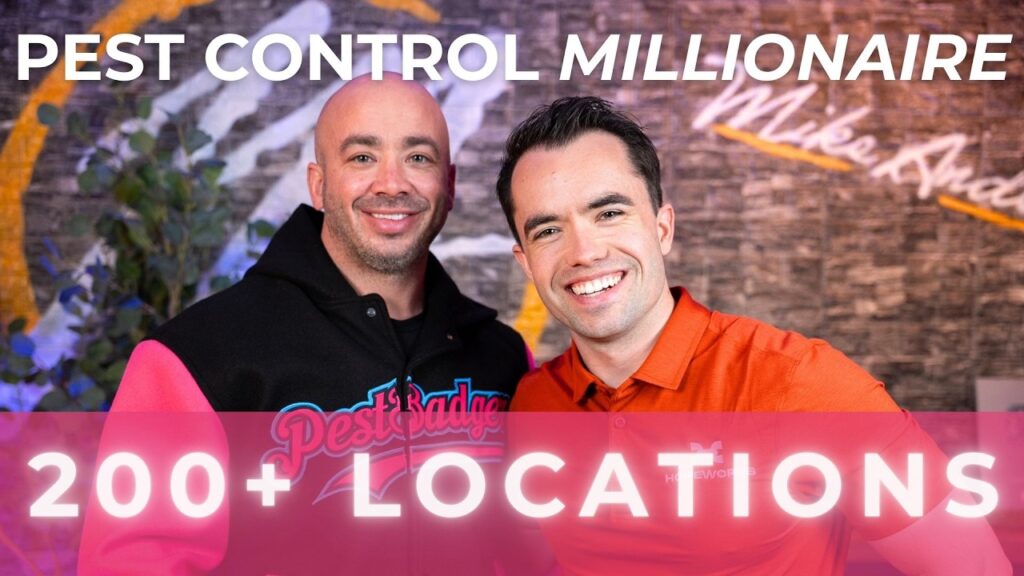
Table of Contents
- 1. Sometimes the first turnaround is you
- 2. Every business has its own flavor of hard
- 3. The first 100 locations almost don’t make sense
- 4. He franchised so he could wear the same uniform
- 5. Most people can’t diagnose their own problem
- 6. Batch your content and aim for quality
- The line I keep thinking about
I drove out to Augusta HQ in Washington to sit down with Mike Andes, who runs Augusta Lawn Care. They have 214 locations now, and in 2024 they did $54 million. He wants to hit 1,000 locations and take the company public.
But the numbers are not the part that stuck with me. What stuck was how he got there. Mike built three businesses at once: media, a franchise, and software. Each one almost broke him in a different way. Here are the lessons I walked away with.
This is part of the Pest Control Millionaire podcast. For more from Mike, see the earlier conversation on how Mike Andes built 150 locations and what he taught me.
1. Sometimes the first turnaround is you
Mike does a show where he flies out and fixes broken businesses, but the first business he ever fixed was his own.
Back when Augusta was doing $700,000 to $800,000, he had no systems and was in the truck every day. One day he was dumping cobbles at a job site. The cable that ran the dump bed had broken, so he had been crawling under the cab to engage it by hand.
That day his hoodie got caught and the machine pulled him in. His arm got stuck, which is the only reason he did not get spun around. The fabric wrapped his neck and shredded it. They rushed him to the hospital because they thought his neck was broken.
It was not, but he could not work for a couple weeks. And in that bed, it hit him. As Mike put it, “everything I learned in my MBA I have not implemented in my business.”
He was lying there FaceTiming his crew about the next job, because they had no training videos. So he wrote down every choke point in the business, every spot where the work could not happen without him. That list became his first content. “The first turnaround was me,” he told me.
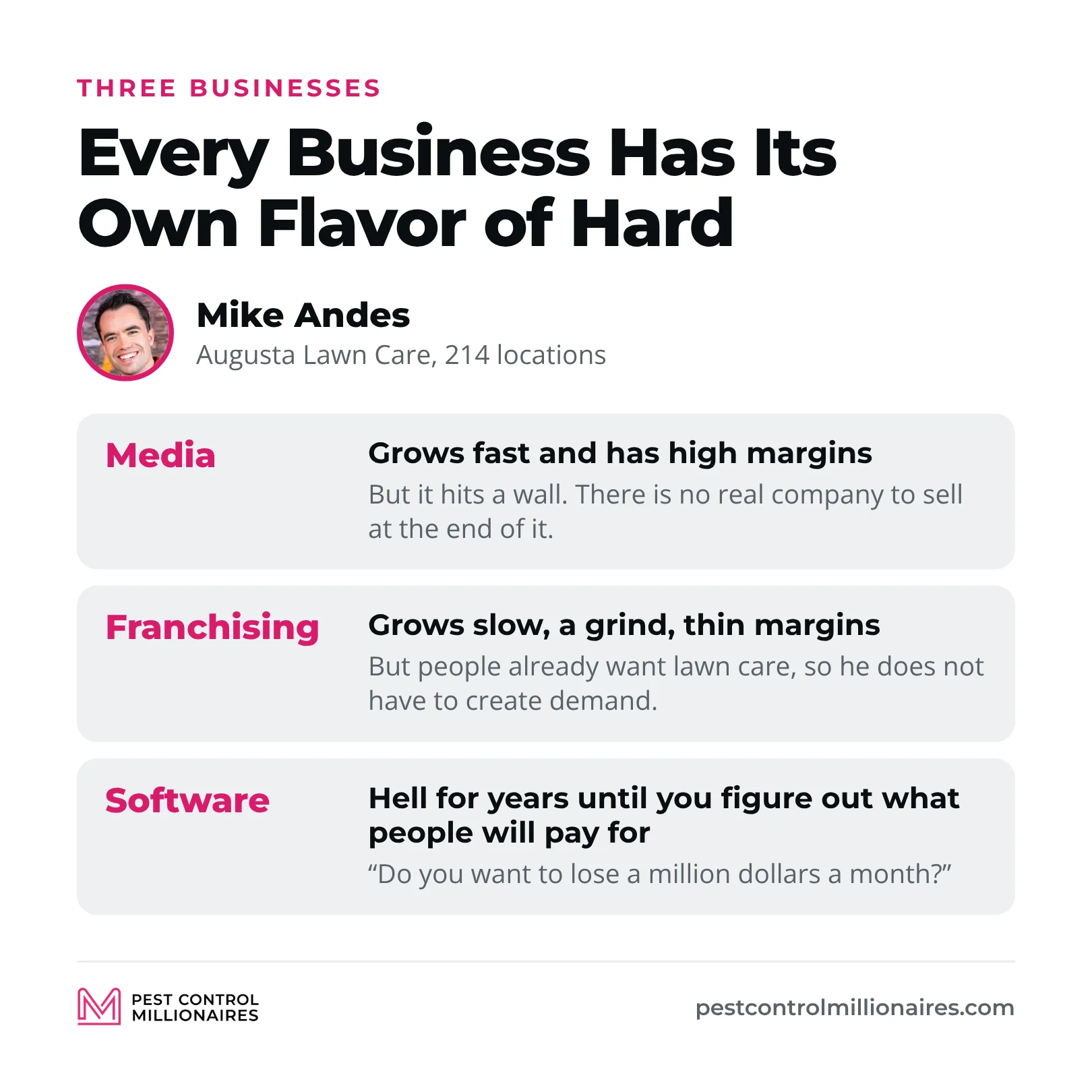
2. Every business has its own flavor of hard
Mike runs three kinds of business, and people always think one of them is the easy one. He says none of them are.
Media grows fast and has high margins, but it hits a wall. There is no real company to sell at the end of it. Franchising is the opposite. It grows slow, it is a grind, and the margins are thin. But people already want lawn care, so he does not have to create demand. Software is its own kind of pain. He says it is hell for years until you figure out what people will pay for.
So when someone tells him software is easy, he has a question for them. Do you want to lose a million dollars a month? And when they say franchising is easy? As Mike put it, “do you want to live in a closet so you can avoid private equity?”
That last one was not a joke. More on it next.
His big point landed with me. As Mike said, “everyone has their version of hard. It’s just a different flavor of hard.”
3. The first 100 locations almost don’t make sense
This was the part I made him explain twice. Augusta charges a flat monthly fee per location, with no royalty. So under 100 locations, the math is brutal.
Here is what he means. His own first location made about $300,000 in profit on $1.5 to $1.7 million in revenue. But he was charging franchise owners around $1,200 a month back then. So to make the same money one location made him, he needed about 20 franchise locations.
And he had to build support for 100 locations while getting paid like he had 20 or 30. Command center, software, coaching, training, all of it.
That is why he lived in the closet of his studio and every dollar went back in. He had people lined up to hand him private equity money, and he turned it down. Instead he told his owners the truth: if we make more money, I make this better for you. That honesty is how he kept control of the company.
4. He franchised so he could wear the same uniform
Mike spent two or three years making YouTube videos to teach lawn care owners. After all that, he had about 2,000 subscribers, and almost nobody listened.
So he figured out why: you cannot change someone’s business from the outside. As Mike put it, “the whole reason we franchise is because I wanted to wear the same uniform as the people I was talking to.”
When owners wear his uniform, they trust that he wants them to win, so they actually follow the systems. That is the whole idea behind getting to 1,000 locations. At that size he can stand next to almost anyone in the industry as an equal.
5. Most people can’t diagnose their own problem
Mike wrote a book with the 13 principles he uses on every turnaround. Good book, but it had one flaw. The owner had to figure out their own problem first.
He compared it to medicine, which he used to work in. People go online and self-diagnose, and doctors hate it. Mike found the same thing with his book. An owner would think he had a sales problem when the real issue was something else.
So he built software instead. He used to call it CoPilot, and now it is Homeworks. The point is simple. As Mike said, the software “will tell you what your problem is, what problem you have, and what to fix how to fix it.” No guessing, and no waiting for him to fly out.
6. Batch your content and aim for quality
This one is for anyone making videos for their business. Mike lives where winters bring 10 to 20 feet of snow, so he cannot film turnarounds then. That is why he batches.
Before fall ends, his team films a bunch of turnarounds at once. They even did an RV trip across the country: ten turnarounds, eight owners, all in a row. That gives them content to release all winter long.
He is also done chasing volume. A small company and a big company take the same effort to film. Same flights, same time. But the big messy ones get ten times the views. So he cut back to one or two turnarounds a month and went after the better stories.
The line I keep thinking about
Near the end we talked about life, not business. Mike got married recently, and he told me he was glad he waited. He splits his life into three phases: grind, build, and thrive. He did not want to be married during the grind, when he was fighting to make payroll.
But the real unlock was something his coach helped him see. He used to think his wife had to be his business partner too, and then he let that go. As Mike said, “I don’t need her to be everything to me.”
That is good business advice and good life advice. You do not need one thing to be everything. Not your wife, not one business, not one product. Mike built three businesses partly because he knows each one can only carry so much.
That is what I took from the day. Thanks to Mike for having me out.
Full transcript
Every word of the episode, from the video captions
Building the business turns you into a different kind of human being. Realize that failure is a part of the I think there's hope out there for all of us.
Here with Mike Andes, it's different because I'm not in my studio.
I'm in your studio. Yeah. But yeah, just you reached out to me a couple months ago and said, "Hey, let's connect." You offered to come see You're like, "Or you can come over here." I'm like, "Wait, I have I have people that live in Washington. I want to check out HQ." So, here I am at Augusta HQ. So, again, I want to start off by saying, "Thank you for having It was fun. Good to see your whole shop or tour. We did get to meet the team. It was cool. But, I just quickly say, "Thank you." man, you have What do you have 200 locations now? What do you know the exact number?
214, yeah. 214? That's cool. 214 locations of Augusta Lawn Care right HQ. Cost 54 million last year. Yep. Oh, well, 2024, yes.
2024? Yeah, the numbers for last year are still coming out. So, we'll figure out. Dang, too [laughter] early. So, what is the ultimate goal? Yeah, like the ultimate goal really is to change lawn professionalism in the industry. Okay. Like the whole reason we franchise is because I wanted to wear the same uniform as the people I was talking to.
Yeah. And I knew it was like to build Augusta and we got to like 7 800,000, but I was in daily operations all the time. I had no systems. I had I got in a workplace accident and realized like, "This is not going to work."
Yeah. And so, I turned around my own business. So, like I we do the turnaround show, but like the first turnaround was me. And in those couple years being able to get the business to where it was really profitable and it could run without me. It had systems in place. And I'm like, "Oh, I'm going to make YouTube videos and people are going to learn about it and it's going to be great." And like no one listened. I think I had like 2,000 subscribers. After like two or three years though being serious trying to like help people and no one's listening. And so I'm like, "Okay, look, there's no way to get like change people's businesses unless A I'm in competing with them or B they're wearing my uniform. And so by us getting to 1,000 locations in Augusta, we can compete with most most of our competition, most landscapers specifically. And then when I say something, the owners know I have their best intent at heart and I just want them to win. And so the adherence to the systems is so much...
Whether be pay for performance or anything we're doing. So like 200 going to 1,000, what's the time frame between Yeah, so I anticipate we'll probably go public in six Yeah, in probably 8 to 12 years. I'm trying to go for six, but we'll see. 8 to 12 is what we've said. And so to go public, but with the software and the media all combined. So we can have like a three-legged Right. Stool. It's like got media, acquisition, then we have the franchise Augusta, and that's really the cash engine. And then the software side Homeworks is the really the valuation. So...
Those three things together is what we think can have something special down the road and really allow us to be able to have a good foothold for robotics. So when robotics come along, I just want to be the number one in that market to be able to really scale that. And so by having Command Center, having the software, having the distribution of all the locations, I think we could scale the robotic side really well. When do you see robotics come out? 10 plus years.
Yeah, we can say that for 10 plus years.
Yeah, exactly. Yeah, so like the technology is there right now, but like we have legislation where on line of sight still that is problematic. But there's several startups that are doing a great job of this. But they can't scale because they're having software engineers in their command center to operate them. But another kind of like intermediary between even full autonomy is having the robot being operated by video. And this is can be done already when I controlled with keyboard on the other side of the city like a mower. Is that person behind that keyboard potentially half the cost of a technician? Yeah. But what's the cost of the of the robot? And can I make the software where it's simple enough to where I can get someone for 15 bucks an hour to operate three of these mowers or get it on autonomy and then when it hits a hits a glitch or a problem or a ball in the middle, I can navigate it manually around it and override the autonomy.
So, there's I think a lot of steps in the in the process. I think a lot of legislation around full self-driving will trickle down into robots. Or...
So, that is that where you see it going? You see like self-driving vehicles pulling your mowers out there, drops the gate, mowers come out, does the mowing by itself, but no one on the site? Yeah, like when we're talking 15 years on the road, I see it as we have a full self-driving vehicle. While that vehicle is in transit, there's a technician that is making sure that things like upsells, the communication to the customer, the ups- like the selling to the customer is taken care of. Yeah. Then they hop out, they're doing the fine-tuning. So, the weed whacking, the blowing, the trimming the bushes, multi- That's not happening with a robot anytime soon. And if you're like, "Optimus." Like, well, yeah, we told we're told self- self-driving was going to be here like 30 years ago. Next year. So, I don't think a like that's going to happen anytime soon. So, I think one My goal is take one technician, but do the work of two people. That's the main goal cuz then we have actual cost savings. And so if I'm mowing if my robot can handle the mower the mowing in the same amount of time that I do the bush trimming or the trimming, the edging, the blowing, then I have a business model.
But there's still some technical things that have to be ironed out for that to happen. Yeah, what's the been the hardest business to scale you got? You said you got Media, you got Augusta, and then you have CoPilot. Yeah. Yeah, so Alex just came out with a video recently that he's like just nailed it so perfectly. Like the media side you can grow very quickly, very high margins, but then you hit this plateau and there's no enterprise value, there's no sellability, etc. There's no but you can't it's all around you. Then like so franchise side, it is a service business. It is much more linear growth. It's a grind. It's not high margin. But it's a service that I can sell for mowing. Like everyone needs a service. I don't have to create demand. So much more linear growth. And I'm still early in the software side, which is as he states like absolute hell for several years until you figure out product market fit and then it can scale and get good margins down the road. And so the hardest one to scale like if I had to say from from the past till now, I would say it's command center cuz it's just so people and even with AI and all the things that we've added with software, it's still the hardest thing to scale.
When you go like this month they're at hiring 40 agents to answer the phone. Training and retention and tracking every word and all the KPIs like that's been the hardest part to scale and do do so in a way that's really top level. Yeah, I would have to agree. I don't know the software part that well yet. But yeah, we talked about this like that's been like HQ's been one of the hardest things for me to so leaning on you for that has been helpful.
As far as growing Augusta, you know, 200 locations and going to 800 locations, walk me through like first 100 then versus the second 100. Yeah, the first 100 was me learning and making a lot of mistakes. Because we have where it's just a flat monthly fee and we don't have a royalty, it's very hard under 100 locations to make sense of it financially. It's like, "Okay, well, my first location is making $300,000 in distributions." It was doing like 1.5, 1.7 million revenue at the time. And I was like, "Okay, so if I'm charging $1,200 a month, which was at time when we started, per location, that means in to be able to get $300,000 in gross revenue, I have to have well, 14, 20 locations. So, 20 locations to get to the revenue of what my one location is making in profit. And that was a tough pill to swallow because I had to build the infrastructure for 100 locations, command center, software, support, coaching, training, all this other But have the revenue of 20, 30, 40, 50.
And so, that's when like I was living in the closet of the studio because like every single penny counted and I was just trying to put every dollar back in cuz like there was always the temptation to go to private equity. And there was plenty of people wanting to give me money for it. We talked about we I asked you that question before. I'm like, how did you how did you get away from not private equity?
Yeah, it was just scrimping and trying to make every dollar count and being open with the owners being like, "Hey, if we make more money, I can do this other thing." Like we just launched this thing recently that cost hundreds of thousands of dollars, but like we can do it now cuz we have the money. And so back then just being very honest with them like, "Hey, like I'm every dollar we make, I'm trying to make this better, but also realizing I have to make it good enough to where new owners want to join." Like why would you join Augusta? And so the first 100 locations were so hard. And it was hard in a different way because like when it came to software and it scaled too fast and I had a bunch of bugs and I had to reinvent the team and redo the whole company. That was different different hard and painful being so cash constrained when we were starting a franchise and doing everything I possibly could for the owners, but also being like constantly like, "I just I just got to make payroll. I just got to get through. Like can I afford this?" And so, it's just every single business has its hard parts and I think everyone when they're looking at other industries like, "Oh, it's so easy.
It's software." It's like, "Okay, do you want to lose a million dollars a month? Like go for it." and they're like, "Oh, franchising is so much easier." It's like, "Okay, great. Do you want to live in a closet so you can avoid private equity?" Like so everyone has their their version of hard and the media side, you know, it's like it's not like it's oh, you just make videos. Okay, you go get your first thousand subscribers. You know how hard that is? Okay, you do it with with business content, not like going out and doing, you know, making tall grass short. Like, that's hard. And so, I think that it's not a matter of like what's the hardest, it's a matter of like every business has hard. It's just a different definition or different different flavor of hard. Yeah, I would agree with all the above.
Hold up, quick pause. If you're running a pest control company or fertilization weed control company and you're not in our Facebook group, you're choosing the harder path. Every operator that's in there is skipping years of mistakes cuz people are actually sharing what's working right now. So, stop trying to brute force your way through growth alone. Search Pest Control Millionaires on Facebook or click the link below. And now, let's get back to it. Let's [snorts] go back to like when you got hurt that day cuz we didn't really talk about that. Walk me through that day and then I have another question of that's forward like what does the day-to-day look like now? Yeah. So, that way we were doing about 7 to 800,000, had three to four employees, Liz was my office manager. She's been here since the day one. Second year. Second year. So, after a year of Augusta, she joined the office. But yeah, that day I was doing a project walkthrough. So, back then I didn't estimate videos and I didn't know what I was doing for systems. So, I was taking the crew to the job site, dumping three yards of cobbles, and then I was going to head back to the shop and do estimates the rest of the day.
And so, the truck that we had was like a 1990 L7000 Ford. It was old. You pull the lever, actual cable down below engaged the PTO. That cable broke. And so, for about a week I'd been going underneath the cab and engaging it manually. So, I did that this time. I was just going to I'd show them the job. I was going to engage the PTO, the thing dumps, at the thing the power take off it. Yeah. Dumps off the all the material. So, on the way back out though, my hoodie got caught, sucked me into the PTO. Fortunately, I was able to my arm got caught. You can kind of still see In the PTO the and kept me from just like spinning over and over, it just got really tight around my neck and then shredded. And so by the grace of God I had dropped out. Couldn't couldn't breathe for a second. And then they rushed me to the hospital cuz they thought I'd broke my neck. And fortunately I did not, but it took a couple weeks to kind of be on the mend, couldn't work. And in that process I had to be like everything I learned in my MBA I have not implemented in my business.
Mhm. And so in the hospital and then in the couple weeks of recovery just like going through every single system of the business and be like how do we make this where it's repeatable and it can work without me? Cuz I realized like I'm on the hospital FaceTiming my crew for the next job that day cuz they didn't have Vestment videos. When I use videos and like systems in the business and just realizing every single choke point and then that's when I started creating content. So like 3 weeks after the accident once I got into the field, I hired my first not my VA offer, I hired like a 1099 contractor like hey, come make videos and I just want to talk about everything I'm changing. And it was basically the hit list of everything I'd wrote down in my recovery of things I needed to change in the business.
And that's when the content...
Inside of things kicked off. Day-to-day now a lot of it right now is content. So 2024 was 100% software. Everything was software. 2025 it was a blend of some still recruiting some really high-level people for the software side, but then also the franchise really try like hey, we got to 150 160 at the time it was like what's going to get us to a thousand? So there's some huge reinventions of what needed to happen on owner success, on the sales side as well as the command center. And so shout out to like the leadership team they did a phenomenal job like reinventing their departments and how we thought about their what they're working on. And then this year it's like media. So it's going to be a full out focus on Home Service Millionaire, you know, the main channel, the Turnaround Show, just like doing more and better. Really? I assume Jon Taffer Yeah, Taffer, yeah.
So did you obviously know him with the coach shoes is that where the turnaround came from? No, so actually I didn't even know about Bar Rescue. Oh, really? What I knew about is though The Profit from Marcus Lemonis on CNBC. And so they stopped that show like in 2020 or 2021. And like the next year I started the turnaround show. I'm like, I love that show so much.
They stopped it because there were a lot of legal issues they were having. Yeah. Cuz he was getting equity and investing Yeah. And people were saying dumb stuff. Like, look, I'm not going to do that. I just want to go there and hopefully we can record it and help other people. And so it was kind of an evolution. It was like the turnaround show. And then I realized, okay, this is not scalable. I can't help people one by one by one. So that's when I created the it basically walks through the 13 principles I use on every turnaround. But the problem with the book is they have to self-diagnose. Like, oh, I have a problem with sales. I have a problem with hiring. And most people actually can't do that. They don't know what their problem is. And like in medicine, when I was in that world, like the worst thing you can do is have people...
Yeah. That's why doctors hate the internet. They're like people [clears throat] are self-diagnosing all the time. So that's what I found happened with the book. And that's when we started CoPilot Now Homeworks. Is the software will tell you what your problem is, what problem you have, and what to fix how to fix it. Instead of relying on self-diagnosing or me coming out and telling you what to do in your business. Yeah, like that. And then you did you were you were in a coach or something like a coach bus or something recently? Oh, we went on RV trip. Yeah, we were traveling from the East Coast to the West Coast. Did like I think 10 different turnarounds and like eight different owners of Augusta. Like stopped all along the way. Made a bunch of content.
That? It was great. Yeah, it was we It basically was so that we could get through the winter, but still release turnarounds. So we just did a whole bunch of them right before the fall. So that we could still release throughout the winter. Yeah, that's what it was like my struggle was in the winter. Like we're we're in 10 20 feet of snow. It's negative 30. I'm like, I don't I don't have to do Batching. Batching. Just tons of content there in fall. Get us through the winter. And then actually next week we're heading out to Florida and Texas. Cool. And how many videos do you release this week? Well, we've always been doing turnarounds once a week. Uh-oh. But we're focusing now on quality. We're going after the really good applicants that we know before we even show up it's going to be a banger video.
Got you. So maybe one to two a month. So, a lot less turnarounds, more talking head in studio, in terms of number videos.
But the turnarounds that we do do, they're so expensive for us to like fly out. And the amount of time we put into them is the same regardless of if it is poop scoop company that we're going to we know is going to get 20,000 views or if it's a two million dollar company with tons of problems and drama and issues that we know is going to make 200,000 views. And so, we're really trying to focus on these ones because the same amount of effort goes into both. Like my time is there, we're flying the team out. All of that still happens no matter what size or how much complexity is in the business. The more complexity, the more story lines, the better the videos do. Yeah. So, why did you rent the RV this time instead of flying them? Just for the drama, you know? You know, we knew the hardcore fans only would watch the actual behind the scenes of the RV. So, the blend you're always trying to do is like turnarounds are very high level like high like at top of the funnel because it's just awareness. Everyone likes they're fun, dramatic, there's characters in them.
But the person that has followed me for years or wants to know about Augusta or the software like really is following they'd watch the behind the scenes. And so, the behind the scenes they get to know me a little bit more cuz the turnarounds is very produced and it's cut. There's not a lot of me like what I like to eat and working out and like all the fun stuff, being with my wife and things like that. So, that's what the turnaround RV trip was is like, "Hey, we'll do 10 days daily vlog style and hopefully people get to know the behind the scenes a little bit."
Yeah. So, what else do you have planned in the turnaround show? We have the turnaround show and then and then like mostly in person like studio stuff. So, the Home Service Millionaire channel goes very deep. So, that's really built for anyone above a million dollars. So, way less I think there's only like 16,000 subscribers, but like it's just for million plus. I don't talk about anything to do with like starting out or like sales. It's like, "I assume you know how to sell if you're running a five million dollar business." Let's figure out general managers, should you split locations, and really thinking about like the business model. And so, lower view, but like really that's the person I'm also like I think a lot of people like oh, you have a million dollar business, you're successful. I've been to so many million dollar businesses, three million, five million dollar businesses where there's tons of debt, they still work 80 hours a week, they can never hand the business off. They have projects out to wazoo that they are the only person they can manage the project. They're tied to their business, they're chained to it. And so, I feel like that content is much for them. The turnaround show, all my free courses and stuff, that's much more for entry level or like zero to a million.
Yeah. I know we got to get rolling, but last couple questions. The How's life changed since you've been married? It's great. It's great. Yeah, like I think it's one of those things we were talking about earlier, like I'm glad I waited. I'm I feel like I'm more mature, but like I'm glad I waited and I could get through the grind phase. I feel like right now we're kind of in the build phase. I kind of like have like grind phase, build phase, thrive phase. And I'm still in the build phase. Like I'm still investing back in the business, I still work a lot, but it's not in the grind phase where I'm struggling to make...
Right. And I'm glad I wasn't married during that phase. And I've said that to her. I'm like, I love you a lot, but I'm glad you didn't come along few years earlier cuz like it was still so much pain and I'm I would not have been able to be a good husband. And so, yeah, learning that game and like obviously I want to be good at business, I also want to be a great husband. So, like learning that over the past year and being relatively new to it is been exciting. Yeah, is she involved in the business at all? She does all the trip coordination for the turnarounds. She also does all the book stuff. So, she is involved quite a bit. She's here and there at the office. And then we have something to talk about with the businesses, which is I like. I thought originally before meeting her, I thought I thought very much I was going to be more of like Alex and Leila. Like I wanted them in the business, working with me 24/7. And I think that I'm very glad now that she is the way she is and we have a lot more separation. And there's pros and cons obviously to both, but she does a great job of trying to learn elements of business so she can talk to me about it, but then also realizing I talked with Dr.
To about this, like she does not need to be that in order to be a great wife. Like, she could know nothing about business and still be a great wife. And then, by that kind of unlocking my brain, I'm like, oh, I she doesn't need to be all these other things. Like, I can listen to podcast and books and videos and talk to people like you and scratch that itch, and she can still be a great wife.
Yeah. And, that was such a big unlock for me is like, I don't need her to be everything to me. Got you. I love that advice. Dr. Cash here real quick, you met him through Alex? Not through Alex, no. It is couple years back and I reached out to his wife, went through like this process of trying to get in, and I don't know why they said yes, still don't know to this day. But we don't do as regular now cuz after the big big the big launch, he you know, economically doesn't make sense to coaching for him. He's phenomenal. There's more people beating down his door every day for coaching. I don't need to He does not do coaching.
Yeah. So, it's more a matter like, if you need help, contact me. So, it I try to not abuse that cuz he is a well sought out person that could probably do more impact in the world by talking to other people than me. And so, I use it very infrequently, but when I do, I try to respect his time. That's awesome. Cool. Well, I'll get out of your hair. But you got to get out to another meeting you got. I got to fly back to...
Let's go. Again, appreciate you having me here. It's fun. Awesome. And I learned a lot. Let's go. Good stuff,...
Appreciate it. Hey guys, thanks for listening to another episode of Pest Control Millionaire. We don't charge any money for this show, but the podcast isn't free. Please like and subscribe and give us a five-star review on your favorite podcast app. This makes a huge difference for us. If you have any specific questions about your business or your personal life that you'd like answered by me or any of my podcast guests, please send an email to And if you want to get in touch with me about our marketing class, we do a live version every Thursday night. Check out our website at Thank you guys for listening. I'll see you guys in the next one.
Watch the PCM Podcast on YouTube