How We Built Pest Badger From One Truck to 20 Locations

Table of Contents
- Decide What Kind of Business You Want to Own
- Learn to Sell Before Anything Else
- Stay in the Game Long Enough to Fix It
- Recruit Great People Before You Need Them
- Give Every Customer an Owner
- Good People Deserve Good Systems
- Stay Close to the Front Line
- The Foundation I’d Build Again
- Frequently Asked Questions
If you gave me a pickup truck and a skid sprayer and told me to build another pest control company from scratch, I’d build it almost exactly the same way. There are a few big mistakes I’d avoid, but the decisions that built Pest Badger are the ones I’d make again.
I’ve been in the service industry for 17 years. By the time this video came out in July 2026, we had grown Pest Badger from one location to 20 locations across nine states. It’s an eight-figure company doing over $20 million a year, built in about six years. I wish my mentors had documented their journey, so I’m documenting mine.
This video is part of PCO Tips. For what I learned before Pest Badger, read 3 lessons that took me 17 years to learn.
Decide What Kind of Business You Want to Own
Before Pest Badger, I ran a lawn care company in Michigan. When COVID hit, Michigan pretty much shut down, but Wisconsin stayed open. So for a few months I drove two hours into Wisconsin every morning, worked all day and drove two hours back. Four hours a day alone in a truck gives you a lot of time to think, and one question kept coming back. If I was going to build another company, what kind of company did I want to own?
I thought I was choosing between lawn care and pest control. I was really choosing between two business models. Lawn care is a great business, but where I live you’re always fighting the weather, with tons of snow six months of the year. Pest control gave me recurring revenue, steadier cash flow and the chance to keep good people working all year instead of laying them off every winter.
So don’t just ask what service you want to offer. Ask what kind of business you want to own three, five and 10 years from now. That one decision affects everything that comes after it.
Learn to Sell Before Anything Else
In June 2020, I started Turf Badger, the company that became Pest Badger. There was no big launch. I had a white F-150, a 250-gallon skid sprayer and enough product to get through the week, and I had never really knocked doors. I sat in the truck before that first house trying to talk myself into getting out. I’d watched the videos, talked to people who knew what they were doing and woken up at 3 a.m. with the pitch running through my head. At some point, another hour of preparation isn’t going to help. You just have to take action.
The first homeowner had a dog that was allergic to wasps and a ground wasp nest in the backyard. I sold that job, then another and another, and if I remember right, I ended the day with four customers. That gave me conviction in myself and in the service. Once I knew I could sell one account, I stopped wondering if I could sell the next one.
If I started over tomorrow, I’d learn sales before almost anything else. Marketing, operations and systems all matter, but if customers aren’t buying, none of the rest of it matters.
Stay in the Game Long Enough to Fix It
For a while I sold during the day and sprayed those customers that evening or the next day, because I was the only licensed applicator. A few weeks in, I brought in a young guy to sell with me, then my brother, then my ops manager from Michigan. We were doing a lot of things wrong. Some customers wanted recurring service and some wanted a one-time application, and I wasn’t trying to build the perfect business yet. I was burning cash, I had a family to feed and I was just trying to survive. The very first job is staying in the game long enough to earn the chance to optimize the rest of the business.
We finished that first season with 400 to 500 customers, and what hit me was the cash flow. Recurring revenue gives you predictability, and it also gives you time. Time to hire, to recover from your mistakes, to improve your service and to make better decisions.
Recruit Great People Before You Need Them
After that, recruiting stopped meaning filling an opening. It meant finding great people before I needed them.
James taught me that. It took six months of texts and calls to recruit him, and he only called me back after the place where he was bartending shut down during COVID. The best people usually aren’t looking for a job. They’re busy working for somebody else and just need the right opportunity, so if you only recruit when somebody quits, you’re already falling behind. More on that in hiring A players for pest control.
James didn’t sell a single account in his first two weeks, while I was traveling. When I finally got to sell with him, I sold one in front of him and we talked it through back at the truck. He sold his second door after that and never looked back. He just had to see it done once. He turned out to be an excellent leader, too. The following year he opened another location, then another, and when this video came out he was overseeing nine locations. He was our flag carrier, the first person besides me to take our model somewhere else and prove it works.
Early on, success meant what I built. Now it means what the people around me have built. Sometimes the best investment you’ll ever make isn’t in equipment or marketing. It’s believing in somebody before they’ve fully proven what they’re capable of.
Give Every Customer an Owner
Once we had good people, the problems just changed. When we were small, I could fix almost anything by getting more involved. With more locations, there were too many customers, employees and decisions for everything to keep coming back to me.
One of my biggest wake-up calls came at a Patrick Bet-David conference, where my leadership team and I worked through an exercise to find the leaks and opportunities in the business. Once we put numbers to it, we found our $3 million leak. Nobody was stealing from us, and marketing was still producing leads. Marketing generated them, the CSRs answered the phones, the door team sold the accounts and the technicians serviced them. But nobody owned the customer from the first conversation through follow-up, retention and additional services.
So we built an inside call center whose job was to own the revenue. Every lead gets worked, every estimate gets followed up, every cancellation gets a conversation and every chance to add a service belongs to someone. It paid for itself over and over, and the full story is in the $3 million opportunity I missed. Making mistakes is part of growing. Paying for the same mistake over and over means you never built the system to prevent it.
Good People Deserve Good Systems
I also stopped believing that hiring good people would solve every problem. Good people can only carry a weak process for so long before it starts to break them down. Good people don’t replace bad systems. They deserve systems that help them win.
Then I had to admit there were parts of the company I was no longer the best person to lead. Most founders sell the work, service the customer, handle the money, answer the phone and make every decision, which works until every department is waiting on the owner. I had to choose between running every part myself and building a leadership team that could take the company further than I could alone.
That’s where Trisha came in. We knew each other through a mentorship program, and she worked for another pest control company. For about a year she’d call to talk through what frustrated her there, and I kept telling her to go back and get everyone on the same page. I wasn’t recruiting her. Then she called about a position I had posted a few weeks earlier, walked through it with me and asked, “Is there any of those things that we just went through that you don’t think that I can do?” I said no. She had already put in her two weeks.
We probably couldn’t afford to hire her at the time, but I knew we couldn’t afford not to. Trisha is now our COO, the detail-oriented integrator who takes my ideas, executes them and catches the details I miss because I move too quickly. And keep your leaders developing, because when they stop, the company stalls out at the limit of what your team knows how to manage.
Stay Close to the Front Line
One of my mentors told me early on that he wished he had stayed closer to service as he grew. Sit with service for a week, sales for a week and the CSRs for a week, and just hear what’s going on. A spreadsheet tells me whether a branch is hitting its numbers on revenue, cancellations, production, route density and labor. It can’t always tell me why.
That’s one of the main reasons I learned to fly. It isn’t about being cool. It turns a five-hour drive into a much shorter trip, so what used to be a three-day trip is now a one-day trip and I spend the day in the branch instead of on the highway. I walk the shop, ride with the technicians, meet the salespeople, hear from the manager and listen to the team talk to customers. I don’t want to be someone they only see in an email, a podcast or a video. The point isn’t catching anyone doing something wrong. It’s getting a pulse on the branch and helping managers see what they can’t from inside the day-to-day. As Josh Fleenor told me, videos, emails and Zoom calls help, but physically being there is so much different.
And when they disagree with me, I want to hear it. I don’t need a room full of people nodding because I’m the owner. The goal isn’t for me to win every discussion. It’s for the company to make the best decision.
The Foundation I’d Build Again
The best part of growing Pest Badger hasn’t been opening another location. It’s watching what the right person can do with the opportunity. What I see next is a full training center, where new franchise partners come for onboarding, technicians learn to service, salespeople get trained and existing partners come back to improve, with every location learning from the others.
I still want to open more locations and build one of the strongest brands in the industry, but the locations are just the result. What I care about most is a company where technicians become branch managers, branch managers become regionals and regionals become owners, and where a salesperson can become a managing partner. You can see what that looks like in how a 19-year-old built a million-dollar branch with us.
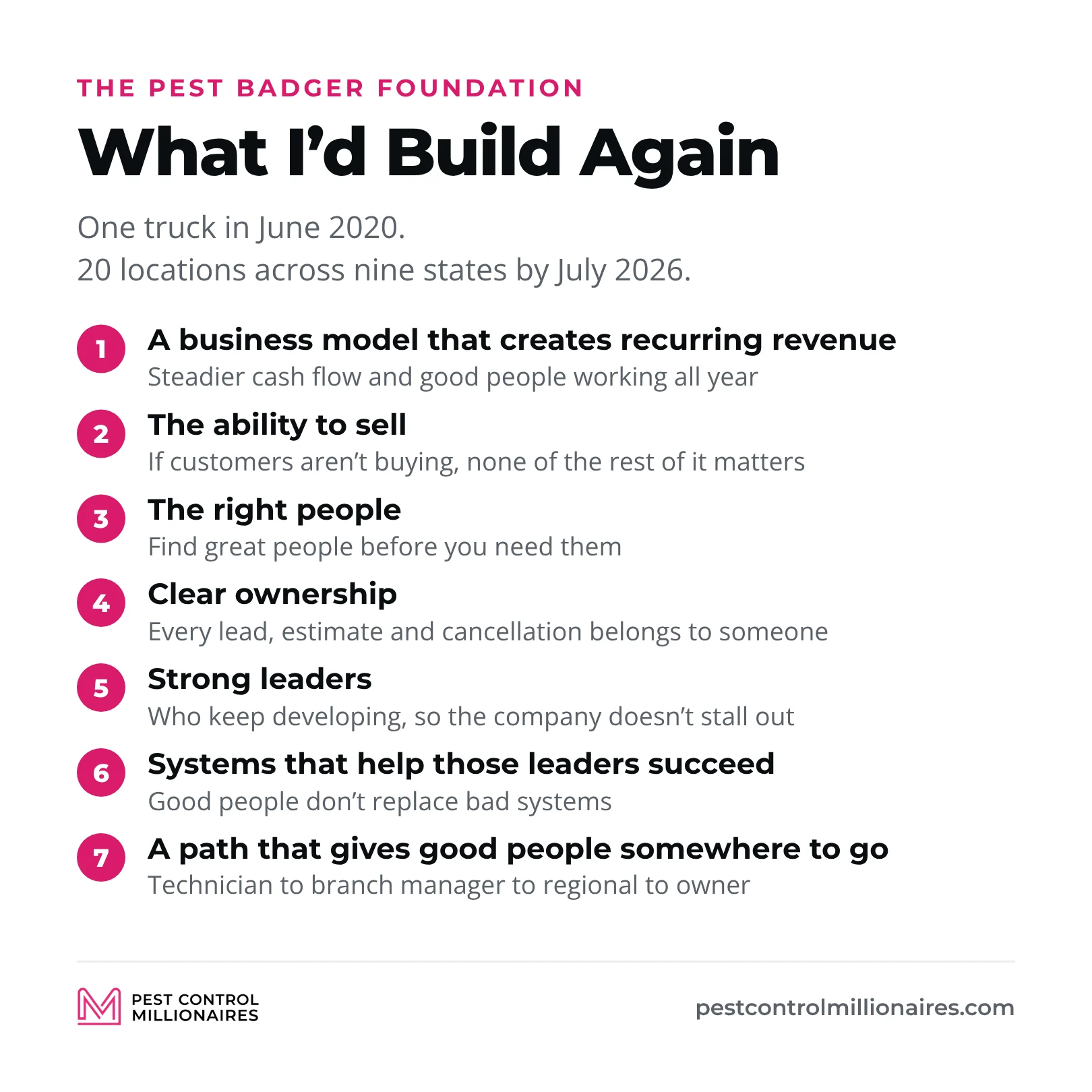
If I had to start all over tomorrow, I’d build the same thing. A business model that creates recurring revenue, the ability to sell, the right people, clear ownership, strong leaders, systems that help those leaders succeed and a path that gives good people somewhere to go. There are plenty of mistakes I’d clean up, but I wouldn’t change the foundation.
Frequently Asked Questions
How did Pest Badger get started?
I started it in June 2020 as Turf Badger, with a white F-150, a 250-gallon skid sprayer and enough product for the week. I had no customers and had never really knocked doors. I sold the first house I knocked, ended the first day with about four customers and finished the first season with 400 to 500.
Why did you choose pest control over lawn care?
Where I live, lawn care means fighting the weather, with tons of snow six months of the year. Pest control gave me recurring revenue, steadier cash flow and the chance to keep good people working all year instead of laying them off every winter. Ask yourself what kind of business you want to own three, five and 10 years from now, not just what service you want to offer.
What should a new pest control owner learn first?
Sales. Marketing, operations and systems all matter, but if customers aren’t buying, none of the rest of it matters. Once I knew I could sell one account, I stopped wondering if I could sell the next one.
How do you keep good people as a pest control company grows?
Give them systems that help them win and a path that gives them somewhere to go. Good people can only carry a weak process for so long. At Pest Badger, technicians can become branch managers, branch managers can become regionals and regionals can become owners.