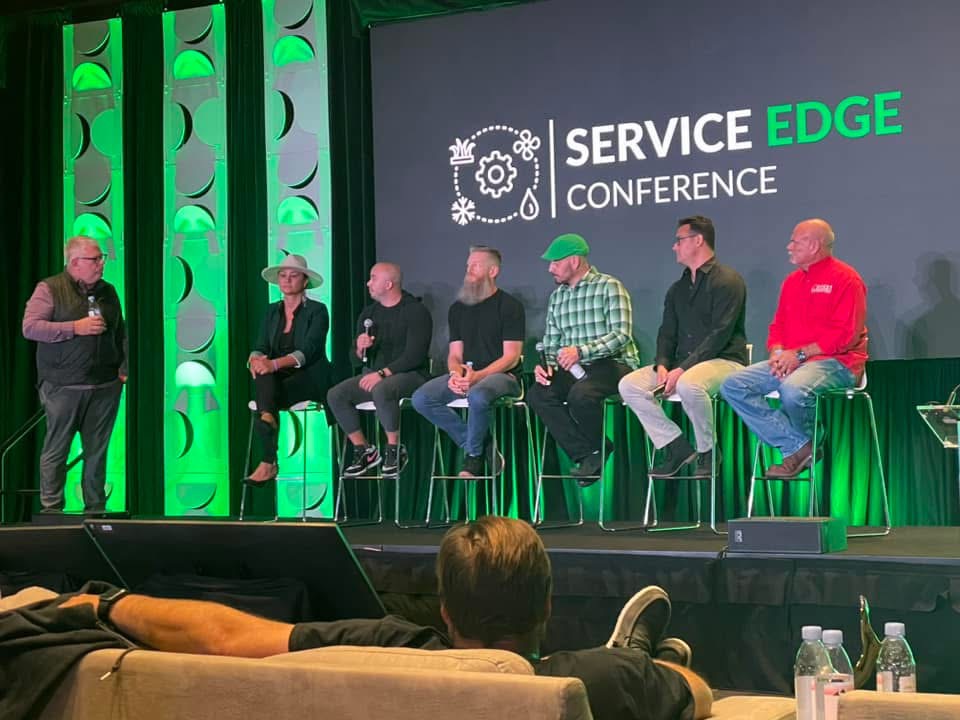


I recently sat down with Alex Deageuro and Justin Lidick, the brothers behind Southwest Weed & Pest Solutions out of Rio Rancho, New Mexico, and their story breaks all the rules. They started the company in 2023 with zero industry experience. Alex works a full-time cybersecurity job for the federal government. Justin is the caretaker for his disabled uncle. And on the side, they’ve built a million-dollar company that’s putting up $100K months and adding 200 new accounts a month. Here’s how they’re pulling it off.
Table of Contents
ToggleTwo Brothers and a Guy Spraying Yellow Stuff
The whole thing started with a drive home. Alex saw a guy on the side of the road spraying yellow stuff on some rocks and thought, “We can make money doing that.” That was the pitch he gave Justin too. It would be easy. Just spray the weeds.
So they bought a Ranger, Justin took a class to get his license, and they started spraying weeds for anyone who would let them. Friends, family, anybody they could reach on Nextdoor. Their dad did landscaping when they were growing up, so yards weren’t foreign. But neither of them had ever sprayed anything.
There’s a funny full circle here. When the brothers were 10 or 12 years old, they went around the neighborhood pulling weeds for pocket change. They quit on one neighbor because pulling her tiny weeds by hand took all day. Today they treat that same neighbor’s yard for weeds and pests all year round, part of the free work they like to do for elderly folks in their area.
For Alex, the push came from his career. He went to college and landed a government job, the standard path in New Mexico. Then reality set in. “Man, this can’t be it,” he told me. “There has to be a little bit more to all this.” They’re 24 and 26 today, which means they were barely into their twenties when they started.
The Mentor in the Bug Shirt
Here’s the wild part. When they started, they didn’t even know pest control was a real industry. Then one day they were spraying weeds at the home of one of Alex’s coworkers, and the neighbor walked out of his house. Big home, probably worth a million and a half. And he’s wearing a shirt with a bug on it.
He walks up and says, “Hey, your license number’s not on your truck.” The brothers looked at each other. Do we need that? He said yes, and then he added, if you need any help, just let me know.
They called him. He became a mentor, introduced them to other local operators, and taught them how pest control actually works. How to treat, how to build routes, all of it. As they put it, “This is all stuff we’ve had to learn. We weren’t prior technicians, salesmen or anything like that.”
Year One: $30K and Every Mistake in the Book
The first year was rough. They made maybe $30,000 total. They got Gorilla Desk as their CRM on day one, on their mentor’s advice, and that was about the only thing they did right.
“We didn’t even know how to spray right,” they told me. “People were getting callbacks all the time, like, we still have ants.” They priced cheaper than everyone in town and were breaking even on weed jobs. They had no Google Business Profile, which they now call one of their biggest early mistakes. They responded slowly to leads on Nextdoor. And they tried door knocking exactly once. A full day of knocking, zero sales. In their words, they’re horrible door knockers. Friends, family, and referrals kept the lights on.
The money leaks took longer to find. Their warranties were way too long, so they were losing money left and right. Their pricing had too many variables. They weren’t charging when a job ran over on product, and they were buying chemicals in small quantities, which kills your margins in weed control. Worst of all, they had no plans. Every winter they were dead in the water with zero income coming in.
Even their quoting was guesswork. They eyeballed property sizes off Zillow, and jobs quoted at an hour would take two and a half. Now they measure every property, price per thousand square feet, and note whether it’s gravel or dirt, because a quarter acre of gravel takes 15 minutes and the same spot in dirt can take an hour. Getting precise fixed their margins and their schedule at the same time.
Cowboy Hats and Black F-150s
Ask anyone in Rio Rancho about Southwest Weed & Pest and they’ll probably mention the hats. Every technician wears a cowboy hat, cowboy boots, tan breathable pants, and a dry fit long sleeve. The trucks are black F-150s with green branding. It fits New Mexico perfectly, where cowboys and farming are part of the culture.
The brothers told me the push to take branding seriously came when they first found Pest Control Millionaires. They wanted a mascot and messed around with their scorpion for a while, but nothing stuck. They took inspiration from Green Mango out in Arizona, but the clean Nikes and white shirts don’t survive a day spraying weeds in the desert dirt. Then they noticed one of their technicians always wore a cowboy hat, and customers loved him for it. So they made it the identity.
It works. Customers bring up the cowboy hats in Google reviews and tag the company in Nextdoor and Facebook posts. Jonas made pink famous in this industry, but I’ve never heard branding quite like this. Nobody forgets the pest control cowboys.
Weeds or Pest? They'd Pick Pest
Southwest started as a weed company and added pest control about six months in. Last year they were 80 percent weeds. Today it’s 50/50, and the brothers have a clear view of both sides.
Weeds are easy to learn and brutal to run. You can teach a tech to mix, identify weeds, and stay away from plants pretty fast. But the equipment is expensive. “If you’re not spending five to seven grand on a sprayer, you’re buying junk,” they told me. You need bigger trucks. The routing is a mess because one property is a quarter acre and the next is a full acre. The season crams most of the revenue into about three months, the wind reschedules your whole week, and plans are harder to sell. They cap their weed warranties too. Nobody is getting a full year warranty on an open acre when seeds blow in from everywhere.
Pest is the opposite. You can start with a B&G and a backpack for about $600. Every house takes roughly the same time, so routing is simple. And plans sell all day, because people understand year round protection.
So I asked them straight up. If you started over tomorrow, weeds or pest? Both answered instantly. Pest control, one hundred percent. At one point they even talked about splitting the company in two because juggling both was such a headache. They’ve since figured out the scheduling, and being one of the only companies around that does both well has become an advantage.
Five Virtual Assistants and a Phone That Never Stops
This is the part that makes the day jobs possible. Southwest runs on five virtual assistants. The office is covered seven days a week, from 7 AM to midnight. There’s a sales guy, an office manager, and two office assistants, and every one of them knows how to sell.
They found their first VA through a lead company they paid up front. That guy is now their main closer, and once he was in, everything got easier. He referred friends from the Dominican Republic, the Philippines, and Mexico. The brothers interview each one and pass on plenty.
I brought up the objection I hear from owners constantly, the fear of thick accents on the phone. They shut it down fast. None of their salespeople have heavy accents, some are Americans living abroad, and their one guy with a slight Dominican accent often outsells everyone else.
The real cost of VAs is training, so build your videos and SOPs before anyone starts. Their first VA was a grind to train. Now new hires ramp fast. And the order matters. Hire a technician first to get off the truck, then train a VA once you’re in the office. That’s exactly how it went for them. Justin moved from the truck to the office after their first tech hire, and the VAs came next, because Alex was taking sales calls all night and nobody had time to grow the business.
The Day Job Advantage
Most people assume the jobs slow them down. The brothers see it differently. Because their salaries cover their lives, every dollar the business makes goes back into the business. “We’ve been working for free for three years,” they told me. That’s how they’ve bankrolled new trucks and equipment, especially since no bank wants to lend to a new company. They had to personally guarantee every work truck they own.
That reinvestment funds 200 new accounts a month. These guys are outgrowing most full-time owners I talk to, on nights and weekends.
The plan is to go full time around the $2 million mark, hopefully by the end of next year. Alex frames it simply. How many people can I hire to replace my salary? Until the answer stops mattering, the jobs stay. Justin admits the double life is stressful, and Alex wonders how fast they’d grow if they could sit in a room and work on it all day together. Based on the last six months, I’d say scary fast.
$3 Leads and the $100K They Left on the Table
Southwest generates leads through LSA, Facebook ads, organic Google rankings, and referrals, with Facebook as the biggest driver. They’re spending about $10,000 a month on Facebook ads, and their approach is pure volume. Around 20 new creative variations a month. AI generated images, photos of their technicians, candid spray shots. All still images so far, with video coming next.
Their best ad ever proves you can’t predict winners. It’s a blurry photo of Alex spraying rocks from 30 feet away, wearing a respirator they don’t even use anymore, with a line about getting your weeds sprayed for forty bucks. That ad was pulling $3 leads. So they test everything, give the algorithm time to work, scale the winner, and have the next one loaded before it dies.
They also had a sharp answer for owners who say Facebook ads don’t work. “They obviously do work. You’re just not spending enough money,” they told me. Spend too little and Meta won’t even push your ads.
The ads worked so well they created a new problem. Justin was fielding around 50 calls a day and they couldn’t keep up. “We probably left a hundred grand on the table this year,” they admitted. That’s what pushed them into VAs, and it’s why they preach speed to lead harder than anyone. On Sundays, when every competitor is closed, they’ll close five to ten jobs just by answering the phone. They close deals at nine or ten at night over text. Even a quick message saying you’ll call in the morning keeps a lead alive. They even picked up the blue iMessage texting strategy from another episode of this show and a call with Jake. Tony Carter told me a few weeks ago that he wants to write a book called Answer the Damn Phone. These two are living proof of the title.
How the Program Compressed Years Into Six Months
Before they joined Pest Control Millionaires, Alex and Justin were doing what a lot of owners do. Paying marketing agencies $2,000 to $3,000 a month and hoping for the best. The results were bad, with lead costs around $100 to $200, and here’s the scary part. They didn’t even know the results were bad until they learned how to run ads themselves. They figure they wasted about six months of agency fees.
That’s what drew them into the group around December. They wanted to learn the ads, and they wanted to be around like-minded people, which is hard to find as young entrepreneurs in New Mexico. “As soon as we learned how to do the ads, it was game on, man,” they told me.
The six months since have been a total rebuild. They learned Facebook ads. They built out GoHighLevel. They hired five virtual assistants. They went from one technician to four. And they stopped selling one-time services and moved everything to recurring, which they said had a lot to do with the group getting their mindset right. Recurring is what finally killed their dead winters.
The numbers tell the story. Their biggest month last year was $30K. Now they’re doing $100K months, adding 200 customers a month, and tracking toward a couple million next year. “We’re just jumping years and years ahead,” they said. Or as Justin put it, “If you would have talked to me three years ago and told me I’d be in the place I am now, I would have thought you were crazy.”
To be clear, the program didn’t do the work. These two did, with a great mentor, total reinvestment, and an insane work ethic. But they came in ready to run, and we handed them the playbook. That combination is why it happened this fast.
Pay People Like It's Their Career
One more thing they’re doing right that most owners get wrong. They pay for performance, everywhere. Their technicians are on production pay, which protects margins because labor costs can never run away from revenue. It also means techs aren’t capped at 18 or 20 bucks an hour. Their best guys hustle their way to $30 or $40 an hour, plus bonuses for upsells and reviews.
The VAs earn commission on every sale, so they’re trained to sell the value of a plan instead of just reading a price and hanging up. And both techs and VAs get real career paths. “They don’t see this as some sort of call center job,” the brothers told me. “This is their career.” Their techs never call in. Take care of your people and they’ll take care of you.
They also credit each other. Having a partner, they said, makes a world of difference.
The Biggest in New Mexico
The goal is to be the biggest company in New Mexico, and there’s one big player in their market they plan on beating out. After that, maybe expansion. Alex was in Arizona on a work trip recently and realized the landscape looks just like home, so Arizona and El Paso are both on the whiteboard. Expansion is uncharted territory for them, which is another reason they lean on the group, where they can ask people who have already done it.
Their message for other owners came in four parts. Don’t give up. Speed to lead, because the first five minutes matter most. Take risks, because hiring their fourth technician was terrifying and turned out fine. And be proud of what you do. “Pest control is not always the most luxurious industry,” they said. Wear it like a badge of honor.
And my favorite line of the whole episode: “The only way to really be successful is to continue to do a hard thing over and over again for years on end. And all of a sudden you become an overnight success.”
Key Takeaways
Alex and Justin’s story is loaded with lessons. First, speed to lead is free money. They figure slow follow up cost them $100K this year, and now they close jobs on Sunday nights just by answering the phone.
Second, you don’t have to quit your job to build a real company. Their day jobs are the reinvestment engine, and reinvesting everything is how a three-year-old company adds 200 accounts a month.
Third, learn your own ads. Agencies charged them $3,000 a month for $100 leads. Running it themselves, their best ad hit $3 leads.
Fourth, recurring fixes winter. No plans meant no income for months. Moving from one-times to yearly plans made the revenue compound instead of disappear.
And fifth, brand for your market. Cowboy hats and black F-150s did more for their local reputation than any logo could, and customers do the marketing for them in reviews and neighborhood groups.
From spraying friends’ weeds out of a Ranger to $100K months in three years, without quitting their day jobs. Alex and Justin are proof that the ceiling in this industry is set by your effort, not your circumstances.
Want to connect with the brothers? You can find Southwest Weed & Pest Solutions on Facebook and on Instagram at @swpestweeds, or email Alex directly at alex@swpestweeds.com. They told me they’re not gatekeeping anything, so if you have questions, reach out. And if you want the same ads training and playbook that took them from $30K months to $100K months in six months, that’s exactly what we teach inside Pest Control Millionaires.
Frequently Asked Questions
How did Southwest Weed & Pest Solutions grow so fast? The brothers reinvested nearly every dollar back into the business because their day jobs covered their living costs. They combined Facebook ads and LSA with virtual assistants answering the phone from 7 AM to midnight, seven days a week, and moved all their customers to recurring plans.
Is weed control or pest control a better business to start? Alex and Justin have done both, and they’d pick pest control every time. Pest is cheap to start, around $600 for basic equipment, with simple routing and plans that are easy to sell. Weed control needs $5,000 to $7,000 sprayers, has messy scheduling, and packs most of its revenue into a three-month season.
What role did Pest Control Millionaires play in their growth? After joining, they learned to run their own Facebook ads instead of paying agencies, built out GoHighLevel, hired five virtual assistants, scaled from one technician to four, and switched from one-time services to recurring plans. Within six months, they went from a $30K best month to $100K months.