
Why Your First Pest Control Hire Should Not Be a Tech

Table of Contents
My name is Jonas Olson. I’m the owner of Pest Badger, an 8-figure pest control business, and we’ve hired over 100 employees. So when I tell you that your first hire should not be a technician, I’m not just throwing out a hot take. I lived the opposite approach, and it cost me a lot of money.
Let me walk you through why admin should come first, how to hire one the right way, and exactly what happened when I did it backwards.
Why You Shouldn’t Hire a Tech First
I get it. Hiring a technician sounds good on paper. It sounds cool when you’re talking to your peers. “Yeah, I just hired my first tech.” Or maybe you’re thinking you just need to get out of the truck. I hear this all the time.
But here’s the reality of what adding another tech actually does to your business early on. It does not add revenue overnight. What it does add is a pile of costs you probably can’t afford right now.
You’re adding payroll for another full-time employee. In most cases you’re probably using a personal truck, so now you have to go buy an additional vehicle and get it fully equipped. That alone is going to cost you real money right out of the gate. Our Nissan NV van came to about $24,000 all in, and about $7,000 of that was equipment.
And on top of that, it creates more admin work for you. You have to find this person, train them, trust them, build systems for tracking their hours and paying them on time. All while doing everything you’re already doing. You’re just adding weight to a structure that doesn’t have a foundation yet.
Why Admin is King
If you had your routes optimized, someone answering phones, doing sales, and setting your appointments, you’d have way more free time to do revenue-generating work.
Think about it this way. When you’re in the field, you’re earning $100 to $200 per hour doing the actual work. But when you’re on the phone scheduling, invoicing, ordering products? You’re earning zero.
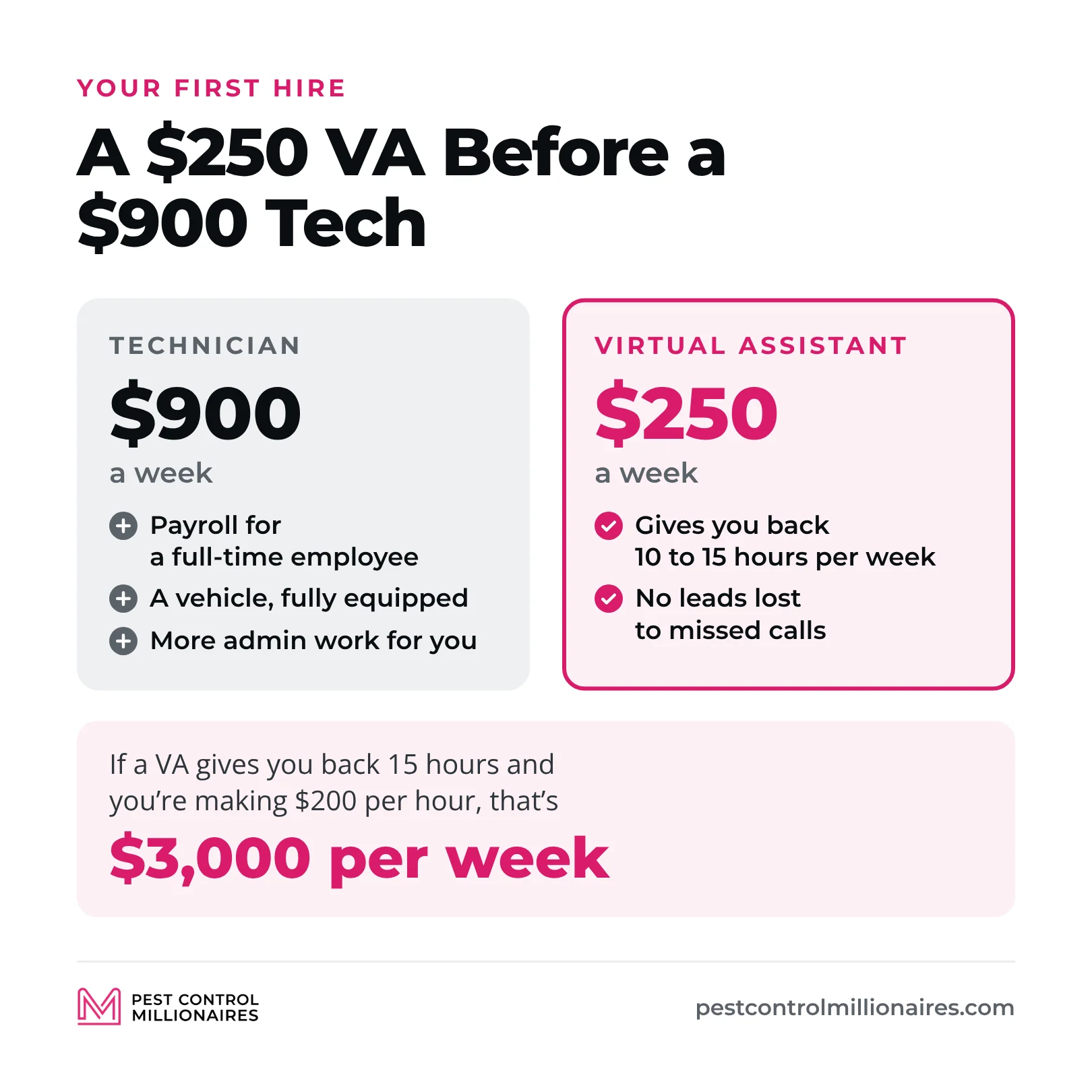
So instead of hiring a $900 a week technician, what if you hired a $250 a week virtual assistant? That VA gives you back 10 to 15 hours per week. You use that time to do more jobs, and you pocket the difference.
Let’s break it down. If a VA gives you back 15 hours and you’re making $200 per hour, that’s $3,000 per week. You’re less stressed, more profitable, and you’re not losing leads to missed calls.
I hear it all the time from operators. They miss 5 to 10 calls per day because they’re too busy working. They’re down in a crawl space or up in an attic and just can’t answer the phone. At this stage in business, most of your leads are probably coming from referrals, which close at a super high rate, around 80% or more. So that’s four to eight closes per day you’re missing. With an average contract value of $600 per year, that’s $4,800 in yearly revenue you’re losing out on per day. That’s $24,000 per week.
And beyond the phone coverage, a really good admin gets you organized. As entrepreneurs, we’re typically not the most organized people, especially if you’re like me. I needed people like that around me. An admin allows you to stay focused on the things that actually grow the business and helps you build a strong foundation for hiring techs down the road.
Think of it like building a house. The first thing you do is pour the foundation. For the first month, month and a half, it doesn’t look like you’re making any progress. You’re pouring the slab, putting up the blocks. But that is the necessary start for the structure to be sturdy later on.
My Hiring Horror Story
This is actually the exact opposite of what I did. I hired a technician first, and it was still chaos. I was still doing the scheduling, still answering calls, still running back from inspections to my truck to check voicemails, trying to call people back right away. My routing was still crappy. It was a nightmare, and it cost me a lot of time.
About three months later, I finally hired a CSR. There weren’t call centers or VAs back then, so I hired an in-person CSR and taught them to answer phones and respond to emails. It saved me a ton of time and stress, both during the day and at night. I wasn’t jumping around anymore. We had our routes figured out. Everything just got smoother and easier.
When I hired that first CSR, it freed up so much of my time in the field. It gave me back an additional five to ten hours per day that I’d been spending running around town losing time and producing zero revenue. And the after-hours stuff, like answering emails, returning calls, and doing routing, I got that time back too.
That extra time gave me the space to work on the business instead of in the business. I got to spend more time on marketing and sales to generate enough leads to actually justify hiring that first technician. And having that margin at the end of the day is what allowed me to get the full value out of having a tech on the team.
It ended up working out. I just wouldn’t recommend doing it the way I did, because it cost me a lot of money for those first few months before I hired that CSR.
How to Hire Your First Admin the Right Way
Step 1: Decide What Type You Need
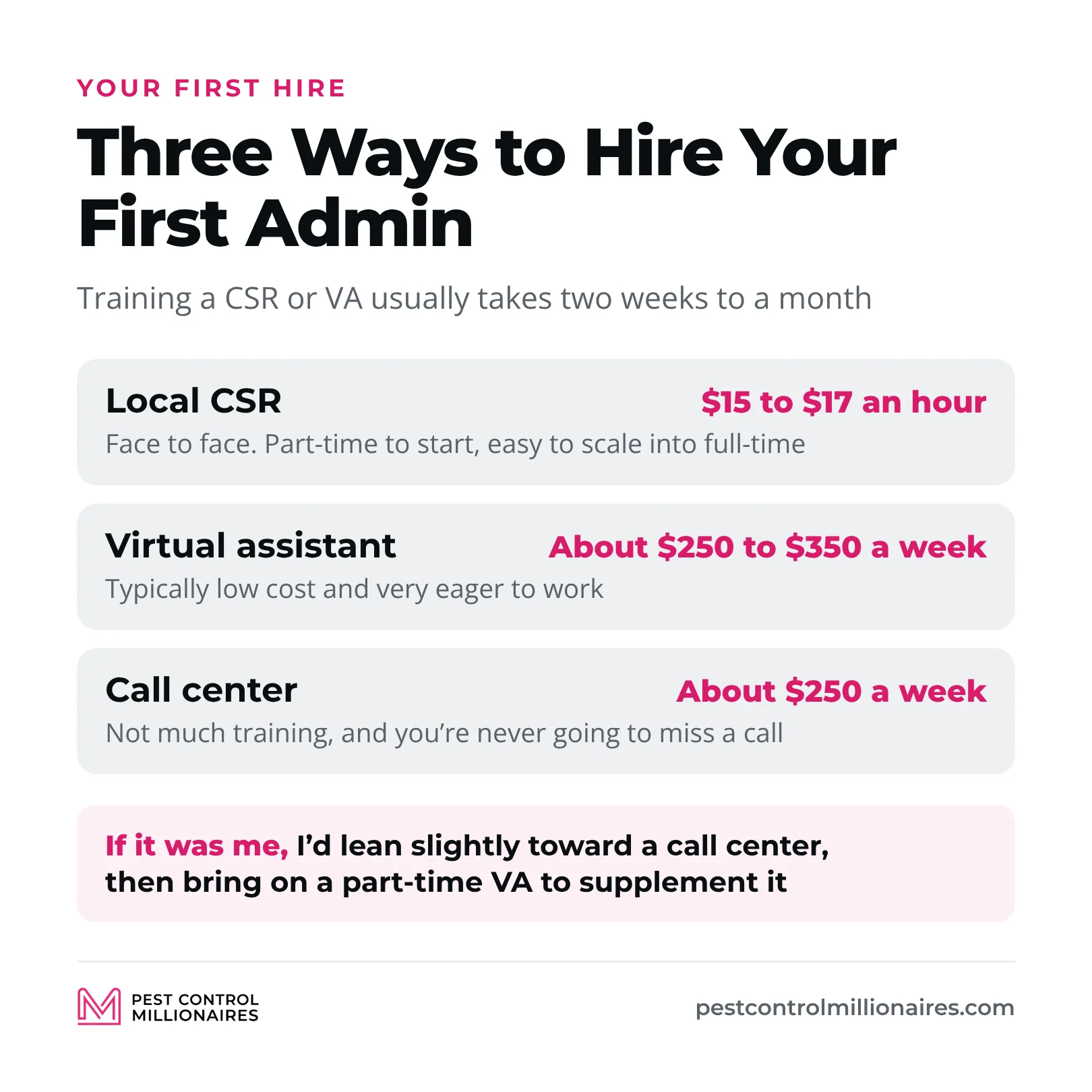
You’ve got three solid options, and each one has its advantages. Local part-time CSR. You see them face to face, and it’s easy to scale the role into full-time as the business grows.
Virtual assistant. Typically low cost and very eager to work.
Call center. You won’t need to do much training. A good company will already have proven systems and 95% of the skills. You just need to teach them about your business.
With a call center, you typically pay per volume or a time block. There are companies out there like CallBoss that do this, and it’s pretty inexpensive. For an entire week, you’re looking at maybe $250 on average. And with these guys, you’re never going to miss a call.
All three options are extremely valuable. You just have to decide which one fits best for your business. If it was me personally, I’d probably go the call center or VA route. I’d lean slightly toward call center right away only because there’s less training out of the gate. Over time, I’d bring on a part-time VA, not to replace the call center, but to supplement it and train them up to the point where they could eventually take over.
Step 2: Set Up Your Budget
For a full-time CSR, you’re looking at $15 to $17 an hour, probably around $500 to $600 per week. If you’re going the VA or call center route, you’re probably in the $250 to $350 per week range for someone answering your phones all the time. That’s less than a single termite job.
Step 3: Training
If you went the CSR or VA route, you’re going to have to train these people. Start by teaching them how to answer phones, then move into scheduling. Teach them how to quote jobs using your pricing sheet. Use call scripts. Record your training videos. Walk them through your CRM so they know every aspect of it.
There are a lot of nuances to pest control, and it’s going to take a minute to get them up to speed. Usually you’re looking at two weeks to a month. Just make sure you have a process in place. Give your CSRs a cheat sheet they can read off of for every part of the business, whether it’s sales, service, or billing. That way they don’t have to call you for every single question.
You’ll be sitting with them for the first week or so and on the phone with them a lot. But if they start documenting every call that comes in, they can reference the cheat sheet and handle most things on their own within the first few weeks. Make it easy. Training is a process, but over time, the value will far outweigh the cost.
Step 4: Teach Them to Sell
Show them how to book inspections for things like bed bugs or bats. Give them the confidence to handle light objections, things like “I need to talk to my husband” or “the price is too high.” Give them the basics to upsell into your next package, whether that’s mosquito, lawn care, whatever you offer.
Make it simple. It doesn’t have to be a hard sell. Just teach them how to sell, because it saves you a massive amount of time. Remember that $4,800 per day example? Once your CSRs learn to sell, the upside is huge. We’re talking up to $24,000 per week.
Step 5: Grow the Role Over Time
Once they’ve mastered the basics, there’s so much more they can take on. They can order products, plan your daily routes, request Google reviews, respond to reviews, and follow up with past estimates. They don’t just save you time. They can start generating revenue.
Final Thoughts
Every six-figure pest control business out there started exactly where you are right now. They didn’t get there by just working harder. They got there by working smarter and hiring the right people at the right time.
So what’s the one thing stopping you from hiring a CSR or a VA right now? Bring it to our free Facebook group. You don’t have to figure this out alone. We’re here to help.
Your first hire is just the start. For more operator-level moves, check out my 25 pest control business tips and tricks from running 20 locations.
Frequently Asked Questions
Why should my first pest control hire not be a technician?
Because a tech doesn’t add revenue overnight. It adds payroll, a vehicle and equipment, and more admin work for you. An admin gives you time back instead. In the field you earn $100 to $200 an hour, and on the phone scheduling and invoicing you earn zero, so a $250-a-week VA who gives you back 10 to 15 hours a week is worth up to $3,000 a week.
What does an office manager do at a pest control company?
Start them on answering the phones and scheduling, then quoting jobs from your pricing sheet with call scripts and your CRM. Then teach them to sell by booking inspections, handling light objections and upselling your next package. Once they’ve mastered that, they can order products, plan your daily routes, request and respond to Google reviews and follow up on past estimates.
How much does a pest control office manager cost?
A full-time CSR runs about $15 to $17 an hour, or around $500 to $600 a week. A VA or a call center runs about $250 to $350 a week for someone answering your phones all the time, which is less than a single termite job.
Can I hire a virtual assistant before a full-time office manager?
Yes. A local part-time CSR, a virtual assistant and a call center all work. If it were me, I’d lean slightly toward a call center first because there’s less training, then bring on a part-time VA to supplement it and train them up until they could take over. See our pest control VA playbook.
What’s the ROI of hiring office help in pest control?
Big, because of what it frees up. A $250-a-week VA who gives you back 15 hours is worth $3,000 a week if you make $200 an hour in the field. And if you’re missing 5 to 10 calls a day, mostly referrals that close around 80%, that’s four to eight lost sales a day, or up to $4,800 a day in yearly revenue at a $600 contract value.