25 Pest Control Business Tips and Tricks (From a $20M Owner)

Table of Contents
- 1. Get a Card on File Before the First Visit
- 2. Stop Doing Free Inspections
- 3. Price From Your Numbers, Not From a Facebook Forum
- 4. Sell Pest Control Like House Insurance
- 5. Take One-Time Services Off Your Website
- 6. Make Your Prepay Offer at the Last Service of the Year
- 7. Upsell Rodent Bait Stations, Encapsulations, and Attic Work in Winter
- 8. Keep One-Time Jobs Under 30% of Total Revenue
- 9. Get a CRM on Day One
- 10. Automate Your Pre-Arrival Communication
- 11. Put Your Shop in the Middle of Your Routes
- 12. Get a Written Company Handbook
- 13. Switch From Hourly to Pay for Performance
- 14. Track Five Numbers Per Tech Every Week
- 15. Answer the Phone Within Three Rings
- 16. Your Follow-Up Is Where the Money Is
- 17. Run Reactivation Campaigns on Your Canceled Customers
- 18. Use AI to Catch After-Hours Service Calls
- 19. Don’t Rely on a Single Marketing Channel
- 20. Hire an Admin Before You Hire a Second Technician
- 21. Brand to Stand Out at 50 Feet
- 22. Use the Offseason to Build, Not to Coast
- 23. Hire People Who Will Push Back on You
- 24. Have the Hard Conversation Today
- 25. Move Fast. A Slow Decision Costs More Than a Wrong One.
- Go Build It
Running a pest control company is simple. Running it well is not. I’ve spent 17 years in the service industry and grown our pest control company from one location to 20 locations across nine states, and I can tell you every single owner I’ve ever met runs into the same exact problems. Bad pricing. Missed calls. Slow winters. Tech drama. Pest control marketing that doesn’t work.
What follows are 25 pest control business tips and tricks I’d give to any operator trying to build a real company. Not theory. These are the exact moves that actually work in the field, pulled from everything I’ve learned building Pest Badger and coaching hundreds of other operators around the country. If you’re stuck in the truck, stuck under a million dollars, or just tired of feeling like the business is running you, this is the playbook. Let’s get into it.
1. Get a Card on File Before the First Visit
This is the single fastest way to stop your business from bleeding cash. Every account should have a credit card or ACH on file before a technician ever pulls into the driveway. When someone calls in, get the card during that phone call. Tech shows up, clocks in, does the job, clocks out, the card auto-charges. Done.
I was on the phone recently with an owner who had to take out a $5,000 loan because he had $250,000 to $300,000 in accounts receivable. You cannot grow a business off AR. Stop chasing credit cards around. Service your customers, don’t chase them.
2. Stop Doing Free Inspections
This one is a killer I see everywhere. Sales guys and techs driving all over town doing free quotes for people who were never going to buy anyway. That’s gas. That’s payroll. That’s time you will never get back.
Charge a small inspection fee. $50, $100, $200, it doesn’t really matter. If they book the service, credit it back on the final bill. It filters the price shoppers, positions you as the expert instead of the free option, and your close rate goes up. I just fundamentally disagree with my techs and sales guys driving around for free all week.
3. Price From Your Numbers, Not From a Facebook Forum
Most of the guys I talk to set prices by Googling their competition or jumping on a Facebook forum. That’s not pricing. That’s guessing. And half the companies you’re copying don’t know what they’re doing either.
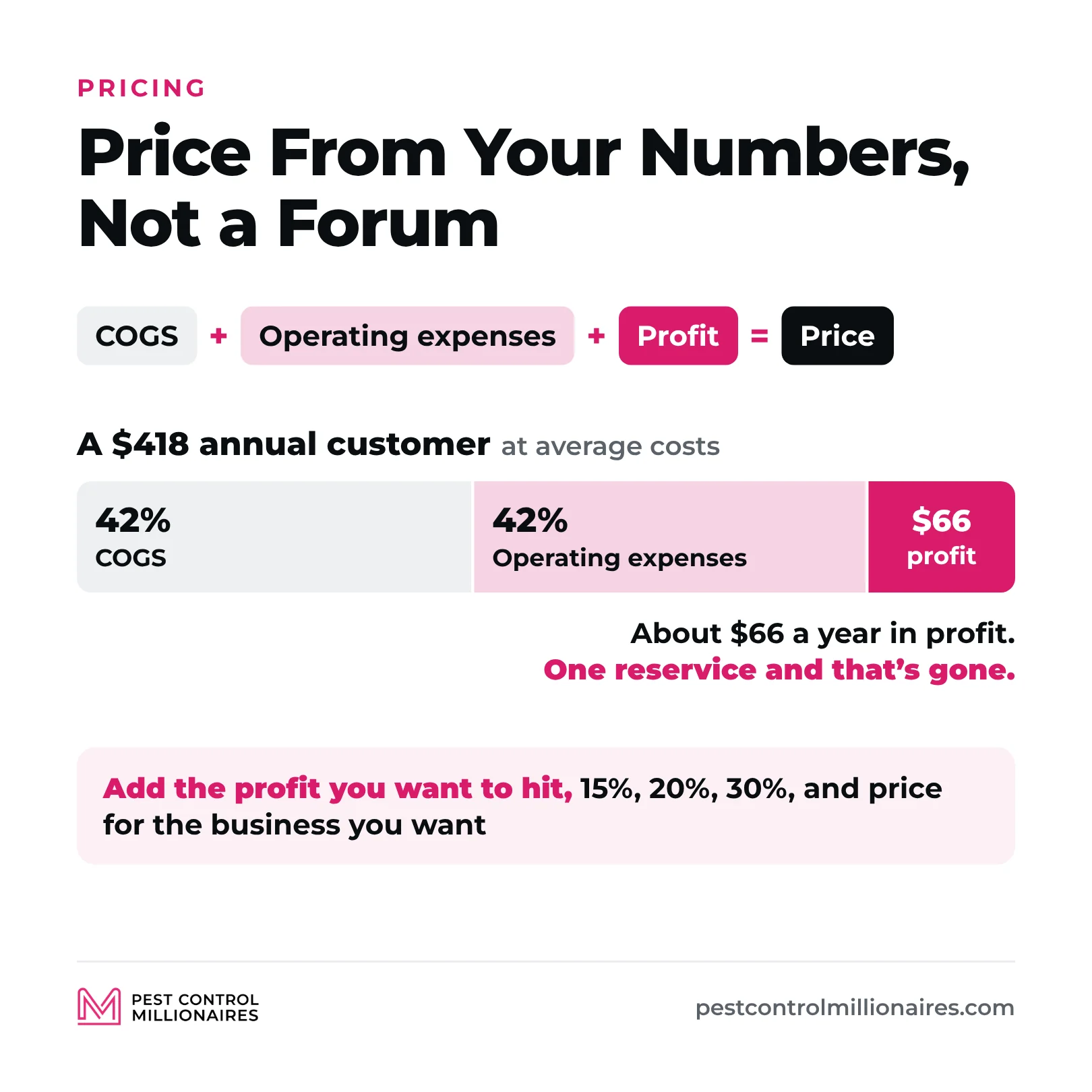
The formula is simple: Price = COGS + Operating Expenses + Profit. Add up what it actually costs to service the customer (labor, vehicle, materials). Add your operating expenses (marketing, admin, software, overhead). Then add 15%, 20%, 30%, whatever profit you want to hit. Most pest control KPI benchmarks show companies average 42% COGS and 42% OpEx. At a $418 annual customer, you’re left with about $66 a year in profit. One reservice and that’s gone. Price for the business you want, not the one you’re trying to escape.
4. Sell Pest Control Like House Insurance
Most companies have a slow season problem because they have a business model problem. They sold one-time jobs all summer and now the trucks aren’t rolling in January. Fix the model.
Sell recurring pest control offers. Monthly, bi-monthly, or quarterly. Position it as insurance for the biggest asset your customer owns. Their home has to be protected year round, and that’s your job as a pest control professional. If you sell it this way, cancellations drop, cash flow smooths out, and winter stops being something you dread.
5. Take One-Time Services Off Your Website
Please. I’m begging you. Take the one-time general pest control off your website. There’s no reason for it to be there. Leave the space for your recurring pest control plans and specialty services like bed bugs, cockroaches, or fleas.
If you still want to sell one-times, don’t sell them for less than 50% of your annual contract value. If your quarterly plan is $1,000 a year, your one-time minimum is $500. This forces the right customers into recurring, and if someone’s still willing to pay $500 for a single visit, great, take the money.
6. Make Your Prepay Offer at the Last Service of the Year
This one is super common in lawn care but rare in pest control, and it’s one of the highest-ROI moves in this entire list. At the last service of the year, offer customers a small discount (or a free add-on like a mosquito treatment) if they pay for the whole year up front by a specific date. That’s how TruGreen does it, while customers are still happy with the service. Don’t save it for a spring letter, especially one with a price increase in it, because that gets people thinking about canceling right when they shop around. When you raise prices, put the new price on the invoice.
At one of our locations, 60% of our clients prepay for the entire year. That money funds our products, our marketing, and our growth before spring even starts. You can literally pull hundreds of thousands of dollars of cash forward and pay for your whole year’s pest control marketing budget with this one campaign.
7. Upsell Rodent Bait Stations, Encapsulations, and Attic Work in Winter
Winter does not have to kill your revenue. Rodents are looking for warmth, so upsell bait stations and exclusions. Those bait stations also need to be serviced every month or quarter forever, which keeps a customer on your route year round.
Crawl space encapsulations are a home run if you have them in your market. We had a guy in our class who went from “I can’t keep my techs busy” to selling $120,000 of encapsulations in two weeks. Attic remediation and insulation replacement can be $5,000 to $30,000 jobs. Wildlife trapping, commercial contracts, foundation sealings. There is always something to sell if you want to sell it.
8. Keep One-Time Jobs Under 30% of Total Revenue
I talked to an owner recently who did 700 one-time jobs in a year with no recurring structure behind them. If he had converted even 60% of those into $800 annual contracts, he’d have added $336,000 a year in revenue and started the next year with about 620 recurring customers instead of 200. The cost of a bad business model is literally hundreds of thousands of dollars.
Your recurring revenue should be 70%, 80%, or 90% of your book. One-times should never be the main course. If they’re more than 30% of your revenue, you’re starting the race from zero every January.
9. Get a CRM on Day One
I talked to a buddy this week who’s been in business three years and told me he wants to sell because he can’t handle the chaos anymore. Six months ago I told him to automate his pest control business with a CRM. He didn’t. There’s nothing I can do for him now.
People say a CRM costs too much. $200 to $500 a month, whatever. You’re not saving money by skipping it. You’re losing money every single day on bad routing, missed follow-ups, unbilled services, and customers you could’ve kept if you’d been organized. If you’re brand new, start with the cheapest one and scale up. Transitioning a $3M or $5M paper-based business to a CRM is ten times harder than starting there from day one.
10. Automate Your Pre-Arrival Communication
Set up pest control business automations so customers get a text the week before, the day before, and the day of the service. “Hey Mr. Customer, we’ll be there on XYZ date. Gates unlocked, pets secured, please be home if we need interior access.” Simple.
You can also auto-text the next customer on the route the moment the previous tech clocks out. Customers respect what you enforce. If you teach them how you do business, they’ll be there every time. This alone will eliminate a massive amount of wasted drive time.
11. Put Your Shop in the Middle of Your Routes
Owners love a big shop. I get it, it looks cool and feels like a milestone. But a shop is just overhead. I have friends running 50, 60, 70+ trucks without a shop at all.
If you do get one, it needs to be in the center of where your customer base actually is. Not on the edge of town where your techs are driving 20 miles each way just to start the day. When I was first starting out, I lived 20 miles from my service area and had 6 to 10 trucks driving back and forth every day. Thousands of dollars a year wasted on gas and time. Map your routes first, then sign a lease.
12. Get a Written Company Handbook
Every problem I see in small companies comes back to this: nothing is written down. People are asking in Facebook groups what to do when a tech no-call-no-shows, or breaks equipment, or won’t wear the uniform. The answer is always the same: you can’t enforce what you never documented.
Spend $500 to $3,000 and get a real handbook. Attendance, dress code, vehicle rules, equipment damage, customer service, PTO, consequences. Day one they read it, sign it, and now you’ve got a reference point for every tough conversation. A handbook eliminates 90% of the drama in your business.
13. Switch From Hourly to Pay for Performance
This is probably my favorite operational move. Get off straight hourly pay. Go to commission, pay-per-stop, or a low base plus commission. We live in America. Capitalism at its finest. May the best technician win.
Build the structure so callbacks get fixed for free on the tech’s time. You’ll keep the minimum wage floor to stay compliant, but the ceiling opens way up for your top guys. A buddy of mine bought seven $100,000 trucks expecting to need them. He switched his team to this model, efficiency went through the roof, and he only needed one of those seven trucks for another full year. That’s what this does to your P&L.
14. Track Five Numbers Per Tech Every Week
What gets tracked gets better. You don’t need 50 metrics. You need five pest control KPIs: revenue per day, stops per route, cancellations per route, callback rate, and drive time percentage. That’s it. Those five will tell you basically everything you need to know about a technician and a route.
Post them weekly. Techs will start competing. Managers will start coaching. When you add leaderboards across multiple branches, it gets really fun. You’ll find one or two small fixes that tighten routes and cut callbacks, and that adds thousands of dollars of profit every year. Competition builds pride. Efficiency builds profit.
15. Answer the Phone Within Three Rings
This is where most companies quietly lose. I call operators all the time who say their leads suck, and their marketing company says the exact opposite. I pick up my phone, call the operator, rings five or six times, voicemail. Call the next guy on Google, first ring, someone answers sharp and confident. They just won the sale.
The first company to answer typically wins. Put yourself in the customer’s shoes. Saturday night, HVAC goes down, you Google it, first company doesn’t answer, you scroll. That’s exactly what happens to your business every day. Fast response. Confident scripts. Actually picking up. Google sees you as more of an authority when you answer, and they’ll feed you more leads because of it.
16. Your Follow-Up Is Where the Money Is
You don’t need more leads. You need better follow-up. Most small operators lose 30% to 50% of the leads they’re already paying for, and it’s not because the leads suck. It’s because there’s no first call, no second call, no third call, no text, no email, no automation.
Build a sequence that hits every new lead with a call, a text, and an email the same day, and then again over the next several days. Automate as much of it as you can. Follow-up is free money. The companies that scale aren’t always the ones with the biggest ad budgets. They’re the ones whose phones actually get answered and whose pipeline never goes cold.
17. Run Reactivation Campaigns on Your Canceled Customers
Every pest control company is sitting on a gold mine and doesn’t even know it. Canceled customers. Old leads that never converted. People who did one job three years ago and drifted off. If you’ve been in business a few years, there are tens of thousands of dollars just sitting in your database.
Build an automated reactivation sequence and let it run in the background. Timed texts. Timed emails. Special offers. A lot of those customers left for financial reasons or hated their new provider. They’ll come back if you just reach out. Automations like this have added six figures of revenue for us in a year, without hiring a single new person.
18. Use AI to Catch After-Hours Service Calls
A customer calls at 7am before you open, or at 7pm when nobody’s at the office. Normally that call goes to voicemail, and the next day somebody’s playing phone tag with them.
As of September 2026, an AI agent answers our service line at Pest Badger, but only when all of our CSRs are busy or the office is closed. It never answers sales calls. Somebody calling to buy pest control still goes to our sales team. The AI is for existing customers who want to move an appointment, ask when we’re coming, give us a gate code or tell us the bugs came back, and it hands anything it can’t handle to our team. Cancellations and upset customers stay with people. In 12 days, it answered 264 calls, and 71% of them came in before 8am or after 5pm. Give it one job, listen to the calls and fix where it screws up before you trust it with more.
19. Don’t Rely on a Single Marketing Channel
Alex Hormozi calls this single-channel risk. Most operators get good at one thing (Google, Facebook, postcards, referrals) and ride it until it dips. Then the whole business dips with it.
Be everywhere. Local SEO for pest control companies through Google Business Profile and LSAs. Facebook marketing for pest control in groups and the news feed. Traditional marketing for pest control: truck wraps, yard signs, door hangers, and Every Door Direct Mail. Pest control social media on TikTok, Instagram, and local conversations. Pick neighborhoods and dominate them across every channel. Familiarity builds trust, and trust wins the sale. You don’t have to blast the whole city. Be intentional, be specific, and be consistent.
20. Hire an Admin Before You Hire a Second Technician
I did it the opposite way and it cost me. Your first hire should not be a tech. It should be an admin, a CSR, a VA, or a call center. Period.
When you’re in the field, you’re worth $100 to $200 an hour. When you’re on the phone scheduling and invoicing, you’re worth zero. A $250-a-week VA can give you back 10 to 15 hours a week of field time. If you’re making $200 an hour in the field, that’s $3,000 a week you were leaving on the table. Admin is the foundation. Pour the foundation before you start building the second floor.
21. Brand to Stand Out at 50 Feet
If your pest control branding can’t be recognized from 50 feet away in three seconds, it’s not good enough. Most pest control trucks are white with a phone number and some clip art. Nobody remembers you. Nobody takes pictures. You blend in.
Pick bold colors. Clean typography. Maybe a mascot that tells a story. When I walked into a new market where everyone’s trucks were green, I wrapped ours pink and put my techs in pink. Now everyone in the market knows who we are. A good truck wrap outperforms almost any paid ad in your neighborhood. And make everything cohesive: website, truck wraps, uniforms, yard signs, Google Business Profile, and mailers all need to match. Consistency creates confidence. Confidence creates trust.
22. Use the Offseason to Build, Not to Coast
Slow season is a choice. The big players know how to grow a pest control business by building their entire next year in December, January, and February, while most operators are sitting around complaining that the phone stopped ringing.
Use that time to build your full marketing calendar. Have your door hangers, postcards, EDDM, Facebook ads, email campaigns, and text sequences all created, dated, and ready to fire. Train your techs. Tighten your scripts. Clean up your CRM. And recruit like your business depends on it, because it does. When spring hits, it should be all execution. No scrambling.
23. Hire People Who Will Push Back on You
John Maxwell calls it the Law of the Lid. Your business will never grow beyond your leadership capacity. If you’re a 5 as a leader, you’ll never hire above a 3. You are the ceiling.
The way to raise the ceiling is to hire people better than you in specific areas. The salesperson who closes circles around you. The ops manager who demands structure and detail you’d never enforce yourself. The partner who looks you in the eye and says, “No, we’re not doing that here.” A-players raise your lid. If you’re the smartest person in your company, your growth is capped. Hire people who will disagree with you, and then actually listen to them.
24. Have the Hard Conversation Today
The tech who needs to go. The customer who needs to go. The price that needs to go up. The vendor you need to push back on. Every problem you avoid gets bigger. Every day you wait is a day it costs you more.
I start almost every tough conversation the same way: “Hey, is it okay if you and I have a tough conversation?” They give me permission, they know what’s coming, and we can get into it without drama. You don’t have to be aggressive. You just have to be clear. Strong leaders face problems early. Soft leaders let them rot, and the whole company goes soft with them.
25. Move Fast. A Slow Decision Costs More Than a Wrong One.
Most owners move too slow because they don’t want to be wrong. But waiting costs you way more than being wrong. Every month you don’t raise prices, you lose margin. Every month you don’t hire, your burnout gets worse. Every month your marketing doesn’t go out, a competitor takes customers that should’ve been yours.
A wrong decision gives you data. You can fix it. A slow decision gives you nothing. We’re in the information age where everyone wants to read one more book, listen to one more podcast, and hire one more coach before they do anything. You don’t improve in your head. You improve in the field. If it’s good enough, send it out. Most people don’t fail because they picked wrong. They fail because they picked nothing.
Go Build It
Here’s the truth. None of these 25 tips and tricks are going to matter if you don’t execute. I’ve watched operators sit on this exact advice for years, keep running the same broken systems, and wonder why they can’t learn how to scale a pest control business past $300K, $500K, or a million dollars. The companies that dominate their zip code aren’t doing anything magical. They’re just executing the basics with more speed, more discipline, and more focus than everyone else.
Pick three tips from this list and implement them this week. Not next month. This week. Then pick three more. Stay locked in for 12 months while everyone else chases shiny objects, and your business will look completely different a year from now. If you want help from operators in our pest control success stories, drop a comment on any of our articles and I’ll personally respond. Want more? Join our free pest control owners group or check out the Pest Control Millionaires coaching program. Let’s go build it.
And if you want to learn from operators who have actually done it, the best pest control business podcasts are the fastest way to get inside the heads of owners who built what you’re trying to build.