Jeff Davenport on Building and Selling a $20M Pest Control Company

Table of Contents
Jeff Davenport is the kind of guest I could have talked to all day.
Jeff and his brothers built Official Pest Prevention in Sacramento. They grew it to over $20 million a year, and by the end they had 170 employees. In their last year alone, they put on more than 11,000 new customers. They sold the company to Anticimex at the end of 2021.
Then he did something most people wouldn’t, and he started over. His new company is Prize Pest Control near Dallas. Here’s what stood out. For another take on building and selling a business, hear Jonathan Pototschnik on why real businesses take five years, and catch every episode on the PCM Podcast.
Sales is just rejection math
Jeff started knocking doors in San Jose in 1994. He sold 300 accounts his first summer, and the funny part is he didn’t even like selling. He told me he sold hard because he was scared to zero, not because he loved to win.
He learned the real lesson on his mission years before. You have to talk to a ton of people to get a few yeses. As Jeff put it, “you just got to be rejected by the right number of people and you keep going and eventually there’s success.” That’s the whole game, and most reps quit before they hit their number.
One conversation changed his whole business
Jeff knocked doors for 12 years. He spent zero dollars on marketing the whole time.
Then one talk flipped everything. He was signing up a landscaper. He asked the guy how he got new customers. The landscaper said he got 60 customers last month from an online lead service. The leads cost about $19 each.
Jeff was shocked, so he signed up that day and got a cell phone just for those leads. His first sale came at 6 in the morning, when he jumped out of bed and put on his best wide-awake voice.
Soon one phone wasn’t enough. Before they had a real phone system, they bought more cell phones and forwarded them in a little circle. One rings, then the next, then the next.
That pivot took them from about $4 million to over $20 million between 2013 and 2020.
More leads beat better reps
This one hit me hard. Jeff doesn’t obsess over sales training, he obsesses over leads.
His point is simple, because your reps are who they are. As Jeff said, “If I give them a hundred leads, their sales are going to double.” Good rep or bad rep, more leads mean more sales.
So if you want to grow, get more leads first, and the rep math takes care of itself.
The one to three million dark hole
I asked Jeff for advice on the stretch that kills most owners. Going from one to three million.
He was honest about it, because you can’t just hire your way out. As Jeff put it, “it’s really tough to hire your way out of there.” You make a big hire to manage two people, and it feels like going backwards.
His fix is the key. Get to where your team can train new people, not you, because you already work 60 hours a week. If training also falls on you, you will burn out and quit.
Retention is about the tech, not the contract
This was my favorite part. Jeff said people don’t stay because of a contract, they stay because of a person.
“What makes a customer not want to cancel is the relationship they have with a service technician,” he told me. When a customer thinks about quitting, it’s not “I’m canceling Prize.” It’s “Dave’s not coming here anymore.”
So train your techs to talk. Send a photo of the wasp nest they pulled, thank the customer, and make them feel it.
And when someone does call to cancel, lead with empathy and let them vent. Then remind them why they signed up in the first place. A great person on that phone can cut your cancel rate in half.
One more thing changed since his early days. He used to fight to hold customers to the contract. Not anymore, because reviews matter too much now. Let the $200 go, and they often come back later anyway.
The price increase trick
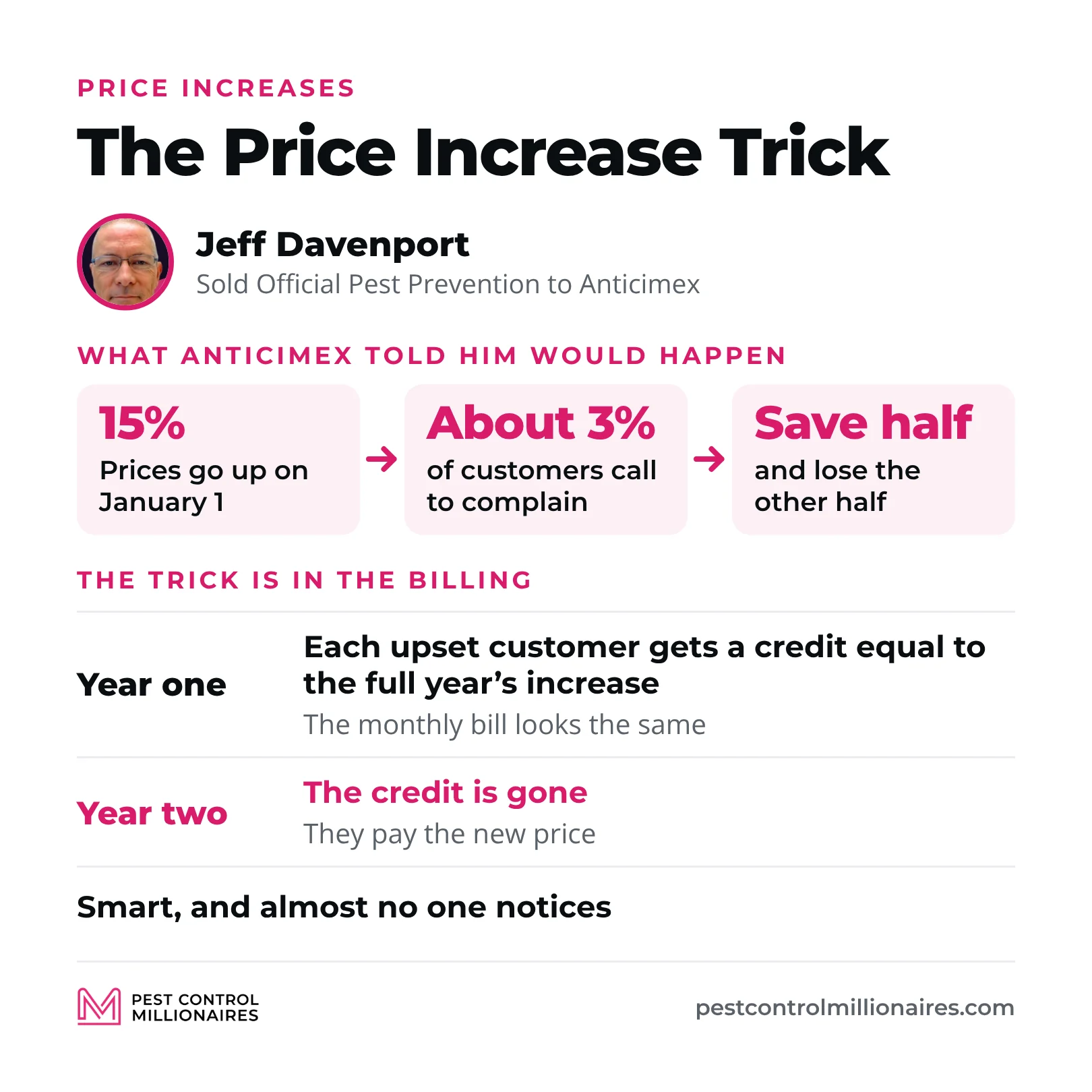
Anticimex taught Jeff something smart after the sale. They raised prices 15% on January 1. They told him exactly what would happen. About 3% of customers would call to complain, they would save half of those, and lose the other half.
The trick was in the billing. They gave each upset customer a credit equal to the full year’s increase. So the monthly bill looked the same that first year. Then year two, the credit is gone and they pay the new price. Smart, and almost no one notices.
Don’t take momentum for granted
At Official, Jeff got around 200 customer referrals a month. He thought that number was small, and he wanted way more.
Then he started Prize from zero, nobody knew the brand, and every single customer was a fight. Now he closes about 1 in 3 inbound calls and about 1 in 5 form leads.
The lesson is clear. Momentum is a real asset, so when you have it, do not stop.
The chase beats the finish
Here’s the thing I keep coming back to. Jeff sold his company for life-changing money. Then he went right back to work with no long break, and he even felt a little down when it was gone.
Why start over? His answer was simple. “It is a lot more fun and a lot more fulfilling to chase a goal than to achieve one.”
He was also honest about the stress. He used to blame his anxiety on the company. Then he sold it, and the worry was still there. “You spend a lot of time worried about certain things that you think are going to destroy you that don’t,” he said. His dad used to tell him, “a coward dies a thousand times but a brave man dies once.”
Find people who have done it
I asked Jeff for his best piece of advice. He didn’t hesitate, and his answer was to find mentors.
“The path to success is going to be a lot slower if you have to figure out and solve every one of your problems alone,” he said. Someone who has been there can save you years.
That’s why I do this podcast. Guys like Jeff have already paid for the lessons, and we just have to listen.
Full transcript
Every word of the episode, from the video captions
Well, we got a special one for you guys today. Super excited. But welcome back to Pest Control Millionaire. This is episode 141. We have a stud in the industry on. I've heard a lot about him. He listened to a lot of podcast. We talked a little bit before the show started. Jeff has built and sold one company already with a massive exit. We won't go into too much detail about that, but it's a big one. And now he's starting back over. I don't know how long it's been, so I get to hear your story. Jeff Davenport, welcome to the show, buddy. Finally get to get to connect.
Yeah, very excited to be here. Thanks for having me. Yeah, it's like I said, I've heard a ton about you from Jake. You've listened to a lot of the podcasts. We don't really know each other, but we know a lot about each other. So, it's finally good to meet you face to face.
Yeah. Again, yeah, happy to be here. And yeah, looking forward to talking.
I'm excited, too. Like, I know that you have a ton of knowledge in that brain of yours. You've been through a lot in the industry, but you've been in the industry a long time. So, there's going to be some gold for everyone, including myself, to learn from you on this one. But so I started out the podcast kind of the you get the you get the routine here. But you and I go way back, you know, high school. Who's Jeff Davenport? If you're like a junior senior in high school,...
I graduated from high school in 1990. And my parents had recently moved to a different town. So I started high school my sophomore year at a in a place where that I didn't know anyone. And so I feel like I was trying to figure out, you know, I was growing up. I'm a teenager and I was just trying to figure out who I was. I played baseball in high school and but I was the new kid the whole time I kind of felt like and so I felt a little bit separated from like most of the high school kids. I didn't grow up with them or, you know, I didn't have a lot of history. And so I worked quite a bit. And my family freedom was kind of all about what you could pay for. My mom and dad gave us quite a bit of freedom, but they didn't pay for our stuff. So I was motivated from a pretty young age to h to work and make money just so I could do stuff I wanted to do. So I kind of equated financial success with with freedom.
And so I, you know, I had from a pretty young age I had paper routes and I worked summers, you know, and yeah, at the time, you know, I would have complained about it to you if you know, because I saw my friends could go to their parents and you know, get 20 bucks or, you know, whatever, but not not me. And so I it was a gift though because we learned I was became pretty independent and so I worked a lot. I had job jobs. I worked on farms and I mowed lawns over the summer and I worked at Pizza Hut and had paper routes and stuff like that.
That's awesome. So, yeah, when I was growing up, I was soon as I got my license, I think I was a sophomore, say a sophomore, and I didn't necessarily love school that much. So, they had a new thing come up called school to work. I was like, that that sounds like something cool for me. So, I get up at 4 or 5:00 every single day. Okay. I go to work from 6:00 till 10:00, 10:30. And then I go to school from like 11:00 till 3:00. Then I go to, you know, rest and practice after that. And then all summer long, like I used to play baseball when I was younger. Should have ran track, should have played baseball, but I decided I like nice things at that time. And I loved working and I like to have like the cool car and the big subwoofers and loud music and it was fun. Like and I look back on it, you know, I learned a lot. I came from like I'd say a middle upper class and we probably had more money than most people, but we weren't rich by any means either.
But I loved to work at a young age and I grew up on a farm with my dad. My dad hard ass worker. He's up at 4:00 3 4:00 every single morning working out in the barn, then going to his day job from 7:00 to 3:30. Then he get done with that and he's a fer and he go shoot horses. So I literally watched this man work his entire life and I just I loved what he did and so I was like I want to be like him, you know? I was bailing hay in the summers helping him up in the hay loft screwing around as kids. But yeah, that was kind of my upbringing too. That was...
And you know, I always wanted to go deep like into into things. I was so I was motivated to work a lot of hours and very few jobs would give me the kind of hours I was looking for. So I was always looking for to have more than one. And then I was especially attracted to jobs like farm work where you know long days and then and I think that's kind of what I what appealed to me about pest control and sales is because you can work as many hours as you want when you're straight commission your your boss is not worried about overtime and they're they're encouraging you to really get after it and then you can kind of do the math and really max out what you what you're able to accomplish with your time.
Yeah and there's just not enough hours to go work a 40-hour job getting paid by the hour. Speaking of that, I think I was making 515 at the time and I remember getting a raise to 535 and thought I was just balling out, you So then where do you go where do you go after high school? What happens there? Where's that transition?
Well, so my family was Mormon and so I went to be so I went to college. I went to BYU.
And my parents had really primed me and my siblings. I'm the oldest of six kids to work and save money for college. So, I'd kind of done that my whole life thinking I need, you know, and tried had tried to save for that. But, so I went to BYU and then I went on a mission. I served a an LDS mission in Washington DC. So, I was there for two years and that was sort of the preparation for of sales. I mean,...
Course it was man. That...
For for me, the experience was very corporate. You know, you've got this corporate structure of, you know, all the missionaries that are there and you're in a group. You've got a mission president and mission assistants that run that for him. Then you've got zone leaders, district leaders. And so, it was like this, it was a very corporate experience. And you learn how to how to encourage people to make commitments that are good for them, right? And so, you know, you're and you and the other thing I learned there was, man, if you know, the whole concept of you got to talk to, you know, 250 people and then you're going to have a few of them that are interested and you're going to have even fewer of those that move forward with, you know, whatever you're trying to sell. And so that's where I kind of that I realized I you just got to be rejected by the right number of people and you keep going and eventually there's success and man with with religion that was a that that number of rejection was enormous you know I mean it was just huge and so...
Where where was your mission at again? So it was Washington DC was really it was called the Washington DC South mission and I was there from 91 to 93 but I really served in Northern Virginia. So Arlington, Alexandria and I didn't spend a lot of time in the District of Columbia itself but it was called Washington DC.
Right on. And then from there you go back to Utah and then did you get recruit? Was door knocking like a big thing then? It was not, but not at all. In fact, but there there was a pest control industry and my roommate, so I was roommates with a guy from my high school and we spent I spent a lot of time my freshman year in at BYU. We spent a lot of time with his cousin and his and his cousin's roommate. These are two guys who had sold pest control it before they had sold pest control in n the summer of 1990 and they came to school and they had made enough money to pay for school. I remember one of the guys his name was Jory Anderson. He's from Sunnyside, Washington, which and I'm from the state of Washington, but we didn't know each other then. But anyway, he had made in four months.
And that doesn't sound like a ton. I mean that's a lot of that's a lot of money now but doesn't sound I mean but in 1990 that was...
Crazy money like that was that was as much as a lot of families made and so he made enough money to pay for school and I just I and I got to know him well and I just I didn't really know what pest control was but I figured if he can do it I can do it and so I right I just decided then I was doing it but I didn't I didn't go the next summer he went he sold in 90 and then he sold in 91 I went home for that summer because I knew I was leaving for to Washington DC. So I went home, worked at home and then when I came back I got back in 93. I went like I got back in October of 93. I did another semester at BYU and then I sold pest control in San Jose in 1994 for a company called Eclipse Marketing. Yeah, I remember the only door-to-door option really...
Back then I mean there were there are other door-to-door sales options but pest control was the only big one and there it was Eclipse Marketing, Apex which became Vivint and then Saleset and Saleset was the one the one that started it all. You should have Scott Harmon on your podcast by the way and I can help you introduce introduce you. But he's like he's he really is sales rep number one. I mean he started sales both Eclipse and Apex like were former sales reps with his company that started their own. So as far as I know he's the he's the guy OG.
Yeah. But so I sold a 94 in San Jose.
Are you sick of paying marketing agencies and not getting results? Well, we are hosting the number one step-by-step class on how to attract and generate sales without paying market agency or having a huge budget. Most lawn care and pest control owners get stuck at a ceiling because they're dealing with outdated systems or relying on guesswork waiting for the phones to ring. Our upcoming class this Thursday provides proven strategies to generate hundreds of leads without a huge budget. We'll show you how to build a predictable systems to grow past a million dollars. We show you how to automate your marketing. We'll also teach you how to delegate and build your team so you have more time. So, click the link in the description below. Trust me, you're not going to want to miss this. This is the one thing that I wish I had learned a lot sooner. Now, let's get back to the show.
What was that experience like?
It was a little scary. I didn't really know what I what I have what was what I was getting into, but I just knew again my friends had done it. They figured it out. I could do it. And I just put everything into that summer. Worked super hard. Lots of hours. Probably not as smart as I could have worked then, but I was you know, of those three companies I mentioned, Eclipse was probably the smaller of those three. I was the number one sales rep for Eclipse that year. I sold like just over 300.
Yeah. So 300 then I mean I went on to do a lot more later but 300 then and I think you I came back to BYU that s that the end of that that fall and realized there was a sales net guy who had sold 400 you know. So I thought here I thought I was doing well in my little pond but I found out somebody else had just crushed it. I think Kevin Olsen who went on to start Preventive Pest Control in Albuquerque, New Mexico, he had sold 420. So I instantly sought him out. I think it was 420. It might have been 460, but it was a lot. He crushed it. And so and he had been in Fresno I think Fresno Bakersfield is what they called his area. So I instantly sought him out. I wanted to know what he did, what he said, how it worked, and we became friends. And we're we're friends. We're good friends now from that you know interaction.
That's awesome. What was it like selling pest control in 1993?
So it was 94 in San Jose. It was fairly new. Most people that you knocked most people we knocked on did not have service. So it wasn't a lot of switchovers and it was monthly. So we did we did service every month. I sold for the service we sold was $29 a month. And I sold for a company in San Jose, a company called Dewey Pest Control. We joked around because our shirt said Dewey and after we talk to everybody and get rejected, they'd all say bye Dewey and they thought that was our name. But it was so it was good. I it took me a while to kind of buy into the product. At that time I had no monthly bills. This is way before cell phones. So I didn't pay for anything monthly. You know, I saved up and paid my tuition, right? Or, you know, this kind of stuff. But I didn't know anybody monthly. So, it was kind of intimidating to me to get people to sign a contract yeah. To me, I this was something I would never purchase.
Because it sound like a lot of money. You didn't own a house then. So, why would you why do you need pest control?
Yeah. It's not a bachelor guy kind of thing, you know, and so but eventually I figured out, you know, that it was a product people wanted and I could sell it and you know, the so the first day we went out, we sold for probably like half the day and I sold two and then and then I remember the second day I was the only guy me and this other guy were the only two that didn't that zeroed and I remember just being crushed. But then one of the guys in our office had sold five that day. And so I went to his apartment and he his name was John Anderson and he I went to his apartment and just again made him tell me everything he said and how it worked and how he got five and just tried to copy him and he was he I think so he was in our office and he was a much he was he was a little bit older than us.
I mean, now it would be silly to call him older because he's probably like three years older than me, but...
Right. Right. But three years at 19. Yeah. I mean, you mature a lot.
Yeah. So, he was he was more experienced and I learned a lot from him and man. So, anyway, that was his his help was a big part of my success.
So, do you think it do you think it was more of what he was saying or do you think it's something else?
No. Well, I didn't I mean, he explained what he said and you know, at the time I didn't really get it to like really apply what he was doing.
Life. Yeah.
I was like, "Okay, I'll say that." But I remember he drew this picture of a house and then he just he kept saying, "Well, I just tell them they got to have it." and I think but I really I watched him knock a door and I watched my our manager who actually had had sold pest control the year before and I remember them actually trying to negotiate seeing them kind of shadowing them on the doors and seeing them talk to people and just kind of push further and then and bring the price down to try to negotiate a deal and seeing that work effectively. So, I just kind...
Yeah, I think as a rookie, you're just again green at life. You don't want to push too hard. You don't really know what to do. Then it's like, okay, now you see someone that just overcame three or four smoke screens or objections. You're like, dang, how did you do that? That was like And then it's like, okay. And then then you start doing it, then it finally clicks. Like, oh, I can do this. And then from there it gets easier, you know? But and for everyone it's a little bit different.
Yeah. Exactly. I didn't like selling very much. I felt a lot of pressure. I kind of felt like in the beginning of well until recently and even now I felt like I worked out a negative emotion more than positive. Like I sold really hard because I was afraid to zero. More than I wanted to get 15. Right. And so and I re I wish I would have done the opposite. You know, sold to build, but I was, you know, I was terrified that I'd go back and look like a failure. And so I think trying to not zero is what motivated me to get going early and work.
Yeah. Because I'll ask that question all the time like would you do you do you hate losing more or do you love winning...
To you it sound to me it sounds like you hated losing more.
That's the way I played baseball for sure. Afraid to strike out, you know, hating to strike out more than more than loving to win, you know, and I think, man, it took me a long time to love building and wanting to do that. I mean, fairly recent phenomenon. I think the last part of my career at Official Pest Prevention.
Gotcha. So, then how long do you go knock doors or how many years you end up knocking doors for someone else? So I knocked every year and then recruited sales reps as well for that company, Eclipse Marketing. So I in 95 I but well but in 95 I managed an office in Atlanta under the Eclipse Marketing model. That meant I didn't knock doors. I was kind of the trainer for the sales reps. I would make sure their stuff got serviced and try to keep them motivated, but I didn't knock doors myself. It was most it was like an admin position and a sales trainer. So in 95 I was in Atlanta. 96 I was a manager but I sold every Saturday in and that was in 97 I was in Charlotte and my I at this point I was married and my first daughter, my oldest daughter was born in Charlotte, North Carolina during that pest control summer.
But I sold then. So I went back to selling. I realized, hey, I can make more money selling. And this is well and maybe I this is before I think I think some of the teams now it's a it's all about recruiting and commission for on your recruits and stuff like that but at least at this point and with Eclipse it wasn't so I started selling I sold 7 like 25 accounts in Charlotte and that went well and then I kind of saw the light I felt like hey I can even do better than that and in 98 I was in Tennessee and then and I sold over a thousand accounts in Tennessee. That was my goal. I kind of felt like, hey, I can do a thousand accounts in four months. And I set myself up pretty well for that. I we went to Nashville and there wasn't a lot of competition there. I went there with a small office like me and like five guys, four or five guys I'd recruited and you know so we'd have like the pick of area and yeah went there did that real proud of that accomplishment and then in 99 I sold in sorry in New Orleans.
But that was a short summer. So in 90 after I gradu I graduated in 98 and I and I went I decided I wasn't going to do a pest control company at this time I went to Southern Methodist University in Dallas for grad school and it was a direct MA PhD program for history. So, I was hoping to teach history at the university level and so started a PhD program at SMU and then that we needed to do some language training because I had to pass a language proficiency exam. So, they sent us to Guatemala to learn Spanish and so I worked that out to do that for six weeks. So, I went to New Orleans. I sold with my youngest my with my next oldest brother and for for about six weeks and then I went to and we sold a lot then. I think I sold like over 400 accounts and just we sold a ton there. It was it was really good. And then and then I went to Guatemala and then came back for school.
That's awesome.
Sorry that's a that's a lot but...
No, that's great. When you were when you started recruiting back in 95, what did recruiting look like then?
Well, you know, one interesting thing about pest control then, so it started in California. Most well, most teams went to California, right? And so, we weren't even sure how well it would work outside of California. It sounds silly now. And then, you know, it was like, okay, it's got to be California. Okay, well, maybe it can be in southern warm climates only. And then oh okay well maybe it can be anywhere and it's all about the and then the other thing there were certain areas it seemed like people would always want to go to offices that had done really well the previous year like oh it's super easy in Las Vegas or oh it's everybody's you got to go to San Diego right or don't go to those places if it had gone badly and it took us a while to figure out hey it's all about the sales rep and who you send there and which sounds obvious now but at the time also people were hesitant to go back and in the beginning people were hesitant to go back to the same area that had just been done because they oh everybody's sold there right and but we were learning and then people I remember also people wondering how long pest control would be a thing until it was done right for whatever reason but so recruiting was kind of challenging you know it's a door-to-door job and at the time like the people they would put our pictures in the in the p in the school newspaper and it would say how much you how much money you made underneath and a lot of people would ask me about that because they would see those ads and we had a lot of pizza.
We recruiting was a lot of pizza parties like the company would offer free pizza to whoever showed up and then they'd talk about the So that was mainly what we did. And then and then your friends and kind of your...
Yeah, that's really cool. So then at what point did you decide, hey, I'm gonna go do this thing on my own?
So the I love the that PhD program was great. I really enjoyed it and I like history. I love reading history and non-fiction books and but if you want to get an academic job in history, you really need to do you need to go somewhere Ivy League. I mean, mo if history departments are shrinking, there's they put out lots of PhDs and schools want their faculty to come from those places. And so, it's tough if you're not if you're if you don't have a, you know, an Ivy League degree or a big big name school. And so, I realized that SMU was not going to get me there. That was going to be junior college or high school, you know, teaching or and that I really wasn't interested in that at the time. Most of the people graduating from our program were getting like one-year appointments to teach somewhere, which is rough because you move across the country, you teach a lot of classes that you haven't taught before.
So, there's tons of prep and then you don't get picked up and you got to go find another job every year. So, I just I didn't want to do that. And then about the same time, my brother was in an engineering program at BYU and he had sold for two years. He sold with me in Nashville. He sold for with me in New Orleans. So we started talking about the possibility of sell of starting a pest control company. And then also we got to know the branch manager of Orkin at at New in New Orleans where we had we had worked and we had to do some reconciling of our accounts with him. So, we were calling him and he was super encouraging. He we talked to him about what we were thinking about doing and he was like, "Well, man, if I were you guys, I would do that." Because he's like, "You guys put us on the map when you were here." you before you guys came, we were nothing. And now we had we made $50,000 in profit last month. And he said, "That's all accounts you guys put on."
And at the time, we were like, "Wow." and we thought maybe we should consider that. So before so we kind of did it out of necessity though both of us felt like plan A was not working and pest control seemed like a pretty good plan B. So we decided to do it and I'd been at SMU for really a year and a half. I'd completed the all the coursework for the master's degree and so I all I had to do is complete my thesis. I could do that from anywhere, you know, and then and I could get that degree. So I it was a good point for me to jump out. Jamie, my younger brother, wasn't worried about completing. So we jumped out and then it was just a matter of figuring out what city we were going to, you know, what area we wanted to go to.
Yeah. Because you said earlier in the podcast that it seemed like everyone went to California. That's the only place you could sell for. And if I remember correctly, that's where you guys started, right? Yeah. So, we went to Sacramento, but you know, it didn't we kind of considered a lot of places. The first thing we did was we took a road trip to visit everyone we knew who had started a pest control company. So, we got in my brother's car and he came he drove to Dallas and then where I was living and we took off. We went and we visited a guy named John Sanders who had started a pest control company in well first I guess there's there was Barrett Pest Control in Dallas. We visited Nathan Barrett who I had known at Eclipse. Then we went to Las Vegas and talked to some friends there who had started a pest control company the year before and his name is John Sanders and he's actually selling solar now I think still for Vivint.
But then we went to see the Preventive Pest Control guys that were in Albuquerque. The guy I told you about who had sold over 400 in well when when we were in California in Bakersfield in Fresno. So anyway, he was in Albuquerque. We saw him and then I went to see a friend of mine named Mike Laauo in San Diego. He had started a pest control company called Pro Pacific and had been in business a couple years. So, we just, you know, we were looking, we were really just looking for some encouragement and you know, we needed somebody to tell us they thought we could do it. I mean, we asked them questions and tried to do homework like we were preparing, but I don't know that it was really much preparation for what we were about to face as much as just, you know, yeah, you guys can handle this and, you know, kind of the bro hug we needed from...
Yeah. So, what made you choose...
Yeah. So, Eclipse. So, and we also wanted to look at some cities. So, Eclipse Marketing had an office in Walnut Creek, which is like a suburb of the Bay Area, San Francisco Bay. So, we went there thinking that might be a good place. And on the way there, my father-in-law had suggested we look at Sacramento. And on the way there, we went drove right through Sacramento. So, we drove through Sacramento to look at the Walnut Creek area and San Francisco Bay. And just liked Sacramento more. Just seemed like it had more of the type of housing we were looking for and like preferred that...
So then you guys just set up shop there,...
Yeah. So that was we drove and we drove through we looked at a lot of the area because we were planning on knocking doors. So we drove through it looking for the kind of stuff we wanted to knock doors on on in and we settled on Elk Grove as kind of our where our office would be. We rented a little office warehouse space in Elk Grove, which is south of Sacramento. And the thought was that we would cover we if we went an hour in all directions, we could cover North Sacramento down to Modesto. So, we'd cover Stockton, Modesto, and all...
Yeah. When you first started there and envision this thing that did you ever think that you're going to grow something that of that size? Not at all. Yeah, if you would have told me then what was going to happen, I just wouldn't have believed you. My goals were pretty small, you know. I thought that I would we'd run this company, we'd sell it at some point and you know, make some money from it, but we'd move on to something different, maybe teaching or something...
Yeah. And so, your first company, what would you name that one? It's called off. It was called Official Pest Prevention. We named it on the road trip. We were trying to just think of something that sounded official, you know, something that sounded like because at the we wanted it to sound like it could be a large company, something like Orkin or Terminix, you know, that when we when people heard it, they might think it was corporate, which is funny because now the trend is local and family, right? You know it would be Garcia pest control or something like that. But yeah, so we picked we wanted it to sound official and then anyway we some pretty soon we just named it Official and then we chose pest prevention just because we thought it kind of told people what we were trying to do.
For sure. It's actually a smart name. I mean the name of what you do is right in right in the what you do is right in the name is what I was trying to say. So what was like your first summer? You I mean was it just you and your brother?
Yeah. So Jamie and I sold and we had a another younger brother that sold with us. I Yeah. And so the three of it was it was the two of us and then him. So and then eventually the three of us just knocking doors and man we worked a lot. So we hired a technician from...
That's my next question. Yeah, we hired it. We didn't know anything about the service and we didn't have much respect for the service. You know, to us it was like mixing water and whatever and spraying it around. How hard can it be? And we would learn. But so we hired a technician who was familiar with the door knocking programs and the kind of volume they could generate. So he came in and kind of taught us how to do service. And then Jamie, we had a friend come in and was a tech for us. His name was Randy. And then yeah, we just started hiring people. That that first guy trained us. He didn't last very long. He kind of moved he moved on. But he trained our first few people. And we did about I want to say we did almost 2,000 like around 2,000 accounts.
The three of us that summer. So, we ended up with like four routes. Well, I don't think we did. We must not have done two. I'm think maybe we did more like I know 15 to,800 accounts is what I'm going to guess we did. And then the second summer we hired reps. So, the second summer we decided we wanted to Well, so we started in we started knocking doors in like April and then we probably went through September. And I we were we were questioning eventually we would knock doors year round and never stop and because it doesn't snow in Sacramento and you can do that. But at the time we didn't think you could. We thought, oh, in the winter, can you even sell this? And so we stopped in the fall thinking, oh, it's too cold. People don't see bugs. And just kind of ran the company and tried to train our techs and get organized.
But man, we worked a lot. We would knock from we'd knock late until like 9 9 10 o'clock at night and then we'd drive back to the office and we didn't have gas cards in our trucks. So we I would take the trucks and gas all of them up. I think we had like six. And then Jamie would sit there and fix pump problems because we had electric pumps. So he'd fix these pump problems that people had had or whatever equipment issues there were. And then so we'd get out of there pretty late and then one of us had to be there the next morning usually at like between 5:30 and 6 to get the first person out and that would show up and because they would show up and run their routes and then and then come in and check out with our just our office manager that we had hired. My wife started in the office and then trained some people that would sort of take over for her.
And at this time was there any like any good softwares or is it all pen and paper spreadsheets?
No, we use software. We used a program though called SPCS.
Never even heard of it.
It was not like a web-based like login, you know, so everything was saved on a on a on discs and it didn't it was pretty it was pretty primitive, but we lived it was it was inexpensive and we used that to schedule and do our billing. For years until we couldn't I want to say we picked up we would eventually switch to FieldRoutes maybe after eight or 10 years things got too big for that software program.
Yeah. And then what like as far as I know you said that next time you hired some sales. What was the pay structure back then? It wasn't very much has really you know with competition has really gone up since then but so I want to say we were earning or paying maybe it was between 25 and 30% sales reps and yeah and so we actually recruited people that we knew or knew of and had sold before. So we were looking for veterans who could put down a lot of numbers. So, we were hoping to have a smaller office but still sell a lot. I remember as far as financing, we didn't borrow any money. We had we I think we each put in 40 or $50,000 and that and we made it on that the first year. We started paying ourselves a small salary in like July.
But you guys are also putting on a ton of accounts yourselves too.
Yeah. We had no almost no commission first year and then the second year. So same year we recruit these guys. We get like four or five guys and they were all pretty good. They had sold before. I think I think we had one guy that was a friend of Jamie's we knew who hadn't sold before and then we had like four pretty solid veterans and they probably averaged like well over 500 like you know five five to 600 each you know. So I think we put on let's say we put on like 200 accounts that summer.
That's cool. Really cool. And then how long do you keep knocking doors for?
Well, so door-to-door sales was like our we were a we were like a football team that runs up the middle only, you know, that's all we did. And so we just did that for like 12 years. We spent zero dollars on marketing. But we switched to local recruiting. So we got tired of going back to BYU even after the or you know because most of the recruiting was done in Provo then. And we just figured we would find local people and teach them how to sell, manage them, and do it that way rather than all these try to try to compete with marketing companies that were...
Yeah. And at what point did you realize that you were sitting on something pretty big?
That took a long time, you know. We were pretty isolated and you know how you just always have the that moving goalpost as a goal, you know? So, whatever you accomplish this summer, it's like great, on to the next thing. We've we were not the type to celebrate a small victory or you know it was always on to the next and so we never really felt like we were significant you know we kind of woke up one day and the company was large. You know, when we sold the company, our our final year, so like the last two or three years, we kind of woke up to, you know, hey, we were bigger than a lot of the companies that had that we had really looked up to for a long time. And you know, our last year we did was 22. So we sold the company in December of 21 and we ran it for another year.
So at the end of that ye last year we were 20 million over 20 million in annual revenue. We had 170 yeah. Another thing we so another thing another accomplishment I'm kind of proud of that last year we put on over 11,000 new customers.
So awesome.
And that was kind of like a like a crowning achievement. That was that was...
Yeah. Were you still out knocking? Were you still training? Were you still...
So this is So we knocked doors with local guys year round. So soon as we started hiring local guys, we realized, hey, we don't want to shut this down over the summer and recruit over again. So we're just going to go. And so we went year round. And often our strategy would be we would we tended to knock we well we would try to knock higher income kind of neighborhoods, but we would drop down and knock a little I don't say well anyway lower income neighborhoods in the winter time that might have more pest problems and we just tried to go year round with with those reps. We usually had anywhere from five to 10 guys. What was your turnover with those with those guys then? Is there a lot? Were you constantly hiring?
We were regularly hiring, but we had a core of people that stuck. One guy we had a sales rep that knocked with us for gosh like 12 years and year round, you know, and...
Yeah, he was a machine. And he did well. He spoke Spanish and well, English and Spanish, right? Yeah, so we had a core of people that would stay pretty long. And then we would add, you know, but we would add people to th to that group that would sell for, you know, few months. You we of course we had that. But then, you know, like anything, I mean, some of those new recruits would become the older veterans over time.
For sure. And so you kind of already brought up the selling. How did that come about? Was it did you guys take it to market? Did someone approach you? It's just you and your brother like how does that all come about? So we had no plans to sell the company and didn't really want to but we so in 21 venture capital was just after pest control you know...
Right yeah and but and so the I mean when we when we were we knew we would sell it someday and so we had kind of explored that thinking well you know we want to be prepared for this and kind of know what that journey is like. And so we had talked to Orkin and Terminix a little bit about hey what's our company worth and but thinking that was way down the road like even when at the time we' sold I was like 49 in I think in 21 when we sold it but so I mean I had a lot and still do I have a lot of work years left I'm 53 now but so valuation when when in the early like right in the beginning you know you always hear of companies that sell and what they s sold for and it was like a dollar to a$130 per dollar of revenue which could be a lot of money but you know what wouldn't be like I never have to work again kind of a thing and so it's just kind of okay it was a good thing to do as when you want to retire is how most I think companies sold but then that that kept hearing about the dollar figure ticking up and In 21, my brother was listening to a podcast, Dan Gordon's PMP Yeah.
Industry Insiders. Yep.
So, and you know, realized, wow, you know, it's really high now, like you know, that multiple had really gone up. And we, you know, we did some math, realized what our company was worth, and I don't know that we really necessarily wanted to sell as much as just, wow, this would be a time to get because, you know, this would be a time to get some like some chips off the table. I was just going to say take some chips off the table. Yep. Again.
Yeah, we had felt like man lots everything we've got is really in this company and you know there's some moments where you see you wonder if it's all over. And so...
What do you mean by what do you what do you mean by that? Like you say by there's some days where you think like it's all over. Hit on that. Hit on that a little more. I mean I know what you mean but...
Well just things happen you know someone is when when your company reaches when once you're over like 10 million someone is always suing you know there there is some there's a couple car accidents that you're still dealing with. There's you know employee issues. There's customer things. There's just some you feel like some someone's always after you. And so you spend a lot of time...
Never ending...
A big target. You know what I mean? You really are. You're untying knots and man you always feel I mean you hope you'll in think you'll probably weather those things but you also realize you know that that you're you're hoping things go well and there's a lot out of your control you know you don't know the background of everybody you've hired you try you do your best but...
Yeah get you know 80 trucks on the road it's just a matter it's not a matter of when they're going to get into an accident or if they're going to get into accident just when and then how many times a And like that that stuff keeps you up at night. You know,...
One when when we had been in business about about two or three months, we had one of our technicians, a lady turned left in front of him on like one of those two-lane 55 mph roads. And he that collision was so violent. I like he was he was actually okay. Called us and I went out. I was close. So I went out to see what was going on. They liflighted the lady out on a helicopter and there were pieces of truck everywhere like in fields. It was just I just couldn't believe it. And that was scary, you know? I mean, you want everybody to be okay, but you're really hoping we didn't cause this, you know, and luckily that wasn't our fault. But anyway, but just stuff like that. I had we had so all kinds of little instance like that. So we you know we so back to the selling thing I guess we decided hey this would be an opportunity to kind of diversify a little bit and not have to worry about that kind of thing.
And so I we our my brother talked to Dan Gordon quite a bit told and Dan told him what he thought he could get for our company at the time. And I think ar and we felt like it was kind of a special moment. Anticimex was had built out their so Anticimex was the was the big buyer then and they had built out an east coast presence you know like this they purchased platforms that they had planned to build around for quite some time. They were starting to do that on the west coast and our company gave them they had purchased a company in San Diego that gave them from San Diego to a lot of LA. We really gave them like Sacramento to Los Angeles. And so we were attractive to them in a way that we might not be so unique later.
Yeah. Because again, that's what they're looking for, you know, like you get a higher multiple if you're if it's more of a strategic buy. They always want to get into that market. So now they're connecting the two markets together.
Yeah. So we were a good fit for what they were trying to do. And yeah, and it was super fast. So in October of 21, Jamie starts talking to Dan Gordon and that thing is wrapped up. That deal is done before the end of the year around de you know the before the end of December. Two months where most of those things can drag out for six months or more. We Yeah, that thing was what? We got it all done. That thing was like Jamie's full-time job. So, I kind of shifted to running the company and that became Jamie's like full-time job just getting them all the due diligence.
Yeah. What was the what was the due diligence process like? Usually, they're like really long and cumbersome and...
Yeah. They wanted to look under the hood and see that you're for real, you know? I mean, they want to see profitability. They're looking at your structure, your team, who if they can run this thing. They're they want to know how you run things, how you how you pay, what kind of liabilities they're going to be picking up by purchasing your company. Although...
Was that was that time stressful for...
Yeah. You know, you're because we're trying to make that decision. Do we really want to do this? And man, you feel this affinity for your team and you know, we I really enjoyed work. The last, you know, as the company grew, I enjoyed it more and more as far as what I was doing. And in the beginning, I did it out of necessity and didn't like it, you know, as much. I was kind of, you know, like we had talked about, I think I was sort of playing the game to not lose. And then towards the end I was really doing this to build the company. I really enjoyed working with employees and being a part of their growth and you know professional journey. We really became we really shift we really shifted into that.
One of the things that we did, you know, in California, it takes 60 days to get somebody licensed. And that's if they if they do everything right and pass the test, right? And it can take if they fail, it's going to be 90 days. And so we had created this little pest control licensing academy. You know, we had we had like just in our Sacramento office, we had probably in the summer 10 or 12 people that were getting licensed all the time. And so we had them we had a lot of people in this little academy part-time and they would often work a full-time job and then they would get licensed with us and we'd pay for pay them to be in there and pay them to get licensed but we'd have them in there and then we'd pull them out as they became licensed and were ready and then we also got to you got to learn a lot about these people. So before they were full-time and hired, we would, you know, we it's almost like a two-monthl long job interview.
But I really enjoyed that process where they would come in. I'd see them go from, you know, and for a lot of technicians especially and sales reps, this is their first real job. So, you know, you pull them out of retail or something like that, but they a lot of these folks would come in and you they' just gotten married or had had a child and anyway, so being a part of seeing them seeing them grow was great. So, anyway, I'd really en I started to enjoy that part of the business. I really enjoyed the marketing and the challenge of acquiring customers and competing a little bit for them. And seeing the company grow and having to install new managers. At the time we sold, we were sort of building like a seuite team of people to help us. We had just hired a really talented human resource person and we were, you know, we were kind of positioning the company to grow with other people.
We did a lot. There were three owners at that time, myself, my younger brother Jamie, and then we had brought another brother of ours into the company through an acquisition. We purchased a company he was a part of that was in Fresno.
That's really cool. I have a lot of questions. I just thought of that. Did you have a full-time recruiter at their...
For hiring? No. We had we did a lot. I mean, we did too much, I think. We had a good team and people that helped us. We had a I guess we had a part-time person who did resume screening and she would send resumes then to me and I did most of the interviewing and hiring. Trying to think if there's anybody at the company that would get mad if they heard me say that because they did. Because I mean obviously other people did some stuff and as as the company got larger, we would involve other people in that interview process so they could kind of weigh in on the selection.
Yeah. Knowing what you know now, would you still sold?
Yeah. Yeah, I would. And you know, I think because I felt I felt like it was such a growth experience for me personally and the way I worked my life was way out of balance. I mean, I worked a lot and my mind and attention and focus was always on the company. Even when I was somewhere else, my mind was on...
Whatever was going. I could be having a conversation with someone and talking to them, but in the back of my head, I'm thinking about something completely...
Yeah. Yeah. And it was so hard to be like even you're going to a I would be going to one of my kids school activities or in a conversation with my wife and sometimes my wife would say, "Hey, where'd you go?" or "Where are you?" You know, because my eyes are glazed over and my mind's just going, "I can't shut that off." And so, I was gonna miss I could easily see myself working in that business until I'm 70 or 80, having missed a lot of really important events. So, it was a good wakeup thing for me. We when we sold the company our in our agreement we had to run it for a year with an earnout and with an earnout goal and we did that and I learned a lot working observing.
My next question is what did you learn through that?
It was great you know that year. So, Entity Mix, every five years, I think they have a really big retreat where they bring all their managers, platform managers and branch managers to Sweden because they're based in Sweden. And that year, so we sold in 21 of December, but that next year in 22, they had this retreat and we went to Sweden with them. And I really enjoyed meeting all of their other platform presidents and all the managers they have and just seeing how they operated, how they talked about their companies and things that they were doing. And they were big about sharing, getting people together and talking about what worked for them and what didn't. There there were there were all the people from Australia. They had just purchased a company called Flick there and a the Australians showed up and talking to those guys about how pest controls done there was fascinating, you know. Like for example, they thought it was strange. Most of their services were one-offs. Like they would do these one-time general pest treatments, but then they would charge a lot for their...
Ter $400. I just had the same conversation two weeks ago with another guy from from Australia.
And I'm like, we do all these inspections for free, which is ridiculous. We spent two hours doing these inspections for free. And then and then but yeah, we have this culture of regular pest control. And it was it was just interesting seeing it was like, you know, very different.
Really cool. Is there anything that surprised you through the selling...
Not really. Our you know, we used a broker and I would not I think that's an important...
Gosh if this is a you're going to drop a bomb right here. This is every person should because I mean I see all the time be like what should I sell my company for? I'm like...
Oh man broker.
It's I mean they guide you through that process. Now, you have to realize most like if you get a big broker, they're going to do a lot of business with those companies that you're selling to. And so, you know, they're not I mean, they are on your side and they're representing you and you need to find somebody that you like. And Dan Gordon represented us well and they can tell you a lot of what's coming and explain, you know, they would he did a great job of telling us, okay, this is the meeting we're going to and this is what they're trying to see and this is what's going to happen.
Did you have did you have several companies bidding on you at the time or is it just Anticimex?
It was really just Anticimex very quickly. I mean it was kind of shocked to ev everybody but very quickly Anticimex was the one left.
And then so the day that the first closing happened before the earnout you woke up to a different number in your account your bank account. What was that...
Yeah that was weird. You know for me the you because we were because we had a the earnout I had I had a year to like run the company and be like an employee of Anticimex. So it wasn't like this it wasn't like this abrupt thing yet then. So I so the next day like the money I mean although it was nice to not have to worry about you know all the things that you have to worry about when you're running the company. So that I think that was the biggest relief. I mean more than just so the money was you know part of I mean obviously why we why we had started it and why we were there but the biggest change was all I did feel a sense of relief that hey all the little things that happened to this company now are not like on my shoulders.
I like I remember so they take your trucks and like they we had like I want to say we ran 55 routes in Sacramento and maybe 25ish in Fresno and some Anyway, all our trucks in Sacramento came to the office at one time which they never had before and then they run your trucks through this like thing and once it gets through the cones and they like take down their information it's their truck, right? So now and I remember one guy got through the cones and one of our techs hit this he hit this fence like this like just coming out of these cones. He hit the fence so hard it was a chain link fence and he hit this big thick post so hard it blew the back tire and like crushed the back end of this. And I remember thinking that's not my truck. And so I didn't have to get like stressed about replacing it and or you know the cost of all that.
And that I mean kind of a silly thing but I remember thinking wow you know a lot of the liability that used to be mine is not and so that was kind of a relief.
Yeah. What about that f what about that like I say first year because I don't know if you stay do you stay another year after the first year?
No. So we sold I stayed one year and then we had a six-month consulting...
Yes. Walk me through like that that year working for someone else after being solo or entrepreneur owner for the last pretty much your entire life. So, I reported to David Billingsley. You know that name from I don't know if you listen to the Dan Gordon podcast, but David Billingsley works for for Dan and Donnie running some peer group stuff, but so I reported to David Billingsley. We were I'll say we were a little bit hard to work with because we were, you know, most entrepreneurs, you know, you want it your way and we're used to having it our way and now we have to report to somebody and but they had they had told us because we had an earnout and they had told us you're going to be in the driver's seat. You're going to do things your way. We're not going to change you.
And they stuck to that. You know, they didn't change anything. They made some recommendations. I'll say one thing I learned. We were kind of we were hesitant to raise pricing enough and Anticimex raises pushes the price like I couldn't believe and they do most of their a lot of their platforms and companies do three services a year and do and but do monthly billing and charge the same, you know, and so we so we on January 1st I think we raised pricing like 15%. It was a big price increase and they told us exactly what would happen. They said, "Okay, so you're going to have 3% of your customers are going to call in and complain and want to cancel. You'll be able to save about one and a half percent of those people and you're going to lose a percent and a half and you're gonna be...
You could raise your you could raise your prices by 20 you know 10% lose 25% of your customer base and still be just as good you still break even and then are you ever going to leave lose 25% never but you could but it's never going to happen but like you said if you have 3% that call and you save 1.5% or and I don't know how Anticimex worked back then but I don't know if they were at that time when you raise price if they call and complain, could you keep that customer at the same price?
Yeah. So, we basically said, "Okay, well, your rate, sorry about the, you know, about the rate increase, just things are more expensive. But let's do this. We will give you a credit for the amount that your your for the price increase." So, let's say your annual contract went up $40, right? So, we would we would give them a $40 credit and we'd say, "Hey, it's good." So, you're going to be the same this year. We're going to give you a $40 credit right now. And but your but the you will see the monthly billing is going to be the same. So, you know, your your monthly billing went from 39 to 46. You will see...
$4 credit. God, that's smart. Because on year two on year two, their monthly bill is still the same. They're not getting the credit.
God, that's smart.
So that's how we handled that. And it was yeah, brilliant, right? I mean, and it and it happened exactly like they said. So, we raised prices and then just kept doing our thing, you know, running the company, selling, trying to trying to make people realize and I was surprised. We were really worried that the employees would somehow revolt or, you know, feel betrayed and...
Because you sign an NDA, you're not allowed to talk about it.
Yeah. Yeah. So, we didn't say anything and all of a sudden you get bought out and now you got to go present it to your to your employees.
Yeah. So, there's one now this was there was one day where we met we told everybody we're having this meeting. It's a companywide meeting and we had it in a actually a church that was across the street. We rented their like auditorium, you know, so everybody's in there and that's when we announced this thing and most people it wasn't a big deal. They you know they there were a lot of people saying hey is my pay going to change and like no...
That's all they care about right you know and a lot of times they come in and get a little bit of raise or whatever...
Yeah in this case we were telling them hey everything's the same we're going to run this thing for for the next year so we're we're you know going ahead with the same mission and people weren't worried most people understood you know we tried to explain it and just be real honest with people about how you know the reasons behind it and people understood and were really nice about...
Sure. So then you work for them for a year, then you get the earnout check. What's that like?
It was cool. So, you know, we were worried that they would try to peel a lot of...
Right. And no, they were they you know, we hit...
You hear so many horror stories. You know, honestly, you hear more bad stories than there are good. So, it's awesome to hear the story.
Yeah, they were very honorable. And I and did everything they said they were going to do. So there were no surprises through that. We even talked to them about staying and considered that you know I considered staying in the end decided not to but I thought about my two brothers I think were less interested in that than me. But I enjoyed being there and I working with the other platforms and kind of cooperating and yeah considered staying for a little while. But you ultimately decided that wasn't the best choice.
Decided that yeah, we sold it to kind move on to, you know, a different phase of life at least. And I wasn't about to stop working, so it wasn't about that, but it was just yeah, I figured we would continue to do something our own. We had a non-compete in California for five years. So, my youngest, but well, my yeah, my youngest brother John lived in Fresno at the time and wanted to move. So, we just decided together that we'd start a new pest control company wherever he moved outside of California.
And now that's Prize, right?
That's Prize Pest Control and it's in Irving, which is the Dallas Fort Worth...
Oh, really? And you do you live in California still or did you move to...
Yeah, so I'm in Sacramento. And Jamie, who lived in Sacramento as well, he moved, but he didn't move to Dallas. He moved, Southern California, San Clemente. So, what's it like starting all over again? Like, it's got to be for most people, it'd be hard to go back into start another business because you're sitting on a pile of cash. Like, the motivation is just not what it used to be. So, there's got to be something deeper than money, What is that for you, Jeff?
This is almost another podcast, right? I mean, so...
This is gonna be a long one. I love this. Like, I love it. Like, I'm having so much fun right now. I guarantee the listeners are just hooked.
Yeah. So, here this is you know what? So I think myself and I'm going to guess business owners that in this like you know similar to us are wired this way, but it is a lot more fun and a lot more fulfilling to chase a goal than than to achieve one. I think I mean you know once you once you achieve the goal no matter how big it is it's over, right? And usually you kind of look back you I looked back on that and it's all the things that got you there which a lot of that you missed right because you were working for the next thing but...
Did like has your lifestyle changed at all?
No, I still lived in the same house.
Did you go buy anything for yourself?
No, I you know the company was doing well at the at the end. Your lifestyle didn't change a ton.
Money was not a big deal for me then. I mean I you know I think like I love to backpack and that's free almost. I mean...
You were you were gone somewhere last happy birthday.
Oh yeah, thanks. That's right. We I was in Yosemite. So I like to backpack and most of the things I do are pretty inexpensive. So I don't have any extravagant like hobbies or tastes. And we live I in 2015 I moved to this little like farm. We live on 20 acres just outside of Sacramento. And so most of what we so I you know we came here to stay here and we put a lot into this little place. So yeah I mean so then it's about you know what do you what kind of worthwhile things do you want to do with the rest of your life you know and I didn't want to start watching daytime television or sit around and so yeah it's about building something and also I think living the that that second phase of my life differently to you know appreciating the present moment more being you know being when I'm at work being at work and enjoying those moments and kind of celebrating small wins and enjoying the time with the team and then being but being other places too, right?
Like being home and really being with my family and being there and paying attention to what's going on. My youngest daughter is 18 now, but man, I feel like I feel like I missed a lot of like age 10 to, you know, 15, some critical years. And so, I mean, I was there and we did stuff together, but again, my focus was so often elsewhere. Yeah, you always see that the question that's asked. It's like sacrifice or regret, you choose.
Yeah. So, and I think at the time, you know, like when we went to Sweden that year, Jamie and I never left the company at the same time ever. There was always one of us there and almost always two of us there. And you know one thing so I never Jamie or I in the 20 what 202 years we 23 years we ran that company never once called in sick. Never once. He never called me and said you know I'm too sick to work today. That's just not thing right. There was a time two weeks ago where I'm passing kidney stones that are size of a like almost the size of a dime and I'm still I we don't have like I for one I love it. And two we don't really have a choice. We have to show up every day.
Yeah. In the early days of the business I had a hard time understanding why wouldn't give to the business in this at the same level we did you know and it was really frustrating to me.
And so we were we were probably a tough place to work.
Yeah. But we're obsessed.
One through five.
Yeah. But we're obsessed about it. Like you said earlier and I said too, like it doesn't shut off. So how do you apply that what you know now? How do you apply that to the second business? And is it And then the second question is like how is it start how is it different starting back over? Obviously you have more capital so it makes things a little easier.
Yeah. So starting the business is interesting. The new one. And I will say too kind of as a an interesting observation that I made when I was at Official, I always blamed my anxiety, the things I was worried about were were all the company's fault. You know, here I've got this big job, a lot of people who depend on me, all this pressure, all these outside forces coming after me, all these competitors and the state regulators and you know, so if I so all of my stuff, it's because of this job, right? It's not because of me. But then then we sold the company and the company's not there and I find I still have all of these all those a lot of that's still there, right? I mean it's not like my life is just perfect because Official's gone. And so then you have to continue to take ownership for some of your stuff, you know, and realize that there's things to work out. And you know, I've I have some of that stuff to work on.
And so, yeah, trying to be a better person, better better business partner, better ever, you know, everything. And, you know, we had grand visions of what Prize Pest Control would be, right? We thought, oh, this is going to be a layup, right? And, no, it's been it's been a challenge still. I mean, and for different reasons at Official, no matter how angry we got with each other, no matter no matter what happened, we were all in and you know, we had no choice but to move forward with Prize. Somebody gets angry, hey, I don't have to be here, you know? I can, you know, I mean, so it's a lot harder. And there are six hands on the steering wheel sometimes, you know, with what I what we thought was going to be this unified vision that is not always so unified and people have different and so it's been that's been challenging where you know so we do have some different problems.
Texas is a is a different place. So, trying to figure out what it's like there. I think has has also been different. You know, mosquitoes are a bigger deal in yeah. Oh, yeah. It's a much more competitive door-nocking area that in the Dallas Fort Worth metro. There's tons of pest control and then but roofing and other industries that knock doors are just wow.
The door knockocking pressure is...
Yeah, there everywhere and I don't see that changing unless some regulations come down from the government but other till then like it's just going to keep getting growing like the community which isn't a bad thing. If you so like do you have a door to door team down there now?
No. So it so we were all door-to-door until about 2012 or 13. We were we probably grew the company from I want to say you know zero to we were probably three million in 2012. We you know right around there 13 14 we were like four and then we kind of made a we made a in a different model. So online marketing with with a it was call centerbased. And so I had this conversation with a customer I had sold I was knocking on this guy's door and he did landscaping. We were talking about ways we both get customers. He was asking me about doortod dooror sales and I was asking him how he picked up customers. This is after he I'd signed him up and he was a so he was a landscaper and he did plumbing and he said, "You know, I got 60 customers last month from Service Magic, which became HomeAdvisor, which is now Angi."
But and I was like, "60 customers? Are you kidding me?" And so I asked him about it and he was telling me what it costs and how it worked. And so I signed up for that and this was the start. So right away we kind of saw pay per call and pay per lead as as pretty valuable because we were knocking doors knew how the effort and what you paid a sales rep to bring in an account. And at the time these leads were probably like $19 or something each, you know, and all obviously the challenge was selling them because they sold them to like five different people. But we were we felt like we you know we were pretty good at sales and kind of understood that battle and so I signed up for the service and had and then I got a cell phone just for these leads and they came to me that thing.
So I just started answering the phone all times of day and night when that thing rang. I remember vividly the first one I sold was one where I was dead asleep and my phone rang at like six in the morning and jumped out of bed, put on my best, you know, I've been awake for two hours voice and sold this account and then and we just decided to grow that. We looked for these types of leads in other places and pretty soon it was too much for me. So, we got another I passed the cell phone off to a sales rep who did that full-time. And then it got too much for one phone. So, this is how this we kind of had this is we didn't have a phone system for this. We got another cell phone, forwarded the two to themselves. And so, one would ring and if you're that one's busy, the other one would ring. We got a third phone like that and that was all it was is this like little circle of cell phones and we had three reps that were that were in an office.
Then we finally got a phone system. But anyway, so we pivoted to this right right away. We could see this is what we wanted to do. We kept the door to door people, but we stopped recruiting and kind of put our effort into this thing. So we started doing finding people who would provide us with leads and then we'd put those leads into the call center and they would sell them and turn them into...
Super awesome. If you I know you kind of started back over, but if you had to like tell me your thoughts here. If you had to go from zero to five million in three years, what would your what would be your steps?
You know, we were in a good position to benefit from to be ready for the call center model because the thing that the bad thing about that is they come from everywhere, right? So these these accounts are not close to each other. That's what I talk about like on my YouTube channel. Like if you're starting out doing door to door, it's nice because it's all condensed into one...
But when you're just starting out and you're not doing any door to door,...
Like you're getting leads from online and you can't control where they're coming from. Yeah. To a point, but within the 30, let's go 30 mile radius like you're bouncing all over the place. So you spend more in drive time.
Yeah. Right. So pest control is about route density and what that one guy one technician who you're paying can can accomplish in the day. And so we having man we had knocked doors and we had some pretty compact routes we were well prepared to now start getting customers all over our territory. So yeah, so I think a blend of door-to-door sales and online marketing is going to be important if you're unless you unless you've got got a long runway of cash to get through...
Yeah. But you hear like the stigma of door-to-door. Do you think that door-to-door can ever hurt your brand?
Well, sure it can hurt your brand, but just bad behavior and bad bad service can, you know, bad service can harm your brand. And so I don't think door-to-door is unique there. It just requires you to manage it. When we were doing door-to-door sales, we didn't care about online reviews at all.
Right. Right. They weren't really a huge thing then. Right.
Yeah. Nobody looked you up on Yelp when you were knocking on their door. They were just looking at you and it was all about the relationship there. So reviews meant nothing to us at the time. And frankly even reputation. We weren't relying on customer referrals, you know. So, door to door gives you a unique opportunity to come in and acquire And I think the right sales reps will have great retention.
I love that you said that because when I first got like I don't come from a door-to-door background. Like I was forced into doortod dooror because of co and so but my one of my early mentors told me that your best sales reps will have like the worst retention. I was like oh that kind of makes sense. They're selling you know 1500 2,000 accounts in four months. I could see it. Then I come to find out like watching my best sales reps who crush they'll do 17 to 25 a day also have the best...
Yeah. You know, we have this guy, well, so there's a guy who started selling pest control the same year I sold in 94 and he and I have we've been competitors and then he actually wor he's worked for Official Pest off and on for a long time and he is a excellent saleserson. I mean he doesn't have a lot of the longevity. He's kind of a, you know, work a few months and then take your money and go play till it's gone and then come back. But, yeah, that's the way that's the way he is. But, he, his his retention rate is fantastic. He specializes in he knocks in really high-end neighborhoods and his people understand that it's for the year and they and he has great retention. So that that was going to be my question to you is what do you think is the difference in sales reps retention? Is it just being open and honest upfront or is it building the relationship? Because you've seen a lot of sales reps in your day. So that's why I'm just getting your thoughts.
Yeah, I think a sales rep for retention is going to be income of the neighborhoods they knock in is going to have a lot to do with it. Then after that I think the way they explain and prep the customer for service. And obviously some honesty. You don't want to if you don't want to promise like a pest that you don't cover right? But...
Never see bugs again, we're gonna get rid of all your mosquitoes. But I think you can sell and be very persuasive and make the product super enticing to the consumer with with and yet be honest about its limitations too.
For sure. Is there anything else outside of that that can help retention? Like did you guys have a start tech that only did your initials or didn't it matter? Did you have a branch manager that would go talk to the customers before they got or maybe after the...
It's funny. We've been talking a lot about this and I think even amongst our owners we will disagree but I would say then after that retention is a whole bunch of things. It's about your about all the times you touch a customer. It's the it's your office person that answers the phone and is knowledgeable and nice. It's your technicians who who are who are good communicators and can let the customer know, hey, this is what I just did for you. All this value and here's a picture. You weren't home. Here's a picture of the wasp nest that I removed and I really appreciate what you're doing. Because what makes a customer not want to cancel is the relationship they have with a service technician. Usually it's not like, hey, if I cancel my service with Prize Pest, it's hey, if I stop this service, Dave's not coming here anymore.
And so you want your customer to feel that relationship like, hey, I want to support Dave. I want him to keep coming. And then I think when somebody does call in to cancel, I think it's about being selling them back into service. I think being able to feel that call and let them know, you know, no, no, wait, wait, wait. Don't stop service. We've done all of this work to get you here to where you're pestfree or, you know, you're not seeing pests like you mentioned. Don't we don't stop and then let let it roll back. Let's let's continue this. And here's what we can do and I can bring somebody to you and you're important to us. We want you to stay. I think I think that phone call is critical and someone someone great on the phone right there can cut your your cancellation rate in half and so it's I mean so it's all of those little touches and that I think that's what and I've also heard people say that it's that your cancell cancellation rate will be very close to the retention rate for your technicians.
Meaning if you've got technicians who have been there a long time, you'll you'll you'll retain customers for a long time. But that's again that's about the relationship they have with your techs.
Yeah, I agree. You have to you have to have empathy, right? You do. That's one of the you can't really teach empathy, but if you have empathy, you're you can really control or really reduce your churn rate or retention rate significantly just by having by understanding what the customer is looking for. Like you said, talking them into service and why they even signed up in the first place. Remind them why they signed up, what was the issue they're...
Yeah, that's that yeah, that empathy. If you somebody who has a difficult time selling or helping a customer stay on service, I think yeah, that lack of empathy or just not you're not understanding what the customer is looking for. So, what went wrong?
And most customers just want to be heard. They just let you vent for a little bit. Maybe they're mad, but once they're vent like, "Oh, yeah, I totally understand, Mr. Customer. This is what we're going to do to fix it. We'll send our, you know, our district manager, branch manager back out there. Will take care of it for you. No cost, whatever. You know what I mean? Don't need to go down that rabbit hole. But, what would be what would be the best piece of advice that you could give to an operator that's stuck between that, you know, that one and three million because it's like that dark hole, you know?
Yeah. So we did well, especially like the one million, you know, one million, you're probably, you know, if you if you've got like three trucks and you're in one of them or, you know, it's really tough to hire your way out of there. You know, you because, man, with with technicians, you know, you hire someone and that person's not working out. You got to hire someone else and train that person. It's...
Yeah. Because like I said, you're at that million-doll mark. You're probably doing, let's just go with 200,000 in profit or EBITDA and then all a sudden you got to go make a 60 $80,000 hire to manage two people. It's like, oh man, I'm going I have to go backwards before I can go forward. It's like that it's just a dark hole, you know?
Yeah. And so you really have to be determined to do that.
So I said go get as get through that as fast as possible.
Yeah. I think to getting to the getting the point to the point where your team can can that that you can hand a new employee to a man your your team and they can they can do all of the training for that person because it's so discouraging and challenging if it's you because you probably already got a 60 hour a week job as it is or more and then to add training to that you're just going to the temptation will be to just give up. And so I think getting as quickly as you can to the point where where your team can replace team members or add team members and handle all that all that training so that so it's not all on your shoulders.
Yeah. Again, it's just it's just a dark hole and it's a tough spot to be. So just grow through it. There's going to be a lot of pains there. But like if you look at all the companies that sold in the past like year, I think 70% of all the companies that sold last year were between one and five million because it's tough and so people just give up and they can make a few, you know, few million bucks or million bucks and go on to the next thing they do. But it's just, it's funny how people get get stuck right there. And it's hard. I get people underestimate the power of momentum all the time. Like when you have momentum, do not stop.
There's a lot of momentum. You know, one...
Yeah. We you know at Official Pest Prevention we were getting a we were probably averaging I you know maybeund in the summertime we'd have sometimes like around 200 customer referrals in a month.
How were you pushing those then? I think or you weren't.
We were not. That they just you just we had so many former customers and we you know we had about 32,000 existing customers just tons of former customers and so former customers would come back and so when I say customer referrals I mean former customers coming back or somebody you know who recommend somebody who was recommended to us and I really took that for granted you know because I that to me 200 a month was a small number and I wanted way more than that. And so I was like, "Okay, great." But we still we've got hunting to do. And so but when in starting Prize, we went from that to zero customer, you know, from nobody knows who we are. And so every customer we're getting was a struggle, you know, and it was there were these shoppers who were calling and getting quotes and we got to convince them to go with us. And that is a different sale over the phone than somebody calling you saying, "Hey, your truck was at my neighbors or my neighbor said to call you."
You know that...
I mean your referral like customer referrals are going to close 80% of the time, you know.
Yeah. We're hoping to sell we feel like a really talented salesperson will sell like one in three inbound phone calls. And then a form leads you're reaching out you know that's all over the place but you'll we'll sell like one in good forms we'll sell like one in five one five and a half and then bad ones you know it can you just sometimes you don't sell any of them but so yeah so anyway that momentum was something we really taken for granted also when you're training a sales rep you know if you set a new sales rep down and you're trying to give this person you know, if it's nice for them to get a kind of a gimme sale, though, here comes a referral. That was easy, you know.
Yeah. When it's brutal and all these people are coming at you with questions and they're challenging you and saying, "Hey, I've got a better offer." And you're trying to teach that person how to close that. It's kind of like a new door-to-door person and you're just praying they get somebody who's got a pest problem or some kind of easy sale the first few days because that's going to that's going to take them success takes them so far.
That's great. If you lost everything today and you had to start back over with 10 grand, what would your play be? Well, I think I'd start with my myself and a and a truck and kind of do a you know and do a sort of lifestyle pest control business where I'm knocking doors and just doing it all from the cab of the truck would be my...
I would do the same. That's what I did...
This is this where we all started which is super cool. Fascinating to see your success that you had and still have a big exit. Like I told you before the podcast started. I love seeing others win. It's freaking awesome. This industry is amazing. It's only getting better. Of course, there's a lot more sophisticated buyers in there. We get it. What has been the biggest difference in pest control and customers since you started company one versus company two? Well, some of the differences are like Texas versus California things. In the consumer often sees rodent control as separate from bugs like, you know, ants, spiders, and so many companies price that service differently. In California, in Sacramento, we didn't. It was just, hey, we cover everything and this is your price. And that's one difference.
The consumer now is what you know before when we first started we weren't paying attention to reviews. Now I feel like reviews are a big deal right everybody sees them and often checks so you don't have to be perfect but you got to have a good score and trying to maintain that is tough. In the beginning like we really expected customers to honor our contracts in the beginning and we were kind of angry if somebody wanted to cancel prior to the year. And so we held on pretty tight and to enforcing that that agreement and not where now you got to be a lot more careful with that, right? Because...
Yeah. Because they could post online. And so that that's actually a question I was going to ask earlier when you were talking about it, like is it worth holding the fuel to the fire that customer to lose the $200 and get a better review or is like, hey, let's let this customer go and hopefully win them back in the future.
Yeah, it costs you way more and often they come back. And so that's an easy that's an easy one. You just let that go. And so it kind of we've had this conversation. So if you're not been through it. And so I was like, it's like again mentor said you have to hold to the contract, whatever. And it's like they're big company. I get it. Like us as a small brand, I say small because we're still relatively small compared to these guys. But in a local market, local mom and pop shop, you can't do that. You can't like I just let the customer go. Like of course we're going to try, but we're not going to say, "Oh, now you got to pay a cancellation fee and then get a bad reputation in a small town." You can't do it. Yeah. And I think yeah, it's just you're gonna you it costs you so much to get those bad reviews. It's going to cost you way more than $200 to have someone just trash you online.
And yeah, so that that was a big change for us.
What about you mentioned pricing contract values? How much have they...
A lot. When we started, we started selling it 29 a month and we were selling so the first time I ever sold an every other month service bimonthly service was when we started yeah. We were monthly all through from 94 to9 I was selling monthly service. We heard of bimonthly and then decided to do that at on that's one thing we picked up on that little road trip I told you about. Decided to sell every other month. But...
Monthly. Yeah.
When you started when you started Official, were you doing bimonthly and at Official from day one? That was the first time I ever sold it. And I remember that first summer we sold we're probably too cheap. We were chicken. We sold it 59 every two months and it was 29.50 a month that the customer paid. And at that time we let them do whatever they want. We let them do month they could pay monthly or they could pay every two months and we it seemed like we had customers that were like we were about 50/50. Driving has become something we've got GPS in our trucks and that's kind of an interesting thing to be able to see your technicians in real time you know where before we never knew. So when we first started, if we wanted to find our technician and he wasn't answering his phone, we had called our customer and asked him if the if the technician was there.
So you work your way backwards through the list or forward. That's funny.
Find out.
Yeah. So if we were trying to find out where this guy was and he you know, and sometimes the customer say, "Oh yeah, I'll go get him. He's outside." And they'd hand the phone to the c to the...
A book or mentor that's had the biggest impact on your success? Well, so lots of them and lots of places. So I mentioned that first you know that that remember that person I spoke to that I that told me about Service Magic and that was kind of the beginning. I mean we to we went from company that was maybe three and a half four million in annual revenue to 20. We did that and like you know that was I mean part of that is just your the momentum thing we're talking about but that was like 2013 to 20 right? So it was like seven years that that journey was seven years and I think of how important that conversation was with that person. Just another business owner and I would say the biggest trying to learn from just everyone and talking to people es I mean the pest control community especially. So I think like I attend D2DCon probably Sam Taggart's conference on the podcast. I've been there. That's who taught me how to do door to door to begin with.
Like if you go out there he'll tell you like on stage to this day he tells my yeah. I didn't know what I was doing. Literally selling onetime pest control 99 bucks. No agreements, nothing. But I was this is co I had to go doing lawn care. Got shut down. Couldn't do anything in Michigan. Started selling pest control in Wisconsin.
Oh really?
Next week or two, I reached out to Sam. He's like, "Hey, why don't you just come out here, do this, you know, a week, this little two-day event." Went out there. Like, I still have the paper upstairs in my in a binder saying like the pricing like 129 whatever, like four times a year, like I have it all written down and never done door to door before. He's and he has this program that was like $80 and $90,000. Can't don't quote me on the exact number. Right around there. And he told me not to do it. He's like, "Do not do this." He's like, "You can't afford it." I'm like, "Nope, I can't." Swipe put on a credit card.
And so the rest is history. Now we're sitting at, you know, I think we started out this year we're around 100 sales reps. So I think we have like 70ome, 60 some left. So that's just kind of the last four years, you know. Well, your willingness to invest in yourself and in your own education is remarkable. I mean,...
I figured that out late. Because, you know, it's funny. We send our kids to school and you know, college is so expensive, but parents like pay that.
You say that, but at the same time, you were also willing to put yourself in and go talk to people that were in different rooms that you were like you started the podcast saying, "Hey, there's this guy that did 400 accounts and I did 300 accounts, but I went and sought this person out." So that's the same thing. You were willing to invest yourself. Maybe it wasn't with money or with an expertise. You were willing to do that for yourself. So you can't say you did it.
True. I mean, and but I just Yeah. Your networking and the things like, you know, you and I, we could go skiing or backpacking or something, you know, and some things that we would say to each other, you know, both of us would probably take ideas back to our businesses that we...
Maybe millions, you know, and so just that realization that there's tons to learn from other people. And so trying to put myself in those positions where I can have those kind kind of conversations with people that are really trying to build and do the same kind of thing. We felt in the beginning, the first few years, we felt like a strong sense of competition with our peers, you know, and were kind of gatekeeping and worried about what people would learn and that was kind of silly because there's enough room for everyone. But then so later started to get to open up and really seek out those situations, you know, at at Anticimex I reported to was a member of Vistage and Vistage is a business group that of just all different businesses, but they meet once a month and he had been a me he had been a member and recommended it and I and so because of his recommendation, I joined Vistage.
So, Vistage has been really helpful. And I just sought out information, lots of podcasts. A Facebook group that's been I that's been really helpful is called Sales Talk with Sales Pros. Are you familiar with Ryan...
Steumman? Yeah. It's this it's a really large group and they I mean you have to kind of sift through like any conversation you have to sift through stuff to kind of but he was one I would listen to a lot of his stuff and he talked a lot about leads and one thing I liked like a lot of people talk about sales training and that's important but if you want to grow leads are what's going to get you more like so my sales people are who they are today, right? And if I give them 50 leads, they're going to sell, you know, whatever percentage they're going to sell those leads. If I give them a hundred leads, their sales are going to double, right? Even so, whether they're great or bad or in the middle, more leads is going to give me more sales. And he was he was promoting that that concept of leads, which at which hit us at the right time and was kind of this message that helped us recognize value in some of the places we were, you know, we were trying to succeed in.
And so that that Facebook group was good. And a lot of you know just so a lot of other networking like pest control operators PCOC is the Pest Control Operators of California. So it's a in Sacramento we're fortunate to have a good group of people and I could we would ask questions and help each other. And a lot of those groups if you go to those meetings they're going to talk about bugs, right? How to get rid of spiders or it's all the reps that want to sell you a new type of chemical and that stuff's not not that that stuff's not valuable, but I was much more interested in man this person's suing me. What do I what do I do with this or you know what do you pay for insurance or you know what do you do in this situation? How do you and they would give us really practical you'd find the right person who would be open and honest and would give you practical advice and but and so that yeah put putting myself in those situations with with people who could help and then being vulnerable to them not trying to always say oh yeah it's great and we're awesome and but telling them hey I'm in this situation and it is a problem.
Yeah. Sometimes you just got to swallow your pride and that's hard for men to do in general.
Yeah. To admit you've got you not everything is easy for you.
Yeah. Everything's not sunshine and rainbows. That's for sure. From the outside or on you're on social media might look like that, but at the end of the day, we all know it's not true. We all go through every single day. Yeah. I wish it was what social media looks like. How are you how are you building Prize now with your you just talked about leads like what's your number one source of lead through for...
Yeah, so we're call center based. We're pulling leads in and we are we don't do any SEO which I think is a mistake. I mean I think we should do some but right now our model is we want every dollar we spend is attributable to customers. So, we want to know if I spent $1,000 with this company, I want to know how many phone calls I got and how many customers I got from that and the value of those that and we're looking, you know, we want to we try to keep we try to hold our lead sources to a model where, you know, we want three times the sa the amount we spend with them in sales.
Yeah. So like your cact customer acquisition cost versus lifetime value of client, so of the first year and I think some people would argue and that well some people would argue that you know obviously there's more value than just the first year you know because you get customers that stay how long.
Yeah. So you...
Yeah. Because but you guys are you guys are also somewhat new. So you don't have a whole lot of LTV to go off of like data. You know right? So you say, "Oh yeah, well it's two years, but it's because most of your you just started, so most your customers always show a year, so your LTV would be off anyway. You just don't have the data yet." But ultimately, it's probably going to be like a five to sevenyear thing. Your your LTV to CAC ratio will probably be 10 to 20 to1. Actually,...
You just it's all an estimate,...
We've got some we've, you know, we've all our service folks are are pretty new. We have a veteran service manager but our you know all our techs are either you know started when we started or and most of them after that.
Which is kind of nice because like I said you have a little bit of capital not a little bit you know what I mean you have some capital to back up where you can go buy your people basically.
Yeah. You know this Yeah. So we started and spent kind of spent aggressively in the beginning and we have come off of that quite a bit. I think we're so we've we've come a lot we've become a lot more conservative with what we're spending and we're trying to make the company survive on its own revenue. Which has been a challenge. You know, at Official we spent a lot of money on marketing Official Pest and we ran out...
As in your door to door team.
Well, door to door and the leads we were buying, right? We ran out of we ran out of leads to buy before we ran out of money. And so we were always choosing trying to get more and telling our vendors, hey, can we supercharge this somehow? And now we're we're not. We're, you know, we're trimming things and only keeping the best the lead sources with the best return. I know we're going on almost two hours, so sorry about that, but I appreciate your time. So I'll ask a few more questions. We'll wrap this thing up. It's been awesome so far. So, thank you. What is the ultimate goal with Price? Is it more of like a legacy thing? What is it to you?
Yeah. So you know, I mentioned it's been a challenge because the, you know, there there are three veteran owners that for the most part we agree and we're brothers, but we are all my way kind of people. But I'm hoping that what it's going to become is you know this we want it to we want to run it and work on it and grow it and have lots of people are ourselves and our team benefit from it and so and just enjoy that building process.
But are are you are all three of you in the dayto-day like you once were?
No. So Jamie's finance, John is operations, and I'm sales and marketing. And, John and I are much more in the day-to-day, than Jamie being finance. But we're getting we're removing ourselves more and more from that day-to-day process. I think we're trying to make do we're trying to, you know, your advice to people that that are in this little company. I think is in the we're hoping it'll do maybe like two and a half million this year by the time we're done. And so it's got about we have about 3,000 customers and a termite...
But you have different worries at this point. Like you're not in the trenches. You don't have to worry about running out of money through this period. You know, most operators at at the 1 to3 million that were given advice to like they don't have the capital. They're just starting out. They're just trying to figure this thing out, you know?
Right. I mean, they have the added pressure. I mean, it's not only just hard work and effort to get yourself out of that hole, but it's you got to worry about Yeah. Running out of money and that's a that's a real thing that Yeah. Because we're not none of us are supporting ourselves with this company right now. But there's still that challenge and effort of how to get your how to remove our ourselves out so we're not just always doing stuff within the company and letting other people do their thing and then working on it, right? And tackling bigger problems than than a service or a phone call, but...
How often do you how often do you go to I wasn't sure if it was like a quarterly thing or That's cool.
I don't I don't go anymore. Yeah, I thought it would be more often. I think I've gone I think I might have only gone twice. I thought I would go pretty often, but it I can do a lot remotely and a lot of our team is remote anyway, so they're not all there. Yeah, so I don't have to go very often.
That's awesome. So what are the fi next five years look like for you, Jeff? More backpacking.
Yeah. Some backpacking trips. Hopefully some good ones, you know. So, my oldest daughter is 28 and she's a librarian for UC Davis and but she's lived she lives in an apartment above our barn. And then my youngest daughter is 18 and they're both and she's going to college. She's going to be this fall at UC Davis as well. And so they're both going to be out and so my wife and I are going to be empty nesters which is kind of kind of different. And it's going to be...
Empty nesters.
Like I'm fearing this day.
Yeah, it's I it's odd. So it's a different feeling and some freedom from like that normal schedule like my kids sports schedule, right? Or we got to be home because Stella is going to be home at a certain time and we need to, you know, we got to make sure she's done her homework or whatever. So...
I just read a quote two days ago, maybe it doesn't matter. A couple days ago, it said, "The hardest thing about being a father is that we're teaching the ones that we can't live without to live without us."
Yeah. Yeah. I think I saw something with that recently, too.
Patrick David.
Yeah. I think I saw that on a TikTok video. But, so we're we're approaching that. So for me it was when we sold the company and I was out of it. That was a traumatic moment. I mean you go from I went from something that occupied my every thought and most of my time and you know just all of my effort and all a sudden it's just poof. It's still...
Take like a year hiatus or anything like most people don't like most people try say they're going to then they go do it and they're bored out of their mind.
No. So yeah. We didn't and we and I wanted to keep working on something and I felt like man it's such heavy lifting in the beginning. If we just get started and get that over with and get some you know get to that point where there's momentum it'd be great. But it was such a shock to not have Official Pest Prevention to worry about. I kind of felt a little depressed. You know, my house had always been kind of my fortress of solitude, you know, where I would work and then even if I came home late, you know, I just come home and I just loved being here and even if I was working a little bit on the weekends, I'd work from here and it was just this like great escape and then now all of a sudden I'm here all the time and I work here and if I'm not careful I can go four days without leaving here, you know.
And so anyway, that was a huge adjustment. I think my wife's going to have a big adjustment, you know, as when when the kit we're both going to going to, but for her, it's going to be different. So, we're we're making our way and trying to figure it out. You know, a lot of the things that we did with in growing Official Pest Prevention was this sort of trial by error. You know, we would we were quick to act and then make adjustments. If it's working, we would go in further. If it's not working, we would, you know, try to make try to correct and we just kind of grew the company with that kind of philosophy where we were constantly learning and you know, like a door-to-door salesman, you know, you knock on a door and maybe you don't sell it, but you think, man, if I had that to do again, what would I say? How would I handle that situation? And you go to the next door and you try to you apply what you've learned and so yeah I so over the next five years I plan to you know do a little bit of that I mean hopefully planning and not having you know giant failures but just you know kind of feeling my way forward and correcting myself if I feel like I'm not in the right place making some adjustments and...
Is it easier this time around because you've been there and done it...
In some ways. But then in other ways your your biggest problem is still your biggest problem, right? Kind of like you know like your kids where you know you look at some of the stuff that they're really worried about like you know and you think man why you worried about that? But it's their biggest problem to them. It's real. Yeah. The other thing with you know your relation the relation the relationship with you know remember I said also I think with Official because so you trade I always thought well you know I'm a I'm anx I have all this anxiety and if I'm if I'm short-tempered you know whatever it's because of this job or if I'm if I'm not eating right it's because I'm stressed or if I'm not you know it's because of this job.
Well, once Official's gone, those problems still exist. But also, you know, you're still concerned about whatever your biggest problems are. So, yeah, it's not it's not just after Official. It's not it's not just a cakewalk. There's still, you know, just worry about the next thing. And so, that's a kind of that's how an entrep entrepreneur is wired is to be...
That that was actually my last question. Can you get it to shut off yet? Can I can I can I shut that off?
Like that that worrying about the biggest problem always?
Yeah. That and like the business itself like with Prize. Does it shut off yet or is it just never going to shut off ever?
It shuts off more and I leave the business to do other things more than I ever did at at Official Pest. So yeah. And I think I'm a little bit better at having my mind in, you know, in where I am, but I that's still that's still something I the that's still something I'm working on to try to be present and because where I'd like to be where I imagine the perfect the perfect Jeff would be this, you know, the world could be swirling and collapsing and there chaos all around me, but I'm like I'm at this pe in this zen peaceful state or you know at least just not worried about it, right? But just I'm going to do what I can do and handle what I can handle and otherwise you my dad always used to say that you know a coward dies a thousand a thousand times but a brave man dies once, right? And I don't know if that's necessarily about bravery or just but a little bit and I think trying live that life where I'm not where I can just be where I am and not be so worried about the and caught up in problems because you spend as a business owner you spend a lot of time worried about certain things that you think are going to destroy you that don't.
Yeah, there you we have so many things that we worry about that we make up in our head that probably aren't even true. But again, it doesn't you can't get it to go away.
So it's hard. I feel like again I feel like I'm better, but that's a that's it's also a lifetime of improvement, you know. I think it's not all about comp competition or where other people are. It's about what you can accomplish, but you I guess you also learn what you can accomplish by what other people do, right? You know, your story is and your what you're doing is really inspirational to a lot of people who want to be there as well, and they learn and follow and do some of those same things because of that. So but yeah, I mean, so I think I'm I want to build things and over the next five years, you know, grow Prize and other businesses as well, other you know, I've got other things I want to I want to do and then mix in some some fun experiences and let go.
You're still young. I mean, you're 50 years old. You sold the company. Like, it's so awesome. Like congratulations. Last question promise. What's the best piece of advice you could give to someone about anything?
From where you're at today I would I would just say be open to mentoring and the advice and contribution of others. You know, if you're somebody who's been there and done it can can help you do it, so much faster and easier and better. There's just a lot the path to success is going to be a lot slower if you have to figure out and solve every one of your problems alone versus finding people who know that solution and can just help you.
Yeah, it's great advice. I said on a podcast yesterday, maybe twice in a row now, like I said, you should always have three mentors. One person that's been there and done it who can solve your problems with one phone call. Second mentor is roughly someone who's same your same size that's going to drive you every single day to get better. And then the third mentor is someone who's young, ambitious, very techsavvy so that you don't get left behind in the times.
Yeah. And then contributing to that, right? So, I think you can you can have all those all and all three of those people that you mentioned can learn things from you when you're...
When you're tribe helpful to them. Yeah.
Yep. Dang. What an awesome podcast. I guarantee you and I could sit here for the next six hours and do this.
Yeah. This has been fun.
Feels like a Joe Rogan podcast that's two and a half hours long. It's awesome. But yeah, Jeff, you're you're an inspiration to myself, inspiration to a lot of people. Know we all want to get there someday. You've done it already. Thanks for taking the time with us today to drop a lot of knowledge. I appreciate you being here. I can't look wait to look forward to our friendship going forward. Again, it was awesome having you here.
Yeah, look forward to meeting in person. And you know, one thing I would like to say that you know, this our our conversation has been very, you know, Facebook sort of presentation. I mean, I've got tons of mistakes that I've made and, you know, all kinds of things I would do differently. And I've got struggles now that, you know, I'm...
And problems I face and Prize Pest Control has not just been a smooth walk in the park e either. So, I don't want to present myself like that. But the...
Me either if you know me and you listen to the podcast, I put it all out there. Same thing with my Facebook. I don't care. Like, I feel like we resonate more with people when we're honest and open about what's behind the closed doors.
Can tell. And I think when you're less concerned about how you look to other people and really into the message and the mission it shows. So yeah, I really I really appreciate the things you put out there. I listen to thoughts of your stuff and plan to keep keep going.
Cool. Well, I appreciate it, Jeff. Thank...
You bet.
See you. Hey guys, thanks for listening to another episode of Pest Control Millionaire. We don't charge any money for the show, but the podcast isn't free. Please like and subscribe and give us a five-star review in your favorite podcast app. This makes a huge difference for us. If you have any specific questions about your business or your personal life that you'd like answered by me or any of my podcast guests, please send an email to And if you want to get in touch with me about our marketing class, we do a live version every Thursday night. Check out our website at Thank you guys for listening. I'll see you guys in the next one.
Watch the PCM Podcast on YouTube