How Jim Steed Went From Sprayer to Owner of Neighborly Pest Management

Table of Contents
- He found the job on an index card
- He bought the company one piece at a time
- Twenty of your 30 years don’t count anymore
- The robots won’t lead your people
- You gain more than you give when you share
- Run your own version of EOS
- Rodent stations, not bait stations
- Tell your people you’re proud of them
- Frequently Asked Questions
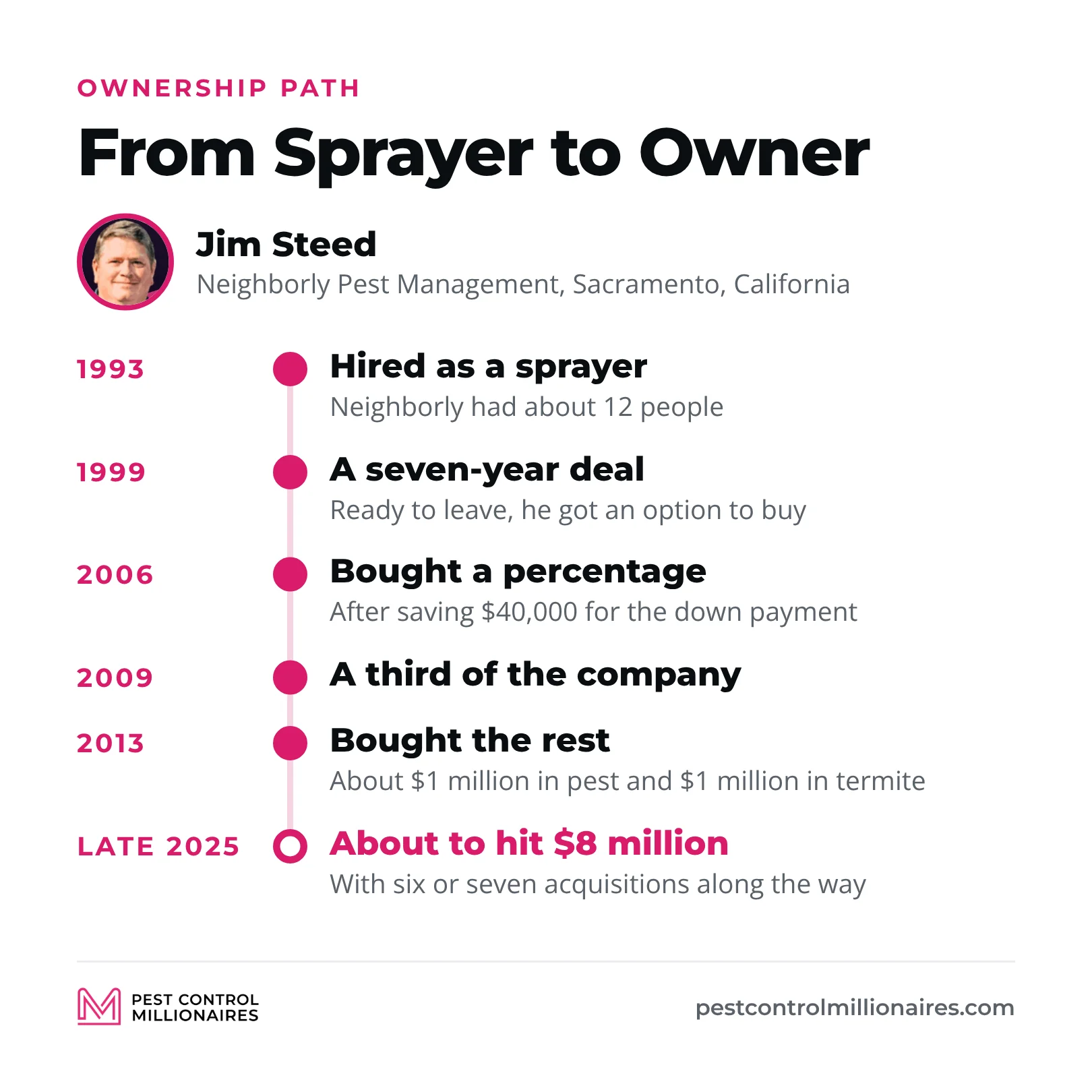
Jim Steed owns Neighborly Pest Management in Sacramento, California, but he didn’t start it. Two guys who used to sell for the distributor Van Waters and Rogers started Neighborly in 1978. Jim walked in as a sprayer in 1993 and bought it from them one piece at a time. When we recorded this in late 2025, Neighborly was about to hit $8 million a year.
A mutual friend told me I had to meet Jim, and our first phone call ran an hour and a half or two hours. The episode took two sessions to record. This is part one, about how he bought the company he started at, why so much of what he learned no longer applies and what’s left for owners when the robots show up.
This episode is part of the PCM Podcast. For part two, read Jim Steed on California’s fight over pest control tools.
He found the job on an index card
Jim skipped college, worked a year at a roll-up door factory and went on a two-year mission to Houston. He came back with “a lot of ambition, but not a lot of money,” took community college classes at night and did landscaping during the day.
In January 1993, his mom, who volunteered at an employment agency, forgot her lunch and asked him to bring it. On his way out, he saw a 3x5 index card on the board for a landscape sprayer. “I don’t think I was supposed to take the card, but I took it,” he said. Neighborly had about 12 people and had decided to go after lawn care, and on February 1, 1993, Jim was hired as the assistant trainee sprayer for the new turf department.
Within a month or two, he heard the other guys talking about production. With a license, you got paid a percentage. “What is this glorious place? When I work harder, I make more money,” he said. He got his outdoor spray license, worked from 6 a.m. to 6 p.m., went to school at night and about doubled his income.
A couple of years in, the manager who hired him quit, and after about two months nobody had taken the job. So Jim asked for it. The owners said he didn’t have the degree. “None of my customers care about soil agronomy. Not one ever asked me about pH. They want to know if it’s green. I’m the guy that makes them green,” he told them. If they didn’t like it, they could fire him. “No one else is doing the job.”
He bought the company one piece at a time
Jim took over the pest control side too, and by 1999 he figured he could build his own company. A guy was ready to loan him $50,000 for equipment. When he went in to thank the owners on his way out, they asked if he’d stay for a deal.
The deal was a seven-year employment agreement that ended in 2006 with an option to buy a percentage of the company at full market price, “maybe above market price,” Jim said. To use it, he had to save $40,000 for the down payment and still have the job. From 2000 on, the two owners came in on Mondays, one went home for the rest of the week and neither worked Fridays, because Jim was pretty much running the company.
He bought a percentage in 2006, a third of the company in 2009 and the rest in 2013. The owners financed it, and every obligation is paid. In 2013, Neighborly did about $1 million in pest and about $1 million in termite.
I told Jim I don’t know if I could have waited seven years. “Looking back on it, I think it was definitely a gamble that paid off,” he said.
The owner financing also laid out the pattern for how he grows. “Most of the growth I’ve had, it’s been through acquisition,” he said, six or seven deals with smaller owners who were done. He sits down with them and says, “Hey, let me figure out something that works for you.” If you want to do the same, start with my guide on how to buy a pest control company.
Twenty of your 30 years don’t count anymore
“If you’ve got 30 years of experience in the pest industry, 20 of those years don’t mean a thing,” Jim said. The marketing changed, and so did the application and chemical technology. There are no more yellow pages. California companies used to power spray, and now most do crack and crevice work with backpack sprayers. Jim expected that switch to take a couple of years of customer education. It went over like a whimper.
The customer changed too. Neighborly’s No. 1 core value is “responsive,” Jim said. As a customer himself, he hates calling and hearing a robot, because “now I’m going to do these robot gymnastics.” What he loves is “Yes, I want pest control. Yes, I’m free Tuesday. Yes, that price is okay. I’m done.”
He splits callers by age. People 35 and younger expect that kind of experience. From 35 to 45, it’s a mix. Over 45, they’re coming along begrudgingly, and at 55 and up, Jim’s age, “we’re still talking about the Flintstones.” We saw it when we added AI to our call center. Some older callers would swear at the AI bot, and younger callers loved it.
Our industry ran almost exactly the same from 1970 to 2010, Jim said. Now the businesses embracing technology are surging past legacy companies that had decades of a head start. “Whoever you have on your team, it better include a lot of young folks because it’s almost a new language,” he said.
I always say you need three mentors. One who has been there and done it, one about your size you can race and one who is younger and knows the technology. For that third one, I lean on people like Dan, who co-wrote our book, and Mat Rogers, who are both deep in AI.
The robots won’t lead your people
Jim thinks we have five to 10 years left under the current labor structure. After that, between drones, robots and self-driving trucks, he expects a robotic revolution like the industrial revolution, and he wouldn’t be surprised if the normal work week ends up at 20 hours.
His message for owners was to “watch this. Pay attention to this. Don’t get run over by it,” and to run with it instead. “Generationally, the enemy is your unwillingness to innovate,” he said. When we recorded this, I had just talked with a company doing $5 million a year that didn’t even have a CRM.
What’s left for us is leadership, which means recognizing talent, organizing it and motivating it. “People are not going to follow the robot down the road. They’re going to follow you because you inspire them,” Jim said.
You gain more than you give when you share
“Whatever a measure of success I’ve been able to achieve, most of it’s been because I’ve been willing to network and just talk to everybody and be friendly,” Jim said. About 90% of his networking has come through his state association, CAPMA, which used to be PCOC. He’s also active in the NPMA, where he chaired the public policy committee in 2024, and he’s done no fewer than 400 legislative visits.
“You shouldn’t hold your business secrets in,” he said. “I have found you gain way more than you give when you share.”
He’d been reading Zip Code Kings, the book I wrote with Dan and Jake Sheldon. Neighborly had never found a referral program that Jim felt good about and that worked. He turned to the referral strategy in the back of the book, and within 10 minutes of reading it, they were setting an appointment to get it going. Then he gave four people on his team their own copies and their own sections, whether that’s SEO, social media or branding, to learn and report back on. That’s a smart way to get a team through any book. For how we run referrals, read how to get more pest control customer referrals.
Run your own version of EOS
Traction is one of Jim’s favorite books. He found its business checkup 33 years in, “and it was like an illumination,” he said.
He also can’t stand corporate jargon, and he’s always hated the word meeting. So the first assignment for his senior managers was to come up with a new name for their EOS meeting. The youngest one said, “Why don’t we call it a rally?” Now they rally twice a month, because once a week was too much. One rally is all about KPIs, and the other has nothing to do with numbers. “You can do your version of EOS,” Jim said.
We learned EOS six to eight years before we recorded, when my mentor brought in an implementer to teach us, and we’ve self-implemented since. We hold our main meeting every Wednesday and short ones on Thursdays, and every branch runs its own mini version.
Rodent stations, not bait stations
As chair of his association’s legislative committee, Jim has fought California’s bans on second-generation anticoagulant rodenticides since 2014. When we recorded this in late 2025, they’d been off limits for structural pest control for about three years, and DPR was re-evaluating them. Jim had reached out to the Center for Biological Diversity, and the two sides held five meetings to look for common ground.
He doesn’t dismiss their side. The photos of poisoned wildlife are heartbreaking, he said. But studies hadn’t shown a measurable change in wildlife since structural use stopped, which to him points to agriculture and illegal marijuana grows. Meanwhile, the number of rats and mice living among people in California has gone through the roof.
Without baits, you’re left with trapping, which is labor-intensive, and exclusion, which is construction-intensive. A multi-housing unit built in the 1960s might need $30,000 of exclusion, so people with low incomes suffer the most. At Neighborly, trapping and exclusion are pretty much all they do. “We don’t even call them bait stations anymore. We call them rodent stations,” Jim said. He expected DPR to finish its re-evaluation within four or five months and probably allow second-generation baits again for structural pest control on a limited basis.
Tell your people you’re proud of them
Jim lost his father in August 2025, and he talked about the other men who shaped him. The two who started Neighborly were his “business fathers,” he said. “They tempered me and all of my excitement,” and they taught him to keep his word and always come through for customers.
He’d read the foreword of our book, where I wrote about my dad, who was killed on the opening day of hunting season. The day of his funeral, I sat down and wrote my goals. That’s when the podcast started, and it’s part of why I wrote the book. Jim shared something he’d learned. “Most of our kids know we love them, but they’re not so sure if we’re proud of them.”
He takes that to work. When an employee does something well, he points out the specific thing. “Hey, you really went in there and handled that super well. I’m just really proud that you’re working for us.” We don’t get that from a lot of places in our lives, Jim said, and owners are in a unique position to give it.
He thinks owners deserve some of that too. Being a successful owner isn’t measured by your KPIs, P&L or multiple, he said. It’s the impact you have on the people around you. “They should never feel ashamed if their business is one million or two,” he said. “Being an owner is for a very, very small percentage of people.” And if you’re comparing yourself to the overnight successes on social media, remember that “you can’t make the crops grow faster.”
Frequently Asked Questions
Who owns Neighborly Pest Management?
Jim Steed owns Neighborly Pest Management in Sacramento, California. It was started in 1978, and Jim was hired as a sprayer in 1993. He bought a percentage in 2006, a third of the company in 2009 and the rest in 2013, and when we recorded his episode in late 2025, Neighborly was about to hit $8 million a year.
How do you buy into the pest control company you work for?
Jim Steed was managing both the turf and pest control sides when he told the owners he was leaving to start his own. They offered him a seven-year employment agreement with an option to buy a percentage in 2006, and he saved $40,000 for the down payment. He bought a third in 2009 and the rest in 2013, with the owners financing it.
How has the pest control industry changed?
Jim says 20 of 30 years of experience don’t mean a thing anymore. The yellow pages are gone, California companies went from power spraying to crack and crevice work with backpack sprayers, and customers expect you to be responsive.
Are second-generation rodenticides banned in California?
Yes, for structural pest control, when we recorded Jim’s episode in late 2025. They had been off limits in California for about three years by then, and DPR was re-evaluating them. Jim expected DPR to allow them again for structural use on a limited basis.
Full transcript
Every word of the episode, from the video captions
Building the business turns you into a different kind of human being.
Realize that failure is a part of the...
I think there's hope out there for all of us. For all of us. They say procrastination [music and singing] be the assassination of destinations. That's why we out here grinded with no association with haters and them other crabs [music] trying to put us down. Pest Badger's in the house. Boy, don't clown. Just keep your eyes on the prize and no giving up. You can do whatever you dream of. Keep your eyes on the prize.
Welcome back to the show everyone. We had a really awesome guest. Really excited. I know Jim and I connected was like two weeks ago.
I think it's like two weeks ago for a mutual friend and he's like, "Hey, you need to reach out to this guy. I think this would be a good connection. We jumped on the phone. It seemed like we were best friends right away. We talked for I don't know, hour and a half, two hours just talking on the phone, just chatting, going back and forth about business." And I was like, "Hey, I'd really like to get in the podcast sometimes." Like, "Yeah, just whenever." So I shot you a message. And last week we didn't really work out. You got sick. I got stuck traveling. I might tell you the story since I kind of left you hang on a cliffhanger. But yeah, I was traveling back from North Carolina doing a little gig out there. Came back and or not North Carolina, I'm sorry. New York and I was on my way back and then my flight got cancelled in Apple from Chicago to Appleton. So I was like but before I went I was like I can either pick Detroit or I could pick Chicago. I'm like, if something happens, at least Chicago is like within 5 hours, I can jump in a car and drive home cuz my daughter had a wrestling meet that day.
So, I rented a car and they're like, "Hey, will you do us a favor and will you take this EV vehicle?" I'm like, "Sure, not a big deal." But they're like, "It's it'll get you 500 miles." I'm like, "Fair enough. My trip's like less than 300." And they're like, "Perfect." I get 200 miles in and this thing dies. Like down to like I don't know 10%. And I'm like, "Okay, now what do I do?" So I found like a charging station, plugged it in for 20 minutes, doesn't move a percent. I'm already late. Now I'm frustrated. And so, and there's no enterprise So I found another little town like an hour north of I just shot straight there. On the way, I was calling all the rental places, found another rental company, found another rental company, traded. I left that rental car there, that rental truck there, got a new vehicle, raced 100 miles an hour to my daughter's wrestling meet, walked in, she was like within 2 minutes walking on the mat. So, I was a half hour late, but I still made it on time.
And so, the next morning had to drive back down there. And thankfully, the place that I rented it from had a charging station. So, I plugged the truck in, went out for lunch or went out for breakfast for what 2 hours. [snorts] It said it was atund had 144 miles of range. Okay, cool. So, my trip's only 50 miles, 55 miles. Not even joking. 10 miles down the road, it's already halfway gone. I'm like, "Okay, this is this is ridiculous." So, I stopped in Green Bay, grabbed another rental car, left that vehicle there at Enterprise, and drove that vehicle down to Appleton and got my truck back. So, three vehicles later, I got my truck and I made it to meet. So, it all worked out the way it was supposed to. But, that's my story. That's what happened. I was like, yeah, it was a good experience. The guy, I'll say the one thing, the guy at Enterprise in Green Bay, can't remember the kid's name. I wish I took his card, was an absolute stud. The way he handled himself, and I was nice about it, too. I just told him the situation. He was an absolute stunt.
I was like, I was like, "No, it just didn't go well. You asked me what happened." And then he's like, "Anything less than a three star for us, cuz I only do three stars, is considered a fail. So, whatever I got to do to make you happy, I'm like, "Hey, I'm not even looking for money back. I just want to let you know the situation so it doesn't happen to the next person." and he's like, "Nope, I'm not leaving here with like this." And he credited me my money back or 100 bucks off or something like that, but he took it really really well. He was I wish I could have hired him on the spot and I wish I would have thought about him like he was that good. But anyway, so that's my story. That's what happened. Then you were sick, so we kind of just didn't connect and I was getting late and so it all worked out, but here we are.
Maybe the best compliment I ever had came from a stranger. I was in downtown walking from the Department of Pesticide Regulation and in California we have our own EPA which is as big as the EPA the section of EPA that that does structural pest control in DC that in fact our California agency has a bigger budget. So it's, you know, all they do is sit there and cause issues in my opinion. But I've spent a better part of the last 25 years working as an advocate for the industry in California with with [clears throat] DPR. And so I was leaving DPR going downtown Sacramento to do some meetings in the capital. And it was raining, but you know, had the tie on and all that other stuff was kind of looking good. Come up to an intersection and an elderly black gentleman walks up to me and he says, "Hey, can I join you in your parasol?" And I said, "Well, you can, of course, but because I'm a man, it's an umbrella."
He said, "I'm sorry, your umbrella, Jim." I said, "Okay." So, we walked and we talked for like four or five blocks, you know, and this guy was at that time he was probably 20 years older than me. This was like 10 years ago. Just totally put together, you know, someone, you know, who's walking with confidence and confidence and we just had a great time talking and we hit his building. He says, "Okay, this is you know, this is my stop here and I'll see you later." He says, "Good luck with you and your umbrella." You know, kind of a funny little joke when he left. And I said, "Hey, I got a question for you real quick. At that intersection, you know, all those people, what made you kind of come up to me and you know, you know, ask for the little walk? And he turned around and as he was walking away, without even looking back at me, he said, "Game knows game.
That's awesome.
See you later."
And I'm like, "First of all, I'll never be as cool as that guy ever."
Yeah. That's awesome.
He was just totally cool to begin with. And I gotta tell you, I've been feeding off that compliment for more than a but doesn't it describe your experience there with with that person?
I love that. And that's when when you recognize the game, wherever you see it with other people, you just want to bring them into your game and have them working with you. But what a what a great experience. He kind of gave me a gift that day that like I said, I've been feeding on that for a long time.
Yeah, I wrote that down. Game recognizes game. I always take notes every podcast. I think I have stacks of these notebooks of just all podcast notes. That's just what I do. So, I wrote that down. But today we have Jim Steed, your owner, founder of Neighborly Pest Control, right? And you're out of that's right. That's right. That's right. Yeah. Yeah. Yeah. You have to tell the story, but CEO. Go with...
Not the founder.
Yes. Yes. Owner.
Oh, I love that. So, we'll let's walk it back a little bit. I love how this started up, but I'm g take you back to like if you and I was asked the same question. You and I are juniors, senior in high school. Who is Jim in high...
He's a guy who knows how to have fun and doesn't have hardly any discipline. He has so much fun that after high school instead of going to college, he goes to work. [laughter] And so I went to work for a year at a rollup door factory from an Australian company called Gliderol Doors. And after that, I went on a two-year mission to Houston.
Oh, really?
Yeah. There's a there's a lot of LDS people in the pest business, I think.
There are. Yeah.
After the door-to-door phenomena. But so when I came back from that, it really you grow up an awful lot, you know, in those two years. You're on your own and you learn a lot of skills and it really it kind of changed me from a child, you know, and then to more of an adult. And I came back and I had a lot of ambition, but not a lot of money and university wasn't really an option for me. I knew I had to do community college. So, started going to school at night and I was just working landscape during the day. And I did that for a couple years. And my mom was a volunteer at at an employment agency. And this was in 1993. So I was about 23 by then a couple years back going to night school.
And she forgot her lunch on this rainy January day. Calls me up and she says, "Hey, bring me bring me my lunch. I forgot it." Like, "Oh, okay." Okay. You know, you don't say no to mom. What I didn't realize is when I brought her to lunch as I was leaving, I looked up on the board and there was this little 3x5 index card. So, they had a job opening for a landscape sprayer. And I don't think I was supposed to take the card, but I took it. Well, it was an advertisement for a job with Neighborly Pest Management. So this company Neighborly was started in 1978 by a couple of guys who used to sell for Univar, Veseris which it is now.
Back then it was Van Waters and Rogers and they had built it up from 78 to 93. There were about 12 people working at Neighborly then and they had decided they were going to conquer the lawn care industry. So they hired this guy who had a degree in soil agronomy and they needed a guy to do all the backpack spraying and I got hired to be the assistant trainee sprayer for the emerging turf department February 1st of And I thought, you know, spraying's better than than hauling rolls of [clears throat] sod. Well, it took me a month or two and I'm looking at these guys and they're talking about they're making production. And I started asking, "What's production? What's that?" Well, if you have a license, you know, you can make a percentage. And I thought, "Oh, what have I found? What is this glorious place? When I work harder, I make more money." [clears throat] So, I asked them about it and they said, "Sure, you know, if you get the license, we'll do that."
So, I went I got my QA license, which is the outdoor spray license here in California first. And away I went. I was here at 6:00 a.m. I worked till 6:00 p.m. I got all the work I could get, whether it was in the spray department or pest control. And I would work all day and go to school at night. And this worked out pretty well. Probably doubled my income just by having that opportunity as things kind of life kind of moved on. It's a smaller company, you know, so they have a problem with the office computers and I could fix that and they had a problem with this and I fixed that in the office and did that and after a couple years the guy who hired me as the manager, he quit.
So, they went on a search for a successor and they couldn't find anyone over about two months to take his job. So, I walked in and said, "Hey, why don't you let me do the job?" And they said, "Jim, you don't have your degree. You're not really at that level." And I said, "Yeah, but none of my customers care about soil agronomy. Not one ever asked me about pH. They want to know if it's green. I'm the guy that makes them green.
All they want to do is make a deal. And I'm better at selling than he was. And I said, "Besides, if you don't like it, just fire me. No one else is doing the And so they said, "Okay, let's see what you can do." And it turned out that I just love to sell. I just I'm not sure what it is about somebody saying yes. It's not necessarily the money because I get as happy with a small sale as a large one. Maybe I get a little happier with the big ones, but you know, there's just something about that, you know, that that resonates in certain people and it's like I that's what I want in my life every day. So, the selling worked out really well. And then I started managing more started managing the pest control to go with it. And then by 99, I had decided, look, I'm building this thing here.
I think I can build my own. And I had a guy who was ready to loan me 50 grand for some equipment. And I came into the owners and I said, "Hey, I think I'm gonna take off, but I want to thank you because, you know, I've learned a lot here." They said, "Well, would you stick around if we made a deal?" And I said, "What do you mean? What kind of a deal?" Well, maybe a deal for ownership. And I said, "Okay." You know, kind of took me by surprise, tell you the truth. So, long story short, the negotiations ended with a 7-year employment agreement that culminated in 2006 with an option to buy a percentage of the company at full market price, maybe above market price, but it was it was a steep price.
So, for seven more years, I worked and I saved. You know, back then it was a lot. I had to save up 40 grand. And if I had my down payment and I was still employed, they hadn't fired me, then I could exercise my So, you know, I just went to work and they those two partners starting in 2000 started to [cough and clears throat] work on a modified schedule because then I was pretty much running the whole company. And so both of them came in Monday and then one went home for the rest of the week and neither of them ever worked Fridays. So from about the time they were oh about 45 or so they neither of them had to work full-time in ever again. I mean you imagine having 6 months a year off. It was it was a really good arrangement for...
Hold up. Quick pause. If you're on a pest control company or fertilization weed control company, you're not in our Facebook group. You're choosing the harder path. Every operator that's in there skipping years of mistakes because people are actually sharing what's working right now. So, stop trying to brute force your way through growth alone. Search Pest Control Millionaires on Facebook or click the link below. And now, let's get back to it. What was your title at this point?
General Manager.
General Manager. And then then I was an owner with with a percentage. And then in 2009, I was able to increase that percentage to a third of the company. And then in 2013, I talked him into selling me the rest of it and became the owner of all of it. [clears throat] And you know, now over time, it took some time to pay them, but all those obligations are are fulfilled. And so since 2013 bought in, we were doing about a million in pest back then and about a million in termite. And we're just about ready to hit eight this year here. So it's been a it's been a good run.
That's a that's a that was a long time to wait seven years. Like I tried to like put myself in that position. I just don't know if I could do it,...
You know? I enjoyed where I was and looking back on it, I think it was definitely a gamble that paid super super well. I mean, super well.
Yeah, I agree.
And I'm kind of glad. I love the brand. Like I love the name.
It's great. I agree.
I love the legacy I've got here. I've got 33 years, you know, that I worked in the same place. Not a lot of people have that in their life, you know, be able to do that. So for me, it's been fulfilling in every way that I really...
Yeah, that's cool. Where were with those options were did they do owner finance for you too where you just start paying them? That's awesome.
Yeah. And interestingly enough, that's what laid really out the pattern for me. Most of the growth I've had, it's been through acquisition.
Yeah. Were you saying that?
Yep. Working with smaller guys who were done and sitting down and saying, "Hey, let me figure out something that works for you and we've had six or seven of those. So, a lot of our growth has come from that."
Yeah, it's great. And then I know that you're very involved like you said with the board out there and I'm sure you meet a lot of guys through the board like as through your networks out there.
Yeah, the associations, you know, like my state association out here used to be called PCO and now it's called CAPMA. The California Association of Pest probably 90% of my networking has been through the trade association and over the last 15 years I've also become much more involved with NPMA. Last year I was chair of public policy for NPMA which you know is kind of the biggest most important committee that NPMA has. I was really shocked when they asked me to be a vice chair and then the next year the chair. But I've enjoyed a lot working with companies all over the nation on and also regulation, California...
I actually have that written down is one of my questions I ask about it.
I've done a lot of I've probably done no less than 400 [snorts] legislative visits. Unreal.
Over my career, yeah. With offices, assembly members, and Senate, testified in front of committees more than a dozen times. And I can't tell you how many hours I've put in a lot a lot of time in Sacramento at the state legislature, the department of pesticide regulation, and we also have a structural pest control board here too as part of that.
Awesome. I have a couple questions regarding that then. How much has how much has the pest control industry changed since you started?
Quite a bit. In fact, I think one of the phenomenons now that's really pronounced if you've got 30 years of experience in the pest industry, 20 of those years don't mean a It has changed so much in the marketing and in the application and chemical technology that whatever you did that first 20 years isn't being done now. There are no more yellow pages. Sorry, you can't hear lectures about those. And that's what that's what we used to do. You know, in California, we used to powers spray all of our and we don't really do that. All of our applications now are cracking crevice with backpack sprayers for most of the companies that are out there.
With that part being said, what was it like because you know you had you had a lot of customers at that point. What was it like adopting from, you know, from power spraying with a truck and a hose to transitioning to a backpack sprayer? As far as like the customer's perspective, it was a lot of education.
No, no, it was it was way easier [clears throat] than I thought. And it turned out that only a few of our oldest customers really cared about how much we were spraying.
Yeah. I think the only reason I asked that is because I get that I hear that question all the time.
Yeah. Yeah. I was really surprised. I thought it was 2012 when things really started to change especially with pyrethroids and because of my involvement in DPR I got recruited into doing the information videos on those. So, if you're ever bored on YouTube, type in pyrethroid working group and you'll see all these videos we made explaining the new regulations on how to make applications. And I think I got like 8,000 views on those now. That's my big claim to YouTube thing. But back then, I really thought, you know, we're going to have to just it might take a couple years to educate everybody. And it went over like a whimper. Like, you know, I took a dozen phone calls and once we explained to them, hey, your your service guarantees are all the same. We're being a little more pinpoint about what we're putting down and where we're putting it down and it's [clears throat] just better for everyone if we do it like this.
People came along, no problem. And it could be that they're just Californians who are kind of trained to like their oatmeal, you know. Yeah, for sure. Yeah. And I think even just like the customer itself has changed a lot too. What do you think? Like I just like I think of like 15 years ago, you could probably get away with maybe call the customer back in a day or two or three days and having to wait for service a week or two weeks. I just feel like the game has evolved. Like you have to answer your phones all the time. You have to get service right away. If someone has a problem, like they're they're they're not willing to wait. If you decide you're going to wait two weeks to answer a phone or call back, it's long gone.
Like the customer has changed so much.
Yeah. Our our number one core value is responsive. Responsive. Number one. And Yeah. And it's just like you know you would if you told somebody 15 years ago, hey, you can get on your phone and dial up a stranger to give you a ride to where you're going. You'd think this would be crazy. It's for perverts and serial killers.
Agree. And if you jumped on your phone and said, "Hey, I need something shipped to my house." You should take six to eight weeks to fulfill an order. And all a sudden it's at your front doorstep and within 4 hours you'd be like, "No." Yeah. I just think the whole a like the customer avatar has changed so much.
Yeah. And I as a consumer I've adapted with it too. So like now I really appreciate maybe sometimes not talking to someone. There's sort of a there's a there's a happy zone. Like I hate to call on the phone and hear a robot because now I'm going to do these robot gymnastics. Press this for that. I'm trying to be AI and guess what you want. I'm going to guess wrong. It. Then I just want to talk to a person. But more than anything else, I just love to say, "Yes, I [clears throat] want pest control. Yes, I'm free Tuesday. Yes, that price is okay. I'm done."
Agreed. And I like and I love it so much, too. Like I'm kind of the same like I'll call like I'll need customer service, but I get the AI thing. I just don't want to talk to the AI thing. And like I don't want to talk to this for I just need a person. Then in the same tone, I'll call to pay a bill and I get the AI person. It's super fast and take 30 seconds. Gosh, I love that.
Exactly. And that's how we're changing, right? That whole experience is evolving. And so people who call you that are 35 years and younger are going to be already immersed in that that type of an experience. That's what they like. That's what they expect. They're comfortable with it. They're almost more comfortable than the person-to-person stuff. 35 to 45, there's a mixture of it. 45 and up, they're they're coming along kind of begrudgingly. You get my age 55 and up and we're still talking about the Flintstones.
It's funny because last year last year we started adapting AI in our call center too [snorts] and you could tell like the people who would call in a little bit older and it's all recorded and they would just be screaming at the AI bot. It was so funny just swearing at it. Then the younger people loved it. So you're you hit the nail on the head there. And I'm in that in between. I'm the 35 to 45. So I'm right in between. So like what I said makes perfect sense. You know, like I like it and then I just dislike part parts of it too. But I think that's going to change. I mean it's constantly changing the next two months, three months, six months, and a year. You're not even going to be able to tell.
Well, our industry operated, I would say, virtually the same for 40 years.
Yeah, I agree. From 1970 to 2010 it was pretty much almost exactly the same business. [snorts] and it by 20 2005 it was changing but it hadn't changed yet. So everything that we learned in those 40 years is not necessarily applicable to how business is done today. And so you really see a lot of the older businesses, they're they're growing a lot slower. They're they're not adapting very quick. And businesses that are adapting and embracing technology are surging in popularity right past all of these legacy businesses that have had decades of an advantage. But technology is changing so quickly that it's leaving you know them behind it. And I have learned this. It's not like we've done one sort of technological leap. We've done like three. [clears throat] And so whoever you have on your team, it better include a lot of young folks because it's almost a new language, right? Like six seven.
I see on Friday was my daughter's 67th day of school. I heard that all day...
Right. Right. See, and for most folks, it'd be like, "What? Huh?" And you've got to have some of those folks around because those are where your customers are going to start to come from.
Yeah. I've said this in the podcast a million times. I said, "You always need three." My It's my personal opinion, you always need three mentors. You need one who's been there and done it, who can save you a bunch of time. That person who's roughly the same size so you guys can race, push each other, then you get then you also need the third one who's younger, knows the technology and keep you up to speed.
You know what's about that now is [clears throat] because things are changing so quickly almost nobody's been there and almost nobody's done that like you know you have become a person who's been there done that now.
Yeah. Right. I know. Yep.
And you've been in business for much less time than me and I'm buying your book [laughter] and I'm learning from your experience, you know, because I'm applying that principle. And so I agree. But isn't it interesting who the been there and done that are now? It's not necessarily these legacy...
Agreed. Yeah. And like with the podcast, again, podcast just started for fun. Like on the call, but it's given me so many opportunities to meet so many people across the country, across other countries. It's been pretty cool. But I've met a lot of young savvy technical people, too. So, it's really really helped benefited me for sure. Like Dan's one of them in the book and Mat Rogers another one. There's like people that are just really, really, really good with AI stuff and what's coming down the pipeline are really heavily involved. And one of my mentor Jonathan is close to robots. He's on the board for a couple big robotic companies. So, it's just it's I have a really close network who's highly in touch with that stuff. So, it's cool. I was at a conference two years ago with Pat at Patrick by David and we were is at the afterparty. I was talking with a guy from Ford. He was over the development of robotics or something for Ford.
He told me that day, he's like, "Jonas, I promise you right now in our factory, we have robots that can do your job. Your job now is just to be up to date and up to speed and be ready for these things to launch because they're going to be doing your job soon." And I don't know what that looks like. You know, none of us do. But, we always thought that the home service would be the first industry that they take over. It ends up being one of the last.
Agreed. Yeah. I think I think we've got probably 10 years 5 to 10 where we will be operating as under [clears throat] the current labor structure we have but 5 to 10 years from now whether it's drones robots even if it's just you know our drivers don't drive anymore right they're all self-driving vehicles and maybe we can get finally get some relief from these outrageous insurance premiums we're all paying because they're they're safer. But, you know, we're we're going to see technology with the emergence of AI, with the emergence of robotics and the combination of the two it's just going to be the robotic revolution like we had the industrial revolution. And I wouldn't be surprised if at at the end the other side of this, you know, that the common work week is 20 hours.
You'll only need to work 20 hours in order to earn what you need to because the labor advantage that is brought about from robotics [clears throat] I think it's going to change the world economy right now you know we have factories that are built elsewhere because there's a labor advantage but once that robotic labor advantage happens here then the domestic industrial advantage becomes an American one and it's going to move fast...
You It'll be it'll be interesting because like just going let's just stick with even just lawn care with with like the robots for lawn care like the lawnmowers. They've been working on that technology for 20 years roughly and it's still not quite there yet. It's moving a lot faster especially with AI and so you're right it's probably 5 to 10 years out then at that point it's hard to say what it's going to look like. Like are we all just going to get paid to sit home? Like who knows? I have no idea what it's going to like. Well, you imagine like an apartment complex that has to hire a landscaper right now. You know, you buy your robotic lawnmowers like your Roomba.
Yeah. Same thing.
Never leave the property, right?
Yeah. I think they just I think they just released the first robot ever that you don't have to have a person there watching it because up until now they've had a bunch of moors that you just send them out, but you have to have someone there watching it. Now, I think they just released the first one. I saw it three months ago that you don't have to have someone there. But then then again, it's like, okay, now the government's going to come in, regulate the robots. Like, how fast are people going to adapt to them? Are they going to go buy their own? Like, who knows?
Well, you know what will really cause the revolution is when the robots are able to make the robots. That's when it's going to really accelerate. Right now, we're we're making them. We're figuring out how they can succeed. You're starting to see them in the farms with the robotic weeding and things like that. The robot.
Those are cool. Yeah, those are really...
And they're they're doing jobs, you know, that that are difficult for us to do and costly. And it as long as we can provide the energy that they're needed and the rare earth materials are there to make the batteries. And it looks like those problems are both being...
Yeah. Nuclear plants. Yeah. Sounds like they're doubling down on nuclear plants in the US, even small ones.
You know, I just see the technology will not decelerate. I think if anything, it might accelerate.
I agree. I think that Elon just said on Rogan's podcast two weeks, three weeks ago, whatever it was, that his newest Tesla will he didn't say it has wings, but he did kind of mention that it's going to fly of some sort. So, it'll be interesting. He said it's going to be the biggest the biggest I don't know how you word it like the biggest release of a vehicle ever in history or any any anything not just a vehicle but anything in history be the biggest advancement ever.
Yeah. I think [clears throat] too that it can't be understated how deeply this is going to affect our society. If you think about education, right, K through 12, why did we go to school? Primarily to prepare us for employment and to give us information, you know, that that we needed. Well, all the information you ever needed is now in your phone. You know what purpose is education really going to serve? And...
Because now at the at the touch of their fingers, they have every answer that is smarter than the person that they're learning from.
So now they can fact check the professor and be like, "No, you're wrong, man."
Right. Exactly. And so it's we're we're going to that's going to catch up with us as a society and how we're structured and what are we doing with our time, you know, how are we spending that? We're going to have providence and resources like never before. I don't expect we'll have homelessness like we have it now or hunger. You know, it's just not going to be that difficult. Was it Elon was talking about the robot surgeons that will be able to do surgery you know at you know one test...
And they're already yeah they're already using it...
And they're better at it you know...
Even with diagnosing like pictures like they'll scan a picture and they said I can't remember what it was it was some sort of a doctor of some sort they thought there was going to be less doctors because of AI and there's actually cuz there was like 33,000 of these specific specialty doctors. Now there's like and then since this AI came out like they need more doctors to read and actually do the work but there's like actually more doctors now like 50,000 of these specialty doctors. So it's funny but the robot itself is better at doing the actual surgery and it's actually better at reading and diagnosing the picture.
Yeah. So for us, you know, as business owners, when you're thinking about the challenge of getting through an eight hour workday with an imperfect human, and then you realize, you know, you might be employing a [clears throat] robot that doesn't need workers comp that that doesn't need a meal break, that that can work 24 hours a day if you have the clientele to send them to, so to speak. It [clears throat] it's it really is shocking at what the future is going to portend and it's probably within my lifetime. Definitely within your lifetime.
Yeah. And to think of like just of all the people that you have on staff, right? Like entomologist, you're not going to need that. The it's going to be so smart. It's going to scan it why it's doing it. It's going to know exactly what it is. Going to know how to solve the problem. Like it who knows? But it's interesting take to think about, you know, what it's going to do to the industry. So that's why I was like how many more years do you got left? I'm like this was my plan. I said I was going to go on a 20 year run. Who knows? Like I don't know what the next five years looks like, let alone 20.
Yeah. I think the message for our industry and owners in our industry is watch this. Pay attention to this. Don't get run over by it. You know, run with it. You have to be, like you said, you have to be willing to adapt and pay attention. And so, like listening to the podcast, having these conversations, people who are in the industry that are close to the people who are launching this stuff, it's going to be...
And as as we get older, you know, generationally, the enemy is your unwillingness to innovate. You want to just you want to just do what you've always done. And the days of that are gone.
Yeah. I actually funny that you said that. I was talking with a company doing $5 million in revenue and they don't even have a CRM.
It's impressive. [laughter]
Yeah. So, like it's like, oh man, like the day those days are just long gone. Like obviously there was a reason that they were talking to me, bringing me in, but it's like there is so much you guys leave on the table, you know? But again, that's just like they're they're stuck in their same way. Has been doing it the same way for 30 years like you said and unwilling to change but then they're...
But you know I do want to touch on one thing that I think is really [clears throat] it's all us. It's going to be left for us the human side of us the owners. And that's leadership, you know, recognizing and organizi recognizing talent, organizing talent, motivating talent. Those things are, you know, people are not going to follow the robot down the road. They're going to follow you because you inspire them and you help and you organize them in a in a way where they can be effective and feel effective and look effective. And so, you know, you're you're touching on networking I think is absolutely critical. Whatever a measure of success I've been able to achieve, most of it's been because I've been willing to network and just talk to everybody and be friendly.
And the network is an [clears throat] exchange. You know, you shouldn't hold your business secrets in and just say, "Oh, that gives me advantage over my competitors." I have found you gain way more than you give when you share. And that's why your your book is so You know, I'm I as soon as I opened it up, I started going through and I thought, my goodness, does the industry know what he's just given them? Because of technology, you know, your book is aging as as we speak, but to me, it is the most current iteration. It's the most current guide book that you could have to really elevate your business and bring it up. And [clears throat] you could pick any chapter you want and work on them one at a time. And if you did one per month over the year, you'd transform your business probably, let alone at at the very least improve it.
And I know I had an improvement within the first 10 minutes. You know, I'm I wanted to ask you a little bit about your dad in a second, but I happened to turn to the back of the book and looked at your strategy for referrals and we had never found something that I had felt good and worked. And within 10 minutes of reading that, we were setting an appointment and we're up and going. We're we're moving. And [clears throat] so you've already improved my business with just those couple of pages and we barely been able to get into the rest of it. I've [clears throat] got four people here that each have their own copy of your book and they're each assigned different sections because they specialize in those areas whether it's SEO or social media branding or whatnot.
And I'm going to be interacting with them over the next couple of months on what have they learned, what do we need to do, how can we improve, and so I just wanted to thank you for taking the time to write the book. You've got one big fan. I don't know how many others you'll get.
I know I have over 500, so that's good.
Hey, well, good. They're smart people. Because you guys have just done a tremendous job putting this together, and it falls right in line with that philosophy kind of networking. It's now connected you and I, you know, and you know, I think I will I will I'll be recommending it to as many folks as I can. If you guys haven't if you haven't got a copy of Zip Code Kings, you should order it today. And then I [clears throat] really appreciated the remarks you made about your father. It could be that I lost my father in August this year. And so when that happens, you know, you tend to really reflect on, you know, what your parents have given you. And you know, when I read what you wrote about him, it kind of I felt like I was almost right there, you know, alongside the bike and the horse and the man for a minute. And something lights the fire right in you something I don't know you never know what it might be a father a mother a moment a mentor or something like that but it's pretty special that you had it with your dad and I think that's neat.
My father was a chemistry professor and an introvert and he was mystified by me because I was a fun-loving extrovert kid and he never understood how I could just walk into a room of people and not feel, you know, shy or weird. And I look back at his legacy of service and the name that he gave for me and [clears throat] the two gentlemen that started this business were my business fathers. They tempered me and all of my excitement and they taught me about being solid in my commitments and in my word when I gave it to people, you know, always coming through for your customers, protecting the business, you know, so that it would be there for everybody and making those tough decisions. But, you know, we stand on the shoulders of some pretty special people. And it sounds like the shoulders of your father are are ones that you stood on.
Yeah, he's a yeah, one of the best and I got super lucky to enjoy the years that I got with him. Obviously he was killed tragically on our opening day hunting season and thankfully I bought a house just like a to flip. He had just moved back here we worked on the house together for a month straight like every single day. So I got to spend a lot of time with him before it happened. So that was it was like meant to be. One of my one of one of my employees at the time was losing his house to the bank. I felt bad of course and then I didn't want him, you know, to lose his house and obviously was like, "Okay, well there's a little way for me to make a little bit of money." So I end up paying cash for the day before it went to foreclosure. Then it just worked out like I didn't really want to buy but then I kind of want to buy it. Then I got into the house and I need some work. I'm like, "Oh man, I really don't want to do this." And then my dad's like, "Well, I'll help you." And then for a month straight, every single day we got to hang out together and work on the house. So we spent a lot of time together before it happened, which was like meant to be.
And he was like the nicest, most caring dad, father, grandfather you could ever imagine. Although he's a super hard worker. Up at 4:00 a.m., 3:00 a.m., didn't sleep. Went out, worked on the farm before he went to work. And he worked from 7:00 to 3. And then after work, he'd go shoe horses cuz he was a farrier on the offseason or off, you know, part-time job. Or he would just go help with friends. He would just go help them split wood or just go help them just do whatever. Like he was always helping people. And then yeah, he, you know, he worked hard. He raced horses for a living. And he won the national championships in like 91, I think. 1991. So that was cool. I get to watch him. I remember like the news coming out there with all their video camera and like I said just I remember the picture I still have it on the wall like picture that they took and I used to ride my bike next to him like I watched him work hard too and so he earned everything that he had but just like the few things that I could take away. He's just like ultra competitive.
Always showed up when he said he was going to. Great father. Like never missed anything. Like I've I was in sports my entire life. My kids been in sports their entire life. And if they had something going on, he lived six hours away, he'd drive home for it. That's just who he was. And so if I could just be half the man that he ever was, I'll be in a good spot. And so I just I cherish every day that I had with him. I miss every day. You know, I think about him every single day. Weirdest thing ever. Just never happened to me. And I'm open about everything. I had a dream about him maybe like two months ago. It was like a happy dream like I got to see my dad and like a real conversation and I remember waking up and I had tears rolling down my eyes like and I was sleeping. It had never happened before. So, yeah, he's a he's a just a really really good guy. And I remember the day of his funeral and I just sat down.
I wrote my goals and I promised my dad that I was just going to go on this mission and I was already I was already fired up before that and this put a whole new field to the fire. That's when the podcast started. That's why I wrote the book. Part of the reason why I wrote the book, you know, it's just to keep pushing. I said I promised them that everyone remember our last name. And I just want as many people and leave the biggest impact that I have on this earth before I leave on every single person that's out there. So if I can help anyone, like I said, to help you with the chapter, like anyone that I can help lift, that's what I did it for is just to like get my name out there so everyone remembers his legacy. I learned once that most the most of our kids know we love them, but they're not so sure if we're proud of them.
And so the council was, you know, make sure they know now and then that you're proud of them. And I thought, oh my goodness, you know, when your parents say, you know, I love you're like, yeah, yeah, I love you, too. You know, and [clears throat] but you know, when your dad or your mom say, hey, I'm proud of you. Oh my goodness. It kind of fills you from head to toe. You know what I mean? And we want that. It's really meaningful to us. And you know, [clears throat] my dad probably he's not going to be able to see any of the other things that I've accomplished or will accomplish the remainder of my life. And they're they're real big motivators. You know, that for me, you could tell it struck a chord that you know, you made some promises to your father and to yourself about that because you're so grateful for the legacy and the opportunity, you know, that they've given you.
I was able to care for my dad the last five years of his life and there was a lot of work in that but you know at the end of the day I look back and you know I'm really proud of that and it's also taught me that that's something we can give our employees you know when they do well probably don't want to be telling them you love them too much you know there might be some lawsuits in there...
But you know when they do something well and you let them know that you're proud of them. We don't get that from a lot of places in our life. And we're in a unique position to give that to our employees. And I know now over the last couple years as I've started finding the right situation where I can point out something specific. Hey, you really went in there and handled that super well. I'm just really proud that you're working for us. I'm really proud that you are wearing our brand and working here. And I want to thank you for that, you know, it's something that means a lot to them. I know it means a lot to us, you know, [clears throat] and we don't always kind of kind of have places to get that anymore. And so I really appreciated the your comments there on your book and since I'm just a little bit older, I can say I'm sure he is very proud of what you're doing, but also you know how you're doing it and what you're going to continue to do.
Not sure how life's going to change for our industry and our businesses, right? But we can carry forward all those le lessons we've learned from them and they're they're kind of they're they're sacred to us, right? The work ethic is super sacred to me. When I was raising my kids, I was kind of clumsy, but I always said there's no fun till the work is done. And when my son graduated from Marine Boot Camp, that's the tattoo he got.
That's awesome.
Yeah. And he just wanted to honor his dad. He's now a staff sergeant in the Marines, MAGTF planner, and he and his wife just got shipped to Korea for two years last month. So, we won't see them for a little while unless we get out there to visit him. But, you know, that work ethic is something, you know, I know my son will always kind of carry forward. And I can see that that your father is always gonna he's he's always there. He's always present. And I thought that was really cool. So, I appreciate you putting that there in the forward of your book.
Yeah. He had this crazy whistle. He was so loud. Like the loudest whistle. He didn't have to use his fingers to just whistle and I would just walk into like a gymnasium or something and just hear that whistle and I just know where my dad was at all time. It was pretty cool. So, we just have that just a cool thing that we always had together. It wasn't all my other siblings. It was just him and I like super loud whistle. I knew where he's at and I just go find him. Was pretty cool. And then what he said about like letting your kids know you're proud of them. My oldest daughter wrestles and she's a beast. She ran fifth in the state. She's a sophomore. It's fun. But every time she goes on the mass, no matter what happens, I'm proud of you. So it's make sure that they hear it a lot, you know. Means a lot.
It does. It does. I think one of the best compliments that I get is like when my dad's friends come around and they'll hear like stories from him and they'll be like, "You look just like your dad or like you have the same mannerisms as your dad or like you know your dad used to tell me that you know he's always worried about his kids, make sure they're taken care of." He's like, "But he's never worried about you. He always knew that you were locked and you already had it figured out." That's always cool to hear that stuff, you...
Yeah. And you know, for for a lot of the owners that are out there, one of the things that I've kind of had on my mind is like our metrics for success, right? Of course, our KPIs. We can sit here and get as wonky as you want with KPIs, metrics, your P&Ls, balance sheets, EBITDA, all that other stuff. But being a successful owner is not based on those metrics. You know, it's based on the impact, the influence that you have on the people around you. And I hope all the owners that are out there that are, you know, are kind of looking to improve and get better. I think that I hope they keep that drive and that ambition. But I also hope that they feel proud. They should never feel ashamed if their business is one million or two or this or that.
You don't have any idea of the impact you made on people in humanity and history. And you know, I hope they're all proud of fulfilling that role because it's a really tough role. Being an owner is for a very very small percentage of people. And no matter what your metrics are, if you've done that, you do have something you should really be proud of.
Yeah. And we all have to start somewhere. You know what I mean? We just do. And then the more that you learn, the more you put yourself out there, you're around people like yourself, you learn and you take that stuff that you learn and you execute. It just takes time. Like you said, Jim, you've been doing this for 30 years. And people want success over a year because they see it on social media. That's just not real life. Just not...
No. No. You can't make the crops grow faster. You can plant the seed, right? But they grow at their own rate, you yeah. Or five if you can.
It's one customer at a time. Or five if you can. But it's just like But people is like, "Oh, I just want to go faster." And we all do. You want to go faster. I want to go faster. We all want to go faster. But I think people just expect, you know, that they're going to go way faster than what they're they can. But they but they also like underestimate how much you could actually pull off in five years.
Absolutely. I mean, one of my other favorite books that I have is this one,...
I've read that book by 10 times. It all my books that I have five favorite books. That's one or two right now of all time ever.
And this great little checkup that it makes you do, you know, in traction where you evaluate your business. I mean, I cannot believe this, but I found that last year, 33 years. And I and that and I finally found it. And it [clears throat] was like an illumination, you know, it turned on so many lights and it brought so much focus to our processes and our systems and working on the business and pulling those things together. I cannot recommend strong enough for folks network with good people and read good books. Your your you know your book is fantastic and Traction's fantastic. I love Traction and we learned EOS probably like eight years, I don't know, six, eight years ago. My mentor brought us out to Park City, Utah, and brought in a person from EOS, an implementer, and taught us all traction out there like said eight years ago. There wasn't any like real implementers around at that time. There wasn't like Zoom in like we had nothing.
So, we had to self, but we've been doing it ever since. And so we run we run our US meetings every single Wednesday 11 o'clock and then we do like mini US meetings every like every single Thursday. It's a lot of meetings, but they're just like mini short ones. But it's I like it a lot.
So one of my irrational prejudices is I can't stand corporate jargon. You know, KPI met all this stuff. We're going to do a team this and that. And so I've always hated the word meeting. Let's have another meeting. And so...
Read the book Death by Means. That's kind of how I feel sometimes, but that we kind of altered it too, you know.
So when we got the senior management together, their first assignment was to come up with another name than our meeting, our EOS meeting, you know, and the [clears throat] youngest member said, "Why don't we call it a rally?" And I'm like, "Man, I love that." So now we have a Wednesday rally. And [clears throat] excuse me. And so we rally twice a month cuz once a week is just too much, but twice a month. And one of those rallies is a KPI rally and one has nothing to do with numbers and one has everything to do with numbers. So it and that's I found that you can do your version of EOS is what I'm trying to say to people.
I agree 100%. You don't have to convert over to some, you know, system and follow it perfectly orthodox. There's just great principles and ideas that people have figured out that will serve you wonderfully if you study them and look and learn them. You'll be a much better version of yourself, but still be yourself, right?
Thousand%. We actually only have like 10 to 15 minutes left. So, I'm going to change subject a little bit because I have some questions I want to ask. About California especially like all the regulations that have recently come out in the last 5 10 year 5 to 10 years around pest control. How's that been out there?
Challenging. Probably the most infamous one has been the ban on second...
That's where I was going.
Yeah. Well, [clears throat] you know, I as the chair of our legislative committee, I've been in that fight since And there were bills for four years that we just defeated before the first ban actually passed. And it's been a long but it's possible now that that ban might be changed and modified. The Department of Pesticide Regulation has been doing a re-evaluation of second-generation rodenticides. And in September, they announced their intention to maybe allow them to be used in California under some potential different guidelines. They open that up for public comment. [snorts] and I've spent the last few years also trying to connect closer with the environmental community that has concerns about this. And so when when it when DPR put this out that they were going to take another look at this, I reached out to the Center for Biological Diversity and I asked if we could have some direct talks between them and industry and see if we could find what was common ground and you know maybe maybe there's some areas where we worked on instead of having disagreement.
So we had five meetings together. It was really fantastic and we just took them kind of issue by issue and I think we were able to see that they were able to see that we wanted to be stewards of public health and the environment. We're not trying to do one at the expense of the other. [clears throat and cough] And some studies have recently come out that have shown that the ban on the use for those for structural pest control has not led to a change in the presence of them in wildlife. So we are now going to have a joint meeting and present our findings to DPR. It's kind of not part of their formal process, but [clears throat] I do think over the next four to five months that DPR is going to come out with a completed re-evaluation that will probably reintroduce the use of second-gens in California for structural pest control on a limited...
So, what is what is the other side's take? Like where are they coming from? Well, it's [clears throat] really it's really sort of a an awful thing when you see the wildlife. So, we'll go out and we'll use them in effective rodent control, but sometimes the rodents will leave and they'll be consumed by a predator, whether it's a coyote, an owl, or some other kind of predator, and all of a sudden, you're you're getting a non-target species. And boy, it just is not good for the wildlife. It's bad news. And so you know the when you see the wildlife that's affected, it's kind of heartbreaking to see the photos and it really pulls on your heartstrings. Look, do we really need to use this stuff if it's getting into the wildlife? And so, what we've really learned is that it's probably not much of it is happening through structural because essentially for the last three years that's been turned off in California, but we have nonprofessional use that still happens.
And those are everything from illegal marijuana grows to legal and permitted use through agriculture where where there's still some issues there. And conversely, we've seen the commensal rodent population in California dramatically increase like through the...
Right. I've heard that's why I was asking how you guys have been handling...
Yeah. And so what that has is we've got far more rodents in the state. They vector more disease. They cause more damage and so it's out of balance and our ability to protect public health has been mitigated by this. So, we're hoping to have those return to structural pest control so that we can bring things more into balance with public health and then take a harder look at where these rodenticides are still being used and their impact on wildlife through some of the other areas where they haven't had mitigations. But in the city, in the urban areas, you know, where we've lost them, all we've seen pretty much is an increase in the commensal rodent...
Yeah. Because everyone like on some of my most viral videos on TikTok or YouTube, it's all about prey, right? Like secondary poison against prey. And I get it. And it's like, okay, well, of course, we're trying to be stewards of the environment, like you said. The other side of the coin is now look at the influx of ro rodents like you said that you can't get control of. So like now what you know so and then if this happens in California that's just kind of where it starts and then it trickles through you know they kind of lead everything and it kind of just trickles to the other states...
And one thing we [clears throat] really haven't we're very fortunate we're very lucky we haven't been burned by rodents as a vector for a disease because that's when the human population really gets damaged. Well, they who was that famous person who was just killed by a rodent. Who was that?
Well, there was the actor.
Yeah. Yeah. His wife, right? Yeah. Hackman's wife. Yeah. Yeah. Yeah. Yeah.
Hantavirus. And so it can, you know, vector diseases. And we've been fortunate. It's not been like the plague where it was before, but we're just fortunate for that. It's essentially, you know, a vectoring highway for diseases because commensal rodent by definition is one that lives among people. So our role as protectors of public health is critical and strong and you know we need to be really careful about letting the rodent populations get out of hand. If that kind of combines with some other disease event that like COVID comes upon us once in a century, rodent control is going to be more than just an annoyance or you know a health factor. It'll be...
Well, do you guys have these conversations when you're when you're talking to their side like this? Yeah, I think that's what I will say we're starting to see people really are understanding that we don't want to live alongside the rodents. They're just too dangerous for that. The problem is, you know, that kind of competes with a bobcat that's bleeding out of its eyes or a mountain, [clears throat] you know, and so we're asking people I mean to make decisions. It's pretty hard to vote for rodenticides [clears throat] when you see a bobcat or a mountain that's that deeply affected. I don't like it and I hate seeing...
Yeah. I don't think anyone would.
Yeah. So, I think I think what's happening now is we're we're starting to find a better balance and an awareness and quite frankly we are the best stewards of that product. The licensed trained individual is going to take better care of that product than your homeowner and your non-licensed user. Because we're we're we're aware of what's going on and we can deploy the bait and take it back on a more responsive basis based on information.
Was it was it a restricted use pesticide before it got banned in California? Yeah. Started out as an RU or an RMS and then and then the next step was just a complete ban of it along the lines of the structural industry. So...
So you so you're saying that it's not really come like because they've seen no reduction on the wildlife side. So therefore you're saying that it's not coming from structural pest control, it's coming from egg or somewhere else. Well, you got to be a little bit careful because it can persist in tissue and environments for quite some time, but we're but we're on our third year, so there should be some measurable difference. And they're just not seeing The data is not showing that. And so, at the very least, it's a strong indication that that there are additional sources, you know, and [clears throat] we made that argument for a long time. You look at the wildlife areas, they're most approximate to agriculture, not the urban areas, right? And so while there's not a lot of quantity of use in second-gens in agricultural, there still is use.
And so those are more approximate and then therefore more likely to be a contributing factor. The illegal use certainly is. Anytime you go to these illegal marijuana farms in California, you'll see it is the rodenticides are used with impunity. There are certain Yeah, there are certain species I think of the fishers, if I've got that right, I might not have it right, but they're they're only affected around the marijuana growth because there's they're they're they're only in the forest. There is no agriculture or structure around them. And so, you know, they're the rodents chew on the plants and on the irrigation. And so, they just get out there with pellets and grind it out and the forest floor is blue with diphacinone, you know, and they don't care. They could care less what they kill. And so, it's how do you regulate that?
Yeah. Who's going to go in and write them a citation? Shoot, the forestry people don't want to go in just because they'll get shot. So, it's important to note that because you want to solve the problem and it's a false solution if you do all these structural restrictions and the problem's really out there in the forests, right? We haven't actually protected any wildlife. Yeah, we've reduced this product in urban areas, but the wildlife still being affected. And so that's, you know, it's some of the things that we're we're trying to talk about targeting. How is this sold? In what quantities is it sold? Can we reduce that amount, you know, and make it more difficult to and I think that's where the solution is going to be. Otherwise, you know, we're getting to the point where in places like Los Angeles and San Francisco, you got the daytime rats running around already. They're out there in the daytime. They don't even care anymore.
So, what are you guys doing to control them now? Like, what can they do other than just a trap? But,...
Well, you trapping and exclusion, you know, you got to try to keep them out. It's very difficult. Trapping is labor intensive. Exclusion is construction intensive, which means you're either paying for a lot of materials or a lot of time, which means people on the low income are suffering the most. You know, you can get you can get a multi-housing unit that was built in the 60s and to really have effective rodent control, you need to do $30,000 worth of exclusion. They're they're not going to pay that bill. So, what are they going to do? They're going to set out some traps and their tenants are going to live with rodents. They're going to live with the asthma effect that comes with the droppings. They're going to live with everything else. And you know, whereas if you had the opportunity to bait, you could have some control there. And there are some bait alternatives. The problems arise in the fact that they're they're not as palatable and there's no antidote, you know, and so yeah. Not not first or second. There's no antidote with these. They're they're acutes. And so you know you something else gets a hold of this...
It's like first gen, right?
Like an animal or a pet.
Yeah. You don't have an antidote which which you used to have that you know that. So you have to be really really careful about your baiting choices and exposure and you know just what you want to get involved with. For us here at Neighborly you know trapping and exclusion are pretty much all that we do...
We don't even call them bait stations anymore. We call them rodent stations. And so my hope is that as technology becomes more powerful in rodent stations, we'll be able to use that information to see how rodents are gaining access, see what they're feeding on, and we'll be able to use technology to make a bigger difference in how we've deployed baits in the past. You know, more effective, reduce the amount we're using and reduce the amount of time they're out.
Yeah. It's like because the first pl the first spot that I went to is like, okay, how does a bobcat or a mountain lion get into urban areas?
Well, you know, in [clears throat] California, a lot of the communities we built spread into those areas. It's like California's environment is treasured. People love living in Tahoe in the mountains. They love the mountains arounding surrounding the LA LA area and they love the coastal mountains as well. And so while the farms are more approximate to a lot of the wildlife areas, there's still a lot of urban areas that are built into the wildlife areas, we've got a community here where my wife and I just bought a little piece of property and they're going to build a home on it for us. And while we were out there last week standing on the property, a coyote 100 feet just ran right by us. And so in their ecosystem, you know, rodents are in the food chain. And that's what they do and that's what they eat. So we need to be as careful about non-target species as we can be.
Yeah, that's fascinating. I know we're running out of time here. You got a hard stop. We got to be off 10 minutes. Should we just wrap this up now and do part two tomorrow? What do you want to do? Yeah. Well, I think we'll wrap this one up and set up another one as soon as it works for you.
Cool. Man, it's been fun already. It went by so fast.
It did. It did. And I really appreciate it. All of it, actually. And I look forward to chatting again.
Yeah. We'll set up part two. But, Jim, appreciate you being here. We haven't even got to like your goals, what they're going to be over the next five years. Like, I want to I want to hear what you're what you guys are up to out there. I want to see where you guys are headed. Like a lot lot more to talk about, but for now, it was good chatting with you and we'll talk at you...
Sounds great. Appreciate the opportunity and your book.
I appreciate you, too. Bye-bye.
Take care.
Hey guys, thanks for listening to another episode of Pest Control Millionaire. We don't charge any money for the show, but the podcast isn't free. Please like and subscribe to give us a five-star review in your favorite podcast app. This makes a huge difference for us. If you have any specific questions about your business or your personal [music] life that you'd like answered by me or any of my podcast guests, please send an email to And if you want to get in touch with me about our marketing class, we do a live version every Thursday night. Check out our website at Thank you guys for listening. I'll see you guys in the next one.
Watch the PCM Podcast on YouTube