Matt Railla on Buying the Termite Company He Was Hired to Sell

Table of Contents
- From a winery to a business broker
- Why nobody would buy a business making $500K
- The ride-along that changed his mind
- How the deal actually got done
- The easiest thing you can do is show up
- Six months of training before anyone goes solo
- The niche inside the niche
- Pre-treating new construction after the fires
- Where he’s headed
- Treasure hunting under a house
I just got off a call with Matt Railla, and his story is one I have not heard before. Matt runs Top Termite in Los Angeles, and he is only two years into pest control. Before that he ran a winery, then became a business broker. Top Termite was one of his listings. When nobody would buy it, he bought it himself.
We had never met before this. He found the podcast on YouTube, we started texting on Instagram, and here we are. Here is what stuck with me after we hung up.
This episode is part of the PCM Podcast. For another owner who bought his way in, read how Ivan Mardesich bought his way into a pest company.
From a winery to a business broker
Matt was a 2.8 GPA soccer kid who played semi-pro in LA, then went to help his dad open a wine tasting room in Northern California. He ended up running it for eight years and got an MBA in wine business along the way. The money never came, though. As Matt put it, “You usually start with a lot of money and you end up with a little money.”
They were getting ready to sell in 2020. Then the pandemic shut them down, and the Napa fires ruined the grapes, so there was no 2020 vintage. For a small winery, a missing vintage means no inventory. They sold what was left to Costco, sold the building, and shut it down.
Back in LA at 31 with no plan, he took a job at a wine distributor and hated it. “I was a horrible employee,” he told me. His brother-in-law was a business broker and talked him into it, so he got his license and went all in.
Why nobody would buy a business making $500K
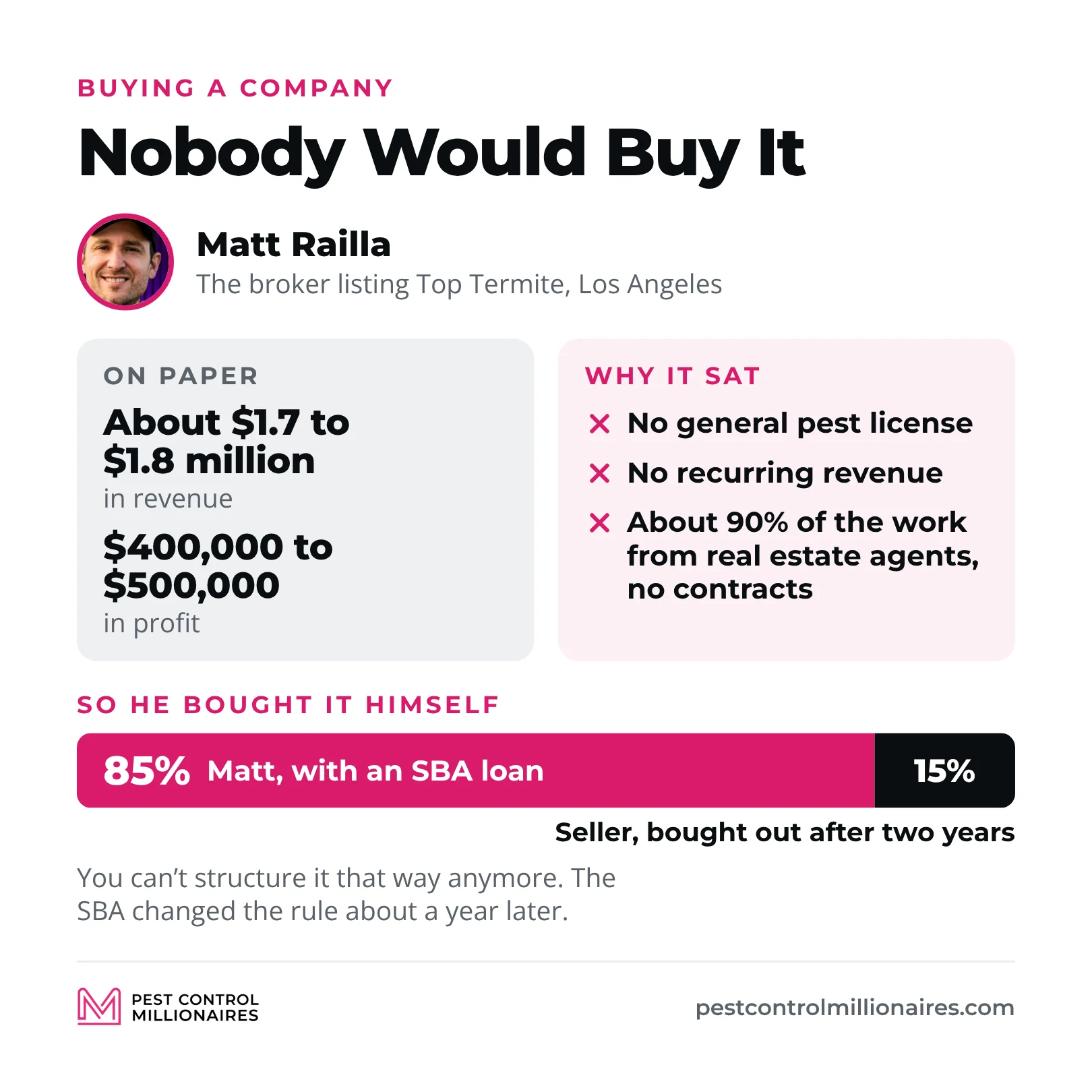
About a year in, Matt listed Top Termite. The owner was 63 and ready to sell. The business did about $1.7 to $1.8 million in revenue with $400,000 to $500,000 in profit, with three inspectors including the owner and one office person. A great business.
The interest was huge. Private equity groups, big pest control companies, hundreds of calls, meetings all day. And nobody bought it. There was no general pest license and no recurring revenue. About 90% of the work came from real estate agents on home transactions, with no contracts, just relationships.
The individual buyers were worse. Matt said a lot of tech guys wanted a recession proof business they could run from a spreadsheet. But this one needed the owner to become a termite inspector and take over the agent relationships in person.
The ride-along that changed his mind
Six months in, the listing was still sitting there. Meanwhile Matt had gone over a year with zero income, because brokers only get paid when a deal closes. So he asked the owner if he could ride along for a few inspections.
He loved it. “I don’t mind crawling under houses and going in attics,” he said. Just as important, the seller loved to teach. Matt called him the Yoda of termite inspectors in Los Angeles, and everyone in the market knew him. That is the person you want to learn from.
How the deal actually got done
Matt did a partial buyout with an SBA loan. He bought 85% and the seller kept 15%, with a buyout after two years. That gave the seller a reason to stay and hand off the agent relationships properly. Matt said you can’t structure it that way anymore, because the SBA changed the rule about a year later.
It was a stock sale, which meant transferring insurance and every document into his name, and the SBA process took about seven months. He also left his own commission on the table so the seller would net more and the deal would close. His broker still got paid and, in his words, didn’t help at all. Sometimes that is what it takes.
Before the close he trained with the seller and got his own license, so by the time they signed in June he was already an inspector. That was right before swarm season, which starts around August in LA.
The easiest thing you can do is show up
The company was old school. It ran out of the owner’s house, the accounting was pen and paper, and the reports were done on a typewriter. Matt brought in QuickBooks and a termite-specific CRM right away.
His two inspectors were both in their 60s and turning away work, so hiring was the first job. His first hire showed up late twice in the first week and then didn’t show up at all. Matt let him go on the spot. “The easiest thing you can do with this job is show up,” he said. I told him the way people start is usually how they finish, and I stand by that.
The next hire was the son of a friend of the seller, early 30s with a wife and a kid, and he has been amazing. Motivated people show up.
Six months of training before anyone goes solo
This one surprised me. Every new inspector rides along with Matt or another inspector for six months, paid, before they go out alone. He said two weeks of training doesn’t work in termite, because you have to know construction, how to handle real estate agents, and how fumigations work.
The liability is real. They inspect $10 million homes, and if you miss something on a real estate transaction, it does not go well. Once they are trained, his guys run their own routes, do their own estimates and pricing, and take their trucks home. Matt runs the whole thing from his garage.
The niche inside the niche
Everyone Matt talks to tells him to add general pest for the recurring revenue. He wants to eventually. But he made a case for staying focused that I liked.
“You can’t just go on Google ads and LSA your way to real estate agents,” he said. The agents call because the company has done good work for 30 years. Nobody can take that book away unless Top Termite stops showing up or does bad work. It is not guaranteed revenue, but it is a moat. I told him the niches inside the niches are where you make money.
Pre-treating new construction after the fires
The Palisades fires burned about 6,000 homes, and 15% of Matt’s business was in that neighborhood. They lost that revenue overnight. Then one of his inspectors, who used to do new construction pre-treats at another company, showed him the opportunity.
Pre-treating a new home costs less than one fumigation and protects the house for decades. Most contractors and homeowners don’t know it exists. Only about 300 of the 6,000 homes have been rebuilt so far, and Top Termite has already done 12 or 13 of them. His take is simple. “We should be spraying every single new construction house.”
Where he’s headed
Matt wants to get from about $2 million to $5 million, and he doesn’t think he can get there by winning agents one at a time in new territories. Agents in Orange County already have a termite guy. So the plan is to buy other termite companies and take over their books. Most of those owners are in their 60s, and their kids don’t want to crawl under houses for 30 years.
He knows how to value a business, which is a real edge in that plan. After that he wants to add general pest, since his inspectors see rat droppings and other issues in almost every home and have to say no right now. Eventually he wants a general manager running the day to day so he can focus on acquisitions.
He also has 30 years of paper records with more than 10,000 home addresses in boxes. I told him to scan them and have a VA enter them, because that list is worth real money the day he launches general pest.
Treasure hunting under a house
My favorite line came near the end. The seller taught Matt that when you’re under a house, you’re treasure hunting. “Those termite droppings are gold. Every time you find a pile, that’s money in your pocket,” Matt said. When I plowed snow, I used to call it pennies from heaven. Same idea.
Two years ago Matt had never thought about pest control. Now he owns a 30 year old company, loves the work, and has no plans to sell. Most of us didn’t pick this industry either. It found us. Thanks for reaching out, Matt.
Watch the PCM Podcast on YouTube