

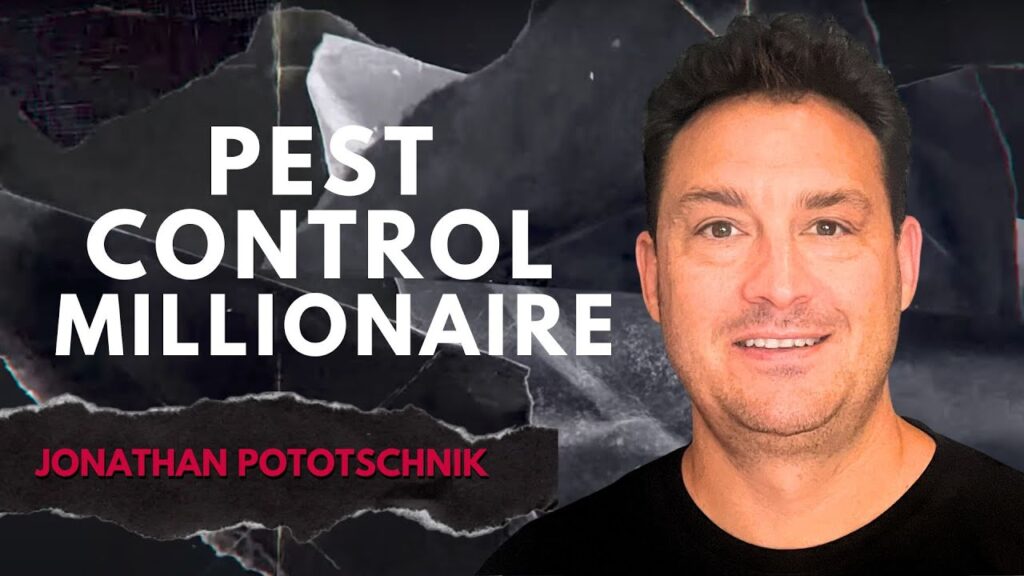
Jonathan Pototschnik started City Turf, a big lawn care company out of the Dallas Fort Worth area, and he also started Service Autopilot. A lot of people know him as the lawn care millionaire. He just came back from a three-year break, and he’s all in on City Turf again.
I had a list of questions ready. He gave me more than I asked for. Here’s what stood out.
For more straight talk from operators who have built and scaled, browse every episode on the Pest Control Millionaire podcast.
Table of Contents
Toggle1. Play the long game
I asked him who he’d want to sit with for a day. He picked Jeff Bezos, not because he studies him, but because of how Bezos thinks about time.
Bezos kept investing year after year and didn’t pull profit out early. He built Amazon, then AWS, then Prime, then more, and most people can’t pull that off.
As Jonathan put it, “the long game is not the way people look at building businesses now.” Plenty of great founders do play long, but most people who say they want to win big don’t think that way. They want the payoff now. Bezos waited. That is the whole point.
2. A break will cost you momentum
Jonathan took three years off. He walked me through three phases.
First he felt off, not sad, just not right. Then he got comfortable. He thought he could ride bikes and race cars forever and be fine. Then phase three hit, and he got tired of the calendar and wanted to build again.
A friend named Dan Martell kept warning him. Every time they met, Dan asked if he was still on his break. Dan had taken time off too and felt the cost. Jonathan agrees now. “You lose a lot of momentum, you really do. It takes a while to get back in the game,” he told me.
He also noticed his health slipped while he traveled. It is hard to eat right and train on the road. Still, he says he would do it again, and he is just glad he came back.
3. The CEO has three jobs
This was one of my favorite parts. I asked what a CEO should focus on. He gave me three clear jobs.
First, cast the vision. Where are we going? What does winning look like? How do we show up for clients and the team? Second, build the team that can get you there. Third, figure out how to pay for the growth.
He added a fourth job for some of us. If your name is part of the brand, you can’t fully step out of marketing, and you become part of the show whether you like it or not.
4. Know your two engines
Jonathan lives by the 80/20 rule. He learned it years ago and still studies the books behind it, like Star Principle and The 80/20 Principle.
For a service business, he says the 80/20 comes down to two engines. One brings in clients. One brings in team members. Everything else is the work in the background that keeps it all from blowing up.
That is it: sell the work, then hire the people to do the work. He says the hard part isn’t knowing the rule. It is looking in the mirror and asking if you really live it. He’ll be the first to say he doesn’t, not the way the experts do.
5. Protect your focus like it’s the business
Jonathan says focus is still a daily fight for him. So he built rules.
He uses an app called Freedom to block websites. He keeps social and YouTube off his phone, and he blocks news too. He writes a list each day of what he’ll do. He doesn’t always follow it, but he tries.
His best line was about ideas. He loves learning, but new ideas can pull him off track. “I don’t need another idea, just need to do the 50,000 ideas I already have,” he said. I do the same thing. I’ll hear something on a walk and miss ten minutes of the podcast because my brain ran off with one idea.
6. Don’t sell what you’d just buy back
People offer to buy City Turf all the time. His highest offer was 20 times earnings. On their numbers, that is a huge check.
He won’t take it, and his logic is simple. “Why would I take the money off the table pay the taxes and then come right back to the thing I’m already doing that’s stupid,” he said.
He believes in home services, so if he sold, he’d just put the money right back into the same kind of business. He already has the team, the brand, and the launching pad, so he keeps going.
7. Build it so it runs without you
One of the books Jonathan likes is Antifragile. You can hear it in how he builds.
He’s not hiring one designer, he’s building a bench of three or four contractors. He’ll even hand the same project to a few people and keep the best work. That way he has backups and better odds.
He thinks the same way about social media. He could be the face of it, but if he’s the face and he walks away, it all stops. So he wants four or five people running it instead. Even if that is a little worse than one star, it keeps moving without him. “I’m highly inclined not to make me the focus of it,” he said. He wants people to see the whole team, not just one person.
8. Keep the message simple
Jonathan is rebuilding all of City Turf’s marketing. He started with the trucks.
His old truck design was from way back in 2007. Too much going on. He says only a couple of things really matter now. “There’s only two things that matter on the truck… pound in the logo, pound in the mascot,” he told me. Then a short line on what you do.
His reason for cutting the phone number and website? People just Google you. If the name is good, they’ll find you. He’s leaning hard on their mascot, Chester, across everything.
9. Change the quality of your revenue
City Turf used to be mostly mowing. Now its top service is fertilization. That shift was on purpose.
Fertilization has better margins, and the costs are better. And it is easier to find people for that work than to staff mowing crews. Mowing leans on seasonal H-2B workers, and some years those didn’t come through. When that happened, the team had to fire clients and scramble with contractors. It hurt their reviews and beat the team up.
So they didn’t just chase more revenue. They changed the kind of revenue they sell. The top line grew slower after they passed ten million, but the business got stronger.
The real goal post
Here is the thing that stayed with me most. Jonathan doesn’t need the money. He could sell. He could sit back. He came back anyway.
I asked why. His answer wasn’t about growth or a number. His measuring stick now is whether the work is fun. He is also honest about luck. He grew up in an area that grew into one of the fastest growing places in the country. A hot, dense market did a lot of the work.
But he’s back because he loves it. He thinks he and Philip can build a nine-figure company together, and he’s having a blast doing it. That is a good reminder for me. Build the thing you actually want to work on.
