From One Mower to $1.4 Million: How Steve Delaney Turned Yard Boss Into Lincoln’s Dominant Home Services Brand


Table of Contents
- Starting in College with a Mower
- The Painful Years of Doing Everything
- The Rebrand That Changed Everything
- Adding Pest Control as a Natural Extension
- The Upsell Machine
- Why Yard Signs Still Matter
- The Truck Wrap Illusion
- The Mindset Shift That Changed Everything
- What’s Next
- Key Takeaways
- Frequently Asked Questions
This Yard Boss success story shows what happens when you commit to growth.
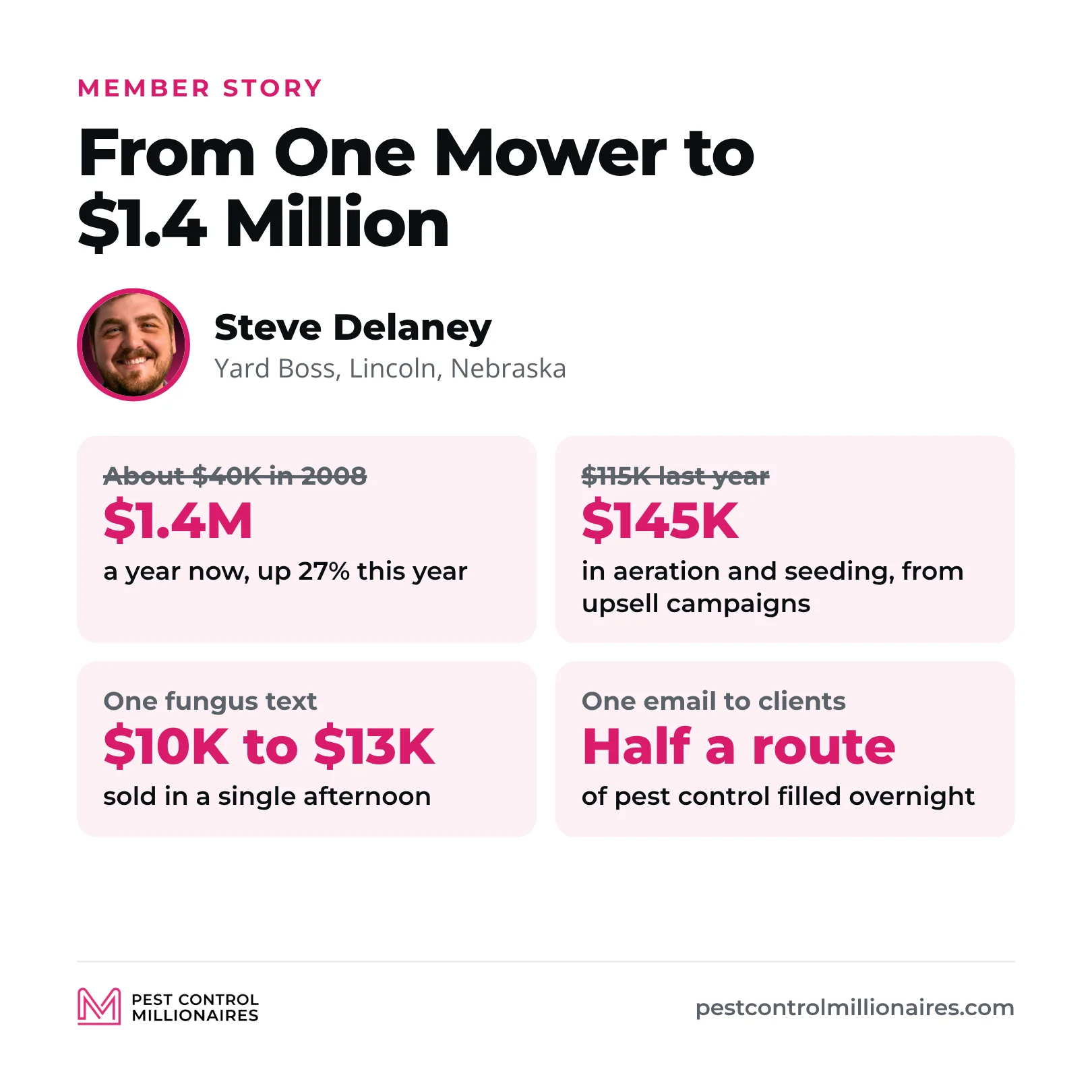
I recently sat down with Steve Delaney, the founder of Yard Boss out of Lincoln, Nebraska, and his story is one of the best examples I’ve seen of what happens when you stop trying to do everything and start doing a few things really well. Steve started mowing lawns in high school, officially launched his business in 2008 while still in college, and has spent the last 17 years building it into one of the top lawn care and pest control companies in the region. They’re doing $1.4 million a year right now and growing fast, up 27% this year alone. His journey from a guy who did absolutely everything to a focused, scaling operation is a masterclass in how to actually build a real business.
Starting in College with a Mower
Steve was originally in school for architectural engineering before he transferred to a program in landscaping and turf management. He’d been mowing lawns since high school and kept it going through college, coming home every weekend to run his route. By 2008, the side hustle was pulling in about $40,000 a year, and Steve decided it was time to make it official.
“I feel like the government needs to know about this before I get in trouble,” he told me, laughing. That was the real start date for Yard Boss, even though the name didn’t come until later. After finishing his internship, Steve went full time and never looked back. He worked every night and every weekend to keep the momentum going, and the business just kept growing from there.
The Painful Years of Doing Everything
For the first chunk of Steve’s career, Yard Boss, or as it was called back then, Steve’s Lawn and Landscaping, did absolutely everything. Mowing, landscaping, patios, retaining walls, sprinkler installs, sprinkler service, snow removal, fencing, decks. If it was outside the home, they were the guys.
“We just were the guy for everything and that was miserable,” Steve told me. “Like absolutely miserable.” The problem wasn’t that the work wasn’t there. It was that doing everything meant doing nothing exceptionally well. Every service had different skills, different equipment, different seasonality, and different customer expectations. Steve was spreading himself so thin that the business couldn’t really grow in any one direction.
The snow removal side was especially brutal. They were doing about 40 acres of parking lots and 10 miles of sidewalks. Steve’s guys were out for 16 to 18 hours at a time on snow days. It was unsustainable.
The Rebrand That Changed Everything
In 2020, Steve made a bold move. He rebranded from Steve’s Lawn and Landscaping to Yard Boss and started dumping services. He cut landscaping, pulled back on snow removal, and began pouring everything into fertilizer and weed control. At the time, the fertilizer division was under $100,000. Today it’s the core of a $1.4 million company.
The name Yard Boss actually had a fun origin. It was Steve’s nickname as a kid because he was apparently a bossy little three year old. His uncle started calling him that and it stuck. When he started the business, someone suggested using it. Steve pushed back at first. He didn’t want his childhood nickname on a company. But looking back, it was one of the best decisions he ever made.
The rebrand did hurt in the short term. People thought he was a new company. Some customers assumed he’d bought a franchise or changed businesses entirely. Steve estimates it took about six to twelve months before things evened out. But once they did, everything clicked. A focused brand, a focused service offering, and a much cleaner operation.
His advice for anyone thinking about rebranding? Do it at the very start if you can. Pick a good name that isn’t tied to your personal name, because your name makes it harder to sell the company down the road. And make sure the name actually means something. “Steve’s Lawn and Landscaping really didn’t resonate well,” he told me. Yard Boss sticks in people’s minds.
Adding Pest Control as a Natural Extension
Steve added pest control a few years ago, and it was one of the smoothest transitions he’s made. The reason was simple. Mosquito, flea, tick, and chigger treatments are basically exterior sprays, and the way Yard Boss applies them is almost identical to how they treat for weeds. They spray the entire lawn and landscaping with a chem gun on a hose, the same equipment and technique they already use every day.
“We don’t have to train somebody one direction or another,” Steve said. The licensing was easy too. His guys already had their lawn care licenses, so getting the additional pest control category was straightforward. And the best part? He already had a huge customer base to upsell.
Steve fired off an email to his existing clients announcing the new service and overnight had half a route filled. That’s the power of adding a complementary service to an established brand. The customers already trust you, already have your number saved, and already see your trucks in their neighborhood. It’s almost a no brainer for them.
The Upsell Machine
One of the coolest things about Steve’s business right now is how aggressively he’s upselling existing customers, and how well it’s working. He’s using GoHighLevel to send targeted text and email campaigns to his client base, and the results have been insane.
The fungus campaign is a great example. Steve’s team noticed a lot of fungus popping up in yards around their area. They sent out a text message to their customers that said something along the lines of, we’ve noticed a lot of fungus, and left untreated this will kill your yard. Within two or three hours, they had to shut the campaign down because they had 200 responses and not enough sales reps to handle them all. They sold $10,000 to $13,000 in fungus treatments in a single afternoon.
The armyworm campaign was the same story. Armyworms can destroy a lawn in 24 to 48 hours, so Steve sent out a text explaining the situation and telling customers they could self diagnose by looking for certain signs. The response was massive.
Aeration and seeding went from $115,000 last year to $145,000 this year, driven largely by these kinds of targeted upsell campaigns. The key insight Steve learned from the program was that people buy when they want or need something. Asking them to commit to aeration back in January for something they might want in September doesn’t work. But when the time comes and you send them a text explaining exactly what’s happening and why they need it right now, they jump on it.
Why Yard Signs Still Matter
Steve spends six or seven thousand dollars a year on yard signs, and he thinks it’s one of the best marketing investments he makes. Yard Boss doesn’t use the standard small signs. They use big ones, about the size of a sheet of paper, with their mascot Blade on them. They put them everywhere. In client yards after completing a job, at intersections, at neighborhood entrances, even in the center of roundabouts, which got them threatened with fines from the city.
The Christmas light signs are especially effective because they tend to stay in yards all the way until spring. People just don’t think about pulling them down when they’re not doing much yard work in the fall and winter. So Yard Boss gets months of free advertising from a single sign.
Steve’s philosophy on visibility is simple. He wants everybody in Lincoln to know that Yard Boss exists, whether they need the service right now or not. “One day you’re gonna be having coffee or drinks with your friend and they’re gonna be talking about getting lawn care, pest control, Christmas lights, whatever. You’re like, well, I don’t know, but I know this Yard Boss, I see them around,” he said. And then when that person goes to Google or Facebook, the ads are already there waiting for them.
The Truck Wrap Illusion
Steve’s fleet is all bright green and blue F-250s and 350s, and they all look identical. Same trucks, same color, same wrap, same everything. People in Lincoln have started saying they see Yard Boss trucks everywhere, which Steve finds hilarious because he only has six trucks rolling on any given day.
“You don’t see them everywhere. We’ve only got six rolling a day. We’re not even in every part of town every day,” he told me. But because they all look the same, people think the company is twice as big as it actually is. Steve also never reuses truck numbers. Their current trucks are numbered up to 25, even though they’ve never had 25 trucks at once. People see truck number 22 and assume there must be a massive fleet. It’s a simple psychological trick that costs nothing extra and makes the company feel way bigger than it is.
The Mindset Shift That Changed Everything
Steve’s biggest turning point came at the end of 2019 when he went to a conference in Dallas and ended up in a mastermind group. He grew up in a town of 8,000 people. Running a million dollar business there made him feel like the richest guy in town. But sitting in a room with guys doing 10,000 clients and multiple locations completely rewired how he thought about what was possible.
“It was a mindset shift really is what it came down to,” Steve told me. He also realized he’d been stuck in his small town too long. Word of mouth had built the business, but the market was maxed out. He had to push into Lincoln in a big way to hit his growth goals, and that decision alone changed the trajectory of the company.
Steve also learned the hard way that marketing agencies aren’t always the answer. He discovered that his own agency had been using GoHighLevel the whole time, a powerful CRM and marketing automation tool, and he had no idea. Once he understood how it actually worked, he was able to have real conversations with his agency about what to do, how to target, when to pull ads down, and when to go all in on something that was working.
What’s Next
Steve’s got his sights set on Omaha. Lincoln can probably support about 3,500 to 4,000 clients, and Yard Boss is at about 2,400 right now. He thinks they’ll get there fairly quickly at the pace they’re growing. But Omaha is four times the size of Lincoln, and that’s where the real runway is.
He’s planning to move into Omaha in pieces, starting on the west side and working his way into the metro over time. The goal is to be there within two years. Steve set a personal goal to be in Omaha by the time he’s 37, and he’s not backing down from it.
Christmas lights will keep playing a role too, even though Steve calls it a love hate relationship. It solves the winter revenue problem that plagues most lawn care companies, and when it’s executed well, it’s incredibly profitable. The key is having the operations dialed in tight enough to handle the compressed timeline. Missing even a week of marketing or falling behind on installs can cost you the entire season.
Key Takeaways
Steve’s story spans 17 years of building a home services business from the ground up, and there’s a ton to learn from it. First, stop doing everything. Steve’s biggest growth came after he cut services and focused on what he was actually good at. Fertilizer, weed control, pest control, and Christmas lights. Similar services, similar skills, similar customers. Focus beats breadth every single time. Kirk Slack took that idea to its logical end and left lawn care for pest control entirely after 14 years.
Second, upsell your existing customers aggressively. Steve’s biggest revenue jumps this year came not from new customers, but from targeted text and email campaigns to people who already trusted him. When the timing is right and the message is relevant, the conversion rate is incredible.
Third, make yourself impossible to ignore locally. Yard signs, truck wraps, home shows, rain gauges, mascots. Steve spends money on visibility everywhere he can. The goal isn’t to close a sale today. It’s to make sure that when someone in Lincoln thinks about lawn care or pest control, Yard Boss is the first name that comes to mind.
Fourth, invest in learning from people who have actually done it. Steve spent the equivalent of a college degree over four years on masterminds, conferences, consultants, and coaching. Every dollar paid for itself many times over. The $20 internet guru isn’t going to get you where you need to go. Find the people who have been in the trenches and pay them for their time.
And finally, expand before you think you need to. Steve stayed in his small town too long because word of mouth was working. But once that market was maxed out, he was stuck. Moving into a bigger city earlier would have saved him years of slow growth. If your market feels like it’s getting tight, it probably already is.
From mowing lawns on weekends in college to running a $1.4 million operation with a clear plan to expand into Omaha, Steve’s story is proof that the right mindset, the right focus, and the willingness to invest in yourself can build something incredible. He’s only 35 and he’s just getting started.
Want to connect with Steve? You can find him on Facebook. And if you’re looking for the kind of hands on education that helped Steve finally understand his own tools and start scaling the right way, that’s exactly what Pest Control Millionaires is built to do.
Frequently Asked Questions
How did Yard Boss achieve growth in the pest control industry?
By doing fewer things. Steve rebranded to Yard Boss in 2020, cut landscaping, pulled back on snow removal and focused on fertilizer and weed control, then added pest control as a natural extension (one email to existing clients filled half a route overnight). Targeted text and email upsell campaigns, big yard signs and identical wrapped trucks did the rest.
What customer retention strategies did Yard Boss use?
The interview focused on selling more to existing customers rather than on retention. Steve stays in front of his client base with timely text and email campaigns in GoHighLevel, like the fungus text that sold $10,000 to $13,000 in treatments in a single afternoon, because people buy when they want or need something.
What advice does the Yard Boss story offer pest control entrepreneurs?
Stop doing everything, upsell the customers who already trust you, and make yourself impossible to ignore locally with yard signs, matching trucks and a memorable name. Steve also says to invest in learning from people who’ve done it and to expand before your market feels tight, because he stayed in his small town too long.
Full transcript
Read every word of the interview
00:00Dan Leibrandt
Hey there, my name is Dan Leibrandt and welcome back to Pest Control Success Stories. Today I'm joined by Steve Delaney, the founder and owner of Yard Boss based out of Lincoln, Nebraska. Steve started Yard Boss back in 2008 while he was still in college. And over the years, he's grown it into one of the leading lawn care and pest control companies in the region, doing $1.4 million a year and quickly growing, running multiple full-time crews and serving both, or serving mainly residential clients. What's unique about Steve's story is how he's blended lawn care, pest control and Christmas lights under one powerful local brand, Yard Boss, while keeping a strong reputation for professionalism, community focus and customer care. From starting with a single mower to managing a growing team and navigating real challenges, Steve's journey is a great example of grit, local entrepreneurship and smart service diversification in the home services space. Now without further ado, Steve, welcome to the show.
00:54Steve Delaney
Thank you. Great introduction.
00:56Dan Leibrandt
Yeah, yeah, of course, man. So walk me back to the beginning of Yard Boss, maybe even what was going on before that. How do you get started in college?
01:05Steve Delaney
Yeah, so I actually was mowing in high school and during college, I actually originally went to college for architectural engineering and did not like that. So I transferred to another community college where I got a degree in landscaping and turf management. And so I always kept the mowing thing alive during college and came home every weekend to do it. And we just made enough money during that time. Like we did $40,000 in revenue. In 2008 and I'm like, I feel like the government needs to know about this before I get in trouble. And so that's when we officially started the business is what I call the official start date was 2008 when we told the government and it was no longer this side hustle thing that we were doing. So, yeah, we started in 2008 when I was in college and over the, you know, over the next year while I was finishing up college, I worked every night, every weekend to keep things going and rolling. Then did my intern, as soon as my intern was done, I left and went full time doing landscaping and mowing. And then down the road, the business evolved where we got rid of landscaping, mowing, and built the fertilizer business up to what it is today. And then added pest control a couple years ago.
02:16Dan Leibrandt
Cool. So when you were first growing the business, what were some of the biggest drivers of growth? How were you getting those initial customers?
02:23Steve Delaney
It was literally just like word of mouth. I mean, 2008, the newspaper was still relevant. And in the small town that I grew up in, we would still run newspaper ads and Craigslist ads and things like that. I didn't know much about Facebook. We dabbled in like Facebook here and there, but I really didn't realize what tool Facebook would be at that point. And then of course, you know, you get about to probably 2012, 2013 somewhere in there. And it's like clear that you know, Facebook is the way to go. And then, you sort of stumble around and try to figure that stuff out as you go.
03:01Dan Leibrandt
Hmm, okay, so it's mainly a word of mouth to start, kind of transition into Facebook, but what were you doing on Facebook?
03:08Steve Delaney
We're just boosting posts, just like telling people that we were installing this patio and then we might put like, I don't know, 25, 30, 50 bucks behind it, you know, in the beginning days. I, cause I had no idea what I was doing. I'm just like, let's try it, see what happens.
03:25Dan Leibrandt
Yeah, yeah. Cool. Okay, so that was working pretty well. So you're just you're posting on your personal profile or your company profile.
03:31Steve Delaney
Personal profile in the beginning and then of course I don't even remember what it was because in the beginning they didn't have business profiles for a while and then you know you get your business profile and You know invite all your friends to like it and then you just keep posting it's actually interesting to scroll all the way back every once in a while take a trip down memory lane to see what you Posted and that sort of stuff...
03:52Dan Leibrandt
Yeah, yeah, definitely. Okay, so you're starting to get into Facebook. Was there like across your journey? Because now you've had the company for about 17 years. Were there any, I guess, like big realizations or anything that's like made you substantially grow through kind of, I don't know, really throughout your journey? What was there any key pivot points?
04:16Steve Delaney
Yeah, there was actually a really key pivot point at the end of 2019. We had just finally bought a CRM and I run into a local competitor who's now a great friend of mine, guy that owns Summit Lawns. He's like, dude, you need software. We had a conversation about that at an Indian shop. Anyway, I ended up at a conference in Dallas. And then ended up in a mastermind group and it's like holy cow like here are all the answers that I've needed there are people out there with the knowledge there are people out there with the training the software like literally everything you need to grow a business and that was a huge pivot point that like It was a mindset shift really is what it came down to over the next probably four to six months. It was a mind shift shift. You got to remember I grew up in a town of 8,000. Like if you're running a million dollar business, you're probably the richest guy in the town. And so it was like a huge mindset shift and you go into these rooms with these guys with 10,000 clients and multiple locations and things like that. And you're like, wow, you're like, this can be done. That isn't like some one-off lucky guy over there that inherited grandpa's business that's been around for 70 years. Like you can build these things pretty quickly if you know what you're doing and you're willing to ask and pay the right people for the answers.
05:35Dan Leibrandt
Got it. Okay, so a big part of it was mindset. And then was there any like specific key takeaways from going to a mastermind or masterminds like that?
05:44Steve Delaney
No, it's just a bunch of little stuff here and there. One of the big things we did is we had to push on the bigger city that was closest to us. We were not gonna hit any of our goals just staying on these smaller towns that I grew up in. So we went to the bigger city in a big way and started to get traction there. Mean, there's neighborhoods the size of the town that I grew up in. Yeah.
06:09Dan Leibrandt
Wow. Yeah, okay. Yeah, I want to ask more about that. You grew up in a small town. Seems like you kind of maxed out that area. So for like for people listening, when do they know that it's the right time to expand? When do you get out of your small town? When should they?
06:26Steve Delaney
Before you start. Like if I could go back knowing what I know now, that would have been like this ancillary market that we like went to and it wouldn't have been our main market for so long. It is probably the biggest error I made. So after college, I lived in Lincoln for a couple of years.
06:28Dan Leibrandt
Really?
06:45Steve Delaney
And then a roommate situation dissolved because guys were going to grad school and stuff like that. And I moved back to Crete to that small town because business was getting better traction there because word of mouth is really powerful, you know, and we were getting traction there. And then we just like maxed that out in a couple of years. And I honestly did not realize that we had it maxed out. Because, and when your market size is so limited, you have to do so many things. Like we had to landscape and mow and patios and retaining walls and not only that, then we had to do business the way Mr. Jones wanted to do business and we had to do business the way Mrs.
07:20Dan Leibrandt
Mmm.
07:21Steve Delaney
Smith wanted to do business, not the way that Steve wanted to do business. And so just because you needed that many clients, you know, there wasn't another client around the corner. And quite frankly, they didn't have options either. You know, because you're the only guy in these towns, so.
07:40Dan Leibrandt
Okay, so your small town was like 8,000. So what is like a good size city? What was the size of the bigger one you went to?
07:48Steve Delaney
Lincoln is about 350,000. And I wouldn't say that that's like a big city. I mean, we can see on the horizons probably in the next four or five years that we're gonna have to do second location to meet our growth goals. Probably going to Omaha within the next three years.
08:07Dan Leibrandt
Okay, cool. Now, I think, I don't know, some people might detest that, guess, like, well, if you go into those bigger cities, there's gonna be more competition, right? So how do you fight against that competition?
08:20Steve Delaney
Here's a better company. You know, at the end of the day, like the simplest way to beat half of your competition is literally answer the phone.
08:30Dan Leibrandt
Mmm.
08:31Steve Delaney
There are so many people, interesting story, literally last week, we busted a gate, getting machine through during aeration and I go out there I'm gonna try to fix the gate. I'm like, I can't do it. I'm just gonna call somebody. I'm not joking. I called eight fencing companies on Google. Two of them answered live. And two of them sent me a text message saying hey responding to my voicemail saying hey can you send me a picture of the gate and the hinge that you're dealing with and Like it didn't matter on cost the one that answered was a big nationally known Company and it's like wow, there's some little hanging fruit and building fences if these guys aren't even answering their phones live...
09:10Dan Leibrandt
Mm-hmm. Yeah, definitely. Okay, so mean, that's a huge part of it. I've noticed that too. Like literally just pick up the phone. If it's not you, know, maybe you're too busy and crawl spaces or whatever. Well, then you have to find someone else that will pick up the phones for you, right?
09:24Steve Delaney
Yeah, there's all kinds of options out there. There's VAs, there's these answering services, and some of these answering services like know the software and the industry is inside. And now you just got to find those specific companies that you can like a four hour onboarding call and they can be running pretty dang good.
09:44Dan Leibrandt
So you have a, now that you guys have grown to a pretty big level, you guys have a full-time office manager now, right?
09:51Steve Delaney
Yes, yeah, we've had one for probably, I don't know, four or five years and we're gonna add somebody else into the office too. It's at capacity. Back to the same thing, we're letting too many calls go to voicemail because we're on the other line.
10:07Dan Leibrandt
For other companies, maybe people are just getting started out or whatever, when is the right time to hire an office manager?
11:25Steve Delaney
As soon as you can. I mean, we did at probably seven or 800,000 in revenue. And the interesting thing is like with any of these positions, you're like, eh, I don't think that I've got enough work to justify this payroll. And if you actually sat down and thought about it, how much stuff is not getting done and you're just getting by on the bare minimum and you can have them pick that stuff up or you can do it because your capacity is now freed up, that's an interesting take that we have. I mentioned that we've hired a field manager recently and he's only six weeks into it. We're doing a slow rollout on it. It's a technician, we're moving up, but he still hasn't taken anything off my plate, but he's doing his job because he's doing all the things that we're like, these can weigh, they're not as important. They're not the biggest fire to be put out, they're still important. So he's just started with those before. He's probably another three months before he's gonna be taking things 100 % off my plate.
12:23Dan Leibrandt
Hmm. Okay, so really as soon as possible because the price or their salary actually is justified because all that money that you're losing on missed calls or maybe upsells or whatever else it actually completely justifies it is what you're saying.
12:40Steve Delaney
Yes, yeah, 100%. And just the customer service aspect. Mean, at the end of the day, you know, I think all of these home service businesses, whether you're HVAC or plumbing and really any business, right? You're really in the customer service business. Like if your customers aren't happy and you're not servicing them the way they want to be serviced and answering their questions and solving their problems, then you're not really any good to them. Like you can be the best pest control guy in the world, but if you can't invoice somebody properly, or schedule them properly. Like the customer is going to get mad, they're going to find somebody else who can do that. So it just heightens your level of customer service by having those folks in there.
13:22Dan Leibrandt
Yeah, yeah, got it. One point that I definitely want to touch on here was that you said that you've grown over really 27 % in sales this year, 20 % more than last year, is that right? How did you do that?
13:33Steve Delaney
Yeah, yeah, that's correct. It is very horrible. I wish I knew like every little thing that we had this like million dollar ad that just like worked really, really good or this, you know, massive account. But it's not that I mean, we're in residential, so we're volume, right? We've had to bring on we've brought on something like 350 or 400 new clients this year and it's just like everything that we Launch is working better this year. So whether it's an upsell campaign or an email or a Trying to reactivate leads that never closed or anything like that is just all working much better this year due to some education and you know the Pest Control Millionaires and learning how to write those things and then also I think it's you know we're finally starting to get traction. A kind of a piece of our story that we didn't hit on is you know I started the business as Steve's Lawn and Landscaping and we mowed and landscaped and fertilized and built patios and did sprinklers and like if it's outside the home we're your guy like we were that company. Like we built decks at some point, we did fences at some points, we just were the guy for everything and that was miserable, like absolutely miserable. And so in 2020, we rebranded into Yard Boss and then started dumping services and building the fertilizer up. So when the fertilizer division was under $100,000 when we made that decision in 2020. And then we have expedited it up to today where we're going to finish 1.4, 1.5 million this year is where we'll end up this year. And I think some of it is just like doing the right thing for long enough. And then you throw the gas that we'll call marketing, you know, on the fire that you can just like explode it then. So you're marketing to somebody, but they're asking their neighbor like, is this a good company? And they're like, yeah, absolutely. So you've got their attention and then you've got the you've got a neighbor backing you up saying that you're a great company and easy to work with.
15:45Dan Leibrandt
Okay, cool. All right, so you rebranded like five years ago and you guys were doing, I mean, what services were you doing? Everything?
15:54Steve Delaney
Everything. Like our main services was sprinkler install, sprinkler service, landscaping, and landscaping is broad. We do everything from installing outdoor kitchen to a simple retaining wall or simple bed planning or pruning. And then we had a couple mowing crews and we had gotten in and out of Christmas lights one other time back in the day, but we had screwed it all up. Like I screwed the business model up terribly back then. And yeah, so we were doing it all. Snow removal, we were big in snow removal. We were doing probably 40 acres of parking lots, probably 10 miles of sidewalks. It was ridiculous, yeah.
16:37Dan Leibrandt
So for other people, what would you recommend? Like just picking a few services or what would you do if you started over?
16:45Steve Delaney
Yes, and services that are similar. Like it's interesting how good you can get when you're only focusing on one thing or two things. Like we added pest control in a few years ago and our intention with the Christmas lights was the Christmas lights was gonna solve our winter problem because the guy is, nobody likes to be called up at 3 a.m. On Sunday morning to go plow snow or Saturday night. So the Christmas lights have kind of been our answer to. Backing off on snow. We still do a tiny bit. We have about 15 very small, think like a McDonald's size business that we take care of. And we do 14, 15 of those accounts with six guys. Like it's a two hour, two to four hour ordeal. Some of these guys are out for 16, 18 hours on snow.
17:33Dan Leibrandt
Yeah, yeah, no, it's insane. So you added Pest Control five years ago or so. How has that been going and why did you do that?
17:43Steve Delaney
We did that because there was a huge opportunity with the mosquito, flea, tick, chigger. So ours is basically an exterior spray, general pest control only. And it kind of comes back to that stick to what you know and what you're really good at. And so we do the exterior. We're not doing termites. We're not doing bed bugs. We're not doing like that gets a little bit further away from being good at it. At the end of the day, and even the way we spray the yard, like some of these pest control people think that we're crazy the way we do our flea, tick and mosquito because we spray the entire lawn and landscaping like with a chem gun on a hose. You would, you know, if you're treating for weeds or what have you. And because we adopted it so similar to what we were doing, and I truly believe that like when we don't have to train somebody one direction or another. Now I see somewhere down the road of us getting really... More lined up with what a traditional pest control guy is where he's got you know his little Ford Maverick and a whole host of project products and different things like that where they can go in it but this has worked really well for us and our customers are ecstatic about it because we keep all of the things out of their home.
19:00Dan Leibrandt
Okay, cool. Okay, so it's been working well and it kind of just seems like a natural pivot or not even a pivot, but just an add-on because it was very similar.
19:06Steve Delaney
Yes. Yes, it's such an easy add-on. Yeah, and the licensing for it is very similar. So our guys had to just go get an additional category to be able to do that in addition to the lawn category. So it was very easy. And once you've got one license and you've been through the process and understand the basics of handling chemicals and don't drink this stuff and how to find the rates and all that sort of stuff, they usually place through their pest control test pretty easily.
19:36Dan Leibrandt
Yeah, also I'm sure you upsold most of your, or I don't know, a good amount of your lawn care people. So that's a lot of additional revenue,...
19:41Steve Delaney
Yeah, yeah. Yeah, so then you got a client base to be like, hey, we're offering something new and you can, you know, fire out an email, text message, upsell and overnight, you know, you've got half a route.
19:56Dan Leibrandt
Hmm. So if you were to do that again of like, let's say you were just lawn and now you're adding pest control right now, how would you make sure that you get as many people from lawn to add on pest?
20:08Steve Delaney
It would be like, and that's an interesting question to ask because I don't think we've rolled that out as good as we could have.
20:15Dan Leibrandt
Yeah, that's what I'm saying. If you were to do it again, it would be the best way.
20:17Steve Delaney
Yeah, if I could do it again, it would be like a multiple approach. So we would probably leave a door hanger after every stop, you know, because we have to leave a door hanger already saying we did visit one and here's what it is watered in. We'd leave an additional door hanger explaining pass with pricing on there that the technician could fill out when they were there. And then we would go into email text message marketing through like GoHighLevel and we would do a multi. Point campaign over probably 60 days where we're making some sort of communication with them in about once a week, once every 10 days explaining a different scenario or question. Think of like Marcus Sheridan's book, They Ask, You Answer. So what are the questions that they're going to preemptively or what are the questions they're going to ask preemptively answer all those in your email text message campaigns. And we would go about that and then we would do a bunch of sort of Facebook, you know, Google and we'd be doing the same thing in the Facebook videos. We'd be answering those questions and how does it work and all that sort of stuff.
21:27Dan Leibrandt
Okay, cool. Love that. And that also kind of ties into the next thing I want to cover, which is you guys have been crushing it on upsells recently. And that has been through doing like different things with GoHighLevel, which also you mentioned I was kind of from the Pest Control Millionaires program where your, your agency was using GoHighLevel, but you didn't know they were so now you're kind of somewhat facilitating telling them to do this and that. Tell me what I mean, first off, like, what are you doing with GoHighLevel? And how did you I mean you said you closed like 10 to 15 K in a week or something. What was that?
22:00Steve Delaney
Yeah, we've done a couple of sales like our aeration. We'll send out like 20 emails for aeration and it's so easy. It's like push now, then the office gets a notification to go ahead and add it for Mrs. Smith or whatever. So, and because like an aeration, like there are people that want it every single year or every other year, every third year, everybody has like their schedule for aeration and aeration and seeding. And so we just fire it off. All the prices are included. In the email and you know it's just a data pool that we pull and a formula that we write to put that number in there and then they just push that button but we had fungus coming into yards and we maybe I don't know if we learned an interesting lesson but we put in there we've noticed a lot of fungus or something to the tune of this we've noticed a lot of fungus left untreated this will kill your yard and I think that that trigger word of this will kill your yard fired people up and we had to shut, which it will, that was not an exaggeration by any means. But we fired that campaign off and literally in two or three hours we had to shut it down because we had 200 responses and we needed to get a sales rep out there to diagnose and sell it and do all that. Fungus is one of those things we have had a hard time getting clients to buy without some sort of senior within the company, whether it's a field manager, technician, agronomist, owner, et cetera, whatever, come out and verify that it is because they do cost quite a bit. Mean, they're about 50 % more than a regular fertilizer program. Yeah. So we had so many appointments. Yeah, we got...
23:36Dan Leibrandt
Hmm. Wow, okay, so you're getting too many leads from that. Now, that's just...
23:40Steve Delaney
Too many appointments. So we shut it down for a day or two, got caught up and then opened it back up. But that first day, we probably sold 10 or $12,000 within an afternoon. Yeah, and then so that's reoccurring too.
23:51Dan Leibrandt
Wow, and that's, yeah, yeah. Was that through email or text?
23:57Steve Delaney
That was a text that we did that in. Yeah.
24:00Dan Leibrandt
Okay, cool. And what percent of your customer base converted? Cause it seems like, mean, that had to be a lot.
24:05Steve Delaney
I guess I didn't even pull that number on what converted versus what was the lead out of that. I never even pulled that number. Just been, it's been a basically that was the kickoff of the most whirlwind fall I've ever had. That was in like late July. Then you roll into aeration. We had an army worm problem in our market at the same time. So we did the exact same thing. We fired off a text message. Here's an army worm. Need to self-diagnose this because by the time we roll a truck out, the yard could be gone. And then because armyworms like literally they just come through and take everything out like 24 48 hours So we fired that off sold a bunch of that had to convert a couple trucks over to spray and armyworms Then you roll right into aeration and seeding that was up like I Guess I don't know the exact percentage of it. I haven't run as percentage But last year we did in the neighborhood of a hundred and fifteen thousand dollars in Seeding and regular aerations this year. We did a hundred and forty five thousand in seeding and aeration. So a pretty significant jump in that. So we roll into that and then here we are in the midst of Christmas lights. Like it has just been like bang, bang, bang, bang, bang, busy, busy, busy. And it's just like everything is firing all right because we've adjusted messaging and who we send it to and how we send it and all that sort of stuff.
25:21Dan Leibrandt
And the seeding and aeration, just be clear, that's all upsells too.
25:25Steve Delaney
Yeah, we do it all upsells. When we send out our prepay option, people have the option to select that they wanted at that time, but we get probably less than five or 10 % of what we'll do, do we get from that. It's just so far out that people, they don't wanna commit to it. When you're doing your prepay option in January and you're talking about a service that they may want or may need in August and September, it's really tough to get people to commit to it then. You know, as a rule of people buy when they want or need something.
25:59Dan Leibrandt
Mm-hmm. Yeah, yeah, 100%. And you also told me that the messaging has changed a little bit and also, like, you your agency was doing GoHighLevel. Like, what have you changed with the upsells, if anything?
26:11Steve Delaney
Yeah, so from the Pest Control Millionaires class, like the biggest thing is like, first of all, I realized like, hey, I've got this powerful tool that my agency's been running. Had no idea. Lean into it. It's not a, the dumpster fire I thought it was that sometimes it worked and sometimes it didn't. Now that I knew how it worked and how to tell them how to use it, they basically built the stuff for us and they help us with some of the creative and stuff like that because. You gotta remember an agency also has probably 100 other clients, right? And they're like, this tanked over here in Tennessee, like, we gotta come up with something better than that if I give a similar messaging or whatever. And so we'll work together to come up with the messaging and what we wanted to say and all that sort of stuff. And then we can have more constructive conversations now with what I've learned on. Ad spend, where we should spend it, what, how to target, what simple messaging, pulling stuff down when it's not working, lighting stuff on fire when it is working, and just going for the moon with it. And it has really helped a lot. And then there's just like, the other piece of it is there's some terms that you didn't realize. Like the one that sticks out in my mind that was kind of like an aha moment for me. Is when you're as each attribution, I believe is the word, where basically they've reached everybody in the market or in the settings that you've put. So that basically means that's gotta come down, another one's gotta go up, even if it's the same ad under different ad set or whatever, even if it was working because they just quit working because Facebook quits pushing them to those people. When you have a aggressive budget like we do, I mean, we hit attribution pretty regularly.
27:56Dan Leibrandt
Hmm, okay, okay. So those are some key takeaways there. And then like moving forward, what is actually, actually, no, I had another question I forgot just remembered with Christmas lights, when did you guys implement that? And I think you said you kind of regret it.
28:12Steve Delaney
It's a love-hate relationship. It really is. I love it because we put money in the bank account before the end of the year. Then sometimes we have guys like, I don't want to say they're arguing over it, but they're like, I want to go to Lights. You stay on fertilizer. They're just kind of ready for something a little bit different by the time we get to November. And I moved one guy over to Lights this morning that thought he was going to be on fertilizer, and he was ecstatic. And so you have that. It's a bit like if you're not prepared and your company's not well equipped, it's not a business for the weak from a sales and marketing standpoint. You, we came in this morning, we had probably 20 or 25 leads. We had all those leads cleared out by 10:30 and they had an estimate unless there was something that we needed the customer from. So we have that, we have to be able to Contact them, get the estimate, do that, and then we have to know where they're going on schedule when they accept. So there was like probably four five of them that just go ahead, sign me up, when can we get installed? And we're like, so then it comes into the operational piece of it, which the operation side has to be on point, on schedule. You've got four weeks to get this done. And if they're even a day behind, then we've got people. Back to my comment of people buy when they want something. Like if they're giving us, you know, four to $800 for a Christmas light job, they don't want you to be like, well, we'll get it by December 1st before everybody lights it up. They like want a day or at least a two day window on this and when you're gonna get out there. It's a tough business because it happens so fast. And if you miss a week of marketing on it or you miss the window on when ads should have been flying, it just goes so fast.
30:08Dan Leibrandt
Mm, got it. Cool, and then something else I want to cover, you said was pretty influential in your growth is yard signs, which I feel like not enough people take advantage of these, and your company name is literally Yard Boss. I feel like you guys are the ones that should be using yard signs the most. I mean, how are you using yard signs and how do they work?
30:30Steve Delaney
So we use yard signs like most pests and fur companies, leave a sign when they're done, but we leave a big one. It's like the size of a sheet of paper. So everybody can see it's got our little character like the guy behind me or mascot. It's got him on it, Blade. And then we have done so many yard signs that we've gotten threatened with fines from the city because there are specific areas that you can put them and can't put them and shouldn't. And this spring I got... Really bold with them where I was putting them in the center of roundabouts. All of our roundabouts kind of have this hill in the middle and so I would put them up on top of that hill in the middle of the roundabouts and they specifically sent us a picture of that one and told us we shouldn't do it with like a text of like the code. It shouldn't be in front of this stop sign and da but we do, man we probably spend on like your corrugated signs, we probably spend six or seven thousand dollars on those a year. We will fly them out. Like crazy in the spring when you see the spring rush on services. And then we will fly them out in a big way on aeration, aeration and seeding, where when we're done seeding a yard, there'll be like a, what size is that? 12 by 18 that we put out in the yards that were completed. We do the same thing with Christmas lights when we hang a house. The interesting thing is the Christmas light wands tend to stay in the yards for a long time, like a lot of times until spring. When our guys get there for first visit, they'll pull the Christmas light sign out in many, many cases. And so it's interesting and I have a theory on it. It's because people aren't tending to their yard as much in the fall. Like they might have leaves to clean up, but that's it. And so the signs tend to stay a lot longer in the yards for the Christmas lights. But yeah, just our Christmas light sign. I think we have 250 we're putting in client yards.
32:22Steve Delaney
After we complete it and we've got 150 that will go in intersection, stop signs, neighborhood entrances, that sort of stuff. And it has always worked really, really good for us. You know, especially when we were getting going, you know, they always say if you're under a million dollars, nobody knows who you are. Right. And I would argue you can get to five million and still nobody knows who you are. And so we literally use those as a tool with my mentality is I just want everybody in Lincoln to know that we exist and what we do. I don't care if you want the service or need the service, one day you will, or one day you're gonna be having coffee or drinks with your friend and they're gonna be talking about getting lawn care, pest control, Christmas lights, whatever. You're like, well, I don't know, but I know this Yard Boss, they see them around and they've got signs and their trucks and all those sort of things. So then they go to Google, Facebook, wherever, catch our ad, if we're doing it right, you know, they were talking about lawn care. The ads will automatically come up for them. Based on their interests and then we get the opportunity to sell them services and tell them why we're the best in the market.
33:33Dan Leibrandt
Yeah, no, you're totally right about that. Someone even on the Thursday group call that we had, you might have heard someone ask, it was something like, you know, I'm looking to get out of the field. I've got a few techs and you know, but like, what do I spend my time doing? And Jonas was like, dude, like just no one knows who you are. Like you just have to do everything related to sales and marketing to make sure more people know about you because you're just, you're like invisible right now. Even if it feels like you have a lot of clients or It feels like all your friends and family know you, but still you need to have everybody in the area know you, right?
34:08Steve Delaney
We do home shows too, just so and we hand out these little rain gauges with our logo on them and these rulers for the rain gauges so you know how much you need to water your lawn and the rulers to get to the appropriate height on the grass and we just literally hand these out. We have no intentions like we just want everybody to know who we are. You know we might sell six or eight or ten accounts but even up until those happen in February and March in our market and even as recently as a couple weeks ago somebody on board, because they're like, we met you at a home show, we saw your booth, I've got this rain gauge, know, whatever that is. And it's just like, we're there to let the world know that we exist and we do this and we're the best it.
34:50Dan Leibrandt
Awesome, cool. Okay, so home shows have worked for you guys too, yard signs and then anything else like marketing related, anything else that's been super influential in growth.
35:01Steve Delaney
Our truck wraps for sure. So we have these bright green and blue, you know, F-250s and 350s that, you know, are becoming very noticeable and, you know, people are citing like, we see your trucks everywhere. I'm like, you don't see them everywhere. We've only got six rolling a day. We're not even in every part of town every day. But people just get that impression when it's like the same. Truck, you know, it's an F-250 or 350, which basically looks identical to the untrained eye. The same cab orientation, like all the way down the list of all the things. It's all the same. So they think that you're twice as big as you are. And then you like, you know, we've been in business so long. We started with one. Truck number one has never been in, hasn't been in service for probably 12 years. So our truck numbers are up to like, I don't know, 25 and people are like, they must have 25 trucks. No, we just like we never reused a number...
36:04Dan Leibrandt
Yeah, no, okay, that's awesome. Yeah, and I also, like you mentioned, I see your mascot in the back. When did you rebrand the truck wraps and also when did you kind of implement and create a mascot?
36:18Steve Delaney
The mascot was sort of last winter. We bought a company a few years ago and they had this mascot but he was living in the 90s and he literally had the old corded phone with the curly cord that you would hang up. He had that in there with a little bubble that said call now. He was just super dated so I just had somebody on Fiverr bring him into the modern century. So we did that and then the branding when we changed the name in 2020 is when we did the branding and we rolled that out. In a big way and spent the money to wrap all the trucks at the same time to look the same and push everything out.
36:54Dan Leibrandt
Cool, awesome, that's also the.
36:56Steve Delaney
That was a big, big initiative, an expensive initiative to get done is wrapping all the trucks, re-uniforming everybody, rebuilding websites, all the things that came with that rebrand.
37:09Dan Leibrandt
Yeah, when do you think people should rebrand if at all? Haha...
37:15Steve Delaney
I guess I don't have an opinion in the market. I have several friends that have rebranded. And I will say this, in the short term, it kind of hurts the business in the first six to 12 months. Because people don't know whether you're new. I still get people that I know, they're like, you bought a franchise, that's why you changed your name. No, I hired a bunch of really smart people to help me figure this out because Steve's Lawn and Landscaping really didn't resonate well. We were dumping landscaping, Steve's Lawn Care didn't like it, you know, and that was one of the drivers for it. And then we ended up with Yard Boss. But to say when... Like my honest opinion, my honest opinion is like when you start the company, spend some money to get it right. Like, I mean, that doesn't mean you go to KickCharge and have to hit Antinality, you know, do the whole tens of thousand dollar thing. That is like, we picked a good name. Your personal name probably shouldn't be in it because it's not good for resale if you ever want to sell your company.
37:58Dan Leibrandt
Well now you... Yeah.
38:28Steve Delaney
I think it just gives a small chuck-a-truck vibe and like you're gonna they're just gonna leave a $20 bill under the doormat and like that sort of that sort of vibe to a company and then but like if you could come up with the name and you could have all that stuff at least halfway there and then maybe you need to adjust the colors and bring a fresh thing into it I think it makes a big impact. Because a lot of SEO comes off of long-term being around, right? Yeah, so when you basically kill all your SEO, because you were still a lot in landscaping and that was doing halfway decent and you come Yard Boss, like you gotta build that back up and that takes some time to build some stuff back up.
39:03Dan Leibrandt
Yeah, Brent.
39:16Dan Leibrandt
Hmm, okay, so it's pretty painful and you might not see any ROI in the first six to twelve months, but ideally you do it when you first start Yeah...
39:25Steve Delaney
Yeah, that's my opinion, I haven't been through it. So the interesting thing is Yard Boss was a nickname I had when I was a kid, because apparently I was a bossy little three-year-old. And that's what my uncle called me. And when I started the business, that was suggested. I'm like, well, I don't want my three-year-old nickname to be the name of the company. And had I done that from the get-go. We would saved ourselves a ton of time and money and stuff. Looking back on it was a really, really good move. But it was, it cost us money to let everybody know who we are. We're the same people, we're all those sort of things. And it wasn't like we changed from, like you could have had Steve's Lawn and Landscaping, right? And you dropped the landscaping to Steve's Lawn. People still probably would have understood what was happening, but we're just like. You're brand new to the market is what people think. And no, we're still doing the same thing we've been doing, just minus a service or two.
40:19Dan Leibrandt
Yeah, yeah, okay, cool, got it. And then one of the last questions I've got for you, Steve, is, I mean, what is the future for you guys? What is the plan and what is the goal?
40:31Steve Delaney
We're gonna go to Omaha probably in the next two or three years. We think that Lincoln, based on the competition, the size, demographics, the size of the city, that sort of stuff, we think we can get that to probably 3,500 or 4,000 clients. We're at about 2,400 clients right now. So, and at the pace that we're getting it, we think we're gonna get there fairly quickly. Like, I've not been there, so I don't know. That's just the... Research I've done, listed ChatGPT's out to figure out how many homes, income, that sort of stuff and try to nail down some things and figure out what the total addressable market is and then figure out how much the competition you think is gonna have because you'll never get 100 % of the people in the market that want the service. So we'll go to Omaha and then I think we'll have a pretty long runway in Omaha. Omaha's about four times the size of Lincoln and we will actually take on Omaha. In pieces. We'll probably start out on the west side of Omaha, service in some of the cities out west and then move further into the metro.
41:38Dan Leibrandt
Awesome, cool. So expanding quickly, getting into Omaha, those places with a bigger population.
41:42Steve Delaney
Yeah, the goal is to be in Omaha within two years. I set a goal at 37 and I set a goal to be in Omaha by time I'm...
41:51Dan Leibrandt
Yeah, awesome, love it. And last question I've got for you is what is your message for other pest control or lawn care owners? What do you think they need to know? What's on your heart? What do you wanna tell people?
42:06Steve Delaney
So this message would probably go for any business owner to be completely honest with you. Is so many people think that they know what they're doing because they're like a great technician and they went off on their own and they got their first hundred clients really easily but like. Your first 100 clients are the easiest to get because it's your mom, your dad, your grandma, your friends, your neighbors, your, guy you went to high school with that you haven't talked to in five years, those sort of people, like get it right away. When you have to start selling to a complete stranger and providing services to a complete stranger that doesn't give you, know, grandma, if you screw up and you accidentally like treat grandma's house wrong or you like don't show up on time to grandma's, grandma's, don't care. She's just happy to see you. But when you start working for strangers that you've never met before, it gets a little tougher. And so the sentiment behind that is like, you've got to ask for help. And the good help is going to cost money. I have paid, the first initial, I tell a lot of people for the first four years that I was fixing this business, I paid the equivalent of probably a university degree over those four years between travel to events, consultants, advisors, mastermind groups. Extra little seminars that were here or there. You know, I was on a plane somewhere probably six or seven times a year for about four years as I was trying to fix this and get it to what I actually dreamed of and enlisting people that had been there, done that, and had that skill. Know, there's people all over the internet for like 20 bucks. They've got all the answers, right? And the answer is probably I'm very good for $20. So you've got to find really smart people, really intelligent people. And the point is, it's probably going to cost you some money. And it seems very expensive at the time, but it'll pay for it in spades. Like the first mastermind group I was in, I believe that was $600 a month. And I remember thinking, and there was no commitment to it, right?
44:16Steve Delaney
You could cancel it anytime. Like well if I cancel any time screw it like if I can't afford this and it's not worth it and I remember thinking I've got two months left on this truck and once I get this truck paid for that's approximately the same amount of money I can just make this work and by the time we got through that two months I had already learned so much that that $600 didn't matter anymore because we were moving so fast and so my answer and short is like find the help, enlist in the masterminds, the consultings, the coaching groups, the courses or whatever, and take them from people who have been there, done that, rather than like a course at a local community college, right? So like we're doing the, obviously doing the Pest Control Millionaires course, right? The University of Nebraska offers a course very similar to that, but have they done it? I doubt it.
45:09Steve Delaney
I literally looked into it when we were doing that and did a Zoom call with them. And it's like, have they done it? Have they actually run these ads and solve that? Is this textbook? Like, your KPI should be this, you're that. You know, it's not like, hey, this works, go straight to this. We know it'll work in the industry. So, yeah.
45:30Dan Leibrandt
Cool, awesome, love that. Yeah, so essentially, you don't know as much as you think you do and you have to find the people that know the stuff and invest in your education.
45:36Steve Delaney
No. Well, and more so than anything, you don't know what you don't know, which sounds really weird to say, but you don't know that, I don't know, I didn't know that GoHighLevel existed and I didn't know that Service Autopilot existed and we should have these CRMs and what a game changer it would be to have these two pieces of software and even dialed into that. I don't know that Service Autopilot or GoHighLevel can do X, Y, Z. So you're constantly networking, figuring out what you don't know.
46:10Dan Leibrandt
100 % man. Well, also I think that's a great place to end the show for people that want to connect with you online, social media, wherever. Can people connect with you, Steve?
46:18Steve Delaney
You can connect with me on Facebook or you can send me an email at [email address removed]. I'm not very good at responding to emails but Facebook is a good spot to reach me at.
46:34Dan Leibrandt
Cool, definitely. So go connect with Steve on Facebook. The links to that will be in the description. Anything else you'd like to plug or promote?
46:42Steve Delaney
No.
46:43Dan Leibrandt
Cool, man. Well, it's been great having you on the show. It's been great learning about your journey and some of the different ways that you've grown. Thought it was super fascinating with upsells and yard signs. Seems like you guys are really crushing it. And yeah, man, it's been an honor to have you on. Yeah, yeah. So thanks for coming on, man. It's been great.
46:56Steve Delaney
We're trying, we're trying, yeah. I appreciate it, thanks for having me.
47:02Dan Leibrandt
Of course.