What Paul Giannamore Taught Me About Selling Your Company

Table of Contents
- Hire people who have had to climb out of something
- Your business is a stream of cash flow
- The margin that actually matters is gross profit
- Geography moves your price more than you think
- Always invite competition
- Get a real deal lawyer, not a nice one
- Read the fine print on private equity
- Two ways to win, and why most owners stall at $2 million
- A few quick deal terms worth knowing
- Buy when nobody else wants in
- Lead, do not just manage
For our 100th episode, I sat down with Paul Giannamore. He hosts The Boardroom Buzz. He has advised on over 650 deals and more than $4 billion in volume across 141 countries. He is one of the sharpest M&A minds in our industry. I pulled him aside at an event a few years back, and I have been learning from him ever since.
This one ran long, and I am glad it did. Here are the lessons I keep thinking about.
For more on selling a pest control business, hear Jeff Davenport on building and selling a $20M company, and catch every episode on the Pest Control Millionaire podcast.
Hire people who have had to climb out of something
Paul grew up on the near west side of Chicago. His high school had metal detectors back in the 90s. He lost close friends to gun violence. One of his best friends was shot a week before Christmas his junior year. That kind of place breaks most people. It made him decide to bust his tail and get out. He got a scholarship to Cornell and graduated at the top of his class.
That story shapes how he hires today. He told me he has a strong bias toward hiring people who grew up poor. He does not want the easy pedigree. “I don’t need some third generation princeling who’s never really had to work for anything in his or her life. I want to hire somebody who’s really gone out there and demonstrated that they can overcome tremendous obstacles.”
I feel the same way about wrestlers. People who have been through hard things just work different.
Your business is a stream of cash flow
This is the one I want every owner to hear. When somebody buys your company, they are not buying your trucks or your logo. They are buying future cash flow. Any income producing asset, Paul said, comes down to the stream of cash flow you are buying.
So two things set your price. One is how fast that cash flow is growing. The other is how safe and durable it is. Then there is the market itself. The same exact business sells for different money at different times. Paul gave a wild example. Take a $5 million business in Virginia and move it back to late 2021. It would sell for about 30% more than today. The business did not change. The market just valued that cash flow differently.
The margin that actually matters is gross profit
Owners love to talk about all kinds of numbers. Paul keeps it simple. “Your most important margin is gross profit.” That is your revenue minus what it costs to service the customer. Your techs, your trucks, the chemicals, the insurance on those trucks. All of it.
Why gross profit and not the bottom line? Because everything below gross profit can be changed. It even changes based on who owns the business. If Orkin buys you, they get their supplies cheaper than you do. So the stuff under gross profit is soft. Gross profit tells the real story.
Geography moves your price more than you think
A carbon copy business can be worth very different money based on where it sits. Paul said a $5 million pest business in Iowa is worth less than the same one in Fredericksburg, Virginia. Same numbers. Same margins. The difference is how many buyers will show up.
He likes the Midwest for a reason most people miss. Mother Nature is a nasty barrier of entry up there, he said. Hard winters and heavy seasonality keep some competitors out. And he does not even need to count the companies to know a market is crowded. He just looks at pricing. Low prices mean lots of competition. Prices in the Southeast run lower than the Midwest, and that tells him everything.
Always invite competition
If you only take one selling lesson from Paul, take this one. Run a real process. When he takes a business to market, buyers sign an NDA, then they have to send a written proposal by a hard deadline. Price, terms, how they will finance it, how much is up front. Miss the deadline and you are out.
That deadline does double duty. It also tells him who the buyer really is. When a buyer fights the process rules, Paul knows they will be the first to cause trouble during due diligence. He weeds those buyers out fast. As he put it, “at the end of the day I run a protection racket for my clients. They pay me money and I protect them.”
You do not have to hire an advisor to do this. But at a minimum, invite every qualified buyer to the table. Most people see one offer, get excited, and sell. They leave a lot of money behind.
Get a real deal lawyer, not a nice one
Same idea, different spot. Paul has watched sellers get hurt by lawyers who are good people but not deal people. His line stuck with me. “You got a heart problem, you go to a cardiologist. Now it’s time for surgery. I don’t want that cardiologist unless he’s a heart surgeon.” A lawyer who does five or ten deals a year is not an M&A lawyer. Find the one who lives in this work.
Read the fine print on private equity
Selling to private equity can be great. You can take real money off the table, roll some equity, and get a second bite when they sell again. But Paul warned about the dark side, and it is scary.
Some firms write deals with a high liquidation preference. That means if anything goes wrong, they get paid back first, sometimes three times their money, before the seller sees a dime. A lot of sellers do not catch it. A lot of regular lawyers do not catch it either. You roll half your price into the new company, the business sells for a soft number a few years later, and as Paul described it, “whoops, sorry, nothing left for you buddy.”
And these firms go looking for the wrong kind of seller on purpose. The best target, Paul said, is the guy who thinks he knows a lot more than he really does. If that stings a little, good. Be the humble one who asks for help instead.
Two ways to win, and why most owners stall at $2 million
Paul says you get returns from a business in only two ways. You reinvest and grow it into an asset you can sell. Or you take the cash out as dividends. Both are fine. But most owners are dividend takers. They pull the $400k out of the $2 million business and buy the Porsche. There is nothing wrong with that. It just explains why so many companies sit at the same revenue for fifteen years. It is a mindset, not a ceiling.
A few quick deal terms worth knowing
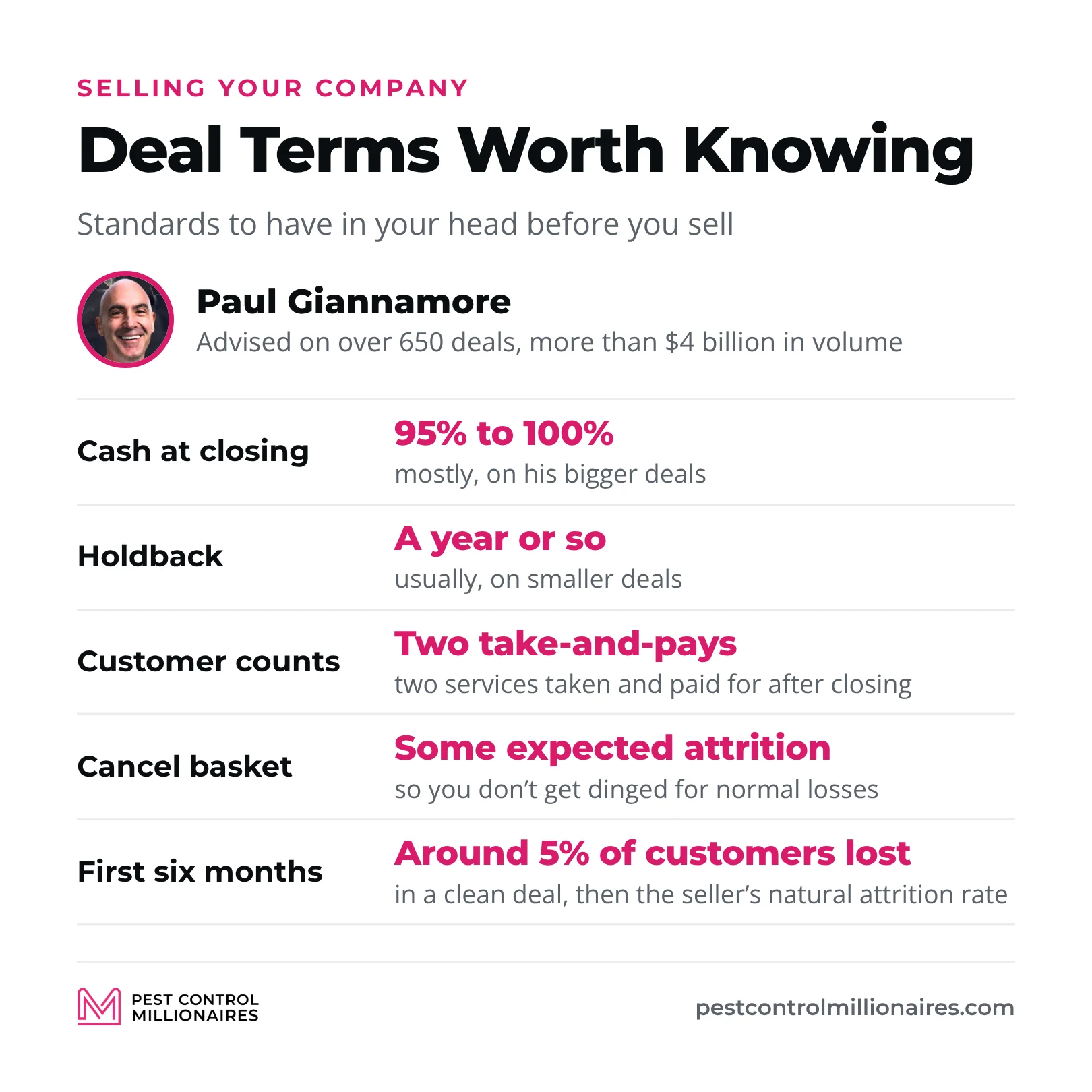
Paul rattled off some standards that every owner should have in their head before they sell.
On payment, his bigger deals are mostly 95% to 100% cash at closing now. Smaller deals usually carry some holdback for a year or so while the dust settles and the buyer confirms you told the truth.
On customer counts, the standard is two take-and-pays. A customer counts once they take and pay for two services after closing. A cancel basket builds in some expected attrition so you do not get dinged for normal losses. And in a clean deal, expect to lose around 5% of customers in the first six months, then it should settle back to the seller’s natural attrition rate.
Buy when nobody else wants in
Paul is not rushing to start a pest company today. Not because it is a bad business. He loves the long term trends. Younger people would rather outsource and stay out of the heat. The problem is timing. Money is flooding in, prices are high, and high prices mean lower returns.
He said something simple that hits hard. “No other area in life do people get excited about high prices.” You do not cheer when tomatoes jump from $15 to $20 a pound. But in business, everyone piles in when prices are high. He wants the opposite. Get in when prices are low and the crowd has left.
If he did start one, he would pick the market on purpose, lean on door-to-door to plant a footprint fast, then get off it. He called door-to-door the cow cocaine of the business. It works, but it is expensive and only getting worse.
Lead, do not just manage
My last big takeaway was about people. Paul looks for a real difference between a leader and a manager. A manager delegates and keeps things running. A leader sets the goal and pulls people toward it. The biggest piece of the leader’s job, he said, is reducing the fog and giving the team clarity. Point at the target in a fuzzy future and make it clear for everyone.
The good news is he thinks it can be learned. He has watched people grow into leaders who were not born that way. You can sit down with a pen and paper and work on it.
That fits how Paul runs his own shop. If he is going to do something, he wants to be the best in the world at it. That is the bar. It is a good one to steal.
Thanks again to Paul for coming on for episode 100. If you are ever thinking about selling, do yourself a favor and talk to a real pro before you sign anything.
Watch the PCM Podcast on YouTube