Why Pest Badger Sold Its First Franchise After Years of Saying No

Table of Contents
For years, if you had asked me whether I’d ever franchise Pest Badger, my answer was always the same. Absolutely not. I probably would have laughed at you.
When I made this video in August 2026, we had just sold our first franchise. So naturally, people ask me what changed. I spent about $80,000 learning about franchising, decided I still didn’t want to do it and built Pest Badger with corporate locations instead, from one location to 20 across nine states. Then one conversation changed the way I looked at the whole thing. Here’s why I said no for so long, what changed my mind, and who we’re willing to partner with.
This video is part of PCO Tips. For how we got here, read how we built Pest Badger from one truck to 20 locations. For another franchisor’s view, read what Mike Andes taught me about franchising for the right reasons.
Why I Said No for Years
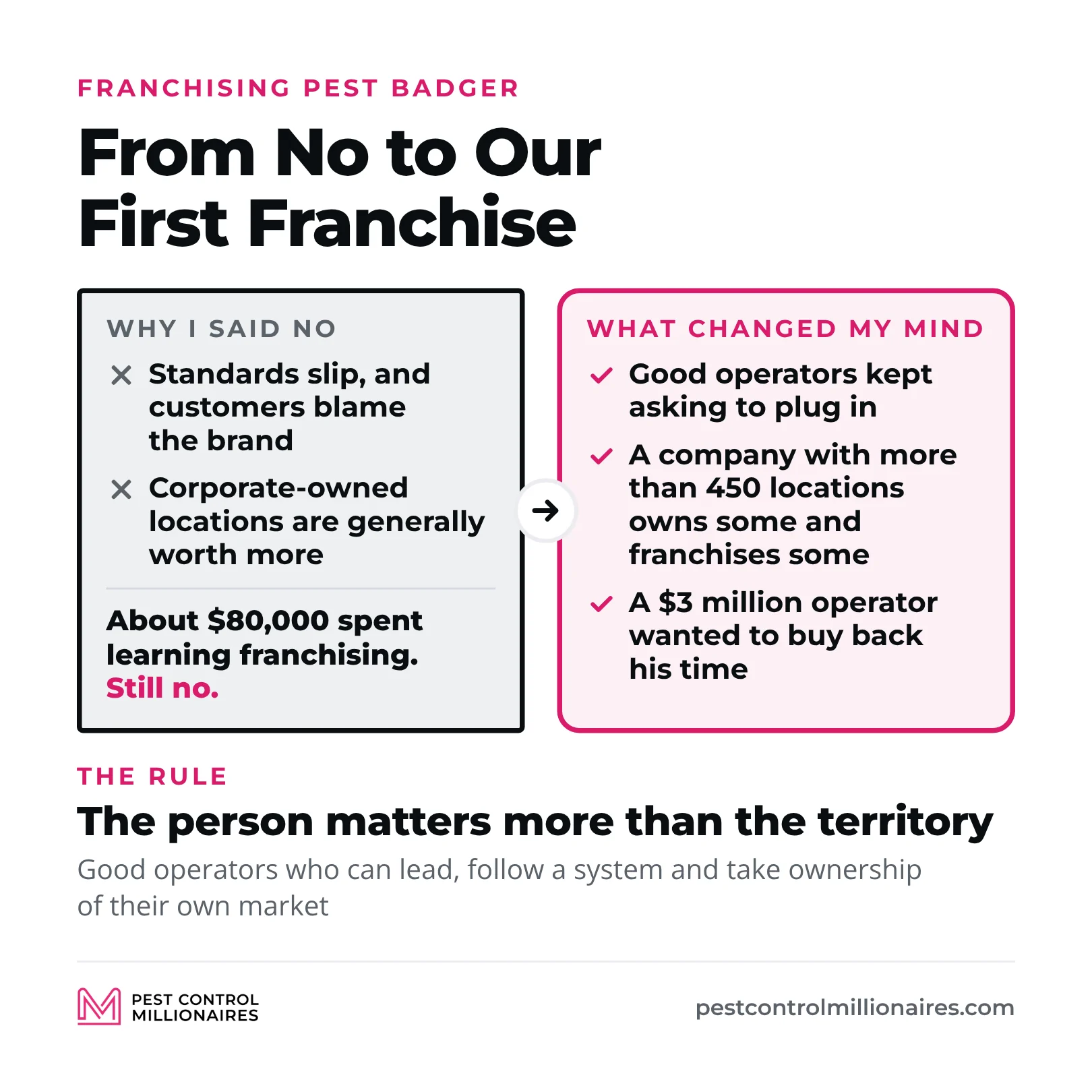
There were two reasons. The first was quality. I talked to several people who had tried franchising, and I kept hearing the same story. They brought on franchisees, the standards started slipping, and customers didn’t care who owned the location. They blamed the brand, and corporate ended up dealing with a bunch of problems. We’d spent years building Pest Badger. The last thing I wanted was somebody in another market doing a bad job and giving us a bad name, with our name on the truck.
The second was valuation. I’d been told that if you eventually want to sell the company, corporate-owned locations are generally worth more than franchise locations. Why would I spend the next 20 years building this thing and then pick a model that might make it worth less?
I didn’t want to make a decision that big off a couple of conversations, though, so I went deep. I spent about $80,000 learning how franchising works. I talked with attorneys, consultants, operators who had done it well and people who failed, including people who brought on five to 10 locations before it all fell apart. Why did it work? Why didn’t it? Was it a partner issue? A training issue?
After all that money and time, my answer was still no. Looking back, that was an expensive way to confirm what I already thought. So we went corporate. We opened locations ourselves, hired the people ourselves and built the infrastructure to support them. Find a market, hire the people, build the routes, get the operation running, then go do it again somewhere else. I walked through one of those builds in how we grew branch 7 from zero to a million in under 12 months.
Good Operators Kept Asking to Plug In
As Pest Badger kept growing, people started reaching out to ask if there was a way to partner with us. Not once or twice. I was having these conversations all the time.
A lot of them were already operators. They owned lawn care companies, pest control companies, concrete businesses, home service businesses and other route-based businesses. They weren’t asking how to start a business. They were asking how they could plug into what we’d already built.
My first reaction was still no. Every time somebody brought it up, I thought about what could go wrong. Are they going to answer the phones like we do? Are they going to take care of the customers? Are they going to hire the right people? What if their name isn’t on the truck, but mine is? Those are legitimate concerns. But when enough good operators keep asking you the same question, eventually you have to figure out whether there’s a massive opportunity you’re ignoring.
You Don’t Have to Franchise Everything
Then I had a conversation with someone running more than 450 locations across more than 50 countries. Some were corporately owned, and some were franchised. I remember thinking, “Wait a minute. He owns some of them, and he franchises some of them?”
In my head, franchising had always been one decision. Either you owned everything or you franchised the entire company, not a mix of both. That conversation completely changed my thinking. We didn’t have to stop opening corporate locations, and we didn’t have to hand the entire company over to franchisees. We could keep owning locations in markets where they made sense and partner with the right operators in other markets.
Once I saw that, I looked at what we’d built differently. We already had the hiring systems, the training, the marketing, the technology, the call center, operations, reporting, pricing and service programs. We’d built all of it for our own locations, with years of mistakes and adjustments behind it. So the question became less about whether I liked franchising and more about whether those systems could help another good operator get where they want to go much faster.
The Call That Changed My Mind
Then a good friend I’ve known for years reached out. He’d already built a fertilization and weed control company to more than $3 million a year, and he wanted to add pest control. We talked for an hour, hour and a half. He asked about pricing, products, hiring, training, software, marketing, the call center and routes, basically everything he needed to figure it out on his own. I’m super transparent, so I gave him all the answers and told him to reach out if he needed anything else.
Then he said, “Well, what would it look like to partner with you?”
I paused for a second. What do you mean? His answer made a ton of sense. He could spend the next three to five years figuring out pest control himself, making the big mistakes, building systems, figuring out the software and the service programs and training a team. Or he could tap into what we’d already built and buy back his time.
That’s when it clicked. He didn’t need Pest Badger because he didn’t know how to run a business. He’d already built a $3 million company. He wanted to add another service line, and instead of spending years reinventing the wheel, he wanted to tap into a system that was already working. That’s the type of partner we’re interested in. If you run a fert company and you’re weighing the same move, here’s how lawn care, fertilization and pest control compare.
The Person Matters More Than the Territory
That’s also why we’re not going to sell a franchise to everybody who asks. I’ve told a lot of people no, and I’m going to keep telling a lot of people no. I’ve had partners before. I know what works, what doesn’t and who I’m looking for.
If somebody thinks buying a Pest Badger franchise means I’m going to go out there and build the business for them, it’s probably not going to work. We’re looking for motivated people and good operators, people who already have a company they want to grow. People who can lead, follow a system and take ownership of their own market. People who understand we’re giving them a head start, not running the race for them.
Trust me, the person matters more than the territory. I’d rather leave a market wide open than put the wrong person in it, because everything I worried about years ago is still possible if you choose the wrong partner. I didn’t change my mind because those risks disappeared. I changed my mind because I finally saw a way to grow with the right people without giving up the corporate side of the business we’d already built.
Why I’m Glad I Waited
Looking back, I’m glad I said no for as long as I did. If I’d tried franchising back when I was learning about it, we weren’t ready. I hadn’t built enough yet. Since then, I’ve learned how to run a multi-location business and built all the infrastructure for our corporate locations. Now somebody can come into Pest Badger and tap into things that took us years, a lot of mistakes and probably millions of dollars to figure out.
The right operator isn’t buying a Badger to put on the side of the truck. They’re buying back their time. They get the systems, the processes, the support and the lessons we’ve already paid for, so they can spend their time building their business instead of figuring everything out from scratch.
I understand that better than ever, because I’ve done the exact same thing with my mentors. The information isn’t hard to find. The expensive part is the years it takes to figure out which information actually works.
If all somebody wants is a logo and a territory, we’re not going to be the right fit. But if they’re already a good operator, or they’re good at sales, and they want to build a great pest control business faster than I did, now we’re having a completely different conversation.
Frequently Asked Questions
Does Pest Badger sell franchises?
Yes. When I made this video in August 2026, we had just sold our first franchise. We still open corporate locations in markets where they make sense, and we partner with the right operators in other markets.
Why didn’t Pest Badger franchise sooner?
Quality and valuation. I kept hearing that standards slip once franchisees come on and customers blame the brand, and I’d been told corporate-owned locations are generally worth more when you sell. I spent about $80,000 learning about franchising and still said no.
Who can buy a Pest Badger franchise?
Good operators, usually people who already have a company they want to grow. They need to be able to lead, follow a system and take ownership of their own market. If all someone wants is a logo and a territory, it won’t be a fit.
Can a company own some locations and franchise others?
Yes. A company running more than 450 locations across more than 50 countries owns some of them and franchises others. That’s what changed my thinking, because we didn’t have to stop opening corporate locations or hand the whole company over to franchisees.