

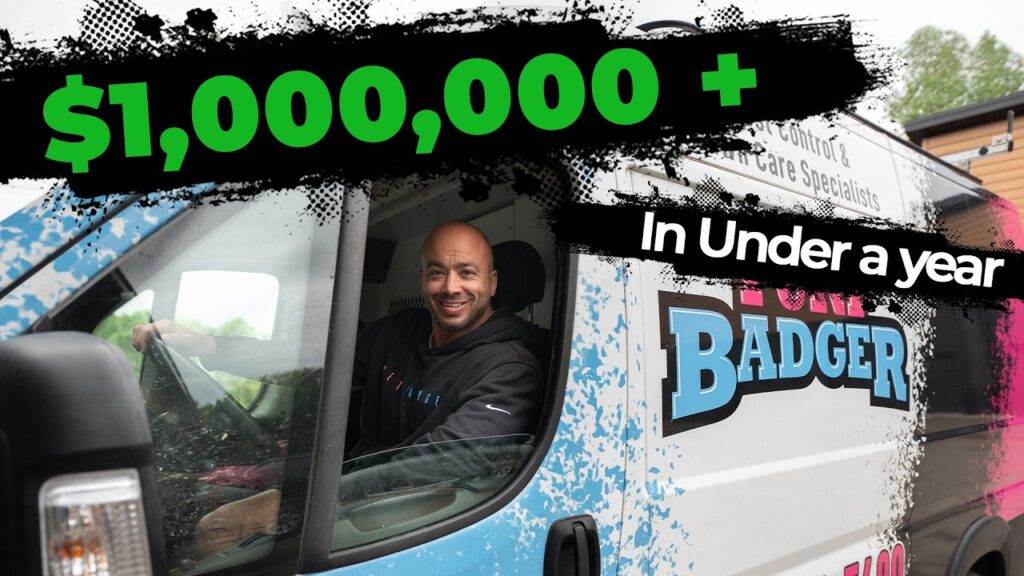
We just hit a million dollars at our seventh Pest Badger location in less than a year. Lucky number seven. I wanted to take you guys behind the scenes and show you exactly what a day looks like at this branch, why it’s been one of our fastest growing locations, and the numbers behind a real technician route.
Table of Contents
ToggleIt Starts With the Morning Huddle
Every single morning, the team gets together before anybody rolls out. They go over customer expectations, what the routes look like for the day, and make sure everyone’s on the same page. It’s not complicated, but it’s consistent.
James Bruce is one of the partial owners at this location, and his day starts early. Salespeople are jumping on his back from the moment he wakes up. He runs the morning meeting with the sales reps, goes through everything, makes sure they have their areas for the day, and sets goals with them. Then he returns the phone calls he missed in the previous hour. After that, he’s hitting doors for the rest of the day, answering calls in between, and knocking until just before dark.
On the service side, Chandler handles most of the service calls. James steps in when Chandler’s tied up. For routing, James handles routes for start technicians and plugs in new sales from the day prior, but the office takes care of all the reoccurring scheduling. James is basically answering questions live and fixing problems in the field. And honestly, the biggest part about being a business owner is solving problems.
The Sales Meeting
Around 9:30, the sales guys show up. It’s a high energy environment. We go over their sales from yesterday, whether they met their goals, and set new ones for the day. Then we dig into objection handling and anything they struggled with the day before.
After that, the guys do pitch practice for about 10 to 15 minutes every single day. What we like to do is pair up a rookie with a vet. The rookie pitches, and the vet coaches them through it. Simple stuff, but it matters. Posture, the cadence of their voice, whether their tone is slowing them down or speeding them up during certain parts of the pitch, asking questions. We really hit home on objection handling because that’s where a lot of your sales are actually won.
Then we go out to the hood.
What Made This Branch So Successful
I asked James what made this location take off, and he gave most of the credit to the people around him. He’s put in a ton of work himself knocking doors, selling accounts, and keeping customers happy. But he said it really comes down to three things: hiring the right salespeople, having solid technicians, and having a team full of hustlers.
It’s not necessarily how good they are at sales. Every single one of them works hard. We have a bunch of rookies this year throwing up huge numbers. They just show up and put sales on the board.
Operationally, by the time you’re on your seventh location, you kind of have a recipe. It’s rinse and repeat. Technicians understand the assignment. Wake up, do your route, move on to the next day.
Brand Presence Matters
One thing we’ve pushed hard this year is vehicle branding. All our wraps are the exact same. Everybody sees the same trucks, the Mavericks going through neighborhoods. We’ve got the big van. We’ve got yard signs everywhere.
This is our 12th month in business at this location, and once that first full year goes by, everybody’s seen us a couple of times. They’re starting to recognize the brand and the name. It’s the same nice people going out and talking to them every day. Your brand is going to build authority over time.
We’ve had customers literally walk up to the door already knowing who we are, ready to sign up right away. That doesn’t happen unless you’ve been visible and consistent.
Competition is always there, but with the brand recognition we’ve been able to build by knocking doors and making our presence known as a pink pest control lawn care company, it’s been absolutely insane.
A Real Technician Route, Start to Finish
I want to walk you through what a technician actually does on a job and what a full route looks like financially.
On each job, the technician starts with a wipe down using the web duster. She starts at the garage, hits the high peaks for wasp nests, then follows around to the porch where the spider webs are heavy. She hits all the window frames, door frames, light fixtures, soffits, and fascia, then ends back at the truck.
After the wipe down, she does the spray. She re-hits the hot spots for wasp nests and sprays about 3 feet up and 3 feet out on the foundation. If there are box elder bugs, she goes higher on the sun-facing side of the house. She focuses on ants, Asian beetles, and sprays around all the windows and doors because those are common entry points for beetles and other pests. She always hits the high peaks again with spray for the wasps since that’s where they like to nest.
The last step is the granular treatment. On initials, she hits the entire yard with a spreader for millipedes, centipedes, and ant hills. It’s basically an extra barrier to keep everything from coming up to the house.
The Numbers Behind a Route
She had 17 quarterly jobs that day, all priced at $150. Her total revenue for the day was $2,550. It took her about 8 and a half hours. Her routes were tight, with drive times of two to three minutes between jobs. That’s where service-based companies make and lose money. Too much windshield time kills you. We make our money on route density.
Here’s how the numbers break down:
Cost of Goods Sold (COGS): 30-35% That covers everything boots on the ground. Gas, materials, things like that. On $2,550, that’s roughly $765 to $892. Tech Pay: 10-14%
On the low end, she’s making $255 per day. On the high end, $357. That works out to $30 to $42 per hour for about 8 and a half hours, which is a great living for a technician. And she’s pretty new, so there’s room to grow with upsells.
Overhead: 35-50%
I don’t like seeing 50%. I want to see it in the low to mid 40s, even 30s if possible. But as you scale, things fluctuate. That’s $892 to $1,275 for overhead.
Net Profit: 1-25%
I’ve seen people make zero percent. You’re making something, which isn’t bad, but you don’t want to go run a whole route making $25 for an entire day. On the flip side, if you’re hitting 25%, you’re taking home $637 per route. If you’re doing that by yourself, you’re in a really good spot. Now multiply that by 10, 20, 30 different routes and you see how this thing stacks up.
The Upsell Game
One thing that separates good technicians from great ones is the upsell. When you go to a job and mosquitoes are terrible but the customer doesn’t have mosquito control, what are you going to do? You talk to the homeowner.
Our technician came from the sales side, so she’s great at this. Her approach is simple and honest. She’ll say something like, “Hey, while I was servicing, I noticed I was getting eaten alive by mosquitoes. That’s something we should definitely get you set up on.” Nine times out of ten, they already know the mosquitoes are bad and they say yes.
Same thing with bait boxes. If there are vole trails, she brings it up. She tells the customer what we do with the commercial bait, and they go for it. That’s how you increase the lifetime value of your clients. Make sure every customer is worth as much as they possibly can be. And the technicians get paid a commission on those upsells, so they’re making extra money too.
Live Sales in the Field
I want to highlight how our sales guys actually work a door. Malachi, one of our salespeople, had a conversation with a homeowner who had used Orkin and WillKill in the past but eventually just started doing it himself.
Malachi’s approach was to differentiate us right away. He explained that the big national companies typically just do a foundation spray and maybe wipe down anything at head height. When we come out, we do the foundation spray, a full web wipe down with a 50-foot fly swatter, powder treatment in the soffits and cracks around window frames and door frames, and a granular treatment in the yard that digs into the soil and disrupts egg cycles for fleas, ticks, house spiders, and ants.
The homeowner pushed back on price. Multiple times. Malachi handled it well. He lowered the frequency from every other month to every three months. He came down on the price. He never got desperate, but he stayed persistent. He explained why two treatments a year wouldn’t work because the product lasts 60 to 90 days and six-month intervals leave gaps he can’t guarantee.
Eventually the homeowner signed up at $129 three times a year. That’s a real sales conversation. Objections, price concerns, a customer who wasn’t sure he even needed it. And Malachi closed it.
The Training Program
When James started, the training program was basically nonexistent. Living on a prayer, as he put it. Now it’s completely different.
New salespeople go out and watch other people close deals first. Then other people help them close deals. Only then are they allowed to go by themselves. A lot of people think door-to-door sales means you’re just thrown into a neighborhood and told to go sell. That’s not how we do it. And that’s why we’ve had a lot of successful people come in and make real money.
We also have new reps shadow five or six different people, not just one. Everyone sells differently. James is more of a relationship builder. He loves to talk to people and his pitch is more of a conversation. Other guys might do more of a traditional sales pitch. Both work. The key is giving everybody the chance to see different styles and find what works for them.
Think Bigger
The biggest thing holding small pest control companies back isn’t skill or knowledge. It’s mindset. James put it perfectly. He was talking to a buddy the other day who said he didn’t think he knew enough to start a business. And James said, when he started his first pest control company, was he the smartest person on pest control in the world? No. He was just out there solving problems every single day.
Most technicians who want to start their own company get stuck in the technician mindset. They’re servicing, they hit their capacity, and they never figure out how to grow beyond what they can personally do. If they took all that same energy they put into an hourly job and redirected it toward sales, marketing, and growth, that’s where the leap happens.
The hardest door to knock is always the first one. I’ve been doing this for years and honestly, the first door every day is still the hardest one. But if you want to grow, especially in the spring when your leads dry up in May and June, you need to be out there knocking doors, hanging door hangers, passing out flyers. That’s how you fill the rest of your schedule.
The number one thing that slows companies down is the mindset. Not thinking big enough.
