5 Things Every Pest Control Company Needs to Hit $1M

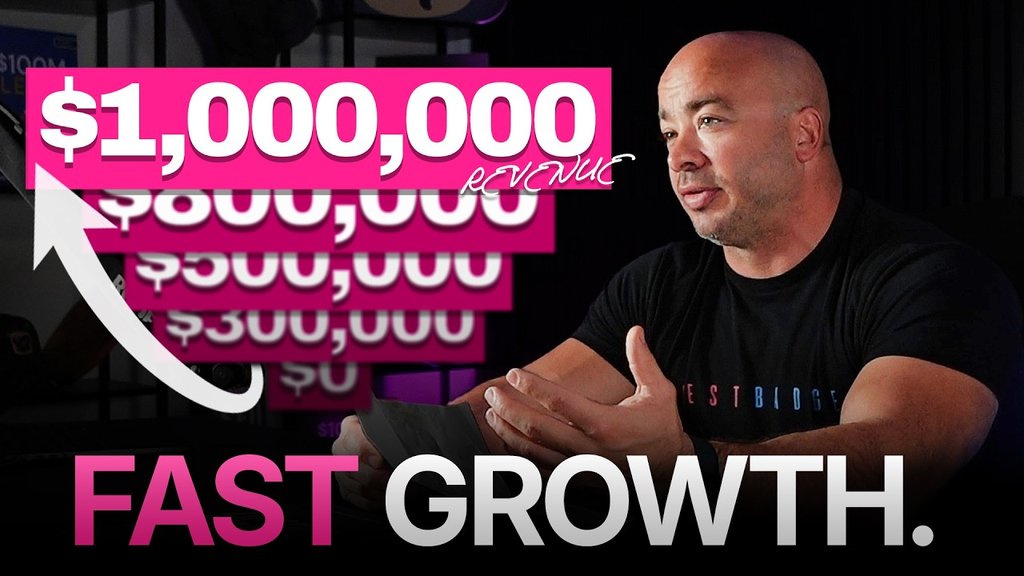
Table of Contents
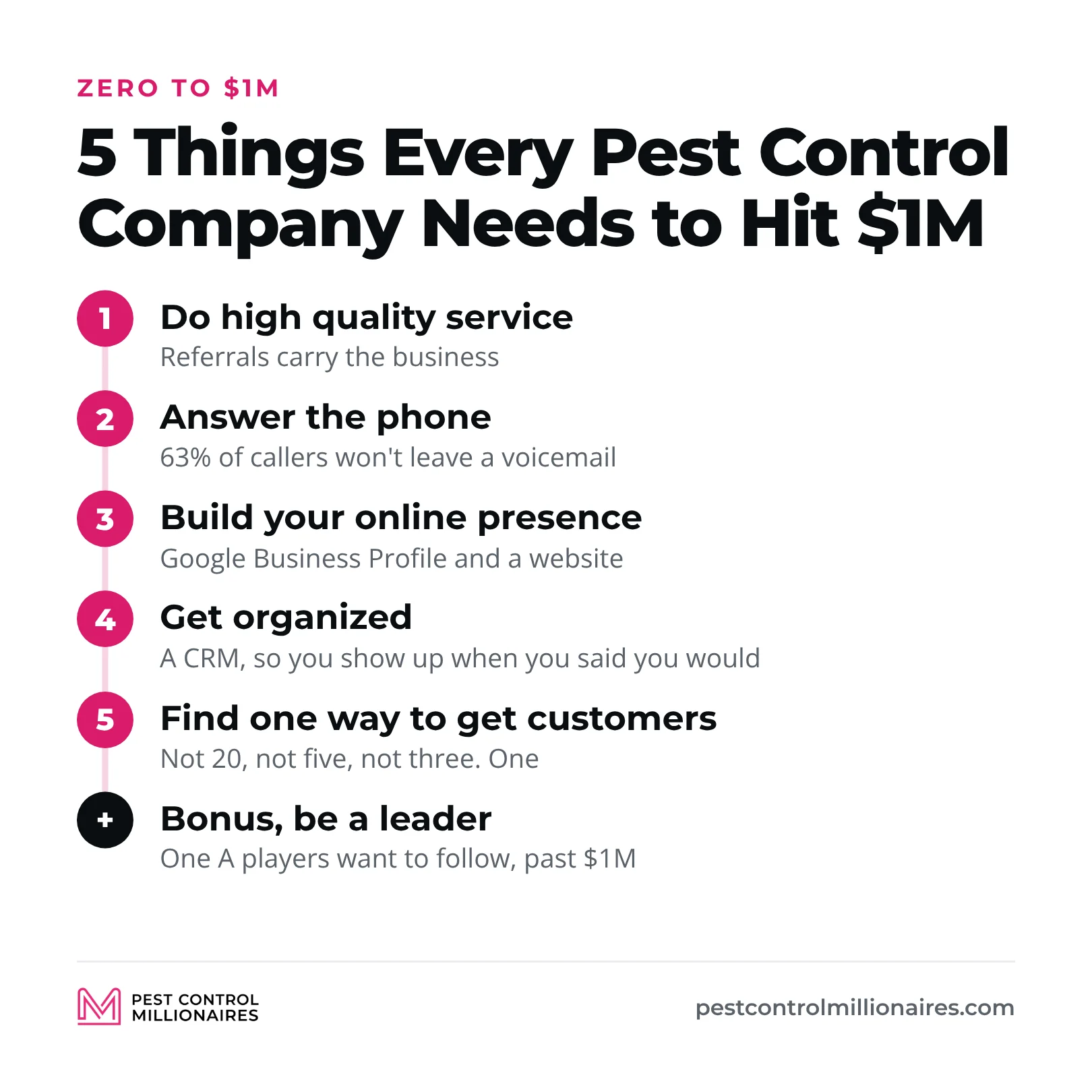
I wrote five things on a sheet of paper on my lunch break. If you want to take a pest control company from zero to $300,000, $500,000, $800,000 and then a million in annual revenue, those five things are all you need. If somebody tells you it takes more than that, they’re usually just trying to sell you something.
None of them are complicated. Most of them are free. And most companies still skip at least one, which is why so many get stuck in the truck or stuck on a treadmill of new customers walking out the back door. At the end there’s a bonus, the thing that matters most once you’re past a million.
This video is part of PCO Tips. If you’re already close to seven figures, read why pest control companies get stuck at a million dollars next.
1. Do High Quality Service
I know that sounds obvious. But if your churn is super high and you’re getting bad reviews, you’re going to have a serious problem, because this is a service business and service literally means to serve. Don’t serve your customers well and you’ll get bad reviews on Google and Facebook, and nobody will refer you.
Referrals are what carry the business. The worst part about starting a pest control company is that nobody knows who you are. They’ve never seen your truck, their neighbors never used you, and they’ve never seen your yard signs. So almost every customer you get in the beginning, you’re paying for somehow, whether that’s door hangers, Facebook ads, Google ads or knocking doors. The only way out of that is people finding you on Google or hearing about you from a friend or a neighbor. That only happens if you did a really good job from the very beginning.
Short term, you can outspend bad service with ads. A lot of companies have grown pretty big that way. But you’ll rarely make it profitable, because customers who don’t stay don’t buy add-ons and don’t talk about you. And in pest control, it gets expensive fast, because you’re not selling a one-time job. You’re selling a 12 or 18 month agreement.
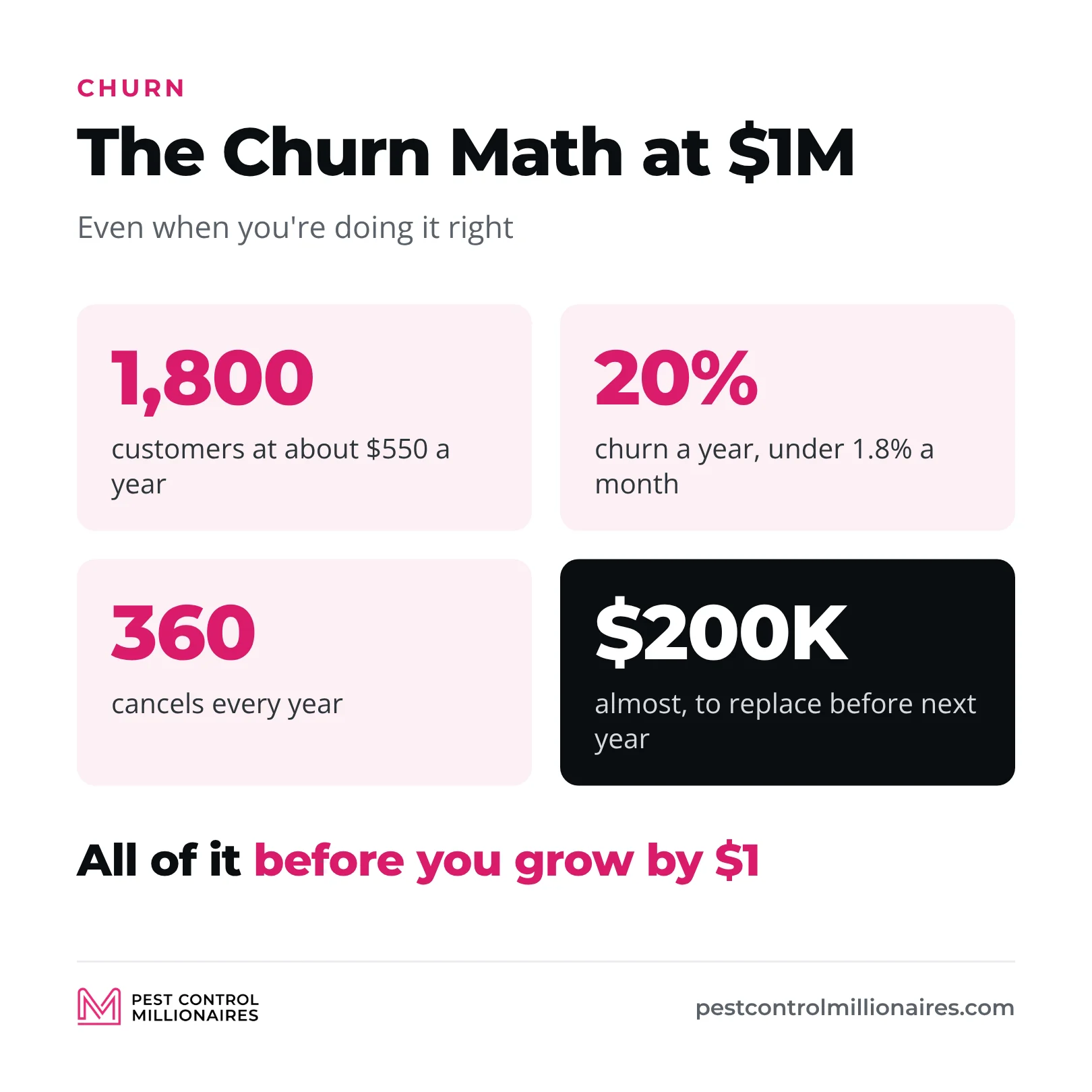
Here’s the math. Bookkeepers who work with pest control companies say the average contract is about $550 a year, which I think is low. Go with that number and a million-dollar company has about 1,800 customers. Keep churn under 1.8% a month and you’re at about 20% a year, so one out of every five customers leaves, even when you’re doing it right. At 1,800 customers that’s about 360 cancels, almost $200,000 you have to replace before you grow by a single dollar. At 3 to 4% a month, you’re on a treadmill.
You’re Going to Mess Up
If you have people working for you, you’re going to mess up. That’s just the honest truth, and it’s going to hurt. The only reason it hurts is that you really do care. There are also customers you will never make happy. You can spray every square foot of their house for half the price and they’ll still find something wrong. Don’t sacrifice good techs or your own time chasing them. Take care of the other 99%, and they’ll leave you a review and tell their neighbors.
That’s why people say you don’t need ads, a website or wrapped trucks, just word of mouth. From the very beginning they’re partly right. You’ll grow slower, but you can build a really good business off great service alone. The hard part is doing high quality service when it’s not you in the truck anymore. That’s where it starts to fall apart. A lot of the guys who say word of mouth is all you need are the ones stuck in the truck. Their quality is so high that they get a ton of referrals and know everyone by first name, but they’ve never built a way to train anybody else to do it at that level.
Doing great work yourself gets you to six figures. Getting from six figures to seven means getting that same quality out of the four or five techs running your routes. That comes down to recruiting really good people, training them and simplifying what you offer. When I hire a tech, we start with ride-alongs. They watch you, then you watch them. After that, do ghost inspections. Go behind your tech on a service they already did and check the work without telling them. That’s how you know what’s actually happening on your routes when you’re not there. Talk to the customer too, and find out whether the tech checked in with them and what they talked about.
2. Answer the Phone
I get it. When I made this video it was almost 2027, and a lot of us would rather text or have everything automated. But most homeowners paying for pest control are 40 to 70 years old, and they still want to call. On most home service websites, the most clicked button is still the phone number.
And pest control calls are urgent. Nobody calls because they’re curious. They’ve got mice in the kitchen or wasps by the front door, or their kid just got stung. They want someone to pick up right now. The phone is hard because it’s on the customer’s schedule. A text or a web form you can get back to whenever you want. A phone call, you have to answer right then and there.
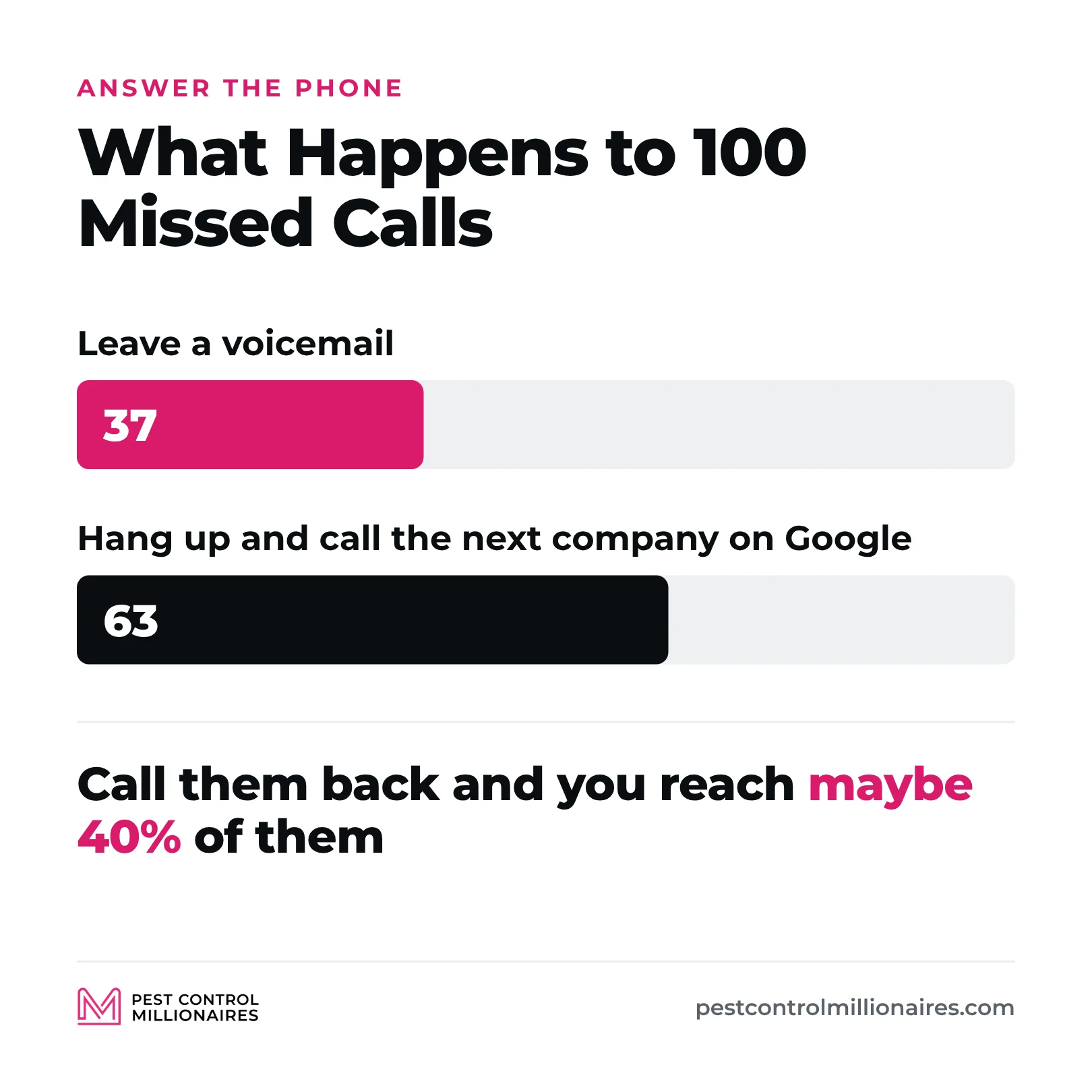
Do the math. Say 100 people call you. Only about 37% will leave a voicemail. The other 63% hang up and call the next company on Google. And when you call people back, you only reach maybe 40% of them, probably less. So the fastest way to double or triple your leads isn’t spending more on ads. It’s answering the calls you’re already getting. Those people already saw your truck, read your reviews or got referred. You did the hard part already.
When you do pick up and handle the call right, you should be closing around 60%, in my opinion. Letting somebody you’ve never met walk around your house spraying product takes trust, and a good phone call builds a lot of it. For most people, a good call just means somebody picked up. The bar is that low. Every so often I call 10 to 20 pest control companies myself to see who answers, and out of 20, six to 10 pick up.
It doesn’t matter if it’s an answering service or a phone that beeps loud in your truck. Figure out a way to answer the phone. Even in my first business, I always answered. I’d be on the lawn mower with my AirPods in, and I’d pause, shut off the mower and answer as fast as I could. If I missed it, I called back within 20 to 30 seconds, before they could go to the next person, and I still closed those. I answered my calls and I showed up when I said I would, and that alone put me ahead of 90% of the companies in our area.
This might come with some controversy, but you really don’t need a full-time office person until you’re at about half a million dollars. Before that, go part-time and cover the rest with an answering service. Once you pass $500,000, a full-time CSR pays for themselves. I’ve done videos about hiring a CSR first, and I still agree with that. Every service business is a little different, and this is just a quick framework. What makes no sense is building a great brand, getting reviews and referrals, wrapping your trucks, and then not answering your phone.
3. Build Your Online Presence
Your online presence is your Google Business Profile and your website. The Business Profile matters even more now, because ChatGPT, Gemini and the other AI tools pull from it. They need information they can trust, and Google verifies your address and puts you on the map. A website can say anything.
So keep it active. Post pictures a few times a week to keep showing Google you’re open for business, and once a month update your services, your service areas and your hours if you need to. Get your address verified if you can. Most one-truck guys can’t, because they run the business out of their house as a service area business, so a verified address puts you ahead of almost all of them. When somebody searches pest control in your city, the map pack shows up above everything else, and it’s free. It just takes time. Add pictures, get reviews, keep it updated, and check it like you check your email. Our Google Business Profile guide goes deeper.
Google’s paid platform for pest control is Local Services Ads. You pay per lead, not per click, and you show up at the very top. That also takes some time to figure out.
Beyond Google, you want a website that brings in leads without you paying for every one of them. A website keeps building value as people find it and you add more to it. If you’re just getting started, a cheap site is way better than nothing, even if people can tell it’s new. Once you’re past half a million dollars, invest in a real website and ongoing SEO, because a good website is almost always your cheapest cost per lead. Spend $500 to $1,000 a month on SEO and it can double the leads coming off your website, one of the best returns you’ll get anywhere in business. It takes a lot of time, though. You can’t hire an SEO company, expect results two months later and then fire them. We’ve been doing it for years.
4. Get Organized
Most guys wait too long for this, and I’m one of them. As entrepreneurs, we’re a little scatterbrained. But even at 10, 15 or 20 customers, get them into something. At the very least that’s a spreadsheet with their contact info. Ideally it’s a CRM that handles scheduling, invoicing, billing and payments.
What sets you apart from every new pest control company that starts in your area is being organized, which means you actually show up when you say you will. Ask your customers what would make you a 10 out of 10, and you’ll usually hear one of two things. The first is something specific about why they left their last company. One lady will tell you the last guy left her gate open and the dog got out. Another will say they never called before showing up, so she just found a sticky note on the door and had no idea what they sprayed. It’s usually one small thing. The second answer is the same over and over. Show up when you said you would, and if you can’t, tell me. Schedules slip, and that’s fine, but some people take days off work or plan around you.
Most companies can’t show up when they said they would because they don’t remember when they said it. They wrote it on a sticky pad while driving and forgot to put it in the schedule when they got back. At 10 or 20 customers, keeping everything in your head is the fastest way to track it, and we all start out that way. At 50, 100 or 200 customers, that’s exactly what stops you from growing. Pest control runs on routes, and you can’t build a good route from memory. A tech could be running 12 to 15 stops a day, depending on how tight your route density is. You won’t get there without systems.
A buddy of mine is at about half a million dollars, super frustrated, and wants to sell. I asked him the same question I’d asked him a year earlier, at the same time of year. Did you get the CRM in place? “Oh, no. I don’t have time for that.” That one thing would solve the majority of the problems that are frustrating him. It costs a couple hundred dollars a month, and it saves far more than that in money, time and headaches.
If you’re just getting started, GorillaDesk is a great place to start. It’s simple and works great on your phone. There are plenty of other options too, like FieldRoutes and PestPac, and I don’t care what you use, just use something. Our pest control business software guide walks through what to set up first. When you hire someone to answer the phones or add another technician, how are they going to know everything that’s in your head? Job notes, pictures and history all have to live somewhere. One simple CRM fixes problems for your technicians, your customers, yourself, your reporting and your finances.
5. Find One Way to Get Customers
To get from six figures to seven, you need one way to get customers. Not 20, not five, not three. One.
We already covered the free ways. Great service, reviews, referrals, answering your phone, your Google profile and your website. But if you don’t want to wait five years, you’ll take profit and put it back into marketing. Anybody who tells you to do 20 things at once either has a huge budget or is trying to sell you something.
I do like testing a few things at the start. I always have. But once you find the one that’s working, go all in. If door hangers are doing well, focus on them. Stop dabbling in a little Facebook, a little Google, a little SEO and yard signs. That’s why one person builds a huge company knocking doors and somebody else says doors don’t work. The difference is that one of them did it thousands of times until he figured out the system. It usually isn’t the channel that’s wrong. It’s the reps you put in.
Do Facebook ads work? Hell yes, and you can also burn a ton of money if you don’t know what you’re doing. Do Google ads work? Again, hell yes, and you can waste a lot of money if you don’t know your negative keywords or you’re showing up outside your service area. Every channel works if you put in the time to get good at it. It takes a minimum of 20 hours to get somewhat good at something, so put in 20 hours of learning and 20 hours of implementing, and you’ll understand how it works. If you’re good on camera, Facebook ads crush, and talking about a job you just finished will probably work really well for you. If you’re not, pick something else.
Test three or four, see what’s working, then commit. Sometimes a channel works great part of the year and you need to switch in the off season. That’s real in pest control, because spring and summer look nothing like November, at least in my market. That’s when you might add a second channel. But one service and one channel will get you over a million dollars in revenue.
Bonus, Be a Leader A Players Want to Follow
These five things will get you to a million dollars. Scaling past a million is where leadership and management come in. You have to be the kind of leader A players want to follow. If the only people you attract are B, C and D players, you have to change who you are so you can attract the best people from your competition and keep them. That’s the most important thing after a million. Getting from zero to a million, you only need these five things.
Frequently Asked Questions
What does a pest control company need to reach $1 million a year?
Five things. Do high quality service, answer the phone, build your online presence with a Google Business Profile and a website, get organized in a CRM, and find one way to get customers and go all in on it. Past a million, leadership and management become the most important thing.
How many customers does a $1 million pest control company have?
With an average contract of about $550 a year, a million-dollar company has about 1,800 customers. At about 20% churn a year, that’s around 360 cancels, almost $200,000 you have to replace before you grow at all.
When should a pest control company hire a full-time CSR?
In my framework, around half a million dollars. Before that, go part-time and cover the rest with an answering service. Past $500,000, a full-time CSR pays for themselves. Every service business is a little different, but there’s no reason to build a great brand and then not answer your phone.
What is the best marketing channel for a new pest control company?
The one you go all in on. Every channel works if you put the time in to get good at it, whether that’s door hangers, doors, Facebook ads or Google. Test three or four, see what’s working, then commit to one. One service and one channel will get you over a million dollars in revenue.