How Many Sales Reps a Pest Control Company Needs to Sell $1M a Month


Table of Contents
How many sales reps would you need to sell a million dollars every single month? When I ask most owners, they just guess. But if you know your average contract value, your close rate and your cost per lead, you can work the numbers backwards and figure it all out. It’s pretty simple.
This came from a question I heard when I was speaking at a conference. Someone asked a pest control owner how many sales reps he had. “Yeah, I got four sales reps,” he said. That answer doesn’t tell you very much by itself. I need to know the numbers beneath it.
When this video came out in October 2026, I’d been in the service industry for 17 years, and we were in our sixth year of building Pest Badger, with 20 locations across nine states.
This video is part of PCO Tips. For what a customer is worth to us and what we’ll pay for one, read how much to pay for a new pest control customer.
There’s No Magic Number of Sales Reps
If somebody tells you that a $3 million company needs three sales reps and a $10 million company needs 10, that doesn’t tell you much. I can give two companies the exact same number of leads and the exact same number of reps and get completely different results. What it comes down to is your average contract value, your close rate, your lead volume and how much volume each rep can actually handle.
Work the Math Backwards From $1 Million
Start with your average contract value. PCO Bookkeepers did an industry cost study using numbers from what I think was a couple hundred pest control companies across the United States, and their average quarterly pest control customer was around $500 a year. I’ll use $550 for this example, because it’s a realistic number for a lot of companies. I think that’s super low, but it’s what the study says.
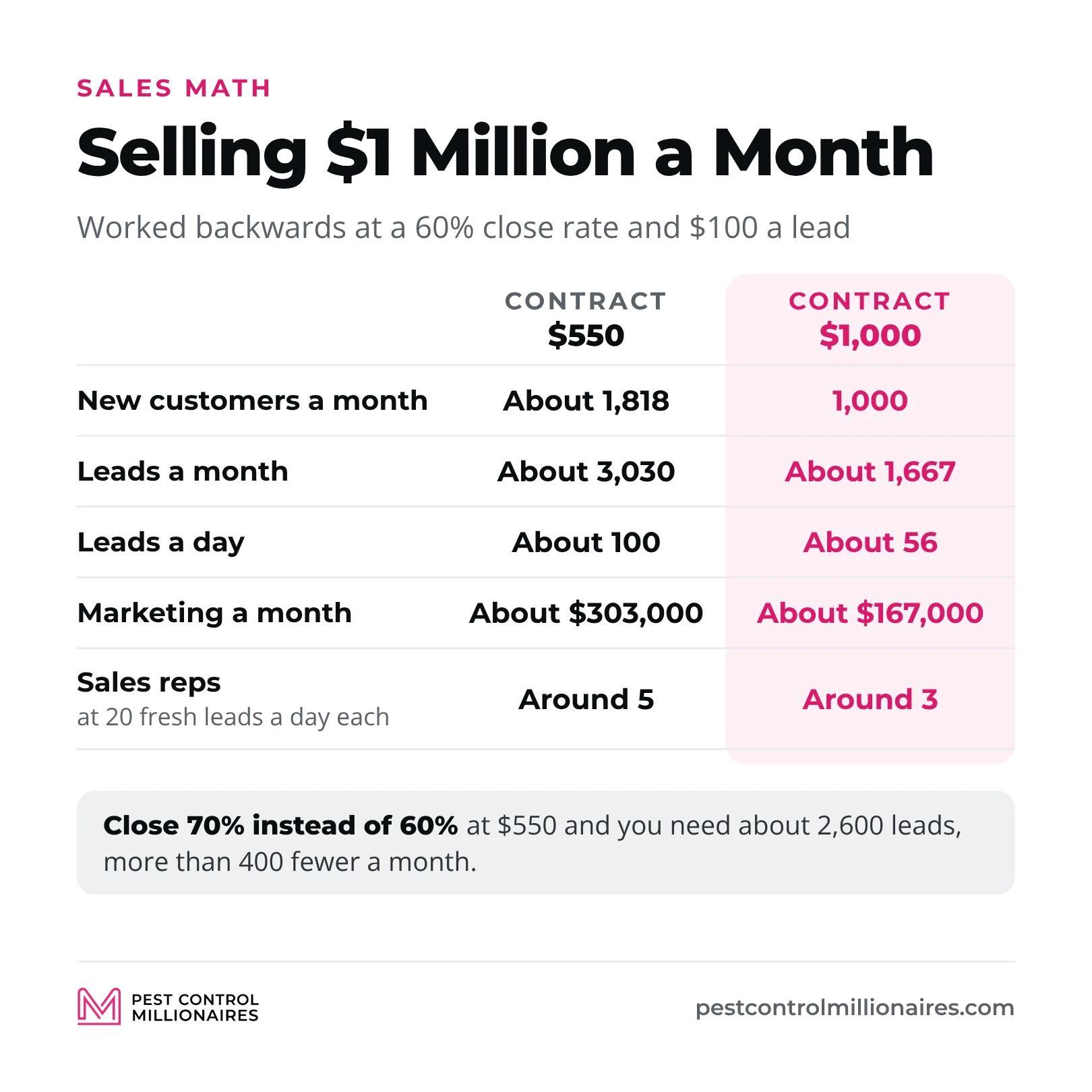
Now say you want to sell a million dollars a month in contract value. At $550 a customer, you need to sell about 1,818 customers every month. That’s roughly 60 new customers every single day.
Next, your close rate. Say your sales team closes 60% of your inbound leads. To get 1,818 sales, you need roughly 3,030 leads a month, about 101 a day.
Then what those leads cost. I’ll use $100 a lead, because it’s easy math. Yours will depend on your market, the channel and the type of lead. At $100 a lead, 3,030 leads cost you about $303,000 a month, around $10,000 a day in marketing.
So don’t just think about selling a million dollars. Think about generating about 3,000 qualified leads every month, with a sales team that closes about 60% of them, about 1,800.
What a $1,000 Contract Changes
Watch what happens when you change one number. Build an offer worth $1,000 a year instead of $550, and you only need 1,000 new customers to sell a million dollars a month. At the same 60% close rate, that’s about 1,667 leads instead of 3,030. At $100 a lead, your marketing goes from $303,000 to about $167,000 a month, and your team handles about 56 new leads a day instead of around 100.
Same million-dollar target, almost half the customers and half the lead volume. That’s a completely different sales operation.
That’s why I think too many pest control companies focus on getting more leads before they spend enough time looking at what each new customer is worth and whether they can raise prices. Your average contract value changes how you build the entire organization.
How Many Reps It Actually Takes
Our average sales call is about 12 minutes. That changes for everybody, so track yours. But I don’t take an eight-hour shift and divide it by 12 minutes, because a rep isn’t sitting there closing deals eight hours straight. They have follow-up, text messages, voicemails, CRM notes and all the leads they’re working. They take breaks, and a bunch of people don’t answer. So say one rep can effectively work 20 fresh opportunities a day.
At a $550 contract value, you’re handling roughly 100 new leads a day. That puts you around five reps for fresh inbound leads only. At $1,000, you’re handling 56 a day, so you’re closer to three reps. It’s the same million dollars in contract value, but a completely different headcount.
And I still wouldn’t build either sales operation to its theoretical maximum. People take days off, get sick and quit. Lead volume spikes in the spring, and new people have to be trained. You need some room.
Measure Close Rate by Lead Source
This is another place I see people mess up the math. Don’t throw every lead in your business into one bucket and tell me your sales team closes at 40%. That doesn’t tell me enough. You have to know it by source. Say our inbound leads close at 60% and our LSA leads close at 70%. Same company, same sales team, but the intent behind those leads is way different. I go through how we track it in marketing KPIs for pest control.
If one channel starts closing over 70% consistently, I start looking at our pricing. If literally everybody is saying yes, I don’t assume our sales team is crushing it. I wonder whether we’re still selling too cheap, even though we’re at the top, and whether there’s still more to go get.
Close rate moves the whole model, too. In the $550 example, a 60% close rate meant roughly 3,030 leads to sell 1,818 customers. At 70%, you only need about 2,600. That’s more than 400 leads a month you don’t have to buy, and at $100 a lead, more than $40,000 a month. We didn’t hire more reps or buy more leads. We improved one number, and that takes a lot of training.
Plan for Ramp-Up Time and Managers
A new sales rep who starts Monday morning isn’t closing at 60% Tuesday afternoon. For us, even with the right training, it’s probably two to three weeks, maybe up to four, before a rep gets where you need them. Say you pay someone $1,000 a week during that time. You’ll have $2,000 to $4,000 in that person before they produce at full capacity. That doesn’t mean the person isn’t good or your hiring isn’t working. You just have to account for the ramp-up when you hire.
Then, once you get to six or seven reps, you’ll have another question. Who’s going to manage all these people? For us it’s something like five to eight reps per sales manager, and I think seven is a really good number. Once you push past that, the calls, the coaching, the one-on-ones and the accountability get really hard to do well. Now you’re not just hiring salespeople. You’re building a whole management structure around them.
Hire Reps When the Leads Are There
Someone told me that for every million dollars, I need a salesperson. I don’t hire the seventh rep because the org chart says we need seven. The lead volume has to be there to support them. If you have enough leads for four reps and you hire seven, you’re taking four people’s opportunities and spreading them across seven people. Everyone’s upset, everyone looks worse, your reps don’t get enough at-bats and payroll goes up. Then you try to fix what looks like a sales problem, when the real problem is that you hired ahead of your lead volume.
It’s also why our inside sales team built inbound first and outbound second. I wanted to understand what a lead was worth, how well we could close it and how much volume a rep could handle before adding a whole other channel.
If I were building the inside call center from zero again, I’d start with one lead channel I can measure. I’d want to know my cost per lead, average contract value and close rate for that one channel. Then I’d figure out how much volume one rep can realistically handle and add people as the lead volume supports them. At six or seven reps, I’d start thinking about management. Don’t build three different sales channels at the same time when you can’t tell me the economics of the first one. Get one working extremely well, then add the next.
The Math Is the Easy Part
If you’re a one-truck operator, three to five or six sales reps probably sounds insane. But the reps aren’t even the hard part. Once you start adding them, somebody has to recruit them, train them, review their calls and coach them. Marketing has to keep generating enough leads to feed them. Those leads have to be answered fast and followed up in the CRM. Then somebody has to go out and service everything you sell.
If sales gets too far ahead of operations, you have one problem. Build a bunch of operational capacity without enough sales, and you have a different one. If marketing slows down, in the winter or whenever, your salespeople don’t have enough opportunities. Behind all of it you still have customer service, retention, billing, scheduling, quality control and leadership. As you grow, one of those almost always becomes the next problem. Fix sales, and operations gets buried. Fix operations, and you need more leads. Generate more leads, and suddenly you don’t have enough salespeople. That’s what building a service business looks like from the inside.
So if you’re at a million or two million dollars a year, don’t look at a million a month and think you just need more sales reps. You need to build the machine that supports them. That took us years to figure out, and we didn’t build it perfectly from scratch. We broke a lot along the way. But every time we figured out one of those pieces, we got a little harder to break and a little easier to scale. The math on the whiteboard is the easy part. Building the machine behind it is the game.
Frequently Asked Questions
How many sales reps does it take to sell $1 million a month in pest control?
It depends on your average contract value and close rate. At $550 a customer and a 60% close rate, you need about 3,030 leads a month, roughly 100 a day, and if one rep can work about 20 fresh leads a day, that’s around five reps. At $1,000 a customer, it’s about 56 leads a day and closer to three reps. Leave room for days off, turnover and spring spikes.
How many leads can one pest control sales rep handle a day?
Our average sales call is about 12 minutes, but a rep also handles follow-up, texts, voicemails and CRM notes, takes breaks and calls a lot of people who don’t answer. So I plan on one rep effectively working about 20 fresh opportunities a day. Track your own numbers.
How many sales reps can one sales manager handle?
For us it’s something like five to eight reps per sales manager, and I think seven is a really good number. Past that, the calls, the coaching, the one-on-ones and the accountability get really hard to do well.
How long does it take a new pest control sales rep to ramp up?
Even with the right training, probably two to three weeks, maybe up to four. At $1,000 a week, you’ll have $2,000 to $4,000 in that person before they produce at full capacity, so plan for it when you hire.