How to Find Pest Control Technicians (Hiring Is a Marketing Problem)


Table of Contents
Hiring is every home service company’s biggest bottleneck, and most owners put zero effort into it.
A few months before I made this video in August 2026, we brought on a technician who had never done pest control. He’d never sprayed a house. Ninety days later, he was running a full route on his own, and that one hire was on track to put over $250,000 in the books for us that year. If you’re short-staffed, that isn’t an HR problem. It’s a marketing problem, and most owners are solving it completely wrong.
I’ve been in the service industry for 17 years, and in the five years before this video, we grew Pest Badger from one location to 20. Here’s how we make sure we always have people coming in.
This video is part of PCO Tips. If you’re hiring for the first time, start with how to hire your first pest control technician.
Employees Are Leads
Stop thinking about hiring as posting a job and waiting for applications. Think about it as a machine, the same machine you use to bring on customers. You wouldn’t run one ad and hope for enough leads to hit your revenue goals for the year. So why would you post one job ad and hope enough people show up to run your entire business?
Employees are leads. You need a constant pipeline, not a one-time push.
What One Good Tech Is Worth
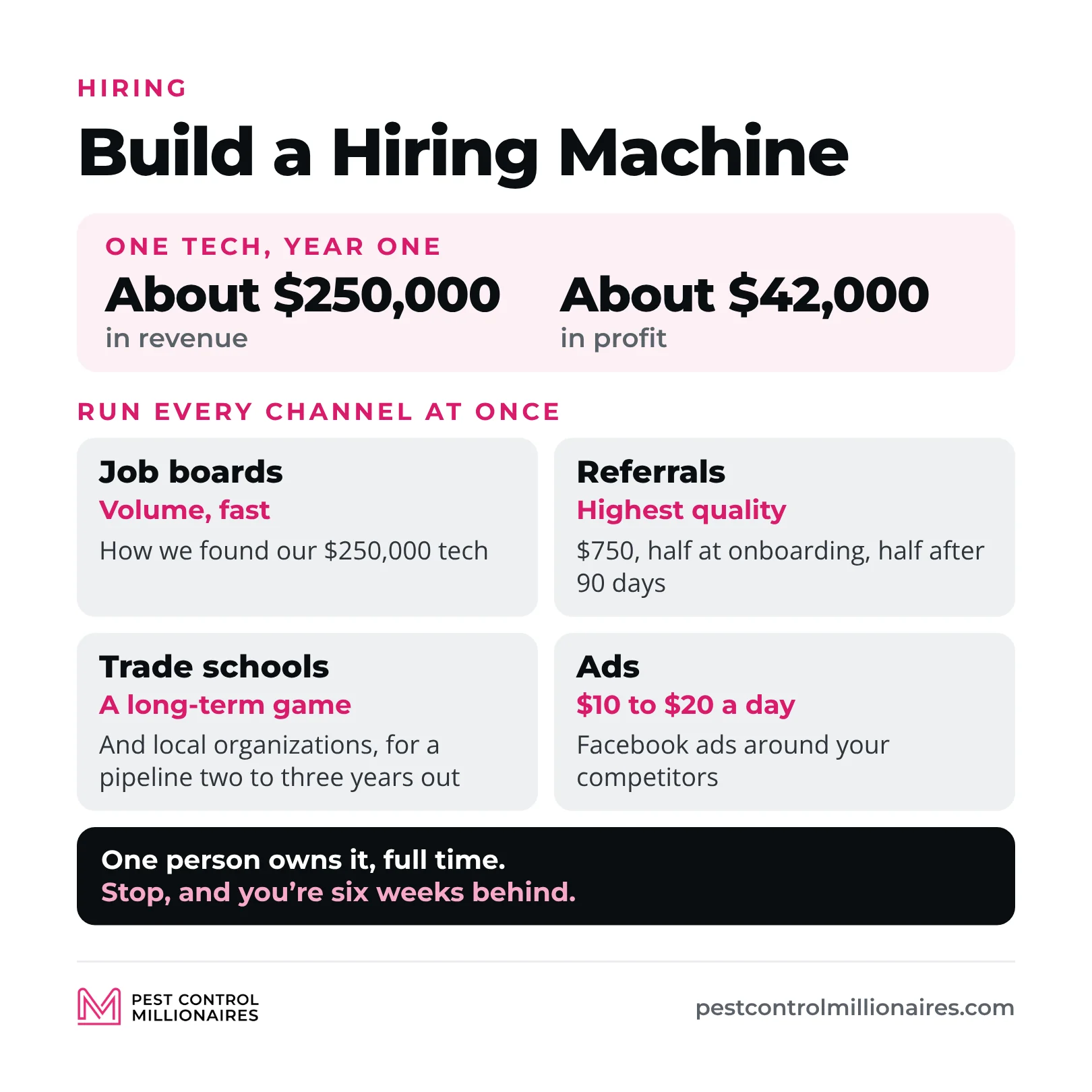
This is where most owners get the numbers backwards. One tech in year one does about $250,000 in revenue, maybe more. At an average route margin, that’s about $42,000 in profit from one person in their first year. As they get better, the routes get tighter and they move a little quicker, that number can go up.
So if one hire is worth $40,000 or more to your business, why are you offering a $100 referral bonus to find them? Or nothing at all? You’re trying to solve a $40,000 problem with a $100 incentive, and it doesn’t work.
It’s not that your team doesn’t want to find good people. They do. Most people want to work with people they like. You just haven’t made it worth their time. If they get paid to bring those people on and paid to actively look, they’ll go look.
Run Every Channel at the Same Time
People DM me, comment, text and call me with the same question all the time. What’s the best way to find techs? Is it Indeed, referrals or trade schools? My answer is always the same. Yes, all of it, at the same time. It’s just like marketing, and each one earns its spot.
- Job boards like Indeed give you volume. They’re the fastest way to get people in front of you, especially for entry roles you’re willing to train. That’s how we found the tech I started with.
- Referrals are one of our highest quality channels, hands down. When someone on your team vouches for a friend, that person ramps up faster and sticks around longer, because they know what they’re walking into and they get to work with their friends. We spend more time with the people we work with than with our families, so we want to enjoy them.
- Trade schools and local organizations are a long-term game. They won’t fill your seats today. You’re building a pipeline two to three years out of people who actually want to be in the trade, not just a paycheck, which means lower turnover and better retention. Build relationships with the high schools and colleges, and reach out in the off-season to the people graduating, so you can get them onboarded and ready for spring.
- Ads. If you can run free job ads, run them constantly. If you have to spend money, there’s nothing wrong with spending $10, $15 or $20 a day to find someone worth $40,000 a year. You can also run Facebook ads all year long, targeted around your competitors, that show your pay, what you do differently and your culture. You’ll pay a lot more on those platforms, but you can find really good people that way.
The one big mistake is picking one channel and hoping it’s enough. We run them constantly, because they solve the problem on different timelines.
Pay Real Money for Referral Hires
Here’s how our referral bonus works. If someone on our team refers a person we hire, they get $750 total. Half comes the week the new person onboards, and the other half after 90 days.
We split it up on purpose. We don’t want people hiring all their friends at once, collecting a big payout and then everyone disappears two weeks later. They have to want to stay. And if your team picks someone they want to work with, who fits your culture, that person typically sticks around a long time anyway.
Once your team knows it’s real money and not just a gesture, they start actively looking. Tell them you’re always looking, for sales, service and CSRs, and have them post stories that show the culture. Then they’re not just casually mentioning it to a buddy. They’re basically full-time recruiters, because it’s worth their time.
Put One Person in Charge of It
Just like marketing, somebody has to own this job. Applicants are leads, so it’s speed to lead all over again. People looking for a job are searching the job boards, so you have to act extremely fast. Most of the time, the first company to reach out wins.
Recruiting has to run the way your marketing spend runs, constantly, with one accountable person owning it. Not “we’re short-staffed, so now let’s post some ads.” At Pest Badger, we have a full-time talent acquisition person whose number one job is keeping all these channels active, checking applications, following up on referrals and keeping the trade school relationships warm. It never turns off, even when we’re fully staffed, because the moment you stop, you’re six weeks behind the next time you need someone.
Keep building the pipeline and following up on those leads. Even a spreadsheet works. Keep a list, and when you need someone, go back to the list.
Top Grade Once the Pipeline Is Full
Once you’re in a really good spot with your technicians, you can start top grading. Say an A player walks in, maybe with a ton of experience or maybe just a stud of all studs, and you have a B player on your team. That’s the time to start replacing your C and B players with A players, so over time you have a team of all A players.
Top grading is one of the biggest tools you have, as long as you keep running ads and finding really good talent. Jake Sheldon’s guide to hiring A players for pest control has more on it.
If you’re short-staffed right now thinking, “I just need to hire this one spot,” that’s the trap. That’s what most people do. Build the machine instead. Pick your channels, pay your people what a hire is actually worth, put someone in charge of it and run it every single week.
Frequently Asked Questions
Where do you find pest control technicians?
Everywhere at once. Job boards like Indeed bring volume fast, referrals from your team bring the highest quality, trade schools and local organizations fill the pipeline two to three years out, and you always spend a little on ads, even $10 to $20 a day. The mistake is picking one channel and hoping it’s enough.
How much should an employee referral bonus be?
Enough that your team actually goes looking. We pay $750 for a referral we hire, half the week they onboard and half after 90 days. One tech in year one can be worth about $42,000 in profit, so a $100 bonus won’t cut it.
How much is a new pest control technician worth?
One tech in year one does about $250,000 in revenue for us, maybe more. At an average route margin, that’s about $42,000 in profit. As they get better, the routes get tighter and they move a little quicker, that number can go up.
What is top grading?
Replacing your C and B players with A players once your hiring pipeline is strong. When a stud walks in and you have a B player on the team, it’s time to make the switch, and over time you end up with a team of all A players.