Josh Fleenor on Buying Two Pest Control Companies

Table of Contents
- Get your reps on small deals first
- Walk away when the customers love the owner
- Only pay for the customers who stay
- Make the welcome personal
- Warn your customers before the door knockers do
- Fast growth finds your weak spots
- Middle managers are amplifiers
- Build it for the next leader
- Frequently Asked Questions
Josh Fleenor is the president of Pest Pros, a California pest control company in the Sacramento area. He has been in pest control for 26 years, ever since he answered a newspaper ad that turned out to be a wrong number. It was a pest control company, and a charismatic guy talked him into coming down. After 18 years and a few companies, including managing a region for one of them, he started Pest Pros. His daughter had open heart surgery at three months old, about six months before he launched, and looking down at her after the surgery, he decided he was building a legacy for her.
He had just done his first acquisition when he was first on the show. By the time this episode came out in July 2026, he had done two more, and Pest Pros had grown 59% in 2025. I wanted to hear what the deals taught him, and what broke when the company grew that fast.
This episode is part of the PCM Podcast. His first episode is how Josh Fleenor turned a $55K branch into $500K a month.
Get your reps on small deals first
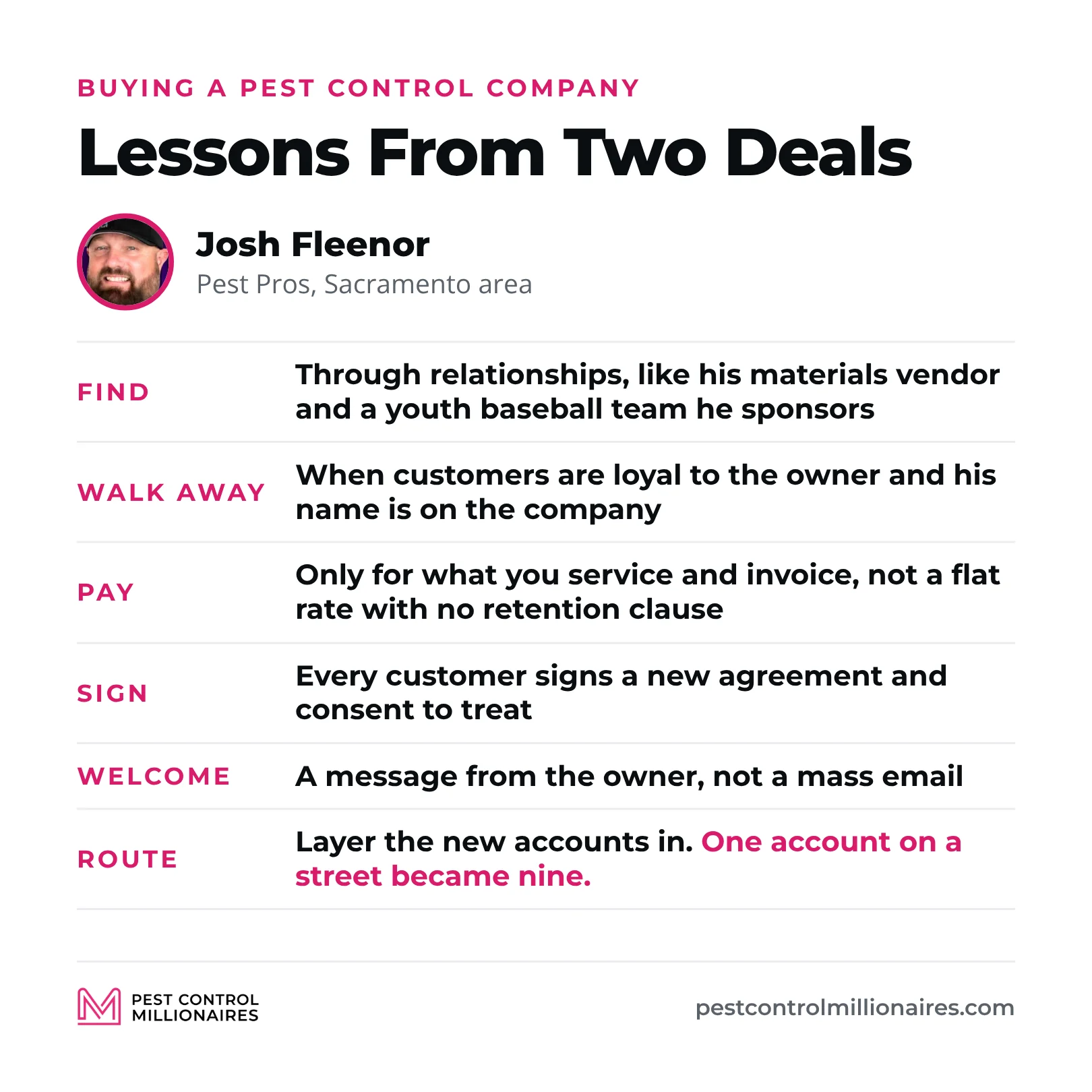
Both deals were small, and neither company had employees. One was a pretty large route. The other was a smaller route where Pest Pros really needed route density, and it came with some really good accounts. Josh wants bigger acquisitions eventually, but he wants his reps first. His very first deal went as smoothly as possible. These two came with their own complications.
Both came through relationships. The vendor Pest Pros buys materials from connected him with one. The other came through a youth travel baseball team Pest Pros sponsors, when someone connected to the team told Josh he had a friend who might be selling. It took about six months of following up before the seller called, and Josh stuck with it because people in that area support local and Pest Pros’ branch there wasn’t getting the growth it needed.
Then both deals sped up. A six-month plan turned into “I want to move out of state, can we get this finished in the next four weeks?” and Josh handled both at the same time.
Walk away when the customers love the owner
Josh also had a shot at a really big acquisition and passed. The culture didn’t align with Pest Pros, the customers were bought into the owner, and the company carried that owner’s last name in a community that’s big on supporting local. “If we were to come in and change it to Pest Pros, I feel like we would have lost a lot of accounts,” he said.
Some companies you buy, you rip the band-aid off on day one and change the name, because it doesn’t carry much enterprise value. Others you just don’t mess with, except maybe adding “a division of” your company at the bottom. Josh watched a big national company buy a local company named after its town and change the name right away, and I’ve watched renamed mom-and-pop shops go downhill fast.
A lot of the time it’s ego. Owners want their name on the side of the truck. Why fix something that isn’t broken? Make it run more efficiently, get your cash back out of it and let the name run. I walk through when we rebrand and when we don’t in the Mosquito Crush acquisition.
Only pay for the customers who stay
The complications came from customers. Some told Josh’s team they would move over to Pest Pros and never did. In a small company, customers get attached to the person, not the service. One told them, “I was just paying for the service because I’ve been with this guy for 18 years and I was just supporting him.” Once the owner sold and moved away, people like that had no reason to keep pest control.
The hardest one was a chain of restaurants that was a big part of one purchase. Its owner kept saying he would sign all the agreements and then dodged the seller’s calls. Josh only pays a seller for what Pest Pros actually services and can invoice, so the seller, who had moved out of state counting on that money, was looking at a much lower payout and panicking. The chain finally signed after a lot of back and forth.
That’s exactly why the protection is there. “I’ll talk to guys that just pay a flat rate out and there’s no retention clause in there and that’s a dangerous game,” Josh said. You don’t know how many customers are going to sign on with you. I recommend a retention clawback for the same reason in the pest control acquisition process.
Every customer from an acquisition also signs a new agreement with Pest Pros. It doesn’t extend their contract. It’s an agreement to continue service, plus consent to treat their property, because Josh wants to protect himself as much as possible in California. That may cost him a little retention, but his team is relentless about following up, so they bring over a decent share of the accounts.
Make the welcome personal
The best thing Josh did was personal. Instead of a mass email from a system, he sent every incoming customer a message from his own email about who Pest Pros is and what it does for the community. People wrote back that they had researched him, found all his content and liked what they saw. “Everything aligns with that. We’re just so excited to come aboard,” one told him. The welcome turned into a lot of referrals.
That content took work. Public speaking never came naturally to Josh, so he goes on camera a lot, because when he finds a weakness, he goes after it. When one guy got tired of Josh’s face and voice in his ads and threatened to punch him, Josh wrote back, “Hey, I can’t do anything about my face or my voice. But if you ever need pest control, I can certainly help you there.”
The routes paid off too. In his route manager, the two purchases layered over each other and over the customers Pest Pros already had. Some accounts were underpriced, but on one street they went from one account to nine, and that density makes up for a lot as long as you route it properly. I covered how we moved bought customers to our pricing in raising pest control prices.
Warn your customers before the door knockers do
Josh has nothing against door-to-door. He was once the start tech for another company’s door-to-door accounts, so he’s had to deal with whatever the reps promised. Pest Pros hasn’t lost many customers to door knockers, but people kept calling about what reps had told them. Some said they never wanted to cancel, but the rep said he’d called for them, and they signed. Plenty of reps do it right. Josh worries about the ones who get manipulative.
So he emailed every customer about the tactics to watch for. He also told them that if they ever felt they weren’t getting the service they needed, or thought Pest Pros didn’t offer something, he’d love the chance to talk, because most likely they do. On a friend’s advice, he turned it into a video for social media, heard from a lot of people who had been through the same thing and sent it to every customer. It really helped retention. His cancel rate was at 1% the last time we talked, and it still was.
Fast growth finds your weak spots
For years Pest Pros planned to grow 44% a year and hit it every year. In 2025, Josh pushed harder, grew 59% and watched some things come unraveling, which he expected. They had workers’ comp claims and several accidents, so they put cameras in the vehicles on top of the GPS they already had.
Cameras are sensitive, so Josh was transparent from the start. He told the team they didn’t want cameras in the vehicles, but at the pace accidents were happening, they’d have to, and they let everybody know how many days it’s been since the last accident. The team took it well, and Josh credits the transparency. When the AI started flagging drivers with a phone in their hand, they gave people time to break the habit, then suspended a few people and let one guy go for continued violations. After that, everybody knew they were serious.
He also dealt with HR situations and employment attorneys, which is tough in California. “The people that are going to sue you are the people that they intend to do that from day one when they start,” he said. As you grow, you need those systems in place. It isn’t about controlling everything. It’s about mitigating risk. Josh wishes he’d put them in sooner, before a year like that, but he thinks the hard parts sharpened Pest Pros for the next level.
Middle managers are amplifiers
The bigger Pest Pros gets, the less Josh knows the people in branches further out, and the less he’s there. He communicates a lot, with videos from the heart in their WhatsApp, regular emails and Zoom meetings, but physically being there is so much different. So he’s making a plan to get out to the branches more. I found the same thing visiting ours, which I wrote about in how we built Pest Badger.
He told me about an escalated rodent account at a restaurant his team was struggling to get under control. He hadn’t been out on one in a long time, and one of his leaders had never seen him on a job like that. Josh went to work, climbing over everything and peeling it all apart. “I’ve never seen anybody operate like that,” the leader said, and he told other people. People need to know Josh isn’t “just some guy in the high tower giving commands.”
He calls his middle managers amplifiers. They carry things down to the boots on the ground and amplify things back up to the top, and he thinks it’s one of the most instrumental roles in the company. If it’s weak, the company feels it. Even with good middle managers, you still have to be seen.
After a year with a lot of people growing into leadership, Josh also wanted a tune-up, so his leaders were about to start Ego Is the Enemy by Ryan Holiday, which he read on his honeymoon in Maui. “We can make a lot of poor decisions based on who we think we are at that moment,” he said. I told him to read Leadership Strategy and Tactics by Jocko Willink, probably the best leadership book I’ve ever read.
Build it for the next leader
Josh gets 20 to 30 acquisition messages a day by text, email and phone. He doesn’t even open them, because he doesn’t want to be tempted. One of my mentors told me you don’t have to respond, but start building a list, and Josh has one. He never says never, but his goal is for his nine-year-old daughter to take over Pest Pros someday. At a Desserts with Dads event, the question was what her daddy is great at. She wrote, “My daddy is great at being the boss.”
He even used AI to help raise a leader. When some kids at school started spreading rumors about her, Josh prompted ChatGPT with early childhood psychology, early leadership development and peer leadership and had it write a story about her handling every situation, plus to-dos for the next day. She did them, and when he picked her up, the first thing she said was, “Dad, it worked.” She learned to address things head-on instead of letting them fester.
Josh thinks leading people works the same way. When you don’t know how to handle something, run it through AI. It isn’t 100% correct, but it can check your thinking and turn it into an action plan. His team runs safety protocols through Claude, which builds the training, tests people to a set score and sends a certificate when they pass. An AI they tested that answered calls after hours and even sold accounts was still a little wonky, but they aren’t giving up on it, because it’s the future.
Frequently Asked Questions
Who is Josh Fleenor?
Josh Fleenor is the president of Pest Pros, a California pest control company in the Sacramento area. He has been in pest control for 26 years and started Pest Pros a little over eight years before his second PCM Podcast episode came out in July 2026. Pest Pros grew 59% in 2025.
How do you protect yourself when you buy a pest control company?
Josh pays sellers for what Pest Pros actually services and can invoice, not a flat rate, because some customers never move over. He calls a flat payout with no retention clause a dangerous game. Every customer from the deal also signs a new agreement and consent to treat their property.
Should you rename a pest control company you buy?
It depends on the name. Some names don’t carry much value, so you rip the band-aid off on day one. When the customers are loyal to the owner and his name is on the company, Josh would rather walk away, and I’d leave the name alone or make it a division.
How did Josh Fleenor find the companies he bought?
Through relationships. The vendor he buys materials from connected him with one of them, and the other came through a youth baseball team Pest Pros sponsors. That one took about six months of following up before the seller called.
Full transcript
Every word of the episode, from the video captions
Building the business turns you into a different kind of human being.
Realize that failure is a part of the...
I think there's hope out there for all of us. For all of us. They say procrastination [music and singing] be the assassination of destinations. That's why we out here grinded with no association with haters and them other crabs [music] trying to put us down. Pest Badger's in the house. Boy, don't clown. Just keep your eyes on the prize and no giving up. You can do whatever you dream of. Just keep your eyes on the prize.
Welcome back to another episode of Pest Control Millionaire. This dude doesn't need much of an intro, that's for sure. I think everyone in Pest Control knows who you are by now, Josh. But we got Josh Fleenor from Pest Pros back on the podcast today. He's down in California, crushing life. Every time I feel like I open up my social media, there's Josh Fleenor at the top. Creating a lot of content, so it's pretty cool. And I know you have a lot of really cool things going on since the last time we chatted. I know you're going through a couple acquisitions. We can chat about always a lot going on in your world. So Josh, welcome back, my...
Yeah, it's good to be back, man. Yeah, lots happened since we spoke last. So...
I'd have to go back and look and see when the podcast we dropped was. That was quite a while ago, wasn't it?
I think it was over a year ago.
Damn, it went by fast, eh?
I know. I meant to go back through it to go so I'm not repeating myself on a lot of the same things.
Yeah, I know. I think there's a lot to talk about. Like you said, you can just do a quick backstory if you want. Don't have to go into the nitty-gritty. Just a quick backstory and then we'll just get into, you know, what we want to talk about today. How about that?
Yeah, sounds good, man.
Sweet. So, just real quick, I know your story, maybe some of the older listeners story, but real quick, why don't you tell us how you got into pest control quick and then kind of where you guys are at today and we'll take it from...
Yeah, I'll give the short version. Yeah, I kind of stumbled into pest control. I think like most people, you know, it's rare that somebody you know, as a child is like, I'm going to be a bug guy or I'm even going to be a you know, an entrepreneur in the bug industry unless, you know, somebody in the family's doing it. And so you know I was pursuing u some horiculture type courses and I was looking to get into landscape design and you know coming from a rougher upbringing. I didn't really have a whole lot of like a clear path on where I was going but I kind of stumbled into horiculture. I was doing landscaping. I really enjoyed it. So I started doing night school and was pursuing more with that. And then answered a ad in a in a paper and it happened to be wrong number and it was pest control company and guy was charismatic. He talked me into coming down and I went you know I can make a little bit more doing this u because it was incentive based and I like the idea of that being a competitive guy and playing sports and all that.
So I gave it a shot. And 26 years later here I am you know been through a few companies.
You're like a regional manager for a company for a while too right? Yeah, I was I managed a region in an area that they had expanded into. And then at some point I was like becoming a stronger visionary as I was building my leadership skills and reading and learning and doing everything that I could. And I found myself not really aligning with the direction of the company, which the direction they were going wasn't wrong. It just I was becoming this very strong visionary and I was realizing that you know the only way I was really going to be happy is if I built something that aligned with the way I felt and I was being pulled that direction. And you know my daughter had open heart surgery at 3 months old. And you know, that was kind of the kind of what gave me the confidence to push forward because I look down with down at her after surgery and I go, you know, I'm sacrificing a lot and you know, I kind of have my priorities out of whack. I mean, I almost lost her and then I just looked down at her and I was like, you know, if I'm going to do this, I'm going to do this for you. I'm going to build a legacy.
I'm going to build it in you know my vision and hope to inspire her to lead and the company after that years down the line.
That's awesome. And then so how long ago was that? Like when did you...
So we just we're we're a little bit over eight years old, you know. So we started a little over eight years ago. So that was maybe about six months before before the start of the company because I had to get some ducks in a row. I had to st I stumbled through a few things and then Pest Pros was born. [laughter]
And you had a lot of experience like that. You said, you know, basically 18 years of experience under your belt before you went and launched your own. So you had a lot of a lot of skill sets for sure as far as selling goes and servicing. You know, you knew the industry very well.
Yeah. You know, I was one of those guys that paid a lot of attention to what was going on. And I worked for a couple different companies that operated a little differently. So, I took inventory of what I saw that was working well and what wasn't. And, you know, I always say, "Oh, man. I wish I would have started this earlier." But, you know, honestly, I think the path needed to be the way it was in order for me to be, you know, the leader I am today, you know, and have the skill set that I...
Yeah, I agree. And so like I got into the industry total opposite like I didn't know anything about it and I start when I started like so I had to learn along the way where you had 18 years experience. So I talked about that a lot re like I've been talking about that a lot recently. If I could go back again would I do it differently? Probably not. But if id have went and worked for someone you know for like you said for 3 to 5 years although it had been really really hard for me to go to work for someone else cuz I haven't had a job in I don't know 20 years at this point. But even right out of high, if I went and worked for a pest control company, I probably would have known a lot more getting in the industry and probably learned a lot of mistakes that I made early on through someone else, you know, from their experience like you...
Yeah. But, you know, those mistakes are they're good. You know, I've learned to like reframe things like it wasn't a mistake, you know, it was it was it was an opportunity for some growth for for me. And it's probably what you needed and what I needed at the time when I made, you know, with the mistakes I've made.
That's why I said if I go back, would I would I have done it differently? Probably not like having worked out the way it was supposed to work out. But hindsight 2020 is always like well if I would have it worked for somebody else I'd have missed all those mistakes I'd have been somewhere a lot faster and further but regardless there's two ways to look at it. So you're eight years in youcliped a massive number as far as a mileston revenue which is cool. Walk us through like the first quickly, you know, like first five years, your stepping stones, what you learned, what it takes to grow a company as large as you have so far.
I think it's important to understand how resourceful you have to become. And you probably learned that through stepping into industry with no experience. But you know, I was in situations where I was they didn't really have a blueprint. It was like, hey, you're going to go manage out here. We have no blueprint on what that looks like and you know I was frustrated at the moment but it made me very very resourceful so the first year I had to be very resourceful is all uncharted territory you know but it was awesome too like it's an opportunity like you're kind of given a blank canvas you know or well you picked up a blank canvas because you made the decision to move that direction and you can paint it in any any form that you'd like and that's where that creativity plays.
So, you know, didn't just I didn't just start going I want to be a cookie cutter version of the last company I operated in. Honestly, I took inventory of everything that I didn't want to do and it was my opportunity to do it my own way. So, like where were you like I know first starting off like a lot of people that listen to the podcast maybe a little bit smaller maybe around the million two three million.
I love that. [snorts]
What does it take to go from that 1 million, 2 million to 5 million plus? Like what do you think?
It's tough. Like you've got to be committed to moving forward no matter what. So, you can't let little situations hold you up, you know, like you have to, you know, you take an opportunity that that lands on your plate, like some type something that's holding you back and go, "All right, I'm going all in. I'm going to figure this out and I'm going to push forward." because we started we didn't have much when it came to resources is like we didn't have much cash or anything. So I had to be the resource I had to figure it out you know I had to figure out marketing I had to figure out what our growth plan was and you know I had to figure out how to pay for these vehicles. We didn't we didn't have any established credit or anything. So it you know it takes you know it takes some real drive to push through...
Yeah. And I think a lot of people like they probably just watch social media and they get a false sense of reality in my opinion. Like it's going to take way longer and take way more effort and money than you're ever going to think.
Yeah. I think sometimes we make it look easy to people like you said. Because I've had a few people start start their own thing and you know and they're like oh I'm going to do what you did. And they've been out on their own for a while and they're not doing anything like what we did. Because they realize like, oh wow, there's a lot that goes into this. It isn't just like, hey, I'm going to start a business and I'm going to be successful. Like, you have to be very intentional in every move, you know, and you can't get caught up in your feelings or anything like that. You're going to fail along the way. But you got to jump on that like, all right, I'm not going to I'm not staying here. I'm moving past this.
There's a reason why a lot of companies don't move past a million dollars. It's, you know, it's your daily actions that lead to that and your mentality. I think from what I've seen from guys that don't reach that million dollar mark or don't push from that one to five is the mentality. You got to have the mentality that you're going to win no matter what and you're going to find you're going to find what you need to make sure that happens. And sometimes that's people too, you know, with growth like you got to bring the right people in and you got to trust them enough to be able to take a portion of the business forward.
Yeah. It's like you hire the good people. And at first you can't, right? You can't hire the...
No, you have you don't have any money for that.
You don't have any money for that. So you're you're figuring all out on your own. You know, then your next step is trying to get out of the truck as fast as you possibly can and then you hire in some leadership. Then you kind of go backwards for a little bit because, you know, there's not a whole lot of cash there. So, cuz I'll go into overhead and you just got to float that forward and but then over time the momentum just starts picking up, you know, and like you said, and there's nothing wrong, you know, some people are like, you know, it's under a million, like have a lifestyle business, they're happy, and there's nothing wrong with that. And they're really good b businesses. They're great. They, you know, they push a couple hundred,000 of cash, the owner makes good money. There's nothing wrong with that. But I think I think you're right. Like I think the people who maybe always wanted to get bigger but then don't is like they just think a little bit too small. And one of my mentors told me early on one of the first things he ever told me is think bigger. And every time that I think that I'm thinking bigger like probably like you like it still wasn't big enough.
Like what the hell was that like that for you? So just the evolution of the entrepreneur and growing and learning you know like new skill sets too. We're learning every single day like I'm sure you are. We have thrown at us every single day, all day long. New challenges every single day that they're overcoming, hiring in, you know, new people, like bringing in bigger, better people. Like, it's so fun. Like, I'm having so much fun right now. It's this past few years has been incredible. Like, it's awesome. Hold up. Quick pause. If you're on a pest control company or fertilization weed control company, you're not in our Facebook group, you're choosing the harder path. Every operator that's in there is skipping years of mistakes because people are actually sharing what's working right now. So, stop trying to brute force your way through growth alone. Search Pest Control Millionaires on Facebook or click the link below. And now, let's get back to...
Yeah. You [snorts] know, I've seen just when we saw when we were talking last year, I was like, man, this guy's everywhere. He's doing everything. And then you look at, you know, you currently are like, man, you moved on way past that, you know. So, just seeing that that next level and the next level beyond that. I know I'm a I'm a big thinker like big I'm looking at like huge goals. I have to I've learned that I have to take my foot off the gas a little bit for everybody else's sake.
Because I'll just wear everybody down around me. They don't they just don't operate like me.
I think that I've done a very good job at that part as I've developed into who I am today where I would just throw like a thousand things at my team at once. And maybe I know I've talked about this before on the podcast, maybe not with you specifically, is I'll have like a I'll have a notes in my in my in my phone, my notes calendar or my notes folder, and I'll put a bunch of notes that I want to implement, like really good ideas, and then I'll sit on them for like a week, and I'll just keep going, adding to it, adding to it, and I'll go back. I'm like, "Okay, well, is that one still important?" probably not. And I'll delete it. So if I bring it to my team like they know now like over a month like I've been processing like processing this thing like now they're like okay now Jonas is this is a 30 day 609 90day thing is it a six-month thing or is it a one year thing like tell us your thoughts. So then I'll say this is kind of what my I'm thinking but where are you guys at like when could we possibly do this? So there's things that I've thought about six months ago or longer that are finally get implementing next week.
So just yeah I've done...
I remember you talking about that and so that's one thing that you learn over time too is to be a little bit more patient with some of that stuff...
And patient when it comes to you and I'm sure isn't our strong suit.
It is not it is not I'm growing there. I'm currently growing there.
Yeah. Like so usually like I say usually more more often than not like when I want things done it's not today or tomorrow. It was yesterday.
Same. Same. I mean, I don't think anybody ever understands at the level you want it done either, cuz I know with me, even with like marketing plan or whatever, it's like we're still doing way too too little. Like, we're not even close to what I want to do with it. And I feel like we're just scratching the surface, but, you know, locally, I get people are like, "Oh, man. I see you guys everywhere. I see, you know, I see your face everywhere." And, there's a lot of growth that happens with that, too. You've probably experienced this is like you start putting yourself out there more and look for me I'm going on camera a lot because I'm trying to get better at speaking publicly you know and it's a challenge for myself because it wasn't something that came natural at all and I still stumble through it quite a bit but I know that's a weakness so that's an area I have to put focus th that's just how I operate if I have some type of weakness I'm going after it fully but you get people who are encouraging you up to a certain point and then you have people that kind of drop off and then you have people that start hating on you and you're like why is this person hating on me all of a sudden?
But the ones I worry about are the ones that are like super silent because they're like what happened there and you get kind like me especially I get kind of in my feelings a little bit about it like what' I do you know like I'm just trying to grow. So I've had to learn to like kind of curb that and go okay well you know they're going to see it however they see it. I'm just going to keep being me.
I'm gonna keep growing.
I've gotten to the point where I just don't give a of what other people think. And it again, I wasn't always that way either.
Cuz as you know, you grow on social media, grow the YouTubes, like you're just going to get hate from so many people, whether it's local or across the country, wherever, maybe other countries. Like there's just, you know, the keyboard warriors out there that lives in their mom's basement still that just have something to say.
My friend has he's a public figure and he's he's he's out there quite a bit and his advice to me was like, you know, I had to do it. I went through that too and I just went, you know, like I call him the people of Walmart. And he's like, if I was walking through Walmart and somebody said, "Man, I hate your voice or that was stupid what you said or whatever." And he goes, "Okay, crazy guy from Walmart." you know, and so when you get a comment on one of your posts, you go, "Ah, people at Walmart, you know,...
And like I'll be a 100 percent honest with you, like I take Joe Rogan's advice to a to a tea." Like he just says, "Post and ghost. Don't go back." No reason to go back and look at it. So, if there's like legitimate comments that like sometimes like my friends will screenshot something and send it to me and they'll send it to me and initially I'll feel like, "Oh, what the hell?" Right. Right. And it's like one, why would you send me that dumb Two is like, "Okay, they'll process it now." I was like, "Is there some validity to this comment? If so, maybe they're right." That's another skill set that I had to learn like, "Okay, take a second like process this like look at from both sides." It's like is there some, you know, is this comment valid? If so, maybe he is right. And so, again, something I had to learn over time, but I just try not to look anymore. Like, do there's so many comments can keep up with him. And it's cool when you have like the, you know, like you said, the people who do reach out like, hey, dude, this is so helpful.
Like, thank you so much. That's what's rewarding, you know, it's like, okay, I'm doing it for these type of people who want to learn.
Yeah. No, definitely. I get those type of messages and I love those and I need those, too. You know, it's like and I always tell them that, you know, I really appreciate that. You know, I really need that. I needed that. And they'll go, "Oh, I'm sure you get a lot of that." And you and it's like, "Not as much as you think." but knowing that it reached somebody, that's the important thing. I [snorts] did I did go through a little phase where we were running a lot of social media ads and my face was on it and one guy was like, "Dude, I'm tired of hearing your voice and seeing your face and like if I ever see you in public, you know, like I'm just gonna punch you in the face or whatever."
And I go in and I was I stepped back and I was like, you know, I'm going to say something clever and I was like, "Hey, I can't do anything about my face or my voice. But if you ever need pest control, I can certainly help you there."
Funny. Yeah. And so like I just don't respond at all because I probably wouldn't say anything very valuable to them at all.
It's kind of laughable now.
Yeah. But there's like I've had I'm sure I'm sure you have too, but like I've had I've had videos do like 5 10 20 million views and you just get whatever. You know what I mean? Like I just not like I'm just not even going to try to keep up and there's just no point.
Yeah. But that's great. You know, we got 5 10 20 million views. So that's the that's the definely...
I honestly don't I don't even think so anymore. Like I just don't like I just I don't care. The reason I bring that up is I think that you know like some people will be shocked when they when they hit that level when they step out of their comfort zone, start pushing like that and they'll be shocked like of what they get hit with.
Yeah. And it's like it just doesn't in my opinion Yes. It gets eyeballs out there. Like I get it. It just doesn't hold a lot like my opinion and I can be wrong. I'm totally with it. It just doesn't add a whole lot of doesn't add a whole lot to the business at all. Like okay this business this thing got five million views. How many leads did it get? Okay. One or two was who gives a Like I don't really care. So like I've been more intentional of where I'm where and how I'm doing content now and the target demographic of who I'm going after. You know what I mean? And so like with like with Facebook ads, obviously you control where where it goes. Ads in general across all platforms, you can control where it goes. But when it's social media and you're making shorts, like they're just going to put it wherever.
Like yes, you can tag the city and all that stuff. It's still going to throw it out there to everyone. People start sharing like, you know, commenting. It goes all over the different countries. Like I don't give a about people in other countries. See who I am right now. You know what I mean? So...
Yeah, it's not targeting, you know, what you're what you're what you're aiming for there.
Yeah, we're kind of going through that right now, too. First, it was like, let's get a lot of content. Let's get better at it, you know, and let's just get reps in. And then it's and then get our brand out there, make people aware of who we are. But and it and it's anybody at first, you know, and then you start dialing things in and you like you mentioned earlier like what's the difference between one and 5,000 is dialing in processes and really understanding like KPIs so you know what you're targeting. You know where your your leakages are in the company. But that only grows, you know, from five to 10 and then so on and so on. So the larger you get, the more dialed in you have to be. And I think a lot of guys that I talk to that are entrepreneurs in this industry, they're more they're stronger visionaries than they are, you know, guys who, you know, like super dialed into managing it all. So you're fighting you're fighting that inner visionary sometimes and like the management of it all could drain you and you have to understand that.
So like putting the people around you or using the vendors that are available out there to dial in some of these things that you're not passionate about but you need, you know. So if you're not passionate about digging into those KPIs when it comes to you know, social media marketing and then making those adjustments and have somebody who's skilled at it handle it for you.
Yeah, for sure. I know you recently t you know I think I think I don't know how many but maybe it was one or two or three acquisitions at this point since the last time we talked.
Yeah. So we've had two since we've talked. I had one shortly before we talked the last time. Yeah. They've been smaller acquisitions. You know I'm learning through it all. And they got they went pretty well. Honestly the first one I ever did went the smoothest possible. The last two came with their own complications, but they worked out well, you know, so I'm doing some smaller ones. I'm hoping to do some larger ones along the way, but I got to get some reps in, you know, where I'm at when it comes to acquisitions, then jump into some massive one. I did have an opportunity for a really big one. But I was looking at it and I was like, their culture doesn't align with who we are. They're really bought into the current owner and even the company's name was that that guy's last name. So, in the community they were in specifically you know, they're big on local and if we were to come in and change it to Pest Pros, I feel like we would have lost a lot of accounts.
I actually just dropped a YouTube video like two weeks ago on the same exact thing. Like...
Oh, did you really? There's some there's some businesses that you purchase and you rip the bandit off day one and you change the name because there's just not a whole lot of enterprise value to that name in my opinion. Then there's some that you just don't mess with. Like in one like that in my opinion is probably one like you just don't mess with like run it the way you can like you could say like division of Pest Pros in the bottom of it to have your name on it. But I've seen it happen all the time, which I'm sure you have too. Like these big companies come in, they buy out this big mom and pop shop. They do change it. Not all, they don't do it all the time. They do change name and it just goes to hell in a handbag quick. And I just I'm not one for that.
I've seen that, you know, in smaller communities that are very much about supporting local. I saw that a big national company bought out a company and I went, that's a strange purchase for them. I maybe they didn't do enough research on that specific market because it was named that town that city was the name of was used for the company. It was bl you know whatever that city is pest control and they instantly changed it.
Yeah. And I think it's almost like an ego thing. Maybe not for these PE companies but like operators just want to have their name on the side of it. And it's like why why fix something that's not broken? Like tweak it the way you want to tweak it. Make it run more efficiently, make sure you get your cash back out of it, but don't necessarily have to change everything about what got them there. You know what I mean? Like leave the name like let it let it run, you know?
Yeah, that one specifically. I actually re I had heard rumor that they were considering selling, so I reached out to them a couple times. I never heard back, but my goal was knowing that market really well. When you when you ran these acquisitions that you said that you ran into a few complications, give me some good examples we can chat about. I'm sure I ran into him, too.
So, you know, some of the people didn't u you know, they said they were going to move over to us, but they didn't. And...
There's sometimes when they're a smaller company, they're really attached to the actual individual and like we talked to some people and they're like, "Yeah, I was just I was just paying for the service because I you know, I've been with this guy for 18 years and you know, I was just supporting him." So the moment they sold and moved out of town, they had no reason to continue with pest control. They were only using it because they liked the guy. So they never really gave us the opportunity. You know, we had a chain of restaurants where the guy was the owner was kept stating that he was going to sign all the agreements and this was a big part of the purchase. So, and I have the seller who is banking on them paying because I'm only paying them based on what we actually service whatever we can invoice out.
And so he's he's calling the guy down and the guy's avoiding him. So, and he was going through a lot of things emotionally too because he moved out of state and he was basing his move on what he was receiving for this and now he's looking at a much low lower payout which we have to put those protections in place. Like I'll talk to guys that just pay a flat rate out and there's no retention clause in there and that's a dangerous game. You don't know how many people are going to sign sign on with you. You know, I have everybody sign a new agreement, but it's an agreement that we're going to continue forward with the service. There's no extension of the actual, you know, contract. But I especially being in California, I want to protect myself as much as possible. Like I have them sign off consent to treat their property. So, you know, maybe we have lower retention because of that, but I mean, [snorts] I think for the most part because we're pretty relentless on following up and making sure we make connection and all that, we get we get a decent amount of the accounts over.
So, did that big risk chain end up signing or...
They did. They did finally, but you know, we had a lot of back and forth with the seller because you know, he was panicking cuz he was basing everything on that.
Yeah, that's pretty crazy. What about the Did it have any employees or one or...
So, these two companies did not have any employees. So, basically we're buying a pretty large route and then the other one was kind of a smaller route in an area where we really needed some some route density, but we landed some really good accounts with it. And how did you find these deals to begin with? Like the two that you two or three that you...
So the first one we found through our vendor where we purchased materials, you know, he had mentioned something to somebody over there and we have such great relationship and they're like, you know, you really should reach out to Pest Pros. So they connected us. So that was great. The other one was through I sponsored a kid for or I sponsored a baseball team like a youth baseball team [snorts] and they had they're travel team and one of the guys on the team, his kid that was on the team saw that we were a sponsor and talked to the coach about us and the guy was like, "Oh man, I love these guys." Like and he was saying, "I'm thinking about selling someday." So he reached out to me. He goes, "Hey, I got a friend who who may be selling." I was like, "Well, connect us." And, you know, took about 6 months before the guy called me, but I kept following up on it. Because I knew it was in an area where we wanted to get we needed some more accounts. It was a tougher area to grow because it is one of those areas where they support local and we had a local branch, but we weren't based out of that area, so we weren't getting the growth that we needed.
So he eventually reached out and he was talking, you know, he was thinking about moving out of state and, we worked it all out pretty quickly. Both of these happened real quick. It's funny because the moment I started talking to both of these, these guys about purchasing their companies, it went from like a six-month plan on when we were going to purchase to all of a sudden it's like, "Hey, I need I want to move out of state and can we get this finished in the next four weeks?" So like I'm doing I'm handling both of them at the same time. So kind of juggling around. But both worked out really well for us.
That's cool. Anything out of those few deals that you want to chat about like any other struggles or anything good that came from it too?
So good. I sent everybody a direct message from me. I sent every potential client that was coming on with that a direct message about who we are and what we do for the community and all of that. And I had so many people reach out and say, "Man, I researched you because we put so much content out there and you know, after you sent that message, I researched you and everything aligns with that. We're just so excited to come aboard." And we ended up getting a lot of referrals because of because of that reachout. So, I'm getting it directly to my email, which I wouldn't normally do. I'd send a mass email from a system, but I felt like with this, it needed to be a little bit more personal. So yeah, we got we got a lot of good referrals out of it, so that was great. New opportunities there for that.
It help Did it end up helping with route...
Yes, big time. So it's cool. I'm looking at like our virtual route manager and you know pulling counts from one purchase versus the other and they were layering over each other and versus what we had. So it certainly helped with route density. Now, one of the things with both of these is some of the accounts were underpriced like according to, you know, our current pricing, but I had to look at like, well, now we went from, you know, in this neighborhood where we didn't have a lot of density. We had one account on that street, now we have nine, you know, so make up for the pricing and...
Yeah. We're not driving all over the place as long as we're routing those...
Yeah. Actually just it's funny that it's today, but actually the my third video of the of the acquisition series dropped today on how we rolled out pricing to all the new people. It was pretty cool. So I know what you're going through there. I have a couple questions that I had written down before we started the podcast that I wanted to ask. How did the billboard thing work out for you guys? I know you had a few big big billboards out there can't freaking talk today, but how did those end up working?
Yeah. So, last year we had 40 billboards going all at once. Yeah. And, you know, we had a good strategy for that. We didn't get a lot of calls where people said, "Hey, I saw your billboard." and that's why I'm calling. But when we got out to accounts, they go, "Wow, man. I saw your billboard. I saw you on, you know, the news. I saw your social media. You know, I see your trucks." It's a multitude of things. And I it's hard to understand your full ROI on that. Because you know, you know, they have to see you several times. I heard something the other day...
Yeah, it's 22 times. They used to say seven, right? Now they have to. So it's so noisy out there. You know, they have to see you 22 times. So we scaled back a little bit on billboards this year because we're making some adjustments. But what I started doing is focusing more on finding prime areas for billboards. And then so it's less volume, but it's a better quality of...
And then how about I know this was like one of your dream things. It was really cool that you guys did it and I think you probably are still doing it, but what about like the NBA big TV?
Oh yeah. Yeah. We're actually negotiating a bigger a bigger relationship right now. So, we also don't get a lot of people that call because say, "Hey, I saw you at the Kings game last night." But they do, say, "Wow, I saw you in there." You know, like you guys are really embedded in the Sacramento area. And that's that was our goal is like we want to be as visible as possible in the area and embedded in local sports in local events, all of that. So, we went into last year going you know, we're going to go we're going to go two feet in on this stuff. So, we were very selective about where we put our money, but it had to be something that was deeply rooted in the area.
I love it. Do you guys service the Sacramento building, like the NBA...
Not yet.
Working on that, too.
Yeah, definitely working on that. We've got into some other local sports arenas and even in the Bay Area. So, we're doing some work with some other sports teams.
That's cool. Another question that I had written down, are you guys still doing your we are your monthly book club?
We Yes, we are. So, we took a little bit of a break from it. We're actually about to kick off yeah. You know, we have to I hate you know, I know everybody's going to probably like, "Oh, man. We're putting this on in the middle of summer, but it needs to happen. So I when I So I got married recently and I was on the beach. Really?
In the in the thick of season, eh?
Yeah. Thank you. And so I was in the beach in Maui and we had this rainy day and we were we had we were in a cabana and we both just read a book all day and I read Ego is the Enemy by Ryan Holiday and I went, "Oh man, everyone in leadership needs to read this." so we came back. It was actually a book that we had just implemented into our intro to leadership, but I feel like there's a portion of that book that applies to intro to leadership, but there's a big portion that applies to, you know, executive leadership. And, you know, we can, you know, we can get kind of clouded view based on our success. And I think that we can make a lot of poor decisions based on who we think we are at that moment or letting our ego grow into something that's leading our decisions. And I thought, you know, this is the perfect time for us is we've had a lot of success and we've had a lot of guys grow at the leadership level in our company.
And I just really feel like we need a bit of a tuneup and not [clears throat] that there's these big egos running around, but to avoid any pitfalls that would come from that and to prepare them for the next level because that's what we need.
I agree. Is that so is that the book you're reading right now is Ego Is the Enemy.
Yeah. So we're about to kick that off the beginning of or about two weeks.
Cool. Have you read which I'm sure you have, but have you read Leadership Strategy and Tactics by Jocko? I haven't read that one. We read Extreme Ownership together, but I haven't read that one. It...
Is probably the best leadership book I've ever read in my life. It's freaking...
Okay, I'm noting that one down. I'm get right on that one.
And I like I liked his first two books, too. But this one is hands down the best book like ever when it comes to leadership. Like it's not just why, it's like it's the strategy behind it and the tactics how to go like actually roll this thing out. It's so cool. To all you listeners, you're welcome. It is such a great book.
I actually I don't know if I talked about this last time, but he has a series of Jocko has a series of children's books called Warrior Kid.
I did not know that.
Yeah, I read Warrior Kid, and there's about five of them, and there's even like a like a tactical handbook that you can purchase with for that, too. I went through every one of those with my eight-year-old daughter at the time. She's nine now. And it really prepared her for like bullies and, you know, and confrontation and helped her with building a bit of a routine in her life.
What is it called? Warrior Kid.
They were they were very...
Yeah, that's awesome. I wrote it down. I'm going to I'll order those after this. So I mean there's so much we can talk about, but next question I had and that's the last question I had written down. I'm sure you guys deal with a lot of door to door companies. How do you guys handle them out there? So, you know, I haven't and I think we talked about this before, like I don't have anything against door-to-door. I just I don't have experience with it. Like I was definitely a start guy for another company at one point. So, I had to navigate, you know, all the things that were promised and navigate that. But I kind of saw that as an opportunity for me to grow my skills when I went into that. How so because of that I know you know a bit about that process and then I've read several books on it and what I decided is you know we haven't lost a lot to them but we get a lot of clients calling us and saying hey they promised me this or they promised me that and there's certainly people out there doing it right it's the ones that we have to be ready for is the ones that are being a little manipulative through it like we've had clients call in and go hey I didn't want to cancel my c my service but they said they called for me and then I signed this agreement.
So what I did is I wrote I made an I wrote an email to every single client just kind of letting them know some of the tactics and what to be aware of and you know, hey, there's certainly people doing it right out there. But and then I also went, you know, like if you feel that you're not getting the service you need or maybe we don't provide something that you need, we would love the opportunity to speak with you so we can provide clarity because most likely we do. And we just want you to know how much we care and value you and all that. And that worked really well. And I so then a friend of mine was like, you know, you should put that in a video. So I did and I put it on social media and I had so many people reach out to me like, "Oh man, I experienced that too." And so I sent that video to all of our clients and it really it's really helped with retention. We don't lose too much.
I mean our cancel I think last time we talked our cancel percentage was at 1%. It's still it's still the same. So...
That's really cool. So over the past year I know you've had a lot of changes that you said you wanted to talk about too. Catch us up what's been else besides acquisition what's been going on I know you went through a lot of ups lot of downs like let's talk...
Yeah I mean we've certainly had challenges so we made a big push last year we grew 59% and you know I mean before that we grew 44% year after year and that was that was the plan it was like we hit our mark every year we our plan was 44 every single year and we did that and last year we pushed it a little bit and some things kind of came unraveling And we expected that. And I and you know I you know I see those as opportunities. When some of these things came along I went all right well good. You know this is an opportunity for us to grow a bit. You know we've had some workman's comp claims. We've had several accidents. U we had to install cameras in our vehicles. We already had GPS. You know and cameras can be a little sensitive when you're when you're installing them for the first time.
For sure you know.
And there. So, we were super transparent through the process or like look, we don't want to put cameras in vehicles, but if we continue at the pace we're going with accidents, we're going to have to and we're very transparent like we'll we let everybody know how many days it's been since the last accident. So, when the team sees it's at zero, they're like, "Oh man, we were on a streak." but after we put the cameras in, everybody responded very well to it. And I think it was because we were so transparent about it. And then then we had to deal with some, you know, driving with a phone in your hand because the AI picks up on that and detected it. And then we had to address that and we've had to suspend a few people. We ended up letting a guy go for continued violations. But then everybody realized, okay, they're serious about this. And I think we were pretty fair about it, too, because we're like, look, this has been a habit for you probably for a long time now.
There's a camera on you. Like, you can't do it. But we understand that like if you go to pick it up and then you set it down, that's not going to be a violation yet. So we gave him some time to transition and then so we dealt with that.
We did too, like I said, it's just as you grow, these are the things you have to have in place. It's not like we're trying to control everything, but we have to have systems and processes in place to try to mitigate risk as much as...
Exactly. So, you know, as you go along, you're like, "Man, we should have implemented that a lot sooner." especially before we took on a year like we did this past year. Being a little bit more prepared for that would have made things a lot easier. However, you know, those are the things that probably sharpened us enough for for the next level. So, you know, we dealt with some HR situations. You know, I had to deal with employment attorneys. I'm pretty educated on that now. I thought I thought I knew enough to protect us. Because I did work with HR reps and stuff and you know, it's just it's tough, especially in California, you know, and you realize that the people that are going to sue you are the people that they intend to do that from day one when they start.
So,...
Yeah, I was talking to a good buddy of mine, too, and kind of the same thing happened to him. [snorts] they brought in someone who they didn't know their background, brought him in and he worked for the a union and he was a union rep. Brought him in, didn't know. So from day one the guys looking for things that they were doing wrong, you know, and started converting some of the people, tell them they should go union. Like it was a mess. But yeah, it ended up starting getting sorted out. But yeah, got to be so careful on who we hire and the backgrounds and where they come from. But yeah, it's tough out there. For sure. You just never know what you're getting, you know.
Yeah. Well, and it's a lot easier when you're smaller because you're usually hiring guys that are a little closer to you. As you get larger, you know, and you open branches further out, like you don't know these people the same. You're not as connected and you're not there as much either.
Yeah. And so that's just that's one thing that I had to learn too is like visiting the branches a little bit more frequently, show my face a little bit more, watching operations a little bit closer, have a much better pulse on things. And I just wanted to feel that out for myself and I and I found to love it. Like it's I don't love traveling. I mean, I love traveling, but I don't love being away from my kids by any means. But going to these branches, seeing how they operate, seeing the things that they do a little bit differently in their in their markets, like it is one of the coolest experiences ever. And I found actually love that job, which is pretty crazy. I didn't think that I would and I love it.
That's great. Yeah, we're kind of going through that right now is, you know, you know, I hired people to take the vision out there and I, you know, I communicate a lot. I send in our WhatsApp. I'll send videos just speaking from the heart. I send emails to the team consistently. We have Zoom meetings, all of that, but physically being there is so much different. And...
Yeah, it's hard to scale for sure. I went, it's kind of a funny story. I don't mean to cut you off, but I was one one of our branches and they knew that I was coming and one of the technicians I showed up on the on the job site to he like looked at me really weird. I was walking up and then I he stopped and started talking to me. He goes, first thing he said, he goes, "Well, that's not what I expected." I was like, "What do you mean?" He's like, "I don't know. They said the CEO of Pest Badger was coming up. I just figured to be some guy in a suit and a tie and get showing up in a limo. Here I am jumping out of my F-150 wearing exactly what I'm wearing today. Like this is how I roll, man. But it's pretty cool to get to know to build a relationship with everyone that works here and just, you know, and it's like I was on there watch him how he service the job, make sure he's holding the brand standards well. Like it's all the simple things you know like one of my mentors told me that he wishes as he scaled his company to stay a little bit closer to the service or to every part of the business like maybe sit with with the HR department for a week, maybe sit with the CSRs for a week, maybe sit with the sales guys for a week, maybe sit with sit with the service.
So you can kind of just hear the pulse of everything that's going on. And he told me early on like he wishes he would have done that a little sooner and then I'm glad that I did it. And I actually enjoy that job and so not that I want to do it forever. But I love it right now and then of course I'm get my pilot's license too which will be here shortly which I'm really excited about. So like these five hour drives are now 45 minute flights for me which is now it's scalable for now you know but it's just love it.
That's great. Yeah, that's kind of what I'm going through right now, too, is just getting, you know, making a plan to get out there more. You know, I've hired people and promoted people to cast the vision and trusted them. And they're doing a good job, but people want to see people want to see the guy at the top, you know. And it's important just helping them on the job, just show them what I do. Like I'm willing to do everything that you guys have already done. So, I just it's cool. Like I'm out there just like grinding away with the technicians and they're like, "Holy crap." You know what I mean?
Yeah. I went out to an escalated account. It was a rodent account at a restaurant that the team was struggling with getting control of. And I hadn't been out in a long time. And even one of the guys in leadership had never been out to a situation like that specifically with me. And I just I went to work, man. I'm climbing over everything like I'm peeling apart everything. And he's like, "Wow." Oh, he's I've heard about like what you know when it comes to that, but he's always hearing the leadership side of it or, you know, I'm leading the company, managing the company. He's not seeing the, you know, the tactical stuff when it comes to, you know, controlling rodents or anything. And he's like, I've never seen anybody operate like that. And that was cool because he went and told some other people that as well. But more people do need to experience that. They need to know know that I do know that I'm not just some guy in the high tower giving commands and you know I think I'm super transparent and I'm very vulnerable when I speak to my team.
But that doesn't always translate the same to everybody, you know, like they can be like, "Oh, this guy is full of BS." And others might go, "Wow, you know, like he really is that guy." but you know, everybody's reality is their reality. You know, however they received it. [clears throat] Mhm.
Is their reality. So, I have to understand that and go, "Okay, this guy needs to see a little bit of me boots on the ground or maybe we do need to have a little bit more face to face time." which gets harder when you your team's growing and it's hard to speak to everybody like that. But you know, it's important. It's important to do that and you know you trust that your middle management can project that for you but you know it's not always going to happen the way the at the level that it needs to happen like I call the our middle management like amplifiers. They're amplifiers either way. They're they're taking things down to the boots on the ground and they're projecting things they're amplifying things up to the top. And I mean it's really one of the most instrumental roles in the entire company if there's some shortage there or u it's going to hurt the company. So we're working a lot on middle management to be those amplifiers and make sure that that's really firing.
But regardless of that you like you still got to be seen. You still got to be out there and you got to make sure that you're connecting with...
Yeah. And I agree with you there. And I think like most people probably don't see the work that we put in, but I said the other day, like I posted, you have to like as a leader, you have to literally be out working everyone. That's just our job. Like if they just see us like not working hard, not putting the weight, why should we? If they're not, if they have to work weekends and we're not, like that's an example, like they're like, "What the hell? I don't want to do this, you know?" So that's just my philosophy. Like I like to still grind like hard. I'm still putting in 60, 80 hour weeks, honestly. But it I it doesn't feel like it because I love it so much, you know.
Yeah, I'm the same way. And you know, it's like I just spoke to my team the other day and I go, "Look, I don't expect you to understand everything that I do." and some of you may feel like I don't do anything. And some of you may feel like I'm, you know, I need to back off a little bit because I'm doing too much. But and but you're all going to see it in your own, you know, your own way. But I'm passionate, man. I don't stop. Like we were on our honeymoon. I'm thinking about like new ways I'm going to implement things and you know I'm reading books. I listened to I think 30 TED talks while I was on flights and you know I used that time. I'm like I was like oh you know I don't want to be away from the company but good you know like I have this time to like kind of think a little bit deeper now you know and you know balance being present with my new wife you know I need to do that.
The good thing is though that she's super passionate about this stuff too. So her and I can can find ourselves, you know, talking about that, you know, to late late hours at night or get up early and start talking about it all. And sometimes we have to make some rules when we go to dinner like, hey, we're going to step away from it for, you know, like 30 minutes and then then we can then we can start talking about it again. And it isn't because we're like tired of it. It's more of like, okay, let's make sure that we're intentional in having other things in our life and talking about other things, too. So, you know, short little 30 minute window to talk about, you know, the rest of the world and things that are going on.
Yeah. Where did you guys go on your...
We went to Maui to Kaanapali Beach.
Did you like it?
Oh, man. We loved it. I mean, we didn't explore as I mean, we're going to go back and explore a little bit more. She had never been. So, you know, we did we did like a helicopter tour, which was one of the coolest things. And, flew up into a volcano that hadn't been yeah. So, we did that. We spent a lot of time just relaxing, you know, listening to music, listening to the waves.
Yeah, I saw pictures. That's sweet.
Did you feel guilty at all?
No. Actually, I didn't. You know, in the past, I had taken vacations and I felt a little guilty, but on this one, you know, it was an opportunity for my team to step up and, you know, to be honest with you, I was I was pretty proud of them. I came back and there were no there were no big fires or anything like that. And nobody had to text me or call me and go, "Hey, you know, we don't know what to do with this." And so, it was really just a good testament that built a strong team and they understand what the vision is and what to do. I know we talked about this in the last one, but we're running out of time here with like six minutes to go. What is the vision and how many times you get hit up with with M&A deals on a day? Oh,...
Man. It's 20 to 30 times a day whether it's a text, email, phone call, it's constant. I don't even open them to be honest with you. I don't want to be tempted by it. [snorts] you know, but...
One of my mentors told me is just like you don't have to respond but start building a list.
Yeah. Yeah, I certainly have that. You never know, like if you're in a situation where you may be ready or whatever, but I never say never with anything. My goal is that my nine-year-old daughter is going to take this over someday. You know, I'm building her to be a strong leader. What's funny is we had at her daycare, they had a thing. It was desserts with dads. And every year we do a question, they do a questionnaire. They'll ask her a bunch of questions. They'll ask me a bunch of questions. And we've been on this hot streak. We win. We win year after year. You know, we just know each other so well. This last year, we got second place. And it was funny because it was like, "What's what's your daddy great at?" And I thought for sure she was going to say snuggling. Cuz you know, that's one of our favorite things is just to snuggle.
And she wrote, "My daddy is great at being the boss." [laughter] And then so I was talking to her about it and she goes, "Yeah, dad, daddy, I want to be a I want to be the boss like you when I grow up. [laughter] but she knows with that it's not like bossing people around. It's like it's being a lead leader and casting a vision and all that." And we talk about leadership so much. I actually used you know people always talking about like how are you using AI in the industry? It's like man how are you using AI to raise your child? I she started having she's a I mean everybody loves this kid. You take her to school the crossing guards, you know, screaming like, "Hey, Dixie." You know, like teachers, parents, kids younger than her, kids older, they're coming up and giving her hugs. And she's always just experienced that. That's just how she is. And this last year, there was some kids and I guess it's natural around third grade, they started having some kids were spreading rumors.
Some kids were saying things about her and she came home upset one day and we were talking about it and I was like I looked at her and I went, "All right, well, I'm glad that you shared that with me." And I go and I go, "You know, I say it's a good thing that these things happened." And she said, "What?" And I was like, "Yeah, good." And she goes, "What do you mean?" And I was like, "Well, this is an opportunity for us to take this and learn from this and navigate it. And a lot of grown adults don't know how to navigate these things." So, I started thinking, I was like, "Man, I got to look for some books that maybe n because" because we had read the Jocko books and even that didn't really help her at this point. And so I took used ChatGPT and I threw a bunch of prompts in there like early childhood psychology, early leadership development, peer leadership, all this stuff. I threw a bunch of stuff in there and then I said, "Okay, create a story."
And we called it Dixie the third grade leader. And I create a story where Dixie navigates and I had her use names and everything, every situation she was dealing with. And I threw it all in there and I go create a story how Dixie navigates all of this and turns turns this around and builds relationships back and just and she so it and then we reread it and she liked it. So I said, "Okay, give her some to-dos for tomorrow at school." And so I gave her to-dos. And she next morning I said, "Okay, what are you going to do today?" And she's going to do this, and this. Well, she went and did it. And then I picked her up and she goes, "Dad," first thing she said, she says, "Dad, it worked." [laughter] But every kid's posturing at that level, like, you know, they want to be relevant. And, you know, because Dixie's light is so bright, it's easier just [snorts] to tear that down.
So, she built a lot of confidence through that and it was really good. And not every relationship was completely mended, but a few kids like broke down and cry. Like it was easy as saying, "Hey, when you said that about me, did you did you intend to hurt me?" And she said that to one kid and the kid just start broke down crying. It's like, "No, I just want to be friends." And then they talked it out and she instead of avoiding it and letting it build and fester, she just addressed it. And I think she learned a lot about just like addressing things head-on through there. So we just started every night. We were building stories and she's all, "Dad, can we do another story?" So, we just do that. So, taking that and thinking about like how we're leading our people, you know, they're just they're going through these same things that this third grader is going through and utilizing, you know, you know, AI to help you through this, help you.
You may not know how to lead these people. You may not have the answer for every situation or you may be unsure of how you're feeling about it. And ChatGPT or any AI platform it is isn't 100% correct but it is incredible tool to run that stuff through and then go okay that aligns with how I feel about it or okay I read that book it st it stated a lot of that now I'm and now I'm hearing it here and then you can have it break down like an actual action plan for you don't have to do all the deep thinking on this stuff...
I love it's so smart and yeah you have AI is there. It's a great tool. We use it a lot as well for all aspects of the business. Like cloud is next level. I love it. Chad, they use a lot too, but cloud plugins are incredible. So yeah, I agree.
We started running some of our safety protocols through Claude and Claude will put together incredible training programs and it'll and it'll like test and they have to hit a certain level. It'll send the certificate right after it's completed. That's wild.
It is wild. I'm We, you know, we just started diving into that a few months ago and I'm already seeing like huge benefit with that. Like, and then being able to take what you can from ChatGPT and tie it into Claude and work with those together. And then there's a lot of other AI platforms. So I think it's important to learn those tools. I know there's people that are super anti- AI. But there's a lot of advantages there if you use it properly. Agreed. It's just going to make people more efficient, that's all.
Yeah, it's only growing. Like we tested out u a call system where it would answer our calls after hours and even sell accounts and it was a little wonky and we made some adjustments. It got a little bit better and like we're not we're not ready to fully unleash that thing. But you know, you got to work through it. You got to work through it. We're not giving up on it because it is the future.
Yep. I agree thousand% it is. All right, brother. Well, I have a hard stop right about now as always. You're a stud. I appreciate your friendship. I appreciate everything that you do. The connections that we've made together. Just keep crushing it out there.
Yeah, I appreciate you, man. Same same goes with you. Keep crushing it, man. You're inspiring us all.
I'm sure we'll chat soon.
Sounds good.
Hey guys, thanks for listening to another episode of Pest Control Millionaire. We don't charge any money for the show, but the podcast isn't free. Please like and subscribe and give us a five-star review in your favorite podcast app. This makes a huge difference for us. If you have any specific questions about your business or your personal life that you'd like answered by me or any of my podcast guests, please send an email to And if you want to get in touch with me about our marketing class, we do a live version every Thursday night. Check out our website at Thank you guys for listening. I'll see you guys in the next one.
Watch the PCM Podcast on YouTube