How Ethan Vickery Turned a Crayon Sketch Into VM Products

Table of Contents
- His first sales job was painting curbs door to door
- Live your movie, and write it down
- VM started with a complaint and a crayon
- Trust takes the first five to 10 years
- Look at what customers already rig up themselves
- Start with the need, then move fast
- He’s not selling, because he’s just getting started
- Frequently Asked Questions
Ethan Vickery is the CEO of VM Products in Arlington, Texas, which he co-founded with Danny Myers. If you’ve ever bought a rodent station that came with the concrete block already on it, you’ve used one of his ideas.
I don’t usually have people on the show who sell products. It goes against what I believe in, because I don’t pitch you products. But I love the innovation VM is bringing to pest control, and our friend Travis put this one together. Most of Ethan’s story applies to running a pest control company. Here is what stuck with me.
This episode is part of the PCM Podcast. When we recorded it, VM was sponsoring the first night dinner at the Real PestWorld house in Dallas.
His first sales job was painting curbs door to door
Ethan grew up in Lubbock, Texas. His stepdad owned a plumbing, heating and air conditioning company and put him on a plumbing truck in the summers when he was in sixth grade. His dad owned a manufacturing company.
In seventh or eighth grade, Ethan and his buddy Eric Connor did something they weren’t supposed to do. Eric’s dad, Dick, went to the hardware store, bought stencils and paint, and told them exactly what they were going to do and charge. “You’re not going to get in trouble. You’re going to paint curbs,” he said.
So they knocked doors and painted house numbers on curbs for three, four or five dollars, depending on whether you wanted Texas Tech red or glow beads. Spray paint was about 39 cents a can. “That was my first like introduction into hey, provide a valuable service, get paid, and have profit,” Ethan said. When we recorded this, Eric owned one of the largest roofing companies in America, and Ethan figures the door-to-door part is why. Door-to-door is still how we build new markets at Pest Badger. Here’s how we run our door-to-door sales team.
Live your movie, and write it down
In college, Ethan sold Bose music systems on a commission plan that scaled up the more he sold. One customer, James Rogers, came in three or four times and bought more than a dozen systems. Ethan asked him, “Can you teach me what you know?” James had about 400 nurses working for him, and on his free Tuesday afternoons Ethan sat in James’s office listening to attorneys and P&L conversations. “I wanted to sit in his chair,” he said.
His dad always told him, “Live your movie.” Now Ethan asks every young person he mentors what their movie is. The marriage, the kids, the house, the truck, the friends, their spiritual life. Then work backward to what each one costs, and write it all down in a binder. “It’s a business plan,” he said. When he asked for money to start VM, he brought a 40-page business plan. Most of us never do that for our own lives.
“Mentorship’s a gift that must be re-given,” he said. That one hit home for me. We have 150-some 18- and 19-year-olds working for us, and watching them go from where they started to building houses and having families three or four years later gives me the most fulfillment at this point in my career. As Ethan put it, “The one thing in life that makes you happy is the involvement in other people’s success.”
He also pays attention to the people who show up in his life. He met Spencer Rutledge working at a grocery store, saw him again about two months later and hired him. When we recorded this, Spencer had been with VM eight to 10 years.
VM started with a complaint and a crayon
Out of college, Ethan got a recruiter, and she had a job selling rodenticides. “What’s a rodenticide?” he asked. “It’s rat bait,” she said. “I will never sell rat bait,” he told her. Then he heard the package, with an eight-state territory, an expense account and a Pontiac Bonneville, and took the job at Bell Labs. It’s crazy how our journey almost finds us. I didn’t go out looking for pest control either.
He moved on to medical sales at Sage Products, but he wasn’t passionate about hospitals, and the service industry kept calling him back. At the time the AIB was coming on strong, and its number one thing was that stations had to be easy to clean. Ethan stopped by the office of a friend he’d made at Bell, and the guy was complaining about how hard his bait station was to clean. “The light bulb went off in my head that this might be an entrepreneurial opportunity,” Ethan said. Some weeks later, at a Macaroni Grill, he drew the first VM station, the easy clean one, in crayon on a build-your-own-pasta sheet. It hangs framed at the front of VM’s office.
He wrote a business plan and pitched it, including to a private equity group that owned an injection molding facility. When he asked Danny Myers, a friend from his territory who knew the industry well, what he thought of that offer, Danny said, “I think we should do this together.” At the signing, Danny’s banker, attorney and accountant all told him not to do it, with Ethan sitting right there. Ethan’s new partner signed anyway.
Danny has since passed away. “I learned more about life than I did business from him in the end,” Ethan said. VM was 23 years old when we recorded this.
Trust takes the first five to 10 years
Pest control runs on trust, and so does making the products we use. “If we don’t do our job, then your job is not done properly, and then that affects your relationship with your customer,” Ethan said. Owners check a lot of boxes before a product goes in their chemical room, like quality, the science and never running out, so a new manufacturer spends most of its first five to 10 years earning trust. VM had no manufacturing experience, and Ethan admits those advisors were probably right.
Early on, a distributor in the Midwest put one of VM’s stations outside his office, and a day later Ethan got a picture of it broken in seven or eight pieces. They didn’t have a cold-weather station yet. “Note to self, sell product from Southern California to Florida. Don’t go north,” he said. To get in front of customers, he followed a friend on the PGA Tour and slept on couches because they didn’t have a lot of money. “What will make us fail will make us succeed,” he said.
Look at what customers already rig up themselves
Then Ethan had his aha moment. Everybody bought bait stations, went to Home Depot for a patio block, and screwed the station to the block back at the office with Liquid Nails. “If I could put those two things together and ship it, I think I’d be onto something,” he said.
Some family friends who had just bought a block machine walked up to him at a Texas Rangers opening day and said they’d heard he needed a concrete block. A paver plant would have made more blocks than he had customers for, and its concrete didn’t have the tensile strength he needed, so his friends let him learn to make the block, attach it to a station and ship it.
Pest control owners rated the idea 10 out of 10. Logistics people said it was a bad idea to ship concrete. But freight came in two categories, nuts and bolts and pillows. “A concrete block is nuts and bolts and a bait station is a pillow,” he said. Stacked together on a pallet, 15 to a layer, they made perfect freight, and freight came out to a smaller share of the cost than on VM’s non-secured stations. “Once we started the secured category, it just changed rodent stations forever,” he said.
It’s a good question for any owner. What are your customers or your techs already rigging up on their own? There might be a product or a service in it.
Start with the need, then move fast
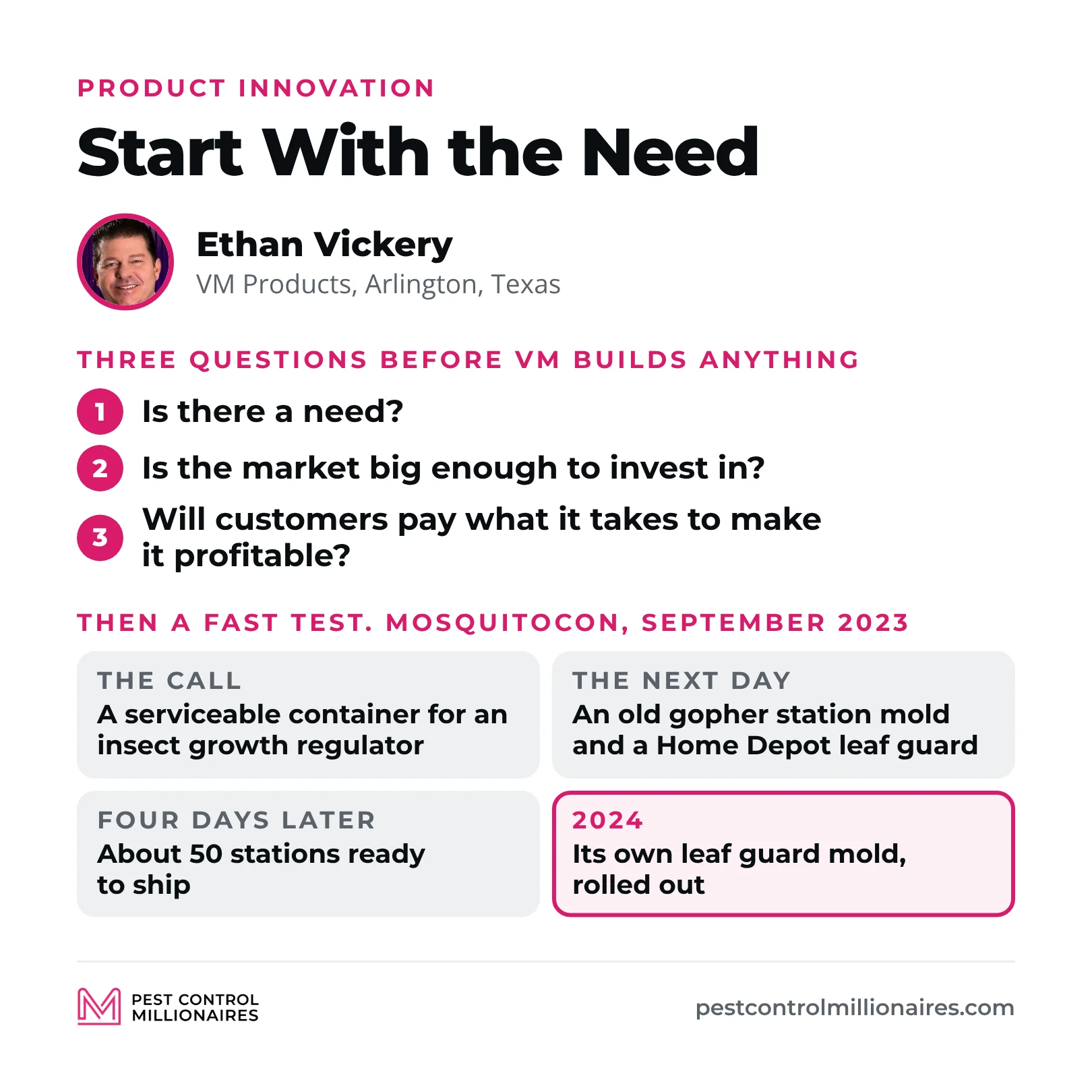
People used to say Ethan could sell ice to an Eskimo. “A great salesman can sell ice to an Eskimo once, maybe twice, but in the end people don’t buy what they don’t need,” he said. Everyone at VM is trained on three questions. Is there a need? Is the market big enough to invest in it? Will customers pay what it takes to make the product profitable? Then innovation has to be fairly rapid, so you find out fast whether it works for the customer and for VM.
MosquitoCon is the best example. One evening in early fall, someone in the industry called Ethan. “I just need a water holding container receptacle that I can put an insect growth regulator in. I need it to be serviceable. I want to put my name on it,” the caller said. The next day Ethan pulled out an old gopher station mold VM didn’t use anymore and sent Mike to Home Depot for a leaf guard to cover the hole on top. It fit perfectly. They riveted it on, and four days later they had about 50 stations ready to ship. That was September 2023, with cold weather coming, and the point was a quick test before spending real money.
The feedback came back fast, so VM built a leaf guard mold and rolled MosquitoCon out in 2024. When we recorded this, it was being sold all over the United States and put into programs. “It’s great for organic growth,” Ethan said, and mosquito is one of the fastest growing categories. I go deeper on selling more to the customers you already have in my guide to pest control upselling and cross selling.
Some ideas wait for their need. VM tried to put color on its stations years ago, didn’t have the horsepower, and put the idea on a wall of ideas at the plant. Then customers in the Pacific Northwest needed active ingredient information on their stations for state documentation. Now a robot places a full-color label in the mold, so you can put your own logo on the station the way Travis has Nice Pest Control’s blue on his. “You can scratch it with a knife, but to get it off, you actually have to cut it out,” Ethan said.
He’s not selling, because he’s just getting started
Most companies VM’s size aren’t founder-led anymore, and private equity has asked to buy VM. People ask Ethan twice a month, if not once a week, “Ethan, how do you sleep at night?” His brain is always on the next project. “I have to have something to do,” he said.
He’s been financially successful, and he isn’t a consumption person. “Consumption consumes you,” he said. His win is growing the business, the people in it and taking care of customers. His grandfather flew an Avenger for the Navy in World War II, had Parkinson’s, and still went to the office until he was 90. That’s Ethan’s plan too.
“I don’t see a scenario where I feel good about selling VM,” he said. He loves what he’s doing, his kids love the company and so do his employees. After 23 years, “I feel like I’m just getting started.” When I asked what he’s most proud of, he didn’t even blink. His kids. Same for me. That’s living your movie.
Frequently Asked Questions
Who is Ethan Vickery?
Ethan Vickery is the CEO of VM Products, which he co-founded about 23 years before his PCM Podcast episode came out in May 2026. He grew up in Lubbock, Texas, and sold rodenticides for Bell Labs before he started VM with an easy-to-clean bait station he first drew in crayon.
How did VM Products get started?
A friend Ethan had made at Bell complained about how hard his bait station was to clean. Ethan drew an easy-clean station in crayon at a Macaroni Grill, wrote a business plan, and Danny Myers offered to start the company with him, even though his own banker, attorney and accountant told him not to.
How does VM Products decide what to make?
It starts with need. Everyone at VM is trained on three questions. Is there a need, is the market big enough to invest in it, and will customers pay what it takes to make the product profitable? Then they test fast. The first MosquitoCon stations were an old gopher station mold with a Home Depot leaf guard riveted on.
Will Ethan Vickery sell VM Products to private equity?
Not by his account. Private equity has asked, but he doesn’t see a scenario where he feels good about selling. He loves what he does, his kids and his employees love the company, and after 23 years he feels like he’s just getting started.
Full transcript
Every word of the episode, from the video captions
Building the business turns you into a different kind of human being. Realize that failure is a part of the journey. I think there's hope out there for all of us. They say procrastination be [music and singing] the assassination of destinations. That's why we out here grinding with no association. We'll hate us then them other crabs [music] trying to put us down. Pest Badger in the house, boy, don't clown. Welcome back to another episode of Pest Control Millionaire. I have someone very special on the podcast today. Really excited about this. Actually our friend Travis put this together. But we have a pretty big player in our industry, which is really cool. We don't have people that sell products every day on here. It usually just kind of goes against what I believe in. Like I don't sell you know I don't pitch people my you know people products, but I love what you guys are doing. I love the innovation that you guys are bringing to the pest control industry. And Ethan Vickery, welcome to the podcast, man. How's it going? I'm doing great.
Doing great. Happy to be here. Thanks for having me. I'm honored to be here. It's pretty cool. It obviously you're the owner founder of VM Products and you have a lot going on. But I always start the podcast out the same exact way cuz I just love to see what people's backgrounds were back in the day like where they came from, what their parents were like, what you were as a young adult, and what that turning point was for you to go from being you know a young kid whatever that may be into an I love the journey. I love the come up. We all go through a lot of struggles. But if you and I are sophomore, junior in high school, who's Ethan then? Oh boy. I don't think anybody really wants to know. I think we do.
I don't know. I you know I told my story at Bug Bux. Alan had asked me, you know, to talk about failure. And so, you know, failure for me is kind of a learned event. It's you know, the way that my parents did things. My parents were divorced, but both my mom and my stepdad and my dad and my grandparents, they were very methodical post World War, right? Like they just they had their steps, they had the way they did everything and we owned my stepdad on plumbing, heating and air conditioning company. Also built apartments too as well and then my dad had a manufacturing company and then my grandfather on my mom's side who was really really influential in my life. He was actually a president of the university and a big research guy all over the globe. He'd consulted for like 55 different countries over the course of his career.
So, you know, even though as as he as you know, as I kind of got into my teenage years, you know, nefarious activities, you know, would happen. You know, I always kind of went back to the way I was raised, you know, steps, one step at a time, you know, how do you build something? And so, when I when I got into high you know, when I was in junior high, one of my buddies, this guy named Eric we did something we weren't supposed to do and his dad took upon himself to say like you guys have to be doing something besides just, you know, being on your BMX's. I don't know if anybody remembers a BMX, but like you had...
Yeah, everybody had that, right? So, you rode that thing as fast as you could with one gear as far as you could go. He said, you know, you guys are going to have to make some money. We're like 7th, 8th grade. I had like a Diamondback back in the day. Yeah, it was a Diamondback. Yeah, it was 100% Diamondback. That's what you had to have. So, had to have the Diamondback and so, he to the hardware store and he bought stencils and paint. And I remember we came in and it was all sitting on the table and both Eric and I had this stunned look on our face and we had no idea what was about to happen. And so he sold life insurance and his name was Dick and he sold life insurance and he's a great guy. He still is a great guy. And he said, "Listen, you guys are going to go paint curbs." And he told us exactly what we were going to do, what we were going to charge. He said, "You're not going to get in trouble. You're going to paint curbs." And so we started painting curbs and it's kind of how I started my door-to-door sales career, right?
We literally just knocked on doors Lubbock, Texas. Back then all the doors had the glass door first, you know, they had a lock on it. So you had to get past that barrier, right? You had the storm door. So you had to get past that barrier and we started we started selling you know, curbs and we'd paint the curbs your address on the curb and we had three different options. We would just paint the number and that was in white and black or we would paint the number and reverse it out and put Texas Tech in red. And then we had these glow beads which I don't know how really effective they were, but they were another dollar. So we could be three, four, five dollars. And so we started and lo and behold, man, we sold some curbs. And then all of a sudden there's some money in our pocket and like and of course we had to you know, pay for the materials. But at the time spray paint was like 39 cents a can or something. Like it was very affordable. And so you know, that kind of shaped how I started doing things from then on.
Like that was like I it my family always worked so I'd be on job sites. I understood how to work, right? And I understood the service business. But that was my first like introduction into hey, provide a valuable service, get paid, and have profit. And so that just stuck with me. Stuck with Eric, actually. Eric today owns one of the largest roofing companies in America. He's done, you know, really, really well. Kind of the same thing. Just, you know, taking his sales experience and you know, just, you know, both of us having a very you know, a will to win, a will to, you know, get something done. He did it roofing, I did it pest control. And I'm sure the door-to-door part of it is why he was successful, right? Like, I mean, selling roofs very similar to what we were doing when we were we were painting curbs. So, when I got into high school, I had a lot of great friends.
Still have some of those friends today from from elementary school, high school. And so, had a lot of fun, you know, I we played sports and I enjoyed that and we one of the things actually in Lubbock Lubbock is obviously known for, you know, the Panhandle. It's a big, you know, agricultural area, oil and gas area, Texas Tech there in Lubbock. And but there's actually there was a family there, the Malouf family, that had a really really high-end clothing store. And so, with the university, there was always a lot of style. And so, in high school, my buddies and I, you know, kind of during that time, you know, the Polos and the Girbaud jeans and the belt loops and the bomber jackets. And so, man, we were just kind of what you see, you know, that I on my social media, if I'm looking at Instagram, it'll show pictures of, you know, high school kids graduating 1991 and that's pretty much what it was.
Just, you know, I had a you know, gratefully an all-American, you know, life as far as, you know, friends and family and you know, going skiing in Colorado and trying to get a beach trip in the summer. My parents did a great job of, you know, getting us out there and enjoying life. And so, it was good. And then, you know, my mom and my grandparents and my dad and all said, "You got to go to college." So, then I graduated from high school and went to Hold up. Quick pause. If you're running a pest control company or fertilization weed control company and you're not in our Facebook group, you're choosing the harder path. Every operator that's in there is skipping years of mistakes cuz people are actually sharing what's working right now. So, stop trying to brute-force your way through growth alone. Search Pest Control Millionaires on Facebook or click the link below. And now, let's get back to it. That's pretty awesome that you were surrounded by a bunch of entrepreneurs at a at a early age that forced you like from being in trouble to go do something productive.
That's really cool. 100%. Like it was, you know, for every action there's a and I think that's you know, if you think back on just, you know, the you know, the American journey, the constitutional journey, the Magna Carta journey, like every everything happens from, you know, something that was learned. And, you know, that's the way I approach everything I do every day is that what will make us fail will make us succeed. And so, you know, the mistakes that we make are not necessarily permanent as long as, you know, they're obviously minor mistakes. And then from those mistakes, you learn how to make yourself, you know, more formidable, make yourself more sharpened, so to speak. And so, having those people in your in my life and around my life as a young person really shaped how I approached everything that I've done, you know, in VM and in other places too as well. So, I love that. So, you said you from there you transitioned to college.
You I think you said your grandpa was a professor. Did you end up going to his college or where did you go from there? No, he was president of Mexico State University in Las Cruces, New Mexico. And I had grown up in Lubbock and my stepdad had like stepdad also built apartments and that business had gotten quite big. So, my mom and my stepdad had moved to Arlington, Texas. And so, I went to Texas Tech my first year. And I you know, I guess this is part of my story. So, you know, I really did not pay attention to the part of college you're supposed to pay attention to, which is, you know, go to class, get good grades. Lubbock is a fruitful environment for having fun. And so, chose to have a little too much fun. And so, had fun. Still like I said, yeah, well, there's a whole lot of distractions. And that that's what...
Were the distraction. There is in college, for sure. So, I ended up leaving Lubbock and went to University of Texas in Arlington. And I met some, you know, phenomenal people. I joined a fraternity. And I met some some great guys, of which I'm still really good friends with today. Three or four of them live within a mile from where I live today. And we see each other on a very regular basis. And so, that ended up kind of the way it was supposed to. Made great friends. And that And that shaped my younger years in and excellence. And you know, framing my mind on how I wanted to start you know, my life and my career. And so, it was it was a good experience. Yeah, so is that is that where you say that your failure came in, that part? Yeah, I'd say so. I had a little too much fun. One of me and one of my that you hear the theme here, right?
Of having too much fun. So, one of my fraternity brothers we found ourselves having a little too much fun as far as, you know, just doing the fraternity thing and Greek life. And there's always something fun in Greek life. And so, we ended up I ended up My parents were really adamant that I started working and paying my own bills and learning how to take care of, you know, myself. So, I ended up getting a job working for Bose music speaker systems when I was in college. And that was just a complete gift, man. I was I was about halfway through school. I was 2 years into it, a little over 2 years, and they had their music theaters that they had put all over the country to take. Yeah, and so the Acoustimass systems, if ever anybody ever went to one of those theaters, you know, there would be, you know, I think True Lies was the with Arnold Schwarzenegger was the movie that we used the most. And you know, you get the Dolby surround sound, and you thought it was really big speakers, and then you would take the speakers off the wall, and then you know, it was the Acoustimass 12 system, and you know, I was a really good job at the time, extremely good job.
I mean, I was looking back on it and what I was making in, you know, it was it was an exceptional part-time job in college. Well, it was a $2,000 music system, and I guess I didn't realize that that was, you know, a lot of money to everybody that was walking into that theater, a lot of the people walking that theater. And I just I went to work every day to sell, you know, X amount. We had a commission plan that scaled up. The more you sold, the bigger the number was, you know, retroed back to, you know, system one. And so, the goal was always to get to that number. And actually, you know, through, you know, not not studying and not you know, not taking school seriously through that time, I actually met a guy that I'm still friends with today. His name's James Rogers. And he had a very successful business, and he had bought several systems, a dozen plus systems that were for clients and friends, etc.
And I remember I asked him one day, he came in three or four times. I'm like, "Hey, you know, can you know, can you teach me what you know?" And it's he just he goes, "Well, what's your schedule?" And I said, "Well, I have Tuesday afternoons where I have nothing on, you know, no school, no work." And he said, "Well, come in on Tuesdays." And so, I started going into his office on Tuesdays. It was close to the college he just let me sit there and learn. And he had I think at the time he had 400 nurse practitioners working for him or nurses working for him and he was managing nursing home, you know, billing. He had a whole, you know, he had multiple lines of services in health care and I just I sat and learned and listened to attorneys, listened to him, listened to, you know, P&L conversations and that really kick-started my desire to be an entrepreneur. Like I wanted to sit in his chair, like get a big office, you know, this is in the '90s and, you know, offices are still a thing today, but like if you didn't have a gigantic office in the '90s and you weren't successful, right?
So, he had this big office and I would sit on a chair next to the desk and I just thought to myself, man, I got to figure out how to be in that desk someday. And so, that you know, those failures I never give up and I still never give up. And so, those failures ultimately were were the, you know, the catalyst having to sit back and think about what's my life. My dad used to always tell me, "Live your movie." And took me a long time when I was younger to really get a handle on what that actually meant. And so, he would started my teenage years, you know, when you start thinking about life and, you know, what's life going to be and sometimes kids do and sometimes they don't, right? And so, but my dad wanted to make sure that I thought about how I wanted my life to be. And so, as as I, you know, continued into, you know, high school, college and he would keep saying live your movie, you know, I think about that that office with James Rogers and sitting there I was thinking about, what do I want my movie to be?
What do I want my life to be? And I wanted to be an entrepreneur and I wanted to be a successful entrepreneur. And so, that really was a big part of how I approached life, you know, going into my early 20s and thinking about how I was going to, you know, tackle this thing called life, which is, you know, not the easiest thing to do, as we all know. Absolutely. When you were at that age and you looking at your movie, are you living your movie today? Yeah, without question. And you know, what's really interesting is through through mentorship and so, James really mentored me and what I learned through mentorship is mentorship's a gift that must be re-given, right? So, as people mentor you have to mentor others. And so, I've really I take that very seriously. So, I've met, you know, a lot, a dozen high school kids, college kids, more than that that, you know, I've mentored and I stick with kind of what I've learned, I stick with my dad's thought process of live your movie.
And in that, I've kind of come up with my own way to mentor and also think about my life, too, as well. And so, you know, I've been you know, in mentoring situations where they're 18 or 19 or 20 and you ask the question, what's your movie? And they you know, there's always this kind of look on their face of like, what do you mean? What's my movie? And I said, it's real simple, like you want a life, right? You've already identified like, hey, I you know, I want to be married, I want to have two kids, I want to live in this house. I love, you know, I love my dad's F-250, like I love, you know, I love a Yukon. I'm a sports car person. I want to live, you know, in this part of town or I want to live in this part of the country. And my encouragement always is to back end you know how how do you how do you get to that point like each one of these things has you know some sort of financial commitment that you're going to have to make enough money to pay for He always asks always ask the question you know what's your spiritual life what you know what kind of friends do you want to have like think through that process how do you see that week and I encourage him to write it down get a binder and write it down write your movie down.
And it's a business plan right I mean when you think about businesses that you go ask for money when I asked Danny Myers them and VM for money I had a business plan that I you know 40 pages of what I thought it was going to take to get VM off the ground and you know it's funny as people we typically don't do that in our own lives and so I just you know I continued you know think about what my movie is you know as I go forward I'm 53 so when you're 53 and I have a 11th grader next year so that part of my life is nearing an end and you know I've got to think through what's the movie for the rest of my life and so but without question I've lived my movie and I'm grateful for that.
I'm happy for so you're sitting back and James Have you lived your movie have you lived your movie? I'm living it currently living it but also probably similar to you like I feel like I'm just getting started. You know and I mentor a bunch of young kids we got 150 some plus kids that you know 18 19 year olds that work for us too so constantly mentoring kids and what I love is like watching their journey and where they started to where they been in the next three to four last three to four years building houses you know buying new cars having families that probably what gives me the most fulfillment at this point in my career. Yeah I would I would say that that's probably the biggest gift that you can give, right? Like it's the one thing. Like what's the one thing in life that makes you happy? The one thing in life that makes you happy is the involvement in other people's And with that, you know, that passion for their success is ultimately your success.
And I and I think I love that about pest control. I love that about the pest control industry of you know, the companies that are successful, man, they believe in the people that work for them. And those those people are you know, rewarded by the effort that they put in their business and then the effort that the everybody around you is putting in. It's a it's a it's a fire wheel of being involved in people's lives and really truly wanting their I agree. And then you know, both are both girl dads. We discuss discuss that and discovered that early with the podcast and my oldest is 16, just had her 16th birthday. Being in position, like said, get her a new car for her birthday. And then watch her wrestle. She's a wrestler. She's killer wrestler. She's sophomore. She placed fifth in the state. Watching her succeed, watching her win at a young age and helping her with that. And my younger kids are super athletes doing gymnastics and dance.
So it's just been a really fun journey on that side of the world, too. So I couldn't be in a better place, honestly. Like feel like I'm very fortunate. Obviously, we both worked really hard to take a lot of risk. Probably some luck involved, too, honestly. Meeting the right people at the right times. Like we can't control But like we always say, the harder we work, the luckier we got in a way, too. And we put ourselves in positions to ask people for help. You met this guy, James I think you said his name, and he says, "Hey, I really like I really want to be in your position. Like hey, can I learn from you?" And it's simple things like that what a lot of people aren't willing to do. Like they don't want to ask for help. Or if they do ask for help, they don't have that person around them. So again, I think a lot of luck plays with us, too, you know?
Like, you were born with parents who are entrepreneurs. I was born with grandpa who was an entrepreneur. They pushed us to go to these things, and some people just didn't have that opportunity. Not that they can't make it, but I feel like I was blessed, you know? Yeah, 100%. Well, and ultimately, I try to be really present to the people that show up in my life, you know, randomly. Could just be, you know, at a restaurant. It could be, you know, here at the office. You know, that's, you know, a UPS driver. Just anybody who's, you know, pay attention to the people who show up, and be present to what their needs are. And sometimes, you never know, man. I've got two employees that are great people that, you know, that started with one of them that I randomly met working in a grocery store. And I'm like, you know, hey, it's Spencer Rutledge is his name. A lot of people in the industry know him. He's a PestWorld all the time. And fun fact, I literally was asking him about something at the grocery store, and I saw him again maybe, you know, 2 months later.
And I thought, you know what? I like this kid. And we started talking, and he went to work for us. And same thing. He's, you know, he's learning every single day. We have high expectations. He's been with us for, well, like 10 years now, 8 10 years. And in that time, he got married, and now he has, you know, he has a baby, and, you know, he's he's living his life. And he's learning how to live his movie. And but that only happens if he gets out of bed. So, he's got to get out of bed every day and understand the and then execute on those expectations. And yeah, so it's a great it's a great part of success is being able to give back on that on that level. I agree. So, we're go we're going to turn back a little bit to go to James's office. You used to get to sit with him a lot every Tuesday, learn from him.
Wrist it off your entrepreneurial journey. Where do you go from there? And you're still young at this age, in Yeah, so I mean, we, you know, while I was in college, I was an entrepreneur on some level. I mean, me and I mean, kind of a classic '90s stuff, like me and my roommate had a DJ business. You know, anything we could come up with to make money and so and then I get out of college and one of my buddies that I'm still really, really good friends with today, we talk weekly and see each other all the time. He's like, "Man, you had a really good job in college. You should get a recruiter." And which would not be, you know, we did it we were not, you know, put in a situation we didn't have an engineer I had a marketing degree. We weren't engineers. People weren't looking for us, right? We had to figure out how to make our own destiny. And so I got a recruiter and she says, "I got a job selling And I'm like, "What's a rodenticide?" And she goes, "It's rat bait."
And I go, "I will never sell rat bait."
It's so crazy to me how like how our journey almost finds us. Like I didn't go out searching for pest control, either. Either did you. No, I didn't. I mean, and all my friends were in health care. So they were all going into like, you know, that was the job to have, right? You wanted to work for Medtronic or GE or something like that. And so and so she tells me kind of what the package is and it was a it was for my age and where I was at in life, it was a great package. And then I had a cell phone, had a eight-state territory, expense account. And the icing on the cake is it had a Pontiac Bonneville. Nice. Those were the best. Those things were fast, too. It was great. A V8 in those things? Four-door Pontiac Pontiac Bonneville and so I said, you know, "What's the company?" And she said it's Bell Labs, which obviously everybody in this podcast knows who Bell Labs is. And so I said, "Well, I'll interview for that job."
And so I went and interviewed for the job and I got the job. So it was it was to your point, somewhat luck. I did put the extra effort in to get the job and I got the job and had a eight-state territory. Phenomenal experience. And one of my buddies that was in he said, "Hey, there's this job that I think you should apply for." of course, now at this point I've worked for Bose music speaker system. I've worked for Bell. Both, you know, great manufacturers with great processes. And he so one of my buddies knew of a job that was opening up at a company called Sage Products. And so, I went and interviewed for this job. The manager, great guy and we went through one interview and the second interview, I remember he asked me, he goes, "Are you a team player?" And I without hesitation, I just said, "Well, that depends on who's on the team." And he started laughing. He goes, "That's the best answer I've ever gotten to that that question." He goes, "I think I'm going to move you to the final and I ended up getting that job.
And I left Bell and they had invented sharps containers. Guy named Vincent Foglia, had invented sharps containers. And the early sharps containers were basically parmesan cheese graters, where you broke the needle off on it. And during that time that he had done that, you know, the AIDS epidemic had had really broken out. And before that, there was no real good way to, you know, get rid of these needles. And so, he started that process and invented the teeter-totter system that people think of today. And they had sold the business to Tyco and kept a big chunk of it. And that left an open position in where I was living, which is basically Fort Worth. And so, got the job and went and sold into hospitals. They had package bathing, that's some equipment, that's oral care products. So, you do medical sales? Medical sales, yes. And they were an company. Very exceptional in they did. So, now I'm my third manufacturer that is really, really good at what they and learning every single day from, you know, great people in their marketing department, their manufacturing, they had a great culture and how they fostered innovation and I learned a lot from that.
And so, I'm doing it for a couple years and you know, healthcare, especially hospital, you know, being in the hospital, which is what we were it's something you either love, you're passionate about, or you're not. And I just wasn't passionate about it and I think because I grew up in a service business, I mean, my stepdad made me get on a plumbing truck when I was in the sixth grade in the summers and, you know, get it get, you know, tools and shovels and, you know, the service industry was just kind of calling me back in some way. I don't think I knew that at the time. And so,...
I just had this intuition that I wanted to start a company. I wanted to come back to pest control and so, I started looking for opportunities and ways to do that. And at the time, one of the AIB was really coming on strong, not that they hadn't been, but they were really coming on strong. And their their number one thing was the stations need to be easy to clean. And you know, I'm a people person, I'm a friend person. Like, you know, if you anybody who knows me knows how much I, you know, cherish my relationships and especially when you work hard to earn those relationships and the trust that goes with that. And so, I still was talking to people and, you know, I'd stop and have lunch if I was, you know, if I had a meeting in the hospital, you know, hospitals are not, you know, you don't really have lunches in the hospital setting, right? You're eating in the cafeteria at the hospital or you'll have a couple hours where you're, you know, have nothing to do or not saying nothing, but you have, you know, paperwork to do, whatever, but you're not in the hospital.
And so, I remember I stopped in to one of my buddies that I'd made friends with at Bell, and he's sitting at his desk. I stopped into his office and just to say hi. Hey, it's good to catch up. And he was complaining about how it was hard to clean his bait station. And the light bulb went off in my head that this might be an entrepreneurial opportunity. And so, that started. Now, it was some weeks later I did a little bit of research and I'm at a Macaroni Grill having lunch and I take a build-your-own pasta piece of paper and one of their crayons and I draw out what I deemed to be is the first bait station, which is the EZ Klean, on that piece of paper. It's sitting in the front when you walk in to the office. I still have it today. It's framed and that was it. So, then I wrote a business plan and presented it to several people and one of them actually happened to be private equity. And the private equity guys owned an injection molding facility and played it up something for me that was very palatable. Danny Myers, I'd made really good friends with him when when I was working in the territory I was asking for his advice on what he thought.
I mean, Danny was always a savvy entrepreneur, knew the industry really well, was well known throughout the country. And so, I was asking his advice on you know, what he thought and then I'm you know, I was asking, "What do you think about this private equity?" And he looked at me and he goes, "I think we should do this together." And I'm like, "What?" And like I really didn't think he was the one that was going to want to do it. And so, we I said, "Okay, great. Let's do it." And the funny thing I like to tell people this story, so Danny had really good advisors, great advisors which really helped VM be successful in the But he had an attorney in a room that was his attorney guy by the name Ed He had his accountant, guy named Reggie Parr, great accounting firm. He had his banker, Chris Strieder. And we're sitting at a conference table. And all five five of us are sitting there.
Me, Danny, and his three his three people, right? His banker, his attorney, and his accountant. All three of them are telling him not to do it. They're all three of them telling him not to do it. And I'm sitting there, I'm like raising my hand, I'm like, "Hey, I'm sitting right here." Like Yeah. It's like Dumb and Dumber, right? Like, "Hey, I'm sitting here. I'm right here." And so he's looking at them and looking at me and looking at the paperwork and yeah, he's like, "I want to do it." So he signed the paperwork and we started and it was it was a great journey and Danny was really good at business, but I think one of the things that, you know, is that I think about most and he unfortunately passed away two years but when I think about Danny, what I think Yeah, thank you. Great great guy. What I think about the most when I think about Danny now is just his his ability to mentor and be present to people.
And without him in my life, you know, I really don't know what not just VM would have looked like, but Ethan Inc. Would have looked like. So, you know, and he grew his business, he sold it, did quite well, invested in other things after, you know, he sold the pest control company and very successful and I learned a lot, but I learned more about life than I did business from him in the end. So And that's it. We started VM and it's been a 23-year journey of ups and downs.
Through that journey. There's a lot like drawing on a piece of paper to your first molding, like talk like I'm I want to hear all of it. Yeah, so you know, the thing about this business, especially on the manufacturing side, you know, trust is very it's not easy to earn is the best way to put it. Like on the pest control side, obviously, you have to earn trust, but it's There's a There's a need. Somebody had a fire ant mound. You know, somebody had a rodent problem. You know, there's Hey, something needs to get fixed. You know, you have to have good people get in front of that customer. In our side, you have to on the manufacturing side, without question, you have to get in front of the But, if we don't do our job, then your job is not done properly, and then that affects your relationship with your customer. So, people take that and you know, when the pest control community when they look at who they're buying from, trust is almost everything, right? Do you trust that they're they're the quality, the thought process, the science, you know, every You're checking boxes of things, delivery of product, not running out of product.
There's pieces of the checklist on the pest control, the PMP side, that are absolute must. And so, when you start a manufacturing company in our business, the first 5 to 10 years, that that's what you're spending most of your time doing, right? There There's examples of people knocking it out of the park with something new and unique that is, you needed that nobody could figure out how to do or they just didn't think about. But, for the most part, when you look at, you know, who most people's chemical rooms, you know, the manufacturers in their chemical rooms, they can point to why they trust that company. And so, you're you are building trust in the beginning. And in our case, because we had no experience in actual manufacturing, it go back to Danny's you know, accountant, attorney, and banker, they were probably right. You know, that's Go back to being lucky, right? So, I was lucky that I found the right guy that just wanted to be a part of it.
So, you go figure out how to manufacture early on. It was funny, we sent some stations to the Midwest and Jim Delaney, who was at Van Waters and Rogers, I think it was Van Waters then or Vopak, maybe wasn't Univar, and not Veseris, and he put he put one of our original stations outside of his office. And, I get a picture day later emailed to me and it's the bait station's broken like seven or eight pieces, right? And so, we did not have a cold weather bait station. Go back to never giving up. So, I'm like, okay, note to self, sell product from Southern California to Florida. Don't go don't go north.
Make sure it's always warm. So, that's how we started and I actually had a really good friend of mine, still friends today that, was on the PGA tour and he came out strong, won one events, was top 10 every week, on Ryder Cup teams and so, I just I my sales strategy was to follow the PGA tour and, you know, go out to events, with people some point during the week, sell during that week. Great guys. Caddy's a great guy. I'm still really good friends with his caddy today. He's in title business now and, Chad's on the senior tour and they would let me stay in their house, like, you know, cuz we didn't have a lot of money. And so, you know, it was it was it was sleeping on couches, doing whatever it took to get in front of a customer, and sell product. And so, then somewhere along the way, I really had, had a an aha moment of at the time everybody was buying bait stations and they'd go to Home Depot and they'd buy a patio block, and then they would bring it back to their office and they'd either rivet it, or I say rivet it, screw it in.
They would set the block, they would screw it in and they would do liquid nails. And I remember thinking to myself, man, if I could put those two things together and ship it, I think I'd be onto something. And so, got lucky, couple of family friends that were were in different businesses. One of them was in the concrete piping business. Was a VP of operations for Hanson, which is now Ranker, I think. But it's one of the kind of industrial pipe concrete pipe companies in the world. And then my good buddy Kelly Stites Greg Minter and Kelly and Kelly owns Champion Shuffleboard and American Dynamo Pool tables. And they had an opportunity to get into kind of a lay down concrete business. And so they did it. And they just literally took some land across the street from Kelly's Shuffleboard plant and they started making grade rings for parking lots.
And along the way they decided to buy a block machine. And you talk about luck. This was luck. And so they buy a block machine because they had a couple of customers and they had another buddy that had a need for a product that a block machine would make. I'll never forget I was at the Texas Rangers opening day and they walked up and all my friends are hanging out and you know, there's like 15 of us and doing what you do at an opening day and we're cooking hamburgers and playing washers and they walked up. We start talking. Just hey, how you doing? It's great to see you. They're older than I am and so I they weren't my normal circle, but we saw each other fair amount. And they like, hey, we heard you need a to make a concrete block.
And I'm like, yes, I do. And they said, well, you we you may be in luck cuz we just bought a block machine. What was important about that luck was two things. If you look at like your paver stones, they make more blocks than I could afford in a in a minute. So like meaning I didn't have a market for it. So like they can make 50 blocks a minute or whatever their cycle time was. Why I had no customers. So there was no way that I was going to go buy you hundreds of thousands of dollars of blocks then try to figure out how to go sell it. And then the other part of it is this tensile strength of the majority of that concrete is different than what I needed for our process. So, by them building a concrete block and having such great experience in very durable concrete, I you know, pipes underneath the ground, grade rings, they started out and they just kind of helped me walk to it. Greg Menteer, who runs that business on a daily basis and knows concrete, it is you know, he's got a really good mentorship attitude about him.
So does Kelly. And they just they allowed me to be in a process of learning how to make the concrete block, to attach it to a bait station, and ship it. And when we finally figured it out, I can remember where I was sitting, and I had the product, and I'm like, "Wow." And that was it was a euphoric still gives me chills now That's giving me the chills. So cool. As it defined it defined my future, and it defined ultimately my children's future, right? The so we make a plat we make a pallet of product, maybe, you know, say we make four five pallets of 60. It was funny when we first we had the bait station, and we had the concrete block, and the layer of 15, if you've ever bought one of our secured products or now our MosquitoCon product, there's 15 per layer. So, sitting outside this office I'm in right now, we're actually moving to a new building in about a month, a lot more space, and a lot more of technology in it for molding.
But we're we're we're I walk outside, and my engineer at the time his name was Larry, and we had made like 15 or 20 of these stations. So, he's like, "How are you going to ship these? We putting these in a box, or what are we going to do?" And I'm like, "Man, I got no idea." So, we take and we put 15 on a skid and they fit perfect. And so, I was like, well, at at that time, you know, most people bought like eight to 10 cases on a order of rat bait stations. So, we got 60 bait stations kind of as an average order. So, we stocked them up times six and he's like, well, we're not going to make any money if we only do is send 60. So, then we started stocking them up to see how high I would get them. And that's how we came up with the pallet configuration and we started shipping them to people early on. I say people, just people to look at it, test it, and play with it, and I'd say non-pest control people.
So, the PMPs, 10 out of 10, this is a brilliant idea. Logistics people were like, eight out of 10, where this is a bad idea. Right, I'm shipping concrete. What it end up being was freight, especially then, was broken down into two categories, nuts and bolts and a concrete block is nuts and bolts and a bait station is a pillow. And if you put them together, they effectively made perfect freight, at least in our format. And so, when we stocked them up and put them on a truck, as it turned we ended up with a percentage of freight cost being less with our secured product than it was our non-secured product. And so, we were able to ship it. We had some learning lessons, some things broke along the way, you know, some pallets fell over. I mean, there was definitely not without failure. And then, that was it. And once we started the secured category, it just changed rodent stations forever and we just we stepped on the gas and it's been a great ride ever since. That's really cool. And then you have and you have a you have a bunch of products now and you move it in, you know, cuz it started with podcasts and you've really been innovating and it's probably hard to be innovative in this industry.
How do you come up with the new what kind of products do you have in today that you're really really excited about? I know I've seen some that are coming out that are really cool. But how do you stay on the forefront of that? So, you know, product innovation is about need, right? So, what when, you know, when I was younger and I was, you know, selling anything I was selling early on, the old adage of hey, you can sell ice to an Eskimo. And that was said about me, you know, several times. And, you know, what I learned through the process of working for great companies that had valuable products is a great salesman can sell ice to an Eskimo once, maybe twice, but in the end people don't buy what they don't need, right? So, you first have to identify need. And that So, that everything in innovation is about need. Market is very important.
Obviously, you know, I here's something the customer needs. Is there a big enough market to actually invest in that need? And then are they willing to pay what it's going to take to be profitable for that product for the need? And so, we basically I've trained everybody at VM to understand those concepts. So, as we look at innovation, innovation has to be on some level fairly rapid. You have to move pretty quick to figure out whether there's going to be a, you know, an end result that that is going to be beneficial for the customer and for for VM. And so, we always start with a need. And I think with with you know, the way that we, because I'm accessible with with people in the industry that know what the needs are, I tend to get phone calls. So, for example, with MosquitoCon, I got a phone call and it was very specific and it was like hey, Ethan, I just need a water holding container receptacle that I can put an insect growth regulator in.
I need it to be serviceable. I want to put my name on And it was it was actually kind of This he calls me up and it's like 6:00 he's like, "What are you doing? It's beautiful time of the year and what are you doing? It's late fall or early fall." I'm like, "I'm sitting on my porch." And he goes and I go, "What are you doing?" He goes, "I'm sitting on my porch." And I and I'm like, "Well, is this a redneck joke or what? Like what's up?" And so he's like then he tells me he needs this water holding container and I said, "Well, let me go to the office and see what I can do." And went to the office the next day. We'd made a gopher station long time ago. Gopher Gopher stations need they're meal bait that goes in it and they need mass. So it's a it's like cereal, right?
And then you need 3 lb of it needs to go in there. So in order to do that, we're going to take our platform and we closed the entry holes for rodent. And we went and went into my engineer's office, Jay's office and I said, "Hey, I need to turn this into a bucket." And there was a hole on top and we had drain holes in the bottom. And he said he goes, "Well, I can I can we don't even use that mold anymore. I can put it in the tool shop and get rid of the drain holes in the bottom. But what are you going to do about what are you going to do about the hole on top?" And Mike Hovis who is wears Mikey, a lot of people seen that on social media. And Mike's kind of the knows where everything's at in the office. We've saved parts for decades. And so he's always with me in the in the And so Jay goes, "What are you going to do about the hole?" And I go I go, "Mike, go to Home Depot and buy a leaf guard." So Mike goes to Home Depot, buys a leaf guard and lo and behold it fits perfect over the hole.
And we rivet the leaf guard to it and 4 days later, we got about 50 stations we're going to get out and ship. And this is in September of '23. And so, I wanted to do a quick Remember the speed thing, right? We're running out of time. It's getting cold. So, wanted to see if there's any merit to spending money on this. And lo and behold, we got enough people playing with it that we got an immediate feedback that this probably is something that we need. And so, we built a leaf guard mold, rolled it out in '24, to tweak it, found partnerships, found you know, found a the right people to play with it, test and you go back to being lucky. That might have been one of the luckiest phone calls I've, you know, I've gotten in a long time. That I wasn't wasn't on my radar screen of, you know, what, you know, this is something that the industry needed.
And now MosquitoCon, which has become MosquitoCon, now MosquitoCon is becoming, you know, a brand standard in our industry, and is being sold, you know, from from left to right in the United States, all all over and being put into programs. You know, what we like to say is, you know, it's mosquito your way. It's a tool that you use along with the other things that you're doing. It's great for organic growth. Everybody in our industry is looking for organic growth today. Mosquito is one of the fastest growing categories, and we just gave a nice tool that use in the program that the PMP partners we have create for their customers, and it's been been really good. So, that's an example of how we innovate. I can keep going on and on. We have our that we're rolling out.
And that came from a Caribbean island that has some cruise ship stopping at it. And they have a migratory crab that goes from the middle of the island to the to the beach, lays eggs, goes back to the middle of the island and dies. And it's the little red crabs that you see on social media covering the roads. Well, when they die, all the carcasses become, you know, a fly breeding ground. And so, I get this I get this statement, "Ethan, we don't have anything to treat flies in the middle of a forest." And it just got my brain going. And a week later, 2 weeks later, my girlfriend and I are in Santa Fe, and we're riding horses, and we're at the stable, and I'm looking at these horses, and they've got, you know, stuff over their eyes, and, you know, the flies are awful. They're everywhere. And I just I remember thinking, "Man, there's got to be something better."
We had made the FBS years and years ago, and it's a good product, our fly bait station. It's, people have asked for changes. We've been busy with other things. And but we dug into it, and that was September of last year. Theme here on September. And I knew that if we didn't go quickly, we wouldn't be able to order the tools and have products ready, for, you know, the fly season this year, so we could get it out to people, get into their programs. And so, we did it. So, we are going to be sending samples out soon, probably an email going out in the next week or two on, you know, samples of the product, and we're starting to take orders, so, great It's a great product. I'm excited about it. A lot of people very excited about it, so, yeah, we just we just keep working on it every single day and listen to the customer. In the end, it's all about what our PMP partners need. I mean, there's no point in making something they don't need.
Yeah, I agree. And then I know but you mentioned earlier, too, when we were talking about Travis in the beginning about his bait station being in full color. Like, how did you guys come up with that? Where did that idea come from? It's super cool and it's very innovative itself. Yeah, so we've not had, a colored private label. We've always had an in-plastic. There's been a need for it. We've worked on several different of you know, ways to you know, to do Kind of go back to you know, what we talked about early on in this of...
You know, working. So, in the summers when I was in my dad's house, he lived in Sedona, Arizona and yeah, it's a great spot. And he lived there OG like when it was still all cowboy and you know, there was country bars and you know, now it's completely different but he was working for a guy that was that working on in-mold graphics and it started with rotational in-mold graphics for surfboards. And so, we went I was I was in this guy's name was Scott Stevenson invented this in-mold graphic process and my dad was doing work for him. So, I was in and around what he was doing. I remember he had he was mad scientist and he had this rotational molding machine and he was trying to mold the graphics into things like surfboards and kayaks, things that you know, you didn't want the graphics to scratch.
And he was very has been has been extremely successful with it. And I never forgot it. So, you know, when we wanted to do color years ago like we tried to do it. We didn't have the horsepower at the time to do it. And so, then we looked at doing screen printing. We looked at actually lasering it into the plastic and we let it go. It just sat on the shelf. If anybody ever does a plant tour, we have this wall of ideas that we've put on the shelf that we just haven't finished. There's some great stuff out there that at some point we'll probably you know, make one of these products or a dozen of these products that we started with that we just didn't vanish. And so this was one of those And we had some customers in the Pacific Northwest that just had to have it because of the documentation requirements at the state level of active ingredients, etc. And I just said, "Okay, we have to figure this out." And so we I got on the trusted Google and I started Googling.
And so the in-mold graphics is for rotational molding, not so much injection molding. And so I defined one for injection molding. And so I found somebody to do it. There was a company. And most of those companies they're not looking for one-offs, right? They don't want a couple thousand a year, 5,000 a year, 10,000 a year. They make, you know, they book out for Maytag the instructions on the washing machine, you know, 1 million of them and they book them out a year in advance. They run them, you know, etc. Like that Think about that's where most of that product's going. And so we had to work with them to for them to understand the opportunity. I had to fit it into our our business model. But most importantly, we had to get it into the mold. And that is the most important part of the in-mold label. So what we're doing The technical name for it's in-plastic label cuz we take a full color label and it's it looks a little bit like a punch card that old-school punch cards in rodent stations, but it's clear and it has your it has your label on it.
Or clear. It's got It's a card that you can put in the case of Travis. He's got the full blue on there in Nice Pest Control. And so but the difficult part is you have to then put that in a robotic automation that will put it in a place where the robot can pick it up and then put it into the mold. And then it actually molds the plastic molds over the label. So it's molded in the label. It will be there forever. So, it's something that, you know, you get you get a couple really great pieces out of it. One is you get your label or excuse me, your logo your way, right? Whatever your brand is, that's your brand standards, it's going in the private label. And then, if you have defined information that's important to you that you don't want to be putting labels, stickers, you know, that are peeling off, coming off weather, humidity, etc., it won't because it's in the plastic.
You can scratch it with a knife, but to get it off, you actually have to cut it out. Like, you can't get it off without cutting it out of the plastic. So, we worked on it for some time, worked on the process, and it's funny cuz Jay, my he's got a big whiteboard and it's got like a stick figure, you know, putting the label in there and it's there's a there's it's there's automation and the label gets taken inside the cage and then the end of arm picks it up, puts it on, puts it in the mold and like we really struggled early on working with automation companies cuz they were really built for, again, Maytag, you know, built for people who were doing very very large projects and it wasn't very specific to what we were doing.
So, I give credit to Jay and in the effort that he put into finding something that worked in our operation and we've done that and it's been very successful very quickly. So, just another piece that we're working Yeah, Austin, congratulations. Couple of selfish questions for myself. You run a very [clears throat] successful company, it's big, lots of volume, lots of revenue. What does your day-to-day look like? I know you're a super busy guy, so what does that look like? So, I wake up, go to the gym, and then I come back to the house. I get to the office and you know, my normal kind of thought processes is pace. So like what's the pace of what we're doing like whether that's you know, orders customers business. If I know certain customers have you know, initiatives that I'm always looking at you know, are we doing what we need to do to make sure their initiatives are are taken care of as it pertains to being products. From an innovation perspective because we always have things going on. You're looking at where we at today like if there's somebody testing the product where has that testing gotten to if we're building a tool if it's a molded product or building a tool, you know, what's the you know, what's the progress of the tool, you know, air zonics was a really hard product to make the oils and the plastics and you so it's following the steps.
Ultimately innovation in its in its most simplistic form is building a house, right? So if you've ever seen a house being built, you know, some get built really well in a timely manner and some take forever to build and the ones that get built in a in a timely manner and build well, they're everybody on the job site is doing what they need to do in a timely manner understanding that if you don't get something done on Friday and Monday's a holiday, you've lost a lot of time. And so most of what I'm doing is time management working with my team of a great team from top to bottom, you know, working with my team on expectations of you know, whether it's 3D rendering for advertising, whether it's you know, you know, some advice of standard operating procedures like for the MagnaFly or for MosquitoCon, like what if people are asking us questions, if that's not for us to answer then you who are we going to help them reach out to answer those questions, finding that information.
We pride ourselves in service. So, if I if I could say what most of my day is understanding what's going on, understanding what the need is, and making sure we're executing on that. And then we also have the travel activity, you know, doing doing shows, events, legislative day, PestWorld, customer events. That for me is not quite as busy as it used to be, but that's still, you know, two, three weeks a year I'm probably going or year, two, three weeks a month I am going somewhere to try to accomplish something with a customer or at some event. So, and then, you know, you get done with that and go for a walk, have dinner, start over, try to have fun on the weekends, play some golf with some old friends, and yeah, so that's what it that's what it looks like.
That's cool. And then, you're again, really large company, and most time they're they usually not founder-led still. They usually got swallowed up by PE along the way. I'm sure you've got hit up by PE a lot. How did you How were you able to stay away from PE? And what's the future like for VM? Yeah, so the easiest way for me to answer that is I mean, obviously PE people asked to buy VM products, strong brand, strong portfolio. But the easiest way for me to answer that is I get asked twice a month, if not once a week, "Ethan, how do you sleep at night?" Cuz my brain is always moving. I'm always working on this project and that project. And so, the easy answer for me is I have to have something to do. And I've been financially successful. I have what I want.
I definitely like what I like, but I'm not I'm not a consumption person. You know, consumption consumes you basically. And you know, for me consumption is not when I say consumption, you know, I don't need more necessarily [clears throat] what I have today, right? Like so it's for for me my win and my success is, you know, growth of the business. It's the people in the business. It is taking care of the customers. And I really I have to have a place to go. My grandfather, my mom's dad retired from Mexico State in 1984. He had a robust consulting business that was for range and land management that he consulted with countries all over the world and the university found value in that and they gave him a very nice office with staff. And he continued to do that till the early 2000s.
And he did not die. I think he died in 2006, 2008. And he literally worked until he couldn't work anymore and went into an assisted living. And that was only because he was in World War II. He flew an Avenger, a bomber for the Navy and he fought the Germans and the Japanese. And so he flown missions in both theaters of war and there's a lot of stress on your body landing those airplanes and he had Parkinson's. But he was completely mentally acute at 92. His body just stopped working and he went to the office until he was 90 years old. And I think about me and like I don't...
Yeah. Right. It's for me that's my plan. So I don't see a scenario where I feel good about you know, selling VM relative to the fact I love what I'm doing. My children love the company. My employees love the company. I feel like we're just getting started and I'm feel like I'm just getting started. So after 23 years, wow, it took all this time. So. That's amazing. You bought a pestle. So, I'll just mention that. I know your VM's one of our main sponsors for the pestle toss. That's really really cool. Thank you for that. And then I heard some talks about maybe some food truck concept. What where did I hear that come from? We have to we have to get it done. There's no guarantee we're going to get it done. Let's be clear.
Right. So, on the food truck, I was at Bug Box, which was a great event. I really enjoyed it. We'll be there in San Diego. With Alan. We'll be in San Diego next year. I'm excited to do that again. But as as one of the speakers, Tyler with with Nice, it turns out he's been friends with Diesel Dave since college. They hiked Europe together or backpacked Europe together. And so, when when we got done with dinner the first night at Bug Box, we went and hung out for a little while afterwards. And I started talking to Diesel Dave. And if anybody's ever talked to Diesel Dave, he's maybe we were just brothers from day one or he's the easiest guy in the world to talk to. Maybe a little bit of both. But we hit it off. And we just started talking about what he's passionate about, the business that they have, you know, building, you know, you know, really unique vehicles.
I think they just did a Zamboni for the hockey team in Utah. And so, it was really really cool. He showed me pictures of that. And we've been actually looking for doing something with a food truck because I hired Richard Cruz about 7-8 months ago. And Richard came to us, been in the business his entire life. His mom was actually an inside sales rep for Vopak, Univar, etc. Way back in the day. So, he's a pest control guy through and through. But he's also big into barbecue. And so, he has actually been to Kansas City the last 3 years and that's the best 750 in the world and I think he placed top 50 last year. And so we got we got a VM sales and technical guy that is a is a phenomenal barbecue guy. Like we got to leverage that, right?
Yes, absolutely. Richard and I have been going through, you know, looking at different options and you know, in the world that we live in, the certified education units and consistent shows year in year out, there are opportunities obviously to be to be at a show and you know, have some connectivity to customer, give some value to the customer, have fun with the customer. And there's, you know, Nisus has done it for a long time. Harry's been really successful with that. We don't want to steal Harry's thunder or Nisus's thunder. We want to have our own kind of, you know, version of it. And so I was just talking to Diesel Dave and I'm like, "Hey, could we build like a food truck or what would that look like?" And so the conversations happened.
We would love to do it. We're we're working through what that looks like. We don't know that we can have it done by October cuz they're quite busy. The Diesel Brothers and obviously they built a an empire on the things that they bring to market and the value they give to their customers. And so I hope we can pull it off. Certainly enjoyed Diesel Dave you know, I'd love to work with him more and his team. And so we'll see. Let's let's keep our fingers crossed that we've got something for the real PestWorld house and we are sponsoring the first night dinner. It is here in Dallas. So we're we're we're giving it a real honky-tonk theme. So for the people who sign up and come, we're you're guaranteed to have a wonderful evening. Yeah, I'm super excited and thankful for you guys doing that. So thank you. Last question I have for you cuz you know, we're out of time right hour right now.
At point in your career, what are you most proud of? My kids. Same. Pretty easy answer. You never even You never even Yeah, you didn't even blink. Yeah, I know. It's my children, without question. Yeah, mine, too.
I mean, I'm very proud of the company, but I mean, ultimately, going back to, you know, what we were talking about earlier about mentorship and I when when I did my first trust, I remember I was sitting with my trust attorney, state attorney, and we got done, and I said, "Now what?" And he said, "Well, you keep, you know, a copy in your safety deposit box. I keep a copy." And I'm like, "Well, you don't give this to like the trust department? Or is like Is there like the trust gods out there or something that you give all these documents to?" And he looked at me and he goes, "No." And I go, "Well, who made those rules?" And without hesitation, he looked at me and he said, "The Magna Carta." And I'm like, "Oh, okay." Right? Like, you know, but the point of that is that, you know, the progression of, you know, time is how we get to where we're at, and learning from our mistakes, and being present to how to be better.
And I think the biggest The biggest gift you can give your children and that your most important role as a parent is to understand teaching them the time that it took for us to get here, and what it's going to take for them to create their lives, and how are they going to add value back all of these people that have, you know, in the United States fought for our freedom, you know, from, you know, going back to Europe and, you know, creating standards and courts, and like there's just there's this history that we don't, you know, think about and talk about in our daily activity, but that's how we got here. And so, for me, that's just the most important part. And along the way, it's been very joyful that my kids are funny and they're engaged, and they love life, and you know, I can't wait to see what they do in their life and my both of them are interested in the business. My oldest is very interested. She's been to legislative day the last two years and so she every calls me every single day after school to ask me what's going on at VM today.
So I have my kids, the people that work for us at VM is really proud of my staff at VM. We have phenomenal people Donnery who everybody you know in this industry knows Donnery and she's been with me now for almost 20 years. But I go down the list of you know, the entire team and proud to have them on the team. Grateful for them showing up and putting 110% every single day. Awesome. Well, I that's pretty much I'm over my time, but I just want to say thank you again. You're very influential to a lot of What you're doing for VM, you're very influential to the whole pest control industry. So thank you for your time. Thank you for sharing the last hour with me and hopefully I get to meet you in person and at the real pest control house. So I look forward to meeting Yeah, we'll make that happen for sure. Can't wait. Thanks for having me. Thanks for the time and again, I do look forward to seeing you soon and have a great year.
Yeah, you too. Take Cheers. Bye. Hey guys, thanks for listening to another episode of Pest Control Millionaire. We don't charge you any money for this show, but the podcast isn't free. Please like and subscribe and give us a five-star review on your favorite podcast app. This makes a huge difference for us. If you have any specific questions about your business or your personal life that you'd like answered by me or any of my podcast guests, please send an email to And if you want to get in touch with me about our marketing class, we do a live version every Thursday night. Check out our website at Thank you guys for listening. I'll see you guys in the next one.
Watch the PCM Podcast on YouTube