Scarlett Nolen on Scaling Pest Control the Steady Way


Table of Contents
I just got off the mic with Scarlett Nolen, and I’m still thinking about it.
Scarlett runs Truly Nolen, one of the oldest names in pest control. Her grandfather started it, her dad grew it, and now she runs it. The company is in more than 60 countries today, and that kind of run is rare. I host a lot of these talks, and this one had a ton of gold in it. Here are the lessons that stuck with me.
1. People won’t live with bugs
Scarlett’s grandfather came out of the Great Depression and moved down to South Beach. He said yes to almost any home service back then, and he even offered to flush toilets for rich folks who had a third home. But one service stuck with him, and that was pest control.
Here’s why that matters for the rest of us. People cut back hard when money gets tight, but they don’t cut back on bugs. As Scarlett put it, “you might hold off on painting your home, you might hold off on upgrades, but you’re not holding off on pest control.”
That’s the whole industry in one line. It held up through the 2008 market crash and again through the COVID shutdowns, which makes it about as steady as a business gets.
2. Ask what breaks when you leave
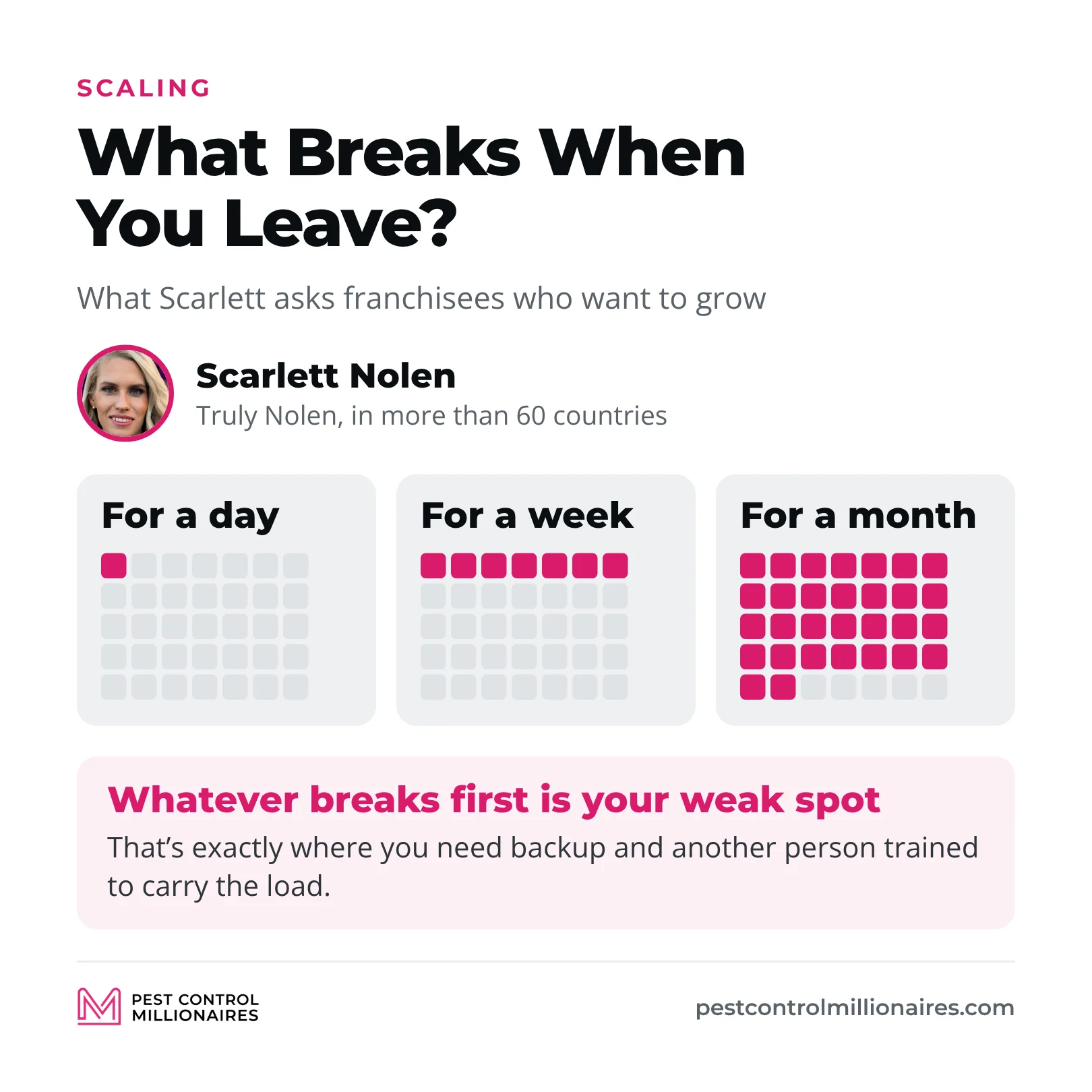
This was my favorite part of the whole talk. Scarlett asks her franchisees a simple set of questions when they want to grow. “What breaks in your business first when you leave for a day. What breaks in your business first when you leave for a week? What breaks in your business when you leave for a month?”
Whatever breaks first is your weak spot, and that’s exactly where you need backup and another person trained to carry the load.
I run 20 locations now, and none of them can lean on just me. Scarlett said it plain: you don’t get to 20 if any one of them needs you to show up. The real job is pulling yourself out of the work.
3. Stop switching your software
A lot of operators change their software every single year while they chase the next shiny tool. Scarlett warned hard against doing that.
Truly Nolen ran an old system called the AS400 for about 30 years. It was a black and green screen and felt very old school, and she even said she kind of liked it. But old systems build up what she calls IT debt, so at some point you have to switch, and the switch hurts.
Her warning really stuck with me. A switch “is going to take way longer than you could fathom, way longer than vendors are going to tell you it’s going to take, and it’s going to be a tremendous distraction for your business.”
So don’t make it worse by jumping around every year. Pick a system and let the business grow on top of it. Plan your next big change three to five years out instead of doing it on a whim.
4. Hire for values, not just skills
Scarlett’s dad had a firm rule about hiring. Don’t bring people in from the outside, because they show up with bad habits. Train them brand new instead.
Scarlett broke that rule a little, and she likes a mix. She promotes from within most of the time, but she leaves room for outside hires too. The reason is fresh eyes. “Some of our best hires have been people from outside the industry that don’t have biases or don’t have years of bias that come and challenge things that have been status quo,” she told me.
Her real filter is values, not the resume. Get the people skills and the values right first, then plug in the rest. Skills and process you can teach, but character you can’t.
5. Build a feedback loop and test small
Scarlett’s best ideas come from the front line, not from the office. The technicians and the customer service reps answering phones see the real problems before anyone in management does.
So she made the feedback formal instead of leaving it to chance. She’s building an AI committee right now, and here’s the smart part. It isn’t just IT people on it. She wants someone from operations, someone from finance, and someone from the field so she gets more angles and makes better calls.
She also runs pilots before any big rollout. A new idea gets tested in a few branches for a month or three, and people volunteer to be part of it. An exec stays close and gathers feedback every week, and if it works, then it spreads to everyone. That beats forcing change on the whole company at once.
We started something like this too. We built a small internal board this year with marketing, sales, and operators on it. There are seven people on it, so the big calls don’t just come from me anymore. They come from the group.
6. Aim for 12%, not 30%
I asked Scarlett to describe the perfect branch, and her answer was fast. Twelve percent growth a year.
She doesn’t want 30, because she’s lived through those 30% years, and they are hard to sustain, they burn people out, and they get volatile. As she said, that steady “12% growth golden goose just growing at a steady rate” is the real win.
She added one more thing I liked a lot. Once a branch clears the $3 million mark, the money really opens up. So grind to get past that hump, then hold a steady pace.
7. Liability is the real threat
I asked Scarlett for my blind spot, since I want 100 locations in the next five years. Her answer was quick. Liability.
“Don’t underestimate the impact of liability,” she told me. “That can change your world in a day.” A fender bender today is not what it was ten years ago, and the bigger you get, the bigger the target on your back.
This is part of why so many owners sell to private equity, because they want the cash and the cover. But Scarlett gave a real warning here. She said PE firms have great salespeople and a lot of shiny tools, and they sell it really well. The value they promise may not be the value you actually get, and she hasn’t met many owners who love that choice.
8. Cut churn with great service
This last one might be the most useful of all. Scarlett built something she calls the yellow standard, and she took it from the Ritz Carlton’s gold standard. The whole idea is bringing hotel-level service into pest control.
Why does this matter so much? Churn. Scarlett and I both got fired up on this one. It costs far more to win a brand new customer than to keep an existing one, yet most companies pour all their effort into the sale and forget the customer afterward.
She put a real number on it. Move your churn from 20% down to 15% and it’s a game changer. That small drop can swing a big chunk of your bottom line.
We’re chasing the same thing on our end. We both pointed to the book Unreasonable Hospitality, so if you haven’t read it yet, go get it.
That’s what I took from Scarlett. Build a business that doesn’t need you, hire for values, and grow at a steady pace. Watch your liability, and treat your customers like the Ritz would. Three generations and 60-plus countries don’t happen by accident.
Full transcript
Every word of the episode, from the video captions
Building the business turns you into a different kind of human being.
Realize that failure is a part of the...
I think there's hope out there for all of us.
Today is a big one. Got Scarlett Nolen with me here today. Representing one of the most established brands in the pest control industry with Truly Nolen Pest Control. You built something that's lasted decades across multiple markets, across multiple generations, which is obviously super rare. So, first I just want to say thanks for being with us today. I know you have a busy schedule.
I'm very, very glad to be here. And I've been looking forward to our chat.
Yeah, it's exciting. So, I always start the podcast out the same way. And your story is similar to most, but very different than most as well. Came up in a very large company that was started way before you even thought about being born.
But if you and I were junior, senior in high school, who is Scarlett in high school?
Oh, man. Who was I in high school? I liked to perform. I was very competitive. So, I By perform, I don't mean in the arts. I mean academically, it was important for me to do well. It was important for me to try my hardest. I always wanted to try my hardest. That was kind of ingrained in me a bit. And I was probably more social than I needed to be, for sure. I was I was kind of like friends with anybody everybody. I went to a relatively small school, but I was friends with There was There was no like, "Oh, I just hung out with this group." or "I just hung out with this group. I kind of floated and a bit friends with every every group.
Got you. I was kind of the same way. And I did a lot of sports, but then I was also in choir, so I like had a mix of friends. I sang with a group and then I like played sports a bunch, so I kind of was like the floater as well. What were the you know, you grew up in a big company. We'll we'll get back to that in a little bit, but like what were the what were the conversations like at the dinner table at night?
Oh, I love that question. So early on young, my dad loved a debate and he like the challenge of a debate and understanding us as children our thought processes. So at the dinner table, he would throw out kind of philosophies or concepts and he would invite and encourage hey, here are two sides of a of a of a challenge and then where would you And the right answer was always like a hybrid or a combination in between, But he really wanted to encourage critical thinking and questioning of things. That is that to him was a really important skill to have is you don't just take things at face value. You want to question and dive deeper and he encouraged that from a very young age. What he did not do which most people assume he probably did, he put zero pressure on me or to join the company in any way, shape or form. It was a lifelong motto of his, do what you love and everything else will follow.
So if you wanted to be an artist like one of my sisters, he was all for that. He really encouraged that. If you whatever you wanted to do he just wanted you to have passion behind what you did. So there was zero pressure to join Truly Nolen in any way, shape or form. Some of us did, some of us didn't, and that was that was something that he was happy to The door was open, but absolutely zero pressure to join.
Growing up, did you think you would...
No. In fact, I thought I would do anything but join.
So, where did where did where did you go from a college? Where did you go from...
Right. Yeah, how did I'm like, how did I get here? I went to University of South Carolina for undergrad and had no intentions of joining the company at that point at all of the...
What did you go to school for?
Psychology and I Yeah, I trained to be a therapist and I went to University of Central Florida for grad school, got my master's in marriage and family therapy and spent a little I had a short stint and worked with families that had gone through like extreme traumas for a short period and still at that point I was thinking about I there was no pest control was on my radar. I was planning on opening up my private practice. I built my website. I got my business cards. I was like ready to go. And there was a waiting period that when you're opening up your private practice, you kind of go through you're you're waiting on the state a bit and during that interim waiting period, I thought, you know, let me just go fill my time while I have some time after grad school to go learn about my dad's company.
Still no intention. Like no real long-term intentions until I can get back to my real career as a therapist. And I just kind of day one went on a ride-along. I'll never forget my first we went to like an extreme bed like probably the biggest bed bug case I've been to ever. Most extreme bed bug situation day And then I kind of got hooked. I always say like I caught caught the bug. I kind of got hooked and just like one thing led to another and I put being a therapist on the back burner and that double-digit years ago. So many...
Yeah, my actually my youngest brother, he went to be a therapist as well. He got his master's, graduated. He did it for like two or three years and decided this is just not for me. Like he's just he's solving everyone else's problems. He's like I have too many problems myself and stressful job and didn't get paid very well for it. He's like, "I'm out." So...
Yeah, it takes a really special person. A lot of my good friends that I went to grad school with, they pursued that and I admire them tremendously, but yeah, I kind of found a different path...
Yeah, so I'm going to rewind a little bit now. Catch us up like how Truly Nolen got started. And we'll connect the dots when you show...
Yeah, many many moons ago. So my Truly Whitfield Nolen, was a serial entrepreneur. Like he said yes to the opposite of finding your niche. He was coming out of the Great Depression, moved down to South yeah. Yeah, coming out of the Great and in South so South Beach was one of the first cities in America to actually come out of the Great Depression economically. And so that's where he was. He was doing home services from can I paint your house to, believe it or not, this was a real service, can I flush your toilets?
1938, right?
That's what that was like a real home service for those that lived on Star Yeah, though like those that live on Star Island and like that was their third home type of thing and you need someone to run the plumbing. That was a service back then. And he would just say yes to everything, but the one thing that stuck, what makes me really love this industry so much, it was pest So, regardless of the Great Depression or the economic times, no matter what, people don't want to live with bugs. So, you might hold off on painting your home, you might hold off on upgrades, but you're not holding off on pest And it really underscored, and that's what like everybody that's in this industry should take so much pride in, is the economic stability of this industry. Especially like we're we're kind of in on a little bit of we never know what the headlines are going to be tomorrow.
Uncertain times, right? Like it's a surprise to all of us every day. And being a pest control is something that I find tremendous, not only pride, but also like comfort in because it's supposed, you know, allegedly, one of those unsinkable unsinkable industries.
Yeah, cuz I mean in 2008, when the market crashed, 2020, we go through...
And plus, you know, you came out of the Great Depression, so yeah, it's definitely, I would say, recession-proof business, but again, knock on wood.
Knock on wood, absolutely.
Cuz we don't ever want it, you know, we don't want it to ever go away, so just going to knock on wood just to be safe. But yeah, it's a great industry, and that's probably one of the reasons that it has lasted so long, cuz people just don't want to deal with bugs, and health-wise, you can't really live with...
So, becoming a part of an extension of the health care industry, and like deemed an essential service, like that saved our butts, like at Truly Nolen, but I think the whole industry as a whole, but getting back to my grandfather, he started to even though he was a serial entrepreneur, he honed in on pest control specifically, and down in South Florida, and my dad worked for him, but my dad had Truly, David Nolen was my dad, so he had a lot of different ideas of how to expand the business. He was more of that business visionary and had conflicting ideas of how the business should be run from his father. So, he broke out, went out west to Arizona, started his own company, obviously made a few good decisions, thrived, expanded, and then years later was in a position to buy his father's company from my grandmother, his mother, after my grandfather had passed away.
So, my grandfather passed away, and my grandmother inherited she wasn't in a position to run a business, and so he was able to buy the business and then consolidate under one umbrella company as Truly Nolen and the gap.
Hold up, quick pause. If you're running a pest control company or fertilization weed control company and you're not in our Facebook group, you're choosing the harder path. Every operator that's in there is skipping years of mistakes cuz people are actually sharing what's working right now. So, stop trying to brute force your way through growth alone. Search Pest Control Millionaires on Facebook or click the link below. And now, let's get back to it. So, at this time he's he just in Arizona and Florida?
Yeah, so well, no, he had a he had expanded a little bit into California and Florida, I believe, at this time. So, he was really coast to coast, and what made it possible is he along the way got his pilot's license.
Hey, I'm getting mine right now.
Oh, really?
I think there's something about pest control and pilots. There's know that we have we have 20 markets at this point, too, and I'm kind of I'm so sick of driving, I'm so sick of flying commercial. Like, I'm burning way too much of my day. I'm like, I got to do something different. So, I started like the journey like 6 7 months ago. It's been It's been fun, challenging, but rewarding for sure.
There must be...
Good for you. Good for you. That's awesome. Yeah. Yeah, it if you look at like the history of Truly Nolen, a lot of our branches are actually really close to airports for that reason. Like they're really close to landing strips. Like the physical buildings. We've evolved, you know, we've evolved a bit, but the old school ones were really close to landing strips because my dad really prioritized like he was a master of managing his own time as he expanded.
I love that. Smart.
Smart man. So, what year what year does he franchise or does he do that right out of the gate?
Smart man, yeah. No, he did that in the '80s. So, domestically in the United States, in the '80s, I believe, and then he started to franchise in 1988. And the franchising domestically, he didn't really have, I think, a huge direction for that early on. It was a bit happenstance. He had someone interested. He had someone interested actually in Canada. And he said, "Sure, why not?" internationally, he had a friend, a colleague that really had a vision for it, Jose Lutz, who took it internationally. He really took it there. Not a part of his initial vision board, if that was such a thing. In his in his era, but he really just the United States, but Jose Lutz was able to take Truly Nolen internationally and make it that international franchise, that global force in pest control.
And what year So, that what year did that start expanding? So, like 1988, and now you guys, I think I read over 50 countries, is that right?
Yeah, a little higher than that. Closer to 65. And I'm going to ask ChatGPT to say, "You're wrong, ChatGPT." Yeah, they have us wrong on a couple things, but yeah. Which is probably not a bad thing.
Well, yeah.
Yeah, I was I was scrolling through that just trying to catch up where you guys were at today, which was super awesome, very successful what you guys are doing. It's been fun to watch. And then so your dad starts at 88. You come into the picture what year? Gosh, that's a great question. I don't know. I like kind of formally joined the company a good 15 years ago, I think, 12 to 15 years ago, somewhere in there. You know, I worked in his office kind of doing odds and ends and filing and faxing and back when we had fax machines. But I really formally started and I was I set up we I went through our manager in training program, which gave me a really thorough every I worked every single position from CSR to rodent technician to lawn technician, termite technician, service manager, branch manager. So I really worked sales.
I worked every position. Struggled in some. I have a lot of admiration for CSRs. And I always say that is that is a really tough position. You're on the front line answering all the questions.
What was your least favorite?
Not all the good ones either, right?
Yeah, and like sometimes not with that field exposure and anything can come at you. At least when you're and you know, in service or sales, you have maybe some time to do a little homework or prep before you meet that customer. You just never know who's going to call you or what they're going to ask. So and the multitasking that's involved, I have a lot of respect for CSRs. It took me a minute to learn our systems. I was I was a little slower on that on that Besides where you're at today.
I know. Well, definitely termite. I've always had a passion for termite. I find it I Well, I love the identification in the world of termite. I'm like, if they're all termite, they're really predictable, really easy to for me to identify in that space, but I always find termite really interesting. It was like a just always like a puzzle and spending a little bit more time at the customer's house versus like going to one or two customers a day in termite versus going you know, 10, 12, more on pest control, I appreciate it.
That's awesome. And then what year did you move into CEO...
So, 2019 was kind of like a transitionary year for me, but 2020, what a what a great year to transition.
What a great year.
What a great year, right? So, I thought I'd really just jump into the deep end. 2020 was my first official year as being president, which was crazy because obviously we were going into COVID. We were all looking at the headlines in the same way. I had no special COVID knowledge. So, I was writing the COVID like unknown wave just like everybody else, which in some ways put me on an even playing field as my colleagues, but it also gave just incredibly steep learning curve because like everybody, we were pivoting a lot of our systems. We're really known at Truly Nolen, we go in people's homes. We are old school when it comes to going inside people's homes. So, that had a pivot in a real way as far as that contact. And one thing we were pretty set up for, we were already used to doing a lot of video conferences. So, we that one was pretty smooth for us, but thankfully to our international we really were able to get insights from our international Truly Nolens is cuz they were experiencing things just a little tiny bit ahead of us.
Faster, yeah.
Yeah, and so we really dived into and we were quick to secure PPE, which was kind of scare It's funny to yeah, like I Yeah, so we were we were able to secure PPE in a way that that thankfully allowed us to still function and keep you know, those that were in the field interacting with people up to up to snuff.
Yeah, no one really knew what was going to happen.
Yeah, behind the scenes were the talks like at Truly Nolen during that time?
So, early early on the first conversation Yeah, was Well, I ran the full game. I'll be transparent as I went from this is crazy, guys. Like this is going to blow over just like mad cow disease. And then maybe days later I was probably like Windexing my like chicken. I don't know. Like I Like I ran the full I ran the full game on a personal level.
But early on from a business standpoint of view, we did some quick like war chesting. Like so before we were deemed an essential service, we had some war chest conversations as far as what can we do to ensure that we can employ everybody. So, are keep people safe and keep people employed were our two top quick in order to do that financially cuz we didn't know if we were going to be deemed essential or not. Like that was still in the mystery zone. We needed to make sure that we had enough cash to keep people employed. What can we sell in a very unknown time to keep to keep our business afloat. Once we kind of strategized that war chest plan then it just became a pragmatic logistics. And obviously, like everybody as things played out and we were deemed essential, an extension of health care that kind of floated away.
Like the war we no need for war chest, we had a great year, huge rodent up uptick...
Everyone's home. Everyone's seeing bugs.
Yeah, everyone's yes, everyone was home doing home projects and you know, we had a little bit of fall off with with our commercial side of our business. We do about 25% of our business is commercial. So we had a little bit of uncertainty there like with restaurants, of course.
Extra money in their pocket.
But the rodent pressure over the past 5 years has just been tremendous. So from a business standpoint of view, our industry has been great and we've been riding that...
Where is what where's your biggest market? Is that the Florida territory?
Yeah, so we do about 60% of our revenue in Florida and we've got some really nice kind of holds in certain pockets. So Southwest Florida has always been a staple for us as well as Southwest and Southeast Florida and then I would say Central Florida is kind of our upper up and comer. We obviously have lots of competition. Where I live in Central Florida, so we obviously I see all the I see all of it. You know, Florida has more pest control companies than...
I don't know. I'd have to It has to compete with Arizona.
Yeah, it's close. So Arizona's our other mainstay. Our home office is in Tucson and so you can't go too far in Tucson, Arizona without seeing a Truly Nolen car and I'm looking forward to Phoenix being our our next big market and you know, in the next 5 years.
Cool. Yeah, cuz like just thinking about those two states in general off the top of my head like during COVID, those two states were pretty quick to move. Like your governor did a really good job in Florida, in my opinion, got everything opened back up fast for everyone. So yeah, you guys were just happy to be in a really good spot. And Michigan wasn't the same. Michigan was very, very odd.
I couldn't imagine living in some of those northern states. I genuinely can't imagine. I felt like we were blessed to have the access to the Like being out in our yards and everything like that. We also operate in California, which they lingered. I mean, that's that they really lingered in that confinement for such a long time. So, that was a tricky Michigan was very similar. Like we live on the Great Lakes here. They didn't even want us going out on the boat by ourselves. It was strange. So, actually, that's how our second branch got started. I'd never knocked doors before. I'm not from that culture. I've never done in my life. But my back was against the wall, so I started going to Wisconsin, which is about 2 hours south of me, taught myself how to knock doors, and that's just kind of how the model started.
Yeah, they were...
Wow. Way to pivot.
Yeah, I didn't have a choice.
To feed my I you know, I got three girls. I had to feed feed my kids, so I had to do something.
Yeah, I love that.
We had just went out for a long winter. Around here, I was like doing like I had like a lawn care or snow removal business back then. So, we're doing snow removal at the time. Had enough contracts to get us through. And then like I saw the writing on the wall with pest control. And then I started going to Wisconsin, started knocking doors, and yeah, the rest is kind of history. So, anyway, sold my lawn care company, did We're doing We were relatively small at the time, and sold that and started over in pest control, and it's been going on our sixth year now, 20 locations, and we're growing strong, so it's been fun.
That's that What's really crazy I was cuz I was reading a bit about you, and getting past like 20 locations is killer. Like getting past three is amazing, because three locations you can kind of still have a grip on things. But past three locations, it's really You got to You got to set up your systems. You got to have process in place. You really can't manage four locations as a tight-gripped manager. So, I think that's just incredible to get past that threshold of three. To find And then you find the magic of Okay, I can multiply this out and I always think the book...
Yeah, and I think like every time you every time that you open up a new one, it gets obviously way faster. We're better at every single time. And I would say yeah, like the first I strategically I think I did it pretty smart. But I'd gone through like a franchise. I you know, I hired a franchise company that taught us the franchise model. And I was thinking about going that route. And then I talked to a few people in the industry that you would know and they're like, "Yeah, it's not a good idea." So, I learned the model though. Like I learned I learned how to run a multi-service unit locations. I was like, "Okay, I like the model, but I'm keeping it corporate." So, that's what we did. And so, the first But one of the things that I learned through there was like keep my first, you know, five offices within driving distance. They told me. So, if there was an issue, I could drive you know, 6 to 8 hours to get there relatively quickly in case something was on fire and I had to get there. So, that's what I did. The first The first few were relatively close, hour and a half, 2 hours to 6 hours away. Then we just kind of scaled from there, you know?
But that was the first few. So, I kept them pretty close, had a tight knit on those like you said. And then yeah, the hardest part after that like I felt like customers was probably in Maybe it's different at scale to your scale, but get customers seemed like the easy thing. But then getting the really good people to manage those locations was kind of a hard...
Yep. No, no, it's the same thing. I 20 question 20 locations, 100 locations, we're dealing with the same stuff.
Right. So, at at your scale, is it easier to find people or is it easier to find customers? When I say people, like leadership team to run execute those.
I would I would definitely say that the biggest challenge is finding the right people. They may have been successful at a different culture or they may have in a different scenario. I sometimes find that they were really successful in a set of circumstances at a different company with different resources. And when they move locations, they may have either taken for granted some of their resources or not realized the foundation that they were sitting And then now in a new environment, some of those things that once came easy might not translate. So, the people skills and just innate leadership and you know, what are your core values, those have to align. And then all the skill stuff and process, you plug in. But yeah, find finding the finding people that we're real we're so spread out. So, finding people with our value system and just that people leadership skills, that's the challenging part.
And then the customer service...
Like you like to have those guys like come into the ranks and then move them locations or would you rather hire someone from another company like you were talking about with that shows that they're really good and then put them in...
So, I maybe this is contra- I like a little hybrid of both. Because so ideally like the there's this kind of 80/20...
Was your dad early on asking you those questions at the dinner table.
Yeah, my dad would say, "Don't hire all Don't hire people from the outside cuz they come with bad habits. Like you want to train them now." I would stray from that a little bit and say I like a little bit of a combination of both. Maybe like an in an ideal world maybe like an 80/20 or a 90/10. I love to promote hire from hire from within and promote from within. You know who they are, they're already trained, you're already invested, they're invested. So, it is a win-win-win and morale boost and creates a lot of opportunity. Having said that, when you're a been around for almost 90 years like we have been. You want to be careful that you're not cross-pollinating. So, you want to you don't want to get too arrogant to say that another company or somebody else is going to come in and they don't have great ideas.
Some of our best hires have been people from outside the industry that don't have biases or don't have years of bias that come and challenge things that have been status quo. So, I like a little bit of combination of both. And I think sometimes it does depend a little bit on what the position ultimately is going to be and what resources they have access to. And what team what other what like who's on the current team and how they're going to complement that team. So, I look at it not just as a singular trait, but more in a system. How are they complementing a system that already exists.
Love it. I'm taking notes. I always take notes for myself. Speaking of multi branches, talk a little bit about culture. Do you find that every branch has their own little culture? Or do you try to keep the culture relatively the same? From your experience of...
Yeah, no. Every branch Yeah, every branch has their own little culture. I mean I love seeing the like I love seeing those. The more identity and independence sometimes those branches can have, a lot of times the more successful they have. We definitely have an overarching company culture and our core values and the spirit of our culture and what we want to see from a like what is the intention or spirit, but how people interpret that every single branch is different. Every single branch has its own little personality and quirks and so forth.
Yeah. I've I mean like I said we're at 20 locations now. I feel the same way. They're all just a little bit different. But I think that the core values are the same, but they're Some of them just have a lot more energy than others. Some of them are a little bit younger, some are a little bit older. So, it's cool to see for sure. But I can still like when it when something's off, I can still feel it. I don't know how to explain it to anyone on the over this podcast. It's just this feeling that I have when I walk in and I just I don't know how to explain it. Do you find the same thing?
Absolutely. I totally know what you're talking about. Yeah, when the when the energy's off, when the culture's off, when something's broken, you can feel it. When things are jiving and they've got their rituals and they've got their, you know, what do they do during Thanksgiving time and oh, everybody knows, you know, so-and-so always does this. They kind of have ca- I don't their X factor and they've got their rhythm and things are chugging along, that's a great culture. But when things are fragmented and there's miscommunication, then you can kind of feel it and everyone's pointing fingers and it's just not a good energy.
For sure. But we won't talk about the bad stuff.
Yeah, yeah, yeah, we don't have that at our company. I'm talking about other...
None of us do. It's Just watch social media, it's all golden. You've been I see you got massive company. What breaks from like that 50 million to 100 million plus?
What breaks?
A hard Yeah, it's probably a hard question, but...
You know what? I actually love this question. I just to kind of unwind it, I asked my franchisees this question and I and I asked it in a different way. I said, "What breaks?" And this might be really relevant to a lot of your listeners is what breaks in your business first when you leave for a What breaks in your business first when you leave for a week? What breaks in your business when you leave for a month? What breaks first? And those are the things to hone in on. Those are your vulnerabilities. Those are the Those are the things that you need to find redundancy for. You need to multiply out. So your business can just continue to operate without you. Cuz as you know with 20 locations, none of the 20 locations can be solely dependent on you. I mean that You wouldn't get to 20 locations if any of them were dependent on you.
And I think a lot of owner-operators, that's the biggest challenge is finding how to detach themselves from their own business. So 50 million to 100 million, every business is a little bit different depending on where the redundancies are. Some things that happen though and like especially in today's world are things like your IT debt. So IT debt, at Truly Nolen we had a software that was very popular in the I think '80s. And that we lived with for like 30 And we had to It was no longer really supported. And we had some We had built up a lot of IT debt. Especially, you know, company has been around as long as ours, you build that up tremendously. So that tends to fracture. The other thing that tends to fracture is what works at 20 million doesn't work at 50 million. And what works at 50 million might not work at 100 million. And yeah, there's all these kind of benchmarks that And sometimes you have to say, "What is the priority?
And how am I thinking about the company as a whole? And where can I find efficiencies? As much as we want to make things custom and tailored, we also have to find the balance between scalability. And when, where, and how you do that might just depend on your strategy, your differentiators, and kind of what your value system, I think a bit is as as a leader.
Yeah, I like that, too. Anything outside of that either that you can think of that that broke between and I know it's like it's a hard question. That broke so cuz you had your tech so which is which is good to keep an eye on. Talk about that real real quick. How was that challenge? Did you guys have to switch like technologies and what was that like? Cuz I couldn't imagine. Like I would never even want to switch now. Like...
I know. I know. The thought of it is like scary. And you get deeper and deeper into it and we were on the AS you really are. Yeah, you're golden handcuffs. We were using the AS/400. So for those of you who don't know, it's like a black and green screen and everything's old school feeling, if you will. I liked the AS/400. I'm probably the only person in my generation that did.
You're like golden handcuffs, you know, like just stuck now.
But it built a lot of IT debt and that's just I mean, you build IT debt in your phone systems. Like every time you don't upgrade your phone, you're building IT debt and you have to manage it because what you don't want to do is take it on all at once. So you really want to be thinking 3 to 5 years out what systems are going to be supported, what systems are going to be need to be updated, and how can I plan so I'm not taking them on one year at a time because when you do have to make a switch, it's painful. It's going to take way longer than you could fathom, way longer than vendors are going to tell you it's going to take, and it's going to be a tremendous distraction for your business. It just it's all consuming.
So, I mean, we've we've done that just over time and we try to just do it proactively, spend a lot of time shopping, spending a lot of time thinking about what's going to be right for us 5 10 years out. What's right for you in the first you know, million is probably not the same software support system that you're going to want for 20 mil you know, for for 20 million or 50 million and you have to think about different enterprise partners as you expand. And there's also just different options constant like always happening. So,...
And that's the I talk about that a lot too is like I always see so many people in the groups like I constantly want to change softwares like every year. I'm every software has its quirks or none of them are perfect. Just stick to the one you're at cuz operators want to change their business so much. They never just their business never just gets a chance to grow organically cuz they're constantly just messing with stuff. Stop. It is a distraction to your team like you said, distraction to everyone and it consumes everyone for such a long period of time. But when you're thinking about these like you said, you don't make quick decisions cuz it's probably the board helps with this, but what is that process like when you say, "Hey, we have to make a big shift." Like what is that process like?
So, it kind of depends what the decision is, but I have in the last 5 years, we've really shifted from a much more of a bottom-up culture. So, our feedback loop to the front line is everything.
That. Yeah.
Yeah, so like our best ideas for 90 have always come from the front line. They've always come from from I mean, that's always been the case, but what was important to me is that we really formalize those processes. So, like I'm the nobody knows two people in my company know this. So, you guys...
Yay. You guys heard it first.
Information. I'm forming an AI committee and on that committee, you know, we obviously the IT department is that's their world that's their expertise, but it's really important to me on that AI committee that I have representatives from operations, that I have representatives from the finance department, that you're getting a nice balance of perspectives. So, whether you're buying acquiring a business or you're making a really big strategic plan that you've vetted it out through multiple people. Ultimately, you have to have an owner and a decision maker. I mean, you just have to say you own that decision, you're the owner of that But, making it a habit culturally to a sounding board that can honestly give true feedback from multiple I think has helped us make more intentional long-term plans and not just jump around or you know,...
No, I love that. Actually, yeah, this year 2026 we're in, we did the same thing. We basically built out a board for ourselves. It's an internal board, but it comes from like marketing, it comes from sales, it comes from operators. There are like there's seven of them on the board. That way the decisions don't just come from me. The decision comes from the board that cuz if I make a decision, it's just for the company. Or if they make the decision, it's for the everybody that's involved in the company, not just for me. So, we actually launched that this year, which has been really actually really cool. Fun to see how they think and I'm not I'm not involved, but they just, you know, we present the questions, they come back with a few answers. It's been really cool.
That's amazing. Yeah, I think you're definitely ahead of the game because people can get people can grow without having that nice committee and I always encourage people the more diverse of thought you can have your committee, whether it's a formalized board, an executive team or just like a coffee a group of like coffee people. I don't know. That you need for coffee. Let them be and I encourage I'm like let people be from outside the industry. Like it's amazing the more diversity and perspective, it'll really open your eyes up.
That's cool. You mentioned a feedback loop from you know from CSRs, technicians, the front lines. How do how do you connect those two dots from like front lines to management?
Yeah, so a little bit of it is selecting the right I mean it's just selecting the right people that we have open communication with that they've had enough exposure and experience to truly know them. So we're kind of cherry-picking people that often times that are trainers. So they're at the best of the best. They also might have just great communication skills because sometimes they're the ones also in being implementers on the other side of that. And a lot of times I'm thinking about okay, I want to I might want a perspective from different states or different markets as well.
So we might say okay, I'd like you know two technicians from the Southwest Arizona market and I'd like three technicians from Texas and you know, I want a couple sales people and you know, I mean I know good amount amount of our people but more importantly our leaders know their people and so they often times recommend hey, we're looking for this person for this topic and we're looking for feedback. So whether we're kind of like cherry-picking a committee or we're just I mean there's also a lot of things you can do as like sending out surveys and getting feedback. I think sometimes you got to be a little bit careful with that cuz if you don't go with what the with what the group says, like it can be very confusing for people. It's like, "Wait a second, we all saw that we voted blue and you guys went purple. Like, what happens?"
A mutiny on your hands.
Yeah, you've got a mutiny. So, you got you have to kind of be you have to be really intentional with that. But we also when we roll something out, when we're testing something, we're not going to test we're not going to just roll something out to the whole company. We're definitely running pilots and those pilots can be a month long, 3 months long, and we let we often times have people volunteer, "Hey, do you want to be a part of a pilot?" Cuz it can be really disruptive and a lot of times people want to and we try to work with the people that want to be a part of the pilot. And you know, we ran a like I can think of a pilot that we ran in Texas and they wanted to be a part of it. And so, we set up regular we had an executive sponsor for that pilot program and we said, "Okay, give us all the feedback." And you know, it's the ex So, the executive team was really looped in on that from the front line feedback on a weekly basis almost.
That's one of the things that I love, too, is when you find a branch like we talked about culture earlier, everyone runs a little bit different. And you find something that works extremely well in that branch like, "Oh, that is awesome. We should try that in a second branch." Then you're like, "Oh, it works great in both branches." Like I said, in north and in south. And also, you can deploy that to all locations and it just helps everyone, which is great. Which is what I love at at the point where we're at. It's really, really cool. I have a What is your like as CEO, president, what is your day-to-day like?
I get you know, I get this question asked more and more lately.
To go deeper than this. This is a good...
I really need a good answer. It changes every day. I you know, I so I spend a lot of time with one doing one-on-ones with my executive team. So, I've got executives that run different departments and like this morning I spent a good amount of time with my head of HR and we were brainstorming and looking at different personality assessments.
Right. I get it.
And we were talking about that. Later this afternoon, I'm going to be meeting with my controller and doing a one-on-one with him and we're going to be talking about and he doesn't know it yet, so I'll but I'll tell you. We're we're going to be talking about what messaging we have behind different reporting and what is the you know, just letting out a bunch of data, but how can we really shape that messaging behind just the infinite number of data points that we have available to us these days. So there's a little those one-on-ones look a little bit different with each individual, but I kind of I dive into different departments every day. Which for my personality type is great.
Me, too.
That like but that might feel chaotic for other people. Yeah, but...
That's where I thrive. Like I can't just yeah. I have a hard time just focusing on one thing for a week or a day or just not put that who I...
Yeah, there's one thing I do want to share with people. There's one thing that I do There's one constant that I have every single day and I encourage front line people I encourage everybody to do this is I find something new to learn every single day. So, whether like the Harvard Business Review, I read a blog or I just find one thing and sometimes that one thing is just going and sitting having conversation with a team member and learning from them. Like it really doesn't matter what it is. I have no consistency on what it is. It can be learning about a new insect. It can be learning about a new business insight. But I am committed to I don't I have to learn one new thing every single day before I go home.
I love that. And same, I do the same thing. Like I read every single day. I usually read about an hour in the morning just to try to learn as well. And then one of the things I ran across is like if you're feeling some sort of type of way like and you're feeling like passionate about something or you what and you really want to let someone know that you have an a thought or a feeling about that person like don't go days without doing it. If you think of it, just send it out right then. So this morning I spent like a good hour on my leadership team and all my like partners like whether that's from the partners that we you know we buy product from partners that we do marketing with and just partners in general managers.
I sent them all a video message this morning. Just showing them that I care and appreciate you guys. Yeah. So just something simple, you know, it goes such a long way for you should. It would it would Again, I did it just because I was feeling that type of way this morning. Don't do it all the time. But it's like, you know what? I just want to let everyone know that I love them, that I care about them. Like you guys you know, people don't care about you until you know you know they're they care about Or that you care about them. And then once they know that they care and you care about them, they'll run through a wall for you.
I might steal that.
I love that.
So this just I sent out a quick video message to all my partners, mentors, coaches in the past. Like I said, it's simple but I was doing it but it yeah, it's made me feel good. Hopefully it and I think it brightened their day too, you know. So I'm going to circle back to your day-to-day. Two more questions there. We're running out of time already. We only have 15 minutes left. What has been your best day?
Oh my gosh. That's a really great...
You know what's coming next, right?
Well, I have my worst day. My best day I don't Oh my god, I don't know. My best day that's really tough. Well, I just got back from our President's Club trip like a week or two ago. And our President's Club trip, we often take our top our top people on a cruise. We were in the Bahamas and Obviously being in the Bahamas on a cruise is lovely, but the best the actual best part about it was during our award ceremony on the on the boat people were just sharing stories and they do this every year, but there was something incredibly special about this year. People just sharing stories about their experience in their careers at Truly Nolen. It was so touching and it was it just gave me an incredible sense of pride and joy and just like I don't know, it just re-energized not that I needed a re-energizing, but it just gave me this just such excitement for and passion for the business and making sure they all succeeded in their careers and so that was pretty cool.
Just like hearing people's is always really exciting. My worst Do you want to ask me the next...
Of course. I don't even need to ask cuz you already know what's coming.
The worst day? Oh man.
The day you signed as president. I'm just kidding.
Yeah, I know. I then COVID hitting was very I would say.
Then COVID hits.
I was I think we all I think we all felt very uncertain at the time.
Yeah, yeah and I know I wish I had less of a like a trite answer, but I That that was there was like a there was a that two-week period before we were deemed...
Essential. Yeah, like it was just am I going to take this third gener you know, The generations aren't known for their success. So, I was like, man, I've been president for like 2 months. And then like did I just is the company going to go under? And two like man, she's been president for 2 months and then just is going to implode. Like that was that wasn't a great feeling. I fortunately had phenomenal people established on the executive team. I had one of my like right-hand people, Mark Ringelsetter, and he was a champion of safety, logistics, and navigating a 99% of getting through and really being a leader through COVID, but it was just super unknown. Like it was as much as experience as Truly Nolen has had through like I want to think every scenario in the world of pest control.
Obviously not a global pande- like that was obviously an unknown.
So, scary times for everyone. So, yeah.
Scary times. Anytime I hear of an accident, that's never That's not a good feeling. Like a ladder accident, car accident, it's never That's Those are Those are dark darker days.
Yeah, I think that you know, the 30 to 50 million, 20 million plus is like I feel like that's probably what weighs on most owners at that scale cuz like they have so many trucks in the road, so many technicians, and there's constantly accidents, deaths, whether that be technicians or you know, family members. I think that's where it takes a toll on most people.
Yeah, the liability definitely changes and depending what state you're in, that can also have a bigger weight as well. The bigger you are, unfortunately, the bigger sometimes the target you are.
What a fender bender used to be 10 years ago is different than it is today.
And...
We found that out the hard way, too.
Yeah, it sucks. And yeah, liability like isn't just liability just isn't what it used to be and I feel like it the world of litigation, it takes some really great companies and some really great and successful ones at that and can be it's a it's one of the biggest threats to your business is that liability and the bigger you get, the more liability management and the bigger part of your running your business it So, you're thinking maybe less about new customers and more about liability management which is unfortunate and it's the legal world that we live in.
For sure. In your world, what is the perfect all just give me give me your perfect scenario for the perfect branch. If you could have every single location across Truly Nolen, this just like this, what would it be?
12% growth.
Cool. Every year?
Every year. I if they're if they're 2 million or 5 million, 12% growth golden golden goose, just growing, growing at a steady rate. You know, when people hit those 30% numbers, it's really hard to sustain.
And it becomes a little bit...
Yeah, it's really hard it's really volatile and it's hard to sustain and people get burnt out and stuff. But that that beautiful 12% double digit growth, double digit earning like it just things can really gain momentum, in a nice way and when you go from that 3 million to 4 million at a single location, there's a lot of a lot of financial upswing when when get past that 3 million hump.
For sure. This is probably going to be a really hard question, too. But, if you could If you were starting Truly Nolen over today, what's one thing that you'd do completely different from day...
I might consider an ESOP.
Nice. I like that. Yeah, we did that 2 years ago. Yeah, that's awesome.
I Yeah, we're we're The logistic Not to get into it, but the logistics behind that are really are impossible at this point. But, if I was like to green screen it, I think this industry could be really right for...
1,000% sure. We did that 2 years ago. Thank Thankfully, we did it early on cuz...
Yeah, you got to do it early on. You got to do it in the beginning.
Yeah, you can't do it later on. You got to do it in the beginning. I'm surprised we don't see more of them. But Yeah, I think that I think we're right for that.
That answer. That's cool.
To feel that sense of ownership. I think that would be That that feeling of sense of ownership, I think, can go a long...
Yeah, so how that happened to me was I actually read Sam Walton's book.
Oh, no kidding.
Yeah, and it talks about basically how he how he started Walmart and then how he there were it was basically all employee owned. And I heard that, I'm like, I love that idea. We're We're going to move forward with that. So, that's actually how it happened.
Very cool. Very cool.
Great book. This is a personal question for me that I had saved for the end. A person at, you know, where we're at today, what's my biggest blind spot?
What's yours?
Oh, man. I don't know what yours is.
So, we're going to go from like 20 locations, you know, I want to have 100 locations in the next 5 years. What are my blind spots?
What is your biggest blind spot?
Counting on you here.
If honestly, I mean, it sounds like you're thinking of all the right things. I would say don't underestimate the impact of liability that that can change That That can change your world in a day.
Yep, I agree.
So that you know, not I don't want to I hate to like scare people. That can change that can change your world in a...
A lot of people that's why a lot of people go PE too, right?
Cuz they have they have they have the money to finance or back them at that...
I would say cautionary tales on PEs. I haven't found too many people that love their decision that went to PEs. Got to be careful and I have a lot of listeners. So but...
No, and that's okay. But I think but it but it's okay not to be status quo. Like you don't have to like agree with everything everyone does. It's okay to push back. Like you guys didn't do it, but there's this is one of the reasons why so many people are forced into PE cuz they want the protection.
They're forced into PE. They get a lot of shiny tools and they're sold really well and the reality is the value that the PE is going to bring might not be really the value to your business or the industry that you think it's going to be. But PEs have phenomenal sales people in them and just really cautionary tale on on falling victim to a PE, but or maybe the wrong PE I should say, but...
So just really watch liability. Make sure we double down on liability going...
Liability, culture, and don't don't hold on to people that don't fit your culture. That don't have your value system. Don't hold on to them. If they don't fit your values, they're they're they're holding you back.
Love that. Wrapping this up cuz I only got 4 minutes left. What are you most proud of? I You know, I'm really really proud of something I established back in 2020 and that's what we call the yellow So the yellow standard is something we've launched internally and that's all about creating exceptional customer You can grow and grow and grow, especially when you got P blank checks coming at you. But what's important to me at Truly Nolen is that we stay true to our quality integrity. And launching the yellow standard, it's something that's I took from the gold standard from the Ritz-Carlton, inspired by the gold standard from the Ritz-Carlton. And it really is my mission to create a phenomenal hospitality experience within the world of service.
Love same here. Love it. I like to go to like different restaurants, the super high-end restaurants, and just watch how they operate, read their books, how they like similar Ritz-Carlton, stay there about a month ago, see how their culture was, see what they do, see how they onboard us, see how they bring us like again, just if we can have that same hospitality in the service industry and have super low churn, cuz again, it's hard to it's way more expensive to get new customers than it is to keep the ones you have. And I feel like majority of this is like they do all the work up front, they're really good at sales, really good at marketing, then the CSRs get paid by the hour, hour, they're not incentivized to keep the customer, they're more incentivized just to talk on the phone and hang up on them or whatever it may be.
But I could not agree with you more that churn is one of the biggest changes in business. If you can change even if you can change your churn from 20% to 15%, it's game changing.
That's 25% of your bottom line...
There's a recent book that I'll leave you with, it's called Unreasonable oh, that's cheating.
Love it. That's the restaurant that I went to. I watched him speak twice, and so I went to his restaurant in New York, yeah.
11 Madison, right?
Yeah, I think yeah, I think so. Yeah, it's but yeah, and I listened to that and I was like that it's all about for listeners, it's all about just these insane restaurant experiences, like things that you could that you get in New York City, like things that you just don't see very often.
Ritz the Ritz that I stayed at was in New York and then we went to 11 Madison just for the experience to get to just again just I want to take from those big companies that are really good. Not only a brand name but at also like just being a really good at customer service. So that's like if I can take just a few pieces from them and put it into our model I think be awesome.
I love that. I love that.
Cool. Well, it I'm up with my time but I just want to say thanks for being here. Thanks for sharing your wisdom and knowledge and appreciate everything you do for the...
Thank you so much.
And talk to you soon. Hey guys, thanks for listening to another episode of Pest Control Millionaire. We don't charge any money for this show but the podcast isn't free. Please like and subscribe and give us a five-star review on your favorite podcast app. This makes a huge difference for us. If you have any specific questions about your business or your personal life that you'd like answered by me or any of my podcast guests, please send an email to And if you want to get in touch with me about our marketing class, we do a live version every Thursday night. Check out our website at Thank you guys for listening. I'll see you guys in the next one.
Watch the PCM Podcast on YouTube