How We Run a Pest Control Door-to-Door Sales Team

Table of Contents
- Why Our Mornings Start at 10:30
- Twice-a-Week National Sales Calls
- The Morning Meeting
- Time Blocks: Reset Every Two Hours
- Pitch Practice and Car Groups
- What the Daily Numbers Should Look Like
- What the Pitch Actually Sounds Like
- Callbacks: Diagnose, Don’t Chase
- Pickup and Debrief
- What Our Best Reps Do On Their Own
- Saturdays and Holidays Are Your Best Days
- Competition Drives the Numbers
- What’s Actually Underneath All of This
One of the most requested videos I get is how we run our sales team here at Pest Badger. So today I want to walk through what a full day actually looks like, from when the reps wake up to when they pull back into the house at night.
I’m Jonas Olson. I’ve been in the service industry for 17 years, and we’ve grown Pest Badger from one location to 20 locations in nine states in about six years. Door knocking is hard to scale, and I’ve written before about why pest control is easy to start and hard to scale. I use this blog to document how we build and what’s actually working for us right now.
Why Our Mornings Start at 10:30
First thing in the morning, our reps wake up between 8 and 9:30. Some of them hit the gym. Some of them just relax. Then we start our morning meeting at 10:30.
That’s actually one of the biggest changes we made this year. Last year we used to start the day at 9:30, meet until 10:30, get on the doors by 11, knock from 11 to 3, and then break for lunch. The problem was that when the reps actually took that lunch, they got stagnant after it. And the early afternoon is one of the best knocking windows of the day. We were losing momentum every single day.
So we pushed everything back. Morning meeting at 10:30, runs to 11:30. On the doors at noon. And then we knock straight through until 9 PM with no real break.
The other thing this gave us was more time in the morning for the reps to live their lives. Some of them want to wake up early and golf. Some want to lift. Some just want to ease into the day. That morning space matters because sales is an individual game but it runs on team energy. The more the guys hang out outside of work, the more momentum carries over to the doors.
Twice-a-Week National Sales Calls
Twice a week, we get every branch on the same Zoom. Tuesdays and Fridays at 9:30 central, right before the local morning meeting kicks off at 10:30.
The call runs 30 to 45 minutes. The managers share what they’re seeing across their branches, the biggest things reps are struggling with that week, and we share some wins. It does a few things at once. The reps get faces to names across branches. They get extra training reps in. And it puts them in front of managers who aren’t their own.
Every branch has different managers with different sales skills. Nobody sells exactly the same. We’ve all got the same bones to the pitch, but everybody’s got their own thing they do at the door. Getting reps on these calls means they’re learning from a bigger pool, not just hearing the same coach over and over.
The Morning Meeting
Each local morning meeting runs from 10:30 to 11:30 at one central location. Some of our locations have reps living in different apartments, so meeting at one spot first gets everyone in the same room and in the same energy.
You need a hype man right off the rip. Somebody who can get the team fired up the second they walk in.
The first thing we do is claps. We go over yesterday’s numbers and clap out each rep’s sale count from the day before. Then we set the day’s goals on the whiteboard, both individual and team. At the start of the year we break down the annual team number into a daily team number, and we cross that off every day and write how far we have left.
From there we move into a training segment. The manager picks one thing, usually something reps struggled with the day before, and runs a short focused training on it. Sometimes it’s an objection. Sometimes it’s a piece of the pitch. Sometimes it’s an office announcement that needs to land cleanly.
Time Blocks: Reset Every Two Hours
Sticking to the schedule is the number one thing we struggle with. Honestly. Reps say they’ll knock noon to 9, but the day gets soft in the middle.
The fix we use is breaking the day into two-hour blocks. Noon to 2, 2 to 4, 4 to 6, 6 to 8. Set a goal for every block. Say your goal is $1,000 per block. If you hit $2,000 in the first one, you don’t carry that momentum cash forward. You start your second block at zero.
That keeps everybody locked in. You can’t coast on a hot morning. Every block is its own day, and every block has a fresh starting line.
Pitch Practice and Car Groups
After the training segment, we pair everyone up for pitch practice. I rotate partners every single day so reps aren’t drilling with the same person all week. Each pair runs at least two pitches, usually one regular and one switchover.
Then everybody loads into car groups. The hoods are pre-mapped the day before by the managers, and the car groups are pre-assigned. Knowing where you’re going and who you’re riding with before you walk into the meeting matters a lot.
You’ll figure out over time that some reps work well together and some don’t. We pay attention to that. When two reps have hoods right next to each other, we’ll put them in the same car so they can ride together and hype each other up.
Here’s why it matters. The hardest part of the day is getting out of the car for the first time. When everybody’s riding in together and the energy’s high, that first door is way easier. Solo knockers struggle on that first door more than they should.
What the Daily Numbers Should Look Like
A few benchmarks we use.
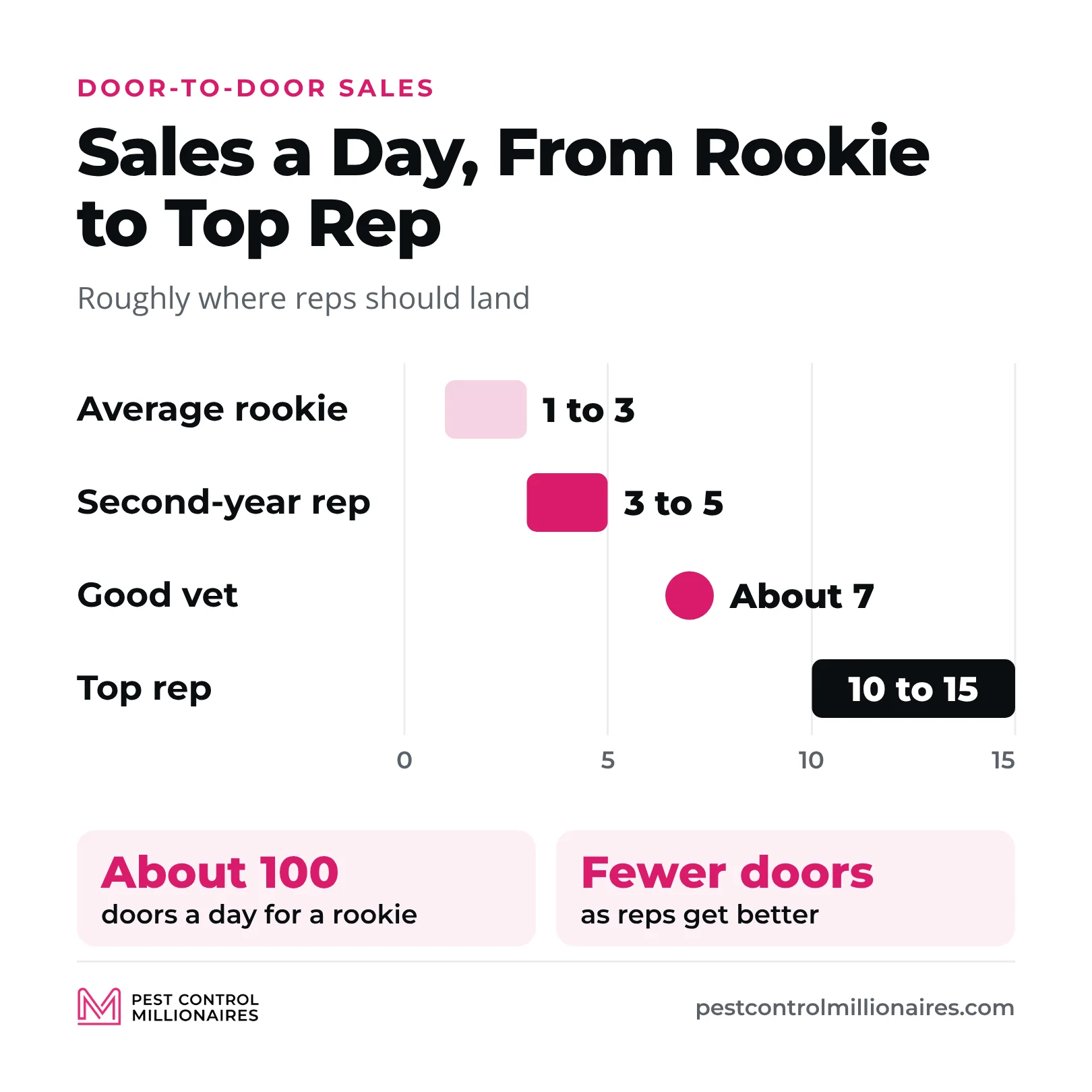
The average rookie should knock around 100 doors a day. We’ve had rookies knock more, we’ve had rookies knock less. Counterintuitively, the better you get, the fewer doors you knock per day. Better reps are diagnosing better buyers, having longer conversations, and not getting kicked off the door as fast. So door count goes down while sales go up.
For sales, here’s roughly where reps should land:
- Average rookie: 1 to 3 sales a day
- Second-year reps: 3 to 5 a day
- Good vet: around 7 deals a day, roughly $4,000 to $5,000 in revenue
- Top reps: 10 to 15 deals on a regular day, sometimes more
There are levels to the game. The harder you work and the more time you put in refining the skills, the higher up you go. Putting in the hours alone is enough to get you to one sale a day. After that, it’s craft. If you want to see how far one producer can go, here’s how one pest control truck did $330,000 in a single year.
What the Pitch Actually Sounds Like
Here’s roughly what one of our reps sounds like working a door:
Hi, how’s it going? Just to give you a rundown, and then if it works for you guys, cool. If not, I’ll kick rocks.
So I do a base spray around the base of the house. I go three feet up, three feet out into the mulch and rock beds. This is where you’re going to get Asian beetles and box elders in the fall time. Do you guys see a lot of those?
Then I also do a treatment out in the yard for ticks, fleas, ants, and spiders. I go 30 feet out from the perimeter of the house. I know you’re getting sprayed for that stuff right now, but this is just going to seep into the soil and prevent them from pushing up toward the house. So the base spray is the secondary, just to make sure they don’t get in.
(Homeowner mentions mice in their camper.)
Yeah, mice are super active every winter and spring. If you look at every corner of your garage, that’s how they’re getting in. See this corner right here? That’s from mice. That’s them chewing through so they can get in.
We actually do an all-natural rodent repellent. We spray it around the perimeter with the same treatment we do for the house, and we can include the camper as well. There’s literally no difference in how we apply it. It’s all included.
So it’s $169. Everything’s included, including the camper. And if something pops up, we come out and take care of it. I just need your permission to work on the property. You can draw a smiley face if you want. I had a guy do that the other day.
The pitch is direct, walks the property, surfaces a real problem the homeowner already has (the mice in the camper), and folds that into the package without making it feel bolted on.
Callbacks: Diagnose, Don’t Chase
Callbacks are a hot topic between reps and managers. Some managers love them. Some hate them. I think the truth is they’re a 50/50 move, and the difference is whether you can execute on them at a high level.
The biggest thing with callbacks is diagnosing whether the person is actually a qualified buyer. Reps get caught up going back to callbacks all day and never get any sales, because the original callback wasn’t real. It was a smokescreen the rep believed.
Before a callback even counts as real, you should have run through all the smokescreens and surfaced whatever the true objection is. If you’re not going to close on the door, you need to create urgency behind the callback. We’re out there because we’re working the neighborhood. Reiterate that you’re going to be taking care of the neighbors the next day. Make it clear you are going to message them and you are going to follow up.
And you have to actually get the phone number with intention. A lot of reps will get the number but never confirm anything. “Yeah, I’ll take your number, I’ll text you” is not a real callback. Get the number, reiterate the follow-up, and make sure there’s urgency behind a decision. A lot of times you’ll actually get a yes or a no back instead of just radio silence.
Rookies struggle with callbacks because they believe everything the customer says. They think every door is a callback. They end up texting 30 people who were never going to buy. That’s why diagnosis matters more than callback volume.
Pickup and Debrief
At the end of the night, everybody gets picked up by the same car group that dropped them off. Getting the team back together at pickup matters because some reps had a great day and some struggled, and the car ride is where the day starts processing.
Lately, when we get back to the house, we’ve been doing a full debrief together. Everyone gathers in the living room and we go around. What worked. What didn’t. What we’re going to do differently tomorrow. That puts us in a much better spot the next morning.
What Our Best Reps Do On Their Own
The reps who actually grow are the ones doing work between the morning meeting and the next morning meeting.
Everyone should know exactly what their goal is and when they want to hit it by. If your goal is $300K or $500K and the numbers you’re throwing up aren’t on track, you have to actually look at it. A lot of reps don’t change anything because they don’t fully realize the situation they’re in. Awareness is the start of everything.
Record your own pitches and listen back. You’ll catch the moments you should have used a different close. You’ll catch the spots where you let the customer drive the conversation. You’ll hear the times you skipped the actual diagnosis. The reps who do this improve fastest because they’re getting feedback in real time from themselves.
On Sundays, our top reps do a personal reflection. What they sold last week. What they need to sell next week. What went well. What went wrong. That habit alone separates the reps who plateau from the ones who keep climbing.
And every rep needs three people around them. A coach, a mentor, and a cheerleader. Each one fills a different role, and you can’t go far without all three.
Saturdays and Holidays Are Your Best Days
Working holidays and weekends is one of the biggest levers you can pull in this business.
Most people get caught up working 9 to 5 and then take the weekends off. But in door-to-door, weekends and holidays are when everybody is home. Saturday is arguably the best knocking day of the week. Treat any Saturday you’re not out at 9 AM like a holiday you wasted.
On weekdays we start later, but on weekends we want reps out at 9 AM. The best Saturday window is 9 to 2. Everyone’s home, everyone’s getting started on the day, everyone’s in a good mood because it’s the weekend and they’re off their normal job. They’ve got time to actually have a conversation.
Competition Drives the Numbers
The other big lever is competition. Healthy competition inside the team is one of the most consistent things we’ve ever done to lift numbers.
We run daily, weekly, and monthly competitions throughout the entire summer. Competitions inside competitions. There’s typically one big month-long competition running for everybody, and then layered on top of that we run dailies like Throw Down Thursdays, where everybody picks a person to go head to head with.
When competitions are running, our numbers go up. When they’re not, things drift. It’s a pattern at this point. So we just don’t let it go quiet. Something is always running.
What’s Actually Underneath All of This
If I zoom out on the whole day, the same thing keeps showing up. Reps win when the structure is tight. When the meeting starts on time and has energy. When the goals are on the whiteboard. When the car groups are pre-mapped. When the day is broken into resettable blocks. When the callbacks are diagnosed instead of chased. When the weekend isn’t a day off.
The reps are the talent. The structure is what lets the talent show up every single day.
Door-to-door is only one side of how we grow. If you want the other side, read about the pest control inside sales opportunity I missed, and for the full picture on filling the pipeline, here’s our pest control lead generation playbook.
And if you want proof door-to-door still builds real companies, one owner built whole branches off it on his way to $11M.