What I Learned Spending $130K With Alex Hormozi

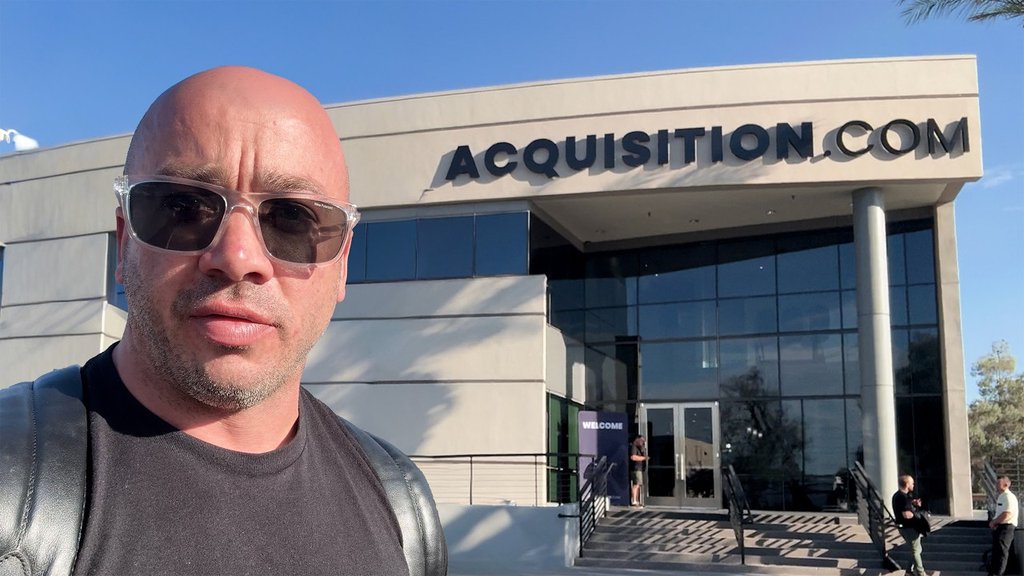
Table of Contents
I paid $130,000 for a day with Alex Hormozi and a day with his team, and most people told me I was crazy. But every time I’ve paid for access like this, I’ve made five or 10 times my money back within the first month. I knew it was what Pest Badger needed.
Every New Year’s Eve, my team and I make vision boards. Mine for 2025 had a picture of Alex holding his book, and the goal was to go spend time with him. I love marketing, and after his book launch, I think he’s the best marketer who ever lived. So I wanted to learn from him.
These are my notes from when this video came out in October 2025, from his scaling workshop to the day with Alex and the plan we came home with.
This video is part of PCO Tips. For the one constraint I worked on for the year after, read why Facebook leads don’t close and how we fix it.
Start With What Makes Your Company Worth Less
In the spring of 2025, I brought my CFO out to Acquisition.com for the scaling workshop. It’s two days with a workbook, and it tells you what your company is worth today. Most people there were surprised their company wasn’t worth a whole lot.
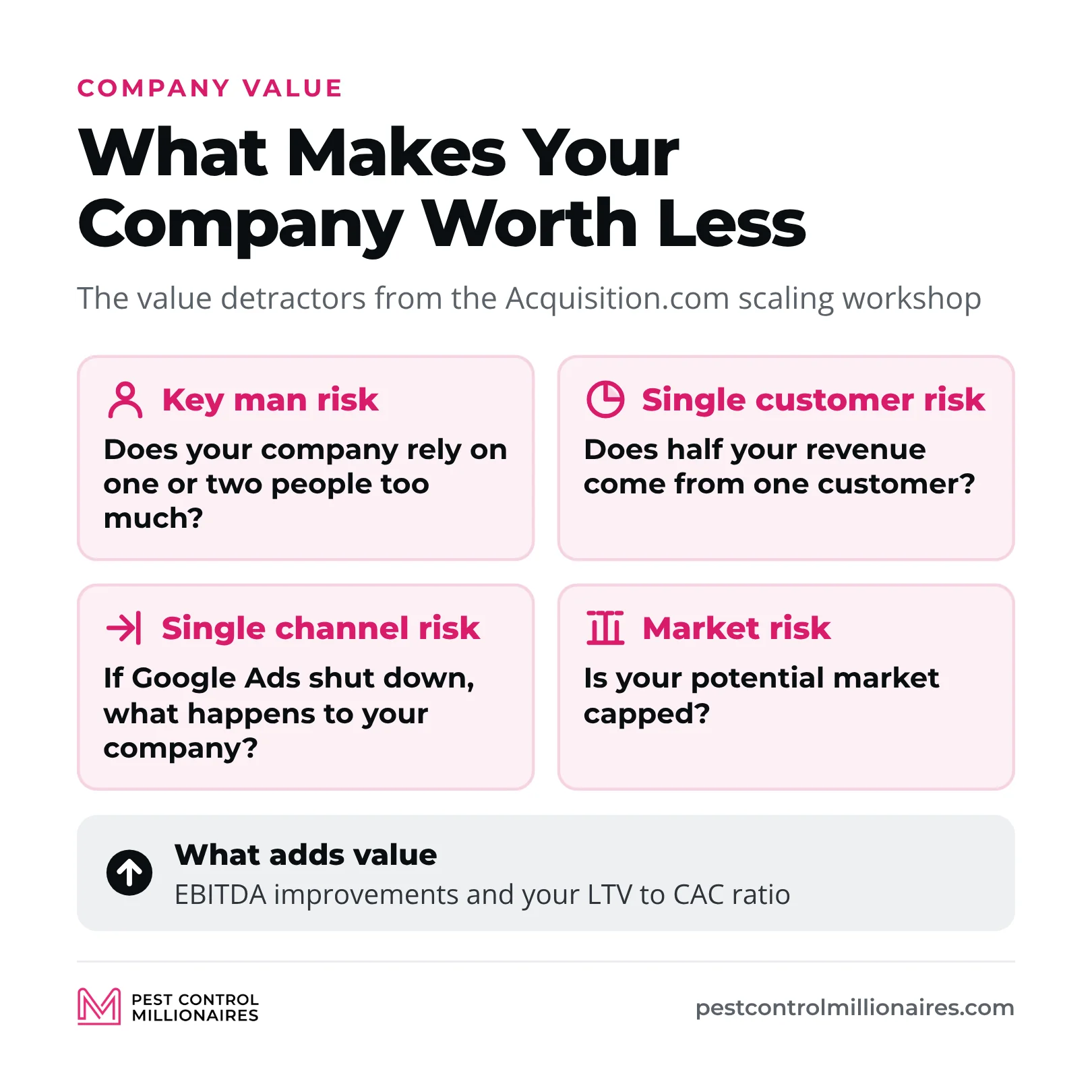
You go through what adds value, like EBITDA improvements and your LTV to CAC ratio. Then you go through what takes value away.
- Key man risk. Does your company rely on one person too much? We found that pretty much every business relies a lot on one or two people. If one big person left our executive team, we could have some key man risk.
- Single customer risk. If half your revenue comes from one customer, that’s a risk. We’re mostly residential, with lots of customers paying smaller amounts, so we don’t really have it.
- Single channel risk. Do you only rely on Google? Only door-to-door? Only referrals? If Google Ads shut down, what would happen to your company?
- Market risk. Is your potential market capped? Is your niche?
At the end of the two days, Pest Badger was in a really good spot. There’s always room to improve, and I loved digging into our LTV to CAC ratios to see where. My CFO also got to see what I like to do, what I’m working on and the people I like to hang out with. If you ever plan to sell, buyers take points off your multiple for things like key man risk, which I cover in selling a pest control company.
How a Letter Turned Into the $130,000 Workshop
On the last day, someone handed me an envelope. “Hey, this is from Alex,” they said, and told me to read it back at the hotel. It was a personal letter, signed by Alex, and about 10 of us got the same one. It goes to companies doing a million dollars or more a year in EBITDA, which is just a fancy name for profit.
A video sales letter explained the levels. At level two, you do strategy sessions with his team on marketing, sales, finance and operations. At level three, you spend eight hours with Alex to set the vision of the company and find the one or two big levers he can help you pull.
I sent it to my CFO. He’s very frugal, which is how CFOs are supposed to be, and I didn’t know what he’d say. I was on the fence when we sat down with their sales team. He looked at me and said, “No, this is a good decision. This is what we need to do.” So we signed up for level three, with level two after it.
What I Noticed About How Alex Operates
A few months later, I flew back out for the eight hours. Every time I spend time with someone of Alex’s caliber, the standard they set for their team is over the moon. His team practices saying hello a thousand times. Every one of them knew my name, my company’s name, my YouTube channel and my podcast.
There were 10 companies in the room. Alex had one to two pages of notes on each one, and each of us got 20 to 30 minutes on our own business, with two or three of his people taking notes for us. One of the first things he said was that he didn’t care if we were there until midnight. By 5 or 6 o’clock, your eyes are rolling back in your head from all the information.
I asked if I could see his gym. On the way down in the elevator, it was just him and me, so I asked if he always knew he’d be famous. He laughed. “No, but I always knew that I would try hard,” he said. I’ve always thought I had a really good work ethic, and it still feels like he finds more time than I do.
At the gym, if one person left one weight out, nobody was allowed to use it. Now his team knows that if something’s out of place, they put it back so everyone can keep using the gym. That level of detail is in everything he does, from the gym to the way he talks to you and trains his team.
We asked him what surprised him most about his book launch. “Nothing broke,” he said. It was planned over two years, down to a backup call center with hundreds of people and backup generators. The goal was $100 million in a day, and he made $105 million. “It’s actually kind of boring,” he said.
Someone asked what commission his salespeople make. Everyone guessed 5%, 10% or 15%. Zero, he said. His reps don’t get so many quality leads because they’re so good. They get them because he is. They’re still paid top dollar, just not with commissions.
Alex Pushed Other Owners to Raise Prices and Niche Down
Most of the companies in the room were service businesses, like landscaping, cleaning, janitorial and solar companies, which his team said isn’t typical.
One landscaping company did $5 million to $7 million a year and was already at the top of its market on price. Alex had the owner almost double her prices, with a whole strategy for it, and people were still going to buy. If you watch a lot of Alex’s stuff, you know he’s not afraid to raise prices.
A janitorial company was niching down into medical cleaning, like hospitals. Alex wanted the owner to convert the entire company to medical, triple or quadruple his pricing, change the name and the brand, and hire pharmaceutical sales reps to sell it, because they already know the industry and have contacts at those places. He always says the riches are in the niches. Bring up a bunch of different services, and he jokes that he’ll niche slap you.
Being at the top of your market on price doesn’t mean you’re charging what you could. We raise our prices every year, and I explain why the best companies in a market charge the most in premium pricing for pest control.
Alex Told Us to Build Out Inside Sales
Then he got to us. “Hey, you guys are doing a great job,” he said. With a few tweaks, he said, we could take Pest Badger nationwide, and he knows we can do it. We run kind of a Chick-fil-A model.
He said we’re really good at making content and at the ad side, so we should double down on content for our ads. And he told us to bring a few of our door-to-door reps into the office and really build out the inside sales team. I’ll be honest, that’s always been a leak, even though it does millions in revenue. We could five or 10x it by bringing good guys in from our door-to-door team, doubling or tripling our ad spend and quadrupling the time my team and I put into ad content.
Contract values and close rates are both higher in the office than on the doors. We weren’t going to stop knocking doors. But this one lever could solve a lot of problems for us. I’ve written before about the leak in our inside sales.
I also asked Alex if I should stop making content. “No, you can’t stop doing content,” he said. People go to your website and see that you look like a reputable business, then check your socials to see that you have a heartbeat, a pulse, and then they buy.
I’d been questioning it for a long time. We get millions and tens of millions of views, but we’re not selling pest control products to those viewers, so customers straight from viral videos are slim to none. The views are cool, but at the end of the day, what we need is customers. As we go nationwide, content helps the brand, so I planned to put more time into content for Pest Badger’s ads and keep making content about growing the company.
The Plan We Came Home With
After the day with Alex, this is how we planned to 10x Pest Badger.
- 10x our ad spend and our ad creative.
- Add a second channel. We’d been doing a lot of Google Ads, LSA and search and a little Meta, so we were going to double down on Meta, with targeting and retargeting.
- Bring our top 10 to 15 door-to-door reps into the call center. They’re used to knocking doors and overcoming objections. A lot of them have been with us for years and earned the spot. In the few weeks we’d been testing it since I got back, they were closing over 80%.
- Double contract values. We’d already doubled them and were still closing that high. These leads come to us with issues, and we just solve them.
- Run two tiers of reps. An inbound team, plus an outbound team for Facebook follow-ups and the door leads that sometimes get missed, even with software.
- Push prepays even harder. We’ve always pushed them, but we planned to give customers an extra discount to prepay the year, so we’re not chasing money and can always go get new customers.
- Aim for 20 to 1 on ad spend. For every dollar, $20 back, so $100,000 in ads brings back $2 million. In the month or so since I’d been back, we’d already proved it out.
- Open four or five offices at a time, and as we get bigger, 10, 15 or 20 a year. If we want to hit $100 million, that’s what it takes.
- Use the owner-operator playbook. Most people want the profit and part of the sale, without the risk or the control. So a general manager gets called the owner, with his plaque on the wall like Chick-fil-A does it. He acts like an owner because he’s focused on profit and his profit share, and he gains equity over four or five years, so he gets his share when we sell.
That was the plan in October 2025, and some of it has changed since. I don’t use a 20 to 1 target anymore. I measure every channel by lifetime gross profit against everything it costs to get the customer, sales commissions included, and in October 2026 our blended ratio was 8.8 to 1. Here’s how much to pay for a new pest control customer. Prepaid is still the best, but data from Alex’s team showed monthly billing cancels the most, so we moved new customers to quarterly billing, as I told Joey Mantione.
Was It Worth $130,000
Hands down, and I’d do it again. Proximity is power. I paid $130,000 for a day with Alex and a day with his team. People like this can solve one or two really big problems for you, and I know that $130,000 will make me millions of dollars over the next few years.
Every time I go to an event, my goal is to find one golden nugget. Alex gave me one. He didn’t hand me the answers, but he gave me a clear vision of what I need to go implement. We planned to do it again in 2026 and spend $130,000 again. I’m going to spend as much time with them as I can and take this thing nationwide.
Frequently Asked Questions
How much does it cost to spend a day with Alex Hormozi?
I paid $130,000 in 2025 for a day with Alex and a day with his team. The invitation came in a letter to about 10 companies doing a million dollars or more a year in EBITDA.
What happens at the Acquisition.com scaling workshop?
It’s two days with a workbook that shows what your company is worth today. You go through what adds value, like EBITDA improvements and your LTV to CAC ratio, and what takes it away, like key man risk, single customer risk, single channel risk and a capped market.
What is single channel risk?
It’s relying on one way to get customers, like only Google, only door-to-door or only referrals. Ask yourself what would happen to your company if Google Ads shut down.
What did Alex Hormozi tell Pest Badger to do?
Double down on content for our ads, spend more on ads and bring some of our door-to-door reps into the office to build out the inside sales team. Contract values and close rates are higher in the office, and in the first few weeks of testing, those reps closed over 80%.
Was spending $130,000 with Alex Hormozi worth it?
Yes, hands down. Proximity is power, and one golden nugget can solve a big problem. Alex didn’t hand me the answers, but he gave me a clear vision of what to go implement, and we planned to do it again in 2026.