How I'd Sell $1M in Pest Control Contracts in 7 Weeks

Table of Contents
- What I Get to Keep, and What It Costs to Open
- One Market and 2,000 Accounts
- The Sales Math Behind Seven Weeks
- You Don’t Need Veteran Reps
- Pay Reps as the Customer Pays, Not When They Sign
- Service Fast, and Hire Technicians Before You Knock
- Trucks, Payments and a CRM From Day One
- What’s in the Bank After Seven Weeks
- Year Two Is Where the Model Pays
- Marketing While the Doors Carry Year One
- The Three Numbers I’d Watch Every Day
- Could I Actually Do This
- Frequently Asked Questions
Six years, 20 locations, nine states. If I lost Pest Badger tomorrow, I think I could be back to a million dollars in annual recurring revenue in as little as seven weeks, starting with just $10,000.
That’s selling a million dollars’ worth of annual agreements, not collecting a million dollars, and there’s a big difference. You can sell a million dollars in pest control and go broke super fast. The biggest thing I’d do differently from most companies is how I pay my salespeople.
This video is part of PCO Tips. If you’re starting from zero, read how to start a pest control business too.
What I Get to Keep, and What It Costs to Open
Say Pest Badger is gone tomorrow. No customers, trucks, brand, office or employees. I keep the knowledge from 17 years in the service industry, my personal vehicle (most of you have a truck or an SUV in your driveway) and $10,000. I do have one advantage. I know enough door-to-door reps that I could probably call 50 to 100 and have them start tomorrow. For this exercise I’m calling five.
Opening costs a lot less than most people think. In this example I can meet the state’s licensing requirements myself, without hiring an experienced certified applicator, which could cost $5,000 to $10,000.
| What I need | Ballpark |
|---|---|
| Licensing | A couple hundred dollars |
| Insurance | About $120 for the first month |
| Backpack sprayer | $200 to $300 |
| Starting product inventory | Under $500 |
| Software, from day one | $300 to $500 a month |
| A sticker or magnet for my truck | A couple hundred dollars |
| Solicitor permits for door-to-door | About $100 apiece, so $600 |
That’s somewhere around $2,000 to $2,600 to get the basics in place. Those are planning numbers, not guaranteed prices in every state. Your state might have more certifications, a business license or different insurance, and the moment you put an employee in the field you need workers’ comp.
You don’t need $50,000 or $100,000 to start a pest control company. I give myself $10,000 because things never go according to plan. You buy more product than you expected, equipment breaks, the insurance deposit is higher, somebody quits after a few days. I want enough cushion that I never make a terrible decision because I’m short on cash.
One Market and 2,000 Accounts
I wouldn’t launch in five cities. I’d pick one market with houses close together and homeowners with the disposable income to pay us. If we’re selling 40 to 50 accounts a day, I need to service them without one customer on the north side of town and the next 40 minutes south. Tight routes, or route density, are what make this extremely profitable.
For easy numbers, I’m using a $600 annual contract, $150 a quarter for four services. I think that’s low too, but it’s an example. If you charge a bigger initial, your cash flow will look better than what I’m about to show you.
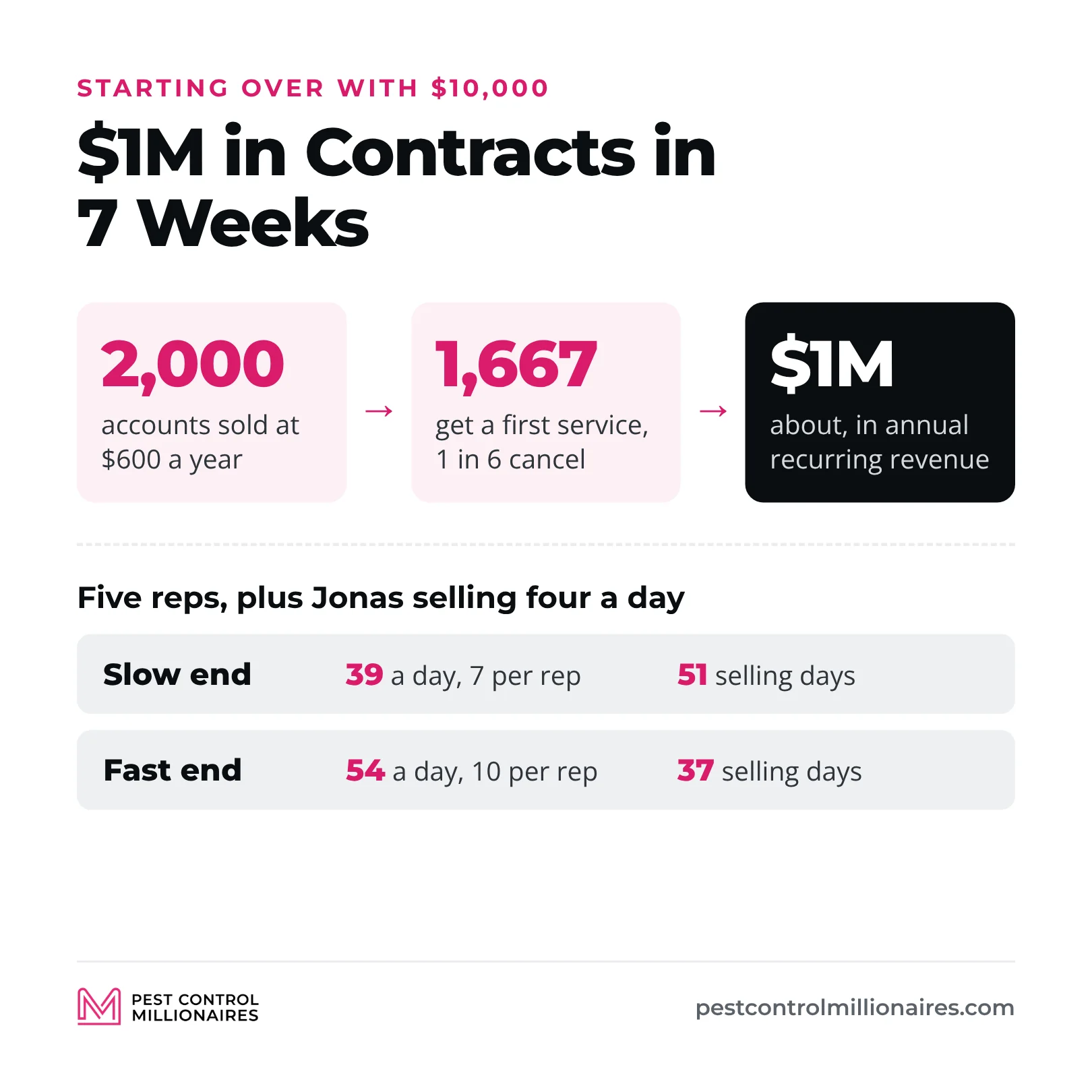
A million dollars divided by $600 is 1,667 customers. Not everybody who signs up makes it to the first service, so I’d plan on losing one out of every six and aim for 2,000 accounts. That’s $1.2 million in sold revenue, and if 1,667 make it through the first service, I’m at about a million dollars in annual recurring revenue.
The Sales Math Behind Seven Weeks
My five guys knock, and so do I. I’m not sitting in the office while everybody else is on the doors. I think I could still sell four a day. Good door-to-door reps sell seven to 10 a day, and some do 20 plus. To keep it conservative, here’s the range.
- Slow end. Five reps at seven a day is 35, plus my four is 39 accounts a day. That’s 51 selling days to hit 2,000, roughly eight to eight and a half weeks knocking six days a week.
- Fast end. Five reps at 10 a day is 50, plus my four is 54 a day. That’s 37 selling days, a little over six weeks.
To hit seven weeks, my five guys need to average around nine sales a day. Some days you sell 70 and some days 25, so seven weeks is my aggressive target. Maybe it takes eight, nine or 10, and I won’t sacrifice the quality of the customers to hit an arbitrary date. I’m confident in this model because the math works even if it takes longer.
You Don’t Need Veteran Reps
If you’ve never sold door-to-door, you don’t need five guys who’ve sold pest control for 10 years. None of my guys had ever sold pest control before. I learned how to sell, I taught them, and they got better than me and started teaching others. When I started Pest Badger six years ago, I knew one person who still works with me today. Everyone else we recruited.
Find a few people who are ambitious, willing to be outdoors, willing to get rejected and willing to learn. Show them how you approach a house and handle objections, have them listen to you sell, then listen to them sell. You’ll spend a lot of time training at first, but you don’t need experienced reps from another company. We walk through a full day with ours in how we run a pest control door-to-door sales team.
Owners also get caught up in the commission percentage. If I offer an experienced rep 40% of the contract, he might tell me he’s going to work somewhere else, and I get that. When we first started, our reps were somewhere between 20 or 25% and 50%, with an average around 30%. I’m using 40% here as the high end.
Pay Reps as the Customer Pays, Not When They Sign
This matters more than anything else in the plan. Sell 40 customers a day and you can create a massive cash flow problem almost immediately. A $600 agreement isn’t $600 in your account. It’s an agreement to pay you $600 over the next 12 months.
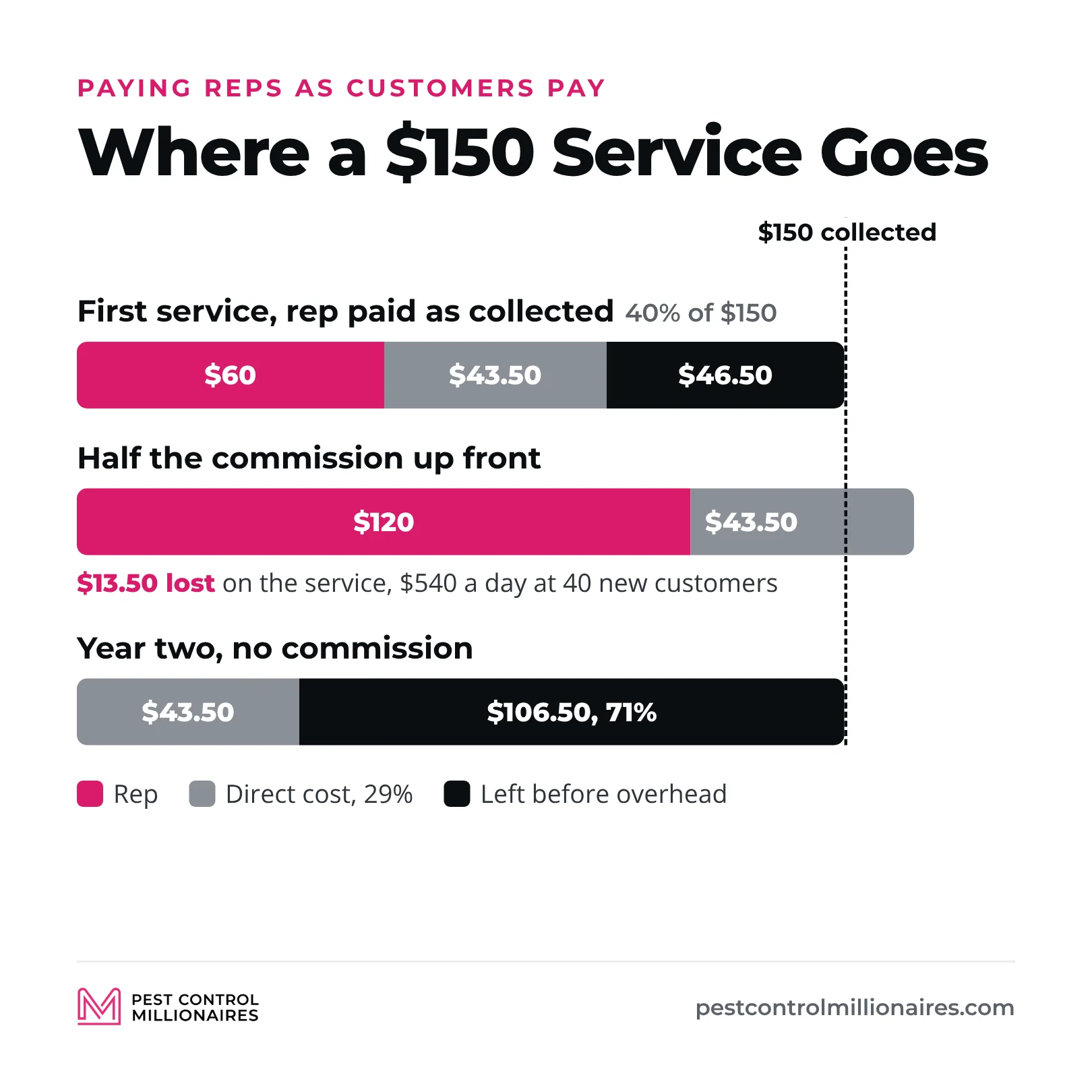
So I’d pay reps 40% of the annual agreement, $240 on a $600 agreement, but not when they sign the customer up. I pay it as the customer gets serviced and pays us.
- The customer signs up for $600, and we do the first service for $150.
- Once that payment clears, the rep gets $60, 40% of what we collected.
- Three months later we service them again, they pay another $150, and the rep gets another $60. Same on the third and fourth services.
- After the fourth service, the rep has their $240, the entire commission. When the 12-month agreement ends, so does the commission, and I don’t owe another acquisition commission when that customer goes into year two.
Here’s what the company keeps on that first service. The customer paid $150, the rep got $60, and at 29% direct cost of service, the service cost us $43.50. That leaves $46.50 before every other expense of running the company.
Now say your reps want half their commission up front on the first service. Instead of $60, you’re paying $120. Your cost of service is still $43.50, so you just lost $13.50 on that service before any other expense. At 40 new customers a day, that’s $540 a day you’re going backwards.
I see this all the time. Sales are through the roof and the bank account keeps getting smaller. Someone tells me they had $250,000 in the bank and owed $248,000 in back ends. They didn’t set the commissions aside, and when the back end checks came due they had to take a loan at 14 to 25%, pay $1,000 a week on it, or give up equity. You can run a back end model if you’re really good with money and actually save it, but most people don’t, and I don’t love paying people on revenue the company hasn’t collected.
Be clear on one thing. Your commission plan has to comply with your state’s wage and commission laws, including when contract-based commissions are earned and paid, and you never withhold wages. I just don’t want to front-load $240 in commission on a customer who might never get a first service.
Service Fast, and Hire Technicians Before You Knock
This model only works if you service customers quickly and really well. If technicians aren’t getting to the houses, reps aren’t getting paid, they get frustrated, and good reps have options. One of my biggest priorities would be every first service done within about 72 hours of the sale.
Keeping up with service is the hardest part of starting over. Forty new customers a day is 40 initial services, and reps don’t stop selling because your schedule is full. A good technician does about 15 stops a day, so I’d need maybe four technicians just for the initials, before re-services, customers who aren’t home, and the quarterly services coming due three months later.
So I’d start recruiting three to four weeks before we knock a door and line up five or six really good candidates, bringing them onto payroll as the schedule justifies it. Hire local people. Technicians driving hours every week to reach the market waste time and add vehicle expense, and I learned that the hard way. Our guide on how to find pest control technicians covers where we look.
Technicians get paid on performance too. By law they need an hourly or other lawful base pay, with an incentive on top for working efficiently and taking care of the customer. In the industry you’ll hear 10% to 14% of revenue or so, about $15 to $21 on a $150 service. But someone rushing to squeeze in two more stops gets you cancellations, callbacks and bad reviews, and the customers your reps worked hard to sign start disappearing. Track production, callbacks, complaints, reviews and cancellations. Our technician KPIs guide has the numbers we watch.
Trucks, Payments and a CRM From Day One
How do I buy four trucks with $10,000? I finance them, and I know I’ll take some heat for that. Say you find a used Ford Maverick for $15,000 with 20,000 miles on it. Depending on your credit, the payment and commercial insurance might run $400 to $450 a month, a ballpark, not a quote. At $46.50 left from each first service, roughly 10 services cover it.
That’s not the whole cost. There’s fuel, tires and maintenance, and a truck that breaks down in June with 15 customers on the schedule means rescheduled services and irritated customers. So reliable trucks have value, but I wouldn’t buy a bunch of them before I had the customers. I’d get enough to start, forecast sales and services, and add trucks as volume justifies it. I just wouldn’t put the business at risk to avoid a truck payment.
Every customer goes on automatic payments from day one, preferably ACH. We take cards too, but processing runs 3 to 5%, which is $30,000 to $50,000 a year on a million dollars in revenue. ACH can take an extra day to clear, so my system tells me when each payment clears and the rep’s commission goes out then. That means a CRM from day one. At 40 to 50 accounts a day, you can’t run this on a spreadsheet.
What’s in the Bank After Seven Weeks
If 1,667 customers got their first $150 service and paid, we’ve collected about $250,000. If some services are still scheduled or payments haven’t cleared at the end of seven weeks, it’s lower than that.
Out of $250,000, about $100,000 goes to the reps at 40%, and about $72,500 goes to direct service costs at 29%. That leaves about $77,500. That’s not profit. Truck payments, insurance, fuel, software, payment processing and everything else it takes to run the operation still come out of it.
But we started with $10,000 and built a customer base worth about a million dollars a year in recurring revenue, if those customers keep paying. I still needed working capital for payroll, insurance, supplies and vehicles before customers paid, but I didn’t have to pay $480,000 in commissions the moment 2,000 agreements were signed. That makes a huge difference.
Accounts sold, accounts serviced and money collected are not the same thing. You can have a record sales month and still be short on cash, and I’ve seen owners confuse sold revenue with money they can spend and get the business in trouble. When I decide on hiring or buying trucks, I go by what’s been collected and what we still owe.
Year Two Is Where the Model Pays
Year one can feel thin, because you’re spending a lot to acquire customers. Year two is the part I like best. If a customer renews at the same $600 plan, we collect $150 a visit, direct cost is still $43.50, and there’s no acquisition commission. That leaves $106.50, 71% of the revenue left after direct service costs. That isn’t 71% profit, because overhead is still there. But you pay to acquire a customer once, and if you take good care of them, you don’t pay again in years two, three, four, five and six.
Not everybody stays, and door-to-door customers can cancel more than customers who found you on Google or came from a referral. So be conservative. Say 25 to 30% of the 1,667 don’t renew after the first year. That leaves somewhere around 1,170 to 1,250 customers, roughly $700,000 to $750,000 in annual recurring revenue at $600 each. At 29% direct cost and no acquisition commission, that’s about $500,000 to $530,000 before overhead.
That’s why I care so much about retention and about training the reps on the initial sale. Lose half your customers and you’re paying commissions on new accounts every year just to stay where you are. Keep them for three, four or five years and the lifetime value gets a lot better, especially when you add mosquito service, rodent bait boxes or exclusion, or they refer a neighbor. I don’t want a company that has to sell 2,000 new customers every summer just to replace the ones we lost. If you want the math on what a customer is worth by channel, read how much to pay for a new pest control customer.
Marketing While the Doors Carry Year One
In this example, the sales team brings in the first 2,000 customers. Would I use Facebook ads, Google ads and Local Services Ads? Absolutely, and at Pest Badger we use them 1,000%. But with $10,000 and five reps, my attention goes to making those guys successful first.
I’d still post on social media every day, documenting the company with photos from our technicians, reps and customers, and I’d ask for Google reviews from the very first customer. At the start nobody knows who you are. After you’ve serviced 1,600 customers in one market, people see your trucks, neighbors talk, referrals come in and reviews build up. That’s how you move from depending on door-to-door to generating inbound leads too. It won’t happen in seven weeks, but I’d build it while the reps bring in the first customers.
The Three Numbers I’d Watch Every Day
If we were actually doing this tomorrow, I’d look at three things every single day during the launch.
- How fast customers get serviced. Selling 50 accounts a day doesn’t mean much if only 20 get serviced.
- Cancellations before the first service. If we’re losing way more than the one in six I planned for, something’s wrong. I’d talk with the rep. Maybe they’re overselling, or not explaining the agreement properly.
- Collections. If customers aren’t paying, I need to know why. Did the rep not get the card on file or the ACH? Did the card not get charged?
When you’re growing super fast, you can’t wait until the end of the month to find out something isn’t working.
Could I Actually Do This
I believe I could, in as little as seven weeks with a strong sales team. But I know how to sell, I understand the economics, I have people who can help me recruit, and I’ve learned the mistakes over 17 years. Without that, it’ll probably take you longer, and there’s nothing wrong with that. You might sell four a day yourself, hire your first salesperson three months from now, and not have a million-dollar customer base until year two, three or four.
The principles still apply. Don’t spend money you haven’t collected. Know what it actually costs to service your customers. Watch your cash flow. Get to customers on time, show up when you say you will, do a very good job, and keep them for a really long time. You don’t build a pest control company by selling a bunch of accounts. You build it by servicing those accounts profitably and keeping your customers happy year after year.
The $10,000 isn’t what gives me the confidence to start over. Knowing what to do with it is.
Frequently Asked Questions
Can you build a $1 million pest control company starting with $10,000?
Yes, I believe I could sell $1 million in annual recurring revenue in as little as seven weeks with $10,000 and five strong door-to-door reps. That’s sold revenue, not cash collected. Without the experience and the sales team, it will probably take longer, maybe years two, three or four, but the principles are the same.
How many customers does it take to reach $1 million in pest control revenue?
At a $600 annual contract, $1 million is 1,667 customers. I’d plan to sell 2,000, because about one in six customers cancels before the first service.
How should you pay door-to-door pest control sales reps?
I’d pay 40% of the annual agreement, but only as the customer gets serviced and pays. On a $600 agreement that’s $240, paid as $60 after each of the four quarterly services clears. The commission plan has to follow your state’s wage and commission laws.
How much does it cost to start a pest control company?
If you already have a truck and can meet the licensing requirements yourself, the basics cost somewhere around $2,000 to $2,600 in this example. That’s licensing, insurance for the first month, a backpack sprayer, product, software, a truck magnet and solicitor permits. I’d still start with $10,000 so a surprise doesn’t force a bad decision.
How fast should a new pest control customer get their first service?
Within about 72 hours of the sale. Reps don’t get paid until the customer is serviced and pays, so slow service frustrates your reps, and the good ones have options.