Pest Control Email Marketing and the 6 Emails Worth Automating

Table of Contents
- Where Email Fits Next to Texts and Calls
- The 6 Emails Every Pest Control Company Should Automate
- 1. Lead and Quote Follow-Up Emails
- 2. The Welcome and Before the Visit Email
- 3. The Review Request Email
- 4. The Referral Ask Email
- 5. Seasonal Add-On Emails
- 6. Win-Back Emails to Canceled Customers
- Pest Control Email Templates and Subject Lines
- Why Buying a Pest Control Email List Is a Bad Idea
- Keep Your Emails Out of Spam
- Follow the CAN-SPAM Rules
- Frequently Asked Questions
Pest control email marketing makes the most money on people who already know you, like customers, canceled customers and anyone with an open quote. Automate six emails, send them from your own domain with SPF, DKIM and DMARC set up, and never buy a list. For brand new leads, email backs up your texts and calls. It doesn’t replace them.
I’m Jake Sheldon, the original founder of Pest Control Millionaires, and I’ve helped 400+ pest control companies with lead generation. Here’s how I use email, how my partner Jonas Olson uses it at Pest Badger, which he built to over $20 million a year, and the rules that keep it out of spam.
Where Email Fits Next to Texts and Calls
Email used to be king. Not anymore. Emails from a company people don’t recognize go to spam or get ignored, while people read every text. That’s why we send only two emails in a new lead’s first week, as I lay out in my guide on how to automate a pest control business. We run our reactivation, upsell and referral campaigns on email instead, because those people already know us. That’s the first rule of email marketing for pest control companies. Send it to people who know you.
One setup tip from Jonas. Keep your marketing campaigns out of the system that sends your bills. When a customer opts out of a campaign there, they can stop getting billing emails and service reminders too. He explains why in his post on marketing automation for pest control companies.
The 6 Emails Every Pest Control Company Should Automate
These are the six pest control automated emails to set up. Each one has a trigger, so you set it up once and it keeps running.
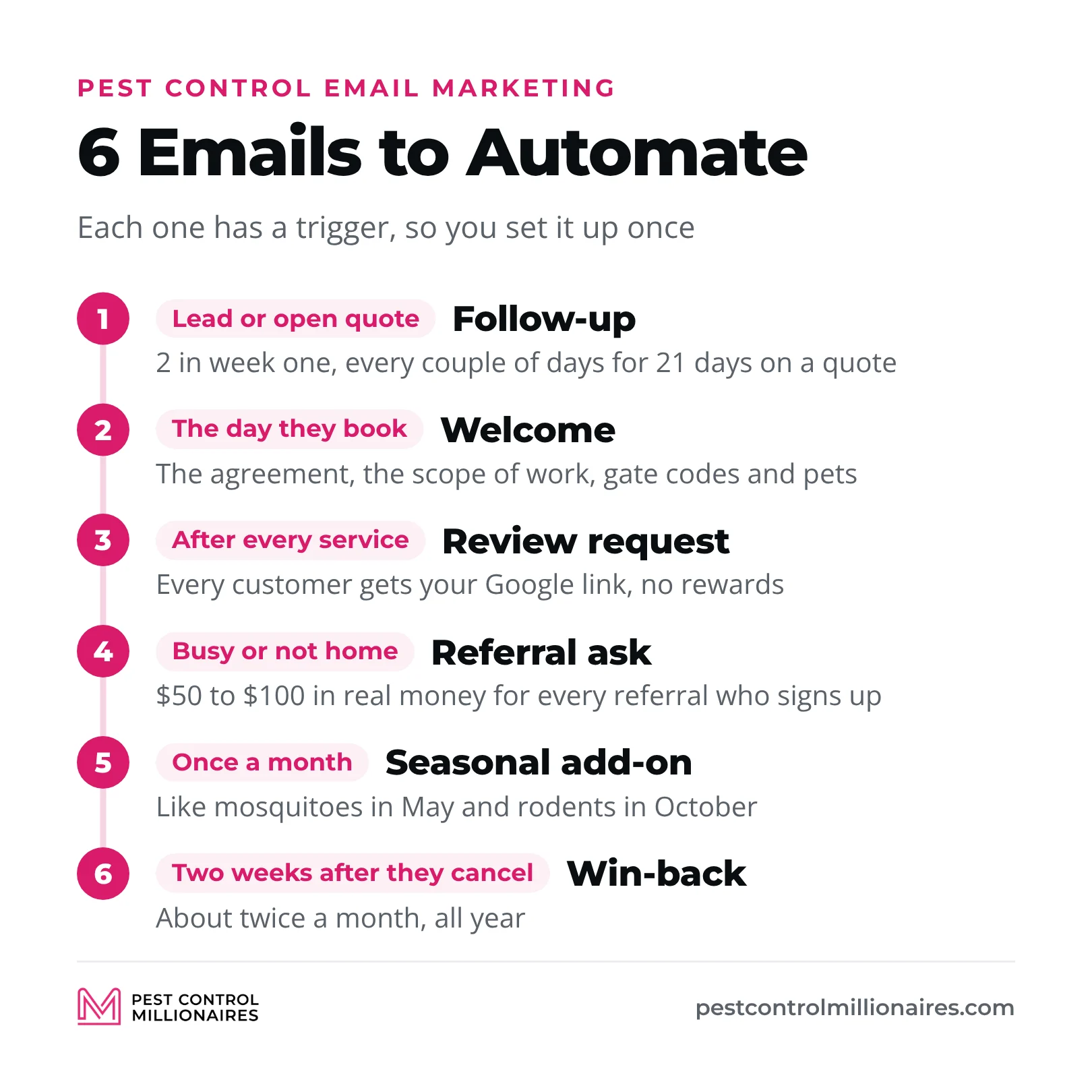
1. Lead and Quote Follow-Up Emails
Our first week with a new lead is 21 touches, and two of them are emails. Use them for what’s hard to say in a text, like your process and the answers to the objections you hear most. Jonas’s answers to those objections are in his pest control sales script.
Open quotes are where email does more of the work. In an August 2026 video Jonas said a lot of companies send out a quote and it just disappears. He recommends a 21-day follow-up, with a call every day and an email and a text every couple of days, until they buy or say no. “I’ve had people sign up on the 21st day,” he said.
Keep those emails plain. Mike Callahan, who sold his lawn company and went on to build marketing automations for service businesses, told Jonas on the PCM Podcast in 2023 that his day-two estimate email is plain text that looks like it came from your phone, down to “Sent from my iPhone.” His signups came in spikes, in the first two or three days, around days 8 to 10 and, to his surprise, around days 18 to 20, when his emails asked for permission to close out the estimate.
Leads who still haven’t booked move into my long-term sequence. Those are texts, not emails, and they’re how I closed one customer after three years. The schedule is in my guide to the pest control sales funnel.
2. The Welcome and Before the Visit Email
The day someone books, send a welcome email. It heads off the surprises that turn into cancellations. Put three things in it.
- The agreement. Billy Wright of Zona Pest Solutions told Jonas on the PCM Podcast in 2025 that customers get the agreement by text or email the same day or the next anyway, so his reps tell them everything at the door, cancellation fee included.
- The scope of work. Cameron Bawden told Jonas on his podcast that his techs at Green Mango go through a welcome packet at the kitchen counter that covers the full scope of work, so there are no broken expectations. Email it too.
- Gate codes and pets. Ask before the first visit, not at the gate.
Then let texts take over. Before we automated reminders, customers told us, “You should have reminded me so I could put my dog away.” Now a text goes out 15 minutes before the tech arrives and another when the service is done, as I explain in my guide to pest control service communication.
3. The Review Request Email
After every service, every customer gets your Google review link. Sending it only to customers who rate you five stars is review gating, and Google’s policy doesn’t allow selectively asking for positive reviews. Never offer a customer anything for a review, don’t pressure anyone, and don’t ask them to say something specific or name a tech. Don’t ask for Yelp reviews at all.
Your field service software can send it. GorillaDesk founder Chris Moreschi told Jonas on the PCM Podcast in 2023 that his software emails the customer for a review when the job is complete.
You can still catch problems. We ask for a separate internal score after every service, and when someone gives us a 4 or below, the automation alerts a manager to call them. The score never decides who gets the Google link.
4. The Referral Ask Email
Jonas’s advice is to ask at the end of every service. “Do you know three to five people who could use my service?” When the customer is busy or not home, a follow-up text or email asks instead.
Make it about real money. At Pest Badger, Jonas pays $50 to $100 by Venmo or Cash App for every referral who becomes a customer, never a credit or money off their next service, and one campaign brought in 255 referrals and 155 new customers. The system is in his guide to pest control customer referrals. Keep the referral ask and the review request in separate emails. The referral pays. The review never does.
5. Seasonal Add-On Emails
When my partner Dan Leibrandt interviewed Steve Delaney of Yard Boss in Lincoln, Nebraska, on Pest Control Success Stories, Steve told him that when he added pest control, one email to his existing clients filled half a route overnight. Customers who already trust you don’t need a discount. Tell them what they’re missing out on.
Time it to the pest. At Pest Badger, Jonas plans one focus a month on a marketing calendar, like mosquitoes in May and rodents in October. One of his best upsell emails started on a walk around his block while mosquitoes attacked him. He wrote it on his phone, told the story and sent it to his team, and it crushed. The calendar is in his guide to pest control offers.
- Leave out anyone who already has the service. Mike Callahan called out the blast that says “if you’ve already signed up, just ignore this.”
- Offer next year’s prepay at each customer’s last service of the year, then follow up by email and text. A free mosquito or flea and tick treatment for paying up front adds value without a discount.
- Don’t announce price increases by email. At Pest Badger, Jonas puts the new price on the invoice.
6. Win-Back Emails to Canceled Customers
At Pest Badger, Jonas starts a drip about two weeks after a customer cancels, with emails and texts about twice a month, all year. He mixes nature and nurture. Nature is what pests are doing right now. Nurture is a real customer’s problem and how you solved it, plus an offer. You already paid to acquire them, so the offer can be big, like a free first service back. Time it to their pest, so a canceled mosquito customer hears from you in May. What to say depends on why pest control customers cancel in the first place.
Expect to win back maybe 1 to 3%, and 3 to 5% if you’re really good at it, Jonas says. With thousands of customers that’s a lot of people you already paid for, and the emails cost almost nothing. His playbook is in reconnecting with old clients in pest control.
Pest Control Email Templates and Subject Lines
Keep subject lines short and honest. Google says the subject has to match what’s inside, and the FTC bans deceptive ones.
| Subject line | What the body says | |
|---|---|---|
| Quote follow-up | Your quote from [company] | Plain text, signed by you. Any questions? Reply here or call me. |
| Last quote follow-up | Should we close your file? | Do you still want us out there? If now isn’t the right time, no problem. |
| Welcome | Welcome to [company] | Your agreement, what’s included, and a question about gate codes and pets |
| Review request | Thanks for having us out today | We’d love your honest review on Google. [Google review link] |
| Referral ask | Know someone with a pest problem? | Here’s your link. You get real money for every friend who signs up. |
| Seasonal add-on | The mosquitoes got me this morning | A true story from your area, then the add-on and how to say yes |
| Win-back | Rodents are moving indoors | How to protect your home, and your first service back is free |
Why Buying a Pest Control Email List Is a Bad Idea
A bought pest control email list is a list of strangers, and strangers are the people who ignore your emails or send them to spam. The inboxes agree. Google tells senders to email only people who want to hear from them and to make sure they opt in, and spam reports drag down your domain’s reputation. Yahoo’s sender rules say it outright. Don’t purchase mailing lists. Mailchimp, which we use for our larger email sequences, bans purchased, rented and third-party lists.
The federal CAN-SPAM Act doesn’t require opt-in, but Google and Yahoo decide whether you reach the inbox, and a bought list’s spam reports hit the same domain your quotes and review requests come from. Build your own list. Every lead form, quote and customer record should have an email on it. Mike Callahan’s advice is to pull leads out of your ad platforms into your own CRM, because otherwise “you’re leasing it.”
Keep Your Emails Out of Spam
Since February 2024, Google and Yahoo have required senders to authenticate their email, with stricter rules for bulk senders. Google counts you as one when you send close to 5,000 messages or more to personal Gmail accounts in a day from the same domain, and once you hit that, you’re a bulk sender for good.
| Rule | Every sender | Bulk senders |
|---|---|---|
| Authentication | SPF or DKIM | SPF, DKIM and DMARC (a policy of none is fine), with a From domain that matches |
| Spam rate | Below 0.3% | Below 0.3%, and Google says over 0.1% already hurts |
| Unsubscribe | An easy way out of every marketing email | One-click unsubscribe on marketing emails, plus a visible link in the body |
| Unsubscribe speed | Within 10 business days (CAN-SPAM) | Within 2 days for Yahoo, and Google recommends 48 hours |
Google recommends SPF, DKIM and DMARC for every domain, not just bulk senders. Send from your own domain, like [email protected], not a Gmail address, a point Jonas made on the PCM Podcast back in 2022. Don’t start a subject line with “Re” or “Fwd” unless it really is a reply or a forward. And keep marketing and transactional email apart, as Yahoo recommends, which is one more reason to keep campaigns out of your billing system the way Jonas does at Pest Badger.
Follow the CAN-SPAM Rules
The federal CAN-SPAM Act covers every commercial email. The FTC’s compliance guide boils it down to a few rules.
- No false or misleading header information and no deceptive subject lines.
- Identify the message as an ad.
- Include a valid physical postal address, like your street address or a PO box registered with the Postal Service.
- Tell people how to opt out and honor it within 10 business days, without charging a fee or asking for more than an email address.
- If you hire a company to send your email, you’re still responsible.
Each email that breaks the law can cost up to $53,088. Emails that only confirm something the customer already agreed to are exempt from most of the rules, but the FTC reads that narrowly. If the subject line reads like an ad, or the pitch comes before the reminder, the email counts as commercial. This isn’t legal advice. Have a lawyer check your setup.
Frequently Asked Questions
Does email marketing work for pest control companies?
Yes, with people who already know you. We send only two emails in a new lead’s first week, because emails from a company people don’t recognize get ignored or go to spam. Email works well for open quotes, review requests, referral asks, seasonal add-ons and win-backs.
What emails should a pest control company automate?
Six. Follow-up on new leads and open quotes, a welcome email when someone books, a review request after every service, a referral ask, seasonal add-ons timed to the next pest and win-back emails that start about two weeks after a customer cancels.
Should I buy a pest control email list?
No. A bought list is full of strangers, the people most likely to ignore you or mark you as spam. Google wants recipients who opted in, Yahoo says not to purchase mailing lists and Mailchimp bans them. Build your own from lead forms, quotes and customers.
What are Google’s email requirements for pest control companies?
Every sender needs SPF or DKIM and a spam rate below 0.3%. Once you send close to 5,000 messages a day to personal Gmail accounts, you also need SPF, DKIM, DMARC, a matching From domain and one-click unsubscribe on marketing emails. Yahoo asks the same of bulk senders.
How often should a pest control company email its customers?
It depends on the email. Review requests go out after every service, win-back emails about twice a month and seasonal add-ons once a month. On an open quote, Jonas Olson recommends an email every couple of days for 21 days.