Pest Control Sales Script for Phone Calls and Web Leads

Table of Contents
- Why Every Call Needs the Same Script
- The Pest Control Call Script in Six Steps
- The Speed-to-Lead Call for Web and Facebook Leads
- Voicemail and Text Follow-Up Scripts
- What to Say When They Say Not Right Now
- Common Objections on the Phone
- The Door-to-Door Script Is a Different Script
- Write It Down and Practice It Every Day
- Frequently Asked Questions
A pest control sales script is the same few steps in the same order on every call. Find out why they’re calling, confirm the problem and what they’ve tried, explain how you’ll fix it, stack the value of your guarantee, give them a reason to book now, answer their concerns, then take the card and book the first visit. That’s the order I teach, and it works whether the phone rings or you’re calling back a web or Facebook lead.
I’m Jonas Olson, CEO of Pest Badger, which we built to over $20 million a year in about six years. This guide is what to say on those calls, built from how we sell and what my PCM partner Jake Sheldon teaches about web leads and follow-up.
Why Every Call Needs the Same Script
We’re not trying to pressure anyone. We’re not trying to sound clever. We’re just guiding the conversation in the right order. Same order, every single call, every single time.
Without that order, good leads leak. When I went through our numbers in 2022, I found a $3 million leak at Pest Badger, and part of it was callers who were ready to buy and still didn’t get closed. Our fix was a dedicated inside sales team. You can write the script that team would use before you ever hire it.
The Pest Control Call Script in Six Steps
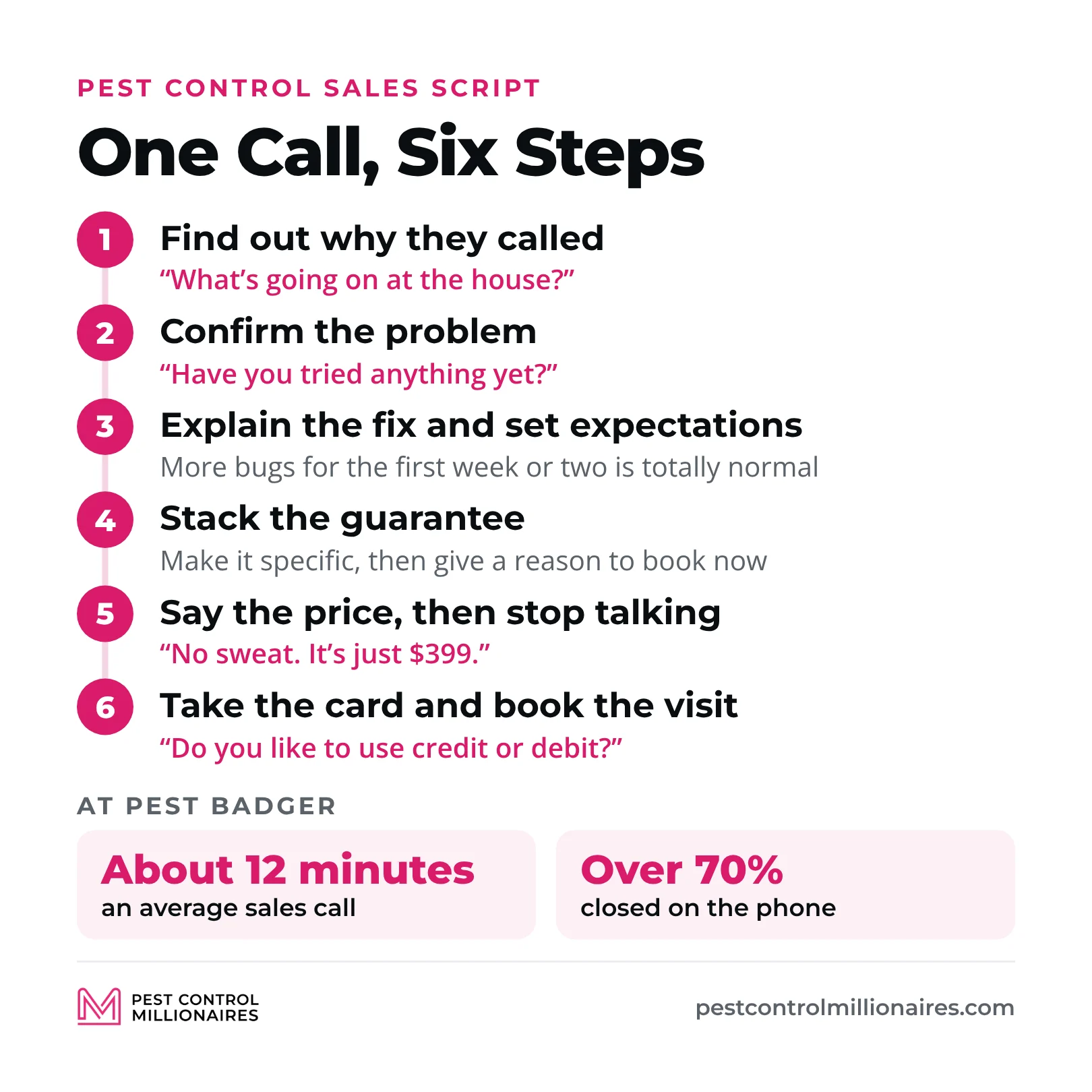
The order I teach has eight parts. Here they’re grouped into six steps that fit on one page by the phone. At Pest Badger an average sales call runs about 12 minutes, so this is a short conversation, not a speech. Answer within three rings and offer a visit the same day or the next.
1. Find Out Why They Called
Give your name and the company, ask an open question and let them talk.
“Thanks for calling [company], this is [your name]. What’s going on at the house?”
2. Confirm the Problem and What They’ve Tried
Sum up the problem so they know you heard it, then ask about the past.
“So you’re seeing ants in the kitchen, mostly by the sink. Have you tried anything yet, or had a company out before?”
The answer tells you which objection is coming. In my experience, a do-it-yourselfer is either trying to save money or has been burned by a company before.
3. Explain the Fix and Set Expectations
Tell them what the technician will do and what happens after. If your service is different, give it a name. Cameron Bawden told me on the podcast that Green Mango’s phone reps make sure customers know that Triblock, their three barriers of protection, is only at Green Mango.
Then be honest about the first couple of weeks. Our technicians tell first-time customers this, and it belongs on the phone too.
“You’re probably going to see more bugs for the first week or two. We’re flushing everything out of the walls and baseboards. That’s totally normal.”
Mosquito control is a reduction service, and we tell customers we can typically reduce mosquitoes by 70 to 80%. As Billy Wright of Zona Pest Solutions in Gilbert, Arizona, told me on the podcast, “If you tell somebody you’ll never see a bug again, they are not going to like you.” My guide to first impressions in pest control covers the first visit that follows.
4. Stack the Guarantee and Give a Reason to Book Now
I think guarantees like “100% satisfaction guaranteed” have gotten played out. Make the promise specific, using your own callback window.
“If you’re still seeing issues in the next 30 days, we’ll come back out there and service it for you.”
Then give a reason to book now. There’s always, always a reason to buy now, and on an inbound call it’s the problem and how fast you can fix it. When my heat went out in the middle of winter, the first two companies didn’t answer, the third couldn’t get someone out for a week, and the fourth came the same day and got the job. I didn’t care what it cost.
“I can get a technician out to you tomorrow morning. Does that work?”
5. Say the Price, Then Stop Talking
“How much does it cost?” is a buying question, and all the value should come before you answer it. Say the number, then be quiet. After the price, the first person who speaks loses. I told PCM member Joey Mantione of Pops Pest Control in North Jersey that during a live breakdown, and I gave him this line.
“No sweat. It’s just $399. Do you like to use credit or debit?”
Joey’s own price line ended with “How does that sound?” and he admitted “it gets so awkward.” My line goes straight to the card.
Quote general pest on the phone. We close over 70% on the phone at Pest Badger, some reps over 80%, on initials of $300 to $400. Exclusion, bed bugs and termites get an inspection in person. My advice is a small inspection fee, $50, $100 or $200, credited back if they buy, because it filters out price shoppers.
6. Take the Card and Book the First Visit
Get a card or ACH on file during the call, before anyone drives out. Then say the terms out loud. Billy Wright learned this on the doors. Rookies think they have to leave out the cancellation fee or the fact that it’s a contract, he told me, and it makes them look shady, because the customer gets the agreement by text or email anyway. Tell them how long the plan runs, what’s included, what isn’t and when the card gets charged. We bill new customers quarterly at Pest Badger, and prepaid is better still.
Book the first visit before you hang up and tell them what comes next, like the text before the technician arrives.
From the PCM Facebook group
What's an easy way to close a higher percent of leads?
9 of 21 owners credit a closing technique like asking for the sale; 6 say listen and educate first.
The Speed-to-Lead Call for Web and Facebook Leads
A form lead didn’t call you, so reach them first. Jake texts within 30 seconds to a minute and calls within five minutes, and I want every lead called at least twice in the first five minutes. The text goes first because most people won’t answer a number they don’t know, and on many iPhones a signed text makes your call show up as “Maybe” and your name. Jake’s instant text is short.
“Hi [name], this is [your name] from [company]. We just received your request for [service]. I’m going to give you a call in the next few minutes to get you scheduled and answer any questions. Talk soon! Reply STOP to opt out.”
When they pick up, say why you’re calling, then run the six steps.
“Hi [name], it’s [your name] with [company]. You just asked about [service] on Facebook, so I wanted to get you taken care of. What’s going on at the house?”
Cold leads need more explaining than referrals, Jake says, and a Facebook, Google or directory lead his team hasn’t called within five to 10 minutes is often signed with someone else. His day-one cadence is in the guide to increase pest control sales.
Judge close rates by source. On Facebook leads I’d call 20 to 30% good, and Jake’s team closes 40 to 45% with its full follow-up system, up from 10 to 15% before it. If one channel closes over 70% consistently, I start looking at pricing.
Voicemail and Text Follow-Up Scripts
If the second call goes to voicemail, leave one. Jake keeps his to three things. Who you are, why you’re calling and what you want them to do.
“Hi [name], this is [your name] from [company]. I saw you filled out a form on Facebook for [service]. I’m calling to get you scheduled and answer any questions before you sign up. Give me a call back at this number, or I’ll try you again in a few hours.”
Then keep going. Jake’s minimum is one call and one text a day for five to seven days. Anyone who hasn’t booked gets automated texts on day 14, 21 and 30, then every two months, then every six months, until they buy or say stop. He closed one customer after three years, and seasonal offers are why. Someone who passed on mosquito control gets this a year later.
“Hi [name], you were interested in our [service] offer last year. This year we’re running the same offer.”
The full schedule is in the pest control sales funnel guide, and the consent, opt-out and calling-hour rules are in the pest control automation guide.
What to Say When They Say Not Right Now
“Not right now” usually means not sure yet. Our inside sales team at Pest Badger works every lead until there’s a decision, yes or no. Agree, then find out what’s in the way.
“Totally understand. Have I given you enough information to make a decision today?”
That’s a gold mining question. “Yes, but what’s the price?” is a buying question, so answer it and close. If it’s a real “not yet,” set a time for the next call.
Then tag the reason in your CRM. Jake’s team tags leads like “needs to talk to spouse,” and the tag moves them into follow-up automatically. Leads who go elsewhere or say you’re too expensive go to the lost pipeline with the reason attached, and if 40% say too expensive, Jake says, look at your prices. The stages are in his guide to pest control sales lead management.
For a quote that didn’t close, I told Joey to follow up for two days, then stop at the house and knock.
Common Objections on the Phone
Most of these answers come from the script my door knockers use at Pest Badger, and the rules hold on the phone. Agree first (“Totally understand,” not “Oh”), don’t repeat their words back, and dig for the real objection.
| They say | What to say |
|---|---|
| “How much is it?” | It’s a buying question. Finish the value, say the price and stop talking |
| “That’s more than I expected” | Don’t drop the price. Go back over what’s included and your callback promise, then ask again |
| “I need to talk to my spouse” | “I don’t want you sleeping on the couch over pest control. What do you think they’d say no to? The price? The product? Me?” |
| “I need to think about it” or “Can you email me a quote?” | “Sure. Have I given you enough information to make a decision today?” |
| “I do it myself” | “In my experience it’s one of two things. You’re trying to save money, or you’ve been burned by a company before. Which one is it for you?” |
| “I already have a company” | “Awesome, who’d you go with?” Then ask what they do on each visit, and never talk bad about them |
The Door-to-Door Script Is a Different Script
There’s the whole inside script and how to answer phones. It’s totally different than the script out on the doors. Nobody at the door asked for you, so you get three seconds to earn the next three. My door pitch is an icebreaker, an introduction, a reason you’re on their street, the offer and the close. The full script is in the pest control door to door sales pitch, and the smoke screens you’ll hear on every street are answered in door to door pest control objections.
Write It Down and Practice It Every Day
Before anyone hires a VA to take calls, Jake asks to see their script, one for general pest, mosquito, termite and everything else they sell. Without it, he says, the VA will fail.
Then practice. We role play with our CSRs and our salespeople at Pest Badger every single day, and as I told Joey, role playing the top five or 10 questions that come into the office takes about 20 minutes a day. Jake’s team listens to recorded sales calls for 30 minutes to an hour a day. And keep people on sales calls. Our AI agent covers the service line when the CSRs are busy or the office is closed, but it never answers sales calls.
When Dan Leibrandt interviewed Alex Deageuro and Justin Lidick of Southwest Weed & Pest in Rio Rancho, New Mexico, for Pest Control Success Stories, they told him they probably left a hundred grand on the table in one year because they couldn’t keep up with the calls. Now five virtual assistants who all know how to sell cover their office from 7 AM to midnight, seven days a week, and on Sundays they close five to ten jobs just by answering the phone.
Frequently Asked Questions
What should a pest control sales script include?
The same steps in the same order on every call, from finding out why they called to taking the card and booking the first visit. In between you confirm the problem, explain the fix, stack your guarantee, give a reason to book now and answer concerns. An average sales call at Pest Badger runs about 12 minutes.
What do you say when you call a pest control lead back?
Text first, then call within five minutes. Say who you are and that you saw their request, then run the same steps as an inbound call. If they don’t pick up, call right back, then leave a voicemail that says who you are, why you called and what you want them to do.
Should you quote pest control prices over the phone?
For general pest, yes. We close over 70% on the phone at Pest Badger on $300 to $400 initials. Exclusion, bed bugs and termites get an inspection in person, and I recommend a small inspection fee that’s credited back if the customer buys.
What do you say when a customer says they need to think about it?
Agree first, then ask “Have I given you enough information to make a decision today?” If they’re still not ready, tag the reason in your CRM so the lead lands in follow-up, and keep calling and texting until you get a yes or a no.
What is a good close rate on pest control phone calls?
It depends on the source. We close over 70% on the phone at Pest Badger, and some reps close over 80%. On Facebook leads I’d call 20 to 30% good, and Jake Sheldon’s team closes 40 to 45% with its full follow-up system. If one channel closes over 70% consistently, I start looking at pricing.