Why Pest Control Customers Cancel and How to Keep Them

Table of Contents
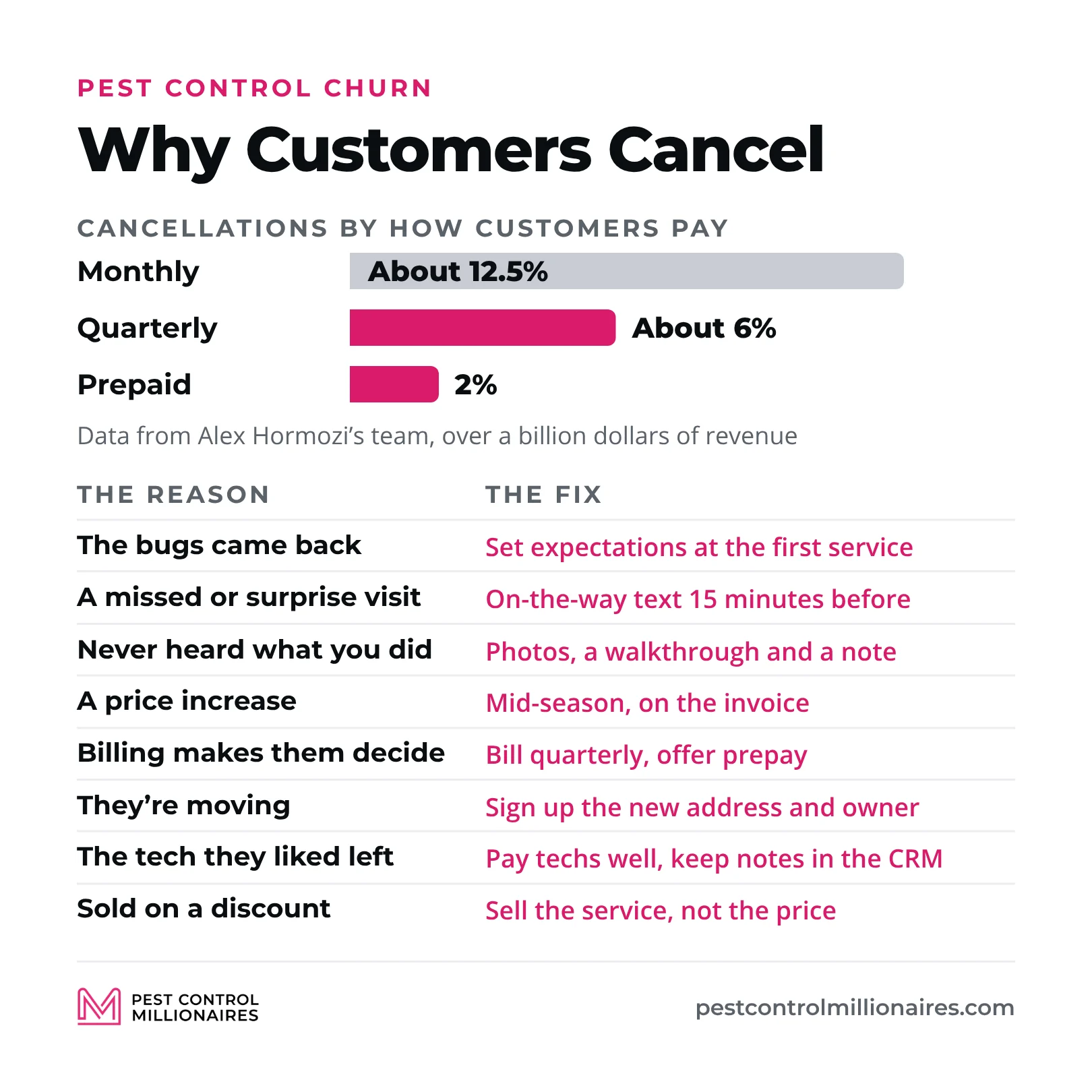
Pest control customers cancel for a short list of reasons. The bugs come back or the service slips, a visit gets missed or comes as a surprise, nobody tells them what was done, a price increase lands badly, the billing makes them decide again, they move, the tech they liked leaves, or they were sold on a discount. Moving is the only one you can’t do much about. The rest you can fix.
I’m Jonas Olson, CEO of Pest Badger, which we built to over $20 million a year in about six years. This guide pulls together what we do at Pest Badger, what my partner Jake Sheldon does in his companies and what PCM members and podcast guests have shared about pest control customer retention.
Why Pest Control Customers Cancel
Greg Young, co-founder of Natura Pest Control, said it best on my podcast. “Retention begins in your marketing and it goes on forever.” Most of these reasons start long before anyone calls to cancel.
From the PCM Facebook group
What is the #1 reason customers cancel?
Moving, selling the home or passing away was the #1 reason for 10 of 28 owners in the PCM Facebook group. Most of the other reasons below start with the sale and the service.
1. The Bugs Came Back or the Service Slipped
Joey Mantione, a member who owns Pops Pest Control in North Jersey, told me he tracked his cancel calls and found two main reasons. The first was customers still seeing bugs, which he put down to setting expectations poorly. You sell the dream of no bugs, and nobody can promise that.
So set expectations at the first service. Our techs tell new customers they’ll probably see more bugs for the first week or two, and that we’ll come back for free if there’s still activity after two weeks. Mosquito control is a reduction service, about 70 to 80% fewer, not zero. The whole visit is in first impressions in pest control.
Then keep the service good. When my partner Dan Leibrandt interviewed Shawn Riley of Tactical Pest Solutions on Pest Control Success Stories, Shawn told him even a 10-year customer will cancel after two bad services. Watch callbacks by tech, and ride along with anyone way above the rest. And when customers stop seeing bugs and think they don’t need you, tell them that’s the service working.
2. A Missed Visit or a Surprise One
Before Jake automated his texts, customers kept telling his team they didn’t know anyone was coming, or they could have put the dog away. Now the field service software sends an on-the-way text 15 minutes before every service. As Jake puts it, the software never forgets. Your techs might. His setup is in pest control service communication.
Showing up when you said matters too. Natura stopped rescheduling current customers to make room for new ones and kept a tech free in case someone called out. “We just fulfilled expectations,” Greg told me.
3. Nobody Told Them What You Did
A customer who never sees the work starts wondering what they’re paying for. Our techs take before and after pictures, walk the customer through what they did and leave a detailed note when nobody’s home. Shawn’s team texts ahead, texts when the service is done and knocks on the door when they arrive and when they leave.
Jake also sends a short internal rating after every visit. Four stars or below alerts the owner, who calls and fixes it before it turns into a cancel. Every customer still gets the Google review link, because Google doesn’t allow picking who gets asked.
4. A Price Increase Handled Badly
Price was Joey’s other main reason. He had texted every customer the new price at the start of the season, and some canceled partway through. He didn’t blame the price. “It’s not that the price is too high, it’s that we’re not providing enough value,” he told me.
When we raise prices, we don’t apologize. We explain what the customer gets, and the new rate shows up on the invoice instead of in a letter. Early spring is the worst time, because it gives people the whole season to shop around. The best window is mid-season, around the second, third or fourth service. The math on 100 customers is in raising pest control prices.
5. Billing That Makes Them Decide Again
Every renewal call and spring letter is a decision point, a chance to say no. I bought a company with 5,000 customers where the CSR called every one of them each spring to ask if they wanted service. I’d rather keep showing up on schedule until the customer calls to cancel.
A monthly charge works the same way, and it’s an easy one to cut in a subscription app when they aren’t seeing bugs. In data from Alex Hormozi’s team covering over a billion dollars of revenue, monthly subscriptions canceled at about 12.5%, quarterly billing at about 6% and prepaid at 2%. I checked it against our own customers at Pest Badger, and our subscriptions canceled more too, so I moved new customers to quarterly billing the same day. The numbers didn’t come with a time period, so use them to compare billing types, not as a target for your own rate.
Prepaid is best. We make the prepay offer at the last service of the year, while customers are happy, and give them a reason like a free add-on, built into the regular price. More in pest control selling subscriptions.
6. They’re Moving
It’s the hardest one to save. Customers sometimes say they’re moving when they’ve switched companies, so look up whether the house is actually listed. If the move is inside your service area, sign up the new address, and go after whoever buys the old one.
7. The Tech They Liked Left
It’s easy to fire Pest Badger the brand. It’s really hard to fire the technician who’s serviced your house for two years and knows your dog’s name. Shawn told Dan the same thing. Customers won’t cancel Caleb, one of his techs, because they don’t cancel the person they know and trust.
That cuts both ways. When a tech leaves, the relationship can go with him. Keep good techs by paying them well. We pay for performance, and techs who make really good money are a lot less likely to leave. And put the relationship in the CRM. Our techs note the dog’s name, where they found activity and what they treated, so the next tech knows exactly what to look for.
8. They Were Sold on a Discount
Cameron Bawden of Green Mango told me you keep a customer at the sale, not at the cancel. Someone talked into signing at the door acts very differently from someone who saw an ad and chose you. I see it too. Some door-to-door reps discount the first service, promise the customer will never see a mosquito again and sell right at the price floor. Customers who come in through our inside sales team stay longer.
Greg lived the extreme version. When Natura was “just a summer sales company” in California, it lost 30 to 35% of its customers a year.
The fix is selling the service, not the price. Stack value into the offer instead of leading with a discount, and train reps so the sale matches the service. As Spenser Morgan of ProForce Pest Control told me, “That sales team has to look, smell and feel like your service team.”
How to Measure Pest Control Churn
Churn is cancellations divided by active customers. Start the year with 1,000 customers, lose 200, and churn is 20%.
Then break it down. I track cancellations every week by technician, route and branch, and dig into any spike. On one route, a spike often points to a tech who rushes or doesn’t explain his work. Natura’s churn model also looks at lead source, time of year and whether there was a follow-up call. Expect the biggest fall-off in spring, when people move, get door knocked and shop around. We see fewer cancellations in December, January and February than mid-season. Cancellations are one of the five numbers I tell owners to start with in pest control KPIs.
What’s a good number? No single number fits every market, so measure your own. For reference, Greg told me the industry standard is about 20%, with his worst office at 27% and a goal of 16 or 17%. When Cameron was on my podcast in 2023, Green Mango’s cancel rate was 15%, down from about 20 to 22%.
Roughly, the average customer stays 1 divided by your yearly churn rate. At 20% that’s 5 years, and at 30% about 3.3. On a $1,000 yearly contract at a 50% gross margin, that’s $2,500 of lifetime gross profit (5 x $1,000 x 50%) against about $1,650 (3.3 x $1,000 x 50%), from the same cost to win them.
How to Save a Cancel Call
Greg calls the cancel call “reactive retention,” a losing battle if it’s all you do. But every account you save is one you don’t have to buy again.
- Make sure it’s really the customer. Some door-to-door reps will call to cancel for a customer. Check the phone number on file or the last four digits of the card.
- Talk to them. If they cancel by text or email, call. Send a branch manager to the house if you have one. Most people just want to be heard. I keep cancel calls with people, not our AI phone agent, because I want to know why they’re leaving.
- Ask why they signed up in the first place. Remind them you solved that problem, and that the treatments are why they aren’t seeing bugs.
- Fix what you got wrong. Comp the service you messed up. Greg’s version is fast response, real empathy and “it’s our fault, we’ll fix it.”
- Save part of it. I’d rather take a bundle from three services down to two or one than lose all three.
- Show empathy when money is tight. Pause them for three months, skip charging a quarter or drop them from $40 to $10 a month to keep the account.
- Give the call to someone good at it. Our retention team is paid to keep accounts, where our CSRs used to just process the cancel. Cameron put one killer in the save seat, as he explains in Cameron Bawden on building a pest control brand people brag about.
How to Win Canceled Customers Back
We put canceled customers in a drip campaign within two weeks, with emails and texts about twice a month. Time offers to their pest, like mosquito cancels in May and rodent cancels in the fall, and call in the off season. You already paid to acquire them, so you can afford a free first service back. Expect 1 to 3% to return, or 3 to 5% if you’re really good. The playbook is in reconnecting with old clients in pest control.
Pest Control Customer Retention Strategies That Work
Put together, this is how we keep customers at Pest Badger, and how the owners in this guide do it.
- Sell the service and set expectations.
- Nail the first visit with photos, a walkthrough and a note.
- Text before and after every visit, and catch low ratings early.
- Bill quarterly or per service, and offer prepay at the last service of the year.
- Raise prices mid-season, on the invoice, with the value explained.
- Keep good techs on pay for performance, and keep the relationship in the CRM.
- Track cancellations weekly by tech, route, branch and lead source.
- Give cancel calls to someone paid to save them, then win back the rest.
Saving even 5% of churn can add roughly 25% to your bottom line. Keeping customers is behind most of the levers in the guide to how to grow a pest control business.
Frequently Asked Questions
Why do pest control customers cancel?
The usual reasons are bugs coming back or service slipping, missed or surprise visits, never hearing what the tech did, a price increase handled badly, billing that makes them decide again, moving, a tech they liked leaving and being sold on a discount. Moving is the only one you can’t do much about.
What is a good churn rate for pest control?
No single number fits every market, so measure your own and push it down. Greg Young of Natura Pest Control put the industry standard at about 20%, with a goal of 16 or 17%. When Cameron Bawden was on my podcast in 2023, Green Mango’s cancel rate was 15%, down from about 20 to 22%.
How do you calculate pest control customer churn?
Divide cancellations by active customers. If you start the year with 1,000 customers and 200 cancel, churn is 20%. Then track cancellations every week by technician, route, branch and lead source, and dig into any spike.
Does monthly billing increase pest control cancellations?
Yes. In data from Alex Hormozi’s team covering over a billion dollars of revenue, monthly subscriptions canceled at about 12.5%, quarterly billing at about 6% and prepaid at 2%. I checked it against our own customers at Pest Badger, and our subscriptions canceled more too, so I moved new customers to quarterly billing the same day.
How do pest control companies maintain customer retention?
They set expectations at the sale, nail the first service, text before and after every visit, bill quarterly or prepaid and raise prices mid-season on the invoice. They track cancellations weekly, give cancel calls to someone paid to save them and win back the customers they lose.