Cameron Bawden on Building a Pest Control Brand People Brag About

Table of Contents
- They made pest control feel like a Lamborghini
- He pays a lot to get a referral, and it is worth it
- Retention is sold, not saved
- Their whole defense against door knockers is the welcome packet
- He learned the hard way that he cannot be everywhere
- The five companies in eighteen months almost broke him
- The franchise story is a lesson in keeping good people
- Where his drive comes from
- The advice that mattered most to him
- A few things I am taking with me
Cameron Bawden from Green Mango gave me a lot to chew on. There are a lot of pest control owners out there working hard and doing good work. But every now and then you talk to someone who is just on another level. Cameron is one of those guys. He built one of the biggest pest control companies in Arizona. He started five other service companies in about a year and a half. He sold most of them off. Now he runs a $24 million business with a real plan to push it to $50 million and sell for more than $200 million.
I wanted to write down what stuck with me. There were a handful of things he said that I think every owner should sit with for a minute.
For another deep dive on building a great company, hear what Chase Goodeill taught me, and catch every episode on the Pest Control Millionaire podcast.
They made pest control feel like a Lamborghini
This was the best line of the whole talk. As Cameron put it, “If someone goes and gets a Lamborghini or Rolls-Royce, they’re going to post a picture about it. It’s a cool car, it’s known for being cool.” So that became the whole goal at Green Mango. Make pest control something people want to be seen with.
And they pulled it off. Their number one source of new business is customer referrals. Not because of some clever discount. People tag and post Green Mango at their houses on their own, because the brand is cool. The flat black trucks. The 22 inch rims. The matching decals. The techs showing up in Nike gear.
He even broke down the small stuff most owners never think about. His guys carry a “door hat” that is different from their “spray hat.” In Arizona, when it is 115 degrees, the work hat gets a sweat mark fast. So they train the tech to leave the nasty hat in the truck and walk up to the door with a clean one. Maybe one out of twelve homes even notices. He does not care. Like he said, how you do one thing is how you do everything.
That is the lesson. Your brand is not your logo. Your brand is the sweat mark on a hat that a customer may never even see.
He pays a lot to get a referral, and it is worth it
“A lot of companies are really cheap on what they give,” Cameron told me. He thinks that is a mistake. Green Mango goes the other way. The person who refers gets a free service, which is about $90 out of pocket. The new customer who signs up gets a free initial, which is about $200. So he spends close to $290 to land a referred account right out of the gate.
Most owners would flinch at that number. Cameron knows a referred customer comes in already sold and already trusting. That is not a cost. That is the cheapest, best customer you will ever buy.
Retention is sold, not saved
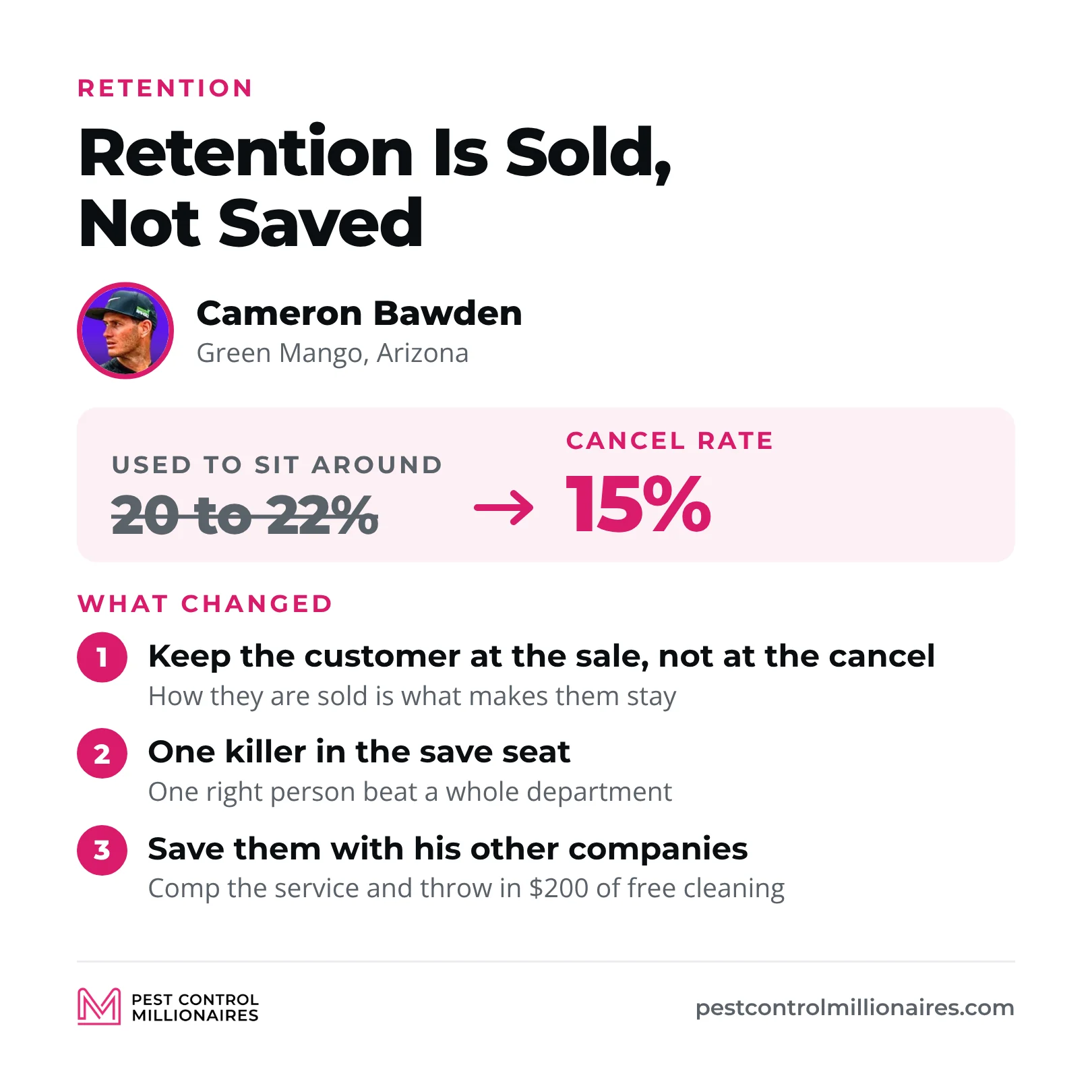
Cameron’s cancel rate this year was 15 percent. That is great for this industry. But here is the part that got me. He said it has not always been that good. They used to sit around 20 to 22 percent.
What changed? A few things. First, he believes you keep a customer at the sale, not at the cancel. A customer who got talked into signing on a door by a college kid acts very differently than one who saw an ad and chose to sign up. How they are sold is what makes them stay.
Second, he stopped spreading the save job across a team. He put one killer in that seat who knows how to save an account. One right person beat a whole department.
Third, and this is the one I am stealing, he uses his other companies to save customers. When someone tries to leave, Green Mango will comp the service and throw in $200 of free cleaning from their carpet company to keep them on board. “They absolutely love that,” he said, “and if you’re on the doors, you just can’t compete with that.” You only get that play when you own more than one business.
Their whole defense against door knockers is the welcome packet
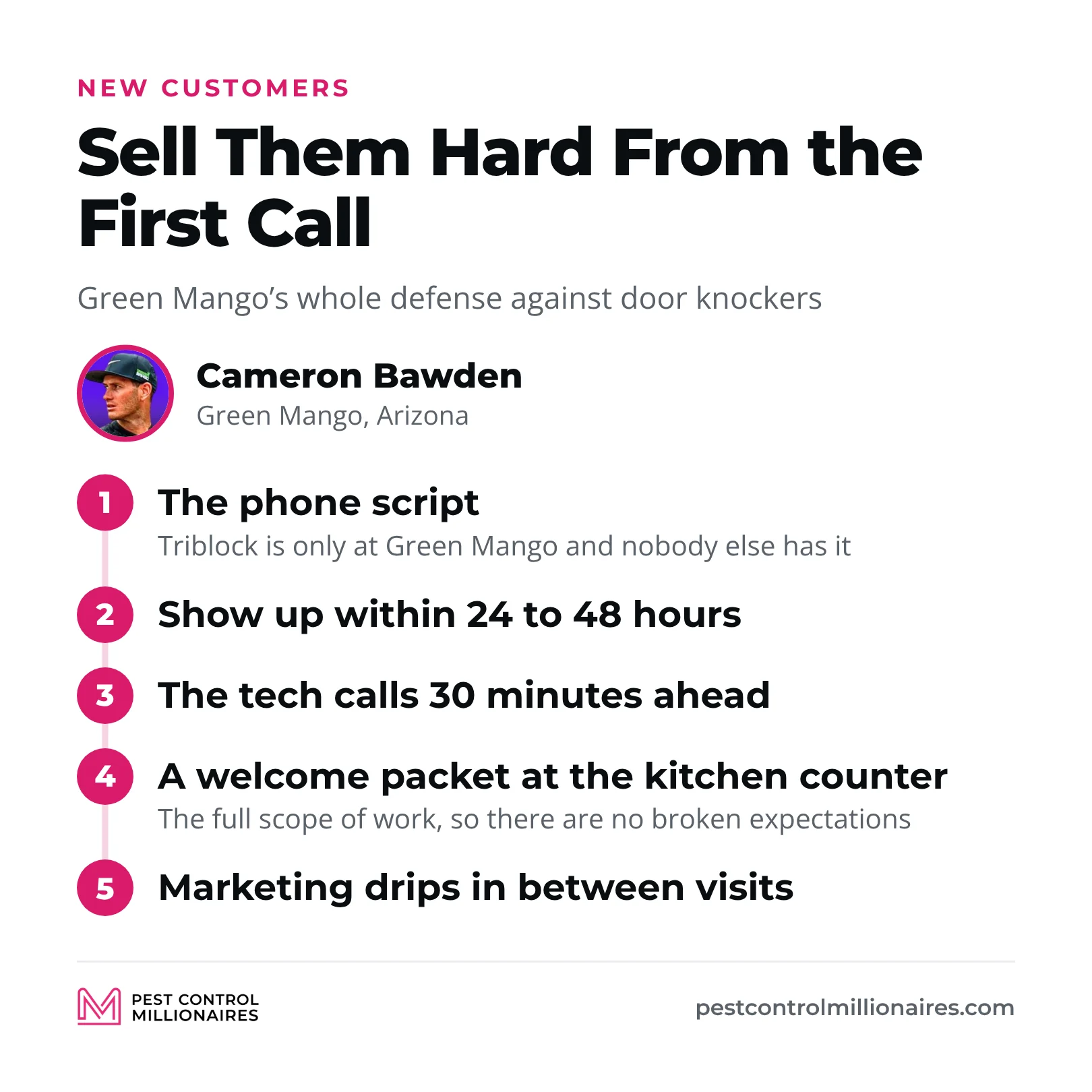
I knock doors, so I asked him straight up how Green Mango holds off companies like mine. His answer was simple. They sell the customer hard from the very first call.
It starts with the script. Their phone reps make sure the customer knows that Triblock is only at Green Mango and nobody else has it. Triblock is their name for three big barriers of protection, put down with a truck mounted power sprayer instead of a backpack or hand can. He told me the name was partly a training tool, so techs knew exactly how to treat a home. It was also a way to sound different on the doors. Every other company in Arizona says they go three feet up and three feet out. Green Mango talks about Triblock and three big barriers. It just sounds cooler, and it works.
Then comes the service. They show up within 24 to 48 hours. The tech calls 30 minutes ahead. A real welcome packet that the tech sits down and goes through at the kitchen counter. It covers the full scope of work, so there are no broken expectations. It also names all of their other companies. After that, they send marketing drips in between visits.
His point on touchpoints surprised me. A lot of us argue that talking to customers more makes them more likely to cancel. Cameron does not buy that at all. He wishes he had more touchpoints, not fewer. He trains techs to knock on the back door, get the customer outside, and show them how the product goes into the cracks and crevices. His logic is simple. A customer might go a year or two with only one real visit. That is not enough to keep anyone loyal.
He learned the hard way that he cannot be everywhere
Cameron opened up in Utah, California, and North Carolina. He sold every one of them off. He just closed on North Carolina a couple months before we talked.
I respected how honest he was about why. “To be honest, I’m just not great at managing people out of state,” he told me. “I can’t create that buy in that I can here.” Every time he opened a branch he would pull someone out of Arizona to set the culture, and it still did not stick. So instead of forcing it, he sold off thousands of accounts at a profit. Then he doubled down on the one market where he is really good.
There is a lot of ego in expansion. Cameron’s takeaway is the other way around. Figure out what you are good at. Pour everything into that, instead of bleeding money to be good at something you are not.
The five companies in eighteen months almost broke him
In 2016 Green Mango had a great problem. Their customers were used to a premium service, and they kept asking. Do you do pool service? Do you do carpet cleaning? Do you do lawn care? So Cameron and Dusty started five other service companies in about a year and a half. He called it one of the craziest times of his life, and I believe him. Their pool business went from zero to the second biggest in Arizona. Their alarm business did about 2,000 accounts in year one, all financed in house. Each carpet cleaning van cost $100,000.
Then in 2018 a big investor pulled out of everything but Green Mango. Cameron had to make a brutal call. He could not pay for the growth and payroll across all of it. So he fire sold the companies that ate the most time and money. He kept the ones that did not. That is how he landed on his three core businesses. Green Mango as the giant, Coconut for carpet cleaning and tile, and Agave Auto Glass for windshields.
The line that stuck with me was about finding the one thing. He believes there is always a point where you are barely making payroll and you have to find the one thing that changes everything. At his glass company, the insurance companies squeezed their margins so hard they almost went under. Then they moved to RV windshields, where the volume and pricing worked. He said it sounds simple now, but it took years to find. And he thinks the people who find that one thing are the ones with the most on the line. The ones who have to cover payroll if they do not figure it out.
The franchise story is a lesson in keeping good people
Coconut, the carpet cleaning business, became a franchise for a reason I did not expect. Cameron had four top salesmen who were killing it. They came to him and said you can either franchise this so we can be part of Coconut, or we will start our own company and become your competition. He said they basically forced his hand. So the first four franchises went to his own guys, and he waived the franchise fees for them. The next two came from people in the market who saw what they were doing and reached out.
He is at six franchises now. He wants four more by the end of the year, and is loosely aiming at around 25 over the next two years. What I took from this is simple. Your best people will leave and compete with you if you do not give them a path to ownership. Cameron turned that threat into growth.
Where his drive comes from
I always like to understand the person behind the business, and Cameron’s story is a good one. He played sports in high school, served a mission in Canada, and got his helicopter pilot’s license. His dad was in real estate, buying and selling raw dirt. Cameron grew up watching him fly investors over land in a helicopter, fly back, write the contract, and get paid. He wanted that life. The plan was come home, fly helicopters, and sell land like his dad.
Then he got home in 2009, and the real estate market was on the floor. His dad was basically retired and told him, without quite saying it, good luck, there is nothing here. Cameron told me he laid on his mom’s office floor, frustrated, unable to think of one thing he wanted to do. He said there is nothing more lonely for him than not knowing the next step. That is the moment right before Dusty pulled him into pest control.
He also joked that he is a third generation carpet cleaner. His grandpa is 90 something, and you can still find him in Park City spraying protectant on a couch. His mom cleaned carpet. His uncles have a company. So there is a real thread running through all of it.
The advice that mattered most to him
When I asked Cameron for the best advice he has ever gotten, he did not give me a business tip. He said it plainly: “Show me your friends and I’ll show you your future.” He believes it so much that he has nieces and nephews come in for internships twice a week. It is the thing he preaches to them and to his own kids. His point was that it does not matter how successful you already are. Surround yourself with people who have no goals and they will pull you down. Surround yourself with people who want to be better, and you become that. It works both ways.
The other one came from Dusty, and it is pure street wisdom. If someone tells you no, find the way to get them to yes. Do not let anyone tell you something is not possible. Just figure it out.
A few things I am taking with me
If I had to boil this whole talk down, here is what I am walking away with:
- Make the work cool enough that customers brag about it for you, and your cost to land a customer takes care of itself.
- Pay big for referrals, because a referred customer is the best one you will ever own.
- You keep a customer at the sale, not at the cancel.
- Be honest about what you are good at, and stop bleeding money to be good at everything.
- Give your best people ownership before they leave and become your competition.
- Show me your friends and I will show you your future.
Thanks again to Cameron for being so open about the wins and the hard parts. Talking to owners like him is exactly why I do this.
Watch the PCM Podcast on YouTube