How James Szojka Built Yard Dawgs Into a $5M Lawn Care Company

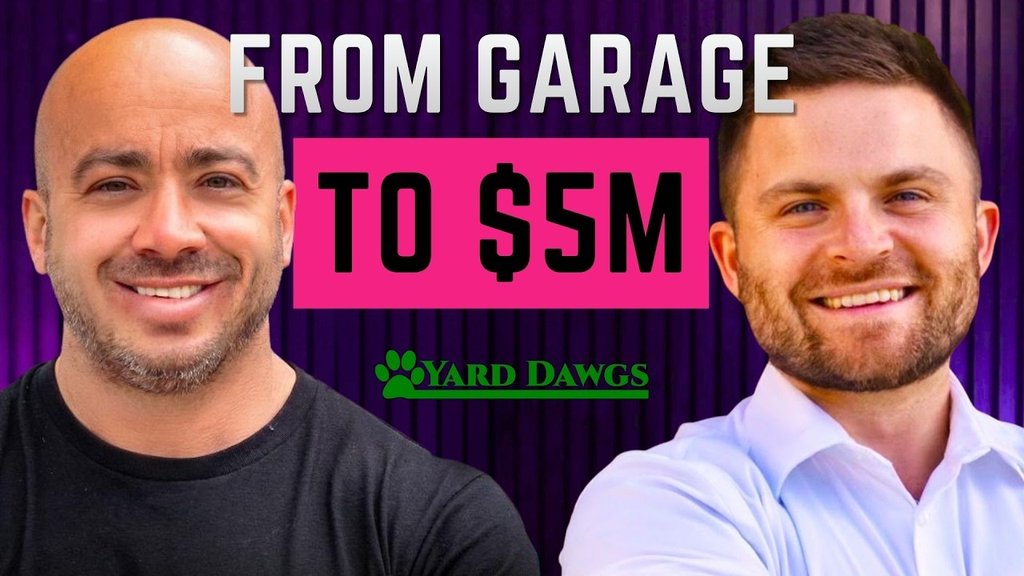
Table of Contents
- You can make money at anything, but not at everything
- Grow a branch to $2 million, then switch it to profit mode
- Start every new market lean
- Retention starts on the sales call
- Train your team to save the cancel
- Charge a premium so you can deliver
- It’s not the market, it’s the person
- Frequently Asked Questions
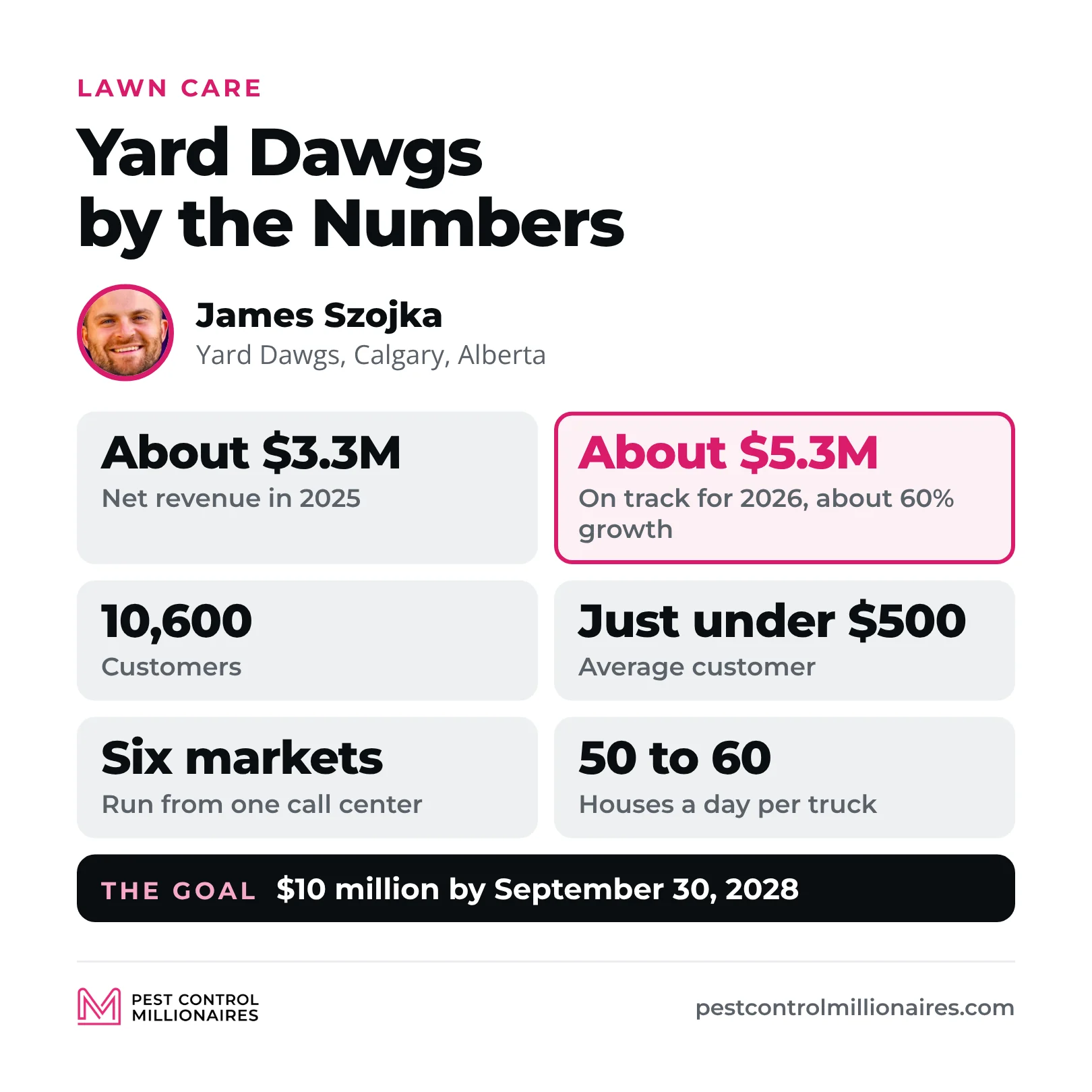
James Szojka co-founded Yard Dawgs in 2014 with his business partner, Liam, who he’s known since kindergarten. They’re still 50/50. Yard Dawgs is a lawn care company based in Calgary that runs six markets in Alberta and Saskatchewan out of one call center. They finished 2025 at about $3.3 million in net revenue, and when we recorded this in July 2026, they were on track for about $5.3 million, about 60% growth, with 10,600 customers at an average of just under $500.
James and I bounce ideas back and forth a lot. He’s in lawn care and I’m in pest control, but he runs a model a lot like ours. Even in the middle of July, when lawn care usually slows down, they were still getting about 50 leads a day. He was walking on a treadmill in his office while we talked. Here’s what stuck with me.
This episode is part of the PCM Podcast. For how lawn care and pest control compare as businesses, read lawn care vs. fertilization vs. pest control.
You can make money at anything, but not at everything
Yard Dawgs started with aerations. A company called Canadian Property Stars gave James an aerator to take door to door for a 30% commission. He didn’t even know what aeration was, just that people would pay about $60 a house. When customers asked about power raking, he and Liam said yes, charged $120, then went home and looked it up on YouTube.
For four years, they were a jack of all trades and master of none, two students running a four-month-a-year gig. After university, they gave it one full year, and to do that, they picked a niche. They looked for the least competition, the simplest business and the most profit, and landed on treatments. Five services, fertilizer, weed control, aeration, seeding and soil enhancements, in three packages, the Pomeranian, the Golden Retriever and the St. Bernard.
No mowing, spring cleanups, snow removal or Christmas lights. “You can make money at anything, but you cannot make money at everything,” James said. Get really good at a couple of things, and you build momentum you can’t stop.
Grow a branch to $2 million, then switch it to profit mode
Calgary, the main branch, grows the slowest because it’s in profit mode. James wants every branch at a sweet spot of about $2 million to $3 million a year, and once it gets there, it switches to profit mode. Until then, it’s in growth mode, with more competitive pricing and the ads running a lot harder. Edmonton, three hours north, was in its second year and already almost half the size of Calgary.
“You don’t need the whole pie in a market. We need a slice of the pie,” James said. There will never be a $10 million branch at Yard Dawgs. He wants 10 to 20 branches doing $2 million a year.
Their three-year goal was $7 million, and 2026 was year two. He figured they could get closer to $8.5 million in 2027 and $10 million by September 30, 2028. “You guys can hold me to it,” he said.
Start every new market lean
A new market starts as a satellite branch, the way James and Liam started in mom and dad’s garage. A storage unit with access to the janitor’s hose and a lot of mixing by hand, because a new market is volatile and you don’t know how it will respond. Once it hits a threshold, call it half a million or 1,000 customers, they invest in more marketing and the operation. Until then, as James put it, it’s “blood sweat and tears, baby.”
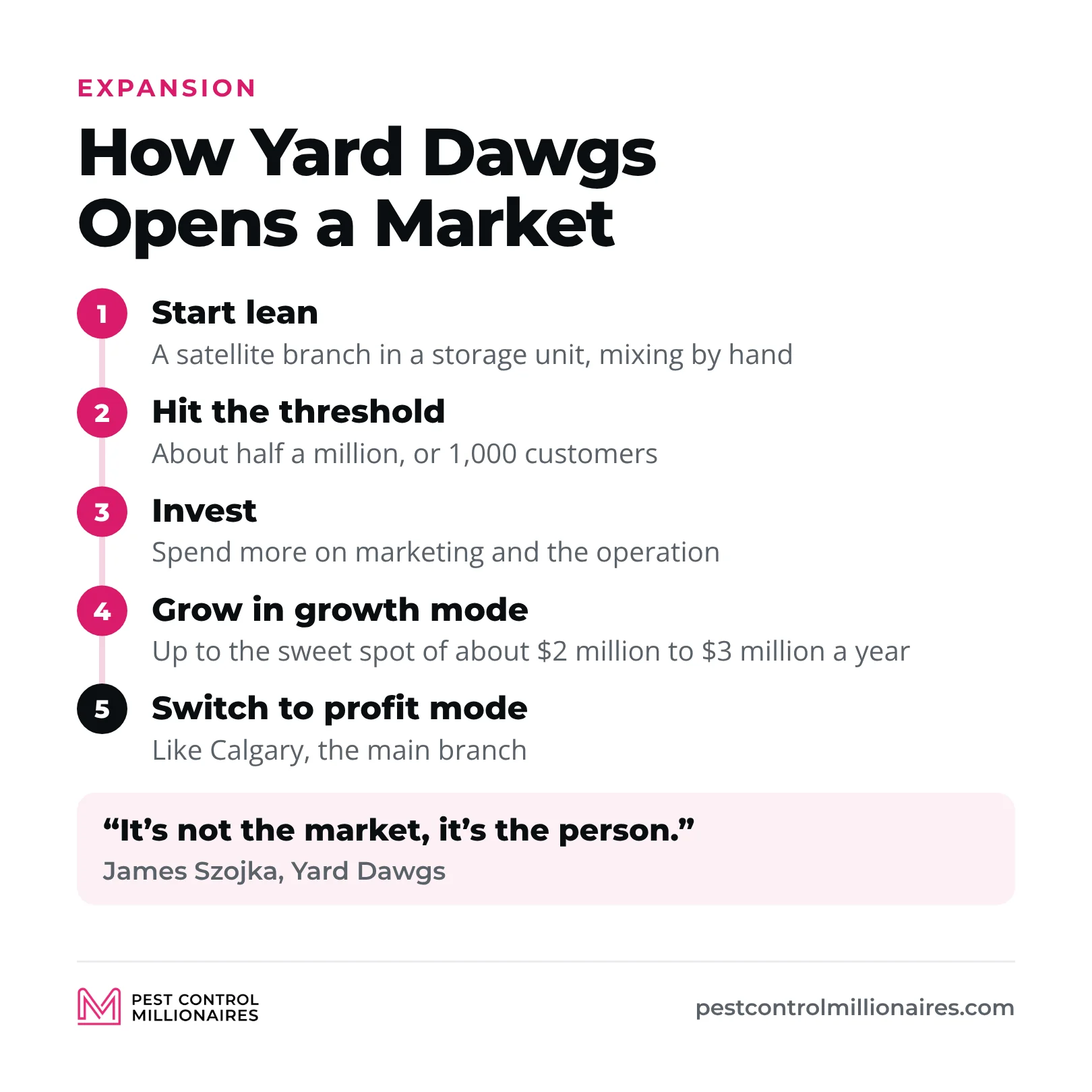
The big investments are trucks and a fill station. Flat-nose Isuzu trucks changed the game for them. They run all liquids, and the average truck does 50 to 60 houses a day on lawns that average about 2,000 square feet. At about $140,000 Canadian each, the Isuzus wait until a market is big enough, so two markets still run the old F-250s. In Calgary and Edmonton, a fill station works like a soda fountain. Someone picks each tank’s formula on an iPad, no one touches a concentrate, nothing is eyeballed, and each truck is filled in about three minutes.
Marketing changes by market, too. Facebook ads crush in Calgary, Edmonton and Red Deer, while Medicine Hat, an older community, wants flyers on the door and postcards. Year two in a market goes a lot better than year one, because people remember you instead of writing you off as another fly-by-night lawn care company. They also call past estimates and previous customers out of HubSpot, starting in February and again whenever inbound slows down.
Retention starts on the sales call
“There’s no point in selling really well if those people aren’t retaining,” James said. Yard Dawgs spent the 12 months before we recorded this getting fanatical about setting customers up properly, and he wants customers staying three to five years at minimum.
It starts with sales. How long until they see a technician, what will the tech do and what customer service will they get? He doesn’t want the follow-up to be great until the customer hands over a credit card and then go to crickets. And if a salesperson misjudges a property or overpromises, it always comes back, as a complaint to the tech and to customer service, then a commission callback or a new quote. His biggest takeaway from Alex Hormozi’s workshop was to focus on one constraint relentlessly until it’s finished, and for Yard Dawgs, that meant setting people up properly. When people ask me what drives retention, it’s exactly this, how a customer is onboarded from day one. I wrote about it in first impressions in pest control.
Train your team to save the cancel
When someone calls to cancel, have a conversation. People move and lose their jobs, but sometimes they just didn’t like the weed control or the frequency. Once James got his team trained to manage cancels, the cancellation rate went down a lot, because it shows you care about their business. Think of how your credit card company transfers you to someone 10 times better on the phone.
Yard Dawgs has a cancel specialist, but James wants everyone who takes a call to leave on good terms at the minimum, then find the root cause. Was it an operational mistake, a sales expectation, a miscommunication or an unreasonable request? The average customer stays about three years, so if someone leaves after two services, there’s a reason. “Just give a damn,” he said. I go deeper on saving cancellations before they happen.
At Pest Badger, calls used to bounce from sales to CSRs to operations and get lost in translation, so we moved to one call resolution, with one person trained on retention, sales, operations and scheduling. James was honest that they weren’t there yet. You have to walk before you run.
Charge a premium so you can deliver
None of this works without a fair or premium price, because the lowballers who nickel and dime can’t execute on it. Yard Dawgs is one of the highest priced services in its market, and when they mess up, which does happen, they make it right. The customer who cancels is often the same one who was always asking for an extra $25 off. I’d say the same. The biggest companies have the nicest trucks, spend the most on marketing, pay their guys the highest wages and charge the most.
It all connects. Yard Dawgs techs are paid a commission on production, only when the work gets done, and service calls don’t pay. So if a salesperson quotes a 4,000-square-foot lawn as 2,000, the tech ends up doing a 4,000-foot yard for a 2,000-foot price and earning less for it.
It’s not the market, it’s the person
Keeping techs through such a short season is tricky. The season lines up with the school year, so they use a lot of post-secondary students, and some techs go on Employment Insurance for about three months and come back. They do profit sharing and bonuses, and they look out for each other. When one tech had to leave in the middle of the day for a family emergency, the other guys split up his jobs.
The bigger answer is a path. All six markets run on an operating partner model, and most of the partners started as technicians. James compares it to owning a Chick-fil-A, with a salary and profit sharing, no franchise fee, no buy-in and no equity, and a way to a healthy six-figure income over three to five years.
So James sees the founder’s job as selling the vision and finding the next operating partner. “It’s not the market, it’s the person. You put a good person in a bad market, it’s going to work out. Put a bad person in a great market, it’s going to fail,” he said. Winnipeg is next, and after that, he likes northern U.S. markets like Boise, Spokane, Minneapolis and Denver, which he calls Calgary 2.0.
His own constraint was getting himself out of the call center. The first time he hired someone to sell, he thought nobody could sell like him, until he watched someone else sell a St. Bernard package. Now he’s probably the worst guy in the room at sales, and he’s proud of it. The mentee should always pass the mentor.
What’s in it for the team? Home ownership is expensive in Canada, so Yard Dawgs has a first-time home buyer incentive, and James wants all 10 people on the corporate team to own a home within five years. When we recorded this, four of them did. And the partnership with Liam works because their values are the same and their skills are different. Liam is a mechanical engineer who handles the numbers, and James has a business marketing degree and runs sales and marketing.
Frequently Asked Questions
Who is James Szojka?
James Szojka co-founded Yard Dawgs, a lawn care company based in Calgary, with his business partner, Liam, in 2014. When we recorded his PCM Podcast episode in July 2026, Yard Dawgs ran six markets in Alberta and Saskatchewan, had 10,600 customers and was on track for about $5.3 million in revenue.
What is the difference between growth mode and profit mode?
At Yard Dawgs, a branch stays in growth mode, with more competitive pricing and harder-running ads, until it reaches a sweet spot of about $2 million to $3 million a year. Then it switches to profit mode, like the Calgary branch, which is why Calgary grows the slowest.
How do you open a new lawn care or pest control market?
James starts lean, with a satellite branch in a storage unit and mixing by hand. Once a market reaches a threshold of about half a million or 1,000 customers, he invests in marketing and operations. And he picks the person before the market, because a good operating partner can make a bad market work.
How do you stop lawn care customers from canceling?
Train whoever takes the call to have a real conversation about why the customer is leaving instead of just canceling them. James found his cancellation rate went down a lot once his team was trained, and he looks for the root cause, whether it was an operational mistake, a sales expectation or a miscommunication.
Full transcript
Every word of the episode, from the video captions
Building the business turns you into a different kind of human being.
Realize that failure is a part of the...
I think there's hope out there for all of us. For all of us. They say procrastination [music and singing] be the assassination of destinations. That's why we out here grinded with no association with haters and them other crabs [music] trying to put us down. Pest Badger's in the house. Boy, don't clown. Just keep your eyes on the prize and no giving up. You can do whatever you dream of. Keep your eyes on the prize.
All right, welcome back to another episode of Pest Control Millionaire. Another stud on end on today. Super excited. James and I, we talk we talk quite a bit actually. We always bounce ideas back and forth. He's stud when it comes to growing his lawn care company. But James, I don't want to butcher your last name because I always do it, but it's so right. Gosh. So Ja, owner of Yard Dawgs over in Canada doing big things, growing extremely fast. Thank you. I don't want to butcher this either, but I think in May you sold like 1.3 $1.5 million in revenue for lawn care. So doing big things with it. You guys are over five million already in sales, which is super impressive. Especially like we were just talking for like the last half hour. You're still getting like 50 leads a day for lawn care, which is usually it slows down middle of July for lawn care. So are you guys getting a lot of rain? Are you guys marketing like crazy still?
Bring us up to speed from the last time we chatted online. Lots have happened.
Yeah, last time we talked we were probably pushing around like last year we ended about 3.3 million in net revenue essentially. So for production was what we ended up doing there. And this year we've grown about by about 60%. We're on track to hit about 5.3 this year. And we have a great team operation where we're at six different markets just in the in the great white north. So our our we start production we started production this year on May 4th and we'll take production here. Yeah,...
It's crazy. And we'll go until October 10th usually, unless like it snows earlier than that. We've been growing, but we've become a lot more fanatical about setting people up properly though because it's not about growing, growing, growing if your retention sucks. So, we've really dialed in on retention the past 12 months and we have been seeing some really good improvements there. And we are focused on training, training, training. I find that in a day of AI coming upon us there too, although you should be leveraging AI to your best ability, don't forget that your team is what's going to make or break you. And like as we approach 5 million this year, sure it's worked to this point, but if we're going to hit 10 million, we do need to keep developing our leaders of the company and systems because if we use the same system right now for 10 million, we would probably break. We're always developing things, but it's been a wild ride and that's a lot of lawn care to do in five months. So, everyone is make hay while the sunshine is the adage for sure here.
Yeah. And if you guys can't tell, James is walking on his treadmill in his...
Yes. Got to keep the energy up. Got to keep the steps in. It's in July, so we have every calorie counts.
That's funny. And then, you said you just did a pretty crazy leg workout today, too. Yeah, one thing that's been actually nice myself and my business partner Liam, we go to the office three days a week around noon. Just to honestly, we see a trainer. He pushes us way harder than we'd ever push ourselves. And honestly, it's kind of spoiled working out for me because I can't do that to myself, you know, like I'm too nice on myself. But you have a trainer pushing you can where you think mentally you're going to stop at 12 reps, lo and behold, you could do 16 if someone was telling you, "No, you're going to keep going. Like you've got more essentially.
I tell my daughter this all I tell my daughters, but my oldest one a lot. If she was here, which she is out there somewhere, she'd tell you I said this all the time. Your mind is going to give up before your body will. I promise you that. Just don't let it win.
That's true.
And I tell myself this all the time, too, but I really instill that into the girls. Your mind's going to quit first. Your body's going to hold up. Like, so you said, if you can think you can only do 10 reps by yourself, you could probably do 16 17 with a with a trainer. And the truth is you can apply that to lawn care and pest control. Like the hardest part of the job is having the same conversation in the middle of your month. You're on sales. You're having the same conversation 100 times a day and you bring the same enthusiasm, the same effort on call 85 as you did for call one. If you can do that, you're going to be a winning salesperson. If you can be consistent, you're showing up, you know, the seven days a week that we do push in the three months where it matters where our longer tsunami is. It's all about consistency. You'll you'll get good to a certain point, but whoever's the most consistent sells the...
Yeah. So last time we chatted, you had like I think I want to say like three offices. Now you're at six. You obviously just got a bunch of new trucks. You didn't have the you didn't have the flat nose back then either. How's that all been going?
Isuzu have changed changed the entire lawn care lawn care game for us. So we're running all liquids now for treatments and it allows we're we're doing the average trucks doing between 50 and 60 houses a day. We are in a market where our average square footage though is 2,000 square feet. Yeah. Sometimes 2.2. Why not? We'll only do lawns up to 15,000 square feet, but we have standardized pricing up to 3,000 square feet.
And we're running it from Isuzus and so yeah, we're in six cities. We have one call center that does sales and customer service, but we're servicing six markets. Most of the markets have the Isuzu trucks, but there are two markets that are still just utilizing some of the old F3 F-250s that we had just because we have the equipment and they're not the size yet to justify these Isuzus because they are expensive. For sure. And so you've been growing so you've been growing through all these markets all online Google, Facebook, referrals, things like that is how you've grown into all these markets. What has been the hardest thing and what do you notice about each location that's been a challenge?
I find that the smaller markets respond differently to the larger markets. So in my in Calgary, Edmonton, Red Deer for example, the Facebook ads crush. In Medicine Hat, which is more of an older community, definitely an older demographic, they don't like the Facebook ads as much. They're like, "No, like we want we want to see the flyers on the door. We want to see the postcards, all those things, too." So I do think we need to revamp the marketing plan for next year. And the truth is that the creatives are different in the places like and I do find year number two goes a lot better than year number one because the first year they see your ad for the first time and like oh another fly by night lawn care company let's kind of see what happens but the second year two comes around like oh it's the same guys I remember this guy okay I'm going to give them a try this year I found that this year all came down to organic so just people looking up lawn care calgary and meta ads we didn't run many Google ads this but we're pushing right now to sell 3.5 million in new net sales this year.
We're a little bit off track of that, but we should be able to hit that goal by when we finish our season, roughly in the first week of October.
Yeah. And do you guys run any retargeting campaigns as well, like people who hit your website before?
I don't for meta ads. However, we use HubSpot for our marketing and reach out and customer service and pipelines and we are doing outbound to past estimates. Previous customers all of the time. So, we start with that in February, start to practice again. Let's get back into the swing of things because we're a little bit rusty now, but we're calling previous estimates, previous customers, and then once every single time our lawn care program reduces in scope, we're usually hit up these lists again. So, when the incoming calls lessen or there's not as many leads, we're going to be doing outbound to make sure that all the sales guys are best utilizing their time and keep the numbers up the best we possibly...
Yeah, for sure. Another question I have a lot a lot of listeners probably run into is people complain about weather where they live where for us you and I, it's like seven months, six, well, six months out of the year, seven months out of year we're servicing. The other five to six months we are not generating revenue. So, how do you guys handle that over...
Any of you people down south about the weather like, "Hey, come up here and give it a try." Like, it's tricky. So, we have a short window like we have five and a half, sometimes six months to do all the production. So there's a few things you have to keep in mind. One is if it is a nice day, we are going to work hard like we are going to go to town and we make sure the expectations with the technicians like hey guys there will be days that we have rain days we can't do anything. Those the days off like here at the company we don't work Sundays for technicians although for sales we will during the 3 months where it matters. So you know you have your Sunday off but there'll be times Saturdays are going to happen and there'll be times when they'll start you know they'll start at 7:00 in the morning and they'll go until 5:00 at night. We do use bike and P for P here. So the whole they're getting a commission based on the production that's happening only if the work gets done and service calls we don't pay for. So there's an incentive to do good work there. But the guys are working incredibly hard. We know it's a short season.
There's good. It's a good opportunity to make some really good money, but we hire people that really want to work. This isn't a 9-to-five balanced work life schedule job here at the company. Like we work hard, we play hard, we give out, we do profit sharing, we have bonuses, we have a lot of fun, we take care of each other as a team. Like one technician a couple weeks ago, his his grandma unfortunately got she got a really bad diagnosis and he had to he had to take off at about noon today. All the guys jump in. Yep. Give me five of his jobs. Give me five of his jobs. They take care of each other on their messages. And like the same goes true of sales here, customer service downstairs where it's easy to break it down into three departments, you know, sales, customer service, operations. But the biggest thing that I've been focusing on is the culture and the driving that we are one team taking care of customers at the end of the day and fails. You have to make sure that you are setting this person up for success because if you misize the property if you overpromise it is always going to come back to you.
You never get away with anything because they're operation's going to go there. The person's going to say something to the technician that wasn't there. They're going to complain to customer service. Customer service is annoyed because they have just as many calls as you in a day, but they're not having the fun of like, oh yeah, I'm really excited to get No, they're hearing all the problems coming their way. Lo and behold, it's going to come back to me and then I'm going to bring it to you and sometimes there'll be a commission call back or sometimes, hey, you have to call this customer and explain yourself or you have to go reququote them because you've under quoted this. So, that's been a bit of a learning curve this season. It is. I do think it's definitely been getting better, but there's a lot of conver hard conversations that need to happen on an ongoing basis here. And I think that's what growth is all about. It's like one of our core values is accountability. And we definitely hold each other accountable here. We don't let the little things slide.
Yeah, that's cool. [snorts] Hold up. Quick pause. If you're running a pest control company or fertilization we control company, you're not in our Facebook group. You're choosing the harder path. Every operator that's in there is skipping years of mistakes because people are actually sharing what's working right now. So, stop trying to brute force your way through growth alone. Search Pest Control Millionaires on Facebook or click the link below. And now, let's get back to...
So what do you do with your technicians in the with the six months off? Do you keep them on like a base pay? Do they do this or do they do they not work? What how does that look like for you guys?
Our season does line up very well with the academic school year for post-secary. So, we do utilize students. They're very valuable to us. Technicians is the hardest job to have customer employee retention though because the truth is it's a really good six six seven months but that's kind of it. We can make we can add about a month or two on the end for training start at the end there too but some guys they will go on EI for about 3 months and then return the following year. Some guys this is a bit of a stepping stone for them but the big thing for us actually is to give them a path to become an operating partner with us. I want a technician to come in, feel it, but then actually start to take ownership like, "Hey, I would love to run my own Yard Dawgs branch in X City." And we want to help people find a path to actually make that happen because out of the six markets that we have, it's an operating partner model. So, it's essentially I think Turf Badger is doing a similar thing. It's like it's like you're a Chick-fil-A owner.
You're receiving a salary and you participate in profit sharing. You don't have the franchise fee. You don't have the buy in, but you don't have equity. However, you do have a great way to grow to make a reasonable, healthy six-figure income over the course of three to five years. So, we're really excited about that model. We have six markets right now and most people have started as a technician and they've worked their way up. So, I'm really excited to see more people take advantage of that program. And but to answer your question though, technicians, it's if you're going to stay a technician, it's tricky to do here because our season is so short. We are not doing snow. We will never do snow. We are not doing Christmas lights, spring cleanups. I've done oh I've done them all. Like I'm saying these and I'm telling you I'm not gonna do it because I've done them. I'm like no long hair is our bread and butter and we're either sharpening our axe to do better next time or we're using that axe profusely. So sharpening the axe using the axe. We're not changing the tool.
For sure. Couldn't agree more. And then as far as like most of your growth, did it come from like two of the bigger cities or kind of a spread out through all of it?
A great question. So the main branch which is Calgary. So we're at we're we're at 10,600 customers right now. Average client price for us is just under $500. Calgary is growing slowest because we are that one's in profit mode and we once we get to a certain point we're trying to get these branches to about $2 to $3 million a year sweet spot and once they're there we transition to profit mode. The other ones are in growth mode. That means that the pricing will be more competitive. The discounts have a little bit more leeway with and I'm running the ads a lot harder. So Edmonton is our second biggest branch. That one's growing like crazy. In two years it's become half the size of Calgary just about not quite but just about and the other markets like Red Deer for example they're growing quite fast as well the ones out of the provinces Saskatchewan a little bit slower than what I'm seeing in Alberta but that's just something to just keep in mind it's not not a big deal at the end of the day again what's kind of cool is that you don't need the whole pie in a market we need a slice of the pie trying to grow these branches to let's say $2 million on average there will never never be a 10 thou a $10 million branch at Yard Dawgs I just want to see 10 to 20 $2 million a year branches is what we're going for here too.
I do the 20 of them.
I like that a lot. And then with those, have you noticed like the markets grow faster or have better retention because the general manager operating manager over there?
It's a little bit early to give a full diagnosis of that because we've only this is only our second year having more than one branch essentially. So we are Edmonton's in its second year, Red Deer is in its second. Saskatoon is in its second. Medicine Hat and Regina are in their first right now. And then Calmon is your second branch. And is that close to you?
Three hours north of the drive. So they're the Edmonton Oilers. I think it's the most northern highest populated city in the world is what it is. They have a good hockey team. Better than the Flames, unfortunately. But that's the that's the biggest highlight of Edmonton. But they are growing. They're growing very fast and people are very happy. We were we're doing our NPS scores. We were checking in. But a big function of someone's success does start with the sales team. Have we set that person's expectations up properly? You know, we deliver on the marketing. They see it, they come in. Have we set them up to be taken care of? Do they know what to expect on the first time? Like how long is it going to take before they see a technician? When the technician gets there, what are they going to do? What kind of customer service are they going to receive in the meantime? What's going to I don't want it to hear the world. You guys were so good at following up. Your communication was great and then I gave you the credit card and then it went to, you know, crickets. I don't want that. I want people to really have an ongoing excellent customer experience.
And that's hard to do. It's easy to be really good at one department out of the three. And no, we have to focus on when I went to Hormozi's workshop a few months ago, they you know, the big my biggest takeaway is they talk about constraints. We are going to focus on this one constraint relentlessly until it is finished and then move on. So yeah, I'm not going to be playing these five different games. No, we're going to focus on one thing until it's finished and then move on. So, for us, it's all about setting people up properly, taking care of them, and there's no point in selling really well if those people aren't retaining. So, we're focusing on retention. We're focusing on sales, but we're focusing on making sure that people are staying with us for, you know, between three and five years at minimum essentially for their lawn care program. So, if retention is there's not even a point in selling.
Yeah. And I agree. And I think most people ask what the biggest driver is for retention is, and it's exactly what you're already talking about. It's from day one, how they're on board as a...
And I will say one thing that's been very valuable for us is that, hey, when someone calls in to cancel, your customer service team needs to know how to deal with that. Don't let people just go, you know, like let's have a conversation. Why are they cancelling? Like yes, people move, people lose their jobs, real things happen, but sometimes like, you know what, I just didn't like your guys' weed control or I didn't like your guys' frequency. Start to have a conversation. And if we start to get people very trained up to manage the cancels, we find the cancellation rate goes down a lot because we are actually we fight we care about your business. I want that. It's like when you go call your credit card company to cancel, they always transfer to someone and that person is 10 times better on the phone than the first person you're talking to. Yes, we do play that game a little bit here, but we're trying to get everybody no matter who receives the call. Let's make sure that we have a really good exit strategy. Let's let's leave on very good terms at the minimum, but hey, maybe we messed up or maybe the expectation wasn't set or maybe we had a miscommunication. Let's get back on the same page.
Yeah, I couldn't agree more. One call resolution, right? So like that's my philosophy like the customer should be able to call talk to one person not get transferred to every single person because it gets lost in translation. But another thing that we had to learn here at Pest Badger too it's like it go to sales sales go to CSR and then vice versa and like operations like it was a mess. Like we can get figure out one call resolution where they can talk to one person that person is trained on retention sales like operations scheduling like they know it all. So much a better spot for the customer experience as well. I agree.
And to be totally vulnerable, we're not there yet. Like we are still having specialists at certain things. I'd love to get to the one call resolutions there too. And you know, this is you got to walk before we run. We're going to learn how to get a little bit better every day. That 1% better every single day. But right now, like hey, we do have a cancel specialist that the calls go through and he does a really good job and that's made a huge difference. But at the end of the day, why is that person cancelling? Let's figure out the root cause. Was it an operational mistake? Was it, you know, was it was it sales expectations? Was it a miscommunication our end? Maybe they have an unreasonable request. That's a very real thing, too. So, just make sure that we are truly having those hard conversations a little bit every day to make sure that it's a smooth ship going...
Yeah. You also while while we're on the topic of retention, is there any anything else that you guys have implemented besides, you know, those few things that have helped with retention? Like I think the biggest thing is just give a damn. You know, give a damn about that person's cancelling. Hey, this person should you know the average customer stays about three years. Why is this person leaving after one year or why is this person leaving after two services? There's got to be a reason and let's figure that out so that we can grow from it. You have to be very curious. That's another core value of ours. Curious and ready for a challenge. Don't just say, "Oh, that's the way it is." No, let's figure out exactly why they're they're cancelling. This kind of gets to the heart of the issue so that we can now improve our systems going forward. It's an ongoing dance. You know, it's an ongoing battle to really start to increase this. So, we're going to make sure that the expectations are set up properly on sales operation. We're trying to we're going to get out there as quickly as we can. I think, you know, in a day of Amazon two day, one day, same day delivery, all these things too.
People that are calling in about their leads, they probably wanted it done yesterday. So, let's get out there as quickly as we can, but let's set the expectation that hey, it might not be tomorrow. It might take, you know, several business days. And to be able to do all of this, you have to charge a fair or premium price. Like do not the low ballers in the market, the people that are just nickeling and dimeming, they can't execute on these kind of things. So, we never play that game. I'm proud that Yard Dawgs is one of the highest priced u services in the market because we will deliver and when we mess up, which does happen, we are going to make it right or you're going to see a service incomparable to the guy that student out of this truck.
We want to make sure that they are getting excellent service all the way through. But that does come with the price. And we're looking for the people that are willing to pay the price to receive excellent service because I don't know about you, but the person that cancels sometimes is the same person that was always asking for that extra $25 off or the person that was reluctant to give the Visa, Mastercard over the phone. I see a lot of patterns and that's definitely one of them...
For sure. And I would say the same thing. The best companies, the biggest companies have the nicest trucks, spend the most on marketing, they pay their guys the highest wages, and have the best service. There's a reason because they're charging the most. They understand the game. They don't want to be the cheapest person in town. And if you are playing that game like a Walmart, that's fine. You just have to know from day one that that's your model and you're going to stick with that forever, right? But I always like to be the same. I like I don't love that model, but it there is that model where I like to be on the premium side, be the highest charging person in the market and be able to pay our guys the most money. Like you said, PP, right? Because again, if they if the sales guys say, you know, it's 3,000 square feet or 4,000 square feet, and then they show up there and it's 2,000 square feet or vice versa, like, okay, well, now I'm doing a 4,000 foot yard for 2,000 foot price, now I'm spending more time here, get a lower P for P. So, yeah, it all makes sense.
Yeah, it's a it's a it's a it's everything's connected, you know, operations, customer service, sales, your pricing, all like everything matters in business. And like when you're starting out, sometimes you got to just, you know, take a whim. Got to look what your competitors are pricing, how they're pricing their things and kind of go something off of that. But eventually you start to get in your own groove and you start to really sell on value, not on pricing because that that pricing game is tough. It is annoying and there's always a someone that's going to slash your prices, especially when you know you're investing in things to make the business better. These Isuzus are incredibly expensive. The decals on the trucks are are those trucks are clean. It's well over 100 grand. It's about about 140 on average. But that's Canadian dollar. That's like 10 bucks for you guys. And but like at the end of the day like it's all full circle and let's focus on every single department and do it to the best ability. Best part.
I love it.
With your with those new trucks obviously you carry a lot more product. Like what were we like F-250s? What were we carrying then? Like 200 gallons.
Yeah, those are 200galon liquid tanks with just weed control in them. Then then we were using a granular fertilizer with you know didn't you guys get a whole setup built in the shop too for to fill the...
We talked about this. You got system. Yeah. Like you know like when you go to you know you go to Costco, you get your $150 hot dog and then you go pump the fill up your Coke, right? It's not Coca-Cola come out of that. It's water plus syrup, you know? Or you go to Sprite, it's that plus the Sprite syrup. We have that for lawn care. So when our trucks drive in, we go to the iPad and we essenti It's a huge liquid vending machine for our products. This guy needs 200 lers of liquid fertilizer. We're going to mix in the weed control or we're going to we're doing our chitch bug sprays right now. So, this tank number two needs this formula. Tank number three needs that formula. We're able to do that all through an iPad. No human interaction with any concentrates of the chemical, which is really nice. I feel really good about that. And it's mixed to the tea. There's no eyeballing. There's no guessing. And we get the formula right so that our materials are down and the lawn care effectiveness is high. The safety factors there too and the time like each truck is filled up within you know about three minutes or...
That's awesome. So I'm assuming that you probably don't have that in the smaller markets yet currently. Right.
Correct. I only have it in the Calgary and Edmonton. And the way that we do our expansion essentially is that a first market with us is going to be a satellite branch. We are going to work it like back in the day Liam and I were working out of mom and dad's garage. Similar idea. We're going to get a storage unit with access to the janitor's hose. And yes, we will be doing some eyeball mixing. We're going to be doing things manually because we can't afford to get the $4,05 $7,000 shop. We can't afford this huge mixing system. So, we're going to start things lean. And once we hit a threshold, let's call it half a million, maybe a,000 customers, we're going to now start to invest in things because at the end of the day, a new market is it's a bit volatile. You don't know how it's going to respond to the market. We don't know how it's going to essentially perform and we want to make sure that we are being smart with our dollars. We can't assume that we have this all figured out and we are untouchable.
No, we have to do things stay smart all the way through know what our threshold is and then when the when that area is working well now we're going to spend more marketing now we're going to really invest in the operations until then blood sweat and tears baby.
Love it. Obviously you run a similar model that's why we talk a lot which is really cool. You're in lawn care. We're in pest control. Same same service like I know different service but same service industry. So it's been fun to watch for sure. What's the goal with Yard Dawgs for I know you said probably closer to 10 million next year but like five years is 20 locations, right? Doing 2 million bucks.
Yeah. You know what I've always had a hard time think about in five year increments because I find it's just so far away. But I right now we're in year number two out of our three-year goal. The three-year goal is to 7 million. So next year is our third year. I think we could probably get closer to about eight and a half or so and then I think the following year we can hit 10. So that'd be 2028. You guys can hold me to it. We should be at $10 million in revenue by September 30th of 2028. From there though, Jonas, I want to just really set up some great operating partners that are growing their branches to about that $2 to3 million sweet spot. A goal that we have here at corporate is I want to see 10 people own a home within the next 5 years. Right now there are four of us out of the 10. I want to see 10 out of 10 or more own a home. And we have a Yard Dawgs first-time home buyer incentive because at the end of the day, the goals in the board are great, but what's in it for them? What's in it for the guy selling day overday or doing customer service, you know, week by week? The truth is, one goal that everyone shares here is home ownership. It's very expensive to own a home in Canada.
And if you do own a home, you're going to be okay, you know, like it's a really good way to grow some equity in your own self, your own your own life essentially. So, I want to see 10 own 10 people at least own a home here within the next 5 years. Yeah. Has Liam always been a part partner of yours at Yard Dawgs?
Yeah, I've known Liam since kindergarten and we started Yard Dawgs together 12 years ago. Still 50/50 to this day. It works because the values are the same, but the skills are different. As people ask like what's the secret to the partnership? It's that we have the same values when it comes to family, you know, God, faith, and the way we do business. Same risk tolerance, per se, but the skills are very different. He's a mechanical engineer. I have a business marketing degree and we focus on what we're really good at. Himself, numbers, accounting, bit of operations, myself, mostly sales, marketing, and then we where we have weaknesses, we're going to hire and build our leadership team around that. So, it's been great working with Liam and we have no plan to change anytime soon.
Yeah, he's a stud. I've talked to him several times. That's really cool. But you guys, again, for all the listeners, you didn't start this way. You didn't start just Yard Dawgs only doing fertilizing. Walk us back through 1.0. Yeah, like 2014, the first year we started with just aerations, you know, we went to I got invited to this company that gave you an aerator, you go door to door with it, make a 30% commission. It's called Canadian Property Stars. And I'm like,...
It's so easy to sell for you listeners. Go sell aeration at the door.
Exactly. Especially in April and May,...
You're you're there. They're like, oh, sure, actually. And like I didn't even know what aeration was. I just knew people would pay like 60 bucks a house to do it. So that's what we started doing. And then eventually they start to ask, "Do you do this service?" Like, "Do you do power raking?" Like, leave and I would look at each other. "Uh, yeah, yeah, yeah, we do power raking." How much do you charge? $120. When can you do it? Tomorrow. Go home YouTube. What is power raking? Cuz like we just got the job, you know, and like show up the next day, go buy a machine on Craigslist or Kijiji or Marketplace and have it there up and running the next day. For the first four years, we were doing we were a jack of all trades, master of none. We were just doing whatever we could to make money. We're students, you know, this is our four month a year gig. But so we mowing, window washing, bit of fertilizer, maybe landscaping.
But then we decided like once we graduated university and I'm married now, Liam's I think was engaged or was at least in a serious relationship. We like, hey, are we going to go get a real job like our parents are praying that we do every night or are we going to go give this one full shot? We decided to give it one year full-time. But to do that, we had to pick a niche. And we looked at the companies around us. What seemed to have like the least amount of competition? What was the most simple of a business? And what was most profitable. And for us, we determined it was treatments. You know, focus on just five services. Fertilizer, weed control, aerations, seeding, and soil enhancements for the Yard Dawgs. Let's make three packages that incorporate those five services. We have the Pomeranian, golden retriever, the St. Bernard, and let's learn how to be the best at these five things. People ask for mowing, we don't do that. Spring clamps, we don't do that. Snow removal, we don't do that. Oh, but there's money to be made there. Well, there's money. You can make money at anything, but you cannot make money at everything.
Pick a couple of things. Get really good at it. Learn how to sell. Learn how to market. Learn how to do great work. And learn how to help make a lot of help a lot of people make a lot of money and help customers get a great looking lawn where they feel like the value is there. They tell their friends and family about it. And all of a sudden, you have this machine that you cannot stop. Momentum, like they say, is really hard to build, but you cannot stop it once it gets going. So we just remind ourselves every single day, let's just keep listen the operation, customer service and sales. We are one team. We are going to work together to deliver for the...
I say this a million times over and over and over again. People underestimate the power of momentum and synergy, synergy, man. Like departmentalize I think is a very valuable thing. Like the first time I ever hired someone to do sales, I'm like no one can sell like me. No one can do it. I'm the only guy in the world that can sell. Finally, I see someone else sell a St. Bernard package. I'm like, "Oh, wait. I don't have to do this all the time." And now, like, I'm probably the worst guy in the room when it comes to sales. And I'm very proud of that. I love that people can do things better than I. Liam and I like it's worked out. It's been great. But we do have the belief that anything that we do, somebody can do it better.
Absolutely. Actually, just I have a YouTube video coming out on Thursday that talks just about this in general. Like at one point in the business, we're always the best person, but it comes to a point like we should be training people to become better than us. Like the mentee should always pass the...
Yes. You should be proud of that. You should want that.
Yeah. You brought up YouTube. We can jam on YouTube a little bit. Have you been pushing a lot of YouTube content this year or you just been too busy in the day-to-day grind?
I've been too busy to be honest with you. I've YouTube's tricky. YouTube's a little tricky to me. I do believe in the value and I do think now that we have we have an office manager starting and she is phenomenal on both sales and customer service and my next six weeks is to pour everything I have into her. Same with Liam there too because I'm the sales I'm still managing sales very heavily and I do think that if there's one we're you know we're talking about delegation right now and we're talking about growing other people. If there's one thing though that I think a founder has that nobody else will have, it's selling the company. It's selling the vision and the dream. And I do think that I would be best suited finding the next operating partner for Yard Dawgs in the next city. Cuz people say, "Where's the next city going to be?" The truth is depends on the person. It's not the market, it's the person. You put a good person in a bad market, it's going to work out. Put a bad person in a great market, it's going to fail. So, I want to spend way more time recruiting and seeking out and hunting for great people that can run a Yard Dawgs branch.
And I do think YouTube is a phenomenal vehicle to do that. So, come this fall, maybe late this summer, I do want to really crank the engine again on YouTube. But to this point, it hasn't been the constraint. Back to the Hormozi thing. The constraint right now is getting myself out of the call center. Not because I think that because I think someone can do better than I can and I'm disservicing my team if I'm going to be the bottleneck. Don't let myself be the constraint. And let's go find those X operating partners because if we're going to grow to the, you know, $30 million mark or even grow up to the hundred million mark, which I think Yard Dawgs actually has the potential to do, it's going to need some great people running the branch as we grow the corporate call center where we are right...
Love it. And then licensing. What's licensing like in Canada?
It's all proincially based. So, right now we're only in the two prairie provinces, Alberta and Saskatchewan. And then beside us, Protection, we're going to open up in Winnipeg, which is part of Manitoba. Those are the three prairie provinces. So we have pretty good access to different types of weed control for example. You can't use pre-emergent Canada like crackass and nut sedge. It's just a it's just the way it is like and so you sell more erration seating because of that. But when we once we start to get into British Columbia so it be like the Vancouver, Kelowna area or if you go into the Ontario area like the Toronto Ottawa GCA curbside laws get a lot more strict. We're having to really focus more on the lawn care side of things less on the weed control. And the truth is at that point we start to look at different time zones as well. Ontario's 2 hours ahead of us. So we're going to have to really if we do that we really have to start to think about hours of operation. We have to have staggered shifts. We have to think about the call center at the end of the day. And I want to be able to use I want to be in growing markets. I want places where markets are growing and people do have a zest for lawn care.
They see the value in it. You go to some places people let their lawns go to And I don't want to be in the place like that. I want people that see, no, my lawn's home's first impression is the lawn. I care about my home. I care about how it looks. I want to be in those kind of markets. So, for that, outside of the three prairie provinces, the good old USA, baby, that definitely could be going start to go south from where we are too. Northern USA has some phenomenal markets as well. Boise, Idaho, Curtain, Spokane, Minneapolis, Denver is like a Calgary 2.0. There's a lot of opportunities, but at the end of the day, the person, not the place. We want to find the right people that are willing to say, "Yes, I think I believe in the Yard Dawgs vision. I believe in myself as an operator. Sales, customer service isn't really my thing, but that's what you guys focus on. You guys are really good at that, too. You guys sell for me, take care of the calls. I'll make sure the lawns here look phenomenal, and I have great guys doing it with me." Those kind of people that were looking for.
Cool. Well, that's probably a great spot to wrap this thing up. You're a stud. I you've probably been on the phone over an hour, 20 minutesish.
Feels like five minutes.
I know. Flying by and I know you're busy. You're still at work. So again, glad we got to catch up. You're a stud. Keep doing what you're doing. Love watching it from afar. I'm sure we'll chat in the next week or so, but just keep doing what you're doing, man. It's...
Thanks for having us. It's always a pleasure. It's a It's a lot of fun to be on here, so thank you for that.
Cool. I'll chat with you soon.
Take care.
Peace. Hey guys, thanks for listening to another episode of Pest Control Millionaire. We don't charge any money for the show, but the podcast isn't free. Please like and subscribe and give us a five-star review in your favorite podcast app. This makes a huge difference for us. If you have any specific questions about your business or your [music] personal life that you'd like answered by me or any of my podcast guests, please send an email to And if you want to get in touch with me about our marketing class, we do a live version every Thursday night. Check out our website at Thank you guys for listening. I'll see you guys in the next one.
Watch the PCM Podcast on YouTube