
Mark Meijer on the $5,600 a Week Left on the Table


Table of Contents
- A solo operator who runs it like he already has a tech
- The model home play that built his route
- Why that play is worth $5,600 a week
- His prices have room, especially every other month
- One Google review isn’t a marketing plan
- Get a simple website up now
- Protect yourself before you scale
- Get ready for the first hire
- The exit is closer than he thinks
- Frequently Asked Questions
Mark Meijer owns Clean Pest Control in Riverside County, Southern California, about an hour north of San Diego. He’s been in this industry about 25 years. He spent around 10 of them as a technician, then ran sales for a Fortune 500 pest company out of an office doing $6 million a year, where his reps sold over 400 accounts a month. When that company was bought out, he went outside and started knocking doors with nothing. Seven years later he’s still a one-man operation, and a good one.
He’s also a Pest Control Millionaires member, and he came on the show so I could break his company down live. He wants to hire his first tech early in 2027, get out of the truck and sell the company in three to five years. We found the gap between where he is and where he wants to be, and most of it comes down to one thing he used to do and stopped.
This episode is part of the PCM Podcast. For more audits like this one, read what I found when I audited five pest control companies.
A solo operator who runs it like he already has a tech
Mark’s company is small, but it isn’t sloppy. He bought FieldRoutes on day one, even though it costs more, because he was taught to begin with the end in mind. “I use Field Routes assuming I’m going to have 5,000 customers one day,” he said. Every week I talk to good-sized companies that still don’t use a CRM, and Mark has seen companies with 1,000 to 3,000 customers running on Google Calendar. That alone puts him ahead.
He runs the route the same way. Most of his stops aren’t timed, and the ones that are get a two-hour window. “I run the business daily as if I’m hiring a new tech,” he said, so a future technician doesn’t inherit a hundred customers with special demands.
When we recorded, he had 254 bi-monthly customers, 51 quarterly and 13 monthly. Bi-monthly is the plan he pushes. His money habits are better than most companies 10 times his size. He ends every month with zero bad debt, almost 85% of his customers pay by card on autopay, and his churn usually runs well under 3%, most of the time under 2%.
He also has a callback system I told him not to touch. When a customer keeps calling him back through the summer, he moves them to monthly at the same price per visit, so $99 every other month becomes $99 every month until fall. “What that does is it decreases my callback rate and increases revenue,” he said.
The model home play that built his route
When Mark started, his back was against the wall, so he knocked doors. But he didn’t just knock random streets. He went after new homes.
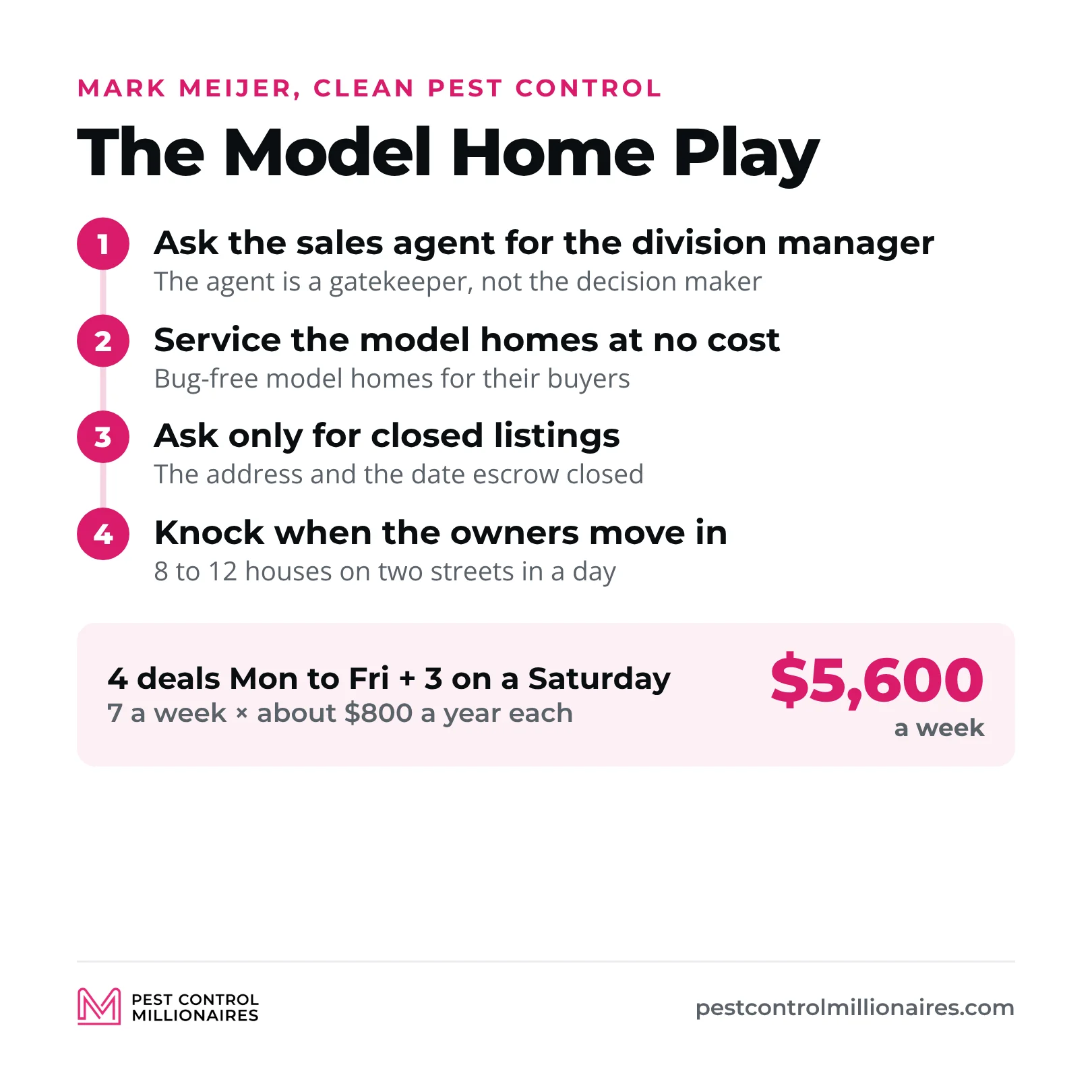
He walked into a subdivision’s model home and talked to the sales agent. That agent is a gatekeeper, not the decision maker, so he asked for the division manager’s number. Then he called the division manager with an offer. “We service model homes at no cost to you guys. We’d like to make sure your model homes are bug-free for your potential buyers.”
The only thing he asked for in return was closed listings. No names, no phone numbers, just the address and the date the buyer closed escrow. “If you closed escrow like on a Wednesday or Thursday, I know what you’re going to be doing on a Friday or Saturday. You’ll be moving in,” he said. Those were the doors he knocked.
It worked so well that builders started putting Clean Pest Control’s information in the welcome packets in their model home sales offices. And because the homes sit next to each other, the route builds itself. “There are days I can do eight to 12 houses on two streets,” he said. Some yards don’t even need him to move the truck, because the backyard gates face each other.
He’s careful about where he does it. A big national company has contracts with some builders for their closed listings, so he stays out of those model homes. He still knocks the owners in those neighborhoods. If you want help with what to say at the door, start with my door-to-door sales pitch.
Why that play is worth $5,600 a week
So why did he stop? “Got busy with work. Got comfortable, to be honest,” he said. When you have more time than money, you grind. Once you’re making good money as an operator, you don’t have to anymore.
Then I asked what he used to close. During the week, he figured about four a week. On a Saturday, when people are home, six to eight hours of knocking would get him three to five. Let’s take the low end. Four plus three is seven deals a week. At about $800 a year per customer, that’s $5,600 a week in new contract value he’s leaving on the table. Mark’s own estimate was closer to $700 a customer, which still puts it near $5,000 a week, and about $20,000 a month.
Knowing his skill set, I think that’s low. He could probably do two a day.
Mark was honest about the other side of it. “Gray hair guy, 52,” he said, and a Southern California summer is exhausting. I’m not telling him to knock all day, every day. Get the services done four days a week and sell two. Even one Saturday makes a difference.
As a technician, Mark is doing a $25 or $30 an hour job. With his sales background, he should be doing $500 an hour tasks.
His prices have room, especially every other month
For a tract home under 2,500 square feet, Mark charged $150 for the initial and $99 every other month, and that $99 includes mosquito. His lots run about 7,000 to 10,000 square feet.
I love that he bundled pest and mosquito into one price. At $99 a month, I like the number. At $99 every other month, I don’t. He’s planning $125 every other month going forward, and I think $125 to $130 is a good spot, maybe higher with mosquito in it. With his experience and the service he gives, he could probably raise prices 20% to 30%.
He did a price increase at the start of summer and got pushback from one customer. He only does them every other year, though. Do it every single year. It’s just inflation, even if it’s only 3%. You don’t have to email or text anyone. Put it on the next invoice, and on a $99 service that’s a dollar or two that nobody notices. My guide to raising pest control prices walks through it.
Mark also uses a power sprayer with a 50-gallon tank, and he thinks it wins him customers in a market where a lot of companies show up with backpacks. It’s perception. The label says to spray to runoff no matter what equipment you use, so the output is the same. But a truck with a big rig in the back looks professional, and a guy with a backpack sprayer makes people think they could do it themselves. The complaint Mark heard about other companies was “they were only here for 5 minutes.” So when you hire, set a minimum stop time, so every tech gives every home the time it needs.
One Google review isn’t a marketing plan
Mark’s wife runs his marketing, and after some trial and error, Facebook won. She writes posts with ChatGPT and puts them in local groups, like mom groups, and she’s smart about where. She posts in the city Mark is in today and the city he’ll be in tomorrow, so a lead from today’s city can start the same day and one from tomorrow’s city starts the next day. That cuts down on buyer’s remorse. Referrals do the rest, and they’ve even closed a couple of sales from the Ring app.
That’s a strong start. But his Google Business Profile had just gone up about a month before we recorded, and it had one review.
Reviews are free, and they make the profile show up more when someone searches pest control near them. Mark is at every customer’s house anyway. Save the review link on your phone, and when the service is done, ask. Say something like, “If I did a great job, would you please leave an honest review?” Nine times out of 10 it’s good. If it’s bad, that’s your chance to go back, fix it and earn a better one. Don’t ask customers to put your name in it, because Google takes those down. When he hires, the tech will watch him ask, and he can pay techs a bonus around reviews. Mark was already changing his FieldRoutes follow-up message to ask for a Google review.
Then swap out the stock photos. Have his wife spend a day with him and shoot Mark by the truck, the truck itself, Mark in uniform servicing a home and Mark talking to a customer. Post one a week. Every week we add photos, we see an increase in leads. More on that in my guide to getting more from your Google Business Profile.
Get a simple website up now
Mark doesn’t have a website. His reason made sense. “I get so much spam calls, spam emails,” he said, mostly from people way out of the area selling websites. “I didn’t know who to trust.”
But it doesn’t have to be a $10,000, $20,000 or $30,000 project. Start with a simple lead capture site, with a form that lands in his inbox, so every lead source has somewhere to go. When he starts spending on Google, he’ll need it. And AI tools like ChatGPT and Claude are already scanning websites to answer people searching for pest control near them. A website shows you’re a legit business with some authority. It might take a few weeks or a couple of months to build, but it won’t take his time. Here’s what goes into a good pest control website.
Protect yourself before you scale
Mark was still a sole proprietor, and his truck insurance was in his personal name. “For anybody watching the podcast, don’t hate on me,” he said. No hate. You don’t know what you don’t know. I didn’t either, until a mentor taught me.
But this one comes first. If something happens while you’re driving down the road, they come after your house and everything you own. Get commercial general liability insurance in the company’s name, get the vehicles out of your personal name and form an LLC (usually an LLC that files taxes as an S corp). Call your insurance agent, tell them what you do and compare the quotes apples to apples. For more on the legal side, read Phil Rinehart’s legal playbook for pest control owners.
Two smaller fixes go with it. Get a business phone app so calls stop going to his personal cell. RingCentral and Lawn Phone both work for less than $100 a month. I’m biased on Lawn Phone, because a friend of mine owns it and I used it for years. And move the last few Zelle payers to a card or ACH. We push ACH, because there are no card fees.
Get ready for the first hire
Mark remembered from one of my YouTube videos that about $200,000 a year is a good marker for bringing on a tech. When we recorded, he was just over $10,000 a year short of that. He’s basically there. Knocking doors, he’d close that gap in about a week and a half. (Why I usually put office help first is in your first pest control hire should not be a tech. Mark’s wife already handles a lot of the office side.)
The truck. Lease or buy depends on the rates. If the lease is 2.9% and the bank wants 6.5%, lease it. Either way, don’t buy new and don’t spend a lot of cash right now. A used truck with 20,000 to 30,000 miles, something like a Ford Maverick for $15,000 to $20,000, plus $1,500 to $2,000 for equipment and a wrap, does the job. Or give the tech Mark’s four-door Tacoma and buy a cheap car to sell in.
Payroll and the handbook. QuickBooks has payroll, and plenty of payroll companies are inexpensive. Line one up now. California is highly regulated, so get a handbook from an attorney. It probably costs a couple hundred dollars.
SOPs. Document what you do today and have ChatGPT turn it into SOPs. Mark wants them simple. “If a tech put my uniform on tomorrow, he could run it,” he said.
More on the hire itself in my guide on how to hire your first pest control technician.
The exit is closer than he thinks
Mark didn’t start out wanting to scale. He wanted to be his own boss. Then he found my YouTube videos and followed the comments into our Facebook group and the program. Now he has a number. “My minimum exit is five million dollars, which means I need to be doing at least two and a quarter, two and a half million dollars a year in revenue,” he said.
Every fix on this list builds toward that. Even a smaller exit changes your life. Build to $750,000 or $1 million a year in three to five years and you could be paying yourself $300,000 to $400,000 and sell for $1.5 to $3 million.
Here’s the plan we left with, in order.
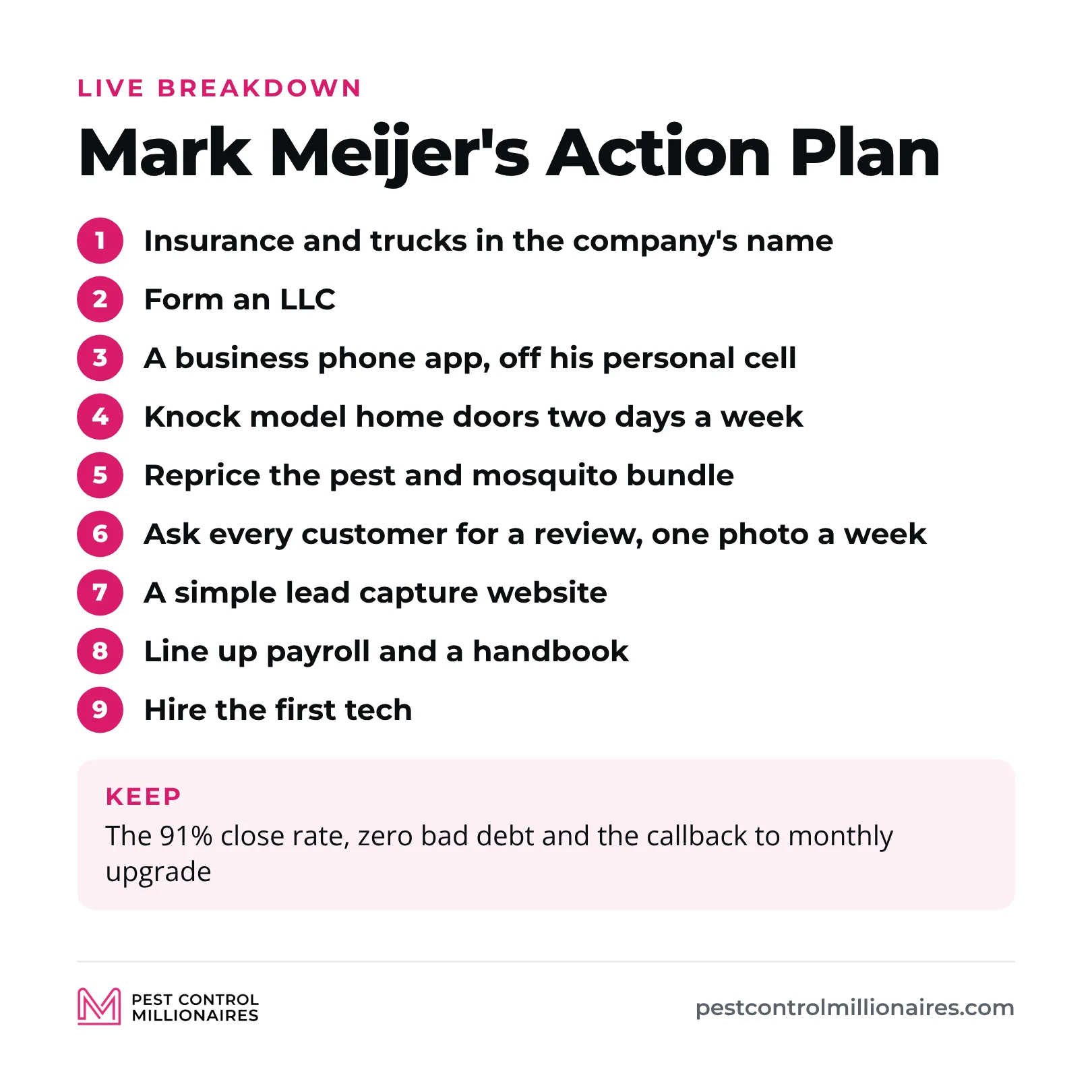
And keep what’s working. When Mark gets someone on the phone, he closes about 91%. He won’t sell over text. When someone texts asking for a price, he texts back asking for a five-minute call. I’ve sold a lot of accounts over text, but it took me a month of rewriting my messages every day to get there. Don’t change the phones, the zero bad debt or the callback upgrade. I’m looking forward to having him back to tell the story a year from now.
Frequently Asked Questions
Who is Mark Meijer?
Mark Meijer owns Clean Pest Control in Riverside County in Southern California. He spent about 25 years in pest control, around 10 as a technician and then as a sales manager, before he started knocking doors on his own. When we recorded this in October 2026, he had run Clean Pest Control for seven years as a solo operator.
How do you get pest control customers from new home builders?
Go to the model homes, ask the sales agent for the division manager and offer to service the model homes at no cost. In return, ask for closed listings, just the address and the date escrow closed. Then knock those doors when the new owners move in. Mark could do 8 to 12 houses on two streets in a day, and builders started putting his information in their welcome packets.
When should a pest control owner hire the first technician?
Around $200,000 a year in revenue is a good marker for bringing on a technician. Mark was just over $10,000 a year short of that when we recorded, so he was basically there. Line up payroll, a handbook and a truck before you make the hire.
Should a pest control company be an LLC?
A sole proprietor puts everything they own at risk. Mark’s first two moves were to form an LLC and to get commercial general liability and vehicle insurance in the company’s name instead of his own. Call your insurance agent and compare the quotes apples to apples.
Watch the PCM Podcast on YouTube