Brandon Sizemore on Betting His House on Mint Pest Control

Table of Contents
Brandon Sizemore co-founded Mint Pest Control, which had four locations and its headquarters in Louisville, Kentucky, when we recorded this. He’s also a CPA who started his career at Deloitte. Then he mortgaged his house to start a pest control company.
I’d been working on getting him on the show for a couple of months, and once we started talking, we had to stop and hit record. We have more in common than pest control. Brandon served his mission in Marquette, Michigan, an hour north of where I live, and he figures he knocked just about every door in town. Pest Badger has a lot of accounts there.
This episode is part of the PCM Podcast. For the guy who trained my first door team, read Parker Langeveld on door-to-door recruiting and playing business.
Nobody is coming to rescue you
Brandon’s parents went through a nasty divorce when he was in high school, and as the oldest of four, he grew up fast. Money was tight. The family got a lot of help from their church, and his clothes came from thrift stores, garage sales and his friends. Financial security became a big deal to him.
After his mission, he spent a few weeks selling security door-to-door in Colorado and didn’t do great, partly because he was already planning his own security company before he’d sold an account. He still counts it as a failure. So he went back to school, finished an accounting program, landed one offer from Deloitte in the middle of the 2008 and 2009 financial crisis and moved to Arizona with his wife around 2011.
That’s where he found out what a service business is. In his first week of training, his new coworkers were talking about their cleaning lady, their pool guy, their landscaper and their pest control person. “Are you guys all like freaking rich here?” he thought. Where he came from, pest control meant grabbing some Raid. Within a few months, he was paying for those services too, because they did things way better and faster than he could.
He tried side hustles that fizzled because he never put all his energy into one. Then one day, listening to Grant Cardone on a long commute, he sat in his car in a parking lot with the engine off and realized he wasn’t giving anything 10X effort. “I remember having the thought that just nobody was coming to rescue me,” he said. If he wanted his plan A, he had to go make it happen.
Recruit your partner like a customer
Brandon wanted a service business, and after first leaning toward pools, he decided pest control was the better business. He asked friends and family to partner with him, and several said no. Then he messaged Mitch, who had been selling for Aptive for five years, on Facebook. They didn’t know each other well, and Mitch put him off at first because he was having a baby. Eventually Mitch came over for dinner, and they sat at the table until 12 or 1 in the morning, both probably shaking, deciding whether to do it.
Mitch wanted one more year of selling first. Brandon had approached him at the end of 2018, and Mint got its first customer in 2020. To keep Mitch warm for that year, Brandon wrapped a truck and made a video and pictures to bring the idea to life. Mitch had two conditions for the name. No eco-something and no green-whatever. They wanted a natural, fresh feel, and they landed on Mint. When Brandon first pitched him, all he had was a picture of a truck and a smile, which is why he still calls himself the best salesman in the company.
Mitch had one more condition. They couldn’t start in Arizona or California, because those markets were saturated. So Mint started in Louisville.
There is no plan B
“When you go bet the farm on something, like I mortgage my house, right?” Brandon said. At that point there’s no plan B. If Mint went under, he could lose his house. He financed everything, bought a few trucks and recruited a door-to-door team for the 2020 season. They lost half of it to the uncertainty around COVID and went out with seven or eight guys. Some of them have since built teams that do $10 to $15 million. He wishes he could have paid them enough to keep them at Mint.
His wife, a stay-at-home mom taking care of their four kids, became the first CSR. Brandon handled the back office, they hired a branch manager, and he taught himself to knock doors, even though he’s an introvert. He was shaking at the first door. Then he sold four accounts in a half day and seven the next, and figured it was luck. He told himself he had to be willing to do every role in the business so he would understand it, so when they couldn’t hire during COVID, he went out and did the tech work for his sales guys too. Kentucky’s governor was strict and the state took forever to open up, so they knocked southern Indiana as long as they could. That first year in Louisville, they put on about $600,000 to $700,000 in revenue.
I was doing the same thing in Wisconsin that summer, servicing almost 30 jobs a day out of a Nissan NV200 with a spotlight on it and learning door-to-door from YouTube until Parker came out to Green Bay to train us. The rest of my first summer is in how we built Pest Badger.
When I asked Brandon what he’s most proud of, he went back to that decision. His wife was already living her dream as a stay-at-home mom, and her support for it still means a lot to him.
Pay to keep your best reps
If Brandon could do it over, he would take bigger risks to keep the legacy guys who went on to build $15 million teams. He lost a lot of reps trying to stay competitive on pay, and Mint had a tough time selling an equity model to reps coming out of Utah, where a lot of people have a bad taste about equity. “I would pay those rates all day long,” he said, about pay he once said no to.
As a CPA, here’s how he justifies it. A door-to-door company can have higher margins than a non-door company because of route density, so it can afford higher costs. You also have to know what you’re building for. If it’s an exit, that can justify paying top rates. Or you can parachute into a market with door-to-door, then let the trucks driving around pull in more calls. If you need to put on $15 million in a season with no book of business behind you, you’d better raise money, finance it or stretch out your payment terms, and you need a cash forecast either way.
He doesn’t much care whether a customer from leads costs $100 or $200. “I’m still just going to run as many freaking leads as I possibly can because it’s cheaper than door-to-door,” he said. I push every dollar I can to our inside sales team for the same reason. Door-to-door is the fastest way to scale, but it’s the most expensive, and a customer sold on the doors is easier for the next rep to switch than one who calls the office. I’d still know the number for every channel, though. Ours are in how much to pay for a new pest control customer.
Open one market at a time
In year two, Mint kept its first-year reps and opened Indianapolis. Mitch’s dad, who Brandon knew through church and who had a lot of business experience, became the branch manager, and Brandon moved there for the summer to knock with a first-year team. They ran those two branches for a few years.
The year before we recorded, with close to 80 to 100 door knockers, they needed more markets and opened two branches in Ohio at once. Brandon calls them soft-fail launches. Some reps knocked poor-performing areas, cancellations piled up, reps left, and when we talked Mint had about 30 knockers trying to build those branches back up. Knowing what he knows now, he would have opened one instead of both. People tend to spread out too fast, and if you do open locations, keep the overhead low.
His other early mistake was trucks. He refinanced his house into used trucks to save money, and he wouldn’t do that again. Now Mint buys new trucks, finances them, pays them off in four or five years and runs them a long time, leasing a few for the summer if it needs them.
Customers just want to know you’ve got it
Brandon spent most of his time as the finance guy, with about 80% of it going to door-to-door, while Mitch ran sales. About a month before we recorded, he moved into the COO seat, with every branch manager reporting to him. Customer experience is his focus now, and retention is the number he cares about most.
When he first got into pest control, he kept hearing it’s a relationship business, yet his branch managers didn’t want to do inside treatments, and most customers aren’t even home. So how do you build a relationship? He went back to what he valued as a customer in Arizona, which was great communication. “If I felt like the person taking care of my home cared about it as much as I did, then we’re good,” he said. His landscaper once let a couple of broken sprinkler heads kill part of his lawn because he didn’t know if Brandon wanted him to fix them. “We would have paid you more just to take care of the thing. You just got to let us know,” Brandon told him.
“Sometimes we think we’re bugging our customers, but the reality is they just want to know that you got it,” he said. Their concerns about pests become your concerns, and you can’t replace one problem with another, like leaving the gate open so the dog gets out. That matters even more because other companies’ door knockers are good at minimizing what you do. Pest control sells an absence, no bugs, so if customers don’t know what else you’re doing for them, it doesn’t matter how good the service is. Jake covers the field habits for that in stop missing the gate and give the dog a treat.
Leaky faucets and dirty bathtubs
Brandon’s leadership team is building its training around Excellence Wins by Horst Schulze, who Brandon credits with the Ritz-Carlton’s reputation. Connecting hotels to pest control was hard at first, so they came up with a way to sort complaints.
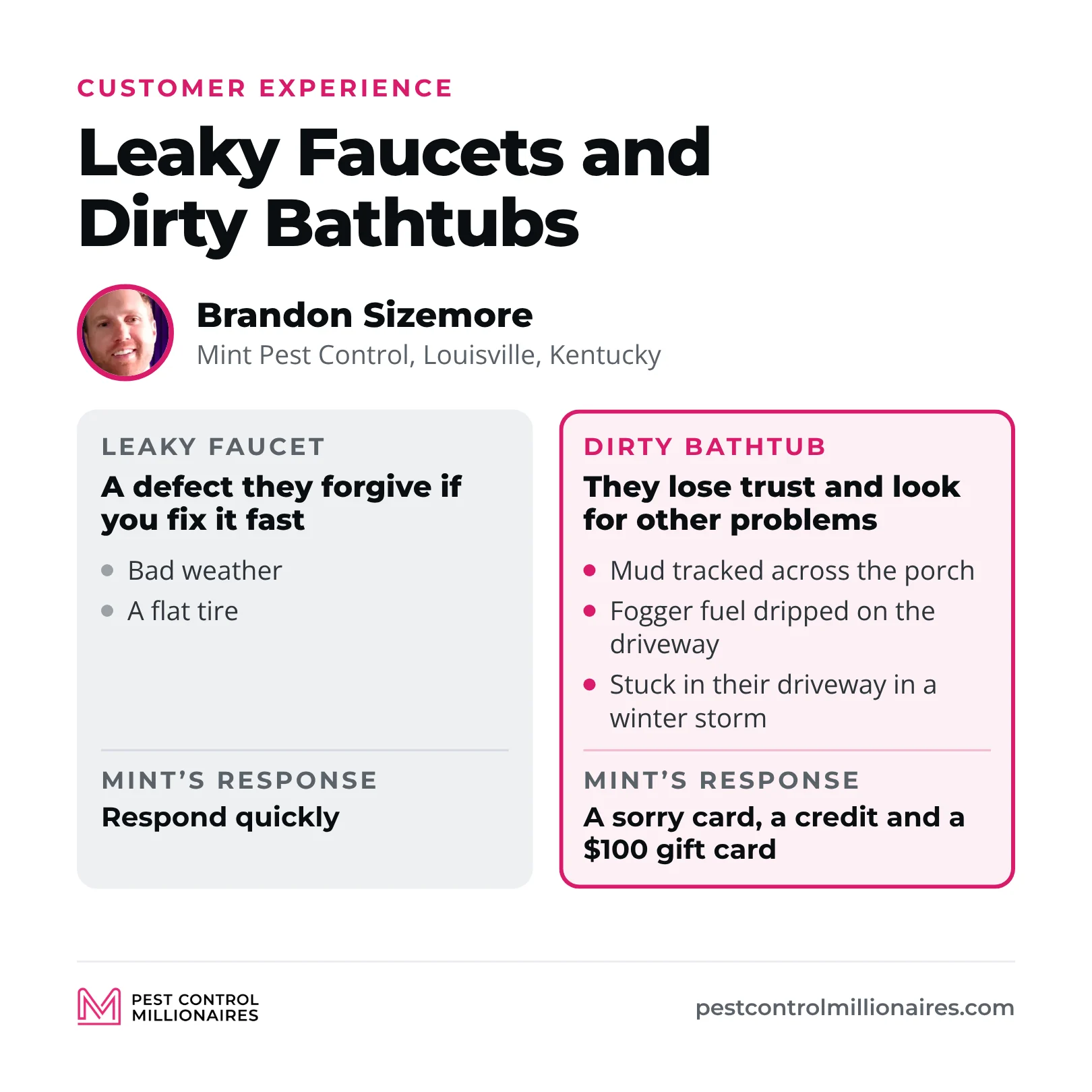
Every customer wants a service without defects, delivered on time, by people who are nice to them. Picture checking into a hotel and finding a leaky faucet. You call the front desk, they fix it fast, and you forgive them. You might still leave five stars. Now picture a filthy bathtub nobody cleaned. You lose trust and start looking for other problems. Did they even wash the sheets?
For Mint, bad weather and a flat tire are leaky faucets. They aren’t Mint’s fault, but they’re still defects in the customer’s eyes, so the response has to be quick. The dirty bathtubs were all real. A tech tracked mud all over a customer’s front porch. Fogger fuel spilled in a truck and dripped onto a driveway, leaving marks. A tech pulled into a driveway in a winter storm and got stuck. For those, Mint sends a card that says, “Hey, I’m really sorry that this happened,” gives the customer a credit on their service and sends a $100 gift card. Brandon says recognizing the difference was hard for his team at first.
Brandon doesn’t think you have to run your company exactly the way one book says, and neither do I. I’ll read five or six books on one topic, like Never Lose a Customer Again by Joey Coleman and The Effortless Experience, then take the best of each and build our own. One golden nugget from a book is all I’m looking for.
Frequently Asked Questions
Who is Brandon Sizemore?
Brandon Sizemore is a co-founder of Mint Pest Control, which had four locations and its headquarters in Louisville, Kentucky, when he was on the PCM Podcast in July 2026. He’s a CPA who started his career at Deloitte, then mortgaged his house to start Mint, which got its first customer in 2020.
What are leaky faucets and dirty bathtubs in pest control?
It’s how Mint sorts customer complaints, from Horst Schulze’s book Excellence Wins. A leaky faucet is a defect the customer forgives if you fix it fast, like a weather delay or a flat tire. A dirty bathtub makes them lose trust, like mud tracked across their porch, and Mint answers those with a sorry card, a credit on their service and a $100 gift card.
Should a pest control company open two new markets at once?
Brandon wouldn’t do it again. Mint opened two Ohio branches in the same year, some reps knocked poor-performing areas, cancellations piled up and the door team went from 80 to 100 knockers down to about 30. Knowing what he knows now, he would have opened one.
Is door-to-door worth what it costs?
Brandon thinks a door-to-door company can run higher margins than a non-door company because of route density, which justifies paying reps well. It’s the fastest way to scale, but it’s also the most expensive, and those customers aren’t always the stickiest, so know what you’re building for and plan your cash flow.
Full transcript
Every word of the episode, from the video captions
Building the business turns you into a different kind of human being.
Realize that failure is a part of the...
I think there's hope out there for all of us. For all of us. They say procrastination be the assassination of destinations. That's why we out here grinded with no association with haters and them other crabs trying to put us down. Pest Badger's in the house. Boy, don't clown. Just keep your eyes on the prize and no giving up. You can do whatever you dream of. Keep your eyes on the prize.
Welcome back to another episode of Pest Control Millionaire. I don't even know what episode we're on for. I know we're tracking 200 here shortly, so we're getting there. But, really excited for this one. We were just chatting shortly. I was like, we have to stop talking. Let's Let's just hit record. We got, Brandon Sizemore. He's with, for the founder of Mint Pest Control. They got four locations. Louisville is HQ. I think we have to we probably have a lot in common, a lot to chat about. Really cool background story that we were just chatting about, but Brandon, I know we've been working on this for I've been working on you for a couple months, I think, sending messages here and there. We finally made it happens, but just welcome to the show, man.
Yeah, Jonas, thanks for having me for episode whatever this is. I don't even know. Like I could probably go look I think officially like what's online. Let's see what it shows. I need a Jamie like a Joe Rogan test. So 180 went out today and I have two other in the queue. Plus you're So you'll be you're technically 183 I think.
Oh well that's awesome. I'm honored to be whatever. You know I finally made it on on the show. I feel famous now. So, yes. This is going to be great.
You are famous. You're doing big things and it's really, really cool. We don't know each other a whole lot yet. We're about to get to know each other and we been going back and forth online, things like that. I just love the industry as a whole. I know you guys, I mean, you guys are super clean. I looked at a bunch of your pictures, checked your website. It looks really, really good. So, good work there. But first question I always ask when we start this episode before we rewind the clock a little bit is if you and I sophomore, junior in high school, who's Brandon in high school?
I'm sure that's an interesting question for a lot of your listeners.
Well, I guess I would say so I mean I guess if it's okay with you, Jonas, I typically like to be pretty vulnerable in ination. And so, you know, for me, high school for I think a lot of people is a big transitional time in their life. And for me, a lot of events happened as well, right? So, in high school is when my parents, they split up. They went through a really nasty nasty divorce and it had a you know, had an impact on to me. I was I was the oldest of four kids and I think it caused me to grow up a lot faster than I probably should have or wanted to. And we didn't come from a family that had, you know, we didn't we struggled a bit financially, right? I think a lot of people from your podcast probably have even even you know better rags the richest stories than I have, but we didn't I don't want to over sensationalize and say we were super you know below poverty or anything like that, but we didn't do great. We got a lot of help from our our church.
You know, all the clothes that I wore were were used clothing from thrift stores or garage sales and probably clothes that my friends just gave me. And so for me growing up in high school, you know, when you're when you're showing up in your friend's clothing the next day, it was embarrassing for me, right? So financial security became a pretty big deal. And I had to like set some boundaries with my mom. Some, you know, there were a few times she'd bring home like used underwear, you know, like boxers and stuff. I'm like, "Mom, I don't want to wear that. Can I can we draw an exception here?" So, financial like security was something I was into. But, you know, I was I was a good student. I was kind of labeled as a as a fairly smart kid early on. I was a few grades advanced, especially within math. But I felt like in order to be like a smart person in high school, you kind of had to create a persona or image that you weren't trying really hard. It had to come across pretty effortless. And so I probably created some bad habits where I where I tried to at least behave or act like I didn't care.
But I was also trying out for like the basketball team. I'm a I'm a big basketball guy. Ran cross country as well. And I if anything I had to work hard. It was that right like I we had a really good basketball team, a really good basketball program and I got cut a few times within you know my freshman sophomore year and I really became like just a fanatic with just getting inside the gym. And when I say gym I'm talking about playing basketball. I should have probably been lifting weights but instead I was a gym rat, right? I was just playing all the time. But it really forced me to try at something to be to be be the best I possibly could. I didn't have a natural talent. And so if anything, I tried really hard. It was that. And I eventually made the team and became, you know, kind of a six-man of the year.
So I really related to like the Knicks just winning the championship with Jalen Brunson. Dude, he was just kind of told like he couldn't make it this whole time. And so it was really cool to see his story of what he's done even now. And I can certainly relate myself.
That's awesome. I love it. Yeah. My parents went through divorce when I was three, so I don't really remember it. And then my then my stepmom or my stepdad and my mom got divorced my senior year. So, you're right. It just changes a lot of things.
Changes. Yeah, it changes. And I mean, it's you know, I don't I don't want to turn this into a therapy session for you and you're going to start billing me, but you know, the reality is that my parents have been divorced several times, right? Both of them. And so it has an impact on how you view relationships and you know, certainly probably has an impact on me today. But, I think where it's really helpful is if you can sort of overcome some of adversity, which I think a lot of your guests have, it can be pretty inspiring as well. So, you know, I you know, kind of going back to my high school time, I wasn't like I didn't fit into any particular group or anything. I would say I'm a bit of an introvert from that perspective.
And I, you know, it's funny because I didn't really know what that meant. You know, people always would say, you know, if you're an introvert, you don't like people. And I've never really fit who I was, right? I love people. I like talking to people, but what I don't do a great job at is small talk, you know, sort of this light-hearted talking about the weather. And I think it probably had some impact to deal with the stuff that was happening at home, you know, so when I'm, you know, dealing with my family falling apart and things are just going in shambles and people want to talk about the weather, it just was hard for me. And so even today I pride myself in digging deep and I'm not sure how but even even in high school I was I was voted you know best personality which probably just my looks didn't help me any.
So they kind of gave me a you know like a gift there. But the reality is like I said I love talking with people. I love listening to their stories and kind of learning more about them and really getting to know them but mostly at a deeper level. That's cool. This probably I probably know the answer to this because I know you went on a mission. Is this podcast is that a challenge for you or are you past that...
Jumping on the podcast here?
Oh, I'm sure. I'm sure. I'm always, you know, anytime I have to get up in front of people or, you know, give a give a talk or a lesson or something, I'm sure just public speaking in general is always going to is always going to, you know, get on, you know, get get your nerves going a little bit. But outside of that, I mean, I certainly enjoy more of those intimate conversations, small group settings. I love talking about deeper conversation. And I don't necessarily, you know, I don't know if I could describe myself as an introvert in that way where I don't like to talk or like to you know, get to know people. It's just I like to do it more at a deeper level, right? Like talking about superficial things just right.
I lose attention quickly, unfortunately.
I think I think that's just an entrepreneurship thing, too. Like we're wired. Yeah, that's cool. Like you have a really cool story already. And then from there you assuming you graduate and then when you start go when you go on your mission.
Probably Yeah, that's probably true.
Yeah. So back then when you served a mission you were it was at 19 years old. It's now changed to 18. And so you typically in my case I went and did a year of college.
And that was when I was first sort of introduced to the door to door scene. I didn't do door-to-door per se at that time. But it was becoming popular. This is kind of the mid 2000s and to be honest with you, pest control wasn't like the sexy thing to go sell at that time.
Still at time what I think what I hear.
Well, it's definitely a lot sexier than it was even then. All my friends were doing security which now they call alarms, right? Which is you have you had companies like Apex and Pinnacle, you know, Apex is now Vivint, right? And so they're all doing that. But it was still just getting started, right? I feel like it was just getting some traction. And this is kind of early to mid 2000s. And then I basically spent my time just taking some generals and just preparing for my mission. It was kind of one of those weird bridge years where you're sort of looking forward to something but you can't really progress in life. You just kind of have to live.
Is that why they changed that to 18?
I think that probably had a lot to do with with it. One Yeah. I mean...
For me it was weird. I had a girl that I was dating at the time and you know I thought would probably wait for me to get back from my mission that didn't happen didn't work out the way that I had thought it would and probably better for both of us in a lot of ways. We're both happily married now. But for me, like that that year just transition and I live with probably five other guys that were like, you know, probably four or five years older than I was. And so I learned a lot from them because I was kind of the young, you know, 18-year-old staying up till 3:00 in the morning. And they had really disciplined habits. They'd all come back from their missions. And the mission definitely causes you to grow probably 10 years, you know, in two years you grow 10 is why you see a lot of these these guys that are just really high caliber and really mature guys. So it wasn't until then I applied to serve a mission.
I was hoping to go over overseas. But as you know early from this conversation, I got a letter that said I'm going to go serve in Wisconsin, which is your neck of the woods. And so I started up there. I started in Marquette, Michigan. My first baptism was a Methodist minister in we baptized her in Lake Superior. Actually, it was like three weeks in. So it was a really incredible experience. I met a lot of great guys that I lived with for two years and so I'm familiar with the UP your hometown Escanaba you know some of these other towns like Ishpeming, Negaunee, Manistique...
So like for all you listeners like usually when people ask where I live I just say Green Bay because it's easier right down Michigan like oh yeah that's by Detroit I'm like yeah know like nine hours south or nine hours north of...
So you ask, "Oh, you're from Green Bay." I'm like, "No, I'm like two hours north." Like, "Well, where?" Like, "Escanaba." I'm like, "That's where I...
Funny. And so Marquette Marquette is an hour north of us. We service there. So we have a lot of accounts there.
Yeah, every Mastique is only 40 minutes from me. We're there a lot. Drive through there, go to the bridge. So yeah, it's just crazy that you know the area. It's pretty cool. And you knocked here, which is cool. Yeah, I probably knocked every door in Marquette, Michigan.
Well, it doesn't take it very long, does...
Hold up. Quick pause. If you're on a pest control company or fertilization weed control company, you're not in our Facebook group. You're choosing the harder path. Every operator that's there skipping years of mistakes because people are actually sharing what's working right now. So, stop trying to brute force your way through growth alone. Search Pest Control Millionaires on Facebook or click the link below. And now, let's get back to it. So, our area in Marquette covered down to like Sawyer, the Ghani area, then left or west of Ishpeming. But I remember when I first landed, we flew into Milwaukee and it took us the whole day to drive up all the way to Marquette and I'm just like, are we going to stop here ever? Right? Because you know what it's like. You drive on these roads and there's trees on each side that you can't see through. It's beautiful in the fall, right? It looks like it's on fire in the fall. So, it's gorgeous. But you're literally in the middle of nowhere, right?
And I remember when I first started knocking, there were doors on on the second story of people's homes. I remember being inhibing and I asked the person I was serving with, I said, "Hey, what are those doors for?" And he's like, "Dude, that you know, it's gets so much snow up here. We have to like be able to get out of our houses at these times." So, I don't know how you do pest control up there. I'm sure it's amazing and obviously you've made it work because you guys have grown like crazy but it's definitely a different place being a so I was aer for for a few months.
That's awesome. What did you think of Lake Superior?
Lakes appears was awesome, dude. I felt like it was Yeah, it was a it was a bit chilly even on a warm day. I think I was did this baptism in June or July and it and you probably don't know this but missionaries aren't able to swim. It was my only time ever to go into like a lake and go swimming. And so I kind of did a little trip and fell onto the water on purpose and intentionally just to kind of get my fix for the next two years. But it was beautiful, man. It felt like honestly such a like I've never seen a lake this big where it just looks like it's an ocean, right? It was it was incredible. It was massive. You're right.
But yeah, like as you know, like it's just not very big. And knocked it pretty in a pretty quick hurry. If you brought a team of five guys, you dock it in a couple days, it wouldn't take long. And so that's kind of obviously you can see where my struggle was. Like I felt like I was a pretty good operator. Have a lot of accounts here, but there's just nothing. There's nowhere to go. And so that's kind of obviously how I had to evolve. I lived here, have kids here, and Green Bay was the next closest place I could get to.
Which is still two hours, you know.
Yeah. And you're right, it's still a bit of ways from you and it's probably not like big. Green Bay is interesting because it's not like the biggest city...
The whole area is like 100,000, but it's not big at all.
People just know of it because they think it's bigger because Green the Packers were there.
Yes, that's right. They make it makes it feel a lot bigger than it is because that city is so fanatical about their sports team, right? They sort of designed their grass and their flowers to kind of match the Green Bay Packers colors. Like the fire hydrants are all sort of painted the same same Packers colors as well.
I think the city of Green Bay population is like 100,000 and behold it's 80,000.
Yeah, that's crazy. That's insane, right?
Like the whole town like congregates there. Like obviously it's packed inside, it's packed outside. All the restaurants, bars are packed.
Yeah. So did so what's interesting is we had a rule in there we couldn't we couldn't we call it tracking you know as as missionaries but it was knocking you couldn't knock on packer sun like you couldn't knock on those days because yeah no one...
It wouldn't make any sense they won't be mad at you too...
Right that's funny I did not know that yeah this is a crazy story like right off the rip we got something in common you've been to Marquette EA like yeah not a lot of people can say they've here. So then from after your mission, I'm assuming you go to college and you probably get recruited. Is that what I'm assuming?
Yeah. So I got back from the mission. And quickly, yeah, you know, folks are are signing up to go sell alarms or security at the time. And I was getting recruiting lunches and calls and stuff and trying to figure out what I wanted to do. I had a few options to go sell with some friends, but I was also meeting my wife. We were quick quick to kind of get married, you know, after dating each other for a year or so. And then because of her situation, she was a she was actually graduating because I was, you know, she was a little bit ahead of me in school because I had done the mission thing. And she ended up was graduating from dental hygiene school. And so I wasn't able to do any sort of knocking until like later in the summer. And so I was going to go sell security with just a really small company. And so I showed up and I was actually going to do this in Colorado, which is where I'm originally from. And I was living at home, which is just was probably a terrible mistake, right, to begin with.
And so I had a few weeks just to go sell. And you can you can imagine just after a few weeks of trying to sell security, I didn't do great. You know,...
Close to home easy.
Yeah. I'm close to home. I wasn't getting any training because I came in super late. And honestly, Jonas, like I think for me too, I just had a hard time focusing on the sales process, right? I It was my first like introduction to like a business and I have an entrepreneurial sort of brain and I was like already ready to start a security before I even like sold an account, right? Which was just insane for me to think about, but that's how my brain was working at the time. And so it was really hard for me to focus on selling one or two accounts or three accounts a week. Like selling three or five was actually pretty good for me. I was like, well, how could how can I build something? And so it was really hard for just a few weeks to really focus. And I still considered it like a failure, right? Where I just I didn't perform what I kind of expected and always kind of carried that as as a time where I sort of failed at this thing.
Went back to school. I got into an accounting program at the school I went to and it's a you know pretty highly rated program and kind of requires all your time and energy and effort like your whole soul is dedicated to try to focus on it and to be honest with you we door too was very different back then than it is even today where it would just felt kind of like a side gig for most people. It wasn't like a career for anyone. And people weren't starting all their companies really even in the mid200s. There were a few that were starting, but it was just like, hey, how can I make 20 $30,000 in a summer and make more than if I were to stay at home? That's how we viewed it back then. And so we kind of made fun of like in my accounting program at least, we kind of make fun of those guys that knocked doors and became those sales bros. You know, they still are today. There's even more of them.
And we kind of almost looked down on them because even the program I was in, it's like your guaranteed job offer rate was like 90% by the time that you were finished your junior year. And so I put all my energy into that and worked really hard just to just to get a job because this was now 2008 2009. The financial crisis hits and I'm like, "Okay, I've got to put on this on hold for this thing about starting my own business because I had this entrepreneurial desire and I just need to make sure I have something to work, you know, have work, right? Because I wasn't we weren't getting as many offers back then." And eventually just grinded and I was able to get one offer from one of the big four firms.
They're called Deloitte, Deloitte and Touche. And so I just took that right. I was like, "Hey, I just need an offer." And that ended up taking my wife and I to Arizona. And that's where we that's where we really started my career. And that was probably about 2011, I want to say. And I had no idea, you know, I' I'd had known some people that sold pest control. That was kind of my first introduction, but I didn't know like there was this service-based business thing that it even existed, right? And I remember my first week, I'm sitting down with these Arizona professionals. We're in training. We're in LA. And they're all we're all around the table and they're talking about their people that take care of their yards or their pools. Like, "Hey, my cleaning lady this, my pool guy that, my landscaper, my pest control person." And I'm just like, "Are you guys all like freaking rich here?" Cuz we like that was me for all of those things, right? If we need pest control is like, "Go grab some raid." Like,...
Never heard of service-based businesses,...
But Arizona, they're really common. Almost everybody has like four or five of them, right? And that quickly became who who we became soon, right? Like we ended up getting some service companies after a few months of living there cuz like these people could do things way better, way faster than we could. And so we would hire cleaning people or pool people. And I thought it was awesome. I thought it was awesome to have like service companies that you can just trade money for and they can do something way better than you could. And so it's kind of my first introduction to like service based I guess you know fast forward from there I actually became so focused you know accounting is at least at the big four you're you're showing up at 7 or 8 o'clock in the morning.
A busy season you're there till 11 at night. There were a few few nights where I slept at my office, you know, for 30 minutes. You know, I've worked a few 36 hour shifts. And, you know, it came to a point where I was like, hey, I'm going to keep pursuing this plan B option until I figure out what plan A is. And I would try to try all these little things like side hustles, right? I sold Amazon FBA for a while. Sold you know, try to buy some homes, invest in real estate, and because I really wasn't putting all my energy and effort into one thing, they all seemed to just fizzle out, And so, I wasn't super successful with those, or at least I didn't consider them successes. And it wasn't until later on where I was introduced, my friend, he was actually contacted by one of those one of the owners of that the Green Mango group probably familiar with...
And he was he was he had like a small pool route of like 30 30 accounts or something and one of them approached him, I think it was Dusty, and said, "Hey, you know, let's start a pool company." and they started a company called Pineapple Pools that was around for a few years. And I remember him pulling me in the first, you know, the first time he wrapped his truck and he's like, "Hey, I got to show you this." And he showed me this truck and I'm just like, "Wow, this thing's pretty sexy. This thing looks really nice." And so that was his first truck that he wrapped. And they ended up having to wrap a ton of trucks because you have to do a lot more accounts with pools and so you need a lot more trucks. And so that kind of got my wheels turning a little bit. I put that on ice for a few years and I remember just one day I'm listening to a lot of audio books. My commute was like over an hour and I was listening to Grant Cardone's 10X or something like that.
What is that book called? And Grant, you know, you know, like him or love him, Grant Cardone's like not my favorite author by any means, but...
Uncle G. Yeah.
Yeah. But this book was definitely Yeah. This has a has a sacred place in my heart because I was listening to it and it was just like, yeah, here's here's why I haven't been successful at some of these other things is I'm not giving it 10x effort, right? And so I just remember sitting in my car and engines turned off. I'm in the parking lot and I'm just like, dude, man, like I remember having the thought that just nobody was coming to rescue me, you know? Nobody's going to come save me or try to be like, "Hey, Brandon, let's go partner and start a company, right?" And I figured I had to go do that myself. If I was going to pursue eventually s pursue my plan A that I wanted to, that I had to go make something happen. And so that's what I did. I started reaching out to friends and people to see if they could partner and I thought I thought a service-based business. I was originally going to start a pool business, but I eventually said, "Hey, I think pest control is probably a bit better of a and tapped a few friends and family and got rejected by several of them."
And eventually found my business partner today who was selling for Aptive at the time. He'd been doing that for five years and just poked him on Facebook and just messaged him and say, "Hey, man. I know we don't know each other super well, but love to sit down and talk. He kind of pushed me off a little bit at first because he was having a baby. And eventually I was able to convince him to just come over to my house one night. We sat around the dinner table and we stayed up to my till like 12 1:00 in the morning around my dinner table just like, "Hey, are we are we going to do this?" And we're probably both just shaking. And eventually he convinced me he was like, "Hey, I wasn't planning on doing this. So it would be nice if I just had one more year to go sell and let's go set start this the next year later and let's go do this, right?" And so that's what happened. We ended up starting in 2020 was when we got our first customer. I think I approached him at the end of 2018.
And during that time I was kind of putting some pieces. I wrapped a truck, took some video cuz I was like, "Dude, I don't want to lose this business partnership opportunity." Then I had to keep him warm for a full year, right? And so I made like a video and some took some pictures to kind of bring the concept to life. And then eventually we decided, hey, let's go get our first customer. And that was in here in Louisville, Kentucky. Because his condition was that I we couldn't start in Arizona. We couldn't start in California because of the saturation at the time, So, did you move there?
At first, no. At first we went out for the summer and my wife started out as our CSR. I was like transitioning trying to handle all the back office stuff. We hired a branch manager and I when I say I put everything into it, I some people think it's easier when you have money to start something and vice versa, right? Like it's there are some challenges either way, right? So for us, for example, when you go bet the farm on something like I mortgage my house, yeah. I financed everything and you have what feels like a lot to lose,...
There is no plan B at that point. It's if you don't have anything you put into it, like you don't have anything to lose. But I mortgaged my house of like I if this goes under, I lose my house potentially, right? So, I financed everything. We bought a few few trucks. We had a door-to-door team that we recruited in 2020. That was chaotic in and of itself. We lost half our team from from what people couldn't predict as far as COVID. And so, we went out with like seven or eight guys. And some of these seven or eight guys are killers in the industry today. I wish they would have stuck with us at Mint. I wish we had the financial backing to have convinced them to stick around. Some of these guys have created teams that are 10 $15 million teams and I wish I could have paid them the money at the time to do that here at Mint. Unfortunately, I didn't have that at the time, but it was a great team.
It was a close squad. Like I said, my wife was taking phone calls. I went and started trying to knock doors myself. Tried to do try to train myself to do it. And slowly but surely we've we've been able to sort of stumble along and grow.
That's awesome.
So that was kind of our first year was it here in Louisville. We got we put on probably six or 700,000 in revenue.
That's awesome. So how'd it go your first year knocking doors personally?
Dude, I mean I told you I'm an introvert, right? So my first the first door, man. I'm shaking in my boots. How about...
Wrote down oh yeah. Right. Like the hardest door was co too like it was during co...
Yeah. And as you know like when you haven't really developed the skill or anything like it's pretty scary. My first day I actually did fairly well though. And maybe it was attributed to COVID. I went out for like a half day and sold four accounts. The next day I sold seven. So I was like I didn't think it was any easier. I thought it was just like lucky, right? And so certainly had a lot of you know tough tough encounters as well. And I wasn't, you know, that lucky throughout the rest of the summer, obviously. But, no, it was it was a good transition and definitely had some negative days, some positive days, and I just had always told myself, hey, I'm need to be willing to do every single role in this business so that I can understand it.
And it got to a point where we were putting on enough accounts that I had to go tech for some of our sales guys, right? So I got in the mint truck and...
It was hard like for us it was during COVID it was really hard to hire.
Exactly. That's why I had to do it right because we had so many people because they're getting they're getting unemployment paychecks and it's just like you know honestly I'm probably shouldn't say it here vocally but we probably had to break some rules and stuff and convince people to work for us. We like we had to just pay people like please we'll give you a huge bonus later to work for us you know down the road sort of thing. But you had to do whatever you could and break some laws when it came to door knocking, I'm sure. But anything to kind of keep the business thriving cuz there wasn't anybody paying me anything, right? I wasn't, you know, I'd already left my job by the time that COVID hit. And so I was like I had no other option. I had to make this thing work.
What was when you were knocking on the door, how was your community? Were they pretty receptive to you knocking? Did you get a lot of backlash? Down there.
The governor here in Louisville was fairly strict, so we took forever to open up.
Same with Michigan. That's how I end up in Wisconsin.
Yeah. And so we knocked in southern Indiana. Yeah. Southern Indiana as long as we possibly could. And again, so you just get so many people, some who were receptive, but just some people who, you know, the types that were wearing masks within their vehicles all by themselves types, you know what I mean? So they use that for every single reason to be super upset with you.
Yeah. I think and then the next year in like the newest smoke screen was like I'm in a meeting because everyone's still home. I'm in a meeting on their phone. Pretty soon their phone would be sliding in their pocket.
That's true. I didn't think about true.
That's so fun. Those years were so great. Like some of the best times like so challenging but so rewarding and fun. And yeah, I remember I bought a van, a Nissan. I still, we still have it. One of our original van is a Nissan, whatever they are, NV200, but I bought it because I had a spotlight on it so I could service that night. I'm out there crying and like, no joke, you ask my guys, I would service like almost 30 jobs a day by myself trying to keep up with a small team with three to five couldn't hire like I had one other technician working with me.
And they were just crushing.
I had the license and then yeah, like I bought the spotlight. So, it's like 10 o'clock at night and I'm just grinding the way like just trying to get all these jobs done, you know, and it worked out really good. I still have the spotlight. It's still pretty cool. So, like just some of the best times like we talk about those days all the time. Like we had Airbnbs that we just we all slept together. It was like, you know, like five to 10 of us that were just it was all the original guys that they're all still here today. So, it's just really cool looking back from those days. You know, again, I had I was forced to go into a new market, forced to knock doors. I' never done it before. It was brand new to me. I almost threw up, but luckily said this on the podcast a million times. The lady's dog was allergic to wasps and they had a ground wasp mess in the back. I was I was like selling whatever I could. I didn't care about selling fertilization weed control or pest control. I was more focused on the fertilization weed control side because that was my background.
But the first first door I knocked just happened to have a wasp mess underground and I sold my first account first door that I ever...
Dude, that's awesome.
And I was like, "Oh, that wasn't so bad." And then I think I sold again probably similar to you, like three to four that day. Probably similar similar second day, like three to four somewhere along there. And then I think my best day that summer was like 15 somewhere in there. And then I was like, I can do this, you know? And then that's kind of how it started here. But I didn't have a team. But I didn't I had never knocked doors before. I didn't I didn't know anyone that knocked doors before, literally. And so like I didn't reach out. I didn't have a friend who worked at after, but I just it was basically YouTube University the entire time just trying to figure it out. I didn't have contracts in place or agreements in place. I was just selling one times. I didn't care. I was just trying to get cash flow, you know? That's just how it...
Yeah. We probably made some some pricing mistakes early on too where we discounted it probably too much and obviously contract values and pricing have changed in the last four or five years significantly right we've seen a lot of evolution happen in the space and so it's almost you know just getting started is kind of the biggest hurdle you know I think you've probably had some some better luck than we have particularly with partnering with with door-to-door people.
Big time...
We've we've had a really tough time convincing sort of an equity model going forward, especially those people who are who are coming out of our area or our locations within Utah. I think there's just been a bit really bad taste or stigma about equity, people getting burned, you know, LTIP models and things like that. People don't even understand what those are. And so we weren't able to keep some of those original guys unfortunately, but we've just been able to make it work despite all the people that have have told us no, which we've had a lot of, right? I think what I've learned mostly as a business owner is just the, you know, go through as many nos as possible. And I think the doors teach you that, right? Like your success comes from hearing more nos.
Yeah. There's a really good book that's called Golf or No. And that's literally what it talks about. Like but yeah. And I didn't know, again, I don't need to repeat myself, but I didn't know door-to-door. All my guys didn't come from the space. They had no idea what it was. Now, of course, they do now. It's a huge industry. Once you're in it, like you're in it. And with social media, like it just got bigger and bigger. So, it's they don't now, but back then, we had no idea. We were just ripping, you know, like five guys knocking doors in the Midwest. I had no clue what they were that's incredibly That's is that's special. So you guys were just literally just going online and trying to find door approaches and...
Well, we were we were damn good, though.
Yeah. And then finally I reached out to Sam Taggart reached out to Lenny. They both emailed me back the next week. I was like in October somewhere in there September October. One of Sam's has an event just come out here. Went out there like you could ask Sam today. He's like he I think I still have the sticky note upstairs. It's like a small like ring binder writing down pricing for me. He's like, he's like he's this quiet guy sitting in the back. I wasn't ever quiet, but I was just listening. Like I was consumed. He's sitting in the back by myself just taking down notes as much as I could. Got the model. I was like, "Oh, this is recurring. That's cool." You know, and I had a different business before was like fertilization we control. So, I got the recurring model like I figured like I knew what to do. And he was just writing down pricing and he's like, "Don't do this, don't do that, go do this, go to that." And I just told I just literally did what he told me to do and that's kind of how I learned.
And then we had met Parker Langeveld. And Parker came out to Green Bay with us and trained with us for like three days and then it was the first time I seen like someone who was just absolute monster on the doors. And then he came back out with us a couple more times and that's who really trained us in really really well. And then yeah, we just kind of ran with it from there, you know. So I did have some learning. I did have a learning curve after that, but originally it was just YouTube University. I think it was end of 2020 20 I think end of 2020 is when I actually got like learned how to do it.
You probably know this mo better than most, but you almost feel like door-to-door and pest control are separate right. Like they're they're they're almost run very differently.
Hands down, they have to be. Yeah.
You probably market those very differently. And I mean, for me, I have a real appreciation for pest control, right? Like, you know, a lot of these PCOs and stuff. And so, that's why I've loved like what you and like Allan Draper are creating with spaces like this because I think it does help create a community for those guys. And you know, I think I mentioned this to Allan not too long ago where I was just like, you know, some of the culture that's created in the door to door space can be really toxic in my And so I have a certain, you know, distaste for it, but you definitely have to have some level of thick skin to be in that space for...
Yeah. How how challenging was it for you on the operational side no, just like learning pest control, learning the op side.
To deal with door-to-door? Yeah. There have been some challenges and it isn't until more recent where I've been able to focus. So I've typically operated as like a CFO role with probably 80% of my time going into door-to-door, right? You know, I just play sort of backup to my business partner who's was our president of sales who's now our chief revenue officer, Mitch Red and, we've kind of tag team that, right? It isn't until more recent, just within the last month or so, where I've shifted over to the operational side and I've taken on the COO seat. So now I have all the branch managers who report into me. We kind of split some of our like the CSR team kind of goes into him, but I handle all the marketing and operations now and still maintain the finance back office support as well. And so that has been pretty interesting because when I first got into this space, I would get conflicting messages. For example, I always heard that this was sort of a relationship based business, but then it came to time when, you know, spending time with customers or communicating with them.
You know, the branch managers would be like, "Well, no, we don't want to go inside, right, and do the inside treatments." And I'm like, "Well, how are you like, how are you know, most people aren't even home?" And I'm like, "Well, how are you building relationships with people when they're not even home then?" And so I had to learn and I'm still learning, right? Like how do you connect with your customers without necessarily them seeing you once a quarter? Like what kind of relationship can you really build in that time? And so ultimately it got my wheels spinning. This is probably three or four years ago and I'm actually excited to be implementing some some techniques today. I realized that, you know, I guess going back to my Arizona days when I'd been a customer, there were a few things that I felt like I valued with my service-based businesses or companies that I worked with, right? And by far was great communication, right? If I felt like the person taking care of my home cared about it as much as I did, then we're good, right? If they if I can feel like they were on top of that that service issue, then then we're we're on the same page, right?
But if I had to be proactive and constantly remind them to take care of my home, that's when there was disconnect. You know, I remember having a landscaper once and he was taking care of our yard and it was doing a decent job, but then all of a sudden we got like a dead spot within our front yard and I'm like, man, something's off with the sprinkler system or something. So, I called the landscaper and he said, "Hey, yeah, you guys have a broken you have a couple broken sprinkler heads." And I'm like, "Well, why didn't you tell us right now? We've got dead grass and you could have just warned us like three weeks ago, you know, three months ago, right?" And he's like, "Well, I didn't know if you want me to take care of it." And I'm like, "Well, we would have paid you more just to take care of the thing. You just got to let us know, right?" And I think sometimes we think we're bugging our customers, but the reality is they just want to know that you got it, right? Like pest control needs your concerns about pests are now our concerns, right?
And so you don't want to replace one issue with another issue by by creating a separate problem from for them, right? So if you leave the gate open, for example, you got a problem. The dog gets out, you got a huge problem. And so we've we've had to sort of change our whole concept of what we think about a customer experience. And we're we're in the process of doing that. We're we're reading a book right now. I think it's called Excellence Wins. And we're just designing all of our trainings off of this book. It's I'm trying to remember the guy's name. He's got he's a German guy, Schulze, I think, or Horst Schulze or something like And his whole focus, he's he's the guy that basically is responsible for the reputation for the Ritz-Carlton, he's also tributed with being the consultant for with Chick-fil-A when they came up with the sort of the my pleasure slogan, right?
And you hear that all over the industry like everyone wants to be the Chick-fil-A of pest control, right? How many times have you heard that phrase? A lot, right? And our mindset is how do we change our perception of what a creating a good customer experience looks like? And so that's everything that we're focused on right now with our team. It's one thing to get rid of the bugs, but how do you provide an experience that customers remember you by? And so that was definitely a challenge and it's been a challenge, but now we're starting to streamline it and it's actually starting to come full circle and I think I'm really excited with how our team's starting to shape up right...
Yeah, there's a lot of good books around around this too. There's like off the top of my head there's like Disney you. That's a good one.
Never Lose a Customer Again by Joey Coleman. That was good. I think it's Exceptional Experience or something like that is another good one. I can't I just I just read that one recently too. It was really good. Yeah, there's some really good books around that customer experience. It's pretty amazing. Yeah, I'm glad you mentioned Disney because that was when I was talking about building a relationship with customers. Disney is one of the best to ever do this, right? They're Disney's not in your home, but they're in your home, right? Like, you know, you don't have Walt Disney or you don't even know who the CEO is, but you know, they've been able to create characters and that's how they've done it, right? Is they've created characters that you can interact with and they ultimately have a relationship that you build. I mean, you go to Disneyland, dude, you're going to have like one, you don't even see that many kids there. You see adults who are dressed up as characters, right?
Like they create fanatical fans. They've done an amazing job at it. Regardless of what you think about them, they've done an amazing job at creating a relationship with their their customer...
I agree. The other one that I read recently was The Effortless Experience.
Really good, too. There's I mean, so when I read books, I'm weird like this. I'll read like five or six books on one then I'll go to the next topic.
Yeah. Because there's so many different perspectives from different people. So, I try to take all those concepts that I've read from previous four or five books and then podcast around that topic and try take a little bit of everything and build our own, you know. So,...
I think that's great. Right. I what you just said there is really really powerful Jonas because I think sometimes people just take one book and they just build their whole company around that book like traction for example. Yeah, it's a it's a phenomenal book, right? But do you have to have your business operate exactly like traction says in the book? I don't think so.
We had to we had to modify it for what worked for us, you know, but definitely some really good concepts around there,...
There's another book called scaling up like another model of EOS like bit bits and pieces of that too, you know. So yeah, I try to just take the best of all...
Yeah. Take take one or two bullet points away from them. I think that's a valuable thing you can take from a book.
But I mean, if I were to run my...
One golden nugget, you know, from one book is all I'm looking for.
One golden nugget. Exactly. But I mean, if I were to run my family like traction, for example, and tell my wife she's going to be the integrator. I'm going to be the visionary. Think how that's going to go.
It's not very good.
It's not the idea. You got to do yeah.
Yeah, that would not fly.
Maybe I should have listened to that quote sooner. Just kidding. So you're like I got a question for you because I was thinking about the suit that I wrote down. Coming from a financial background,...
Accounting background and going in the door to door space where it gets expensive, how did you how do you how did you wrap your brain around all that to make it make sense for you?
Yeah, I know in some ways I probably made some mistakes because of my accounting background, right? Where and maybe I'll dive in that in a second. I think it certainly helped me. This is coming from a financial person. You know, I still have a license.
I ask the question. Yeah.
Yeah. I still have a CPA license. I keep it active and, you know, I value financial literacy and knowledge. I think it's super helpful. I do think that it's possible to become overwhelmed and too into the weeds of finances that prevents you from being able to run a business. And what I mean by that is like, you know, you take your customer acquisition costs. Let's let's take for example your marketing costs and let's say it's like, you know, just sub $100 or below $100, like is that really going to change much how you operate your your business? If it was like say $150, $200, $250, you probably still are going to run a lot of leads, you know, to try to get as many leads from that as possible. But what sense does it really make for you to know your customer acquisition cost? And I'm sure a lot of finance guys will shoot me for this. Like it's important to know like what your return on investment is. But if people are like, "Hey, you got to know your numbers." I don't really care if my customer acquisition costs a 100red or 200.
I'm still just going to run as many freaking leads as I possibly can because it's cheaper than door-to-door. Right. Like that's how I think about it.
Yeah. Yeah. Right. Agreed.
I'm trying to max that thing out.
Yeah. I'm going to I'm going to push as much budget to the inside sales team as absolutely possible.
And I think door to door is a great sign of that. You think you look at what commissions have done in the last four or five years and they're still doing it, right? They're still doing door-to-door. So what would have known for me to think about and I've lost a lot of guys because I was trying to be cheap or not cheap but you know trying to you know be competitive within the space and here it is that now like I would pay those rates all day long if you know rates that I said no to. You know what I'm saying? So I think I think you can shoot yourself in the foot too. But there's a lot of benefit of knowing your strategy, right? You know, door-to-door guys have a certain strategy. Non-door guys have a different strategy.
It can be really helpful just to have an idea before you execute on on a on what you're going to do to understand it, right? The other thing for me was process driven. So you understand sort of lead and lagging indicators. For example, you know, you look at your finances and if you want to move a lever somewhere, you've got to say, okay, well, what's going to drive gross profit up? You know, what are the what are the list of things that are going to do that? Whether it's route you know, targeting certain areas to be more efficient, you know, be more efficient on time, reducing your retention or you're reducing your attrition rates, right? Like those are some of those indicators that you need to be monitoring before you're going to see it impact the P&L. And then you can even just trace that all the way through through all your activities and then try to take the activities you're working on and try to measure it against it.
So for example, for us this customer experience standpoint, customer experience is hard to measure. You could do NPS scores, but it's always like, okay, who's filling those out? There's things that we pay out for now just we're so focused on retention right now and improving our retention that like that's you know you can you can say what other numbers I'm concerned about retention is like it right now the biggest one that I care about because I'm focused so much on that customer and trying to create that that value for customers to see.
Yeah. Because as you know, the fastest way to scale is door to door, hands down. Most expensive, too. But it's not always the best customer. And if that customer is sold in the doors, the odds of them getting switched over by cheaper prices because it's the same customer profile is probably pretty good. And it's just not as sticky as a count that comes through the office.
Yeah. No. And those door-to-door guys are good at...
Very good. Are so good...
At maximizing and minimizing what they do versus what you do, right? And so if your customers aren't trained to know what you're doing, then it doesn't matter how what kind of service you're providing if they don't know about it. And pest controls kind of can be that kind of service, right? Where it's like, hey, you really don't know what you got. You're just you're you're you're selling something absent of, right? There's no bugs. Well, what else what other value are you delivering? Is important for your customers to know. I was just going to say like going back to this book, you know, I had our leadership team read this Excellence Wins book and I think it was kind of hard at first for us to sort of connect pest control to his industry, which was the hospitality industry.
So we kind of came up with this concept within customer complaints, right? If you think about when you show up at a hotel room, like typically think about what you do, right? The first thing you do is you kind of walk the room, right? You may walk out on the balcony, look around, then you come into the bathroom, check it out, and make sure everything's sort of in order, right? And we have like sort of this identifier. We call it like leaky faucets or dirty bathtubs, right? Because there's things that will go wrong in your business. And how do you categorize them? And so we've done the same thing. This is just recent. So it's why it's the top of my mind right now. If you imagine you're in that hotel room and the faucet you see is kind of dripping, right?
There's a few things that you want to have as a customer that this author talks about is that you know all all people want they want a product or service without defects. They want something that's delivered timely to them and they want to deal with people that are that are kind that are nice people, right? That are nice to Well, you obviously found a defect in the service that's being offered. And so you might make a phone call to the front desk and say, "Hey, there's a leaky faucet that that needs to be fixed." And what are they going to do? They're going to send somebody up and they want it to done timely, right? And you're going to be pretty forgiving in that situation. They come, they fix it. Okay, all all is in order. Five star review still could be left, right? Well, what happens when you go into that that room, you walk the bathroom, and you look at the bathtub, and that thing is just filthy like no one's even cleaned it, right? You're going to have a different experience as a customer. Now you lost trust with the hotel staff. You're now going to question, hey, are there other things in the room that they didn't even fix or clean up that are now causing problems?
Like, did they even wash the sheets? You know, so you're going to start looking around and trying to find other defects. And so how you respond to those different concerns that happen, those issues that happen in your business are extremely important, right? So for us, let's think about some examples that happen with we get leaky faucets. For us, like, you know, let's say bad weather, right? We may think, well, that's not our fault. We don't drive the weather. We can't control it. And that's true, but it's still a leaky faucet in your customer's A flat tire, still leaky faucet, right? You're going to have to, hey, we can't get to you today, but we're going to have to get to you soon. So, they want to have a service response quickly. But imagine some another situation you service the home and the technician stepped through the mud and crawl, you know, walked all over their front porch. Or somebody spilled their fuel in the truck and it dripped all over their their driveway and it left some marks. You have another technician who pulled into the driveway in a winter storm and got stuck, right?
None of these are real examples, by the way. I'm just kidding. They are all real examples for for us. And so that's why we track those, right? So those to us are dirty bathtub situations. And we have to respond to those a bit by what we what we typically do is we send a hey I'm really sorry that this happened card and then we also discount their service we give them a credit and then we send them in those cases we'll send them like a $100 gift card try to really bend over backwards to make that situation better because we recognize that and I think we had a hard time recognizing that as a team and so that's what we've been changing and sorry to go on that that tangent, but it was just something to mind right now because of the position that I'm that I'm shifting into.
Yeah, that's cool. So, and then for the you know, for a financial standpoint of paying guys more now, maybe your views have changed a little bit. You said you're willing to pay those. How do you how does you as an accounting guy make justify those yeah, for door to door.
For door-to-door? How do you look at us from a financial?
I think we still try to be I think we still try to be competitive. I definitely think that you have to either change strategy, meaning that you either have to find folks that aren't going to be in this piranha fest sort of slash heart of Utah like you know competing at the highest I do think that a door-to-door company has higher margins than a non-door company because they have higher route density and so they can justify paying those higher costs particularly because they know that they're getting accounts that are going to be close together. So, it justifies for some of that higher cost, but you have to be prepared to say, hey, what are we building for? You know, are we building for an exit? And so, that might be a little bit more driving your decision to pay those those higher rates. It might be something, hey, we're going to do this for a little bit and then we're going to use a pull strategy to then grab more customer bases by getting our trucks driving around.
So, you think about your business for example, you have great branding. You know, early on like when we were designing our trucks, by the way, like we had like four trucks and one of them was like a bright pink, you know, sort of T-Mobile looking colored...
Yeah. And we were going to call it Eek or something, but we went with Mint. This was like back in 2018. So I get your branding. You know, it makes a lot of sense. And he's like, "Hey, well, more trucks driving around. You're going to get more phone calls and it might make sense for you to parachute into a market, use door-to-door to drive a lot of customer base into that." And then, as you know, once you get a customer base, you can start really going to work. And so I think that's another tool. So, you got to just figure out how you use door to door to your best advantage as well. Just depending on what your strategy is.
I love it. And then I actually I always take notes, but I had mint written down and circled. Where did you come up with the name? Was it Ryan Reynolds?
No, it wasn't Ryan. I don't I think we came up with it before we even knew...
I think so, too. I think so, too.
I don't know when Mint Mobile came onto the scene, but we came up with it. I actually do credit, you know, my friend listens to this. I do credit to Pineapple was just a really cool a cool image that I saw. And so I was trying to like figure out a name that sort of when I when I messaged my business partner now, Mitch, he's like, "Hey, there's like two conditions that for naming." He's like, "We can't name it eco something. We can't name it green whatever." Right? And not to not to, you know, discredit anybody else with those type of names, but we still wanted to give that sort of natural feeling, fresh vibe. And there's been some others that have come out with that name now since. Unfortunately, it's not like a an easy name to trademark or anything.
But there's been some some other companies that that have have taken the name in their markets as well. But yeah, that was kind of our knee-jerk for them drawing, you know, I had a designer draft a truck and so when I approached Mitch, all I had was like a truck and a picture of a truck and a smile and I just say, "Hey, dude, like come come start a company with me."
That's awesome. He said, "Let's go."
Yeah. So I still say to this day I'm the best salesman in our no, I got him. Yeah.
Because you recruited him. Yeah. And then So walk me through the next three locations like how how do those how did those happen? What was your thought process around opening those next three markets and did you learn anything through those?
Sure. Yeah, absolutely. So the first one, the second year we started and that came for a few reasons. One, we retained our first year guys into our second year. So, we knew that we were going to start growing and it was Mitch's dad had seen what we started and he was somebody that I knew through church as well, was actually pretty high ranked in a church calling and had a lot of business experience as well. And I think he was interested in joining and he said, "Hey, I would love to come out. I'll be your branch manager. I'll start this thing with you." and he was somebody that we trusted to do that. And so he's brought a lot of skill, a lot of operational knowledge at least from like business. And so that's where I went. I moved to Indianapolis for the summer and knocked there with a first year team and you know, we did we did fairly well.
And ran those two branches for a few years. And then our Ohio branches were were branches that we opened up last year. We had just gotten to a big enough space. I think we probably had close to like 80 to 100 door knockers at the time. And so we kind of like needed more markets to kind of expand and open up. And we certainly had some I don't know like some soft fail launches in those markets too. Some of our our guys like I don't know, I won't I won't bore you with the nuance in those disagreements, but they started knocking like just poor areas of, you know, just poor performing areas and it kind of hurt us a little bit and it obviously hurt them too unfortunately because we had a lot of we had a lot of cancellations in those markets And I think they had a hard time trying to get going.
And so you lost some some reps. And so we've really scaled down. We probably have more like 30 today knocking and trying to build up those branches. And now we're just using a lot of like our phone support to capture in some of our legacy branches. So we're just going to start running more ads and stuff like that.
Cool. Love that. And then what are some of the biggest lessons you've learned? Maybe open in branch two and then branch three and branch four. Do you wish you would have waited? Do you think that you guys did the right thing? Anything like that?
Yeah. No, I think we did the right thing. Branch two came quickly, but I thought it was a good move. Three or four just came last year, so we've been in business five or six years, so we did wait quite a bit to open both of those. Maybe would have opened up just one instead of both, just knowing what we know now. I definitely think that people tend to over spread out too quickly and branch out. But if they have the right model, like I, you know, you take somebody like yourself, Jonas, I think you have a cool model where, you know, if you're either partnering with people or opening up, you know, areas in smaller locations and you can just open up a bunch of those. I don't know if all your locations have like brick-and-mortar, you know, spaces or not, or if you're just able to do it in a, you know, really sort of low-cost way.
You can, right?
The less overhead, the better.
Yeah. Minimize the overhead. If you can open up locations with little overhead, it's still a great model. And then also with, you know, I some of the mistakes I made early on was, because I mortgaged my house, like I basically just refinanced it into buying trucks and stuff and I bought used trucks because I was trying to be cheap. And I don't know if I would do that again. I would, you know, we'd like to get new trucks that we tend to run for a long time, make us a lot of money, finance them, pay them off in four or five years, and then, you know, we own the trucks, right? Like that's typically what we've done. And if we have to sort of lease a few at during the summer, we will. I think we've run it really smart. If I were to do some things differently, yes, I would have taken some bigger risk. I would have done whatever I could to keep some of these legacy guys that have built $15 million teams. Like that would have been...
But for a lot of guys that are listening to this, like they go put on $15 million in revenue. It's probably going to cost you 15 million that year. How do you support that? How do I support that?
Yeah. How would you support that? Would you go raise money? What would you do? You said you do whatever it takes. So,...
Yeah. I mean, this was probably a few years ago, so it wouldn't have cost me 15 million. So, I would have done that.
But, I've talked to some of those owners of those companies that do it and they still operate at a decent margin even even at that high of acquisition on their on their cost. Obviously, if you don't have some book of business, I think that makes it a little harder, right? If you're starting right out of the gate to go put on 15 million and you need 15 million, yeah, you better go raise some money. You better raise us a lot of money for us. Yeah, it would be a conversation to say, hey, like we're probably not going to pay ourselves very much. We're going to we're going to invest in growth and we're willing to do things like that. But, you know, in this case, it's more of a profit year, I guess, for us because our team sort of shrunk down. Yeah. Like, you can't complain. You're either growing or you're making money. So, it's like it's a good business,...
Yeah. Although, because you don't want to go the opposite way. You don't want to not make any money and you don't want to not grow. So, no, I mean, if you're starting, if you didn't have anything, then yes, you're going to have to find money somewhere to pay these guys and financing would be one. The other two is just restructuring the terms to sort of extend out payments as long as possible would be the other thing. But, you've really got to figure out a way to manage your cash flow and have some sort of cash forecast for it.
Yeah. Do you still run a backend model?
Yeah, we have a we have we've we've done a few things. But we have kind of a traditional backend model and then and then, you know, we also can extend stuff out for sort of longer.
Yeah, I love that.
Yeah. He's got to make it work, right? There's so many ways to skin this cat and whatever you can get your guys to get on board with, more power to you. You know what I mean?
Yeah. Like there's just there's so many things that people hear you see and they do and just like there's things that I wouldn't do like just Yeah.
You know what I'm talking...
Yeah. And honestly there's things that people are that we're doing that I'm now doing that I thought like I probably wouldn't do. Like we're doing some more inside sales this year. We're doing a lot more termites and you know exclusion type work. I didn't think we'd ever be an exclusion type business.
My gosh. Yeah, Chanel.
Yeah. And I And we'll probably do more like we'll probably get into attic insulation here soon. And I didn't think that would be be us, you know. Probably we didn't think we'd probably be in commercial. We're getting a lot more commercial recently. So, I don't know. I mean, there's things to do at the right time, the right place, right time. And to your point, yeah, there's a lot of different ways to do this. I mean, I've been shocked, man, just to see like some of these guys grow without door-to-door teams that are growing really well. Like, it's impress that that's impressive, right? Those are the guys that interview because those are the guys that are like, you know, have a lot to say. And I don't know that we're able to mimic that because we kind of play to our strengths, but I definitely admire it.
For sure.
For sure. What's the goal with Mint? Like what do you what's the next 3 to five years look like for you guys?
Like we're probably I don't know that we'll like be like a hundred million dollar company or anything. I don't know that's our goal. I can see us exiting at some point in our lives. We're trying to run it as though we aren't. If it depends on the on what comes along you know if the right partner came along and they said hey let's you know let's introduce an equity model then that could change our our strategy right we're just we're in growth mode still we're trying to grow as much as we can and when we can't because of unforeseen reasons then we take some profits, right? And so we're both in like our we're in all all our partners in a good good financial situation to just continue to keep this thing growing. And I think we'll constantly or we'll we'll consistently be in growth mode for as long as we can and as much as we possibly can.
That's kind of our...
That's really cool. And you already mentioned a few books. Any other good books that you recommend to the listeners? I've been on like a business book break a little bit and I've been reading a lot more I don't know what kind of books you call like intellectual sort of style books but you know I definitely think everyone should read this excellent wins book that I just described. It's an easy read and it I think it resonates and I think it would change a lot of people's perception of how to do customer experience in the industry and actually I think be great overall. One of the books I read recently that was really that's really stuck with me and I think it's probably everyone in the country needs to read is called The Righteous Mind. It's probably 20 year old book or so by Jonathan Haidt.
And, you know, it's a little bit more, you know, I wouldn't say it's a difficult read, but it's a little bit more challenging in the sense that it's more science-based. This guy's a moral psychologist and really talks about why people tend to agree or disagree and sort of create tribalism within religion and so if you feel like you're a conservative or liberal and you fall on one side and you just can't understand why the other person thinks the way that they do, this is a book for you, right? And I think it really opened up my mind and say, "Hey, hey, here's the people that disagree with me and think differently. How can I see where they're coming from?" And that was really fantastic, phenomenal for me to read and just make me think differently.
And then I say the last one that I read that recently, it's kind of an anthropology book, deep read. One of those books that will make you like think you're the dumbest person because what the way this guy writes is doesn't waste a single word when he's when he's writing and it's a it's a thicker book. It's called Sapiens by Yuval Noah Harari. And it will make you question your whole life almost like it's a it's a huge anthropology book and it just kind of describes us as people. And I think, you know, in a lot of ways, business is about people. And if you could understand people, you're going to you're going to do well at this thing. And I don't know, there's some concepts in there that I thought were really just made me second-guess a lot of our social interactions and you know how how we operate as as a human species.
And so I think that book was really eye opening for me.
That's awesome. Are you a ChatGPT guy? You Grok, what do you what do you use over there? I've been using ChatGPT for You mean for like AI tools?
I use my tools are Midjourney. ChatGPT. Yeah. And I think I'm going to probably look into Claude. Everyone's talking about it.
I use Claude all day, every day. It's...
Like I'm like I've been using ChatGPT for years.
Okay. I stuck in ChatGPT because it had all my history until I found out you can download your history and export it into export and upload it into clots. It has all your information. Now that I'm in cloud, it's like a bad addiction.
So you So you have to sell me on it. Is it is it you use it mostly for business or for just...
Yeah, mostly for business. It's just cool like you can you can have it like open up a window in Google Chrome. We can d deep dive into your CRM. We can it dude it's incredible.
Really? Okay. I'm gonna I'm gonna mess around with it.
Yeah, it's pretty impressive. I got my CFO on. I got my COO on it and they're Yeah. Wow. It's great tool.
Are they using it within spreadsheets and stuff too or are they using it? Okay, that's awesome.
Amazing, dude.
Yeah. I mean, just like tell what to do, pull the information, export it into a Google Drive or Excel spreadsheet. It's dude, it's incredible. I know our head of marketing or our president of marketing, he's he's been using it for some of his marketing tools and he's like, "Dude, I really think I can scale myself and like multiply my efforts." And I'm like,...
"Great. It's just each person that much more powerful." Yeah. Last question for you, then we jump off here. It's already been an hour and a half, which is crazy because it doesn't feel like we usually said try to keep these 45 minutes to an hour when we just keep chatting. What are you most proud of?
I guess I'll keep it personal and in business in general. Like, you know, for me, you know, I go back to sitting in my car just thinking, "Hey, nobody's going to come rescue me," sort of thing. And then now where we're at today. It was funny cuz Allan Draper got up on on stage at Bug Bux Con and kind of described emot, you know, emotional experience where he was talking about starting his own company, Proof, and talking to his wife about it. And it sort of resonated with me having the same conversations with my wife. And honestly, I didn't quite get quite the hey yes, let's go do it as as much as he probably did. For me, my wife was kind of already living her dream as, you know, she wanted to be a stay-at-home mom. She was taking care of four kids at the time, but to be able to come together and make that decision and for her to support me in that like still means a lot.
And so, as you know, like when you have to go to sort of look around a room and say, "Hey, we're going to go do this thing." And then actually go do it means that much more, right? And I say that like we're successful or something, but the reality is like we're still doing it...
And I really enjoy what I do right now, I'm having a blast, right? And I'm not and I'm still doing a lot of the same stuff I did even as an accountant, right, in some ways.
I love coming to...
But I'm like, this is my dream job, man. This is like if I did this for the rest of my life, I still would be pretty happy about it. And now get to make like a decent living. This is pretty nice, you know? So there's a lot of flexibility. There's a lot of tools that you can go explore. There's like you're feel like you're growing something. We as humans love to create things. Creating businesses just feels like a, you know, sort of a creational appendage to what we do. And so I'm really proud of like, you know, just what my wife and I have sort of built as a family, what my partner, my business partner and I built as a business, what the employees that we have, our our sales guys, the family that that I that my wife and I built together. Like, you know, just building, creating, and growing. Like, it's just so awesome, man. I just I love it. The relationships that we sort of get to create in this industry, I didn't think that was even a thing.
I didn't even have any idea that that was going to be a thing when we started. You guys haven't even started your your podcast by the time that we best control Control. So, now that you guys have that, there's just a much better community you're creating that I love to see you guys grow in. And so, it's just been an awesome, you know, I'm just really proud of the creative liberties that we have in these these positions. Me,...
Too. It's so awesome. All right, man. Well, you're a stud. I love watching what you guys are doing. It's going to be fun to watch your journey for the next couple years. Make watch you guys going but you guys are in a really fantastic run. Only going to continue to get bigger. So, thanks for spending the time with us. It's great getting to know you and look forward to chat with you more in the future.
Okay, thanks Jonas.
See you, bro.
Hey guys, thanks for listening to another episode of Pest Control Millionaire. We don't charge any money for the show, but the podcast isn't free. Please like and subscribe and give us a five-star review in your favorite podcast app. This makes a huge difference for us. If you have any specific questions about your business or your personal life that you'd like answered by me or any of my podcast guests, please send an email to And if you want to get in touch with me about our marketing class, we do a live version every Thursday night. Check out our website at Thank you guys for listening. I'll see you guys in the next one.
Watch the PCM Podcast on YouTube